
Category: Articles

  • Astrophysics, Loving Science, and Inspiring: An Interview with Dr. Storchi Bergmann

    Astrophysics, Loving Science, and Inspiring: An Interview with Dr. Storchi Bergmann

    Dr. Thaisa Storchi Bergmann is a Brazilian female astrophysicist whose work on LINER-type galaxies is shaping the way we currently look at space. My team, Hidden Figures, decided to do a youtube video about her life and her accomplishments as a scientist, to spread awareness on prominent women scientists in their field.

    When the Hidden Figures team sent Dr. Storchi Bergmann sent an email disclosing the video we made for her, we were not expecting to receive such a response back. We were actually able to set up a time and date to interview her to pick this Astrophycisist’s mind over a video call. We had three interviewers: Maria Del Rosario Garcia-Chilla, Kyungsoo “Kevin” Kim, and myself: Isabella Beeco.


    Beeco: “In past interviews, you mentioned liking science since you were a kid, but what made you interested in science while growing up? Did it come from a family or role model, or was it a love you discovered on your own?”


    Storchi Bergmann: “I think I discovered more on my own and maybe I also was lucky to have good teachers. My science teachers were always good, and then I think this had an influence on why I like to do science. I think you guys mentioned in the video already that I had a small lab that I assembled with the help of my father. My father was an accountant and saw that I liked science, so he helped me build a small lab. He would buy my microscopes and solutions for chemical reactions. He would support me and buy materials for me. He was very supportive, but it was more my own desire and my good science teachers.” 


    Garcia-Chinchilla: “Your article on Galaxy NGC 1097 in 1993 marks an important discovery of a black hole in a LINER-type galaxy. Can you take us back to that day and tell us about what you saw and your work life?”


    Storchi Bergmann: “By the time that I began to work on active galaxies, actually I did my thesis on active galaxies, and at that time it was the late 80s. I finished my Ph.D. in 1987. At that time, we had the idea that these active galaxies that had bright emission lights from the nucleus were the ones that had the black hole. So I was interested in those galaxies, partially because I wanted to understand and observe the black holes. And over the years, with the launch of the space telescope it became more clear that not only the active galaxies have black holes, but most galaxies that had a center concentration of mass, because there are a few galaxies that are very diffused and don’t have a central bulge. For example, the milky way has a bulge so it has a black hole because it has a dense structure of stars. But for example, the Magellanic clouds that are neighbors to our galaxy, are diffused or irregular galaxies, and these ones, we don’t see evidence of black holes, so far. So it looks like most of these big galaxies, like the Milky Way and M87 Galaxy, that we looked at had a black hole in the center. I used a different method in my research paper than the Hubble uses. Hubble looks at the gas and the monument of stars. The Hubble would be able to see more because the view of the Hubble is much better at spatial resolution. So one point over the surface of the earth, because you are above the atmosphere, instead of seeing one point you see many many points, so you can see a structure inside the points that you see in a round base telescope. The resolution points .05 while the telescope without the new optics we have now is 1. So, it is 20 times better now. Inside this one second, the Hubble had 400 points (400 times more). They could see the velocity of the stars when you observe inside these regions increases much more than you would expect if there wasn’t anything there. If it was only stars, then you would expect a small increase in the velocity. But with a black hole, there is a high increase in the velocity in the stars due to the gravitational pull of the black hole. In order to see the pull of this black hole, you have to be very very close to the black hole. When the Hubble was launched, it could observe nearby galaxies that were not active and saw blackholes in those inactive galaxies.


    By 1990, this idea was getting more clear that not only the active galaxies had black holes, but also other inactive galaxies. So, when I published my paper, Galaxy NGC 1097 had a LINER nucleus that was something that people were not sure if it was a black hole or an inactive nucleus. SO when I showed the broad emission lines from the doppler effect, it showed that there was gas rotating at velocities at 1000 rotations per second, the only option was that it could be a black hole pulling this gas down. So I saw gas emission, I could calculate the velocity, and the only explanation was that it was a black hole. Still, there was this idea that only active galaxies had black holes, so I showed that they didn’t need to be active. It was interesting because it was a transient event, because people had observed it before, but didn’t see this. So I observed it at the moment where the nucleus captured a star and disrupted it.”


    Beeco: “What has been the focus of your research recently?” 


    Storchi Bergmann: “Now we have this idea, that most systems have black holes, and models of galaxy evolutions show that if you only use gravity, dark matter, and bionic matter that you see, you would build an even expansion of the mini-verse, you would have galaxies that would be too big. The conclusion is, how do we avoid making galaxies bigger than what we see. When we look at the galaxies we see that there is a limit to the size of a galaxy, but this limit is not well explained. So we had to put some feedback, and this feedback then attributed to a black hole in the center would capture matter, then become an active nucleus, then the black hole when the matter is captured it produces Slite when the disk gets hot and out force, which is a forceful ejection of matter. So you see some energy coming from the surrounding region of the black hole, and this energy pushes mass away and a galaxy grows by adding more mass. If you have some feedback effect that pushes some matter away, you can avoid making the galaxy too big. The idea is that in the evolution of a galaxy the black holes form together at the beginning of the universe, and eventually there are some phases when the galaxies are active when the gas is captured by the black hole, making an accretion disk and shines and pushes gas. The evolution of the galaxies at the beginning of the universe 13.7 billion years ago, the galaxies were born 13.4 billion years ago, and apparently, the black holes were formed with the universe. There is a feedback effect for when the black hole captures matter, and then the galaxies become so big. This feedback is predicted by the models but is also seen in nature. A few years ago, I was more worried about how the gas arrives at the center, which\ is an important physical problem because it has to lose some momentum to go into the black hole. So I worked a bit on this, and now I am working on the feedback processes. Can we see this feedback? Because the models see some feedback is coming to visualize the galaxies as they are. I am calculating this feedback. But right now, I am seeing a little less feedback than we need. On the other hand, I am doing only optical studies and maybe I need to do other methods, like other wavelengths. Optical studies only show you ionized gas, but we should also look at neutral and molecular gas. We are interested in looking at molecular gas because lots of galaxies have an abundance of this in the center of their galaxy. This molecular gas is best observed by radio wavelengths like with the Alma Telescope. I am trying to map these feedbacks because we need the feedback to reproduce the galaxies as it is. Does nature support these recipes? I am looking to see if the observations replicate what these models need. On the other hand, we need to look at other gas phases and look at the changes of the accretion disks. 

    I am also doing the same things with other objects as well. The other project is what is the effect of the black hole when it is active in the evolution of the galaxy: the feedback effect.”


    Beeco: “Was there a moment in your career where you realized that this was the perfect job for you?”


    Storchi Bergmann: “It was when I was a teenager preparing to go to college, I was not sure what I was going to be in my profession. So I chose architecture, actually, and took the exams. I was lucky that the physics institute was near the architecture institute, and we had a physics course for architects, and we would go to the physics institute for classes. Every Time I went there I would look at the labs, and then my love for science from my childhood and teenage years came back to my mind, and I was like ‘What am I doing in architecture? I want to be a scientist.’ I think that was an enlightening moment. I never had much of a role model in science; I just did it because I liked it. My role model was actually a cousin, two years older, who loved architecture so I chased after hers. But then I realized that that was her dream and not mine. I thankfully realized it soon enough and changed majors after 6 months at the architecture institute. I think that was the moment.”


    Garcia-Chinchilla: “Are there any women you worked with that you think deserve more recognition? If so, who?”


    Storchi Bergmann: “Well I would say that my advisor is one of them, Miriani Pastoriza. She is an Argentinian woman who came to Brazil and founded the Extragalactic Astronomy group. She began the group. When I arrived at my institute for my Ph.D., she was the only one who could advise me on astronomy, which was interesting and she arrived one year before me. She had some political issues; she was almost arrested in Argentina, and she came to Brazil and found this job before she did her Ph.D., using her largest telescope at the time in Argentina, the big 2.5m telescopes in Argentina Cordoba Observatory (before Chile). So she would go even with her baby girl, and she would take her to the telescope because they couldn’t afford any care. She receives some recognition in Argentina and South America, but she deserves worldwide recognition.


    Beeco: “How has changing technology impacted your research?”


    Storchi Bergmann: “I think that the main impact in my research was the beginning of the integral fumes spectrographs. When I began you could either do imaging or spectroscopy, which would isolate a part of the galaxy, but then around 2000 the integral fumes spectrographs came along which combined the ability of imaging and spectrographs. Each pixel of the image had a spectrum graph, it is like 3d. You have a data cube instead of a 2d image. We use it to study the image and take spectrographs of the image, and get it all together. This technology is revolutionizing the study I do, especially for studying the gas flows in space. This is one example that is important. Programming and big databases are now more accessible to look at other observatories’ public data. Your research in the database and see a large enough sample of the data you would use. Of course, technology is always improving, and it is revolutionizing our discoveries. Also, adaptive optics, which the Nobel prize winners used, which shoots lasers that make an image which distorts in the atmosphere they can tell how the deformation should be.”


    Garcia-Chinchilla: “As a teacher and a mother, do you have suggestions that we should implement in schools and universities to increase or maintain interest in science?”


    Storchi Bergmann:  “I think that the kids are already interested in science. We shouldn’t make them lose interest, because it is amazing that when I have given talks at schools, mainly my kid’s schools, I realize that kids from 10 -12 years old are the most interested in science. In terms of interaction and questions, they want to know everything. They ask and ask and ask and ask, and I would get exhausted. For example, I would go to school and give classes to kids in that age range, but 13-14 was a totally different story. Many are looking at themselves and doing other things, and only a couple of them are interested, but when they were ten years old, all of them were interested. So I don’t know what makes them lose this. I don’t have the statistics, but I think that 80% of the kids are interested in science and when they are older it is like 20%. I don’t know if the schools are not interesting enough or they aren’t showing science as if it is not joyful. So I think we have to maybe work better during this age to keep them interested.


    I have a colleague here named Daniela Povoni who is the director of our planetarium, and she has special programs for high school girls. And she is very successful, she makes astronomy activities for everyone to do together. I think there are some interesting activities that are out there that we could work better on.”


    Beeco:  “As someone who is an inspiration to many students in astrophysics, what is some advice you have for them moving forward in their careers?”


    Storchi Bergmann: “If they like and are ready for the subject, well I think it is wonderful. I still love it and there are so many topics that we don’t know about, and those new students could expand the knowledge of astrophysics. The most interesting thing about science to me is that every day you make a new discovery. You are discovering new things and adding knowledge into the world. For me, this is very appealing. So if you want a life of discovery, do research. Astrophysics is very exciting because we leave our little planet earth and look at the universe and the big picture. There are so many things to be discovered out there.


    Another thing is that if you want to be a successful astrophysicist, you have to be good at computing and math. It’s important for you to try to develop this ability even if you don’t have a natural talent. Don’t give up too soon before persevering. Practice practice practice, and you will become good at those things.


    Sometimes, in the past, parents have talked to me because they were worried that their kids were going into fields without many opportunities. They were worried their kids would have to become professors at some universities. And nowadays, some researchers that left the Ph.D. went to work in different fields, a friend of mine went to work at an oil company. Because the major teaches you useful computing skills and mathematics, you can apply yourself to many different fields. Another girl that I know now works in a computing company that works with databases. So I think that in science, you develop so many skills that are desirable in other areas, like big data and computing, and critical thinking. If you want to be a researcher, which I love, you can. But if you change your mind, you can use the things you learned for different careers. This is what I say to calm the parents. Their kids aren’t losing time; they are developing practical skills. Some of my students went to work in the university, to research, or to different industries. I didn’t have a student of mine who didn’t have a good job to go into.”

    Garcia-Chinchilla: “Since you were just talking about your field going into other fields, do you get to collaborate with other professionals, like engineers or chemists? If so, do both fields benefit from working together?”


    Storchi Bergmann: “I, myself, didn’t do this much, but a colleague of mine wanted to do some research and she needed equipment to do this research. She hired some engineers and project scientists to create a group to build things. So, I am more into observing and interpreting data and models, but some people like my colleague enjoy building things and collaborating. And actually, when I visited her and her institute, I got to know a lot of astronomers and a few engineers socially. When I learned about their life and how much they earned, I discovered that engineers earned more than the astronomers at the institute who were in charge, because they had to make all of the equipment the astronomers used. There are some interactions that interact a lot, especially when building instruments and testing them. I think it is common, mainly in institutes. Since I work at a university, I do less of it because the university is more teaching and researching and advising students whereas institutes here don’t teach and they develop infrastructure.”


    Kim: “Since you are now in the leading position in your field of study, and have a lot of students and colleagues. Who was the most unique connection you have made in your profession?”


    Storchi Bergmann: “That is a difficult question. Earlier I mentioned my advisor who I admire very much, but I also admire a lot of my other colleagues. I did, however, have two outstanding students. One was a guy who had a very very large capacity of work. He was the database guy, and he would analyze everything in such a short time. He would finish a problem I gave him within one night and come the next day with it solved. He was my first Ph.D. student, actually. He did so much work, that when he finished the work I gave him, he would work with other professors. Another one was a student I advised in observations. He also wanted to do some modeling. He was really clever in a sense, and he wanted to do some modeling, so he learned by himself how to model. He is now a professor in San Paulo and is still doing his models. These two students really impressed me with their efforts and dedication. I say that I had two outstanding students and my advisor, who faced a lot of adversities. My advisors wouldn’t take excuses from students and were really tough because of what she went through and she is a model to follow. The close collaborators I have worked with are also very admirable. I do not have any idols however, I just recognize clever people.”


     Kim: “Last question: when you switched to astrophysics did you have any moments of doubt? If so, how did you overcome this hesitation.”


    Storchi Bergmann: “I switched from architecture to astrophysics, because I didn’t really think too much into what I wanted to do and ended up picking architecture because my cousin also did. I didn’t research in advance. In our university, we have an astrophysics major and a physics major. The astrophysics major is very similar to the physics one except you take one astrophysics course per semester. So, by the end of 8 semesters, you have 8 disciplines of astrophysics. Some students arrive in astrophysics thinking they will just romanticize astronomy and telescopes but then realize it’s physics and lots of work. Like I would go to the observatory once a semester because I was working so much. Some students think they will just look at the sky every night. You have to read a lot and be informed about the major you want to join and decide if this is what you want. If you don’t read, you will be disappointed. Now we have google, this information is at your fingertips.”
  • Dino Nuggets: The Evolution of Birds from Dinosaurs

    Dino Nuggets: The Evolution of Birds from Dinosaurs

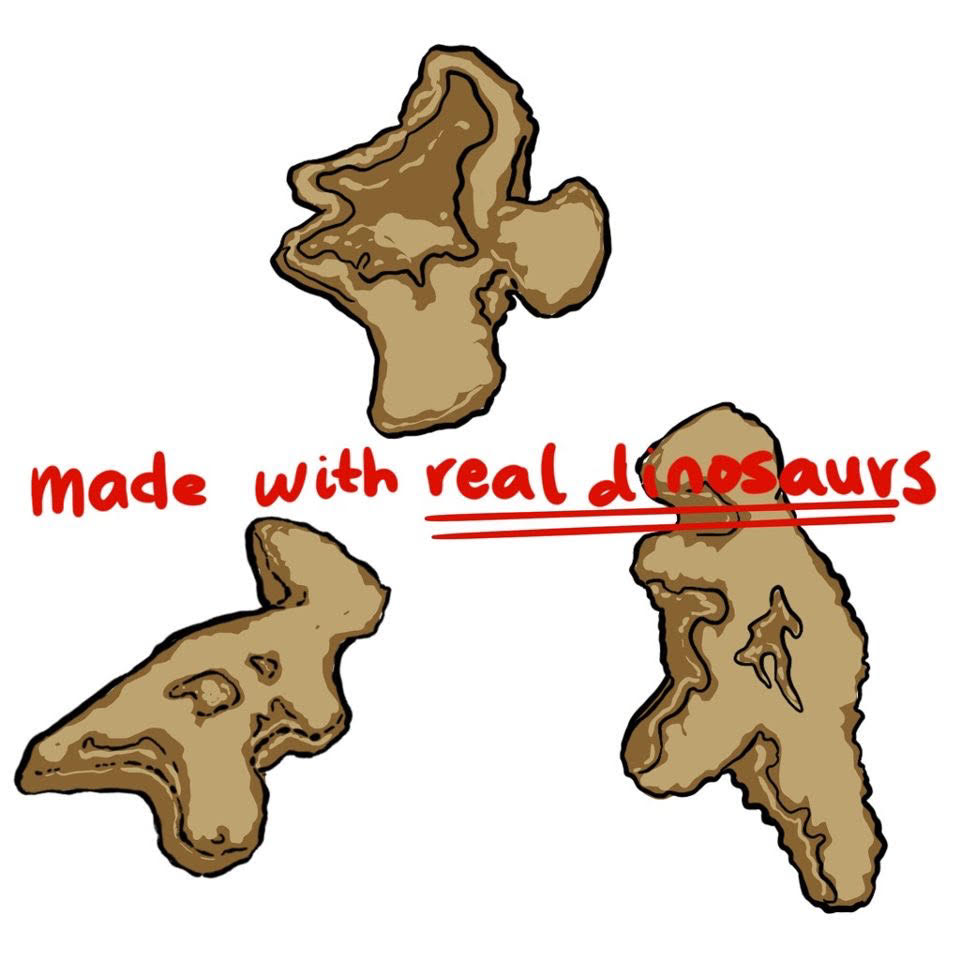
    Dino nuggets are pretty yummy right? These childhood snacks—or adult snacks if you’re like me— are dinosaur-shaped breaded chicken nuggets. At first glance, they might seem like a clever trick to get some protein into kids, but what if there was more to it? What if a trace of the true self exists in the false self?


    Dino nuggets Illustrated by Bella Beeco

    To begin, let us understand how scientists classify animals. The two main systems they use are the Linnaean and phylogenetic systems. The first groups organisms mainly on physical traits that connect them—like the existence of backbones for example—and the second groups organisms according to their evolutionary history, which often is revealed by DNA and RNA similarities. We do not have access to any dinosaur DNA these days, so the best way to connect any currently living animals to dinosaurs is by comparing their physical traits.

    Dinosaurs, mighty as they were, are simply very large or even small terrestrial reptiles that inhabited earth around 250 million years ago. On the other hand, we have birds, usually small, bright and most of them love to fly! The physical similarities might not seem obvious at first but scientists have spent years making this connection. It was not one big jump from a T-rex to a pigeon; this evolution took millions of years with many intermediate species in between.

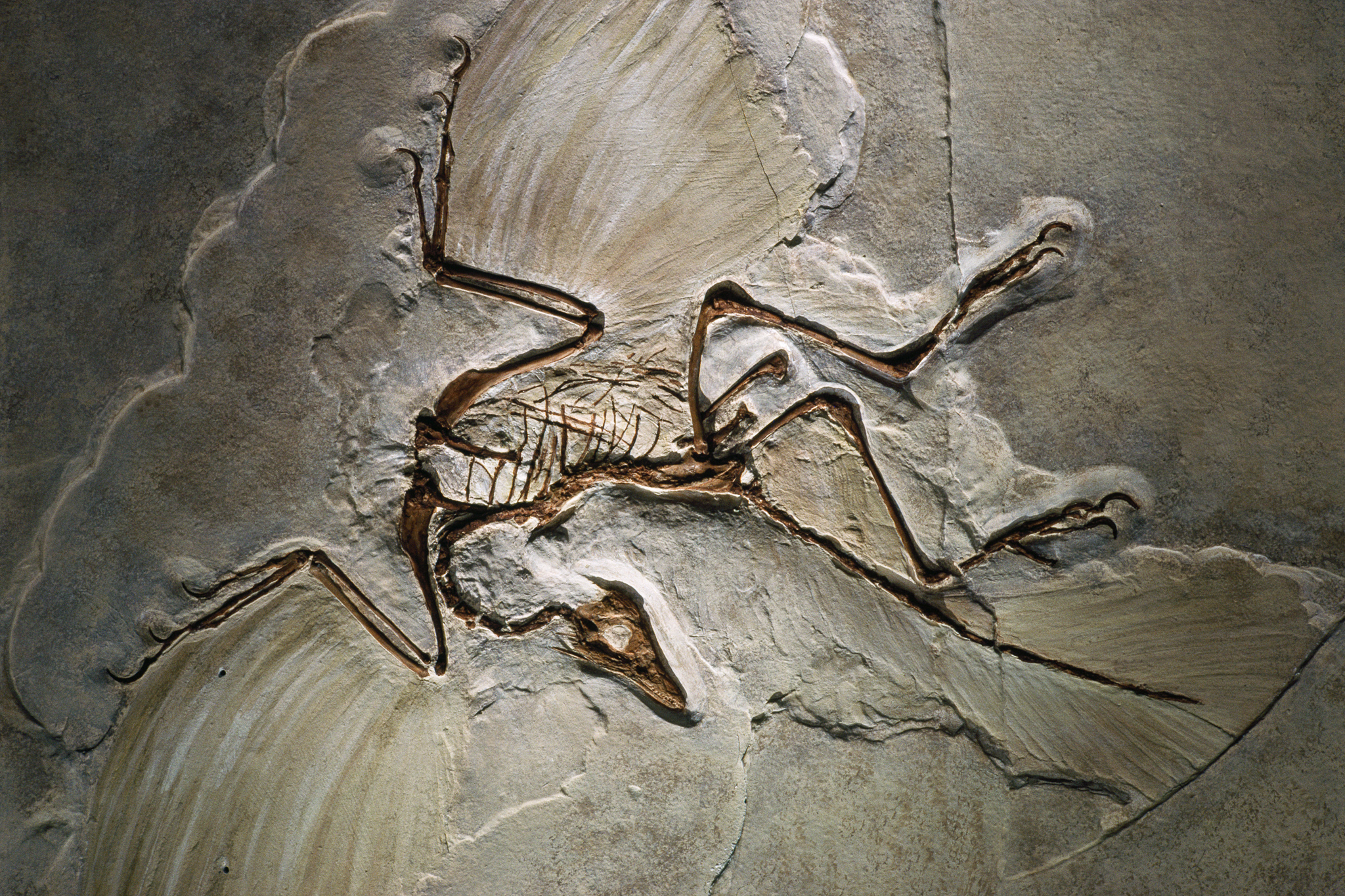
    In 1860, the fossil of a small avian dinosaur called the archaeopteryx was found. This fossil was the first clue to birds’ ancestry. Simply speaking, the archaeopteryx was an intermediate animal between dinosaurs and birds. Its bone structure, tail, and teeth were most similar to that of a reptile yet it had wings and was covered in feathers. This is not to say that the archaeopteryx was the first bird to exist because it had feathers or a different bone structure, but we consider it to be the first avian dinosaur that we know of. We’re not even sure if it could fully fly or just glide from a height.

    Archaeopteryx fossil. James L. Amos, CC0, via Wikimedia Commons

    There is no definite line to be drawn between dinosaurs and birds as of course since the process of evolution is a continuous one. This new advantage of aviation could have possibly saved this dinosaur from predators and allowed it access to more resources which would increase its chances at survival and reproduction. With each passing generation, qualities that improved flight could have been chosen for and accumulated; these qualities include hollow bones, wing-like limbs, feathers, and shorter tails.

    The archaeopteryx  was the size of a modern day raven,which was not the most common size at the time. But as the years passed more and more smaller dinosaurs evolved. Paraves, a type of avian dinosaur, was shown to grow at a rate 160 times faster than the rate at which other dinosaurs were growing during the Jurassic period. This shrinkage could have been very beneficial for flying. The lighter the animal was, the easier it was for them to soar instead of just glide. Recent studies have also shown that modern day birds highly resemble late embryos of dinosaurs.

    One primary physical difference between birds and dinosaurs is the presence of beaks vs. teeth. The strong jaws of dinosaurs had developed pointy ends that would help them precisely pick up food when their hands started to turn into wings. Their mouths were still filled with teeth but they had slowly started to harden and sharpen into toothy beaks that were found on dinosaurs similar to Ichthyornis dispar which lived around 100 million years ago. Over time those dinosaurs started losing their teeth for reasons that are hypothesized to be evolutionarily advantageous. Some scientists hypothesize that tooth loss could have been under selective pressure for shorter incubation periods, lighter head weight and better center of mass, or even as an adaptive response to an extinction event.

    A trademark of modern birds are their feathers. There has not been a definitive answer to why dinosaurs first developed them or exactly when. We do know that they started as a sort of hollow spine-like filament on the skin then this filament branched into a softer “fluffier” protofeather similar to the feathers of modern young birds called downy feathers. Those feathers were further toned and perfected to what we see today over the past million years. Feathers could be a heating mechanism that kept dinosaurs at a certain body temperature or to provide their eggs with warmth during incubation.

    Feathers could have also been a sexual advantage that was used for attracting mates. Just like how ostriches or peacocks use their feathers to attract females more than fly, some non-avian dinosaurs had feathers that are speculated to be for the same reason. Newly found fossils also show that dinosaurs displayed similar courting rituals to modern day birds. Scraping, a process where a male tries to impress the female by mimicking nest-building behavior, seems to be an age-old tradition that theropods started and many birds today still use to woo their mates. Additionally, some dinosaur fossils like the Hadrosaur skull show a hollow nasal chamber that was used for deep loud noises to communicate with others and call for mates. A similar anatomy can be found in the southern cassowary nowadays; they also use it for mating calls.

    Birds are now classified as coelurosaurians which is a clade containing  their closest ancestors; coelurosaurian translates to “hollow tailed lizards” from Greek. They share common features like hollow bones, an erect perpendicular placement of their legs, a fused clavicle and furcula, 3-toed legs, as well as shorter stiffer tails. From all the previous evidence we discussed in the fossil record we can safely say that birds are avian dinosaurs.


    العربية

    إن ناجتس الديناصورات لذيذة جدا ، أليس كذلك؟ هذه الوجبة الخفيفة مصنوعة من قطع الدجاج بالبقسماط

    المشكلة  على هيئة ديناصورات. للوهلة الأولى ، قد يبدو الأمر وكأنه حيلة ذكية لإدخال بعض البروتين إلى نظام الأطفال الغذائي بطريقة مرحة ولكن ماذا لو كان هناك المزيد؟ ماذا لو كانت الذات المزيفة مرآة  للذات الحقيقية؟

    أولا,  دعونا نفهم كيف يصنف العلماء الحيوانات. النظامان الرئيسيان للتصنيف هما نظام لينيوس الثنائي ونظام النشوء والتطور. يقوم النظام الثنائي بتصنيف الكائنات الحية تبعا للسماتها الجسدية التي تربطها – مثل وجود أو عدم وجود العمود الفقري – وتصنف المجموعة الثانية الكائنات الحية وفقًا لتاريخها التطوري  والذي غالبًا ما يتم الكشف عنه من خلال أوجه التشابه بين ال DNA و ال RNA. لا يمكننا الوصول إلى DNA أي ديناصور في عصرنا الحالي، لذا فإن أفضل طريقة لربط أي حيوانات حية حاليًا بالديناصورات هي بمقارنة سماتها الجسدية.

    الديناصورات على الرغم من عظمتها وكبر حجمها هي ببساطة زواحف كبيرة جدًا -أو حتى صغيرة – سكنت اليابسة منذ حوالي 250 مليون سنة. في الشق الآخر نرى الطيور ، كائنات عادة ما تكون صغيرة وملونة ويحب معظمها التحليق! قد لا تبدو أوجه التشابه الجسدية واضحة في البداية ، لكن العلماء مضوا سنوات عدة للوصول لهذا الرابط. لم يكن هناك قفزة كبيرة واحدة من ديناصور التي ريكس إلى الحمام مثلا فقد استغرق هذا التطور ملايين السنين و العديد من الأجناس الوسيطة بينهما.

    في عام 1860 ، تم العثور على حفرية ديناصور محلق صغير وسمي بالأركيوبتركس. كانت هذه الحفرية أول ما دل العلماء على العلاقة بين الديناصورات والطيور. ببساطة ، كان الأركيوبتركس حيوانًا وسيطًا بين الديناصورات والطيور. كانت بنية عظامه وذيله وأسنانه تشبه إلى حد كبير هيكل حيوان زاحف ولكنه كان ذو أجنحة وكان جسده مغطى بالريش. هذا لا يعني أن الأركيوبتركس كان أول طائر موجود لأنه كان يحتوي على ريش أو بنية عظمية مختلفة ، لكننا نعتبره أول ديناصور طائر نعرفه. لسنا متأكدين حتى مما إذا كان بإمكانه الطيران بالكامل أو الانزلاق من ارتفاع فقط.

    لا يوجد خط فاصل بين الديناصورات والطيور بالطبع لأن عملية التطور عملية مستمرة. يفترض العلماء أن خاصية الطيران الجديدة كانت ميزة تكيفية اضافية قد تساعد الديناصور في الهرب من الحيوانات المفترسة وتسمح له بالوصول إلى المزيد من الموارد التي من شأنها أن تزيد فرصته في البقاء والتكاثر. مع كل جيل يمر، كان الاصطفاء الطبيعي يفضل الصفات التي أدت إلى تحسين الطيران وزيادة فرص النجاة؛ تشمل هذه الصفات العظام المجوفة والأطراف الشبيهة بالأجنحة والريش والذيول القصيرة.

    كانت حفرية الأركيوبتركس بحجم غراب في وقتنا الحالي، وهذا لم يكن الحجم المتعارف عليه للديناصورات ان ذاك. ولكن مع مرور السنين ، بدأت الديناصورت بالتقلص. تبين أن بارافيس ، وهو نوع من الديناصورات المحلقة ، ينمو بمعدل 160 مرة أسرع من معدل نمو الديناصورات الأخرى خلال العصر الجوراسي. كان من الممكن أن يكون هذا الانكماش مفيدًا جدًا للطيران. كلما كان الحيوان أخف وزنا ، كان من الأسهل عليه التحليق بدلا من مجرد الانزلاق من طرف هاوية. أظهرت الدراسات الحديثة أيضًا أن الطيور الحديثة تشبه إلى حد كبير أجنة الديناصورات في الشهور الأخيرة.

    أحد الاختلافات الجسدية الأساسية بين الطيور والديناصورات هو وجود المنقار بدلا من الأسنان. تطورت نهايات مدببة بدلا من  الفكوك القوية للديناصورات كي تساعدهم على التقاط الطعام بدقة عندما بدأت أيديهم في التحول إلى أجنحة. كانت أفواههم لا تزال مليئة بالأسنان التي سرعان ما بدأت في التصلب والتحول الى مناقير مسننة كالتي تم العثور عليها على الديناصورات المشابهة لـ Ichthyornis dispar التي عاشت منذ حوالي 100 مليون سنة. بمرور الوقت ، بدأت تلك الديناصورات بفقد أسنانها لأسباب يُفترض أنها مفيدة من الناحية التطورية. يفترض بعض العلماء أن فقدان الأسنان قد يكون تحت ضغط انتقائي لفترات حضانة أقصر ، أو وزن رأس أخف ، ومركز كتلة أفضل ، أو حتى كاستجابة تكيفية لحدث الانقراض.

    من أوسمة للطيور الحديثة, ريشها. لليس هنالك سبب محدد لماذا طورتها الديناصورات لأول مرة أو متى بالضبط. نحن نعلم أنها بدأت كنوع من الخيوط المجوفة الشبيهة بالعمود الفقري على الجلد ثم تشعبت هذه الفتيلة إلى ريش بدائي “رقيق” أكثر ليونة شبيهاً بريش الطيور الصغيرة الحديثة التي تسمى الريش الناعم. كان هذا الريش مشابها أكثر لما نراه اليوم على مدار المليون سنة الماضية. يمكن أن يكون الريش آلية تسخين تحافظ على الديناصورات عند درجة حرارة معينة للجسم أو لتزويد بيضها بالدفء أثناء الحضانة.

    يمكن أن يكون للريش أيضًا فوائد جنسية تم استخدامها لجذب الأزواج. تمامًا مثل الطريقة التي يستخدم بها النعام أو الطاووس ريشه لجذب الإناث أكثر من الطيران ، كان لبعض الديناصورات غير الطيور ريش يُعتقد أنه لنفس السبب. تظهر الحفريات المكتشفة حديثًا أيضًا أن الديناصورات عرضت طقوس مغازلة مماثلة لطيور العصر الحديث. يبدو أن الكشط ، وهي عملية يحاول فيها الذكر إثارة إعجاب الأنثى عن طريق محاكاة سلوك بناء العش ، هو تقليد قديم بدأه الثيروبودات ولا يزال العديد من الطيور يستخدمه اليوم لجذب أزواجخم. بالإضافة إلى ذلك ، تُظهر بعض أحافير الديناصورات مثل جمجمة هادروسور غرفة أنف مجوفة كانت تُستخدم لإصدار أصوات عالية للتواصل مع الآخرين واستدعاء أزواج. يمكن العثور على تشريح مماثل في طائر الشبنم الجنوبي في الوقت الحاضر. يستخدمونها أيضًا في مكالمات التزاوج.

    .تصنف الطيور الآن على أنها كويلوروصورات وهي كليد يحتوي على أقرب أسلافها ؛ coelurosaurian من اليونانية يترجم إلى “سحالي مجوفة الذيل”. يتشاركون في ميزات مشتركة مثل العظام المجوفة ، والوضع العمودي المنتصب لأرجلهم ، والترقوة الملتصقة واللفيفة ، والساقين الثلاثة الأصابع ، وكذلك ذيول أقصر صلابة. من كل الأدلة السابقة التي ناقشناها في السجل الأحفوري يمكننا أن نقول بأمان أن الطيور هي ديناصورات محلقة.

    .

    Resources :

    https://www.nhm.ac.uk/discover/what-are-dinosaurs.html

    http://www.eartharchives.org/articles/what-are-birds/

    https://bio.libretexts.org/Bookshelves/Introductory_and_General_Biology/Book%3A_Introductory_Biology_(CK-12)/05%3A_Evolution/5.01%3A_Linnaean_Classification

    https://www.jstor.org/stable/24996750?casa_token=2leTuPnjTMYAAAAA%3AA6NB0eEyk4lN-gV_g4P-lo-DG8vRNPEuJnyiT0e77aaU_59ugCYzlL7ZANbbtRn8YmDPz0g4Sm-DHJHWn-iJfUjVfk_jqBy1S68VW9CFoFQTAs1em9XW&seq=1#metadata_info_tab_contents

    https://academic.oup.com/biolinnean/article-abstract/8/2/91/2682639

    https://news.yale.edu/2018/05/02/scientists-find-first-bird-beak-right-under-their-noses

    https://royalsocietypublishing.org/doi/10.1098/rsbl.2018.0090

    https://www.ncbi.nlm.nih.gov/pmc/articles/PMC2842673/

    https://onlinelibrary.wiley.com/doi/full/10.1111/evo.12363

    https://www.geol.umd.edu/~tholtz/G104/lectures/104coelur.html

  • The Yellow-Bellied Sapsucker: A Well Traveled Woodpecker

    The Yellow-Bellied Sapsucker: A Well Traveled Woodpecker

    The Yellow-Bellied Sapsucker: A Well Traveled Woodpecker

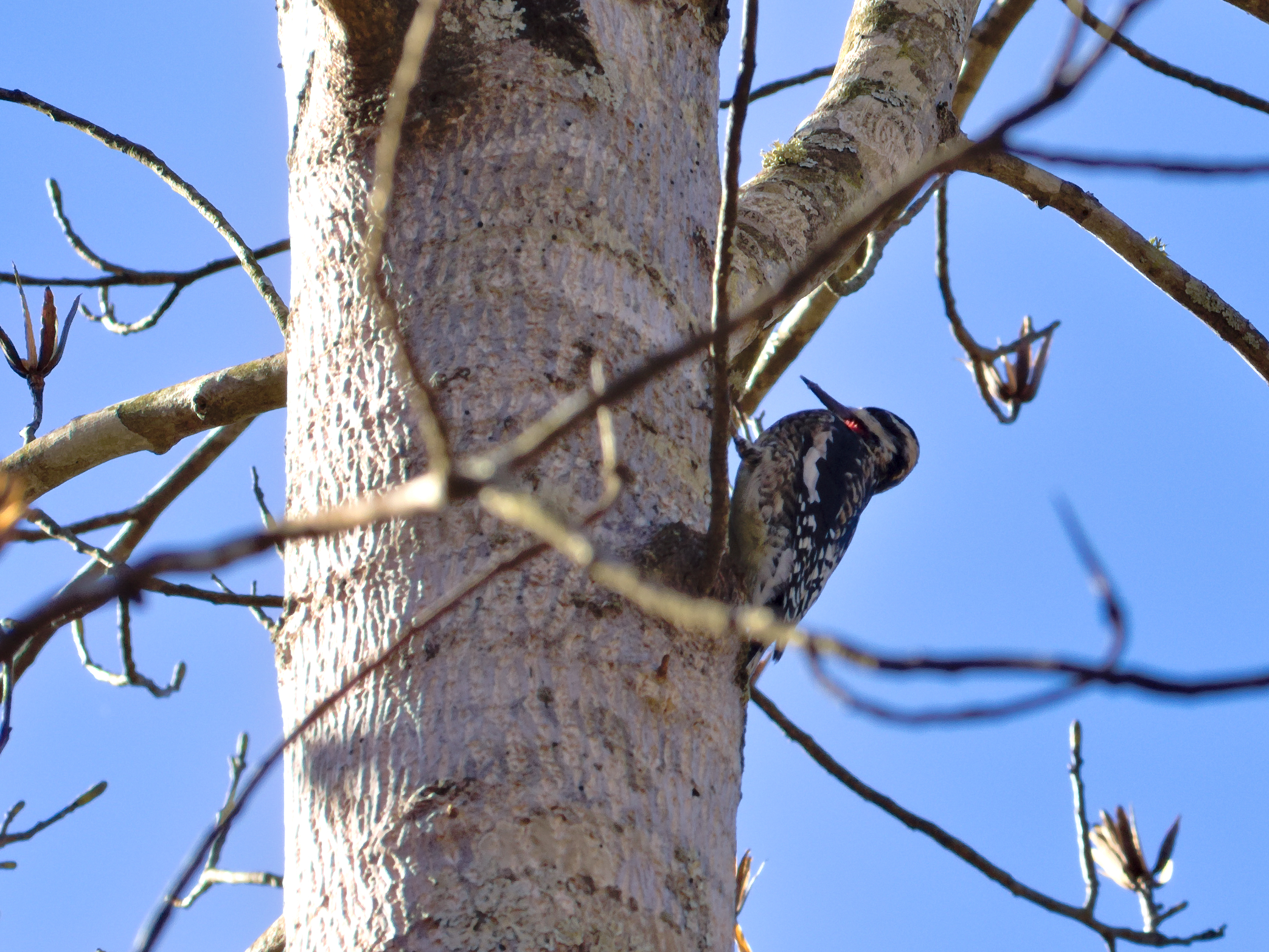
    A yellow-bellied sapsucker.
    A yellow-bellied sapsucker.

    The yellow-bellied sapsucker (Sphyrapicus varius) is a woodpecker that has a wide range across North America. In summer, the sapsucker can be found as far north as Alaska, Minnesota, and Nova Scotia and in winter, the birds can be found as far south as much of Central America and the Caribbean. The yellow-bellied sapsucker is migratory — the birds spend the winters in the south, and their summers in the north. This is unusual for woodpeckers. Out of the twenty two woodpecker species found north of Mexico, fifteen of them don’t migrate at all, with many of these species only flying for short distances during their regular activities. This leaves us with seven woodpecker species that do migrate — and of those, the yellow-bellied sapsucker takes the crown for the largest migration range. Interestingly, the sapsuckers do their migratory flying at night.

    Yellow-Bellied Sapsucker Habitat and Diet

    The yellow-bellied sapsucker is found in forests. Maple forests, aspen forests, and mixed forests are all popular habitats for sapsuckers. Research has shown that maple forests have better outcomes overall for breeding sapsuckers than aspen forests. However, both maple and aspen forests allow sapsuckers to sustain their populations over time. Both of these forests have trees that are good for sap drilling — the yellow-birch in maple forests, and the paper birch in aspen forests. Sap is one of the primary food sources of the yellow-bellied sapsucker (which, given the name, isn’t very surprising). Sapsuckers have a variety of preferences for trees to tap for sap depending on their range. In urban areas of Southern Florida, for example, black olive and tropical almond trees are a preferred source of sap. Yellow-bellied sapsuckers also feed on arthropods (think of spiders, centipedes, insects, and the like), especially while nesting.

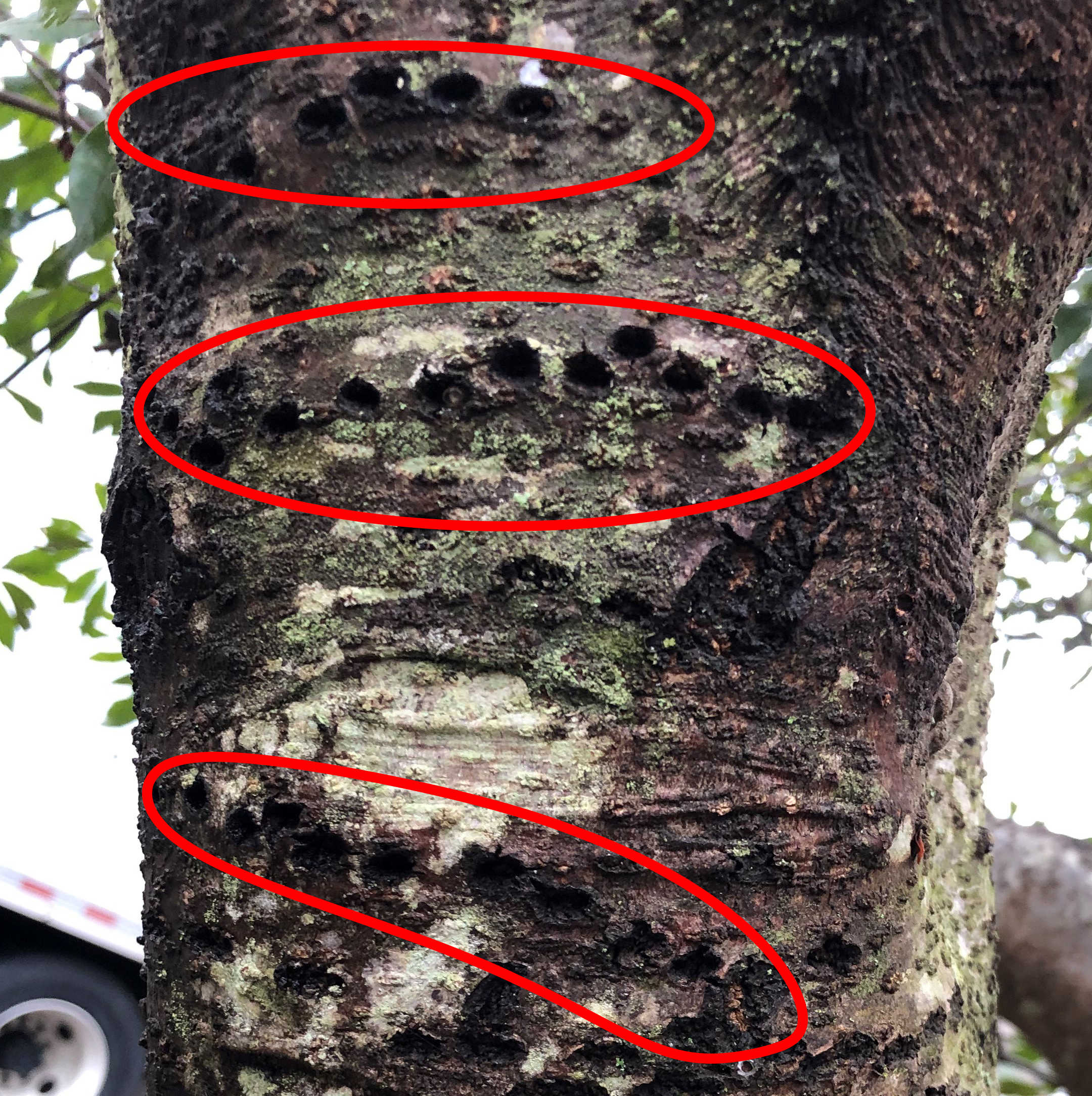
    A tree with lines of sapsucker holes.
    Pictured: Sapsucker holes in a tree. Drilling holes in straight lines is typical for them.
    Why are woodpeckers so concussion proof?

    One of the most interesting behaviors woodpeckers exhibit as a group is the tree drilling that they’re named for. A very common question related to this drilling is how do woodpeckers avoid rampant brain injuries due to ramming their heads against trees repeatedly, at high speeds, for ages. Woodpeckers routinely bash their heads into trees at far more than double the acceleration that would concuss humans. While humans are concussed at 300 g of acceleration, woodpeckers have been known to regularly drill into trees at accelerations on the order of 600–1500 g.

    A variety of mechanisms have been proposed to explain the woodpeckers’ resilience to brain injury. There are three primary reasons woodpeckers aren’t all concussed all of the time. The first being their small size. The acorn woodpecker’s brain, for example, has a mass of 2.5 grams. A human brain has a mass of 1400 grams. The woodpecker brain is so much smaller than a human brain that they generate much less force when they smack into the skull. The second limiting factor that protects woodpeckers is the short duration of impact. One of the documented factors that increases the likelihood someone will be concussed is how long their brain is exposed to high acceleration. A woodpecker only drills against a tree for a millisecond or less each time, so their time of impact is very short.

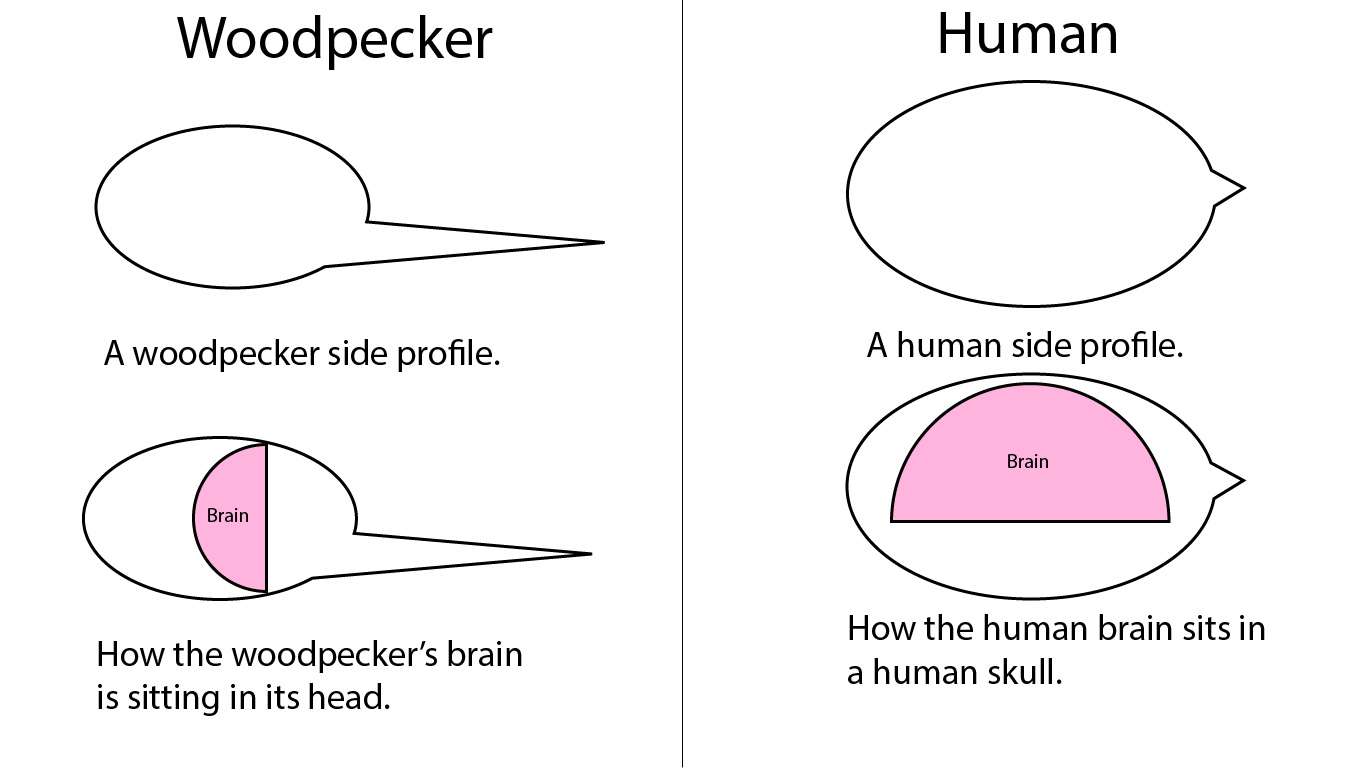
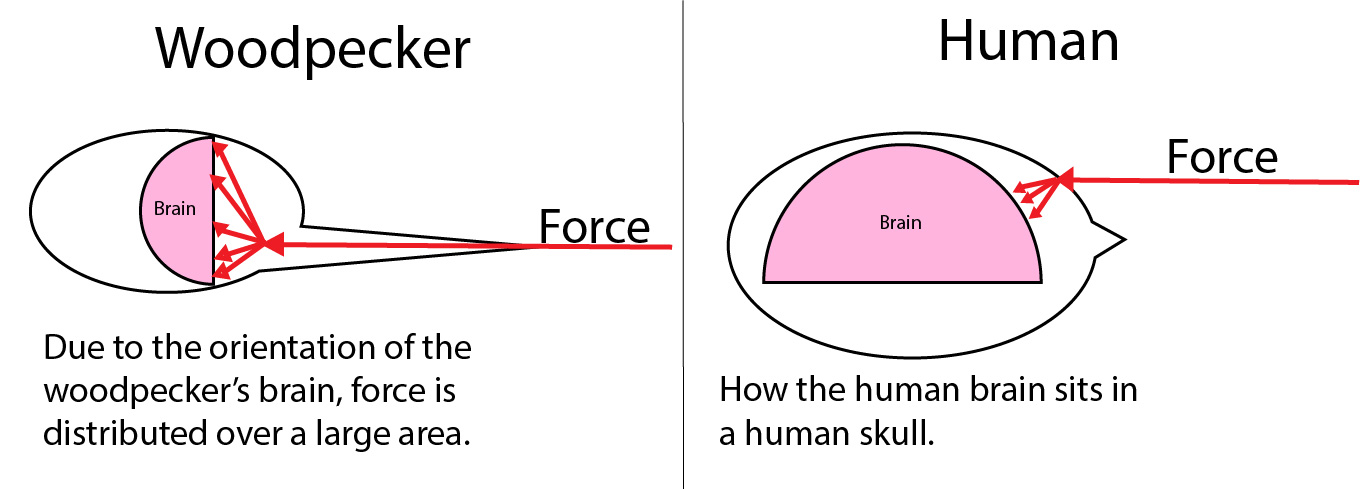
    The last quirk of woodpecker anatomy guarding them from brain injury is how their brain sits in their skull. Both human brains and woodpecker brains are hemispherical (if you cut a globe in half, you will have two hemispheres). If you cut the globe in half at the equator, your top hemisphere is oriented like a human brain is. If it were to go flying forward, only the small portion at the front will hit the skull. This concentrates the impact right around the forehead area. On the other hand, a woodpecker brain is much more like if you had cut your globe from the Arctic to Antarctica, and chose to look at the left section. The large flat side of a woodpecker’s brain rests against the front of their skull. When their brain goes smacking against their skull while they drill, the force is distributed among the largest possible region of their brain. This lessens the impact overall.

    An image illustrating the difference in orientation of a human brain versus a woodpecker brain, as described in the paragraph above.
    Notice the difference in alignment when comparing a human brain to a woodpecker brain.
    A visualization of how the force is more distributed over the woodpecker's brain compared to a human brain.
    Look at how much more relative space the force has to distribute itself on the woodpecker’s brain versus the human brain.
    Ecological Status of the Yellow-Bellied Sapsucker

    Ecologically speaking, the yellow-bellied sapsucker is in a good place to stick around. The International Union for Conservation of Nature (IUCN) has marked the yellow-bellied sapsucker as a species in the “least concern” of going extinct. Despite this, there are still some concerns for the sapsucker, especially as they’re being seen more and more often in urban and suburban areas. Being in areas with humans presents several new challenges for sapsuckers. Flying into windows is one of these concerns. Some research has been done into this phenomenon, known as “window strikes”. One study suggests that migrating birds are at a higher risk of striking windows than year-round resident birds, which poses a threat for migratory birds like the yellow-bellied sapsucker. Another threat to sapsuckers in areas with high human density are pets, domestic cats in particular. Outdoor cats have long been a threat to bird populations, and sapsuckers living in areas with them are no exception. Like many other species, the yellow-bellied sapsucker’s future will be strongly impacted by human activity.

    References

    Diamond, Joshua M, & Ross, Michael S. (2018). Tree selection and foraging height of wintering Yellow-bellied Sapsuckers (Sphyrapicus varius) in an urban environment. The Wilson Journal of Ornithology, 130(4), 932-939.

    Gibson, L. J. (2006). Woodpecker pecking: How woodpeckers avoid brain injury. Journal of Zoology (1987), 270(3), 462-465.

    Kerlinger, P. (2008, April). Sap hunter: why the Yellow-bellied Sapsucker does what most woodpeckers don’t: migrate. Birder’s World, 22(2), 52. https://link.gale.com/apps/doc/A175629258/ITOF?u=gainstoftech&sid=ITOF&xid=177e1123

    Natola, Libby, & Burg, Theresa M. (2018). Population Genetics and Speciation of Yellow-Bellied, Red-Naped, and Red-Breasted Sapsuckers (Sphyrapicus varius, S. nuchalis, and S. ruber). The Journal of Heredity, 109(6), 663-674.

    Sabo, Ann M, Hagemeyer, Natasha D G, Lahey, Ally S, & Walters, Eric L. (2016). Local avian density influences risk of mortality from window strikes. PeerJ (San Francisco, CA), 4, E2170.

    Tozer, Douglas C, Nol, Erica, & Burke, Dawn M. (2011). Quality of mature aspen and maple forests for breeding Yellow-bellied Sapsuckers (Sphyrapicus varius). Canadian Journal of Zoology, 89(2), 148-160.


  • The Evolution from Fossil to Monster

    The Evolution from Fossil to Monster

    Humankind as a species is over 200,000 years old. We are travelers, storytellers, and connoisseurs of legends and tales. For thousands of years, mankind has entertained our children and fellow tribesmen with fables and stories of the unknown, the cryptic and the mythological. It is a unifying factor in our world. Every story needs a strong villain to maintain equilibrium and for many, the villain was the monster. From Greek and Roman to Japanese and Native American, fantasy and folklore have been influenced from the history of this planet. All cultures have created monsters to fuel their fears. Either to rationalize the unknown or to provide comfort for themselves, men and women of the past have created these stories for purposes that have been lost to time. Yet, monsters are alive and real today, be it in between a page or in a culture. These beasts came from our imaginations. However, many of these terror-bringers were imagined based on fossils, skeletons, or unknown sightings that frightened the inhabitants of their lands. 

    From tales of creation, to the flood, and even tales of doom, every culture has unifying legends. Some cultures produced monsters so terrifying that they were hidden and lost to time, while some have been immortalized in books, movies, and videogames. The primal fear of the unexplainable had to be justified through something tangible by mankind. Two monsters that have fueled the nightmares of children and men; two giants of terror that were produced from the unknown, can now be explained.  

    THE CYCLOPS:

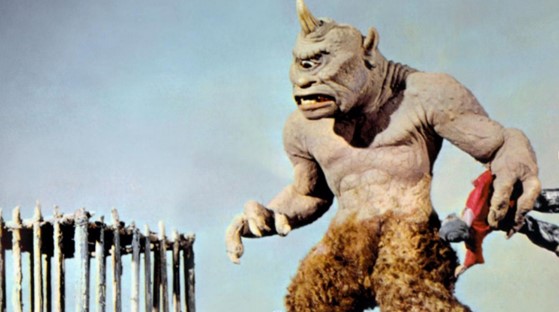
    Cyclops are a cannibalistic giant race bearing a distinct feature: a singular eye in the center of their forehead. Notable cannibals and warriors in Greek mythology, the cyclops were born from the Greek God Poseidon but were cast away because of their grotesque ugliness. In Greek stories and in pop-culture, cyclopes have been used as a formidable opponent to heroes and heroines. The most well known depiction of the cyclops race comes from Homer’s The Odyssey. Other notable depictions have been seen in The Cyclops (1957), Wrath of the Titans (2012), and Tron: The Odyssey (2017). 

    According to Homer, Polyphemus was the cyclops leader on the isle in which Odysseus was stranded on his return home. Polyphemus was a sheep herder and a brutal warrior. During Odysseus’ time on the island, Polyphemus severed a man in half with a single bite and crushed a man in his grasp. A nightmarish scene that captures our fears of these cannibal giants; the infamous cyclops look, from Greek vases to modern day, has endured the test of time.Cyclops from “Seventh Voyage of Sinbad”. Director Nathan Juran

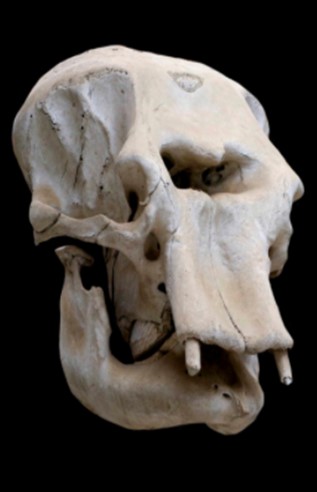
    Their faces look eerily similar to elephant skulls:Elephant Skull. Photo courtesy of Felipe Romao


    These skulls can easily be viewed as a horrific mono-visual monster. Ancient Greece had two different species of elephants roaming the area: The Cyprus Dwarf Elephant and the Cretan Dwarf Mammoth. Such large skulls would have to be supported by tremendous bodies. These skulls sported massive tusks and teeth which were perfect for crunching the bones of men.  

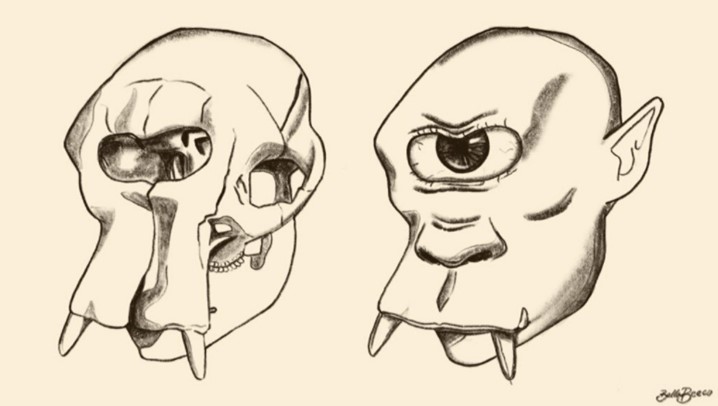
    In the early 20th century, Paleontologist Othenio Abel suggested that the inspiration of cyclops comes from the fossilized skulls of pygmy elephants found in the ancient Greek region. Found on Cyprus, Crete and many other surrounding Grecian islands, these ancient dwarf elephants died around 11,000 BCE. These elephants had a shoulder height of five feet, with an averaged- size femur of over two feet. Anatomically, elephant and human femurs look similar, which is a proposed explanation to the human element of the cyclops. From these basic anatomical parallels, the cyclops could have been born. When the image of the cyclops was mixed with human fear and superstition, the cyclops became the monster we know today: a giant cannibal terror. 


    Courtesy of Bella Beeco
    Elephant Skull transforming into a Cyclops Skull, Courtesy of Bella Beeco

    THE YACUMAMA:

    The Yacumama is a South American tale that derives its nature from the Amazon river. Meaning “The Water Mother” in Peruvian, the tale dates back to that of the Incan civilization in the 13th century. A massive 30 meter serpent monster, the Yacumama had jaws that could swallow a man whole. In her legends, any animal or man that disturbed her waters became her prey. The local indigenous people would blow on conch horns to protect themselves before entering the water, believing the Yacumama would reveal herself if present. 

    South America has many depictions and lore of snakes. The Aztec and Incan civilizations both had powerful gods depicted as these slithering creatures. The Aztecs had Quetzalcoatl who created mankind. The Incas had Amaru who was the water God and protector of the rivers. The legend of the Yacumama can be traced back to the 15th century when it was told to the Spanish Conquistadors. 

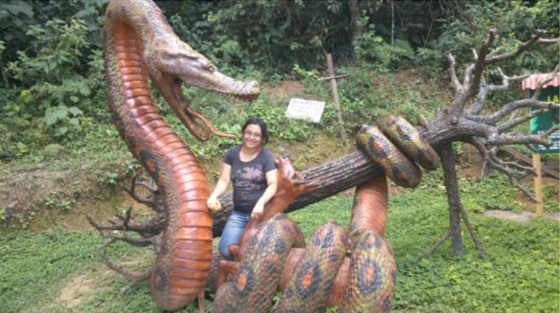
    A modern depiction of the Yacumama: 

    Photo of a Yacumama Statue in Parque Tematico Peru. Courtesy of Mike Dreckschmidt

    As anacondas and rivers in South America are mutually inclusive, the pairing of Yacumama and her watery home was natural. South America is home to thousands of rivers including the Amazon, and is home to 169 species of snakes, including the world’s heaviest species: the Green Anaconda. The largest Green Anaconda recorded weighed over 500lbs and was nearly 20 feet long. The longest snake species, the Reticulated Python, which measured over 25 feet long, is not native to South America but is a related species to the Anaconda. While these are the largest snakes ever measured in current day, the largest snake ever found hails from South America: The Titanoboa.

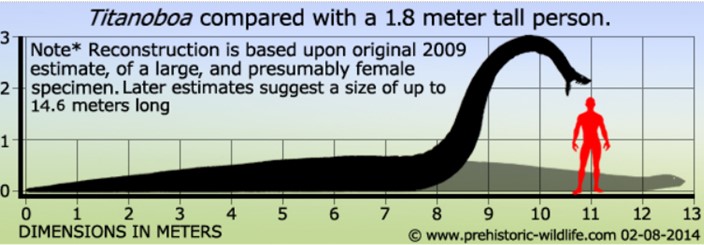
    Titanoboa fossil size model. Courtesy of Darren Pepper

    The Titanoboa fossil found in Colombia created a fear of all ancient snakes. Weighing in at over 2,500 lbs. and reaching up to nearly 50 feet in length, this behemoth snake truly could have swallowed a man whole. This dinosaur-sized serpent could strangle and crush every living organism that came within striking distance until its extinction 56 million years ago. If these snake fossils had been found by natives in South America prior to the official paleontological discovery, a giant water serpent named Yacumama could have certainly been created to explain the phenomena. The Yacumama is possibly an exaggeration of a sighting of a large wild anaconda, or it could have been a fossil based explanation from an earlier find of a titanoboa fossil. A massive serpent, a man eater, and a terrifying hunter from the depths, the Yacumama was definitely a monster that inspired fear, but it is also a monster that can be flushed into explanation. 


    References:

    • Aym, Terrence. “History Mysteries: The Legendary Yacumama, Mysterious Monster of the Amazon.” Salem-News.com, Salem-News.com, 16 Aug. 2010, www.salem-news.com/articles/august162010/monster-amazon-ta.php.
    • Combing, Beach. “Cyclops Origins.” Beachcombing’s Bizarre History Blog, Beachcombing’s Bizarre History Blog, 8 July 2011, www.strangehistory.net/2011/06/07/cyclops-origins/.
    • Dreckschmidt, Mike. “Terrifying Legends of Peru #3: Yacumama and Sachamama.” Traveling and Living in Peru, Peru Exprience S.A.C, 6 Aug. 2020, www.livinginperu.com/terrifying-legends-peru-3-yacumama-sachamama/.
    • “Green Anaconda: National Geographic.” Animals, National Georgraphic, 10 Oct. 2018, www.nationalgeographic.com/animals/reptiles/g/green-anaconda/.
    • Hennings, Julie, and Harry Lynch. “Birth of a Monster.” EarthDate, Burea of Economic Geology, www.earthdate.org/birth-of-a-monster.
    • Juran, Nathan, director. Seventh Voyage of Sinbad. Columbia Pictures, 1958.
    • Pepper, Darren. Titanoboa, Www.prehistoric-Wildlife.com., 2011, www.prehistoric-wildlife.com/species/t/titanoboa.html.
  • Getting Back to Our Roots:  Using interconnected plant roots as short term data transmitters

    Getting Back to Our Roots: Using interconnected plant roots as short term data transmitters

    I am an Avatar the Last Airbender fanatic. I remember sitting on the couch awestruck watching the final battle between Ozai and Aang. Avatar the Last Airbender never left my heart and I was absolutely delighted to see Netflix’s revival of the show this year. When the Legend of Korra, Avatar’s sequel, was added to the streaming platform, I was overjoyed. During my binging of the fourth season, something perplexing caught my attention. (Do not worry, this contains no spoilers). In one episode, Korra uses the spirit vines to find and communicate with lost children. My fascination exploded and my engineering brain won the “thought-struggle” contest. The premier question: “could plants be used to communicate and send information”? Imaginative thoughts began: tree roots becoming telegraph lines and conducting Morse Code communications. The possibilities of tree root communication would be useful and wonderful, but the biggest obstacle question became apparent: would it work?

    The short answer is, “possibly”, and the reason being is that there are very few studies on the ability of plants to communicate with electricity. Electricity is the basic building block of data transmission. Channeling electricity holds the key to transferring data from one place to another. Current world-wide working channels include optic fiber, copper wires, and Wi-Fi; these channels work by transmitting data by producing electromagnetic signals. The signals carry the information from the output port to the receiving input port. Since plants have an anatomical ability to transmit electricity from their roots to their leaves and vice versa, plants have the potential to be the next transmitting service platform. 

    How plants can transmit data goes back to their roots, literally! Plants are living structures. They are built in three compartments: the root system, the stem, and the leaves. Each part of the plant has separate functions. The roots are used as an anchor in the ground and to soak up molecular nutrients in the soil. The leaves are used to convert sunlight and carbon dioxide into sugars via photosynthesis, and the stem is used as a highway to transport the chemicals and nutrients to the various parts of the plant. While this is basic science, there is a vast oversight on this knowledge. All of what has been said is chemistry. It seems that plants do not use electrical signals in the same way that animals use them. 

    But what does electricity have to do with plants? Similarly to computer data transmissions,  information is sent in electrical signals within plants. Actually, all living beings do this unknowingly, even humans. Every breath taken, hand signal, or step taken requires electrical pulses from the brain to make the movement or action occur. While plants certainly do not walk or make hand gestures, it does seem that they do use electrical signals to send instructions. Some plants like the Mimosa Pudica or the Venus Flytrap  use electrical signals to close their leaves. But, how do normal plants like flowers, trees, and vegetables use electricity?  

    Normal plants do use electricity and electrical potentials to work. In times of droughts, stress, or infections, plants send signals to regulate and try to fix the problem they are experiencing. These messages may originate from any location in the plant; sometimes they originate from an entirely different plant that is connected by their root system. In a study by Annemart Koornneef and Corné M.J. Pieterse (2008), it was found that plants when under attack can cross talk – or talk to plants beside them using the root system as an electrochemical message board. If this interconnected root system can provide a linkage mechanism between plants for them to communicate, then it could be plausible to manipulate the roots to send messages. But this raises the question of can humans manipulate the electrical messaging system? 

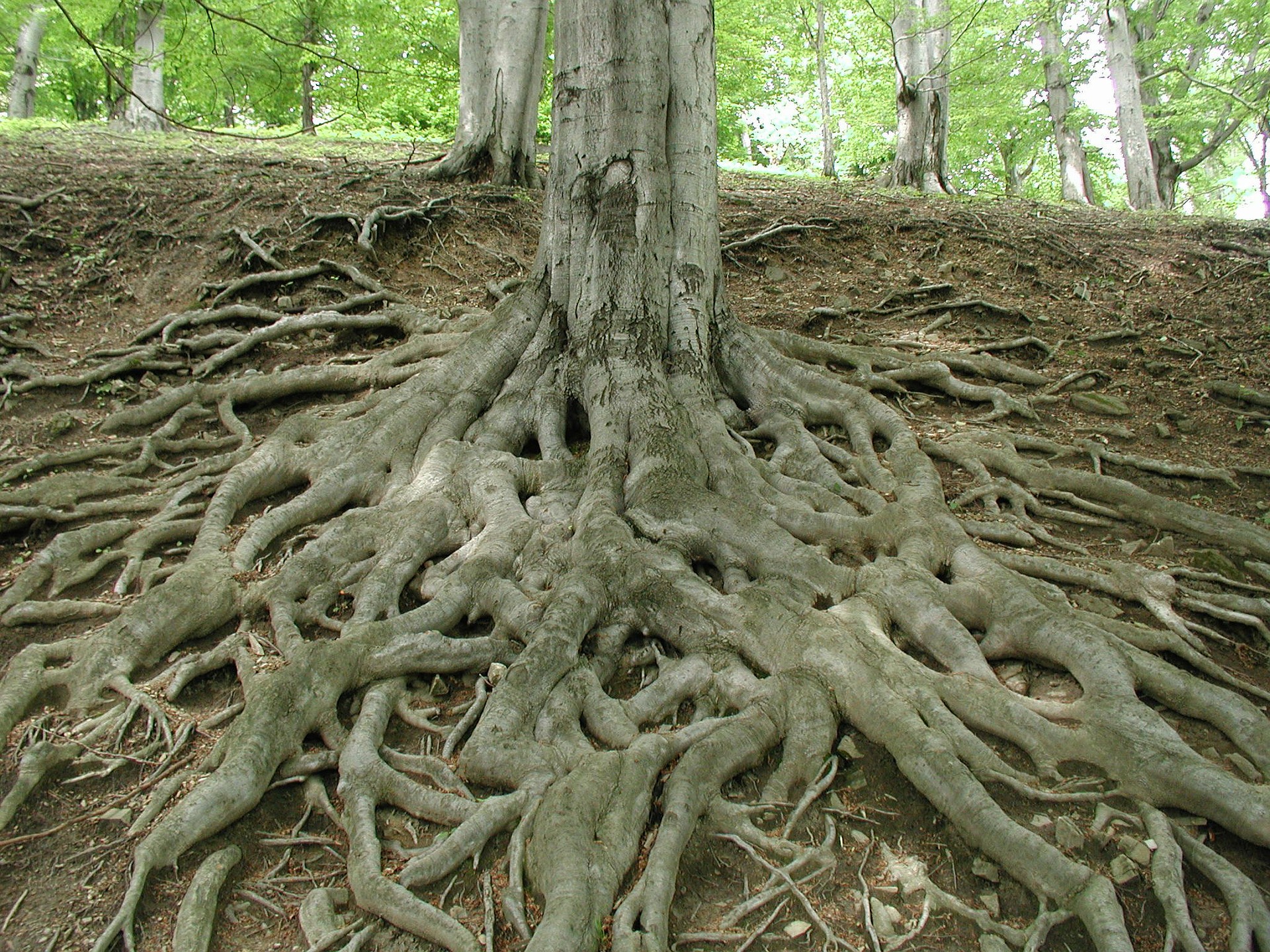
    Possibly! One study proved that human applied current on the plant genus arabidopsis, the plant species that are related to mustard and cabbage plants, can conduct current at 3.5 inches per minute. This study confirms that sending man made electrical currents can happen and work, albeit slowly. Yet, the problem lies on the path of travel: the root system. The root systems of trees are interconnected when living in forests or highly populated plant communities. This is because of mycorrhizal fungal connections. The tree roots are not actually intertwined, but are connected by the interconnecting fungi roots that are attached to each individual tree’s roots. An example would be a vast canyon, where the opposing sides are two separate trees and their roots. The mycorrhizal fungi roots act as a bridge connecting the two trees. This bridge acts as a chemical, electrical, and nutrient highway that one tree can use to provide for the other. 

    These mycorrhizal fungi are in nearly every environment in the world. They act as a super highway between hundreds of trees at one time. In a lab setting it was found that mycorrhizal fungi can act as an electrical conductor. The use of these fungi as an electrical forest super-conductor seems to be the perfect setting of a possible natural underground communication and data transfer center. With the entire forest connected by fungi and trees, the plausibility seems to come more into focus. Even in America there are some forests that are so vast that this could be used as a super highway. 

    Take Malheur National Forest in Oregon, where it proudly hosts the world’s oldest and largest organism on Earth: The Honey Mushroom. Estimated to be 8,700 years old, the mushroom covers 940 acres of underground forest floor. The Malheur forest is covered in trees, bushes and ferns, and other plant species, but is all connected by the honey mushroom mycorrhizal network.

    Or consider the Panda in Fishlake National Forest in Utah. The forest is composed of an enormous grove of interconnected Aspen trees, effectively creating one organism. In the forest lies 47,000 nearly genetically identical aspens trees sharing one root system. Spanning 107 acres, Pando – the name of the single Aspen organism – is the largest tree system in the world that spans the same root system. 

    Beyond North America, think of all the forests in the world: The Amazon in South America, the Congo Basin Forest in Africa, the Sumatra rainforests in Asia, and the hundreds more in Europe and North America. The benefits of implementing and advancing the science of this is world expanding. Some possible benefits for data communication through forest roots include the reduced strain of wireless internet; ecological benefits for increased opposition to deforestation and worldwide planting efforts to rebuild forests. Another benefit is the possible use of discrete non-verbal and non-interceptable communication transfers. Tree root communication has the potential to be used for private and military uses for short range data transmissions. 

    Yet, no task is without its problems. Possible problems that could arise from using this system include lost transmissions from utilizing the wrong root/mycorrhizal pathway; plants and their root systems die and decay, so the cost of upkeep would be massive. Other problems that are the most immediate are that the technology required for this is possibly millions of dollars of research and years away. On both sides of sending the message and receiving the message from a root system is tricky. Beyond picking the pathway, the coding of the message also possesses quite a problem. All these problems are significant roadblocks, but can ultimately be overcome with science, engineering and time. 

    I personally believe that tree root data transmission would and could be of significant use with endless possible benefits. Hiking in the woods with no cell reception? Just tap into a tree and place out a distress call! In quarantine and want to talk to someone in your wooded neighborhood? Send out a tree root instant message! My first thoughts were using tree roots with Morse code or even how farmers in the great depression used their barbed wire fences as communication devices. The root system communication and data transfer would expand and grow over time as more and more forests mature and grow. A future where you could tap into a pine tree and dial up your neighbor down the street may seem foreign, but in the future, calling, texting, sending memes and gifs, or encoded data plans may be a possibility. 

    It all goes back to finding our roots. 

    References

    • Gebelhoff, Robert. “Plants Send out Stress Signals Just like Animals, Scientists Find.” The Washington Post, WP Company, 28 Apr. 2019, www.washingtonpost.com/news/speaking-of-science/wp/2015/07/30/plants-send-out-stress-signals-just-like-animals-scientists-find/.
    • Jabr, Ferris. “Plants Cannot ‘Think and Remember,” but There’s Nothing Stupid about Them: They’re Shockingly Sophisticated.” Scientific American Blog Network, Scientific American, 16 July 2010, blogs.scientificamerican.com/observations/plants-cannot-think-and-remember-but-theres-nothing-stupid-about-them-theyre-shockingly-sophisticated/.
    • Nield, David. “Plants Can Secretly Send Underground Electrical Signals. Here’s How They Do It.” ScienceAlert, Communicative & Integrative Biology, 14 July 2020, www.sciencealert.com/here-s-how-plants-can-secretly-send-each-other-underground-electrical-signals.
    • Thomas, Brian. “Shocking Evidence of Electrical Signals in Plants.” The Institute for Creation Research, The Institute for Creation Research, 11 Sept. 2013, www.icr.org/article/shocking-evidence-electrical-signals.
    • Yoon, Carol Kaesuk. “Plants Found to Send Nerve-Like Messages.” The New York Times, The New York Times, 17 Nov. 1992, www.nytimes.com/1992/11/17/science/plants-found-to-send-nerve-like-messages.html.
  • Three Dog Star Night (Part 1)

    Three Dog Star Night (Part 1)

    I am just old enough to remember a time when most textbooks only spoke of exoplanets (i.e. those outside our solar system) in the hypothetical sense, their existence taken as an assumption rather than demonstrable fact, while the question of whether our 8-planet solar system was typical or an anomaly remained a hotly-debated topic. Despite over a century of attempts and subsequent erroneous claims, it wasn’t until 1992 that the first confirmed exoplanet was discovered, two of them as a matter of fact, orbiting the pulsar PSR B1257+12. As surprising as this was to the scientific community, the high likelihood that the planetary pair had formed as the result of a merger between two white dwarfs rather than a collapsing gas cloud meant the world would have to wait another 3 years for the confirmation of a “true” planet orbiting a main-sequence star like the Sun. The discovery ushered in a new era for astronomy and as of November 1st, 2020 there have been a whopping 4,370 exoplanets confirmed in 3,230 star systems. This menagerie of other worlds, ranging from “hot Jupiters” and lava worlds to gas and ice giants and seemingly everything in between stands in stark contrast to the apparently silent heavens, leaving a profound question unanswered:

    “Where is everybody?”

    Despite what many a crackpot relative or internet crank will tell you, humanity is, to the best of our knowledge, completely and utterly alone in a universe so vast it defies comprehension, a contradiction commonly referred to today as The Fermi Paradox. The concept of aliens and the foundations of the Fermi Paradox have been around for a surprisingly long time, entering the Western conscience with the speculation of Epicurean philosophers like Democritus of ancient Greece, who today is famous for the first conception of atoms. From the viewpoint that the world was merely a chance jostling of these atoms, they argued it was not only reasonable, but exceedingly likely that there exist other inhabited worlds similar to our own. To paraphrase the argument: “who ever heard of a single ear of wheat growing alone in a vast, fertile field?”

    Should you happen to see this mentioned on the next episode of Ancient Aliens, it’s worth noting that Democritus’s ideas about “aliens” (and atoms) are not quite as modern as they sound, instead more akin to our modern idea of beings from “parallel universes”, not habitable planets orbiting other stars since the ancient Greeks had no idea what stars and planets actually are, much less orbits. To them, these other worlds existed but were forever inaccessible to us. What’s important is that the core idea, that it’s improbable that life should arise on Earth and only on Earth begins here. Its dismissal by the Aristotelians, who preferred what can be known to what might be and whose influence on Western culture remains to this day, caused such discussion to take a back seat during the early Middle Ages, but the idea remained nonetheless, never being fully dismissed as “impossible” by theologians who were wary of placing what they saw as limits on the omnipotence of the Christian God. Contrary to the popular misconception that discussion of such matters would get one labeled a heretic and burned at the stake, the idea of aliens inhabiting other worlds within our universe that were, at least in theory, accessible to us in some way first arose in the Western world during the late Middle Ages. In his influential work De Docta Ignorantia (1440), Nicholas of Cusa argues that:

    Life, as it exists on Earth in the form of men, animals and plants, is to be found, let us suppose in a high form in the solar and stellar regions. Rather than think that so many stars and parts of the heavens are uninhabited and that this earth of ours alone is peopled – and that with beings perhaps of an inferior type – we will suppose that in every region there are inhabitants, differing in nature by rank and all owing their origin to God, who is the center and circumference of all stellar regions (II, p. 12).

    His work sparked intense discussion among Christian theologians over whether or not such aliens had been “redeemed” and even whether “original sin” would apply to them. After all it was probably a safe assumption that they were not descended from the mythical Adam and Eve.

    The idea stuck around and was eventually taken up by the scientists of the modern era, including the likes of none other than Harlow Shapley who stated in an interview for The Sydney Morning Herald (1959) that:

    The universe has 10 million, million, million suns similar to our own. One in a million has planets around it. Only one in a million million has the right combination of chemicals, temperature, water, days and nights to support planetary life as we know it. This calculation arrives at the estimated figure of 100 million worlds where life has been forged by evolution (p. 5)

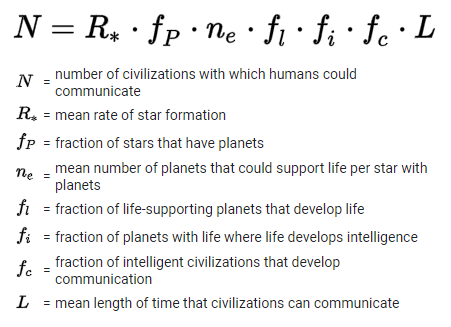
    Five months later, Frank Drake performed the first systematic search for extraterrestrial intelligence by monitoring two nearby sun-like stars, 6 hours per day for four months, searching for radio signals around the emission frequency of neutral hydrogen, the most common element in the universe. The reason for this frequency choice is simple: if somebody out there wants their message to be heard, they’ll put it where everyone is already looking. A year later, while preparing to host a meeting for SETI to discuss the future potential of such search efforts, he penned the equation which would bear his name.

    Though initially conceived as little more than a mathematical conversation piece, The Drake Equation (as it came to be known) at last allowed astronomers to estimate the number of intelligent civilizations within our galaxy, for the first time couching the discussion in numbers rather than idle speculation. The only problem? Nobody had any real idea what any of these numbers actually were. The various numbers proposed at the meeting by Drake and his colleagues as an “educated guess” give a final value somewhere between a minimum of 20 and a maximum of 50,000,000. Such an enormous range perfectly illustrates their aforementioned uncertainty. In the six decades since, the data from countless observations, surveys, and space missions from NASA, ESA, and observatories around the world have finally shed some light on a few of these parameters which, in theory, allow us to narrow down the estimates a bit.

    Mean Rate of Star Formation, R*

    Our first parameter in the Drake Equation is R*, the average rate of star formation. For our purposes here, we are only looking for life within our own galaxy so we will use the rate of star formation in the Milky Way. Calculations from the available data suggest that somewhere between 0.68 and 1.45 solar masses of galactic material goes into making new stars every year. To find the star formation rate, we need to also account for the average mass of new stars using the available empirical data which indicates a value of around two stars per solar mass worth of material. Multiplying these two numbers together gives us a value between 1.5 and 3 new stars per year formed in our galaxy, a value slightly higher than the original 1961 estimate of 1 per year.

    R* = 1.5 – 3

    The Fraction of Stars that have Planets, fp

    As mentioned previously, the exoplanet surveys thus far found 3,230 star systems that contain planets. However this figure only tells us the number of stars that have been found to possess planets, not the fraction of them that do. The total number of stars surveyed is much larger at over half a million. Dividing the two numbers gives a value for fp of less than 1%. At first glance, this looks pretty dismal, but there are some important caveats that we need to account for. The majority of exoplanet discoveries were made using the transit method, which makes continuous observations of a star’s light to look for periodic dimming caused by a planet passing in front of it directly along our line of sight. Our chances of observing such dimming is directly related to the star’s radius (bigger is better) and inversely related to the planet’s orbital distance from its host star (closer is better). Should our line of sight to a given system happen to be anything other than virtually edge-on, the transit method will not detect any planets there, even if there actually are. For those that we are fortunate enough to be observing nearly edge-on, if a planet’s orbit is too wide then it will not pass in front of the star from our perspective, thus there will be no dimming and the planet will go undetected. Finally, if a planet is too small, then the star’s dimming could be too small for our instruments to detect and the planet will go undetected.

    It perhaps seems that we’re out of luck on getting any reasonable estimates, but statistical analysis of the transit data combined with that of surveys using other methods of planet detection such as doppler spectroscopy and gravitational microlensing point towards a conclusion that even the optimists of the 1960’s would consider absolutely astonishing; fp may very well approach 1, far larger than the maximum estimated value of 0.5 made 60 years ago! In other words, it’s possible that nearly every single star in our galaxy has one or more planets!

    fp ≈ 1

    Thus far things are looking better than ever for the potential development of intelligent, detectable civilizations (IDCs) in our galaxy, only deepening the paradox. However from here on our estimates for successive factors in the Drake Equation become increasingly speculative.

    The Fraction of Potential Life-Supporting Planets that Develop Life, fl

    This number is even more difficult to estimate than the previous factor. Our current sample size for life-supporting planets that go on to develop life is 1, with a possibility of 5 more if Mars, Venus, Titan, Europa, and/or Enceladus are eventually found to have or have had life. Some scientists argue that life arises as a rule virtually as soon as conditions are right, so this value should be ‘one’. Others argue it may actually be a freak occurrence even in all the right conditions, so this number should be tiny. In the case of our planet, life appears to have developed as soon as the conditions were right, but any attempt to extrapolate this to other planets contains heavy anthropic bias as our model planet (Earth) was not chosen randomly but rather by the organisms already inhabiting it. There currently is no evidence that abiogenesis occurred more than once on Earth, yet if it were a common phenomenon we might reasonably expect it to have occurred several times. It certainly could have, but all known terrestrial life shares a common origin, meaning if it ever did then those lineages are most likely long gone. If abiogenesis does indeed turn out to be an incredibly rare event, there is still a potential loophole. Remember, we only care about the number of habitable planets that go on to actually develop life, not how that life got there in the first place. It is entirely conceivable that planets, including our own, could have been seeded with microbial life that hitched a ride on a rogue piece of post-collision debris ejected from another already inhabited planet, a hypothesis known as panspermia. A technologically advanced civilization could also choose to do this intentionally in order to spread its genetic family throughout the galaxy. It may sound far-fetched, but humanity already has the capability to do this. Scientists and engineers go to painstaking lengths to sterilize spacecraft in order to avoid unintentionally ‘infecting’ other planets or moons with potentially invasive extremophile Earthlings. The various proposed panspermia hypotheses are a topic that honestly deserve an article all their own, so for now we will wrap things up optimistically and use the original estimate made by Drake and his colleagues back in 1961.

    fl ≈ 1

    You may have noticed we skipped over a factor, the average number of habitable planets per star with planets. Like panspermia, this factor warrants its own discussion and is the subject of part two in this series. Stay tuned!

  • Three Dog Star Night (Part 2)

    Three Dog Star Night (Part 2)

    Welcome back to our discussion on the Drake Equation and the Fermi Paradox! If you haven’t read part 1 already, it goes without saying that you should start there! This time around, we will be discussing what we know about habitable planets… or at least what we think we know. Strap in, friends. This is going to be a long one.

    Before we proceed any further we need to introduce the concept of ‘filters’, i.e. factors that may inhibit the development of life and, ultimately, intelligent, detectable civilizations (IDCs) on a given planet. It is crucial to keep in mind that all proposed filters are not absolutes, rather they are speculative reasons why IDCs may be rare, thus resolving the Fermi Paradox. For convenience we can designate “Lesser” filters as those which eliminate 0% to 50% of all planets, “Minor” filters which eliminate 50% to 90%, “Major” filters which eliminate between 90% and 99.9999%, and finally “Great” filters which eliminate 99.9999% to 100% of planets. With this caveat in mind, we move on to our next parameter in the Drake Equation.

    The Average Number of Habitable Planets per Star with Planets, ne

    In order to determine what types of planets can support life, we first need to know what conditions are actually right for life, a difficult task given our current sample size of one. Of the eight planets in our solar system, only Earth is known to host any life at all. Though the emerging field of astrobiology is beginning to shed new light on the issues of whether or not life could have existed on Mars and Venus in the past or concurrently in the subsurface oceans of moons like Enceladus and Europa, the question remains open. Note that we are only looking for planets with the potential to support any life for this number, be it microbial or otherwise. We certainly do not expect microbes to start sending messages out into space, but the distinction between life and intelligent life is one that will be accounted for by subsequent numbers in our equation. This will allow us to save many of our potential filters for later and simply focus on habitability in all its possible forms. Sadly, those that remain are the ones we are most certain about.

    We can begin to approach the problem by flipping it around, instead asking the reverse, “What conditions preclude life from developing?” If we focus exclusively on planets, our sample size has septupled since there are seven planets in our solar system that are known to not support life. Investigating the factors that prevented life from existing for a significant amount of time provides us with some starting filters which allow us to eliminate entire swaths of planets from the veritable zoo of those discovered.

    Filter 1 – Location, location, location!

    The clichéd real-estate adage provides us with our first filter. Since we are focusing solely on the Milky Way, we don’t need to worry about galaxy type. Our own existence is proof that our galaxy is among those that are right for hosting life, so we need not concern ourselves with filters like active galactic nuclei, galaxy mergers, etc. However many astronomers propose that a star system’s location within a galaxy is an important factor. There may very well be a so-called “habitable zone” on the galactic scale in addition to that found around the individual stars themselves. Close to the crowded galactic center a system is likely to be subjected to nearby supernovae, migrating black holes, asteroid/comet impacts, passing pulsars, and other devastating natural phenomena with the potential to sterilize entire planets. On the other hand, systems at the galaxy’s edge are unlikely to have enough nearby gas and dust to sufficiently drive the formation of stars and planets. The average stellar metallicity (how much of a star is composed of elements heavier than helium) declines as distance from the center increases, so stars near the galaxy’s edge are expected to have fewer rocky, potentially life-sustaining planets. As it turns out, this may not ultimately be the case as some data suggests rocky planets could be more common around lower-metallicity stars, but for now this will be our working assumption.

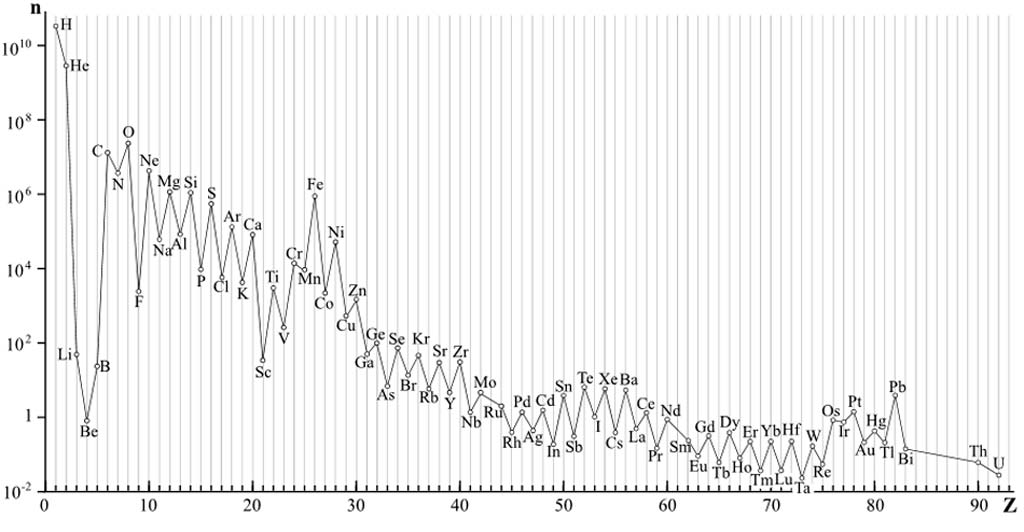
    This limits the expected life-sustaining region of our galaxy to stars whose orbits lie from at least 1 to at most 10 kiloparsecs from the center. For reference the Milky Way has a radius of only about 15 kiloparsecs, and with a little data and some rough assumptions, one can calculate that only around 10% of all stars in our galaxy lie in this region. This number is still staggeringly large and includes, to first order, around 20-40 billion stars or so. Of those we can reasonably exclude the 10% of stars in our galaxy that are not on the main sequence. Given that the average number of planets per star may be as high as 10 on the extreme optimistic end, this leaves a maximum of about 360 billion planets to work with.

    In addition to the galaxy, the stars themselves each have their own habitable zones, defined as the range of orbital distances within which liquid water could conceivably exist on the surface in large quantities. There are only three planets in our solar system that exist more or less within the sun’s habitable zone: Venus, Earth, and Mars. Of these three, Venus and Mars are each close to the edge of what can be considered the habitable zone, and given the concept’s speculative nature these boundaries could grow or shrink with new information. The most we can do right now is place an upper limit on this value of 6, based on research by Dr. Christa Van Laerhoven and her colleagues, though the actual number is almost certain to be lower. For simplicity, we can estimate the average number of planets in a star’s habitable zone to be 3. The size and location of the habitable zone is determined by the type of star. Large stars (O, B, and A types) account for only about 7% of all stars and tend to burn out too soon for complex life to really gain a foothold. It’s uncertain whether planets around smaller, red dwarf stars might host life. The data indicates the planets orbiting in their habitable zones may be tidally locked to the star just as the moon is to the Earth, with one side facing the star at all times. While this doesn’t preclude life from forming, it certainly makes things more difficult. Red dwarf stars may account for as much as 75% of the stars in our galaxy, so whether they should be included in the search for life is a crucial question that will hopefully be answered as more data becomes available. Nonetheless we have our next filter: of the main sequence stars, at most 93% of them are expected to be habitable.

    There are without a doubt more particulars of planetary arrangement that come into play here, such as having a stable, mostly circular (low eccentricity) orbit, the role gas giants like Jupiter may play as cosmic vacuum cleaners, and more, but the only thing we know for sure regarding the rest of the Location Filter is that we just don’t know.

    Filter 2 – Earth-Sized:

    Planets that are too large tend to be gas or ice giants, with no solid surface and crushingly thick and turbulent atmospheres. Life could form here, but if it does, it’s likely the exception rather than the rule. At the same time, the cores of planets that are too small tend to cool too quickly and lose their magnetic fields and subsequently their atmosphere to stellar winds. Mars is a perfect example of this. Looking at the best current estimates, we can see that only around 1,237 of the 4,370 exoplanets discovered so far are “Earth-sized”, i.e. range from 0.8 to 2 Earth radii. We can be generous here and allow for the fact that exoplanet survey methods are biased towards larger planets by estimating that perhaps 40% of planets are Earth-sized.

    Filter 3 – Atmospheres, Plate Tectonics, and Moons:

    Being Earth-sized helps when holding onto an atmosphere, but this does us no good if it isn’t the right atmosphere, and we need look no further than our own solar system for the perfect illustration of this. Venus is 93% the mass of the Earth, yet its atmosphere is crushing at a choking 100 times the density of Earth’s. Unlike our own atmosphere which is about 70% Nitrogen, Venus’s atmosphere is more than 96% CO2, 30 times the CO2 concentration of our own atmosphere. This runaway greenhouse effect famously makes Venus the hottest planet in the solar system, with surface temperatures hot enough to melt lead. Unfortunately we have no real data for this yet as we lack the ability to reliably observe exoplanet atmospheres, though that is expected to change with the launch of the James Webb Space Telescope set to launch in October of 2021. For now, we will be generous and use our own solar system as the model by assuming that 50% Earth-sized planets do not have the right atmosphere for life.

    Two other factors that make Earth, well, Earth-like are plate tectonics and our Moon. Plate tectonics play a crucial role in cycling numerous elements, including carbon and phosphorus, in and out of the environment. It’s thought that Earth’s water and the theoretical collision with a Mars-sized planet which formed the moon are two of the main factors that got plate tectonics going. Venus, which lacks both, shows no signs of tectonic activity, past or present, even though its core is known to still be molten and active. The Moon is somewhat of an anomaly in its own right. Of all the planetary moons in the solar system, it is by far the largest relative to the size of its host planet. Its existence helps to stabilize Earth’s axial tilt and over billions of years, through a quirk of angular momentum conservation, gradually slowed our planet’s initially brisk rotation to the 24 hour day/night cycle we experience today. It also generates tides and thus tidal pools, which some theories for abiogenesis claim provided the conditions for the origin of life on the early Earth. Again, we will be generous here and presume that 1 in 2 Earth-sized planets in the habitable zone of their star are actually Earth-like.

    Filter 4 – Phosphorus Scarcity:

    A recent study of two supernovae remnants, the Crab Nebula and Cassiopeia A, by Dr. Jane Greaves of Cardiff University and her team suggests that phosphorus may be produced in vastly different quantities during supernova nucleosynthesis. It’s somewhat common knowledge, even among the general public, that the Big Bang produced only Hydrogen, Helium, and a possibly a small amount of Lithium, and that all elements higher on the periodic table were produced in the cores of stars as byproducts of nuclear fusion, a process known as hydrostatic burning, but this is only half of the story. Stellar nucleosynthesis can only account for the production of a specific set of elements, most of which have an even number of protons due to their fusion being reliant on Helium and none of which are heavier than Zinc (element 30). All elements with more than 30 protons can only be naturally produced by what happens after stellar nucleosynthesis ends, in the explosive deaths of stars and the violent collisions of their remnants. As the star collapses infalling matter piles up and is “bounced” back out, producing large numbers of neutrons and sending shockwaves through the star’s layers which quickly fuse lighter elements into heavier ones through the process of rapid neutron capture, known as the r-process. In fact the majority of the elements trace their origins to events beyond the cores of main sequence stars as can be seen in the chart below. All of this results in massive discrepancies in universal abundances between elements, shown in the second image. Taking particular note of what the data shows regarding the six elements considered most critical for life: Hydrogen, Carbon, Nitrogen, Oxygen, Phosphorus, and Sulfur. Phosphorus in particular is required for the metabolic processes of all known cells (via ATP) and forms the backbone of both DNA and RNA, yet it is by far the least common of the six.

    (By Cmglee – Own work, CC BY-SA 3.0, https://commons.wikimedia.org/w/index.php?curid=31761437, based on data by Jennifer Johnson at Ohio State University)

    The most likely production process involves a silicon-30 isotope capturing a neutron during the supernova, briefly becoming unstable silicon-31 before one of its neutrons emits an electron and an antineutrino to decay into a proton, transmuting the atom into phosphorus-31, the element’s only stable isotope. The problem is that silicon-30 is not the most abundant Si isotope, accounting for only about 3.1% of all naturally-occurring Silicon, and its cross-section for neutron capture is quite small, meaning a neutron has to hit it just right to get absorbed. Supernovae are not evenly distributed around the galaxy, and thus we already expect that phosphorus isn’t either. Should it be the case that Phosphorus is not a ubiquitous byproduct of supernova nucleosynthesis, the element will only be rarer and more unevenly distributed than previously thought. There could very well be entire swaths of the galaxy with virtually none at all.

    While it might be possible for life to develop that does not rely on phosphorus, the chances of that actually happening are probably slim, and such life would be the exception rather than the rule. We ourselves are composed of approximately 1% phosphorus, the planet’s crust is about 0.1% phosphorus, and the entire solar system is roughly 0.0007% phosphorus by mass. On the scale of the entire universe, phosphorus only accounts for about three of every ten million atoms, or 0.00003%, and would have been even lower than that when our solar system began to form 5 billion years ago. Naturally, older star systems are expected to have less phosphorus on average as fewer phosphorus-producing supernovae would have occurred prior to their formation. Even our apparent relative abundance of phosphorus is so low that it presents a problem for scientists seeking to tease out the origins of life. Phosphorus also tends to bind into molecules that are heavier and thus would have sunk towards the core during the planet’s formation, though the collision which we think formed our Moon may have played a role here in dredging some up from the Earth’s interior. Its common compounds also tend to be insoluble in water which is problematic since life processes are pretty much predicated entirely on water solubility. Unlike the Earth’s carbon cycle which is relatively quick on geological timescales and involves the atmosphere as well as the planet’s interior, the phosphorus cycle is one of the slowest and independent of the atmosphere, so biologically-available Phosphorus is only refreshed by tectonic activity. That life should rely so ubiquitously on phosphorus despite its apparent scarcity tells us either that phosphorus-based life is easier to form than non-phosphorus-based life or that life based on phosphorus has an evolutionary advantage over life that is not. Possibly even both. Water is quite common in the universe, and so it may be that Phosphorus is what makes Earth truly unique among the planetary zoo.

    Until there is conclusive evidence one way or another, we can take this potential filter with a grain of salt and estimate that only 50% of planets have a sufficient amount of Phosphorus present on the surface. We can now combine all our filters into one to calculate a final value for ne and find that several Lesser and Minor Filters have combined to form one Major Filter. With less optimistic estimates, such as excluding red dwarf stars, and a few more assumptions and factors accounted for, this has the potential to reach Great Filter status and serves as the foundation for the Rare Earth Hypothesis.


    ne, Optimistic = 3 x 0.1 x 0.9 x 0.93 x 0.4 x 0.5 x 0.5 x 0.5 = 0.0125

    ne, Rare Earth < 0.000001


    For now, this is where we will leave the second half of our discussion of Drake’s equation. We can take all the factors we’ve discussed so far, multiply them together, and multiply this value by the length of time life has existed on Earth (3.5 billion years) to get a somewhat crude estimate for the number of planets in the galaxy which might contain life in any form.

    NOptimistic = 131,250,000

    NRare Earth < 10500

    When compared against the hundred billion or so planets that are estimated to reside within the Milky Way, even our deliberately generous estimate indicates that only around 0.13% of planets harbor any life at all. If we apply the Rare Earth filter for ne, then only about 0.00001% of planets in the Milky Way are safe havens for life. These numbers will only diminish as we start accounting specifically for intelligent life in subsequent factors of the Drake Equation. After all, the Fermi Paradox is specifically about why we haven’t heard from any other intelligent life, not merely the chances that extraterrestrial life in general exists.

    Next time we’ll be discussing that second half of the Drake Equation and the implications further proposed filters have for our chances of detecting intelligent life within the Milky Way. Unfortunately, the last three factors rely heavily on speculation in the absence of virtually any reliable data, and we will delve deep into some of that speculation in part 3. In part 4 we’ll discuss the final factor of the equation and run some example calculations before finally delving into what the Drake Equation actually is. In the meantime, if you’d like to try your hand at estimating the number of inhabited planets or intelligent civilizations in the universe, you can use this handy link for calculating the Drake Equation.