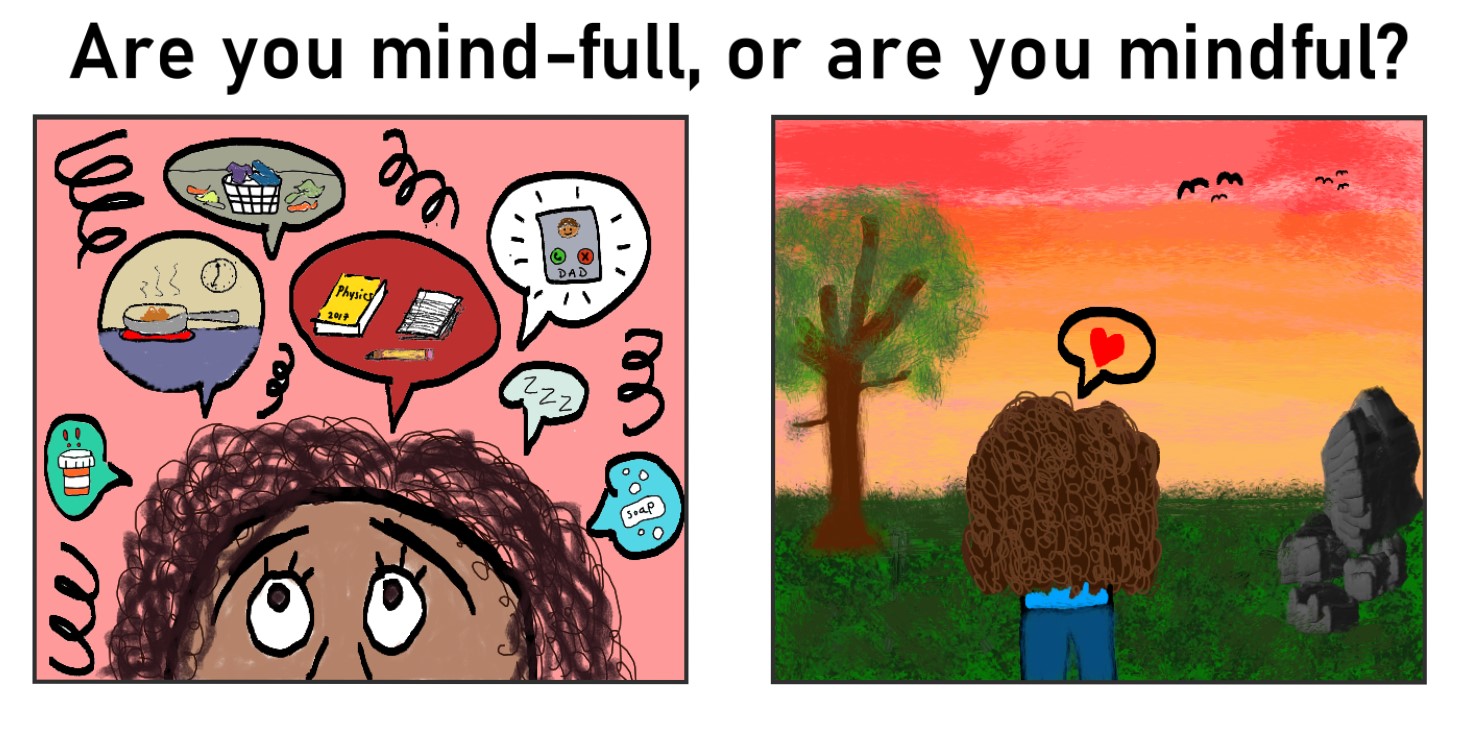
There is a difference between being mindful and being mind-ful! Illustration by Devi C.
Self-care and mindfullness go hand-in-hand, are things that we all need, especially in the midst of the COVID-19 pandemic. Self-care is a way to keep yourself healthy mentally, physically, emotionally, and spiritually. But why is self-care so important? According to Matthew Glowiak, a counselor at Southern New Hampshire University, self-care is often the first thing that we neglect when we find ourselves in difficult situations, whether it be failing a class, financial stress, or family and friend drama (Glowiak, 2020). Mindfulness means maintaining a moment-by-moment awareness of our thoughts, feelings, bodily sensations, and surrounding environment, through a gentle, nurturing lens (Berkeley, 2021). That is why it is important to continuously practice self-care and mindfulness, even in challenging times. By scheduling some time every day or every week to engage in self-care and be mindful, you better equip yourself to handle the things life may throw at you. You will be able to reset yourself into a healthy point so that you can carry on doing the things you need to do and prevent burnout.
By not practicing self-care or being mindful, you are more likely to develop anxiety, depression, irritability, resentment, and whole bunch of other negative effects. Having a self-care routine and being mindful have been scientifically proven to reduce or get rid of anxiety, stress, depression, and frustration and anger, and has been proven to improve happiness, concentration, sleep quality, energy, and many other positive implications (Glowiak, 2020). They have been proven to reduce physical health illnesses such as heart disease, cancer, and stroke.
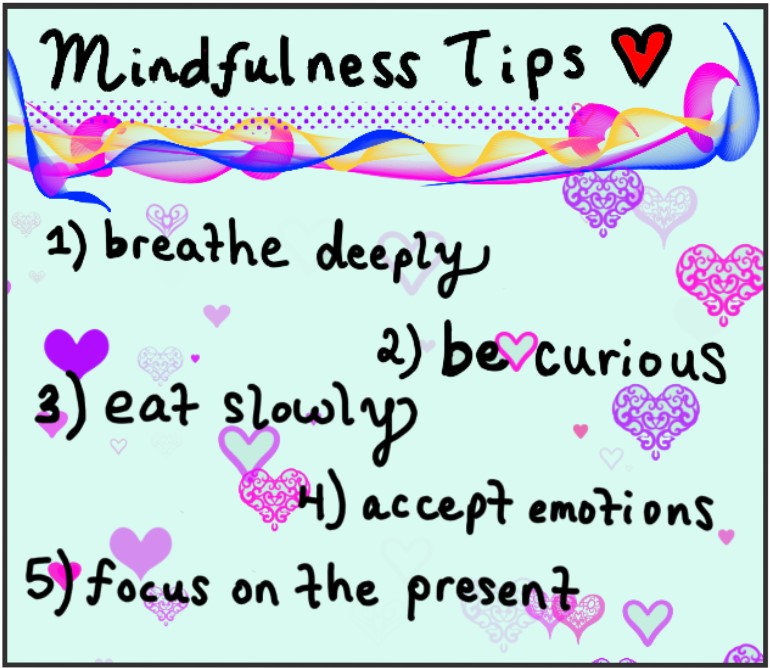
One of the biggest excuses for people who do not engage in regular self-care or mindfulness is that they do not “have enough time”. Everyone has lots of things going on in their lives, but it is essential to carve out even just a mere 5 minutes of self-care – it does not have to cost a thing! Instead of scrolling on Instagram or TikTok, here are some simple & quick ways to implement self-care into your daily regime and practice more mindfulness.
Five easy ways to practice minfulness. Illustration by Devi C.
Practice affirmations
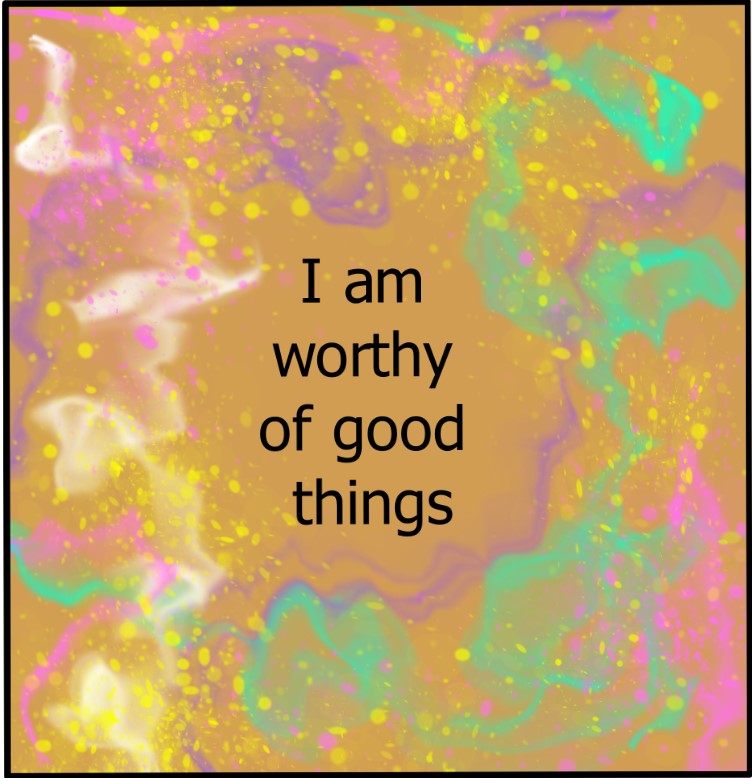
Affirmations serve as “integrity boosters”, raising a person’s sense that they are a coherent, moral, and adequate individual. Many people wish to view themselves as compassionate, worthy, and capable individuals, but sometimes their behaviors, attitudes, and intentions don’t always align with that ideal (Critcher, 2015). By practicing affirmations aloud repeatedly, one can allow themselves to truly feel that they are who they ideally view themselves to be. Repeat this with me 5 times:
Read this alound to yourself — “I am worthy of good things”. Repeat. Illustration by Devi C.
2. Drink a cup or two of water first thing in the morning. Your body will thank you and this will help prevent you from feeling groggy from dehydration upon waking up from a night’s sleep.
3. Have a little dance party in your room/home. Blast on your favorite songs and dance like nobody is watching!
4. Move your body for at least 30 minutes a day. This can be as simple as walking to all your classes in the day, instead of opting for the bus or scooters.
5. Get a plant. Nurturing plants is very therapeutic and they are lovely to look at!
6. Stop to smell the flowers – literally. This only takes a few seconds, but is very helpful in helping ground you in the moment and connect you with the very present.
7. Say no. It is important not to overextend yourself – you need to take care of you first before you can take care of others. You are more important than your to-do list. Prioritize you wellbeing above little tasks you might think or feel you need to do!
Ribbert the frog says hi! Illustration by Devi C.
References:
Berkeley. (2021). Mindfulness definition: What is mindfulness. Greater Good. Retrieved March 18, 2022, from https://greatergood.berkeley.edu/topic/mindfulness/definition#:~:text=Mindfulness%20means%20maintaining%20a%20moment,through%20a%20gentle%2C%20nurturing%20lens.
Whether you dabble in it or appreciate it, we come across art in any shape or form several times in our daily lives– especially the visual kind. For most, we came into contact with making art in some art class in elementary school, using nontoxic watercolors and, if they let us, acrylic. These paints, obviously, are very different from those that professionals use in their lives, but in what ways? Why don’t professional artists use Crayola watercolors for their work? The answer may lie in the science and chemical composition of the paint itself.
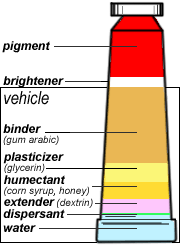
For starters, paints contain binders, solvents, and pigments. The pigment is the actual color part that we see, and the more light that’s absorbed by it, the deeper the color. Binders are what help the pigment stick to the surface of a painting and can vary depending on whether the pigment is organic or inorganic, but most paints use a gum arabic binder.
handprint.com
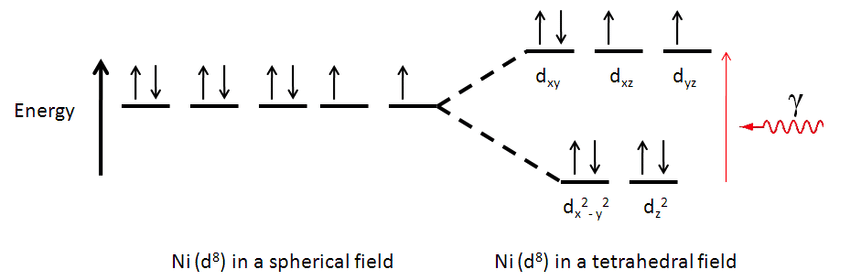
Typically, organic pigments are more preferred due to their more vibrant colors and their increased stability. These paints will use a turpentine binder. Inorganic pigments, however, are more affordable and are heat and light stable. These pigments are made of metal oxides, usually transition metals that can sometimes be toxic, so these aren’t commonly used. These elements usually have their bonding electrons in d-orbitals, and when bonded, can lead to these orbitals splitting into 2 levels of energy which allow electrons to absorb energy and move between the two levels, but the wavelength they absorb can be different depending on how large the gap between the 2 energy levels are. The light that is not absorbed and reflected is what we perceive.
Gamma represents the wavelength that’s absorbed (ResearchGate)
Staying with pigments, the more pigment, the more it will cost. Typically, artist-grade paint will have a higher concentration of finely-ground pigment, increasing surface area of the pigment and its vibrancy. Another factor that will raise the cost is if the pigment is organic or inorganic. Organic pigments, which can be more expensive since they are naturally-found colors and can be rare, are more vibrant and retain color over time when exposed to light.
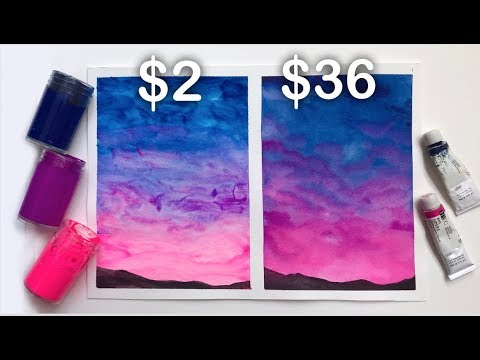
A more expensive, higher quality watercolor may have smaller, more concentrated pigment. Due to the smaller particle size of the pigment (which can get as low as 0.05 microns), the color will literally seep into the fibers of the paper and will stain (stick to the paper better after it has dried) more effectively, which can be better or worse depending on your art style. However, this pigment concentration and permanence also implies that the paint is suspended in fewer fillers and uses a more effective binder, which also increases the price.
AhmadArt, YouTube (2018)
As someone who likes to dabble in watercolors and has used paints of all different quality, learning specific aspects such as these helps with understanding why it may be sometimes worth it to invest in a more expensive watercolor palette. Because sometimes, the price can be translated into its quality. However, it can be easier to see it in person, or maybe under a microscope because after all, a picture is worth a thousand words.
References
acrylgiessen. (2022, February 16). Best Watercolor Paints – All About Professional Watercolor Paints. acrylgiessen.com. Retrieved March 4, 2022, from https://acrylgiessen.com/en/best-watercolor-paints/
Compound Interest. (2014, March 21). Inorganic Pigment Compounds – The Chemistry of Paint. Compound Interest. Retrieved March 4, 2022, from https://www.compoundchem.com/2014/03/21/inorganic-pigment-compounds-the-chemistry-of-paint/
Guide, S. (2021, May 19). Best Watercolor Paints – How to Choose the Right Watercolor Paint Set. craft-art.com. Retrieved March 4, 2022, from https://craft-art.com/best-watercolor-paints/
MacAvoy, B. (n.d.). handprint : how watercolor paints are made. Handprint. Retrieved February, 2022, from https://www.handprint.com/HP/WCL/pigmt1.html
McArdle, T. (2008-2022). Watercolor Paint Buyers Guide: Learn What to Look For When You Buy Watercolors — Art is Fun. Art is Fun. Retrieved March 4, 2022, from https://www.art-is-fun.com/watercolor-paint
Last year I thought that I was 100% certain about what I wanted to do when I graduated. My initial plan was to graduate with my bachelor’s and then find a career in the battery industry. I thought “Oh, I don’t need a job that is super involved, doing something simple will make me happy and satisfied”.
That changed after Summer 2021 when I took part in an internship at Los Alamos National Laboratory (LANL) in New Mexico. With the help of the Office of Energy Efficiency and Renewable Energy in the Department of Energy, I was connected to LANL to work in their Materials Synthesis group on a project to create metal complexes that can be used as a powerful source of liquid energy through hydrazine. To give a quick summary, Even though I wasn’t able to complete every part of the project over the summer, my time at LANL gave me confidence in myself as a scientist. I learned a ton of new skills and techniques and got feedback from the other interns and my mentors throughout the semester (big shoutout to my mentors Ben and Andrew, and my other friends in MPA-11, y’all rock <3). In addition to the new skills I learned, taking advantage of my time at a national lab allowed me to mess up and understand why things went wrong, go to research talks about topics I had no idea even existed, and ask questions about the field we work in to think about how we can improve.
This is one of the reactions I did at LANL. Essentially, the molecule on the left undergoes an electrochemical reaction to lose its positive charge. Then nitrogen gas is added, allowing this molecule to form more bonds. This can react further to form hydrazine (N2H4), an energy-dense liquid.
Okay cool, great, awesome, why am I raving so much about working in a national lab? Couldn’t I just write a whole article about it? Yes, I could, and hopefully, that’ll come soon! It’s important to me because this internship gave me a new perspective on the different career options that are possible in energy storage, and it became the building block to why I decided to apply for graduate school. I realized that I wanted a career that would allow me to do more in-depth research on energy storage systems. The field is interesting to me because energy generation research, though researched and well understood, doesn’t have a variety of fully commercialized energy storage systems. This makes it harder to use these systems when their demand is the highest. Energy storage research also involves the collaboration of engineers, scientists, and policymakers to promote the research and development of these systems. There is high potential in most of these systems, in my opinion, to become commercialized and integrated into the energy grid. Specifically, I want to do research on batteries and fuel cells because the chemistries of how they work are interesting to me, where changing the material of one part of a battery is a tradeoff on their overall energy efficiency and safety, among many other factors.
When I thought about all the cool things I could do and take part in (and maybe even lead (; ), I got even more excited to dive into the industry right after I get my degree. Then, as I started talking to group scientists and researchers (as well as a few disappointing searches through the LinkedIn job portal), I learned that those dreams I had in mind for my career could not be easily done with a bachelor’s degree. And then I thought, “Welp, what am I going to do now?”
As someone who often talks about being ready to graduate, the realization that pursuing graduate school would very likely be my next option made me a little complacent and frustrated at first. “I thought I would be done by now, and I gotta do MORE WORK?!” was one of the many thoughts that went through my mind. But as I thought about it more, I realized that there were more reasons why I wanted and needed to go to grad school. For the areas of energy storage research that I’m interested in, I need more experience working with different characterization and spectroscopy techniques to understand what’s happening on the nanoscale to better understand why they are happening and what can be done to improve them.
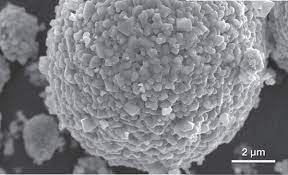
Scanning Electron Microscope (SEM) image of graphite used in batteries. SEM is one of the many characterization techniques that I hope to learn how to use in graduate school.
Additionally, there are many new projects in energy storage that up-and-coming scientists want to get to work on, and of course, I want to be a part of the next generation of energy storage research. The biggest roadblock that is keeping me from easily joining these with only a Bachelor’s is that in order to be the ideal employee in the energy storage industry, I need to work on more projects that will build my understanding of different systems. I hope that by achieving these goals, I’ll be prepared to work with batteries, fuel cells, supercapacitors, and whatever technology will be waiting for me.
Okay, so now that y’all know why I applied to grad school, next up is how. It may or may not be surprising, but preparing my applications and doing them was definitely the hardest and most involved part of the process. I want to start with a few disclaimers before I go over the things I did while completing my applications. First, this journey and how it “ends” are still up in the air, as I haven’t gotten any decisions yet. How all that goes will hopefully be updated later on during the spring semester. Second, my process doesn’t reflect how everyone should do it. Keeping to a timeline is difficult, and changes are bound to happen. Don’t stress if when you decide to apply for grad school you submit things close to the deadlines and you aren’t done weeks early. Lastly, you can take all these tips how you want, if you have any opinions, let me know what you think! I’d love to discuss more things that I may have missed.
And with that out of the way, let’s get started!
Step 1: Deciding where you want to go.
There’s no better step than the first step! This is where you think about what you want to focus on for the next two or more years. If you want to do energy research, then find universities that work with that, and if you wanna work on biochemistry, then find schools that fit in that area. If you have a more specific area of research you want to focus on, once you find a school that has the coursework and facilities you want, you should search for professors who have projects in that area. In my case, I want to research batteries or fuel cells, so I looked for professors who have similar projects. I tried to have at least four professors that I could see myself working with.
Of course, along with the research and coursework available at the universities you’re interested in, there are other factors that may be important to look into:
Fellowships: I could write a lot about fellowships and why they’re so good to apply to. For one, there are a number of opportunities to apply for that will support you whether you’re pursuing a Master’s or Ph.D. (or even both), especially as a minority in STEM. Some examples include the NSF Graduate Research Fellowship Program, the GEM Consortium, Sloan, Hertz, and many more. These fellowships usually help balance the cost of tuition, as well as provide stipends, networking opportunities, and even opportunities for internships.
Weather: It may or may not be self-explanatory, but wherever you decide to go, make sure you know how the weather is throughout the year. If you can’t survive in the Southern heat, then Texas or Georgia may not be the best spot to be in. If you love the mountains, then Colorado or New Mexico could be the place for you.
School Demographics: The biggest factor to me when looking at where to apply was the statistics about my class. What I look at is the percentage of students that identify as Black or African American. I also looked into the work that the schools have done to provide spaces and student organizations for their different identities. I applied to Georgia Tech (my current university) because I know that the black community there is strong and I applied to the University of California San Diego because they have a number of initiatives to support black students and the school provides fellowship opportunities for minority students.
City Life: Whether you’re social or you’re an introvert, it’s good to live in a city where you can have some extra fun. No matter how dedicated you are to your work, we deserve to treat ourselves to some fun! Most colleges and universities are in a place that has some good food spots and cool attractions.
Testing Requirements: Because of COVID, we’re starting to see a new look at the graduate school application process. This year, the GRE test at most schools is either optional or not required. If a program requires the GRE, then I recommend taking some thought and maybe asking your advisors if it’s worth it. I can’t say much on this because none of the programs I applied to required it.
Step 2: Organize, organize, organize!
There are a lot of different things to organize before starting your applications that will you in the long run. First off, get your recommenders in mind ASAP. I always think it’s best to have 4 people you can reach out to because even though many schools will only ask for 2-3, it’s good to have multiple people who can be ready to write a recommendation for you in case someone else is no longer able to. You should have recommenders that can speak to your future goals and how you think you’ll be able to achieve them, your ability to do research well, and if you will be successful in and out of the classroom. For my applications, I asked my academic advisor, my research advisor that I worked with for two semesters, my internship supervisor, and my professor that I’ve worked with for a few years.
It’s also good to have information for them that will help them while they write about you. With some help and advice that I got from my advisor, I made a spreadsheet that shows the information about the schools that I’m applying to, the deadlines, plus additional info like the submission process and links to learn more about specific programs. Another document I made to help my advisor was a “motivations document”. I used this to make it clear to my recommenders my short and long-term goals, why I want to pursue a Master’s to reach those goals, and what draws me to certain schools and their research labs.
Lastly, for myself, I kept a larger document that has the application information for each school and fellowship. This helps to keep me organized on any deadlines when I should send out recommendations, what I should think about when writing my statements, and supplemental questions.
Step 3: WRITING TIME!
So this is the part that will take a lot of time, but the details aren’t too extensive. It really is just sitting down and thinking hard about how you’re going to talk about who you are, what you’ve done, and how you’re going to be an incredible and successful scientist that any university would love to have. It’s very important to talk about why you want to pursue a graduate degree, any relevant research experiences, what about the school is attractive to you, who you would like to work with. Some additional points that may be good to address are your background (race, ethnicity, financial, etc.), any low grades, and coursework (this is best if your undergrad institution has limited STEM courses or if the field you’re going into is very specific). There are many videos and websites that talk about what makes a good personal statement.
After you finish your first drafts of your statements, don’t be afraid to send it over to people you know for review. Whether it’s from your friends, your teachers, or your siblings, every little comment given will help make your statement even better. Others will likely notice more minor (or even major) things that could be edited, and once they’re finished I highly recommend reading it out loud to make sure it makes sense to you.
Step 4: Submit and Wait
When everything looks right, you don’t see anything else wrong with your statement, and you feel confident and happy with your statement, go ahead and hit submit! After the application, most schools will ask for an application fee, but depending on the school and your situation, you can apply for a fee waiver that covers it! In my case, because of the GEM Consortium Fellowship and some diversity and inclusion events I attended, I was able to get fee waivers for 4 of the 5 universities I applied to.
The waiting game can be hard to deal with if you’re a little impatient like me and want to know the decisions ASAP, but it provides time and space to reflect and prepare for anything that might come next. Some programs, if they’re exclusively coursework with no research, may ask to interview you, but most will contact you once they reach a decision. If you get that acceptance, amazing, you just have to decide where to go, who to work with, all the fun details. If you don’t get the results you’re hoping for, that’s fine too!! By this point, you will have put in such hard work and dedication towards these applications, and no matter the result, I can be 100% sure that you will have learned something about yourself.
So to finish things out, I want to give some more perspective on how the process was on my mental health. Overall, the process of applying made me so much more confident in myself. Looking back at my experiences made me realize just how much I’ve done and how incredible it really is. At first, I felt like it would be difficult to talk about myself well and how I would be a great fit, but I learned how to hype myself up while also proudly noting what I was lacking and ready to learn in grad school.
I also won’t lie when I say doing grad apps while in one of the heavier semesters in my academic career was STRESSFUL. Working to balance my classes and clubs led to some weeks being quite draining. Many of my other friends who were applying to grad school in this cycle also agreed that there were definitely weeks where our mood was “Yaay, we have a free week to spruce up my application!”, and others where the mood was “Wow, I’m tired from all these classes and meetings, I just wanna take a 37-hour nap.” No matter how we felt though, we stayed strong and pushed through to the end, because we knew that once we finished all of our applications, we were now one step closer to the future that we see ourselves in.
Hope you enjoyed this article! It’s a lot of information as I wanted to give an honest and helpful look at what I did and what might help others out that might be a bit scared and unsure about applying for grad school. It was terrifying to me when I started, but it’s only thanks to the help of my brother, who’s a grad student now, my friends applying with me, and all the advisors and recommenders, that I felt confident I had done something that I’m proud to share with the world. I can’t wait to see what will happen next, and I’ll keep y’all posted on how things go!
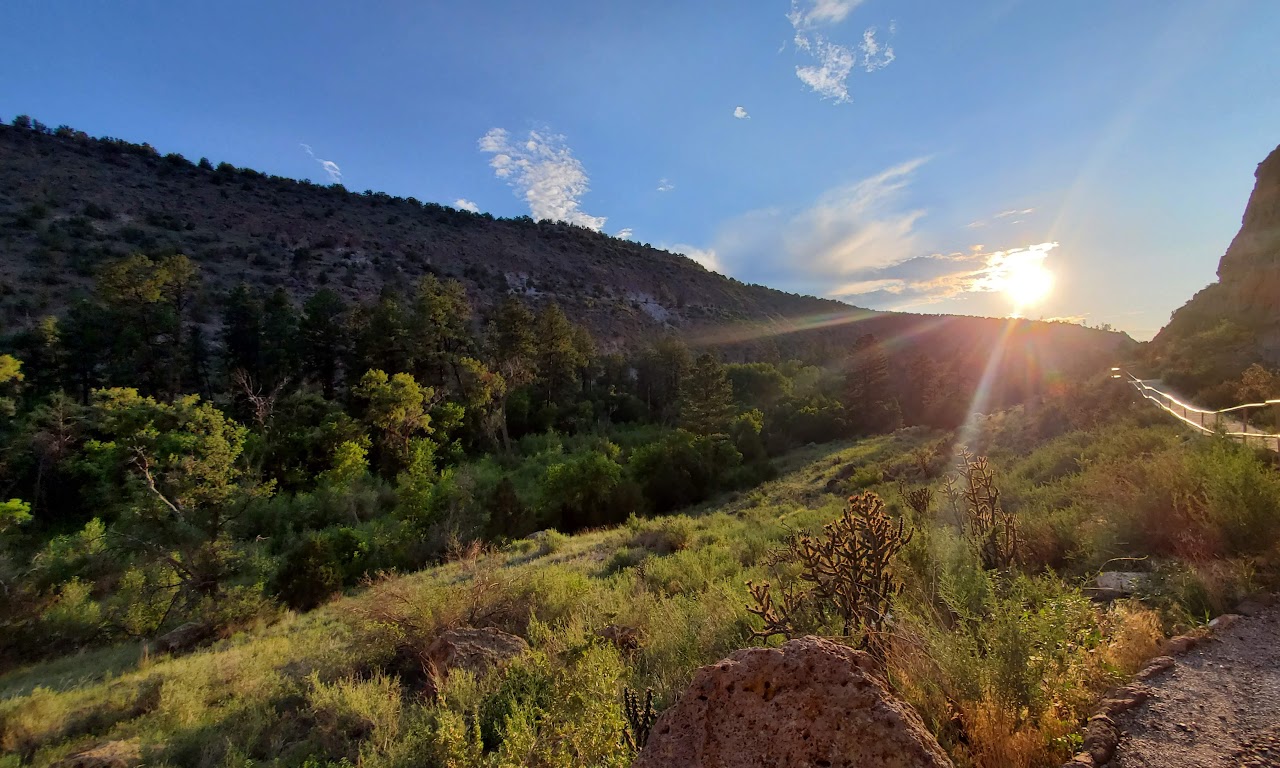
No better way to end this post than with a beautiful nature pic! This is from the Bandelier National Monument in Los Alamos, New Mexico, taken around the time I decided to take the big step to apply to grad school!
References
Sponsored by Thermo Fisher Scientific. (2020, January 28). Determining battery structure and composition using SEM. AZoM.com. Retrieved March 5, 2022, from https://www.azom.com/article.aspx?ArticleID=15475
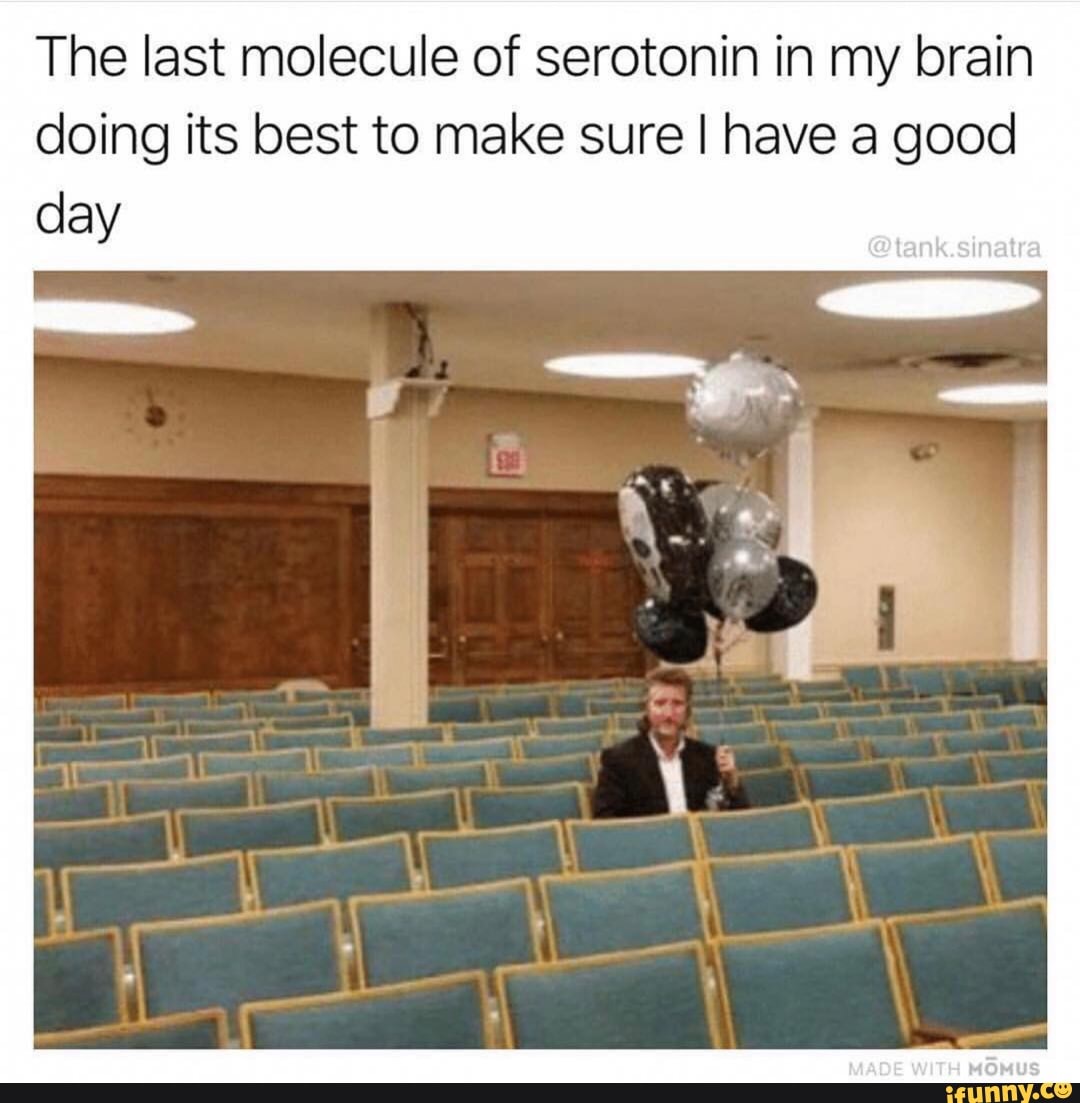
As a neuroscience major, it makes me extremely happy when words about the brain and nervous system enter the popular vocabulary. And recently, I’ve noticed people have been using neurotransmitters to talk about their feelings. If someone wants to say something brings them joy, they’ll say, “That’s my dopamine!”. Or, if someone feels unhappy, they might share a meme about how they want more serotonin (like the meme below!)
But to me, the biggest indicator of whether something has entered the popular consciousness is if there’s music about it. So, through the article series “Neurotransmitter Notes”, I want to chat about songs that talk about the 8 major neurotransmitters: epinephrine, norepinephrine, dopamine, serotonin, GABA, acetylcholine, glutamate, and endorphins. Today, we’ll tackle the most famous neurotransmitter of them all: dopamine.
Neurotransmitters
Hold on, what’s a neurotransmitter? The Encyclopedia Brittanica defines a neurotransmitter as “any of a group of chemical agents released by neurons (nerve cells) to stimulate neighbouring neurons or muscle or gland cells, thus allowing impulses to be passed from one cell to the next throughout the nervous system” (Neurotransmitter | Definition, Signaling, & Types | Britannica, n.d.). So, neurotransmitters (NTs) are chemical messengers that neurons use to pass signals onto one another. What differentiates NTs from one another are that NTs will only be sent and received by the neurons that have the protein receptors that fit with it. Neurons are classified by the type of neurotransmitter it can “understand”: so, you’ll have dopaminergic neurons (which send and receive signals about dopamine). Those dopaminergic neurons, when binding to dopamine, will cause the effects that are associated with dopamine.
Dopamine’s Effects
Like I mentioned earlier, dopamine is known as the “happy” chemical. But it’s not just released when you feel good: it plays many, many other roles. One role is controlling decision making. For instance, higher levels of it are related to whether someone chooses to do a more difficult, rewarding task over a simpler, less rewarding one (Dopamine Affects How Brain Decides Whether a Goal Is Worth the Effort, 2020). These facts, I’m sure, were handy when writing the lyrics to this dance jam:
The songwriters have demonstrated here the happy feeling associated with dopamine, as well as its importance in controlling behavior. However, there’s also an error: neurotransmitters don’t travel in the bloodstream. Dopamine happens to be unique because it has an alternate form that does travel in the bloodstream, but that form doesn’t have the same effects as what the song’s describing. It’s likely that they mixed up neurotransmitters with hormones, which do travel in the bloodstream.
Dopamine Doesn’t Just Move You, It Motivates You
Not only can dopamine make you feel good and affect your decision making, it can impact your motivation. This motivation can be in the form of how well you can focus and retain information for a task (executive function). Executive dysfunction occurs in people with ADHD, who also often have lower levels of dopamine in their brain (Logue & Gould, 2014).
Motivation also plays a role in addiction. The ventral tegmental area (VTA) is a section of neurons in the brain that play a major role in people with addictions, and these neurons are dopaminergic. In the song “Dopamine” by Bliss n Eso, the singer talks about his reliance on alcohol to help him through times of stress. This chorus describes how it felt for him to use it:
However, over the course of the song, he cites his connections to his wife and child as motivation to become a better person. And by the end, this same chorus has taken on a new meaning. By the way, long-term intense romantic love still makes your VTA light up with dopamine, years after the honeymoon period has ended (Acevedo et al., 2012).
Dope-amine or Nope-amine?
I suppose we can take from this a lesson: dopamine is not just a feel-good chemical– it’s crucial for the proper functioning of your brain. Don’t try to chase that short-term high: if you take care of yourself and make meaningful connections to other people, dopamine (and life satisfaction) will come to you.
Check out this playlist with the tunes mentioned in this article, as well as some other neuroscience related songs! (Note: please be aware that some songs in this playlist may have explicit lyrics.) I’ll be back soon with some more Neurotransmitter Notes!
References
Acevedo, B. P., Aron, A., Fisher, H. E., & Brown, L. L. (2012). Neural correlates of long-term intense romantic love. Social Cognitive and Affective Neuroscience, 7(2), 145–159. https://doi.org/10.1093/scan/nsq092
Dopamine affects how brain decides whether a goal is worth the effort. (2020, March 30). National Institutes of Health (NIH). https://www.nih.gov/news-events/nih-research-matters/dopamine-affects-how-brain-decides-whether-goal-worth-effort
Logue, S. F., & Gould, T. J. (2014). The neural and genetic basis of executive function: Attention, cognitive flexibility, and response inhibition. Pharmacology, Biochemistry, and Behavior, 0, 45–54. https://doi.org/10.1016/j.pbb.2013.08.007
Neurotransmitter | definition, signaling, & types | britannica. (n.d.). Retrieved February 19, 2022, from https://www.britannica.com/science/neurotransmitter
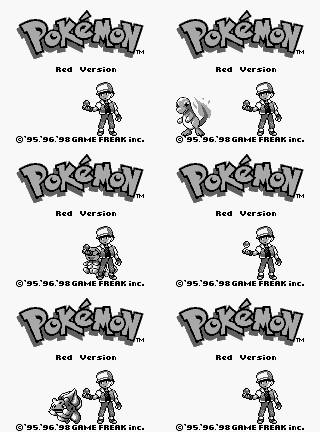
I still remember the first time I booted up my brother’s GameBoy Color and saw that iconic title screen of Pokémon Red where each of the starters would flash by. The hardest choice as a kid (and still a difficult one now) was picking which of the three starters you wanted as your main partner. Would you choose the Fire-type, the Water-type, or the Grass-type? The one thing you knew going into this choice though was that most starter Pokémon were based off real life animals, plants, or objects. For example, in Pokémon Red, the Grass-type starter Bulbasaur is based off a mixture of frogs and onions, while the Fire-type Charmander is based off a salamander, and Water-type Squirtle is based off, well, turtles.
So I thought, well why not take up this trend and create my own set of starter Pokémon based on some real world counterparts! I’ll be taking three real plants/animals, designing them as Pokémon and crafting a move set based on some of their coolest ecological adaptations. Then you can choose who you’d like to start your Pokémon journey with! Welcome to the next generation of Pokémon: Generation Earth!
Generation Earth Starters
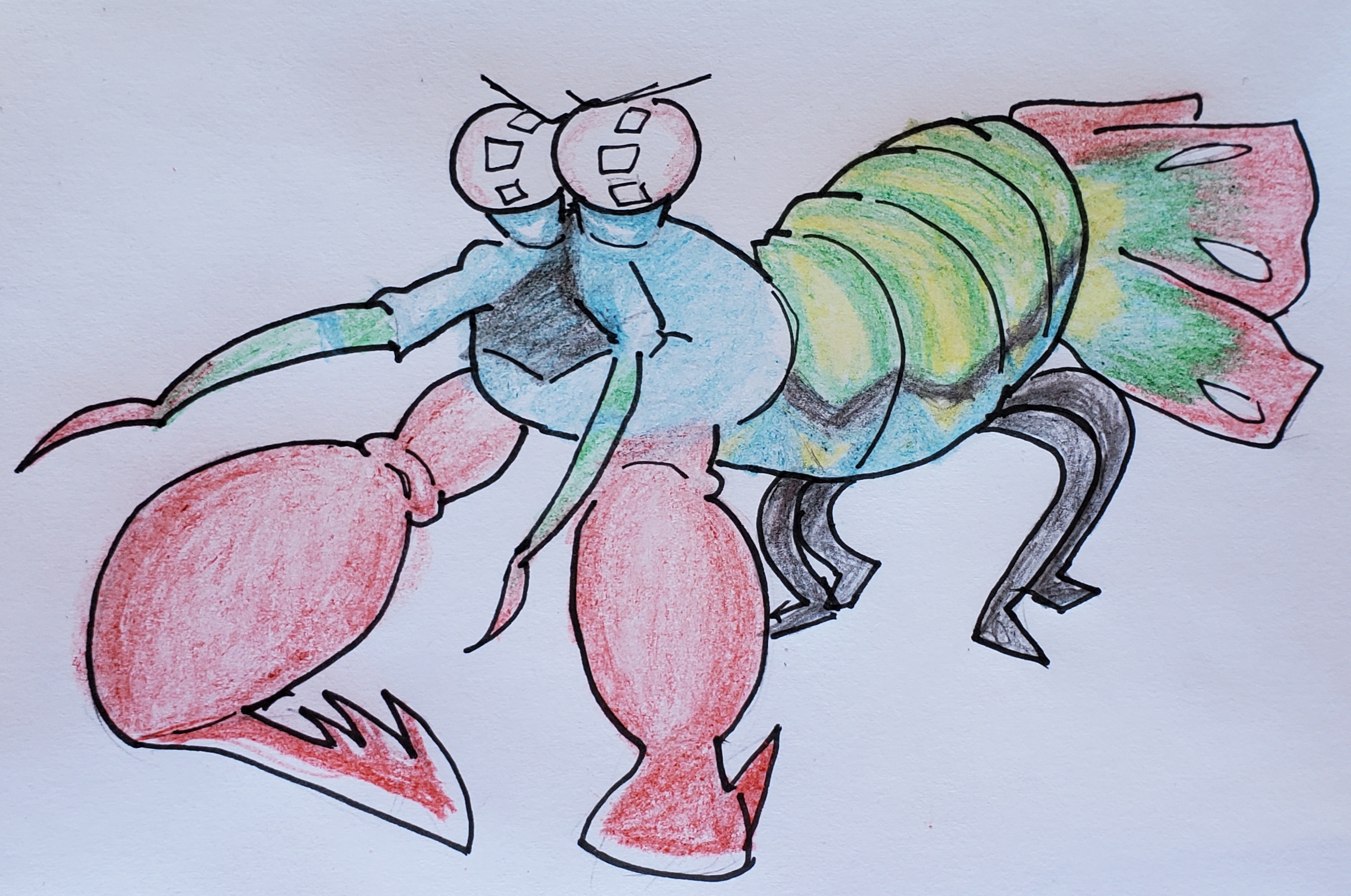
Water-Type Starter:Stomato (Stomatopods or Mantis Shrimp)
Dual Type: Water/Steel
Move set:
Mantis Punch – releases an intense punch that stuns the foe for a turn.
Power: 120, Accuracy: 70
Bubble Punch – punches the foe with a beam of bubbles.
Power: 90, Accuracy: 80
Triple Sight – increases accuracy by focusing on three different objects.
Power: —, Accuracy: 100
Color Burst – increases attack by allowing the user to identify more colors.
Power: —, Accuracy: 100
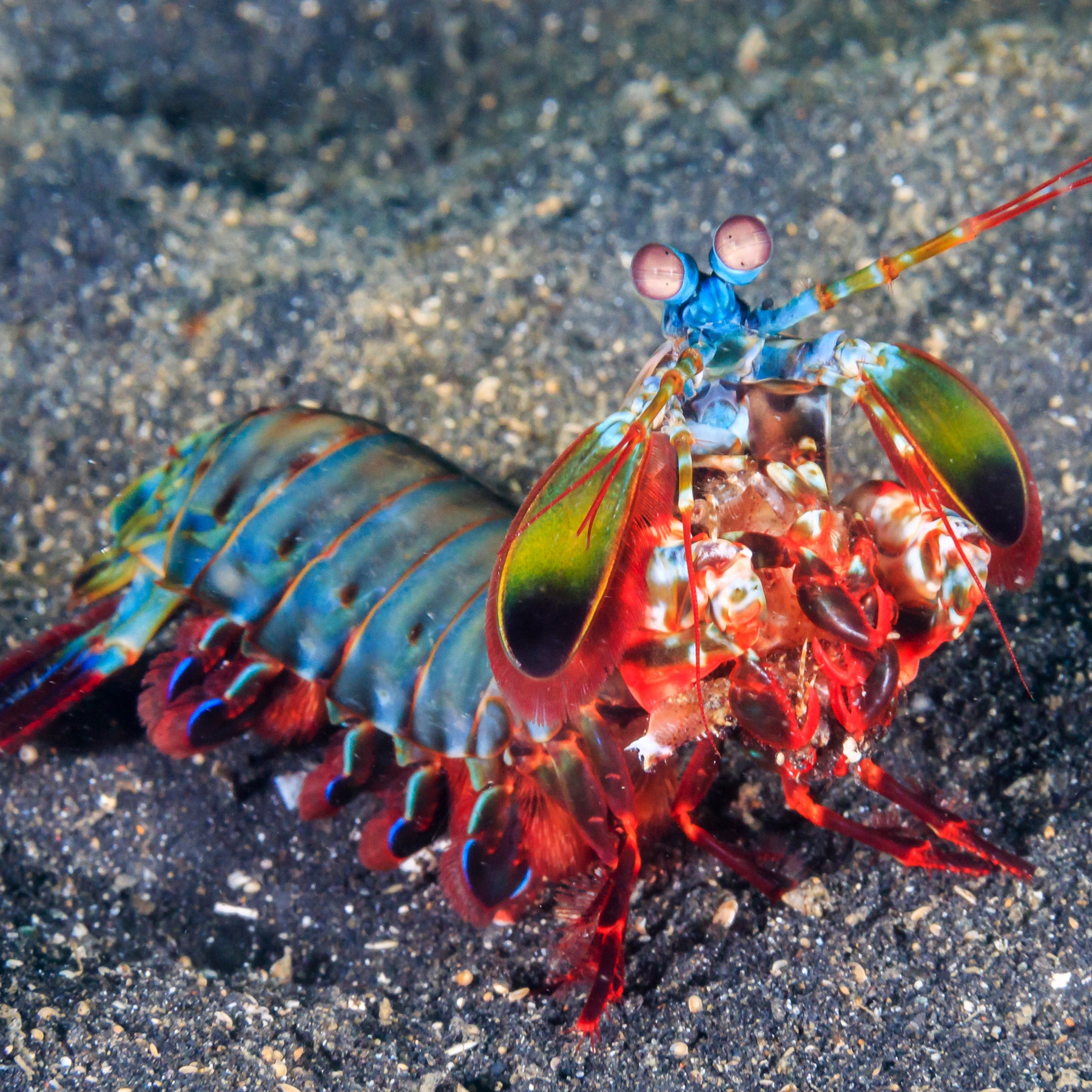
The fierce Water/Steel hybrid, Stomato, is based on its just as fierce real world counterpart, the stomatopod, or more commonly known as the Mantis Shrimp. These carnivorous crustaceans live in most shallow, tropical regions and can be broken into two main groups based on how they catch prey: spearing and smashing. Stomato is based on the smashing group as you can see from his punching moveset. Let’s breakdown these moves:
Mantis Punch:The Mantis Shrimp’s main claim to fame is its fantastic punch, which can reach a force over 1,500 newtons and possess an acceleration of 102,000 m/s2, which is basically as if they were shooting a .22 caliber rifle! These punches can tear through crab shells with ease, allowing the Mantis Shrimp a delicious meal. As such, Stomato’s Mantis Punch is his fiercest attack and can absolutely decimate an opponent if he lands a hit.
Double Bubble Punch: The Mantis Shrimp doesn’t just attack in ones though. Because of how fast their punch is, they create a ‘cavitation’ of bubbles that follows their initial punch and hits their prey a second time. This cavitation of bubbles is also burning hot (almost 4,400C). If their prey isn’t killed by the first attack, they sure are killed with the second round. To only make things fair, I separated this bubble punch into a new move for Stomato, but it still delivers quite the hit!
Triple Sight: While the Mantis Shrimp’s eyes might look creepy to us, they have a ton of unique abilities! Mantis Shrimp possess trinocular vision, meaning that they analyze distance and depth by focusing on objects in three separate regions. This helps them get an extremely accurate understanding of the space around them and where their prey is. For Stomato, his trinocular vision allows him to easily lock onto his foe and increase the accuracy of his attacks.
Color Burst: The Mantis Shrimp’s eyes possess another interesting feature; they contain twelve types of different photoreceptors (the part of the eye that responds to light and helps distinguish colors). That might not seem like a big deal at first but just compare that to humans who only have three types! Because of the large number of photoreceptors, the Mantis Shrimp can see a wider range of colors than a human (and most other animals on the planet). Scientists are still trying to figure out exactly why and how the Mantis Shrimp has so many, but many hypothesize the Mantis Shrimp utilizes each photoreceptor to identify and process the color (while humans need other parts of their brain besides their eyes to process colors) which is extremely helpful in the colorful coral environments the Mantis Shrimp can live in where they need to spot prey quickly. Stomato takes after this with his move, Color Burst, which lets him identify multiple colors at once to better find his target on the battlefield.
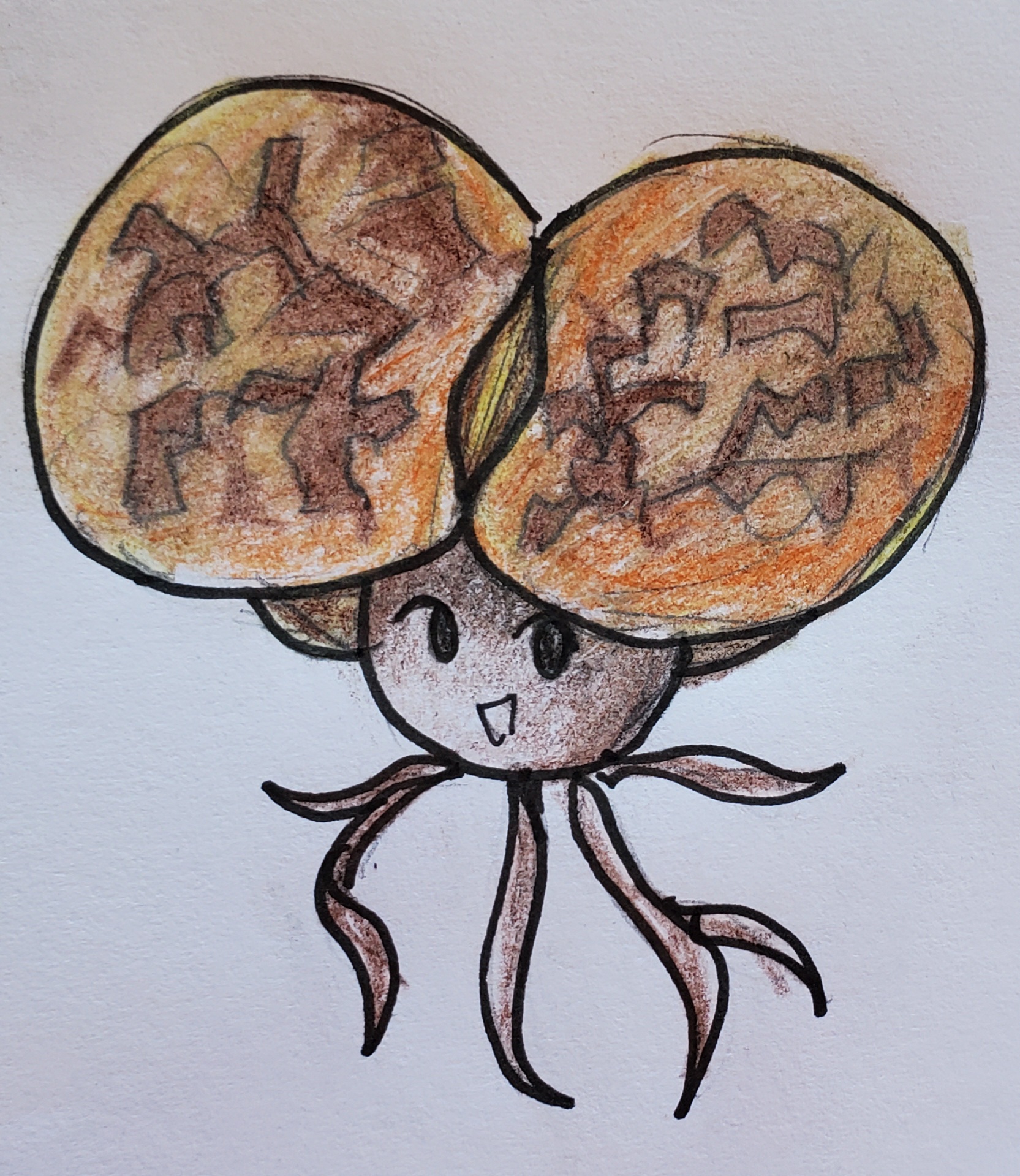
Grass-Type: Lithop (Lithops or living stones)
Dual Type: Grass/Ground
Move set:
Camouflage – hide as a rock to lower a foe’s accuracy.
Power: —, Accuracy: 100
Aqua Retain – stores water for the next three turns to replenish HP.
Power: —, Accuracy: 100
Metabolic Cooling – darkens the battlefield and releases chemicals.
Power: 90, Accuracy: 100
Leaf Shield – tightens its leaf window to raise its special defense.
Power: —, Accuracy: 100
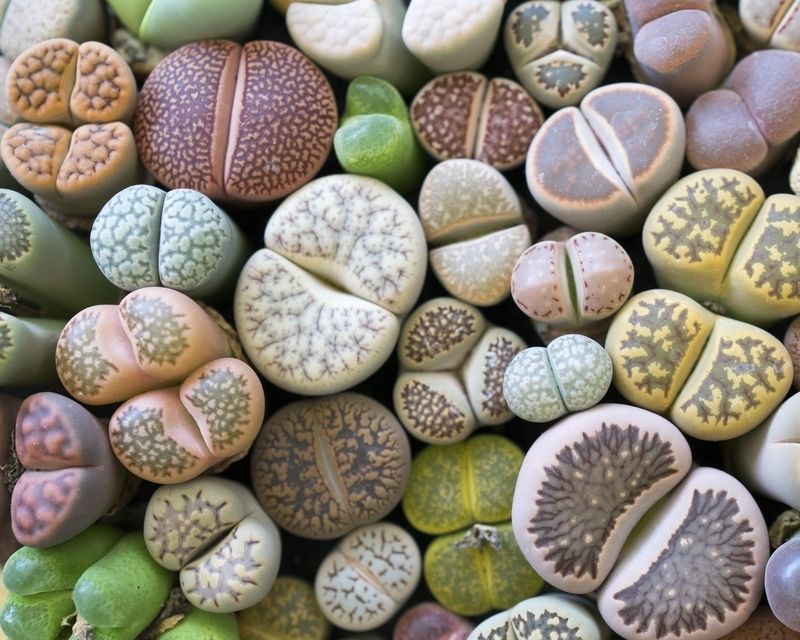
Our lovely little Lithop has its name taken straight from its real world counterpart’s scientific one. Living stones, as they are more commonly known, are plants that typically reside in the drier, warmer areas of southern Africa. They’ve gained this nickname due to their appearance of stones of pebbles. To thrive in such xeric environments, lithops have forged numerous adaptations to help them conserve water and protect themselves from overheating and radiation. Let’s take a look at these adaptations and how they’ve formed Lithop’s moveset:
Camouflage: The most obvious one; living stones keep their stems underground, only revealing two succulent leaves above the surface. Without close inspection, this pair of leaves adorned with graveled patterns give a rock-like appearance to the lithops. This appearance can fool nearby grazers to move past them. As such, Lithop utilizes its move Camouflage to hide itself from its opponents, making it harder to see within the landscape and harder for the foe to hit!
Aqua Retrain: The two succulent leaves and below ground stem of the living stone have other benefits too. If you’ve ever seen a succulent leaf, you know it’s much fatter than most traditional green leaves you see on bushes or flowers. This is because these leaves store water in them for the plant to use during periods of drought. Living stones are especially great at this since by design, they have a low surface area to volume ratio, meaning they can store a lot of water while minimizing the amount of exposed plant surface area. Lower exposed plant surface means less water will be lost during the day due to transpiration. Because of their great water retention mechanics, our Pokemon Lithop can also store water for multiple turns and use that water bit by bit to help heal and regrow itself after damage.
Metabolic Cooling:Lithops, like many plants found in arid environments, have to adjust their process of photosynthesis to not lose too much water. One of the ways they do this is through Crassulacean Acid Metabolism (CAM), where only at night will the plant open its stomata (think of these as plants’ pores) to collect carbon dioxide from the air. Without the sun present, the plant is less likely to lose water vapor when it opens its stomata which helps it conserve its water supply. For our Pokemon Lithop, I did a bit of a flip to make the move an attack, so instead of collecting the chemicals from the night air, it releases them to harm its foe. Sometimes in art you have to make a few adjustments for things to work!
Leaf Shield: As you know, most of the living stone is hidden within the succulent leaves or beneath ground. To bring sunlight into the plant for photosynthesis, lithops possess a small leaf window. The exact purpose of this window mystified biologists for years (was it to directly channel sunlight into the areas for photosynthesis?) until a few studies revealed its reasoning. Within the harsh sunlight of the desert, it’s very easy for the internal parts of lithops to overheat and be damaged by UV radiation, which can dramatically reduce photosynthesis. This leaf window then shields the internal portions of the plant from sunlight and keeps its internal temperature from rising too much. Because of this, our Pokemon Lithop utilizes its leaf window as a defense mechanism to special attacks that could cause damage or status effects to it.
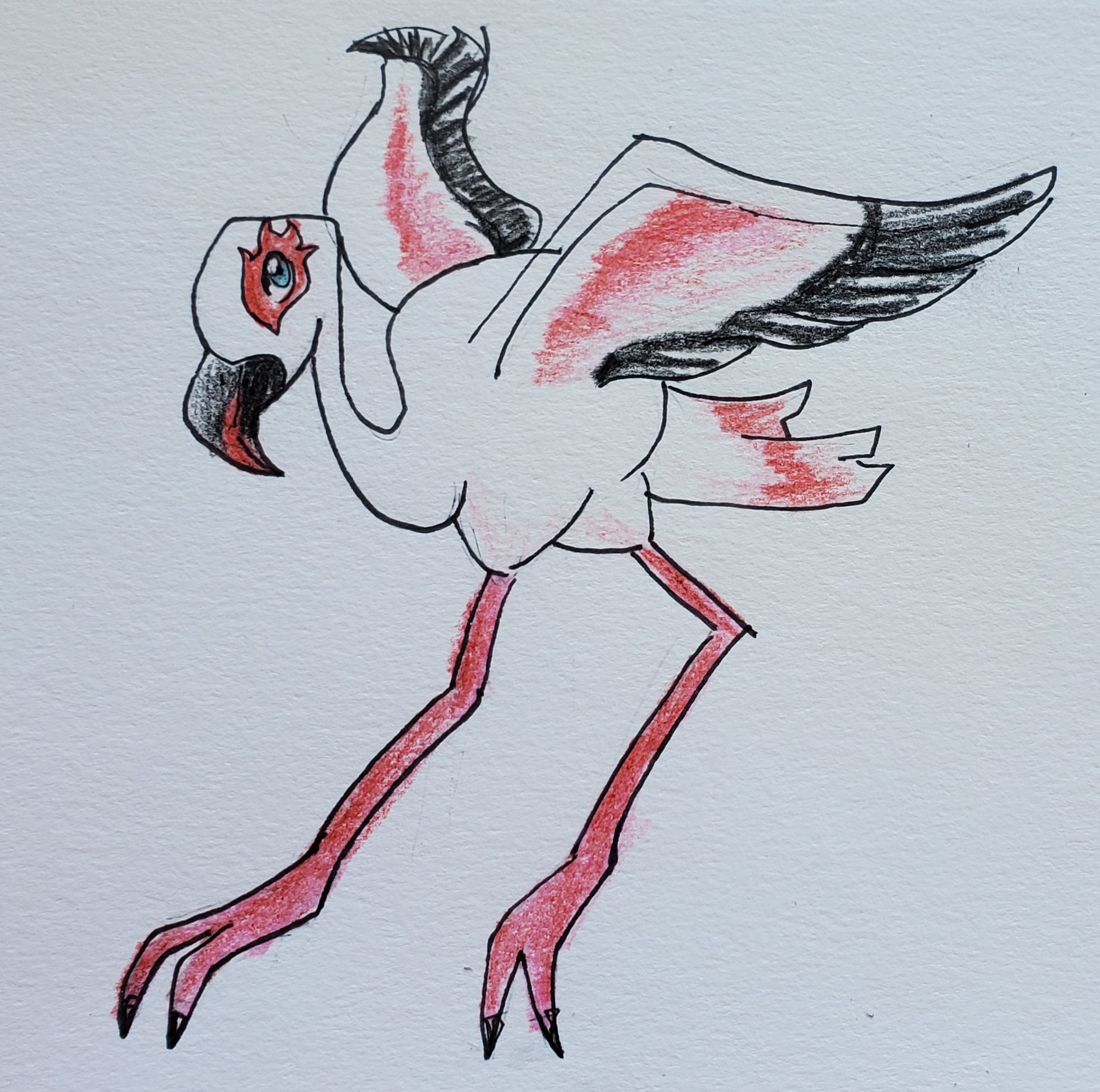
Fire-Type Starter: Flameingo (Lesser flamingos)
Type: Fire-Flying
Move set:
Boil Spout – Squirts boiling water at foe.
Power: 90, Accuracy: 90
Purify – removes salt from water to heal the user’s HP. Effect doubled if attacked by a Water-type move the previous turn.
Power: —, Accuracy: —
Harden – raises defense; no status effect can be imposed on the user.
Power: —, Accuracy: 100
Volcanic Ash – uses wings and legs to scatter burning ash and mud at foe.
Power: 70, Accuracy: 100
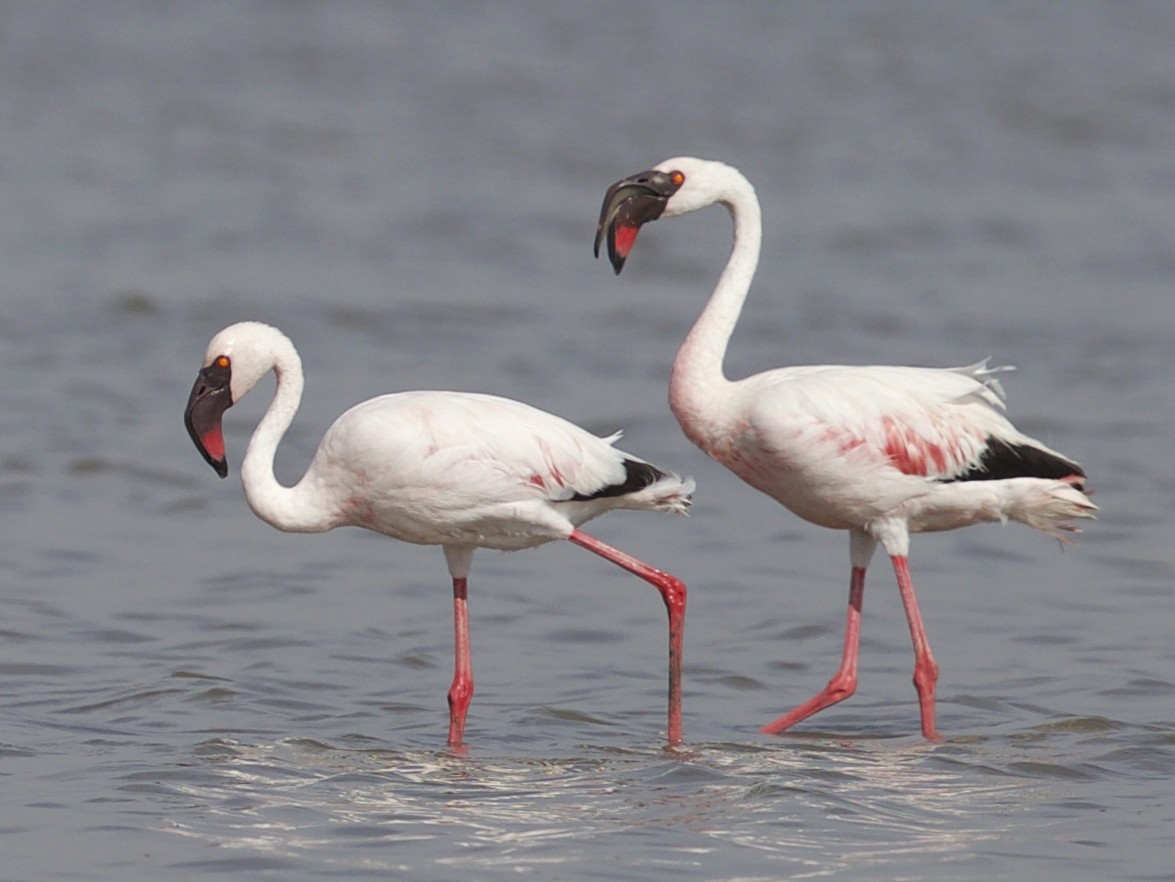
While a bit more of a stretch than the other two, let’s not forget our Dual Fire/Flying type, Flameingo! Flameingo is based on the phoenicoparrus minor, or more commonly known as lesser flamingos, which make their home in the volcanic waters and pockets of places such as the African Rift Valley, the Galápagos Islands, and the high Andean plateaus. These animals are extremely sturdy and have adapted to living in some of the hottest and most dangerous places on Earth, which is why Flameingo takes the spot of our fire starter. Let’s check out her moveset:
Boil Spout:Since the lesser flamingo utilizes alkaline volcanic lakes for sustenance, they have adapted to be able to drink near boiling water without causing serious burns. Flameingo takes after this trait (with a bit of a stretch to just say boiling) and can attack her enemies through spitting boiling water back at them. Let’s see if her foes can handle the heat!
Purify: The lesser flamingo often takes up residence in hypersaline lakes or geysers, so they must utilize different glands in their head to remove the salt from the water they drink. Once the salt is removed from the water, it drains out their nasal cavity. Our Pokemon Flameingo has this ability too, allowing her to restore her HP by making freshwater to drink. If attacked by a foe’s water-type move the previous turn, she’ll just have more to heal herself with!
Harden: To stand in the near boiling volcanic lakes, the lesser flamingo would need to have tough skin and thankfully it does! The lesser flamingo has developed extremely scaly and leathery skin on their legs which allows them to stand in the hot salt water of their homes without getting burned. Flameingo’s move, Harden, comes from this thick skin adaptation. She can increase her defense by hardening the skin on her legs so it’s harder for other Pokemon to attack her, especially with Special Attacks!
Volcanic Ash: The harsh volcanic environments with their deep saline mud pits keep almost all predators away from lesser flamingos’ and their eggs. While the lesser flamingo might not often get into fights, I’ve honored their habitat and its deadly effect on others in this move. Flameingo can use her leathery legs and powerful wings to kick and spray fiery ash and mud into the faces of her foes.
Choose Wisely!
Now that you’ve seen these three Pokemon and their basic moveset, which one will you choose on your Pokemon journey? Which real life counterpart do you think has the coolest ecological adaptations?
I hope you enjoyed this crossover of biology and Pokemon!
Campbell, V., & Moslemi, J. (2015, June 3). Flamingos of the Altiplano, high in the Bolivian andes. All About Birds. https://www.allaboutbirds.org/news/flamingos-of-the-altiplano-high-in-the-bolivian-andes/
Candeias, M. (2021, February 28). A surprising realization about leaf windows. In Defense of Plants. https://www.indefenseofplants.com/blog/2017/12/21/a-surprisng-realization-about-leaf-windows
Egbert, K.J., & Martin, C.E. (2002). The Influence of Leaf Windows on the Utilization and Absorption of Radiant Energy in Seven Desert Succulents. Photosynthetica, 40(1), 35-39. doi: 10.1023/A:1020129820295
Field, KJ, George, R, Fearn, B et al. (2 more authors) (2013) Best of Both Worlds: Simultaneous High-Light and Shade-Tolerance Adaptations within Individual Leaves of the Living Stone Lithops aucampiae. PLoS ONE, 8 (10). e75671. ISSN 1932-6203
Martin, Brandmeyer, E. A., & Ross, R. D. (2013). Ecophysiological function of leaf ‘windows’ in Lithops species – ‘Living Stones’ that grow underground. Plant Biology (Stuttgart, Germany), 15(1), 243–247. https://doi.org/10.1111/j.1438-8677.2012.00672.x
Physical characteristics of Flamingos. SeaWorld Parks & Entertainment. (2022). https://seaworld.org/animals/all-about/flamingos/characteristics/
Yong, E. (2021, May 3). The mantis shrimp sees like a satellite. National Geographic. https://www.nationalgeographic.com/science/article/the-mantis-shrimp-sees-like-a-satellite
A good way to stop seizures is to simply cut the brain in half. Such a procedure isn’t performed after one or two episodes, but rather when a patient’s quality of life is starting to deteriorate considerably due to their epilepsy. After surgery, the two hemispheres of the brain are unconnected and unable to exchange information. In the 1960s, an American neuroscientist named Roger Sperry carried out a series of experiments on split-brain subjects. Trials were carried out by placing the individuals in front of a screen and a table with a variety of objects. The screen could display photographs side by side, one on the left side and another on the right. By flashing pictures at one-tenth of a second or less, the researchers ensured that only one eye would be able to incorporate the information.
A quick review of how the brain works – the left hemisphere is connected to the right hand and right eye, and contains the language centers. The right hemisphere is connected to the left hand and left eye.
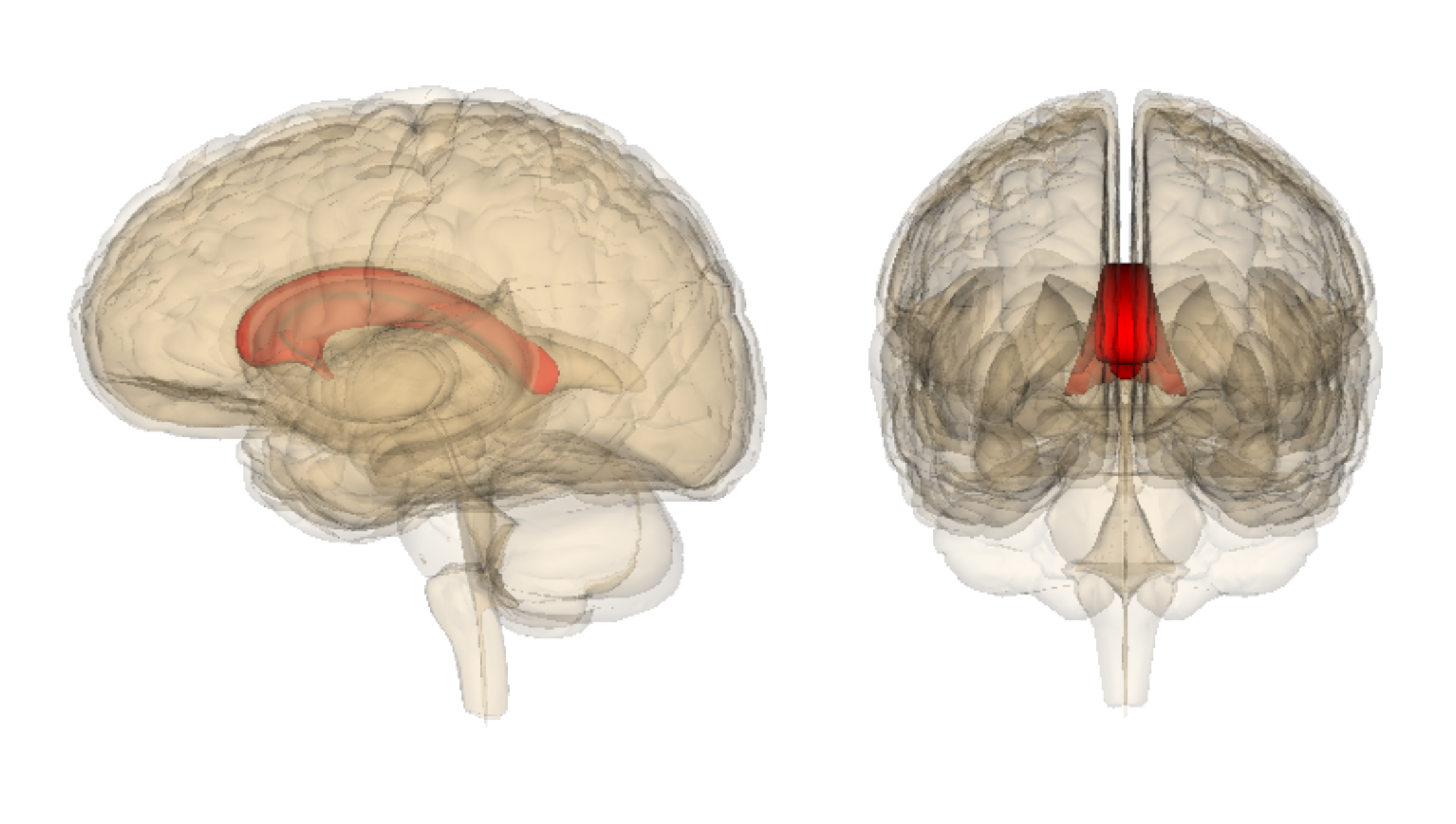
Because the right hemisphere is unable to communicate verbally, subjects were unable to tell researchers which image had flashed on the left side of the screen. However, if asked to pick out the pictured object from the table, the left hand (controlled by the right hemisphere!) was able to do so with ease. Keep in mind that this is despite patients insisting that they had not seen a picture of the object which their left hands were holding. In some sense, they were correct. The left hemisphere, which controls speech, had not seen the object – only the right hemisphere had, and was unable to communicate this to the left hemisphere due to the severing of the corpus callosum, the body of fibers which joins both sides of the brain.
When the phrase “key case” was shown to the subjects, “key” on the left side of the screen, “case” on the right, the subject might guess that the experimenters were referring to a case of beer, though the left hands would pick up a key.
Even though the right side of the brain is unable to vocalize anything, it nevertheless appears to be quite distinctly human. For instance, if prompted to pick up silverware, the left hand might grasp for a fork, whereas the person would say that they are holding a knife, spoon, or fork with equal probability. Furthermore, the right side can reason abstractly. If shown a picture of a wall clock, it can sort through materials and pick out a toy watch!
(collaged images of Ada Lovelace, the “analytical engine”, and a letter between Lovelace
and life-long friend Charles Babbage”
As a founding person of modern computer programming, Ada Lovelace worked closely with friends like Charles Babbage, Luigi Manebrea, and so on. If you’re interested in reading more about her scientific contributions, here are some helpful links: