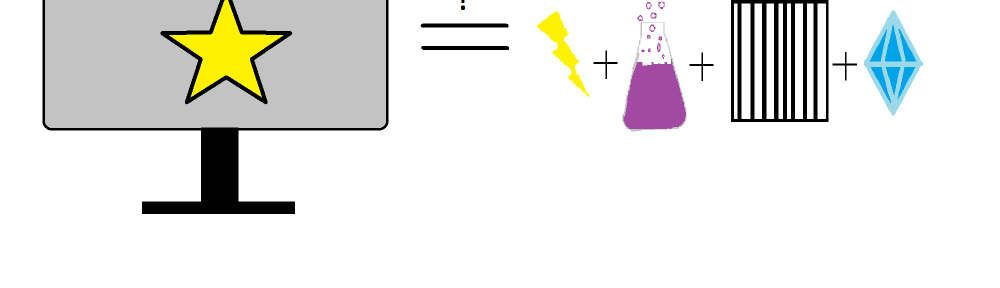
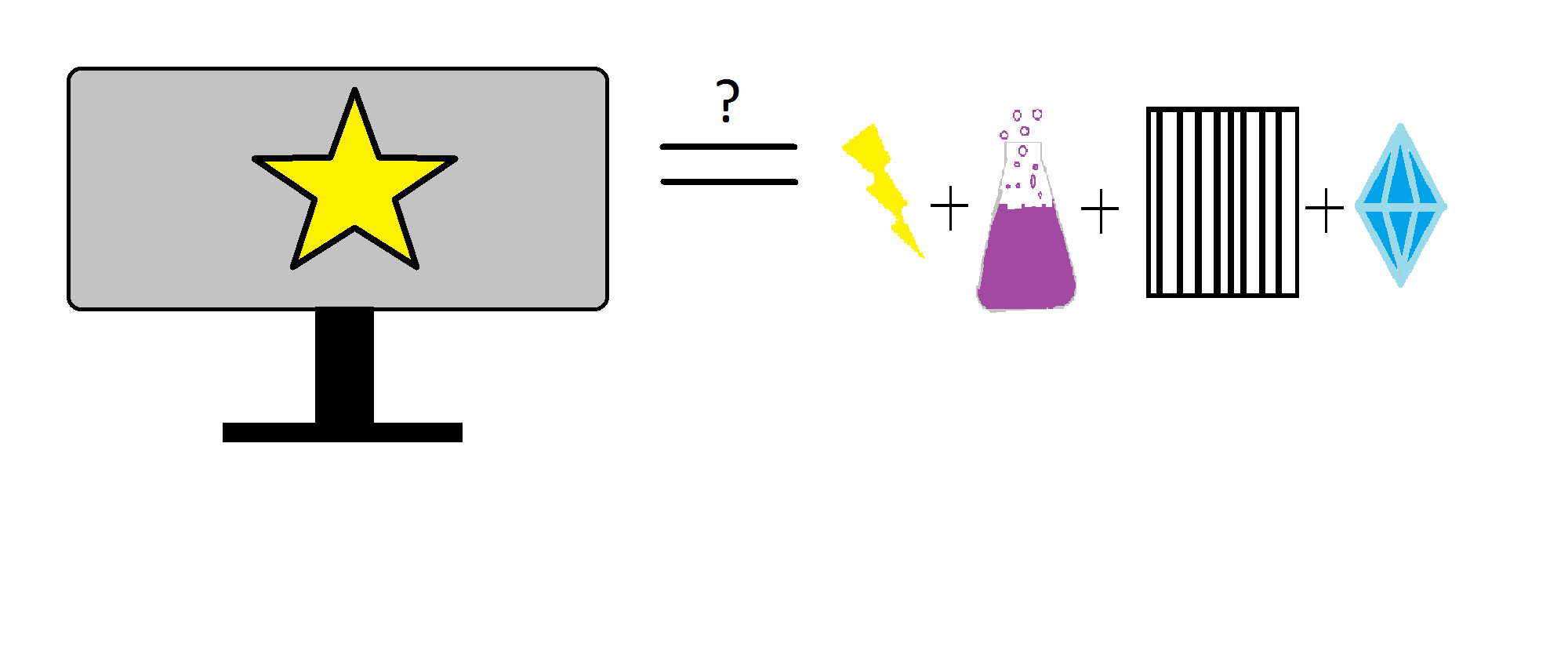
One of the most popular displays today is an LCD display. They come in televisions, computer monitors, phones, and more, but do you know that chemistry and physics are the fundamental to create these screens?
LCD stands for Liquid Crystal display and were used to replace Cathode Ray Tube displays because the CRTs were too bulky making televisions and computer monitors huge. Inside of an LCD display there are multiple layers: a thin filmed transistor, an electrode pattern, a liquid crystal and some level of polarization.
The thin filmed transistor is a very specific form of glass known as Borosilicate glass, made up of around 13% boron trioxide and around 80% silicon dioxide. Its physical properties due to its compound make up allows the glass to be more shock resistant and heat resistant than your average piece of glass. The electrode pattern uses metals like copper and titanium to transfer electrons. The polarizer mainly works with filtering light. Previously, light was just projected onto the television. Now a polarizer filters light waves by direction reducing the amount of power required to use a lit up display. It also allows for smooth picture transition. Finally the liquid crystal is used to produce the crisp look of an LCD screen. This crystal starts out as a liquid and when it comes into contact with the average atmospherics on the surface of the earth, this liquid crystallizes, like a spiders silk. It has the unique ability based on its shape and structure to show or not show various light rays. The polarizer prepares the light for this liquid crystal making its job possible.
So there you have it, now you know whats behind that magic box in your living room!
Apollo 13 is perhaps one of the most well known of the Apollo missions, though it did not start out that way. Initially there was so little public interest in the mission that there were no live television interviews with the astronauts[1]. However, by the end of the mission, the entire world was paying attention. In fact, television coverage of the Apollo 13 splashdown surpasses any televised event in history up to that point including the first lunar walk of Apollo 11[1]. Despite the many complications and difficulties the mission faced, along with the fact that the astronauts never reached the moon, Apollo 13 was in many ways one of NASA’s greatest successes.
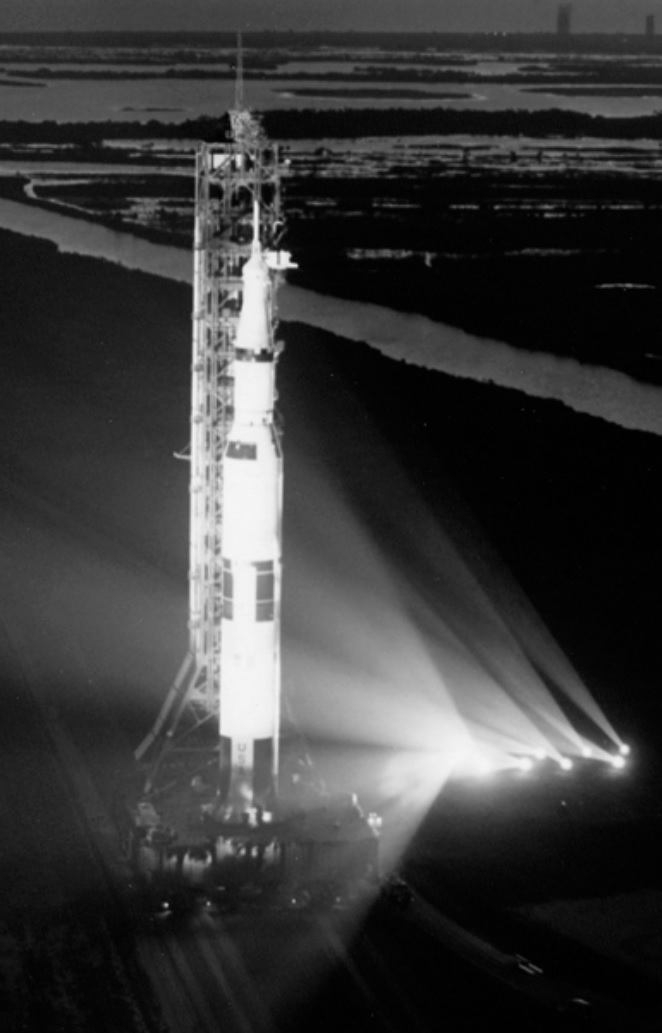
Apollo 13 launched from Kennedy Space Center on April 11, 1970 at 19:13:00 GMT (Greenwich Mean Time)[2]. The launch proceeded without any serious complications. After launch there were few noteworthy events until the accident that would effectively end the mission. At 55 hours 53 minutes ground elapsed time (GET), mission control temporarily lost all telemetry data for 1.8 seconds[2]. It was at this time that the warning system sounded and the crew heard a loud bang. Shortly after this, the crew reported that one of the cryogenic oxygen tanks was reading a pressure level of zero[6]. The oxygen tanks fed fuel cells which provided electrical power, generated oxygen for breathing, and produced water for the crew[6]. It soon became apparent that one of the oxygen tanks and three fuel cells, which powered the life support and other systems, had been lost[4]. The loss of this system was so severe that it quickly became evident that the new goal of the mission would no longer be to reach the moon, but instead simply to return the crew to earth alive[6].
After the accident the command module quickly began losing life support capabilities. In order the survive the rest of the mission, it was necessary for the crew to use the lunar module as a life boat of sorts[2]. The command module, which had been designed to be the major source of life support for the entire trip, only had 15 minutes of power left in its batteries while the crew was still three days from home. Without the fuel cells, the command module had no means of recharging its batteries, and the only source of power available were the batteries on the lunar module[3, 7]. At 58:40 GET the crew had powered up the lunar module, transferred the guidance system to the lunar module, and powered down the command module[2].
Having solved the first problem of providing immediate life support for the crew, the next issue that needed to be addressed was the crew’s trajectory. Earlier in the mission, the crew had performed a maneuver to lower the spacecraft’s approach to the moon[2]. Before this maneuver, the crew had been on a direct return to earth, but now the crew would miss earth entirely if they did not fire the retrorockets on the service module and jettison the lunar module[4]. Firing the retrorocket would be extremely dangerous without knowing the full extent of the damage, and releasing the lunar module was not an option as it was their only source of life support at the time. Another problem that the crew faced was that they were unable to determine their alignment due to the fact that the the lunar module was not meant to be used for calculating alignment and because debris still floating around the ship made it difficult to determine which stars were debri and which were real[6]. Without being able to determine their alignment, NASA could not determine the exact direction and burn time necessary to return them to a safe trajectory. The decision that was ultimately reached was to use the lunar module’s descent engine to put the crew back on a free return trajectory which would land them in the Indian ocean without any further corrections[4]. Another correction was planned for two hours after passing the moon. This second maneuver would get them back to earth faster and adjust their trajectory to land in the Pacific were the main recovery forces were stationed[2]. In order to solve the problem with alignment NASA figured out a way to determine alignment using the earth, moon, and sun through a telescope on the lunar module[6]. A procedure which had never been done or tested before. Both of the corrections were completed without incident and the crew only needed to make two small midcourse corrections to stay on the intended trajectory[4].
Having solved the crew’s immediate problems NASA now had to figure out how to stretch the crew’s resources to last the length of the mission. The most important consumables were water to cool the lunar and command module systems, drinking water, breathing oxygen, lithium hydroxide cartridges which were used to remove carbon dioxide from the air, and power stored in the lunar and service module batteries[2]. While it appeared all of these supplies were critically low immediately following the accident, the engineers at NASA managed to stretch them enough that by the time the crew landed there were several hours of each consumable left[2]. Oxygen for breathing and water for drinking were simply taken from the stores on the command module. Most of the rest of the consumables were saved by not using power in the lunar and command modules when not performing a maneuver, except those that were necessary; life support, communications, and telemetry[6]. This extended the crew’s recourses past what they needed including providing enough energy to recharge the command module’s batteries which were required for re-entry[6]. While the power down conserved necessary resources it came at a price. The temperature in the cabin was only 38oF and having no hot water to rehydrate the crew’s meals meant that all their food was also cold[6].
Having ensured that the rest of the consumables would last at least the length of the mission, the next step was to find a solution for the lithium hydroxide cartridges. These cartridges filtered carbon dioxide through them to remove it from the atmosphere and prevent the crew from suffocating. There were not enough cartridges in the lunar module to last the length of the mission and the modules from the command module did not fit the filter in the lunar module[6]. NASA eventually figured out a way to build an adapter for the cartridges using nothing but materials the crew had at hand. Mission control read the instructions up to the crew and the crew assembled the adapter out of cue cards, plastic bags, and tape[6].
The crew turned the systems in the lunar module on three hours ahead of schedule, in order to warm up before the arduous task of preparing for reentry[6]. Before the crew had to detach the lunar module. The crew climbed out of the lunar module and into the now fully powered command module. Since the command module had no thrusters to control push or pull, the crew simply fired pyrotechnics to detach the lunar module and let escaping pressure propel it away from the command module[6]. The crew watched as the lunar module, the lifeboat that had saved their lives, drifted off. Not designed for reentry, the module burned up in the atmosphere as it fell to earth, though some of the pieces survived and landed in open sea near Samoa and New Zealand[2].
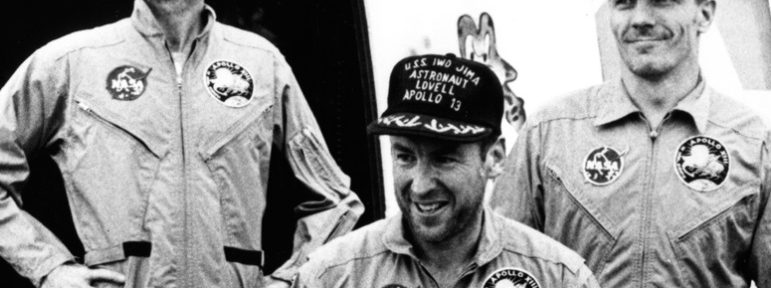
The command module entered earth’s atmosphere 142 hours and 40 minutes into the mission with a velocity of 36,210.6 ft/s[2]. Mission control lost communication with the crew for roughly three minutes due to the incredible friction generated from re-entry, which interfered with their signal[6]. The command module had three large parachutes which slowed the crew down so they splashed down at safe speeds[6]. This system worked without any problem and on April 17 at 6:07:41 GMT the crew splashed down only about 3.5 nautical miles from the recovery ship, the USS Iwo Jima[2]. The crew was in good condition on board the USS Iwo Jima within 45 minutes of splashdown[4].
References
[1] J. Kauffman, “A successful failure: NASA’s crisis communications regarding Apollo 13,” Public Relat. Rev., vol. 27, no. 4, pp. 437–448, 2001.
[2] R. Orloff and D. Harland, “Apollo 13: The seventh manned mission: in-flight abort 11–17 April 1970,” in Apollo, Springer New York, 2006, pp. 361–392.
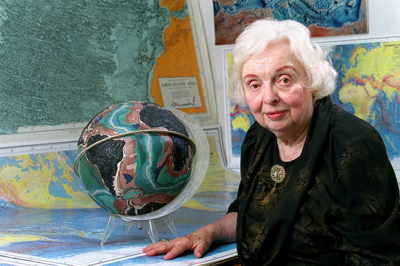
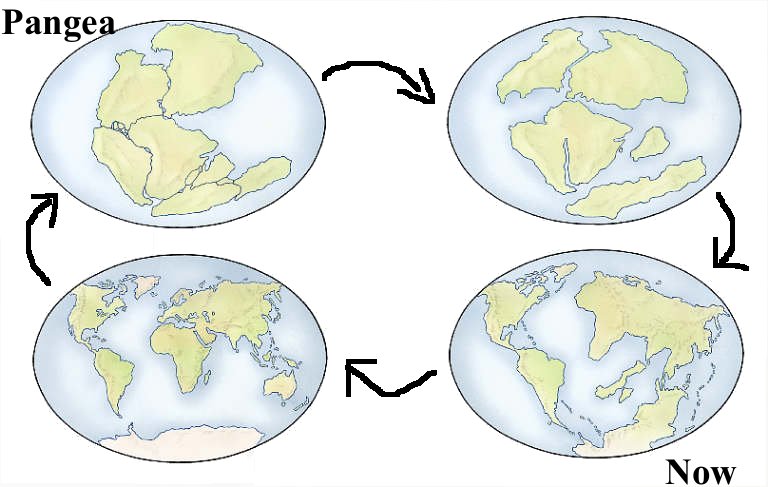
You’ve all heard about the theory of continental drift, right? You’ve heard of Pangaea and how the tectonic plates move around? This is something I remember learning about in elementary school and have always thought of as a theory that has been accepted universally for hundreds of years or so. When we look at world maps, it’s so obvious that the continents would fit together like a puzzle. I recently learned on a visit to Columbia University about the work of Marie Tharp, a woman who worked at the university and made breakthrough ocean floor mapping discoveries that started this theory.
A simple model of the supercontinent Pangaea turning into the 7 continents we have today via continental drift
Marie’s map wasn’t published until 1959. This was one year after my father was born. He was born into a world that didn’t know about tectonic plate movement or that the seven continents used to be one big continent. To me that’s like being born into a world where most people still think the Earth is flat. In addition to Marie’s work dramatically improving human knowledge of the Earth, her work was impressive because she did it during a time that belittled any ground breaking work done by a female. Whether people realize it or not, she drastically changed the way we understand the Earth and the way people look at the work of females.
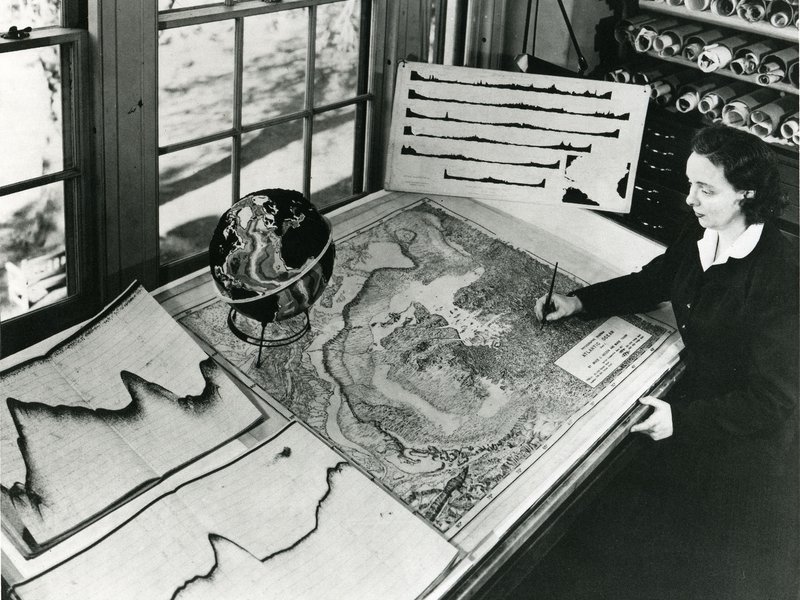
As a female researcher who wants to get my PhD and spend the rest of my life studying the Earth, I find it hard at times just to motivate myself to keep going down this path of endless studying, reading, and working. I realize my struggles are trivial compared to Marie’s. She conducted great science all while battling sexism. Before 1970, women made up less than 4% of all doctorate earth scientists, as they were discouraged from studying geoscience. Despite society telling her to pursue other work, Marie did what she could to contribute to geoscience. She worked as a drafter at Columbia University. Because she was not allowed on the ships that were gathering data in the field, she stayed in New York where the men would send the data they were collecting from the ship. The men on the ship, which set sail in 1953, were collecting sonar data to determine how deep the ocean floor was and to understand ocean floor topography. At the time, they assumed the ocean floor was flat because they had no data to believe otherwise.
Marie hard at work turning sonar data into a map of the ocean floor
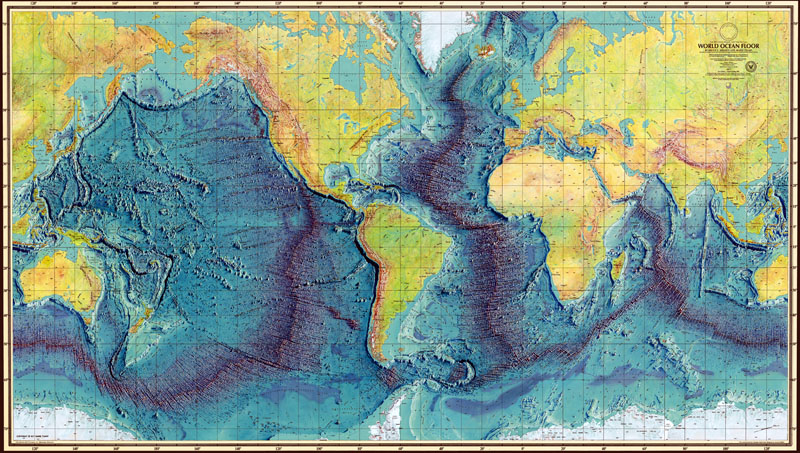
The ship spent years sailing around the world and sending data to Columbia. Marie spent just as much time back in New York crunching the numbers and turning the data into a map of the ocean floor. Because this was a time before computers, Marie mapped out each point by hand. Her first major discovery was the giant rift valley down the bottom of the Atlantic Ocean–what is now called the mid-Atlantic ridge. This had never been previously discovered but is now known as the fault line where the Eurasian and North American tectonic plates are pulling apart. As she continued to draw out the data, she saw more of these large topographic features on the ocean floor. When Marie completed the map, she showed it to the men that were on the ship and they dismissed the theory of continental drift as “girl talk” and refused to believe that she analyzed the data correctly. A few decades earlier, Alfred Wegener proposed the idea of continental drift but it was largely rejected due to lack of sufficient data. Even now, with a map of ocean topography showing robust evidence for continental drift, the theory was still rejected because the evidence was proposed by a woman.
Marie was forced to check and recheck her work for months due to their pessimism of the quality of her work. It was not until over a year later that people started to accept her map and her theory, when seismic data was collected at the bottom of the Atlantic Ocean supporting her map of the mid-Atlantic ridge. By 1959, the map was widely accepted and published. However even when her map was accepted, she was largely cheated out of credit for her work. The collectors of the sonar data were the primary owners of the map, with Marie receiving partial credit for her years and years of analysis and mapping. Not only did she solely calculate and draft the topographic data, but she was responsible for igniting the acceptance of the theory of continental drift. She revolutionized the way we see the Earth today, yet received minimal credit, pay, and status in the scientific community.
Only within the last few decades has Tharp been credited for her significant contributions to geological sciences. Her name is now the primary author on most ocean bathymetry maps, as it should be. These maps are seen all over the world and are used to understand tectonic plate dynamics, predict earthquakes, and so much more, to better understand both the past and future of our beloved planet Earth.
The final published version of a Marie Tharp ocean bathymetry map
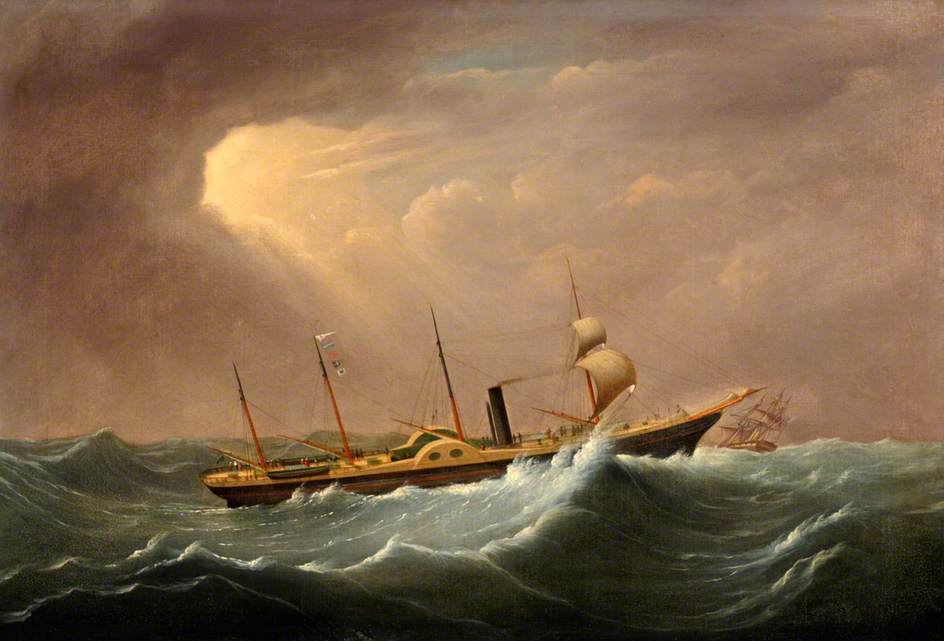
Isambard Kingdom Brunel was fascinated with the idea of building steam driven metal ships that could travel across oceans. He calculated that though the volume a ship could carry was cubically proportional to its dimension, the drag it experienced was only squared. This meant that the larger a ship was, the more fuel efficient it would be proportionately speaking. Brunel put his theories into practice with the construction of the Great Western (1836), the longest steam ship at the time, powered by the common day technology of paddlewheels and sails. Brunel’s ship was in a race with the Sirius to make the first transatlantic trip on steam power alone. Unfortunately, a fire in which Isambard was injured, delayed the ship’s departure. Although the Great Western left port four days after the Sirius, she arrived in New York only one day behind and, unlike the Sirius which had to burn furniture, rope, and spars as fuel, the Great Western still had a third of her coal left over.
The SS Great Western by Joseph Walter
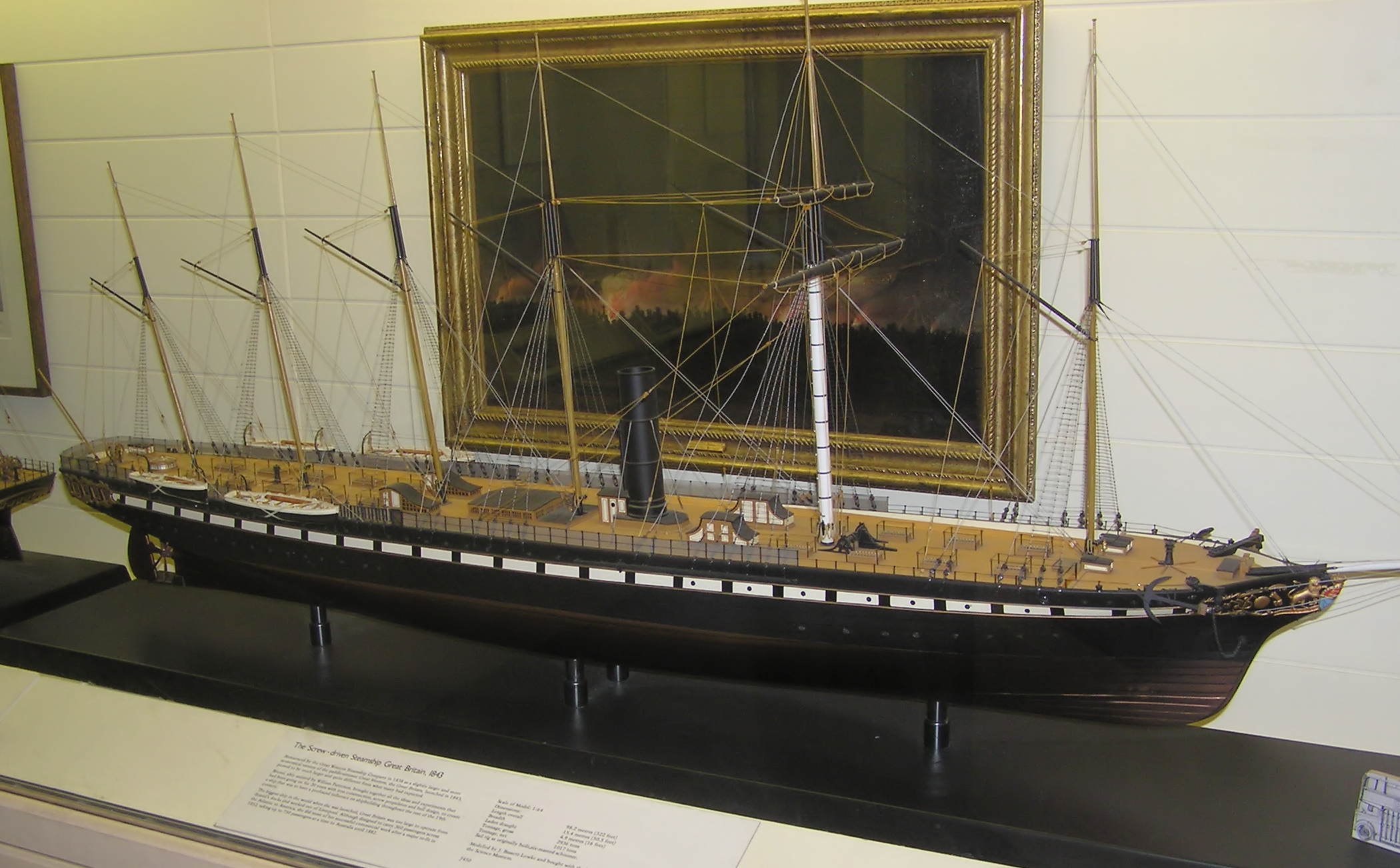
Brunel’s theories on the size of ships had been proven correct, and he proceeded to build the Great Britain (1843), the largest ship in the world, which was also not only one of the first screw propeller driven ships, but also had an iron hull. For combining these two technologies, it was considered the first modern ship.
Model of the SS Great Britain
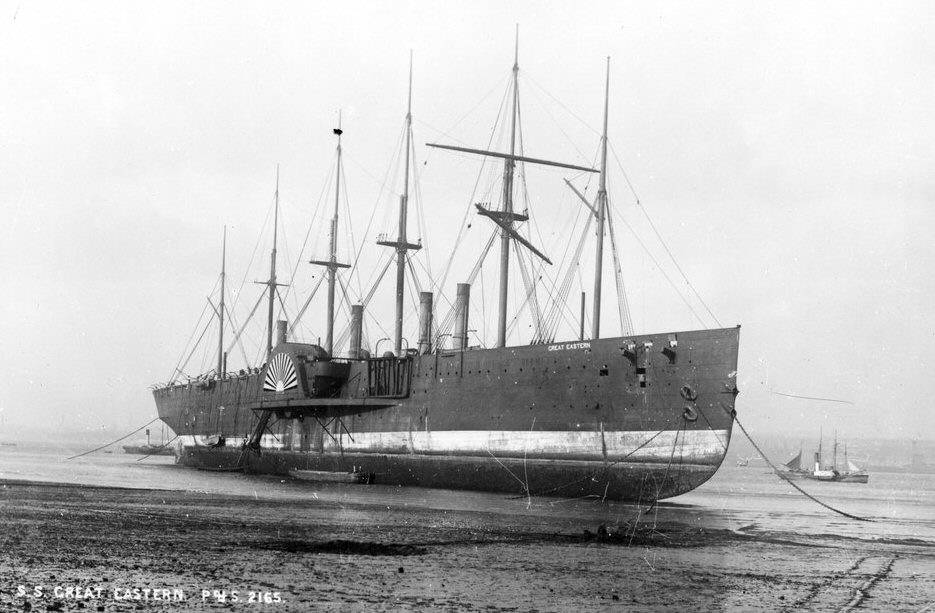
Finally, Brunel built the Great Eastern (1858), nearly three times the length of the Great Western and was propelled by sails, paddle wheels, and a screw propeller. All three of these ships again gave testimony to Brunel’s genius and vision at combining and applying the technology of the day through a variety of means to bring England roaring into the modern era.
The SS Great Eastern by Allan Green
So why have I spent three post giving you a history lesson about a man who you’ve probably never heard of? In the early 2000s the BBC had a competition where they asked their public to vote for who they thought the ten greatest Britons were and they then did a one hour segment on each of them. Many recognizable names such as Newton, Shakespeare, Queen Victoria, and Churchill make the list, but Brunel who actually won second place behind Churchill is an unknown figure in America. This oversight is slightly shameful as Brunel is practically the founder of modern England and therefore by extension, America. His vision, courageously enterprising nature, and inexhaustible energy made him not only the leader, but the epitome, of the industrial revolution. Men like Brunel took on projects and works with the help of machines that had never before been tried. He had the incredible audacity to fly in the face of the limitations that man had contended with for centuries. Men like Brunel, through the industrial revolution, dramatically improved the quality of life for the average citizen. It is no wonder then that with Isambard’s resume of accomplishments and legacy that he is not only considered the greatest British engineer who ever lived but also the second greatest Briton in history.
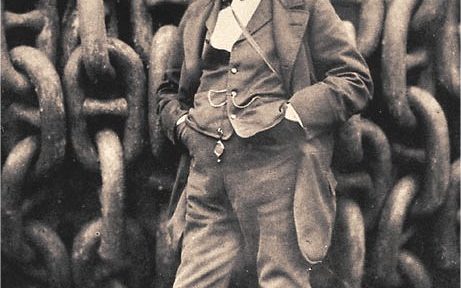
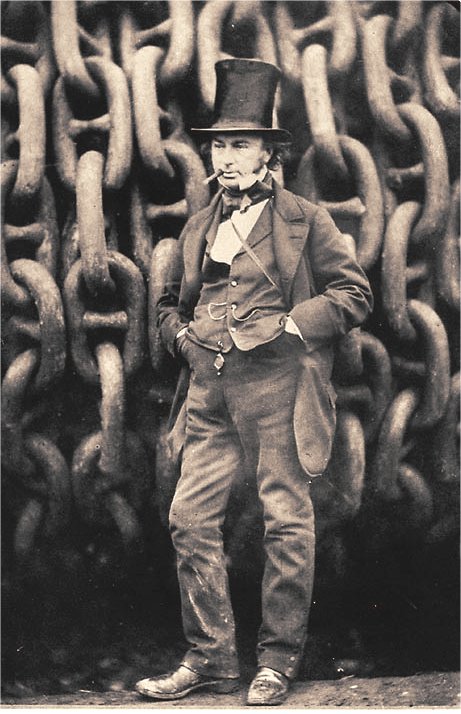
Brunel at the launching of the Great Eastern by Robert Howlett
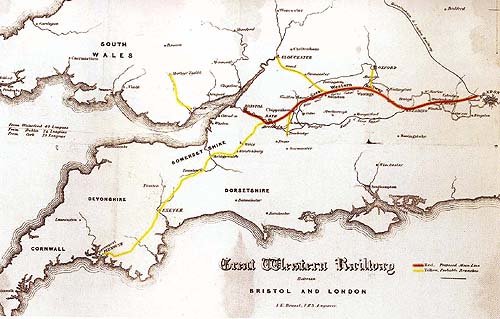
After living in Bristol for a time, Isambard went on to work on constructing The Great Western Railway (GWR) which would connect Bristol and the south west of England with London. At the young age of twenty seven in 1833 he began his work. Isambard was a great visionary who saw potential on a grand scale. He didn’t just want to build a railway. He wanted to build the fastest and smoothest railway in England.
To accomplish this he tackled a couple of controversial issues. He decided to use a broad gauge (the width of the track) of seven feet. This was counter to common practice of using the regular gauge which was thinner. This broad gauge would allow for trains with larger wheels where the carriage sat between them instead of on top, lowering the center of mass. The goal of all of this was to allow much faster travel and at the same time a smoother, more comfortable ride. Secondly he surveyed a route for the railway that would almost never change elevation. By doing this, the train would maintain the same speed for most of its journey. Once finished, This vision of excellence was England’s pride and joy and nicknamed “God’s Wonderful Railway.” Isambard’s genius was not in inventing new technologies, but in his ability to combine the resources and technology available to him and to expand society’s capabilities beyond what was thought possible. This genius was evident in the construction of the GWR.
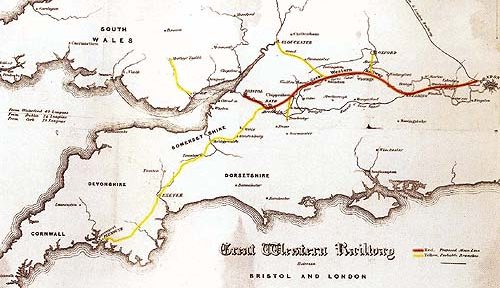
A Map of the Great Western Railway Connecting Bristol and London
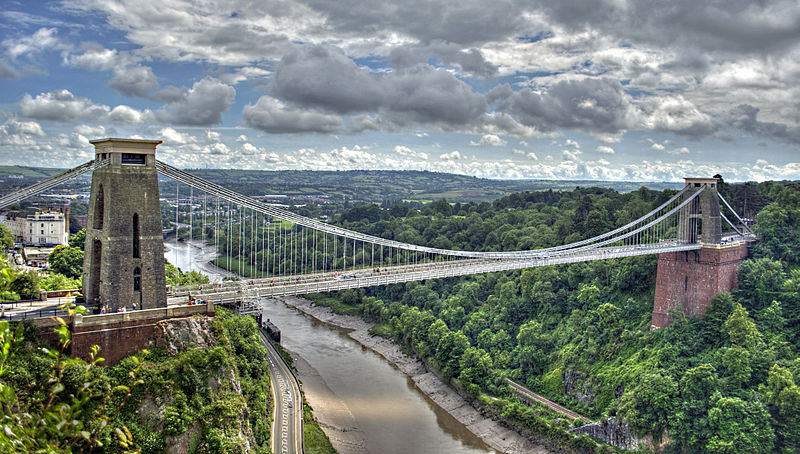
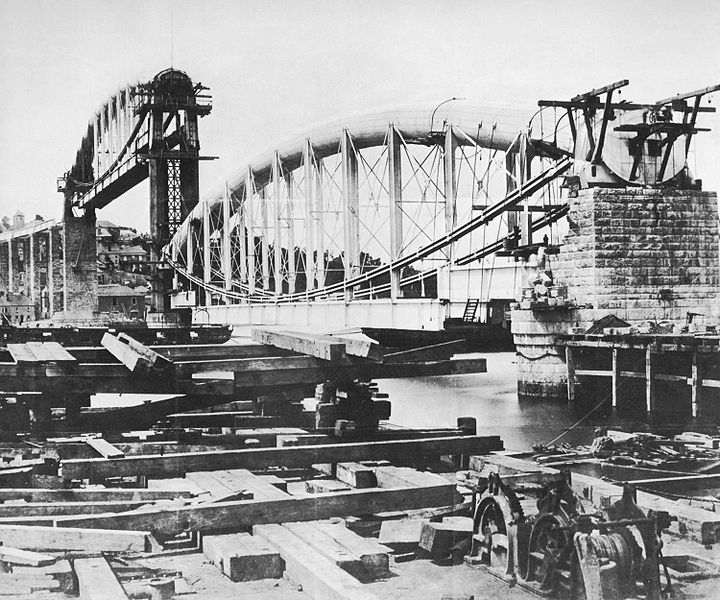
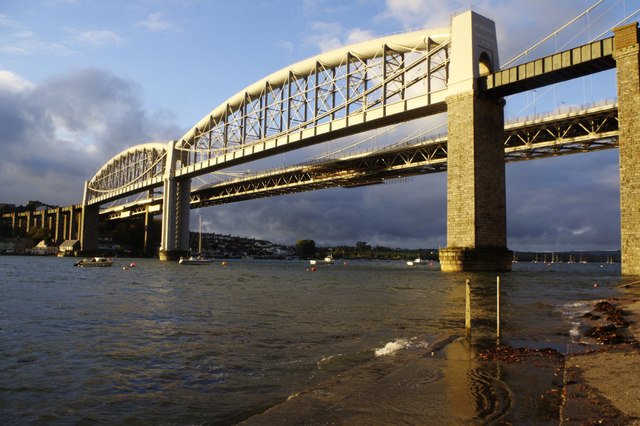
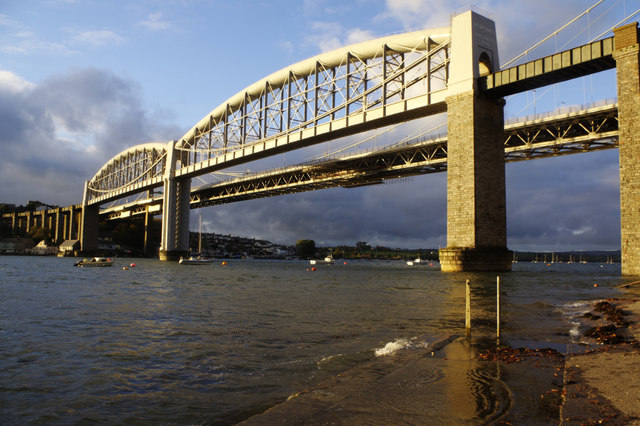
Three of I.K. Brunel’s most memorable civil engineering projects were a part of the GWR. The Royal Albert Bridge, the Maidenhead Railway Bridge and the Box Tunnel. Each of these projects show Isambard’s audacity and vision in their own way. Spanning the river Tamar, the Royal Albert Bridge was the first of Brunel’s tributes to ancient Egyptian architecture and a bold engineering project. What was unique about this wrought iron suspension bridge was that it didn’t anchor its pylons in the bank for support, like most suspension bridges still do today. Consider the Clifton bridge, another one of Brunel’s more traditional suspension bridges. Like the Golden Gate Bridge it has cables anchored on either shore supporting the pylons. The Royal Albert on the other hand, has lens shaped iron trusses (supporting framework) which keep the pylons from collapsing inward from the weight of the bridge. The Royal Albert Bridge’s elegant design still stands today as a testimony to Brunel’s vision of engineering as not just a pragmatic field of work, but an artistic one as well.
Clifton Suspension BridgeThe Royal Albert Bridge TrussThe Royal Albert Bridge
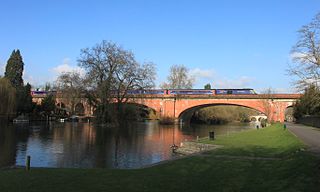
The Maidenhead Railway Bridge further exemplifies Brunel’s audacity and understanding of aesthetics. At the time, this simple but elegant little bridge had the longest spanning brick arches in the world. Many engineers laughed at the project, claiming that the arches were too long and that the bridge would collapse as soon as he took away the scaffolding. Well, it didn’t collapse and the bridge still stands there to this day, nearly two hundred years later. Again, Isambard proved his courage and strength of character in the face of adversity.
Maidenhead Railway Bridge
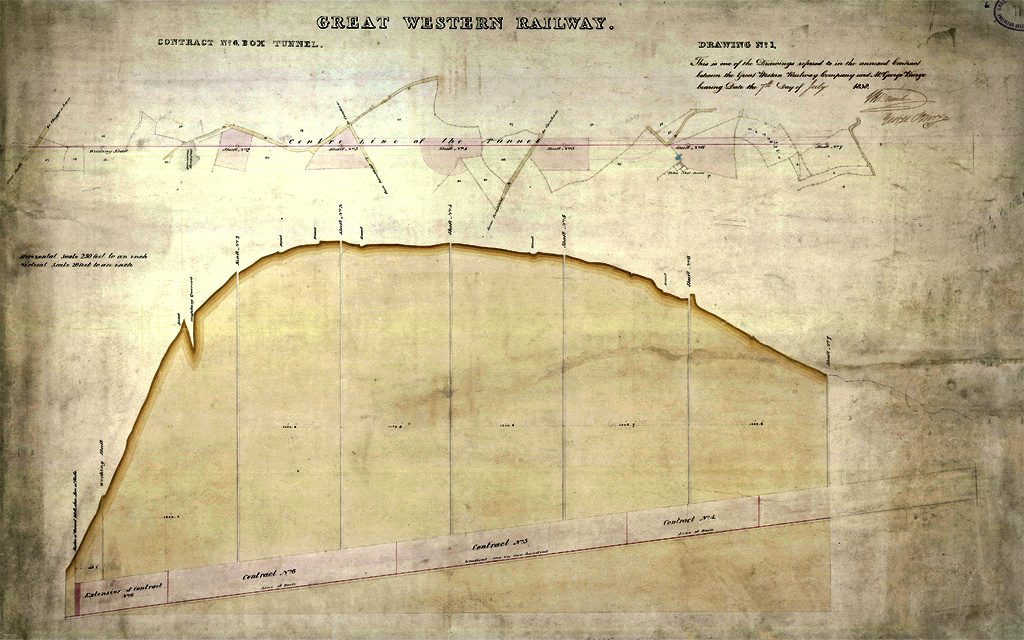
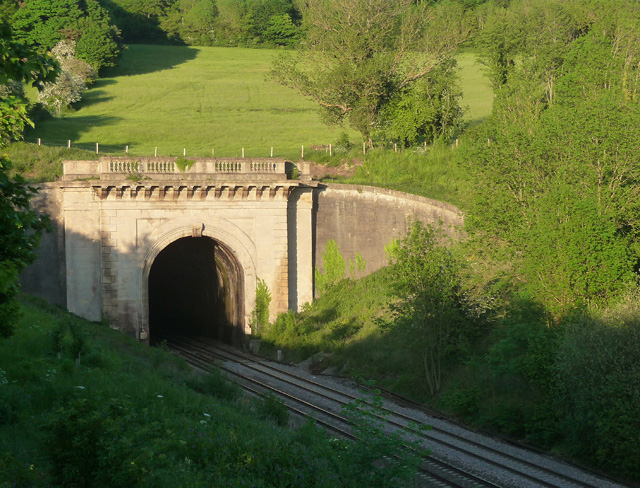
The third historic civil engineering project we will look at is the Box Tunnel. It goes under Box hill and was one of the most challenging segments of the railway. The ground they were tunneling through was composed of oolite limestone, fuller’s earth, and forest marble. The oolite was particularly difficult to tunnel through and required almost exclusively explosives. Showing wisdom far ahead of his time, Brunel contracted the job out to different teams who had previous experience with each specific forms of geology, thereby making his plans suit the ground, which was something his father always advocated. The tunnel needed no inner support against cave-ins as it was through such solid rock. Unfortunately, because of the nature of the tunneling, the loss of life due to accidents was extremely high. Even so, when the Box Tunnel was finished it was the longest tunnel in England. There is much debate as to whether Brunel built it intentionally so, but the tunnel is oriented so as to let the sun through from end to end only on his birthday. The length and difficulty of the tunnel along with the graceful entrances on either side made the Box Tunnel one of the most memorable engineering projects on GWR.
Box Tunnel PlansBox Tunnel Entrance
Any one of these three constructions would have made Brunel a memorable engineer, but that wasn’t the end. In addition to being an incredible civil engineer who worked on such world renowned projects as the Thames Tunnel and the Great Western Railway, Brunel was also interested in building ships. I will go on to discuss this monumental career shift into mechanical engineering in my next post.
Buchanan, Angus.Brunel: The Life and Times of Isambard Kingdom Brunel. London, New York: Hambledon and London, 2002. Print.
Pugsley, Alfred.The Works of Isambard Kingdom Brunel : an engineering appreciation. London ; Bristol: Institution of Civil Engineers ; University of Bristol, 1976. Print.
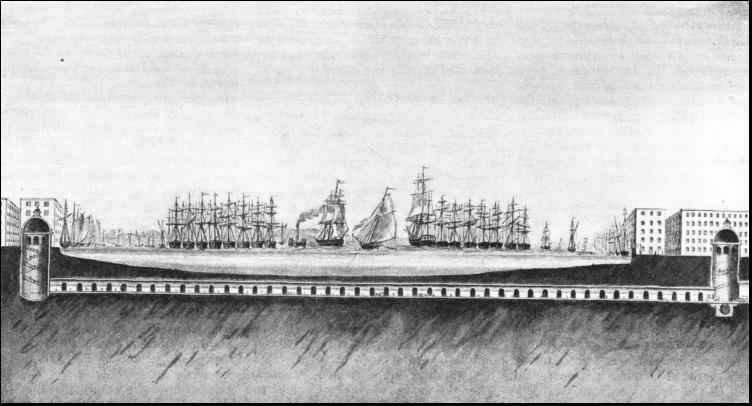
To Isambard Kingdom Brunel, January 12th, 1828 seemed like just another Saturday morning. Little did he know, it could have been his last. Brunel had only slept a mere four hours the night before, but this was typical as he had been working twenty hours a day trying to build the most daring engineering project in the world: the first-ever underwater tunnel. This tunnel under the river Thames was to be twelve hundred feet long. Brunel and the six workmen he was with that morning knew that the river had been dredged the day before and that there might have been some damage done to the river bed. As they were walking along the tunnel inspecting the walls, the water suddenly broke through the brickwork and the tunnel flooded with river water. Tragically, the six workmen were swept away to their deaths in the disaster. Unfortunately, workplace deaths such as these were much more common as they were only beginning to develop safety standards. As for Brunel, he was knocked unconscious and flushed back to the entrance of the tunnel where, waterlogged and half drowned, one of his assistants plucked him from the water. This simple act saved Brunel’s life. The twenty two year old would go on to become the greatest British engineer in history.
Cross-Section of Thames Tunnel Project
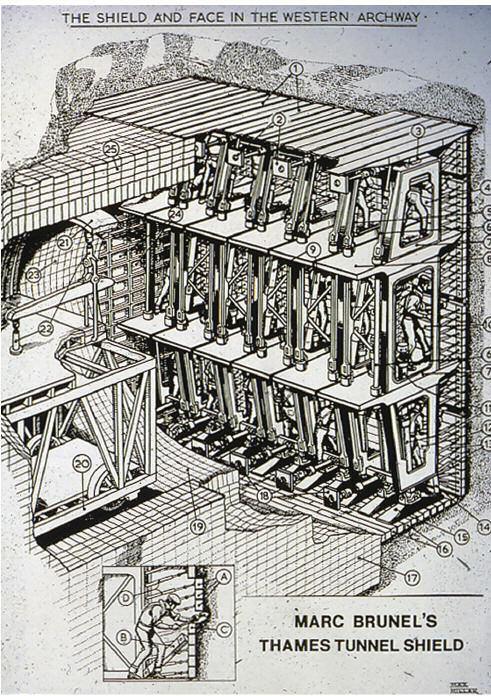
Isambard Kingdom Brunel was born to Marc Isambard Brunel, who was a well known civil engineer in his own right and patented the tunneling shield mechanism, which protected workers as they dug out individual sections. This tunneling shield’s principles are still used today. At the age of eighteen, I.K. joined his father’s company, which was building the Thames tunnel. Due to a senior engineer quitting the venture and his father’s ill health, Brunel found himself in charge of the project. The young engineer was working furiously and often at the front of the operations. The tunneling encountered many problems, particularly flooding. During one of these flooding instances, his swimming prowess enabled him to save the lives of a number of other workers.
Tunneling shield invented by Marc Brunel
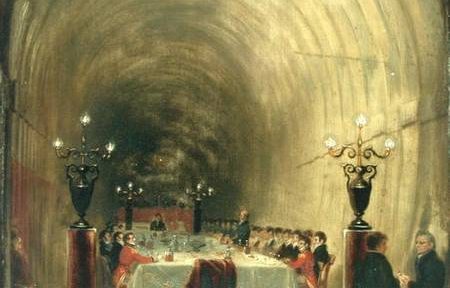
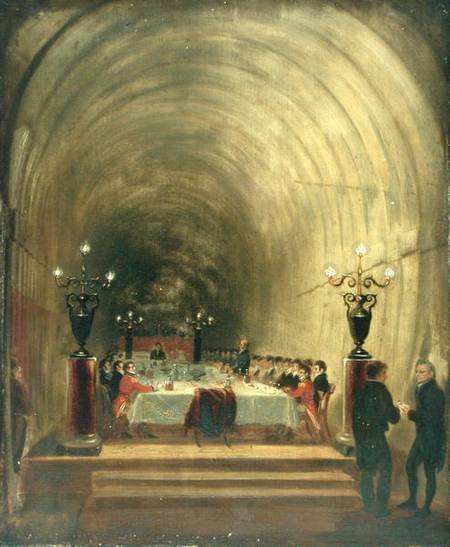
In addition to the engineering difficulties of the project, Brunel had to overcome financial setbacks as the Thames tunnel project suffered from a chronic lack of funding. He adapted and learned the social graces required to court investors. To promote and publicize the project, he turned the tunnel into a venue where he held dinner parties for curious and influential guests. After the accident on the twelfth of January 1828, Brunel spent a number of years looking for other projects and recovering from internal injuries. His time working on the tunnel, bearing such a great responsibility, had given him experience and authority when leading men.
Banquet in Thames Tunnel – George Jones
Brunel would go on to make an even greater impact on English civil and mechanical engineering by building railways, tunnels, bridges, and ships which I will continue to tell you about in subsequent posts. His determination and drive in the face of projects that had never been attempted makes Brunel the perfect example of the spirit of England during the industrial revolution. I discovered this historical engineer while I was in high school, and he instantly became one of my role models and a reason why I became interested in mechanical engineering. My hope is that you too can be inspired by this daring young man who was only 22 when he took on the Thames tunnel project, nicknamed “the eighth wonder of the world”.
Buchanan, Angus. Brunel: The Life and Times of Isambard Kingdom Brunel. London, New York: Hambledon and London, 2002. Print.
Pugsley, Alfred. The Works of Isambard Kingdom Brunel : an engineering appreciation. London ; Bristol: Institution of Civil Engineers ; University of Bristol, 1976. Print.
As a US citizen who travels internationally to conduct research, I’m well aware of the perception that gringos = $$. Sometimes that perception is true and you have money on your person or have access to it. But sometimes you simply represent wealth in some sociocultural way. Regardless of the reason, the fact is that I get robbed sometimes. Getting robbed is no fun, but it does make for some good stories.
Robbers are opportunistic, and travelers are, by definition, out of their element, so opportunities arise to rob travelers. Robberies are also about communication, i.e., “Give me your money now.” Pretty simple, huh? Well, sometimes the solution (i.e., not getting robbed) can be just as simple. If the robber doesn’t speak English and the robbee pretends not to understand the phrase “Give me your money now” then the would-be robbery is at a communications standstill. This dumb gringo trick works great, and I’ll use it as long as no weapons or physical assaults are involved. Before I developed this trick, however, I did wind up engaging a robber in a conversation in his native language.
I was out in the Neotropical boondocks very late one night alone in the rain, catching toads (it’s what I do). A guy on a horse came up behind me and startled me. Yeah, I get really focused on toads, so scenarios like this can happen; and, I don’t hear well. I assumed that I had accidentally trespassed onto his land, so I initiated the conversation of apologizing if I had done so, and promising to leave immediately if I was out of place. Turns out he did not care at all where I was, but he did want to rob me. Immediately, I was kicking myself for making the evidently poor decision a few hours earlier, to put my entire research-travel grant funds in my pocket, rather than leave them in the truck on the highway. Eventually, after a long conversation, I convinced him that my boss (who did not exist) had all of the funds back in the fancy hotel in the capital city because no one with lots of money would ever trust it to some schmuck pathetic enough to be hired to catch toads on a rainy night with all these mosquitoes around. I showed him my bag full of toads as evidence of the veracity of my story. He agreed that this made sense, and then demanded my flashlight. So, I asked him please not to take my flashlight, because then I couldn’t even do my shitty job and I’d get fired. He got off the horse, gave me a hug, and said something to the effect of, “I’m sorry for you my friend, as your lot in life is even worse than my own.” Of course he had a machete, because he was an actual cowboy, but he never raised it at me. If he’d raised that machete, he would have had a few hundred dollars instantly.
So, not all robbers are necessarily bad people. But I’ll tell you who are bad people: corrupt government officials. As robbers, they have a huge advantage and they know it. They have, ironically, the authority of law on their side, and the mere threat of being arrested during my travels is scarier than any gun I’ve had shot in my direction. These guys always have guns. They also have the mandate to set up roadblocks and stop all cars in the name of programs like the War on Drugs. For the corrupt ones, their day job is to make sure that the only people carrying drugs and weapons on that road are the people from the pre-approved local cartel. So they are not kidding when they search or grill you hard about carrying unauthorized drugs or weapons; just don’t conflate their diligence with caring about preventing drug trafficking. Once they clear you at the roadblock, they sometimes settle into robber mode. This authoritarian backdrop makes for some effective robbing. The game becomes a push-and-shove of “how little can I give them” vs. ”how much do I think this guy has on him.” To their credit, they are smart enough to realize that they have to be practical and discrete about all of this because if they just carjack you and take everything, then well it would be awkward to have you sitting there on the curb, and they have the keys to your truck, but they can’t take off with your truck until the end of their shift. These guys are not dumb thugs. They are fully aware of their advantage and thus are really impatient with any attempts you may make to stall the obvious outcome. In other words, I tried the dumb gringo trick at a roadblock exactly once. It escalated very badly, and they got all my money. Lesson learned.
The wandering toad-seeker runs into other brands of robbers as well. Gas station attendants can make a great cover for a top-class grifter. These folks have all day every day to figure out new, and often ingenious, tricks to rip off the customer. Again, they have an advantage on their side. You stopped and engaged them in this transaction, you need the gas that only they can access, and at some point you are going to give them the amount of money that they say you owe them. Add in the ever-bumpy cultural and language barrier plus, in my case, raging dyscalculia, and they definitely have the upper hand. If you do not pay them what they say you owe them, then you are stealing which is illegal (see “getting arrested” above). What are you going to do…drive off without paying? I dare you. The solution is to learn the more obvious scams and block them before they can play out.
Hookers are a complex reality. I want nothing to do with hookers, but, as a male gringo, they come to me. Remember gringo = $$ and, I usually wind up spending a lot of time politely declining the well-crafted and earnest sales pitches of hookers who assume I am rich. One night, however, the terms hookers and robbers became synonymous. After a moderate round of drinking in a large tropical city, my gringo colleague and I were walking back to our shabby hotel. He picked the route back, I argued against it because it seemed sketchy, but he won the argument. So I’m crossing the dark lonely back alley that people like me know to avoid and suddenly I am physically surrounded by three hookers who are busily putting their hands in my delicate areas and busily cramming my own hands into their delicate areas. There are eight hands involved here. My two hands are “occupied” against my will and the other six hands are occupied with violating my privacy and rifling through my pockets. Take-home advice: don’t wear baggy shorts in sketchy neighborhoods at night. It was over in seconds and they were gone. I’m not dumb, so I didn’t have my passport or watch or anything like that on me. They got my six leftover dollars that I had not spent on beer. Ok, so I got mugged or whatever, and they got six dollars. No one got physically hurt, and it was far less terrifying than the threat of getting arrested by corrupt cops. What was really terrifying was my first response to the assault: I launched into my rote spiel politely declining their sales pitch. That is how off-guard I was to the actual situation; it didn’t even occur to me to fight back, or run, or scream or anything remotely more rational than essentially saying “no, thank you.”
Afterwards, and to this day, the truth slaps me hard. I wasn’t being solicited, I was getting robbed. And whether the robber is a street thug, an official, a grifter, or a lady of the night, the victim is always the same: the hapless gringo perdido.