Apollo 13 is perhaps one of the most well known of the Apollo missions, though it did not start out that way. Initially there was so little public interest in the mission that there were no live television interviews with the astronauts[1]. However, by the end of the mission, the entire world was paying attention. In fact, television coverage of the Apollo 13 splashdown surpasses any televised event in history up to that point including the first lunar walk of Apollo 11[1]. Despite the many complications and difficulties the mission faced, along with the fact that the astronauts never reached the moon, Apollo 13 was in many ways one of NASA’s greatest successes.
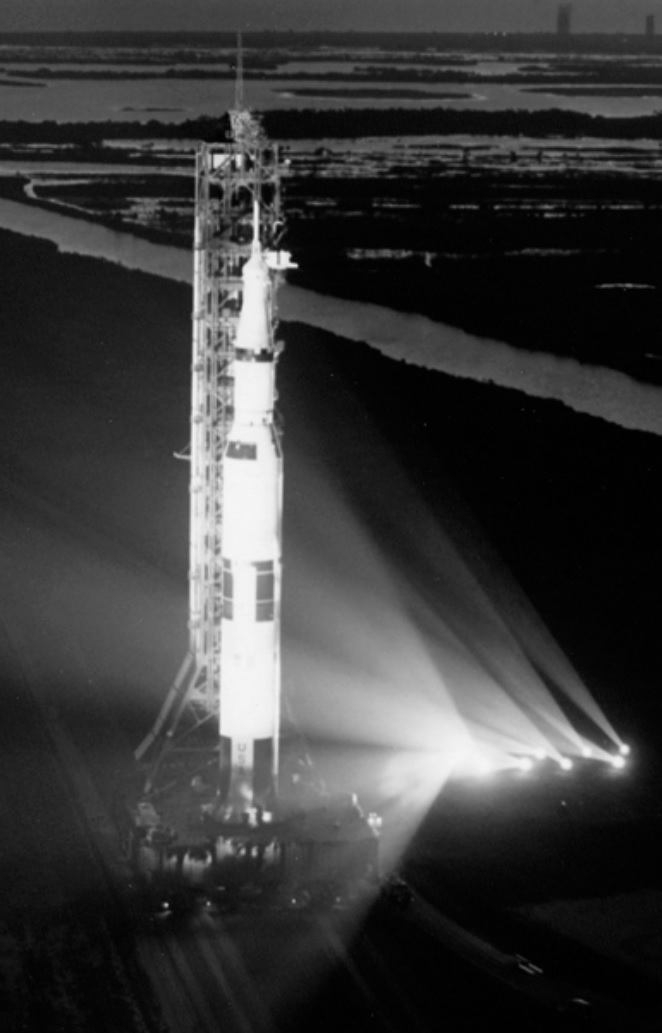
Apollo 13 launched from Kennedy Space Center on April 11, 1970 at 19:13:00 GMT (Greenwich Mean Time)[2]. The launch proceeded without any serious complications. After launch there were few noteworthy events until the accident that would effectively end the mission. At 55 hours 53 minutes ground elapsed time (GET), mission control temporarily lost all telemetry data for 1.8 seconds[2]. It was at this time that the warning system sounded and the crew heard a loud bang. Shortly after this, the crew reported that one of the cryogenic oxygen tanks was reading a pressure level of zero[6]. The oxygen tanks fed fuel cells which provided electrical power, generated oxygen for breathing, and produced water for the crew[6]. It soon became apparent that one of the oxygen tanks and three fuel cells, which powered the life support and other systems, had been lost[4]. The loss of this system was so severe that it quickly became evident that the new goal of the mission would no longer be to reach the moon, but instead simply to return the crew to earth alive[6].
After the accident the command module quickly began losing life support capabilities. In order the survive the rest of the mission, it was necessary for the crew to use the lunar module as a life boat of sorts[2]. The command module, which had been designed to be the major source of life support for the entire trip, only had 15 minutes of power left in its batteries while the crew was still three days from home. Without the fuel cells, the command module had no means of recharging its batteries, and the only source of power available were the batteries on the lunar module[3, 7]. At 58:40 GET the crew had powered up the lunar module, transferred the guidance system to the lunar module, and powered down the command module[2].
Having solved the first problem of providing immediate life support for the crew, the next issue that needed to be addressed was the crew’s trajectory. Earlier in the mission, the crew had performed a maneuver to lower the spacecraft’s approach to the moon[2]. Before this maneuver, the crew had been on a direct return to earth, but now the crew would miss earth entirely if they did not fire the retrorockets on the service module and jettison the lunar module[4]. Firing the retrorocket would be extremely dangerous without knowing the full extent of the damage, and releasing the lunar module was not an option as it was their only source of life support at the time. Another problem that the crew faced was that they were unable to determine their alignment due to the fact that the the lunar module was not meant to be used for calculating alignment and because debris still floating around the ship made it difficult to determine which stars were debri and which were real[6]. Without being able to determine their alignment, NASA could not determine the exact direction and burn time necessary to return them to a safe trajectory. The decision that was ultimately reached was to use the lunar module’s descent engine to put the crew back on a free return trajectory which would land them in the Indian ocean without any further corrections[4]. Another correction was planned for two hours after passing the moon. This second maneuver would get them back to earth faster and adjust their trajectory to land in the Pacific were the main recovery forces were stationed[2]. In order to solve the problem with alignment NASA figured out a way to determine alignment using the earth, moon, and sun through a telescope on the lunar module[6]. A procedure which had never been done or tested before. Both of the corrections were completed without incident and the crew only needed to make two small midcourse corrections to stay on the intended trajectory[4].
Having solved the crew’s immediate problems NASA now had to figure out how to stretch the crew’s resources to last the length of the mission. The most important consumables were water to cool the lunar and command module systems, drinking water, breathing oxygen, lithium hydroxide cartridges which were used to remove carbon dioxide from the air, and power stored in the lunar and service module batteries[2]. While it appeared all of these supplies were critically low immediately following the accident, the engineers at NASA managed to stretch them enough that by the time the crew landed there were several hours of each consumable left[2]. Oxygen for breathing and water for drinking were simply taken from the stores on the command module. Most of the rest of the consumables were saved by not using power in the lunar and command modules when not performing a maneuver, except those that were necessary; life support, communications, and telemetry[6]. This extended the crew’s recourses past what they needed including providing enough energy to recharge the command module’s batteries which were required for re-entry[6]. While the power down conserved necessary resources it came at a price. The temperature in the cabin was only 38oF and having no hot water to rehydrate the crew’s meals meant that all their food was also cold[6].
Having ensured that the rest of the consumables would last at least the length of the mission, the next step was to find a solution for the lithium hydroxide cartridges. These cartridges filtered carbon dioxide through them to remove it from the atmosphere and prevent the crew from suffocating. There were not enough cartridges in the lunar module to last the length of the mission and the modules from the command module did not fit the filter in the lunar module[6]. NASA eventually figured out a way to build an adapter for the cartridges using nothing but materials the crew had at hand. Mission control read the instructions up to the crew and the crew assembled the adapter out of cue cards, plastic bags, and tape[6].
The crew turned the systems in the lunar module on three hours ahead of schedule, in order to warm up before the arduous task of preparing for reentry[6]. Before the crew had to detach the lunar module. The crew climbed out of the lunar module and into the now fully powered command module. Since the command module had no thrusters to control push or pull, the crew simply fired pyrotechnics to detach the lunar module and let escaping pressure propel it away from the command module[6]. The crew watched as the lunar module, the lifeboat that had saved their lives, drifted off. Not designed for reentry, the module burned up in the atmosphere as it fell to earth, though some of the pieces survived and landed in open sea near Samoa and New Zealand[2].
The command module entered earth’s atmosphere 142 hours and 40 minutes into the mission with a velocity of 36,210.6 ft/s[2]. Mission control lost communication with the crew for roughly three minutes due to the incredible friction generated from re-entry, which interfered with their signal[6]. The command module had three large parachutes which slowed the crew down so they splashed down at safe speeds[6]. This system worked without any problem and on April 17 at 6:07:41 GMT the crew splashed down only about 3.5 nautical miles from the recovery ship, the USS Iwo Jima[2]. The crew was in good condition on board the USS Iwo Jima within 45 minutes of splashdown[4].
References
[1] J. Kauffman, “A successful failure: NASA’s crisis communications regarding Apollo 13,” Public Relat. Rev., vol. 27, no. 4, pp. 437–448, 2001.
[2] R. Orloff and D. Harland, “Apollo 13: The seventh manned mission: in-flight abort 11–17 April 1970,” in Apollo, Springer New York, 2006, pp. 361–392.
[3] “Project Apollo: A Retrospective Analysis,” NASA, 2014. [Online]. Available: https://history.nasa.gov/Apollomon/Apollo.html. [Accessed: 16-Feb-2017].
[4] S. A. Sjobe, “Mission Operations Report: Apollo 13,” Houston, Texas, 1970.
[5] “Apollo 13 seeks Age of the Moon,” Nature, vol. 226, p. 8,9, 1970.
[6] Office of Public Affairs, “Apollo 13 ‘Houston, we’ve got a problem.’”; Washington D.C.: U.S. Government Printing Office, 1970.