England’s Greatest Engineer: The Great Western Railway

After living in Bristol for a time, Isambard went on to work on constructing The Great Western Railway (GWR) which would connect Bristol and the south west of England with London.  At the young age of twenty seven in 1833 he began his work.  Isambard was a great visionary who saw potential on a grand scale.  He didn’t just want to build a railway.  He wanted to build the fastest and smoothest railway in England.   

To accomplish this he tackled a couple of controversial issues.  He decided to use a broad gauge (the width of the track) of seven feet. This was counter to common practice of using the regular gauge which was thinner. This broad gauge would allow for trains with larger wheels where the carriage sat between them instead of on top, lowering the center of mass. The goal of all of this was to allow much faster travel and at the same time a smoother, more comfortable ride.  Secondly he surveyed a route for the railway that would almost never change elevation. By doing this, the train would maintain the same speed for most of its journey. Once finished, This vision of excellence was England’s pride and joy and nicknamed “God’s Wonderful Railway.”  Isambard’s genius was not in inventing new technologies, but in his ability to combine the resources and technology available to him and to expand society’s capabilities beyond what was thought possible.  This genius was evident in the construction of the GWR.
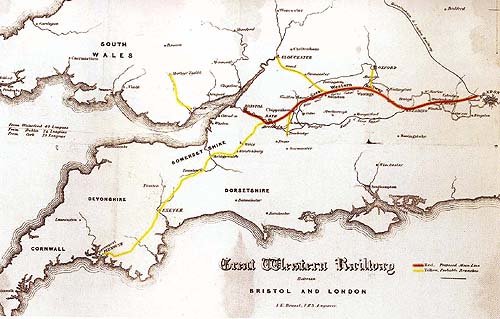
A Map of the Great Western Railway Connecting Bristol and London

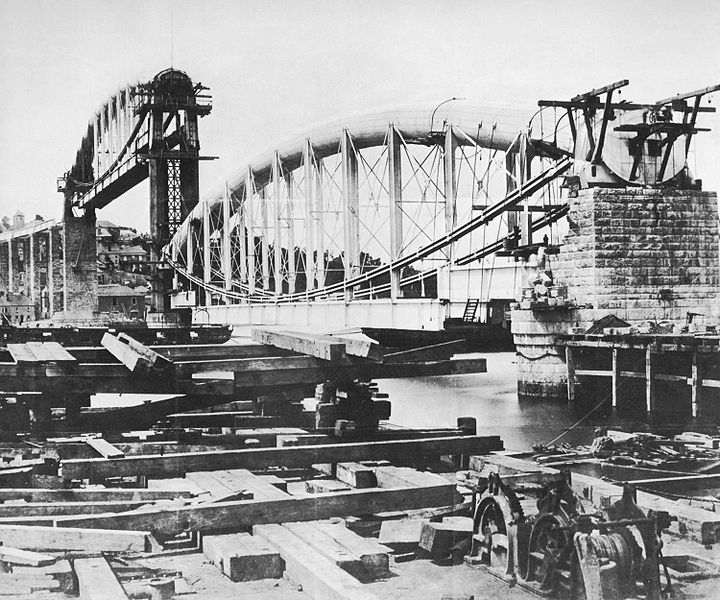
Three of I.K. Brunel’s most memorable civil engineering projects were a part of the GWR.  The Royal Albert Bridge, the Maidenhead Railway Bridge and the Box Tunnel.  Each of these projects show Isambard’s audacity and vision in their own way.  Spanning the river Tamar, the Royal Albert Bridge was the first of Brunel’s tributes to ancient Egyptian architecture and a bold engineering project.  What was unique about this wrought iron suspension bridge was that it didn’t anchor its pylons in the bank for support, like most suspension bridges still do today. Consider the Clifton bridge, another one of Brunel’s more traditional suspension bridges. Like the Golden Gate Bridge it has cables anchored on either shore supporting the pylons.  The Royal Albert on the other hand, has lens shaped iron trusses (supporting framework) which keep the pylons from collapsing inward from the weight of the bridge.  The Royal Albert Bridge’s elegant design still stands today as a testimony to Brunel’s vision of engineering as not just a pragmatic field of work, but an artistic one as well.

Clifton Suspension Bridge
The Royal Albert Bridge Truss
The Royal Albert Bridge


The Maidenhead Railway Bridge further exemplifies Brunel’s audacity and understanding of aesthetics.  At the time, this simple but elegant little bridge had the longest spanning brick arches in the world.  Many engineers laughed at the project,  claiming that the arches were too long and that the bridge would collapse as soon as he took away the scaffolding.  Well, it didn’t collapse and the bridge still stands there to this day, nearly two hundred years later.  Again, Isambard proved his courage and strength of character in the face of adversity.

Maidenhead Railway Bridge

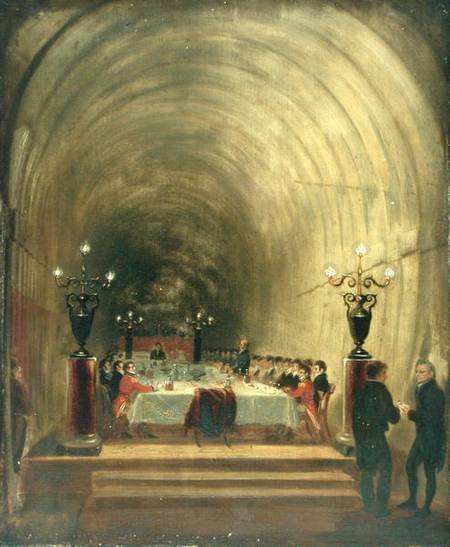
        The third historic civil engineering project we will look at is the Box Tunnel. It goes under Box hill and was one of the most challenging segments of the railway.  The ground they were tunneling through was composed of oolite limestone, fuller’s earth, and forest marble.  The oolite was particularly difficult to tunnel through and required almost exclusively explosives.  Showing wisdom far ahead of his time, Brunel contracted the job out to different teams who had previous experience with each specific forms of geology, thereby making his plans suit the ground, which was something his father always advocated.  The tunnel needed no inner support against cave-ins as it was through such solid rock.  Unfortunately, because of the nature of the tunneling, the loss of life due to accidents was extremely high. Even so, when the Box Tunnel was finished it was the longest tunnel in England.  There is much debate as to whether Brunel built it intentionally so, but the tunnel is oriented so as to let the sun through from end to end only on his birthday.  The length and difficulty of the tunnel along with the graceful entrances on either side made the Box Tunnel one of the most memorable engineering projects on GWR.
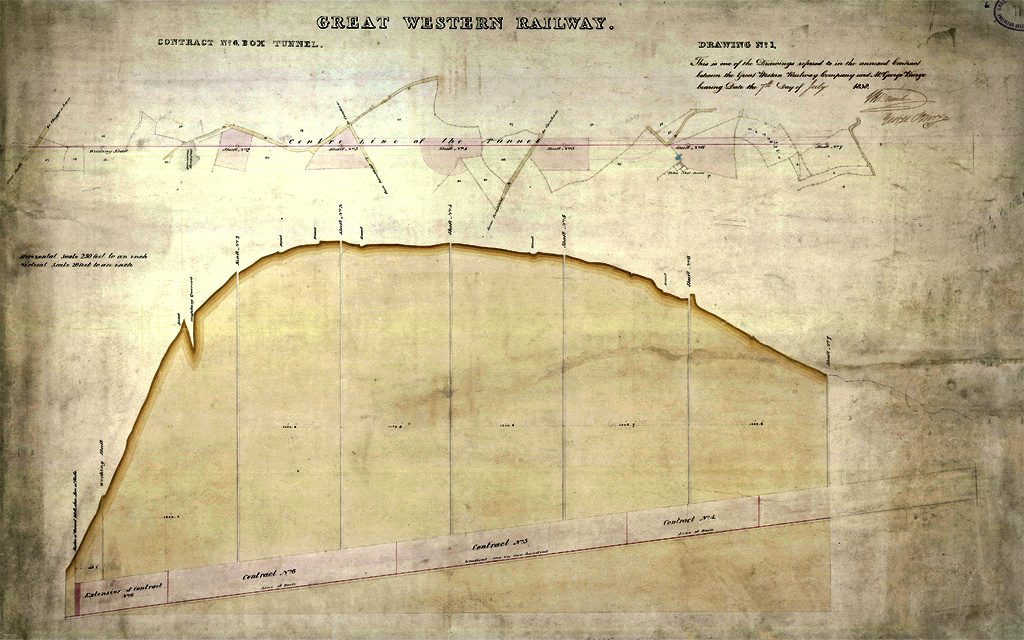

Box Tunnel Plans
Box Tunnel Plans
Box Tunnel Entrance
Box Tunnel Entrance

        Any one of these three constructions would have made Brunel a memorable engineer, but that wasn’t the end.  In addition to being an incredible civil engineer who worked on such world renowned projects as the Thames Tunnel and the Great Western Railway, Brunel was also interested in building ships. I will go on to discuss this monumental career shift into mechanical engineering in my next post.

Content Sources:

  1. Petroski, Henry. “Engineering: Isambard Kingdom Brunel.” American Scientist. 80.1 (1992): 15-19. Print.
  2. Buchanan, Angus.Brunel: The Life and Times of Isambard Kingdom Brunel. London, New York: Hambledon and London, 2002. Print.
  3. Pugsley, Alfred.The Works of Isambard Kingdom Brunel : an engineering appreciation. London ; Bristol: Institution of Civil Engineers ; University of Bristol, 1976. Print.

Image Sources:

http://www.freshford.com/bradford_trains1.htm

https://commons.wikimedia.org/wiki/File:Clifton_Suspension_Bridge_2012.jpg

https://commons.wikimedia.org/wiki/File:Royal_albert_bridge_hist.jpg

Royal Albert Bridge

https://commons.wikimedia.org/wiki/File:Maidenhead_Bridge_-_fGWR_43132.JPG

https://commons.wikimedia.org/wiki/File:Network_Rail_Virtual_Archive_Box_Tunnel.jpg

Box Tunnel, Box

Your journey starts here! Let’s talk!

ThemeRex © 2026. All rights reserved.
  Timothy Durham was convicted of rape when a test showed his DNA genotype matched the DNA recovered from the crime scene. Eye witnesses testified that Durham was in a different state at the time of the incident, but he wasn’t exonerated from his 3000 year sentence until follow up DNA analysis showed that the preliminary forensic analysis used in the trial was misinterpreted (Thomas et al.). DNA testing serves an invaluable part in our criminal justice system, but it comes with complications and bias that can lead to wrongful convictions and misinformed juries.  

Background:

Forensic genetics aims to identify the origin of a biological sample. It can be traced back to Karl Landsteiner who discovered human ABO blood groups. With blood groups, suspects could be eliminated based on their blood type. For example, if a suspect had type A blood and there was type B blood left at the scene by the perpetrator, the investigators could rule out the suspect. Unfortunately, the reverse didn’t work. If the suspect and perpetrator both had the same blood type, it can’t be concluded that the suspect was guilty. Blood identifiers evolved into 8 distinct categories which improved the ability to eliminate suspects, but could only conclude that (if the system matched) it might be the perpetrator or this person might be related to the perpetrator (Jobling and Gill). The field evolved in the 1980s with the discovery of Minisatellites, lines of repetitive DNA that don’t encode proteins. Minisatellite patterns in DNA create what we know today as the DNA fingerprint, and it has a much higher accuracy rate than previous methods (Augustyn et al.). Around the same time, a breakthrough for victims of sexual assault was discovered. In the case of assault, bodily fluids of both the victim and the assaulter can get mixed. A process called differential lysis was created which could selectively increase the concentration of sperm in a fluid sample thereby allowing for accurate DNA testing (Jobling and Gill). Forensics evolved to use single-locus probe testing after several years because of its ease of interpretation. It looked at specific minisatellites that had high variability between subjects. This was the first DNA-based method to be used in a criminal investigation. Two murder homicides from several years apart were connected using DNA evidence. The evidence was then used to exonerate an innocent man, and the guilty party was found when he tried to evade mandatory DNA testing for all men in the small town. His guilt was then reinforced when the DNA profiles matched, and he gave a confession (Jobling and Gill). Finding DNA at a crime scene doesn’t guarantee that you’ll find a murderer. There are issues with non-pure samples and limited samples that make DNA work difficult, and accreditation of facilities and new techniques and take time (Jobling and Gill).  

Subjectivity of DNA Interpretation:

In a 2009 publication, the National Academy of Science discusses the possibility for subjective influence in lab based forensics. The interpretation bias happens in complex cases where, for example, there could be a mixture of DNA. A study published in 2011 looked specifically at this issue. A gang rape happened in Georgia, and the mixture in DNA from the case was used to prosecute one suspect after another suspect took a plea bargain to testify against him. With DNA mixtures, there are three possible conclusions: suspect excluded, suspect cannot be excluded, and inconclusive. If the suspect is excluded, it means that there’s little to no possibility that his DNA is part of the sample. If the suspect cannot be excluded, it means that there’s a possibility that his DNA is part of the sample. In the trial, the DNA examiners who knew the context of the case concluded that the suspect being prosecuted could not be excluded. The 2011 study gave the DNA evidence from this case and the DNA profiles of the suspects to 17 forensic examiners. These examiners had no context of the case, and they all worked independently. Of the 17, only 1 came to the same conclusion (suspect cannot be excluded) as the examiners who knew the context of the case. Twelve of the 17 concluded that the suspect who was prosecuted and convicted had no relation to the DNA found in the sample. Not only does this show that subjectivity occurs due to the context of the case, but the 17 examiners came up with different findings based on their past experiences meaning that not all DNA analysis is objective. Some organizations like the Scientific Working Group on DNA Analysis Methods say that quantitative statistical evidence should be presented with every categorical conclusion, but the US doesn’t require this (Dror and Hampikian).

False Positives:

There are two categories that cause wrongful identification in a DNA report: coincidental matches and false positives. Coincidental matches are DNA matches between two unrelated people. The probability of these matches is about 1 to 500,000 for white individuals and about 1 to 350,000 for black individuals. This small probability of coincidental matches makes people feel confident in DNA evidence. False positives, on the other hand, are matches between DNA and test DNA that result from issues in the forensics lab. There have been multiple cases of forensics labs accidentally switching victim and suspected rapist DNA which lead to convictions that were later overturned when the lab realized the error. There are also cases of misreading or misunderstanding a sample. In a case from 1993, a man was convicted of rape because someone interpreted a mixed sample of victim and perpetrator DNA as an individual sample. The conviction was again overturned. To prevent false convictions, retesting DNA is allowed, but it’s not an efficient solution. Many people are pushing for statistical information on the probability of false positives, so that the jurors can make accurate judgements based on DNA evidence (Thomas et al.).  

Conclusion:

DNA analysis is a useful tool for the criminal justice system, but subjectivity can be an issue in forensic testing. To combat wrongful convictions, there are organizations like The Innocence Project who use DNA testing to free the innocent, but reformed forensic testing standards should be put in place to prevent subjectivity and to ensure juries are correctly informed during trials. https://www.innocenceproject.org/    

Citation:

Augustyn , Adam, et al. “DNA Finerprinting.” Encyclopedia Britannica , 26 Apr. 2018, www.britannica.com/science/DNA-fingerprinting#ref153186. Dror, Itiel E., and Greg Hampikian. “Subjectivity and Bias in Forensic DNA Mixture Interpretation.” Science & Justice, vol. 51, no. 4, 2011, pp. 204–208., doi:10.1016/j.scijus.2011.08.004. Jobling, Mark A., and Peter Gill. “Encoded Evidence: DNA in Forensic Analysis.” Nature Reviews: Genetics, vol. 5, no. 10, Oct. 2004, pp. 739–751., doi:10.1038/nrg1455. Thompson, William C, et al. “How the Probability of a False Positive Affects the Value of DNA Evidence.” Journal of Forensic Sciences, vol. 48, no. 1, Jan. 2003, pp. 1–8., doi:10.1520/jfs2001171.