Category: today i learned (til)

health, fitness, medicine, environment, ecology, how to learn tricky topics in science and math, new discoveries, news, current events

  • Reacciones Nucleares y Exploración Espacial: “Direct Fusion Drive”

    Reacciones Nucleares y Exploración Espacial: “Direct Fusion Drive”

    Se usaron los cohetes por primera vez en China en siglo XIII. Fueron tubos de bambú que se llenaron de pólvora y se fijaron a las flechas para lanzarse a sus enemigos mongoles. Setecientos años después, tubos más grandes se llenaron de hidrógeno y oxígeno líquidos, se fijaron a unas astronaves, y se lanzaron a la luna. Ahora, en el siglo XXI, vemos otra evolución, “Direct Fusion Drive,” (DFD), pero los conceptos fundamentales de cohetería que derrotaron a los mongoles en la Batalla de Kai Keng son los mismos fundamentales que nos van a lanzar a Plutón más rápidamente.

    Los Básicos de la Cohetería

    Pues, ¿cómo funcionan los cohetes? Teoréticamente, funcionan debido a la tercera ley de Newton que dice que las fuerzas ocurren en forma de pares, una acción y una reacción con magnitudes iguales, pero direcciones opuestas. Se mezclan y se queman los propelentes en una cámara de combustión. Los gases producidos van por una tobera y aceleran hacia velocidad supersónica (piensa en cómo cubrir parcialmente la boca de la manguera con el pulgar acelera la velocidad del agua). Al salir del cohete, los gases de escape de la combustión hacen una fuerza de reacción igual pero en la dirección contraria, una fuerza llamada empuje. El empuje hace volar el cohete. Ya que el cohete lleva su propio oxidante (el químico que causa combustión), no necesita oxígeno de la atmósfera para hacer combustión como un motor del coche. Por eso, es ideal para la exploración espacial.

    Cohetes Convencionales

    Desde el comienzo, los cohetes convencionales han sido propulsados por las reacciones químicas exotérmicas. Una reacción exotérmica es una reacción química que produce calor. 

    Hay 2 tipos principales de estos cohetes: cohetes de combustible sólido y cohetes de combustible líquido. En el primero, se mezclan los combustibles desde el principio y entonces se enciende la superficie de la mezcla para causar la combustión. No obstante, en el segundo, originalmente, los propelentes son separados y entonces son inyectados en la cámara donde se mezclan y se queman.

    Cómo Funciona “Direct Fusion Drive”

    Los dos métodos han enviado a incontables astronautas al espacio, pero dentro de las siguientes décadas, DFD los podría reemplazar. DFD pretende usar la potencia de sus reacciones de fusión para propulsar la astronave y generar electricidad. Imanes potentísimos están alineados para crear una forma cilíndrica. Se ubican imanes más pequeños, pero aún más potentes, en ambos cabos. En el centro de esta configuración, helio-3, un isótopo del helio que tiene 1 neutrón, reacciona con deuterio, un isótopo de hidrógeno que pesa el doble que hidrógeno común (isótopos son átomos del mismo elemento pero que tienen cantidades diferentes de neutrones). Estas reacciones y algunas reacciones extras crean una región de fusión. Plasma fresco fluye sobre la región, extrayendo energía. (Plasma es un estado de materia similar a gas, pero que contiene iones y electrones. Porque plasma contiene electrones, es un buen conductor eléctrico e influenciado fácilmente por campos electromagnéticos).

    Antenas alrededor del motor crean un campo magnético giratorio que induce una corriente eléctrica en el plasma. Los iones del plasma se calientan hasta se fusionan. Los productos de fusión salen del motor como los gases calientes de un cohete convencional, generando empuje.

    Este proceso produce un montón de calor que es usado en un ciclo Brayton para producir más de 200 kW de potencia eléctrica. Se expulsa al espacio el calor que queda.

    Una Comparación

     Cohetes convencionales tienen muchas ventajas: gran empuje y bajo costo (relativamente). Son fiables y se han usado hace siglos. Pero el tamaño compacto y la eficiencia de DFD son los que atraen el interés de los científicos. Una variable muy importante de cohetería es el impulso específico– impulso por unidad de masa de propelente o con cuánta eficiencia el cohete crea empuje. Si el impulso específico sube, el combustible necesario para el impulso deseado baja. El máximo del impulso específico de cohetes convencionales es aproximadamente 500 segundos, pero un motor de DFD cuenta con un impulso específico de 10.000 a 20.000 segundos y es tan pequeño como una camioneta.

    NASA predice que una misión de 10.000 kg con DFD podr­ía llegar a Plutón en 4 años, un tiempo más corto que los 9,5 años que tardó New Horizons propulsado por propulsión de hidracina. Además, tendría una enorme capacidad de hacer trabajo científico debido a su potencia eléctrica aumentada.

    El Futuro

    Para concluir, NASA está muy emocionada del concepto de DFD porque puede encajar en la infraestructura actual de NASA y sería una opción de fusión de radiación poca; sin embargo, todavía hay muchas mejoras que hacer. Por ejemplo, aún no se ha mostrado fusión nuclear, el concepto central. El diseño de DFD va a su segunda etapa que pretende mejorar su capacidad de protección radiológica y su proceso de caldear el plasma. Según la cronología actual, se planean vuelos para después de 2030, y en el futuro, DFD podría propulsar plataformas orbitales, viajes interplanetarios, y bases lunares y marcianas aún.


    Do you speak English? See the English translation here!

    —

    Bibliografia

    Paluszek, M., Pajer, G., Razin, Y., Slonaker, J., Cohen, S., Feder, R., … Walsh, M. (2014). (rep.). Direct Fusion Drive for a Human Mars Orbital Mission (pp. 1–9). Princeton, New Jersey: Princeton Plasma Physics Laboratory Office of Reports and Publications. 

    Princeton Satellite Systems. (2018). Technical Video of Dfd Engine. YouTube. https://www.youtube.com/watch?v=hggqvB5I95I. 

    Thomas, S. (n.d.). Direct Fusion Drive: Enabling Rapid Deep Space Propulsion. Lecture. 

    Benson, T. (2014, June 12). Brief History of Rockets. NASA. https://www.grc.nasa.gov/www/k-12/TRC/Rockets/history_of_rockets.html. 
  • Vinyl is Better than Digital Music

    Vinyl is Better than Digital Music

    Hear that music??? That, my friend, is the sound of classic vinyl…

    Meet Ernie. My vinyl player 🙂

    You know that round spinning thingy that plays music that your grandparents and/or parents used growing up? Well, good news – it’s not extinct! When it comes to enjoying music, one of the best ways that I have discovered is by using vinyl (aka: the record player).

    Compressed MP3 files and digital streaming services such as Spotify, Apple Music, Pandora, and YouTube have been the social norm for listening to music; however, vinyl sales have tremendously increased from under a million in 2007, to more than 8 million today in the U.S alone. According the British Phonographic Industry, vinyl sales hit a peak in the UK and the US in recent decades. Why? Because vinyl just is better!!

    Let’s delve into the reasons why vinyl records are superior to digital MP3.

    1) Simply put, vinyl sounds better than MP3:

    Vinyl is the only playback format readily available to consumers that is fully analog and fully lossless. That means that with a quality record player, you get to enjoy a high-fidelity listening experience. High-fidelity equates to high-quality reproduction of sound, that has inaudible background noise and distortion – giving a sound extremely similar to the original. Who wouldn’t want to listen to music that sounds as authentic as the source intended it to be?

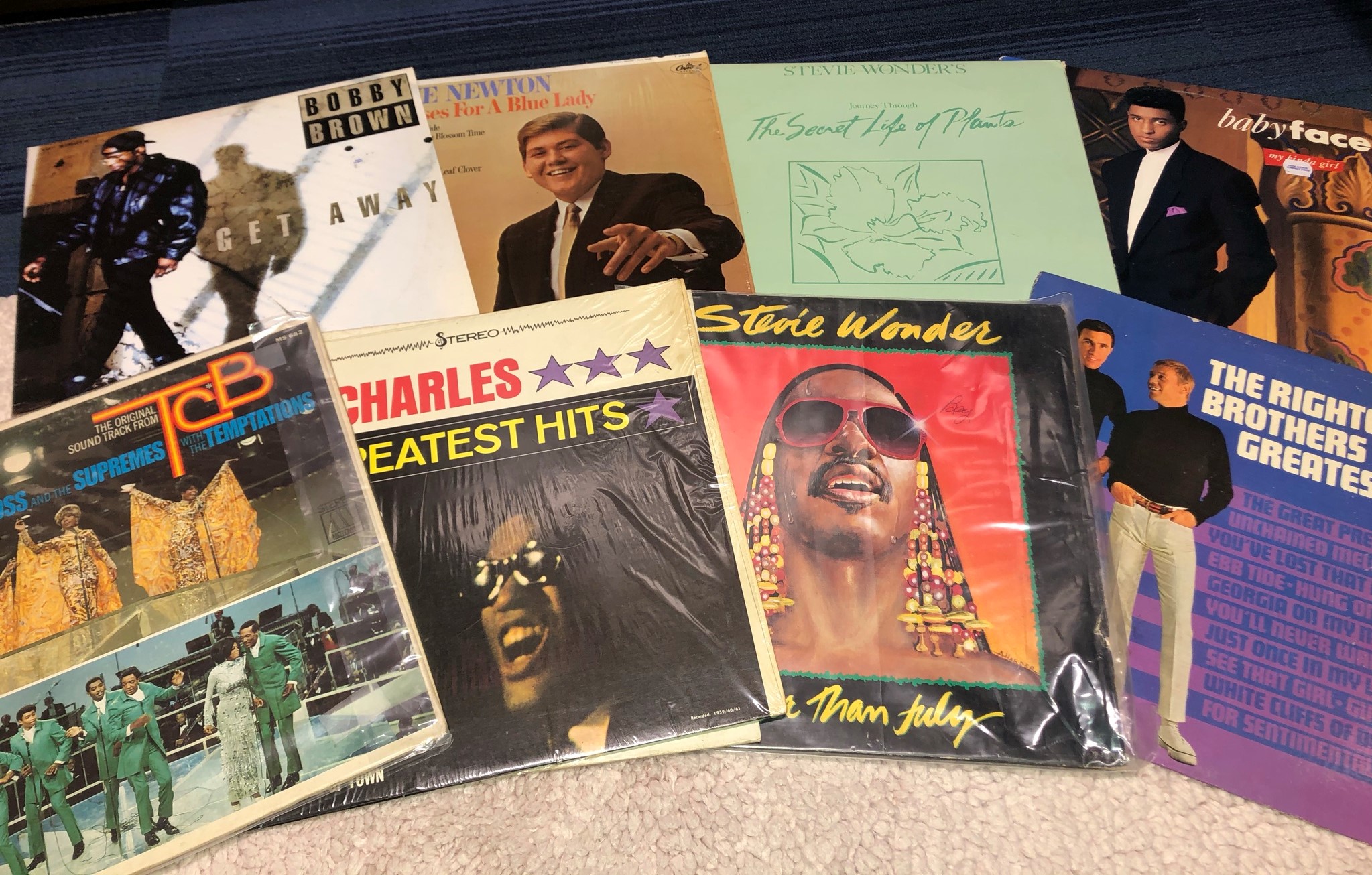
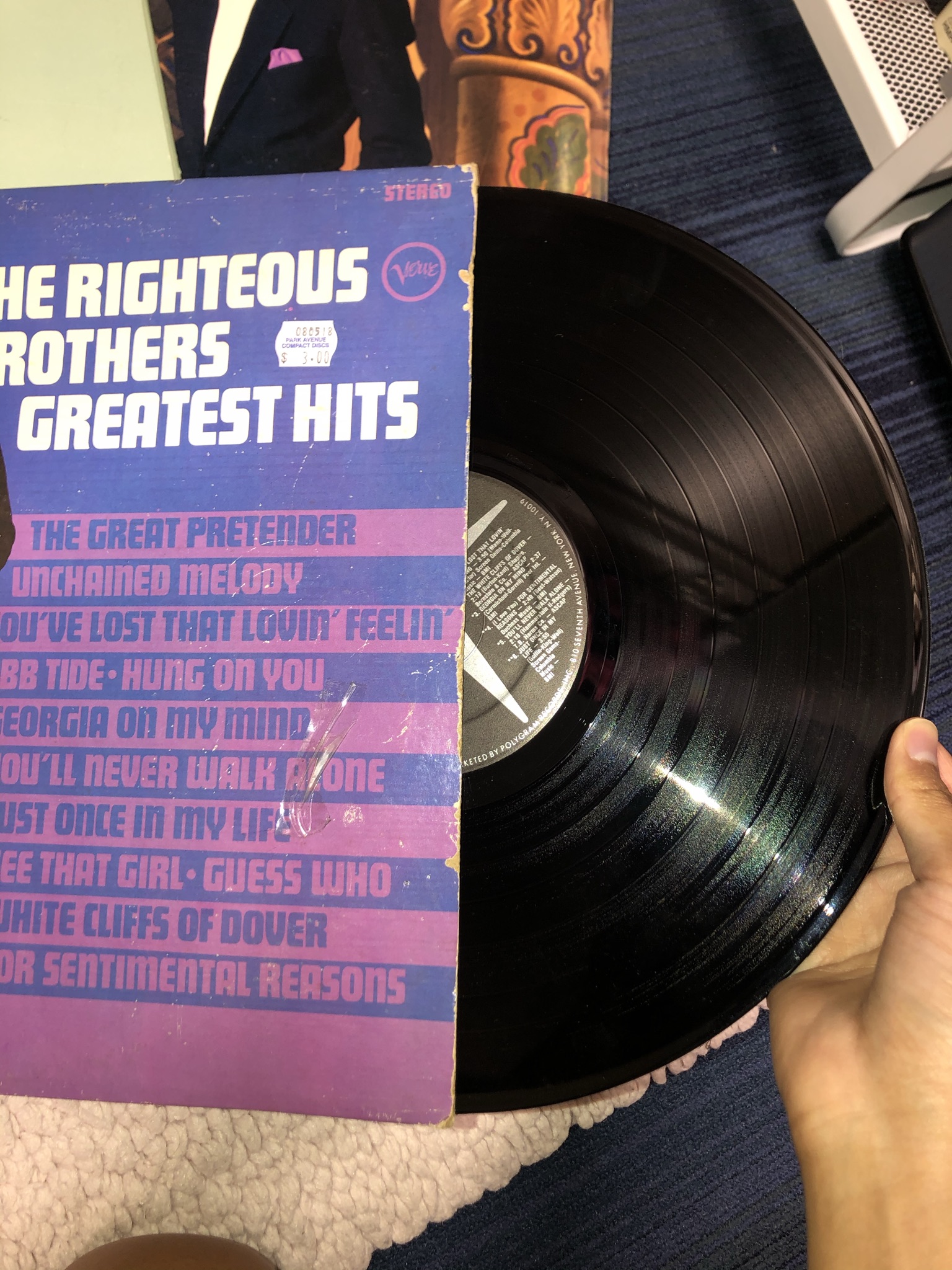
    The quality is immaculate. The song you hear playing in this article is featured above. It is a vinyl by the Righteous Brothers, with a song clip entitled “The White Cliffs of Dover” (1965).

    2) Listening to vinyl is a complete experience:

    An expanding collection of my vinyls!

    You know when you can feel the music when listening to your favorite songs? Well, with vinyl, you not only figuratively feel the music coursing through your mind and soul, but you can physically feel the music through the tangible form of the vinyl. There’s nothing like unraveling a vinyl wrapped in its cover. There’s nothing like being able to smell the music, just like the comforting smell of books in the library. With vinyl, you get to fully experience music with literally all of your senses.

    3) Going to record stores is so fun!!

    There’s nothing like the nostalgic and magical experience of entering a record store, whether it’s your first time, third time, or hundredth time! You can easily spend hours in the record store browsing, searching, and discovering music! You can mingle with other vintage audiophiles, and you can usually always get a special discount when buying vinyl in bulk! Furthermore, there is no monthly subscription to enjoy the music you want (Haha, take that Spotify and Apple Music)!

    Unraveling a shiny vinyl!

    Vinyl is an unbeatable classic that has remained relatively unchanged for the past 40 years! Since it’s creation in 1948, numerous developments and refinements within the vinyl industry have been made to perfect its technical and practical excellence. As George Plasketes, a professor of media studies and popular culture in the School of Communication and Journalism at Auburn University in Alabama, put it:

    “Vinyl is not simply a recording format, but the artefact of an age; it is an experience that embraces emotion, passion and romance”.

    Keep calm and vinyl on!

    Sources:

    Oregonian/OregonLive, David Greenwald. “Does Vinyl Really Sound Better? An Engineer Explains.” Oregonlive, 19 Nov. 2014, www.oregonlive.com/music/2014/11/does_vinyl_really_sound_better.html.

    Plasketes, George. “Romancing the Record: The Vinyl De‐Evolution and Subcultural Evolution.” Wiley Online Library, John Wiley & Sons, Ltd, 5 Mar. 2004, onlinelibrary.wiley.com/doi/abs/10.1111/j.0022-3840.1992.00109.x.

    Sarpong, David, et al. “’Vinyl Never Say Die’: The Re-Incarnation, Adoption and Diffusion of Retro-Technologies.” Technological Forecasting and Social Change, North-Holland, 29 Nov. 2015, www.sciencedirect.com/science/article/pii/S0040162515003078#bb0310.

    Zabowski, Jason. “4 Reasons Why Vinyl Is Better Than MP3.” VOX Player, 21 Nov. 2017, https://vox.rocks/blog/vinyl-is-better

  • The Birth of a Cyclops

    The Birth of a Cyclops

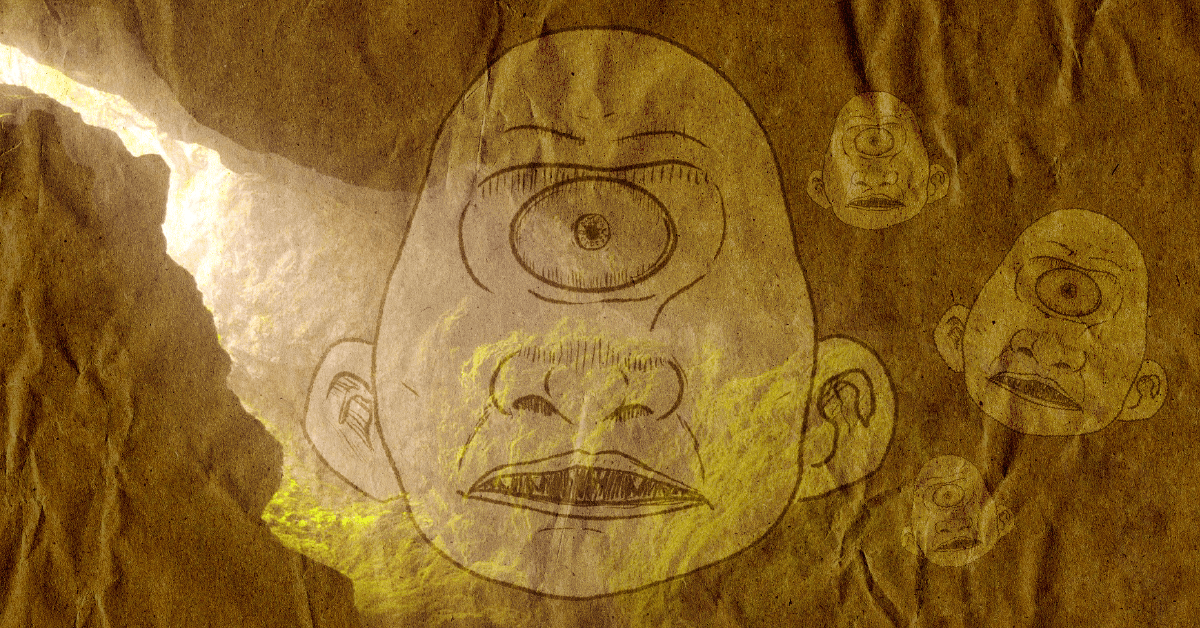
    Monstrous, one-eyed giants have prowled around our imaginations for at least 4,000 years – the oldest known description of such a creature was written on Babylonian tablets found near the Tigris river. The first stories about Cyclops emerged in Greece in the 8th–7th century BC: Homer’s epic poem Odyssey, followed by Hesiodus’ epic poem Theogonia, and later Euripides’ play Cyclops in the 5th century BC. What inspired these tales of a “horrid creature, not like a human being at all”? In 1914, the paleontologist Othenio Abel suggested that Ancient Greeks found local fossils of pygmy elephant skulls which contained a large, central nasal cavity resembling a single eye socket. You can read more about this idea in a previous Charged article!

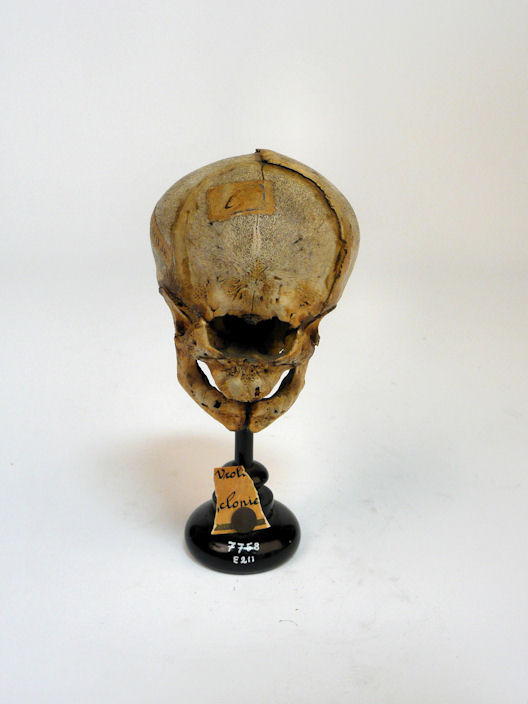
    Cyclopia specimen at Museum Vrolik via Facebook

    Descriptions of Cyclops also appear in scientific literature and records throughout history. In 1619, the Italian physician and philosopher Fortunio Liceti wrote a letter about cyclopia, a rare congenital malformation that gives the appearance of a single median eye. Cyclopia gained attention in the 18th–19th century with the rise of teratology, the study of congenital malformations. During this time, Willem Vrolik, a Dutch anatomist and pathologist, developed a collection of human and animal cyclops specimens, and the French naturalist Geoffroy Saint-Hilaire created the “cyclocephaly” classification for facial anomalies affecting the eyes. It was not until the 20th century that scientists developed a better understanding of this rare condition.

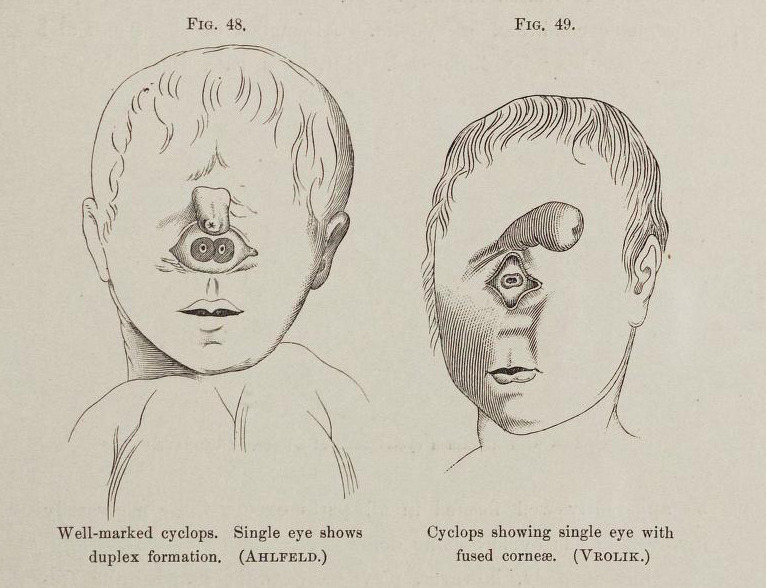
    Cyclopia fetuses via Wikipedia

    Cyclopia occurs in about 0.001% of births with an excess of females and twins. Half of these infants are stillborn due to brain development being impacted—cyclopia is a type of holoprosencephaly, a birth defect that causes the ventral brain to form incorrectly. The lack of separation between the cerebral hemispheres causes an ependymal (neural) cyst around the center of the forehead, and in some cases the two eyes fuse together. The appearance of a single median eye is exaggerated by deformed orbital bones that cause protrusions above the eye(s) and the appearance of a single nasal cavity.

    The exact cause of cyclopia remains unknown. It is likely that exposure to teratogenic environmental factors or chromosomal abnormalities contribute to this unusual and deadly congenital development. A study with mice investigated the relevance of Hedgehog (Hh) proteins which are responsible for inducing cells in the ventral brain region of the embryo. Specifically, mutations in Sonic hedgehog (Shh) proteins produced cyclopia in some infant mice. Another study found that transforming growth-factor-B (TGF-B) genes could play a role—in zebrafish, the cyclops (cyc) gene is believed to signal the TGF-B genes to develop the ventral brain and identify the midline where the hemispheres will split, so mutations in the cyc gene can produce cyclopia. However, it will take a lot of research to untangle our brains and truly understand the medical factors behind the mythical Cyclops.

    – – – – –

    Sources

    Blader, P., & Strahle, U. (1998). Casting an eye over cyclopia. Nature, 395(6698), 112-3. doi:http://dx.doi.org/10.1038/25836

    Homer. (1999). The Odyssey (S. Butler, Trans.). Urbana, Illinois: Project Gutenberg. Retrieved from https://www.gutenberg.org/ebooks/1727 

    Kalantzis, G. C., Tsiamis, C. B., & Poulakou-Rebelakou, E. (2013). Cyclopia: From greek antiquity to medical genetics. Italian Journal of Anatomy and Embryology, 118(3), 256-62. Retrieved from https://go.openathens.net/redirector/gatech.edu?url=https://search.proquest.com/scholarly-journals/cyclopia-greek-antiquity-medical-genetics/docview/1497034944/se-2?accountid=11107 

    Källén, B., Castilla, E. E., Lancaster, P. A., Mutchinick, O., Knudsen, L. B., Martinez-Frias, M., …Robert, E. (1992). The cyclops and the mermaid: An epidemiological study of two types of rare malformation. Journal of Medical Genetics, 29(1), 30. doi:http://dx.doi.org/10.1136/jmg.29.1.30

  • The Cilantro Controversy: A Scientific Look

    The Cilantro Controversy: A Scientific Look

    Cilantro: A Very Controversial Herb

    Cilantro (also known as coriander) is a plant that has been cultivated for thousands of years. Cilantro, unlike your more run-of-the-mill herbs, has a very polarizing smell and taste. Eventually, research was done into the sharp divide over cilantro, and something fascinating emerged. Scientists found that members of certain ancestries are far more likely to despise cilantro than others. Twin studies were also consulted to see if there could possibly be a heritable element to being a cilantro hater. The link found was stronger for disliking the smell (.52) than the taste (.38). Respondents who didn’t like cilantro often referred to the herb as smelling soapy, which isn’t particularly appetizing.

    How Do You Smell Cilantro?

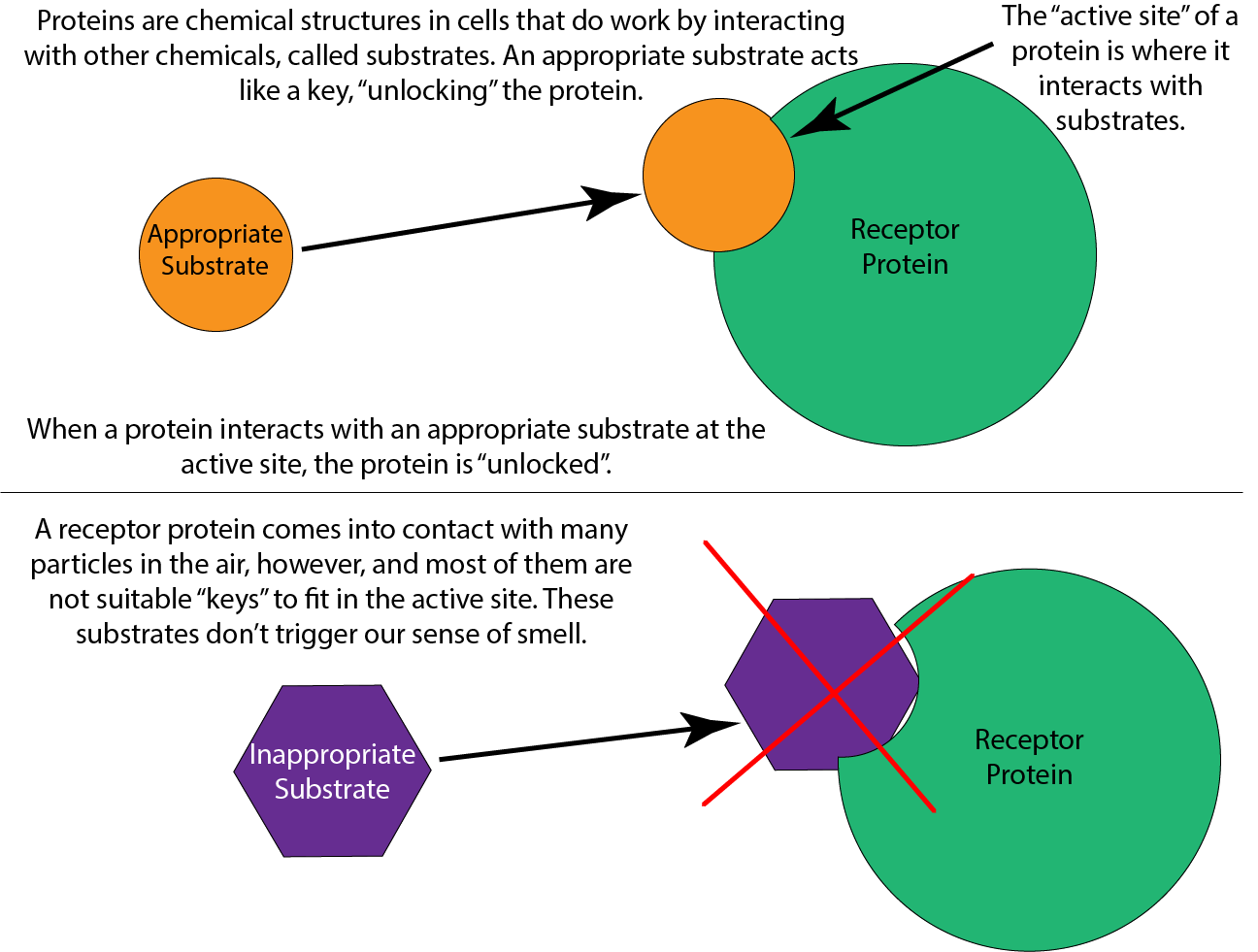
    Your brain has a specialized region dedicated to identifying smells, known as the olfactory epithelium. The olfactory epithelium sits right up your nose. The epithelium contains special proteins, which are chemicals in cells that do work, called receptors. These proteins are able to “match” up with one or a select few chemicals found in the air. You can think of them like poor quality locks that fit a few keys, rather than just one. Each receptor’s shape matches up to one or several molecules that you breathe in.

    An illustration of the lock and key model, showing how the shape of the protein is what determines whether or not a potential substrate will fit inside.

    If a receptor is activated by something in the air, it sends a signal to another part of your brain, the olfactory cortex. The olfactory cortex uses this signal to interpret what you’re smelling. The olfactory cortex also coordinates the smell with the rest of your brain’s activities – if you smell your favorite food, the olfactory cortex lets you know to start feeling hungry.

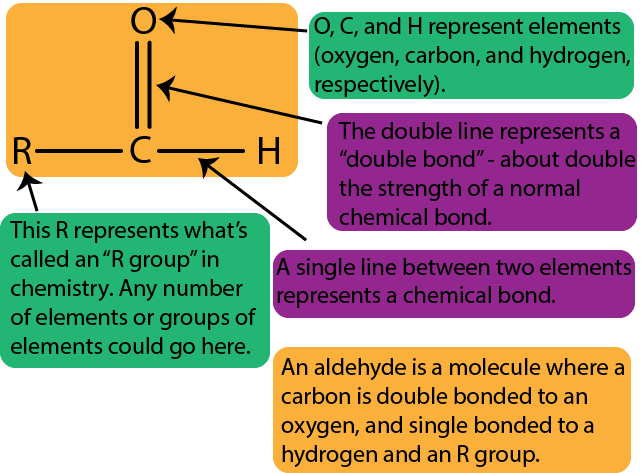
    The chemicals that enter your nose when you take a whiff of cilantro are called aldehydes, in particular the (E)-2-alkenals (mostly (E)-2-decenal and (E)-2-dodecenal).  Aldehydes are a class of organic molecules found all around in nature. They’re grouped together as a result of the chemical structures they have in common. All aldehydes have an oxygen double bonded to a carbon. This carbon is bonded to a hydrogen and atom/group of atoms.

    A diagram of the basic model of an aldehyde: a single carbon, which is doubled bonded to an oxygen, and single bonded to both a hydrogen and an R group. R groups are any given arrangement of molecules or single elements.

    As cilantro sits out on your counter, some of its aldehydes evaporate in the air. When you smell the cilantro, those aldehydes bind to the aldehyde receptors in your olfactory epithelium. Then, the receptors tell the rest of your brain that you’re smelling cilantro.

    A Quick Genetics Lesson

    Before we investigate the findings into the cilantro soap gene, let’s take a quick look at some of the genetics involved. Inside each and every one of your cells, there is a copy of your DNA. DNA (deoxyribonucleic acid) is made up of two long strands of repeating units called nucleotides. Each nucleotide has a nitrogenous “base” which the rest of the nucleotide’s structure hangs on to. The four variants of this base are identified by four letters: G, C, A, and T. How the sequences of these letters vary determines the genetic code. A gene is a section of nucleotides that corresponds to a protein. Proteins are molecules that do all sorts of important functions in the body. Remember the olfactory receptors we talked about earlier? Those are proteins. Variations in the olfactory receptor genes, for example, might change the shape of those receptors. Depending on where the shape of the receptor is changed, this could alter the sense of smell of someone with a changed receptor. There are different kinds of ways a gene can be mutated, or changed to be different from the “normal” version of the gene. One of these mutation types is known as an SNP (single nucleotide polymorphism), which means just one letter is different from normal.

    Potential Soap Genes

    This report conducted a genome-wide association study on 14,604 unrelated participants of primarily European ancestry. Two SNPs were found to be associated with finding cilantro to taste like soap. Let’s take a look at each of them. The first SNP was found on chromosome 11, located near the olfactory receptor genes. Researchers suspect that the SNP alters either the OR6A2 receptor or OR10A2 receptor. In particular, the OR6A2 receptor is known to be directly involved in smelling aldehydes, which is what we primarily smell from cilantro.

    The other SNP that was found to be linked to smelling cilantro as soap was inside the gene SNX9. Researchers were baffled by this finding, as this gene encodes the instructions to create a chemical that helps cells communicate within themselves and re-construct their cell membranes when they duplicate. Now, this apparently has absolutely nothing to do with cilantro, and it’s very possible that it could be a false positive. However, the equivalent to this gene in mice was found to be associated with non-syndromic hearing loss in mice, so it’s not impossible to think that it could be related to human senses as well.

    Soap Tasting Populations

    There were several significant differences between populations when it came to cilantro tasting like soap in this study. Women were significantly more likely to find cilantro soapy than men. Out of ancestries, Europeans were more likely than South Asians, East Asians, Latin Americans, and those of African descent to find cilantro soapy. No difference was found between Northern and Southern Europeans, or between Ashkenazi Jews and other Europeans. Although the South Asian group studied in this report was small, a significant association was found. This suggestion that there is a significant association between the genome and a person’s response to cilantro even outside of the European group. However, the heritability estimate made in this study was very low. This could be evidence that environmental effects and/or epigenetic effects have an impact on how someone tastes cilantro.

    References

    Browning, Peggy. (2018). Smell. In Gale Encyclopedia of Nursing and Allied Health (pp. 3266–3268).

    Eriksson, Nicholas, Wu, Shirley, Do, Chuong B, Kiefer, Amy K, Tung, Joyce Y, Mountain, Joanna L, . . . Francke, Uta. (2012). A genetic variant near olfactory receptor genes influences cilantro preference. Flavour (London), 1(1), 22.

    Solomons, G., Fryhle, C. B., & Snyder, S. A. (2014). Organic chemistry (11th ed.). Hoboken, NJ: Wiley.

  • Deep Philosophical Questions About the Universe

    Deep Philosophical Questions About the Universe

    Are you currently laying in bed in the wee-hours of the morning and are wondering… what even is life?? Why on EARTH am I here? If aliens exist, then why haven’t we made contact with them yet?….. Or maybe extraterrestrial life has already attempted to make contact with humans, but our technology is not advanced enough to detect them…

    Well, look no further in your search for some interesting and deep, philosophical questions. If you are scrolling through your phone in bed, these questions might help you fall asleep — but not because they are boring, rather, they will have your mind thinking deeply, to the point where your brain will be thinking so deeply that it will get tired, and thus, you might fall asleep from mental and intellectual exhaustion.

    These four questions are all about the universe, and will surely make your head spin like a spiral galaxy. Some of the questions have been supported by research, others are too complicated or abstract to conduct studies on. Hopefully some day in the future, scientists will be able to answer some of these questions with complete assurance.


    1)   WHAT CAME BEFORE THE “BIG BANG”?

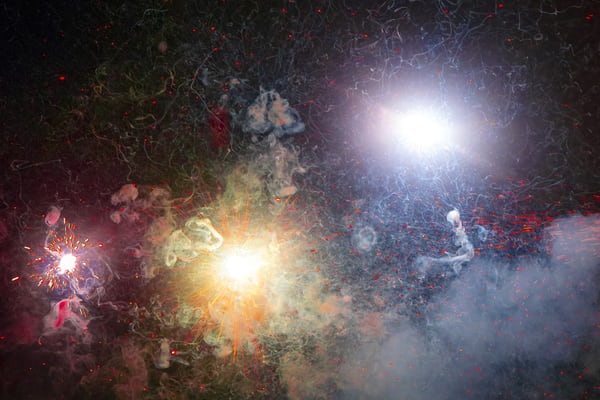
    Photo Credits: @ActionVance: https://unsplash.com/s/photos/space-explosion

    Depending on your belief of how the universe became, there are two most popular beliefs: the Big Bang, or that simply God created all of the universe and life. The Big Bang hypothesis states that about 13.8 billion years ago, all of the current and past matter in the universe came into existence at the same time. But, have you ever thought of what happened before the Big Bang? If nothing existed before the Big Bang, then how can something can just come from nothing? And how did that nothing become something?? According to Stephen Hawking,

    “Asking what came before the Big Bang is meaningless, according to the no-boundary proposal, because there is no notion of time available to refer to. It would be like asking what lies south of the South Pole.”

    He proposed that there’s no  end,      or beginning,      at all.

    Take a second and try to grasp that idea… Can’t grasp it? Me neither.

    In relation to Hawking’s “no-boundary” principle, it is like looking at the tip of a pencil. Take the example picture of my pencil below:

    “No-boundary” principle. Featuring my pencil

    Just as the tip of the pencil has a diameter of zero at its top-most point and gradually widens as you move to the right — the universe smoothly expanded from a point of zero size. Very peculiar and mind-blowing, isn’t it?!?


    2)  ARE WE ALONE IN THE UNIVERSE?

    My creepy drawing of an alien.

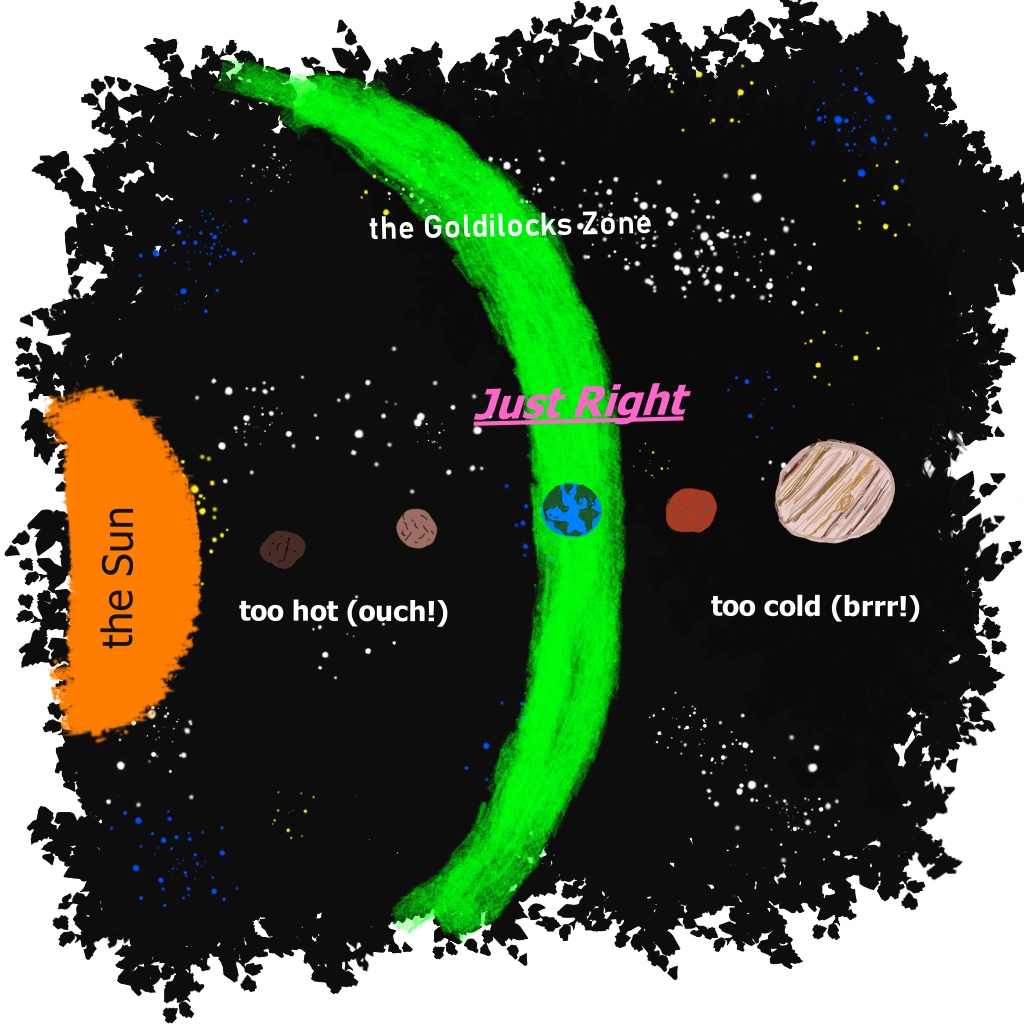
    To many people, there is no way that extraterrestrial beings cannot exist, even if they cannot see them. To others, aliens are a fantasy that has never, currently does not, and will never exist (except for E.T.). Dr. Zank and his colleagues from the University of Alabama in Huntsville within the Department of Space Science are among some of the scientists looking for the factors that make conditions optimal for exoplanets to fall into the “Goldilocks Zone”. The Goldilocks zone is where the planets are not too cold, nor too hot — but juuust right to possibly foster life.

    My representation of The Goldilocks Zone.

    There are lots of stars, called G-type or G-class stars, that are similar to our Sun. They radiate more light toward the infrared spectrum and they look promising for hosting exoplanetary life. Our nearest neighbors, Alpha Centauri A and Alpha Centauri B, look promising.

    The Fermi paradox offers an interesting perspective about the absence of evidence for extraterrestrial beings. Italian-American physicist Enrico Fermi created the Fermi paradox, which is the apparent contradiction between high estimates for the probability of extraterrestrial civilizations and the lack of evidence, thereof. However, various solutions to the Fermi paradox belong to different categories, such as the ones included below, regarding aliens:

        1. They Are Here: Aliens visited Earth in the past and they left evidence, via Alien Artifacts/Hieroglyphics, UFO’s, and witnesses.
        2. They Are Us: We– the humans– are the descendents of them ancient alien civilizations and we are the aliens.
        3. They Exist, But Have Not Communicated With Us, Yet: Aliens do indeed exist, but they either have not had enough time to reach us, are signaling but we do not know how to interpret the signaling, they have no desire to communicate with us (because humans are dumb, duh), their technology is too advanced, or they are all dead because of various catastrophes (that humans will eventually face).
        4. They Obviously Do Not Exist: Life is extremely rare, planets with the “perfect” conditions are rare, and humans are the superior race.

    Pick and choose your fighter as you will. I am not going to tell you which one to believe, but I will say that they can all be true — because we have not found evidence (or a lack thereof) of each possible solution.


    3)  IS THERE INHERENT ORDER IN NATURE, OR IS IT ALL JUST RANDOMNESS AND CHANCE?

    The recognition of randomness and apparent chance can be outwardly shown through things like galactic evolution (ie: the formation of the Universe), biological evolution (ie: development of early life), and geologic phenomena (ie: volcanos, mountains, rivers, etc). However, these phenomena can also be described via the perspective that there is inherent order in nature. For example, some Darwinistic-like theories suggest that through natural selection, life and everything that exists on the planet now is the result of deterministic principles.

    However, both are important to describe nature.  Nature is neither chaotic nor orderly; and neither random nor deterministic. In classical physics, things are observed as the same result every time given the same initial conditions. However, also in physics, the Big Bang theory suggests that the universe was created suddenly, by chance of the right conditions.

    So what gives? →  A paradox.

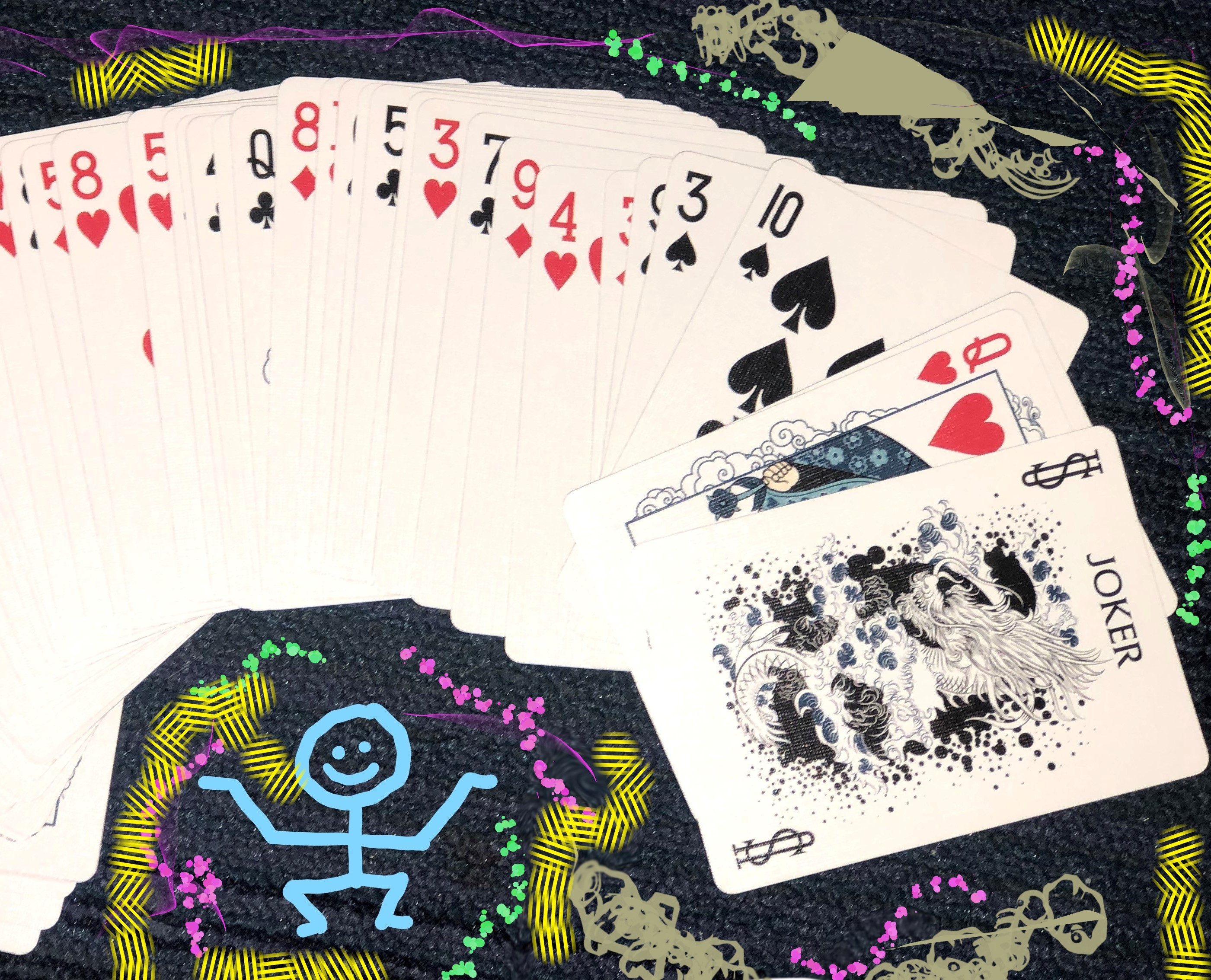
    A paradox such that chaos is deterministic, created by precise rules that do not involve any elements of chance. With this paradox, the future is completely determined by the past, but through time, small uncertainties accumulate upon each other — thus, even if a particular behavior is predictable in the short term, it remains unpredictable in the long run.

    My deck of cards with (literal) chaos surrounding it.

    “Essentially, there is order in chaos: underlying chaotic behavior there are elegant geometric forms that create randomness in the same way as a card dealer shuffles a deck of cards or a blender mixes cake batter.” — Chaos, Scientific American Journal

    Opposites truly do attract, in this case. I would have never thought of how order and chaos could mesh together so … naturally.


    4)  DO WE LIVE IN A SIMULATION?

    Are we sort of like puppets??

    The idea that we could be virtual beings living in a computer simulation means that our simulated environment would create perceptions of reality on demand, rather than simulate all of reality all the time. This is similar to a video game where only parts of a scene are rendered to be visible to a player.

    According to Neil deGrasse Tyson, “Maybe that’s why we can’t travel faster than the speed of light, because if we could, we’d be able to get to another galaxy… So the programmer put in that limit”.  A new analysis by Nick Bostrom of the University of Oxford shows that ‘the odds that we are living in base reality—meaning an existence that is not simulated—are pretty much even’.

    Bostrom’s simulation argument showed that at least one of the following scenarios must be true:

    1. Humans almost always go extinct before reaching the simulation-savvy stage.

    2. Even if humans make it to that stage, they are unlikely to be interested in simulating their own ancestral past.

    3. The probability that we are living in a simulation is close to one.

    If you think that perspective is interesting, take a look further. On November 12, 2019, professors at the Georgia Institute of Technology debated on the question: “Do we live in a simulation?”. There were lots of interesting answers, including the one below by professor Hans Klein in the School of Public Policy:

    “It’s a simulated world that we live in to the extent that we live in this world that arrives to us through media the nature of the simulation is that institutions have interests and the interests of the media corporations and the interests of the entities that are being reported on by the media corporations. They’re all actively shaping the information flows that come to the public, it’s quite significant […] A lot of effort is made to influence how our knowledge of the world is mediated and it’s done in such a way so that we will so we end up living in if we live on critically we live in a world that’s a bit of a bit of a fantasy world and it’s a fantasy world that reflects off in the interests of media institutions and powerful societal interests.”

    In a sense, Klein is saying that we, as humans, are creating our own simulating reality through the media and information we consume and the powerful interests of society that media corporations help perpetuate. With this perspective, maybe we are living in base reality after all…


    ALAS,

    As mysterious as the universe can be, hopefully one day humans will be able to answer these questions with impeccable certainty. Maybe the universe or some higher power does not want us to know the truth about our universe… Or maybe simply, humans just are not advanced enough yet to grasp the true notions of our reality, origin, or purpose. Hopefully you are asleep by now (if you wanted to be), but if not, may the Universe always be with you!


    SOURCES:

    Ananthaswamy, Anil. “Do We Live in a Simulation? Chances Are about 50–50 – Scientific American.” Scientific American, Scientific American, 13 Oct. 2020, https://scientificamerican.com/article/do-we-live-in-a-simulation-chances-are-about-50-50/.

    “Before the Big Bang: The Prehistory of Our Universe – Brian Clegg – Google Books.” Google Books, Brian Clegg, Aug. 2009, https://books.google.com/books?hl=en&lr=&id=3fZ0SM78LFsC&oi=fnd&pg=PP2&dq=what+happened+before+the+big+bang&ots=6aaH7pfy8I&sig=Gw6XKD59ZborhgRoidXqEaSqb88#v=onepage&q=what%20happened%20before%20the%20big%20bang&f=false. Accessed 10 Feb. 2021.

    C. JOHN MANN; Randomness in Nature. ‘GSA Bulletin’ 1970;; 81 (1): 95–104. https://pubs.geoscienceworld.org/gsabulletin/article-lookup/81/1/95 Accessed 2 Mar. 2021.

    Chaos. Scientific American, 1986, https://www.jstor.org/stable/pdf/24976102.pdf?refreqid=excelsior%3A9e5867f32c36ce9d2401f9b76c3af1cc. Accessed 26 Feb. 2021.

    Cvitanović, Predrag, et al., editors. Professor Debate on the Topic – Do We Live In a Simulation? Georgia Tech Library, 12 Nov. 2019, https://smartech.gatech.edu/handle/1853/62045. Accessed 3 Feb. 2021.

    Fermi’s Paradox.http://abyss.uoregon.edu/~js/cosmo/lectures/lec28.html. Accessed 18 Feb. 2021.

    “If the Universe Is Teeming with Aliens … WHERE IS EVERYBODY?: Fifty … – Stephen Webb – Google Books.” Google Books, https://books.google.com/books?hl=en&lr=&id=Kp6g79LuKWEC&oi=fnd&pg=PA2&dq=do+aliens+exist&ots=aAMZyI0X6s&sig=0DONvBxxF8VTV6N37huhr3X5M5c#v=onepage&q=do aliens exist&f=false. Accessed 6 Mar. 2021.

    “Physicists Debate Hawking’s Idea That the Universe Had No Beginning.” Quanta Magazine, Natalie Wolchover, 6 June 2019, https://www.quantamagazine.org/physicists-debate-hawkings-idea-that-the-universe-had-no-beginning-20190606/. Accessed 2 Mar. 2021.

  • Dino Nuggets: The Evolution of Birds from Dinosaurs

    Dino Nuggets: The Evolution of Birds from Dinosaurs

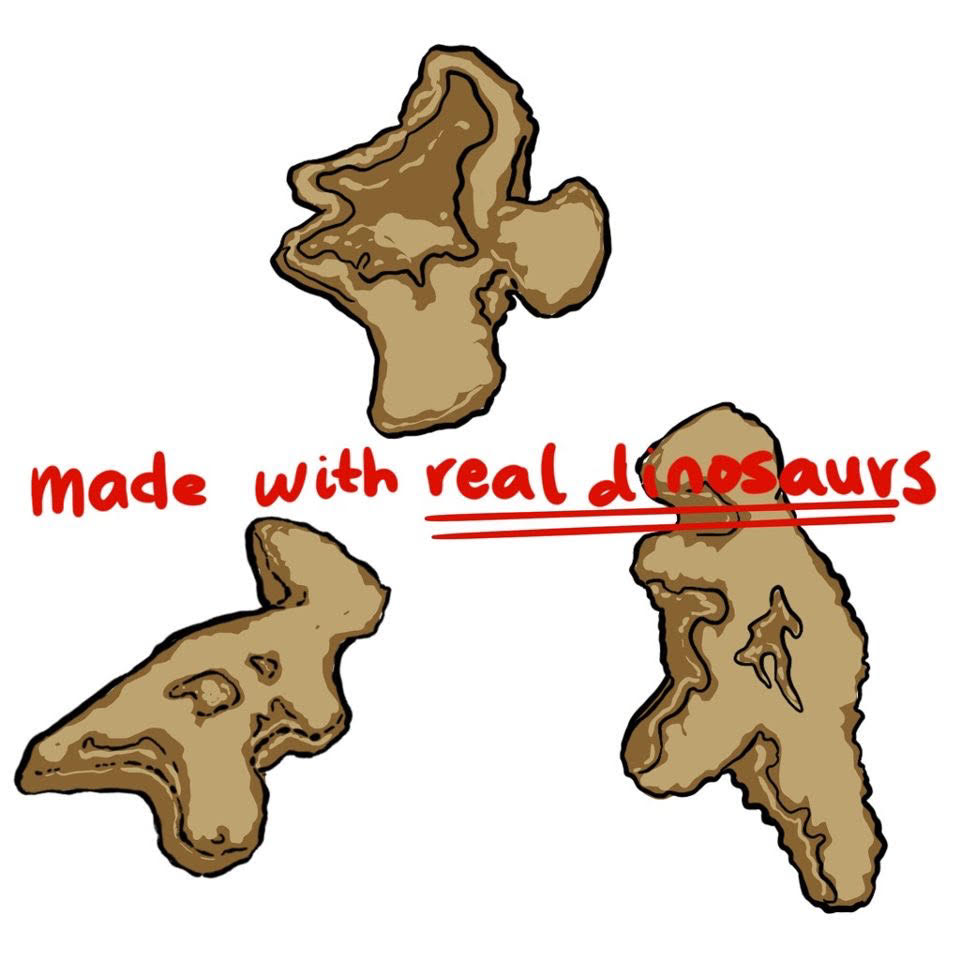
    Dino nuggets are pretty yummy right? These childhood snacks—or adult snacks if you’re like me— are dinosaur-shaped breaded chicken nuggets. At first glance, they might seem like a clever trick to get some protein into kids, but what if there was more to it? What if a trace of the true self exists in the false self?


    Dino nuggets Illustrated by Bella Beeco

    To begin, let us understand how scientists classify animals. The two main systems they use are the Linnaean and phylogenetic systems. The first groups organisms mainly on physical traits that connect them—like the existence of backbones for example—and the second groups organisms according to their evolutionary history, which often is revealed by DNA and RNA similarities. We do not have access to any dinosaur DNA these days, so the best way to connect any currently living animals to dinosaurs is by comparing their physical traits.

    Dinosaurs, mighty as they were, are simply very large or even small terrestrial reptiles that inhabited earth around 250 million years ago. On the other hand, we have birds, usually small, bright and most of them love to fly! The physical similarities might not seem obvious at first but scientists have spent years making this connection. It was not one big jump from a T-rex to a pigeon; this evolution took millions of years with many intermediate species in between.

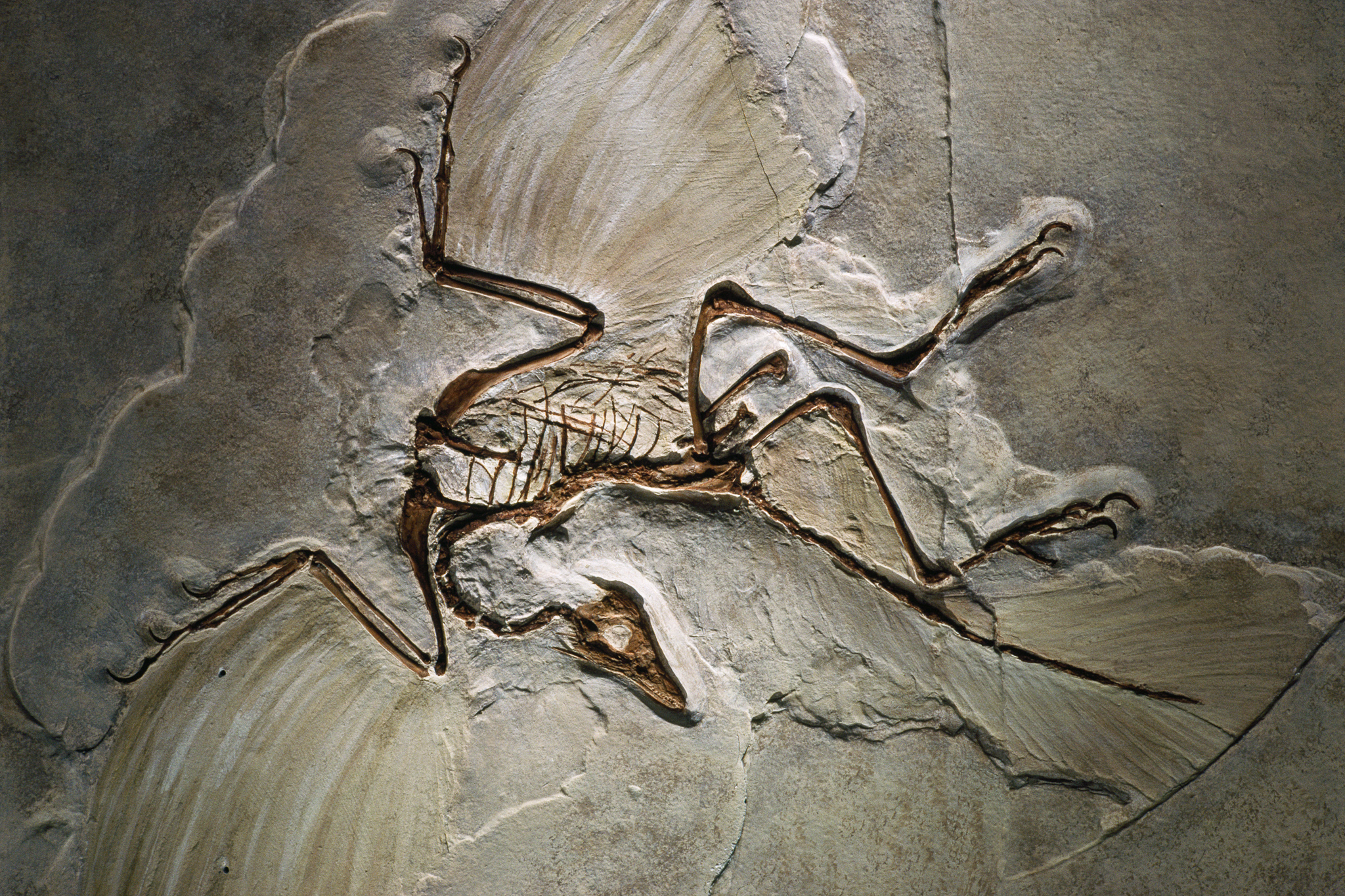
    In 1860, the fossil of a small avian dinosaur called the archaeopteryx was found. This fossil was the first clue to birds’ ancestry. Simply speaking, the archaeopteryx was an intermediate animal between dinosaurs and birds. Its bone structure, tail, and teeth were most similar to that of a reptile yet it had wings and was covered in feathers. This is not to say that the archaeopteryx was the first bird to exist because it had feathers or a different bone structure, but we consider it to be the first avian dinosaur that we know of. We’re not even sure if it could fully fly or just glide from a height.

    Archaeopteryx fossil. James L. Amos, CC0, via Wikimedia Commons

    There is no definite line to be drawn between dinosaurs and birds as of course since the process of evolution is a continuous one. This new advantage of aviation could have possibly saved this dinosaur from predators and allowed it access to more resources which would increase its chances at survival and reproduction. With each passing generation, qualities that improved flight could have been chosen for and accumulated; these qualities include hollow bones, wing-like limbs, feathers, and shorter tails.

    The archaeopteryx  was the size of a modern day raven,which was not the most common size at the time. But as the years passed more and more smaller dinosaurs evolved. Paraves, a type of avian dinosaur, was shown to grow at a rate 160 times faster than the rate at which other dinosaurs were growing during the Jurassic period. This shrinkage could have been very beneficial for flying. The lighter the animal was, the easier it was for them to soar instead of just glide. Recent studies have also shown that modern day birds highly resemble late embryos of dinosaurs.

    One primary physical difference between birds and dinosaurs is the presence of beaks vs. teeth. The strong jaws of dinosaurs had developed pointy ends that would help them precisely pick up food when their hands started to turn into wings. Their mouths were still filled with teeth but they had slowly started to harden and sharpen into toothy beaks that were found on dinosaurs similar to Ichthyornis dispar which lived around 100 million years ago. Over time those dinosaurs started losing their teeth for reasons that are hypothesized to be evolutionarily advantageous. Some scientists hypothesize that tooth loss could have been under selective pressure for shorter incubation periods, lighter head weight and better center of mass, or even as an adaptive response to an extinction event.

    A trademark of modern birds are their feathers. There has not been a definitive answer to why dinosaurs first developed them or exactly when. We do know that they started as a sort of hollow spine-like filament on the skin then this filament branched into a softer “fluffier” protofeather similar to the feathers of modern young birds called downy feathers. Those feathers were further toned and perfected to what we see today over the past million years. Feathers could be a heating mechanism that kept dinosaurs at a certain body temperature or to provide their eggs with warmth during incubation.

    Feathers could have also been a sexual advantage that was used for attracting mates. Just like how ostriches or peacocks use their feathers to attract females more than fly, some non-avian dinosaurs had feathers that are speculated to be for the same reason. Newly found fossils also show that dinosaurs displayed similar courting rituals to modern day birds. Scraping, a process where a male tries to impress the female by mimicking nest-building behavior, seems to be an age-old tradition that theropods started and many birds today still use to woo their mates. Additionally, some dinosaur fossils like the Hadrosaur skull show a hollow nasal chamber that was used for deep loud noises to communicate with others and call for mates. A similar anatomy can be found in the southern cassowary nowadays; they also use it for mating calls.

    Birds are now classified as coelurosaurians which is a clade containing  their closest ancestors; coelurosaurian translates to “hollow tailed lizards” from Greek. They share common features like hollow bones, an erect perpendicular placement of their legs, a fused clavicle and furcula, 3-toed legs, as well as shorter stiffer tails. From all the previous evidence we discussed in the fossil record we can safely say that birds are avian dinosaurs.


    العربية

    إن ناجتس الديناصورات لذيذة جدا ، أليس كذلك؟ هذه الوجبة الخفيفة مصنوعة من قطع الدجاج بالبقسماط

    المشكلة  على هيئة ديناصورات. للوهلة الأولى ، قد يبدو الأمر وكأنه حيلة ذكية لإدخال بعض البروتين إلى نظام الأطفال الغذائي بطريقة مرحة ولكن ماذا لو كان هناك المزيد؟ ماذا لو كانت الذات المزيفة مرآة  للذات الحقيقية؟

    أولا,  دعونا نفهم كيف يصنف العلماء الحيوانات. النظامان الرئيسيان للتصنيف هما نظام لينيوس الثنائي ونظام النشوء والتطور. يقوم النظام الثنائي بتصنيف الكائنات الحية تبعا للسماتها الجسدية التي تربطها – مثل وجود أو عدم وجود العمود الفقري – وتصنف المجموعة الثانية الكائنات الحية وفقًا لتاريخها التطوري  والذي غالبًا ما يتم الكشف عنه من خلال أوجه التشابه بين ال DNA و ال RNA. لا يمكننا الوصول إلى DNA أي ديناصور في عصرنا الحالي، لذا فإن أفضل طريقة لربط أي حيوانات حية حاليًا بالديناصورات هي بمقارنة سماتها الجسدية.

    الديناصورات على الرغم من عظمتها وكبر حجمها هي ببساطة زواحف كبيرة جدًا -أو حتى صغيرة – سكنت اليابسة منذ حوالي 250 مليون سنة. في الشق الآخر نرى الطيور ، كائنات عادة ما تكون صغيرة وملونة ويحب معظمها التحليق! قد لا تبدو أوجه التشابه الجسدية واضحة في البداية ، لكن العلماء مضوا سنوات عدة للوصول لهذا الرابط. لم يكن هناك قفزة كبيرة واحدة من ديناصور التي ريكس إلى الحمام مثلا فقد استغرق هذا التطور ملايين السنين و العديد من الأجناس الوسيطة بينهما.

    في عام 1860 ، تم العثور على حفرية ديناصور محلق صغير وسمي بالأركيوبتركس. كانت هذه الحفرية أول ما دل العلماء على العلاقة بين الديناصورات والطيور. ببساطة ، كان الأركيوبتركس حيوانًا وسيطًا بين الديناصورات والطيور. كانت بنية عظامه وذيله وأسنانه تشبه إلى حد كبير هيكل حيوان زاحف ولكنه كان ذو أجنحة وكان جسده مغطى بالريش. هذا لا يعني أن الأركيوبتركس كان أول طائر موجود لأنه كان يحتوي على ريش أو بنية عظمية مختلفة ، لكننا نعتبره أول ديناصور طائر نعرفه. لسنا متأكدين حتى مما إذا كان بإمكانه الطيران بالكامل أو الانزلاق من ارتفاع فقط.

    لا يوجد خط فاصل بين الديناصورات والطيور بالطبع لأن عملية التطور عملية مستمرة. يفترض العلماء أن خاصية الطيران الجديدة كانت ميزة تكيفية اضافية قد تساعد الديناصور في الهرب من الحيوانات المفترسة وتسمح له بالوصول إلى المزيد من الموارد التي من شأنها أن تزيد فرصته في البقاء والتكاثر. مع كل جيل يمر، كان الاصطفاء الطبيعي يفضل الصفات التي أدت إلى تحسين الطيران وزيادة فرص النجاة؛ تشمل هذه الصفات العظام المجوفة والأطراف الشبيهة بالأجنحة والريش والذيول القصيرة.

    كانت حفرية الأركيوبتركس بحجم غراب في وقتنا الحالي، وهذا لم يكن الحجم المتعارف عليه للديناصورات ان ذاك. ولكن مع مرور السنين ، بدأت الديناصورت بالتقلص. تبين أن بارافيس ، وهو نوع من الديناصورات المحلقة ، ينمو بمعدل 160 مرة أسرع من معدل نمو الديناصورات الأخرى خلال العصر الجوراسي. كان من الممكن أن يكون هذا الانكماش مفيدًا جدًا للطيران. كلما كان الحيوان أخف وزنا ، كان من الأسهل عليه التحليق بدلا من مجرد الانزلاق من طرف هاوية. أظهرت الدراسات الحديثة أيضًا أن الطيور الحديثة تشبه إلى حد كبير أجنة الديناصورات في الشهور الأخيرة.

    أحد الاختلافات الجسدية الأساسية بين الطيور والديناصورات هو وجود المنقار بدلا من الأسنان. تطورت نهايات مدببة بدلا من  الفكوك القوية للديناصورات كي تساعدهم على التقاط الطعام بدقة عندما بدأت أيديهم في التحول إلى أجنحة. كانت أفواههم لا تزال مليئة بالأسنان التي سرعان ما بدأت في التصلب والتحول الى مناقير مسننة كالتي تم العثور عليها على الديناصورات المشابهة لـ Ichthyornis dispar التي عاشت منذ حوالي 100 مليون سنة. بمرور الوقت ، بدأت تلك الديناصورات بفقد أسنانها لأسباب يُفترض أنها مفيدة من الناحية التطورية. يفترض بعض العلماء أن فقدان الأسنان قد يكون تحت ضغط انتقائي لفترات حضانة أقصر ، أو وزن رأس أخف ، ومركز كتلة أفضل ، أو حتى كاستجابة تكيفية لحدث الانقراض.

    من أوسمة للطيور الحديثة, ريشها. لليس هنالك سبب محدد لماذا طورتها الديناصورات لأول مرة أو متى بالضبط. نحن نعلم أنها بدأت كنوع من الخيوط المجوفة الشبيهة بالعمود الفقري على الجلد ثم تشعبت هذه الفتيلة إلى ريش بدائي “رقيق” أكثر ليونة شبيهاً بريش الطيور الصغيرة الحديثة التي تسمى الريش الناعم. كان هذا الريش مشابها أكثر لما نراه اليوم على مدار المليون سنة الماضية. يمكن أن يكون الريش آلية تسخين تحافظ على الديناصورات عند درجة حرارة معينة للجسم أو لتزويد بيضها بالدفء أثناء الحضانة.

    يمكن أن يكون للريش أيضًا فوائد جنسية تم استخدامها لجذب الأزواج. تمامًا مثل الطريقة التي يستخدم بها النعام أو الطاووس ريشه لجذب الإناث أكثر من الطيران ، كان لبعض الديناصورات غير الطيور ريش يُعتقد أنه لنفس السبب. تظهر الحفريات المكتشفة حديثًا أيضًا أن الديناصورات عرضت طقوس مغازلة مماثلة لطيور العصر الحديث. يبدو أن الكشط ، وهي عملية يحاول فيها الذكر إثارة إعجاب الأنثى عن طريق محاكاة سلوك بناء العش ، هو تقليد قديم بدأه الثيروبودات ولا يزال العديد من الطيور يستخدمه اليوم لجذب أزواجخم. بالإضافة إلى ذلك ، تُظهر بعض أحافير الديناصورات مثل جمجمة هادروسور غرفة أنف مجوفة كانت تُستخدم لإصدار أصوات عالية للتواصل مع الآخرين واستدعاء أزواج. يمكن العثور على تشريح مماثل في طائر الشبنم الجنوبي في الوقت الحاضر. يستخدمونها أيضًا في مكالمات التزاوج.

    .تصنف الطيور الآن على أنها كويلوروصورات وهي كليد يحتوي على أقرب أسلافها ؛ coelurosaurian من اليونانية يترجم إلى “سحالي مجوفة الذيل”. يتشاركون في ميزات مشتركة مثل العظام المجوفة ، والوضع العمودي المنتصب لأرجلهم ، والترقوة الملتصقة واللفيفة ، والساقين الثلاثة الأصابع ، وكذلك ذيول أقصر صلابة. من كل الأدلة السابقة التي ناقشناها في السجل الأحفوري يمكننا أن نقول بأمان أن الطيور هي ديناصورات محلقة.

    .

    Resources :

    https://www.nhm.ac.uk/discover/what-are-dinosaurs.html

    http://www.eartharchives.org/articles/what-are-birds/

    https://bio.libretexts.org/Bookshelves/Introductory_and_General_Biology/Book%3A_Introductory_Biology_(CK-12)/05%3A_Evolution/5.01%3A_Linnaean_Classification

    https://www.jstor.org/stable/24996750?casa_token=2leTuPnjTMYAAAAA%3AA6NB0eEyk4lN-gV_g4P-lo-DG8vRNPEuJnyiT0e77aaU_59ugCYzlL7ZANbbtRn8YmDPz0g4Sm-DHJHWn-iJfUjVfk_jqBy1S68VW9CFoFQTAs1em9XW&seq=1#metadata_info_tab_contents

    https://academic.oup.com/biolinnean/article-abstract/8/2/91/2682639

    https://news.yale.edu/2018/05/02/scientists-find-first-bird-beak-right-under-their-noses

    https://royalsocietypublishing.org/doi/10.1098/rsbl.2018.0090

    https://www.ncbi.nlm.nih.gov/pmc/articles/PMC2842673/

    https://onlinelibrary.wiley.com/doi/full/10.1111/evo.12363

    https://www.geol.umd.edu/~tholtz/G104/lectures/104coelur.html

  • The Evolution from Fossil to Monster

    The Evolution from Fossil to Monster

    Humankind as a species is over 200,000 years old. We are travelers, storytellers, and connoisseurs of legends and tales. For thousands of years, mankind has entertained our children and fellow tribesmen with fables and stories of the unknown, the cryptic and the mythological. It is a unifying factor in our world. Every story needs a strong villain to maintain equilibrium and for many, the villain was the monster. From Greek and Roman to Japanese and Native American, fantasy and folklore have been influenced from the history of this planet. All cultures have created monsters to fuel their fears. Either to rationalize the unknown or to provide comfort for themselves, men and women of the past have created these stories for purposes that have been lost to time. Yet, monsters are alive and real today, be it in between a page or in a culture. These beasts came from our imaginations. However, many of these terror-bringers were imagined based on fossils, skeletons, or unknown sightings that frightened the inhabitants of their lands. 

    From tales of creation, to the flood, and even tales of doom, every culture has unifying legends. Some cultures produced monsters so terrifying that they were hidden and lost to time, while some have been immortalized in books, movies, and videogames. The primal fear of the unexplainable had to be justified through something tangible by mankind. Two monsters that have fueled the nightmares of children and men; two giants of terror that were produced from the unknown, can now be explained.  

    THE CYCLOPS:

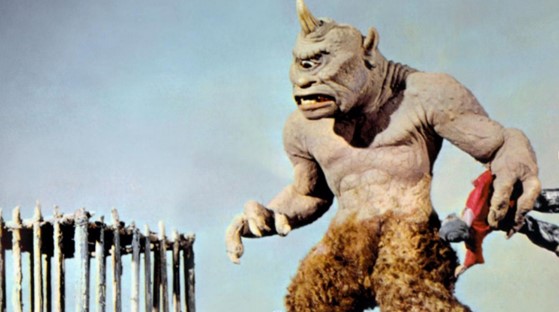
    Cyclops are a cannibalistic giant race bearing a distinct feature: a singular eye in the center of their forehead. Notable cannibals and warriors in Greek mythology, the cyclops were born from the Greek God Poseidon but were cast away because of their grotesque ugliness. In Greek stories and in pop-culture, cyclopes have been used as a formidable opponent to heroes and heroines. The most well known depiction of the cyclops race comes from Homer’s The Odyssey. Other notable depictions have been seen in The Cyclops (1957), Wrath of the Titans (2012), and Tron: The Odyssey (2017). 

    According to Homer, Polyphemus was the cyclops leader on the isle in which Odysseus was stranded on his return home. Polyphemus was a sheep herder and a brutal warrior. During Odysseus’ time on the island, Polyphemus severed a man in half with a single bite and crushed a man in his grasp. A nightmarish scene that captures our fears of these cannibal giants; the infamous cyclops look, from Greek vases to modern day, has endured the test of time.Cyclops from “Seventh Voyage of Sinbad”. Director Nathan Juran

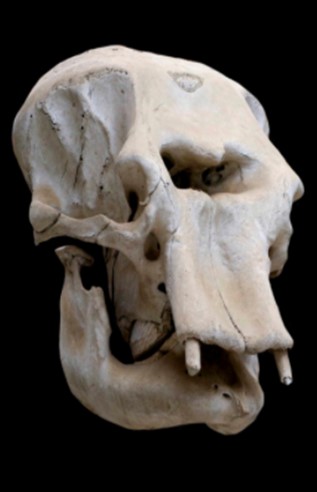
    Their faces look eerily similar to elephant skulls:Elephant Skull. Photo courtesy of Felipe Romao


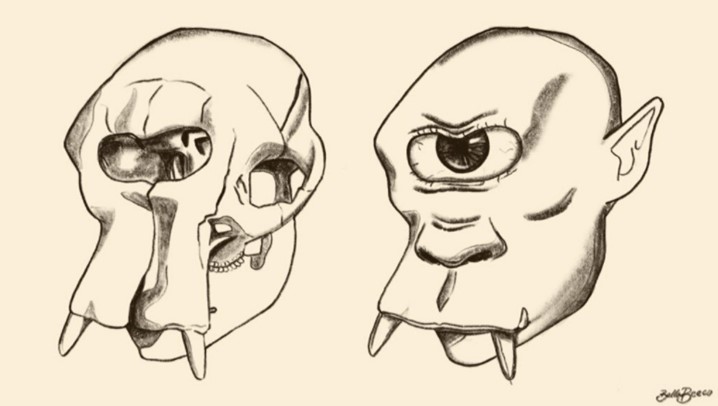
    These skulls can easily be viewed as a horrific mono-visual monster. Ancient Greece had two different species of elephants roaming the area: The Cyprus Dwarf Elephant and the Cretan Dwarf Mammoth. Such large skulls would have to be supported by tremendous bodies. These skulls sported massive tusks and teeth which were perfect for crunching the bones of men.  

    In the early 20th century, Paleontologist Othenio Abel suggested that the inspiration of cyclops comes from the fossilized skulls of pygmy elephants found in the ancient Greek region. Found on Cyprus, Crete and many other surrounding Grecian islands, these ancient dwarf elephants died around 11,000 BCE. These elephants had a shoulder height of five feet, with an averaged- size femur of over two feet. Anatomically, elephant and human femurs look similar, which is a proposed explanation to the human element of the cyclops. From these basic anatomical parallels, the cyclops could have been born. When the image of the cyclops was mixed with human fear and superstition, the cyclops became the monster we know today: a giant cannibal terror. 


    Courtesy of Bella Beeco
    Elephant Skull transforming into a Cyclops Skull, Courtesy of Bella Beeco

    THE YACUMAMA:

    The Yacumama is a South American tale that derives its nature from the Amazon river. Meaning “The Water Mother” in Peruvian, the tale dates back to that of the Incan civilization in the 13th century. A massive 30 meter serpent monster, the Yacumama had jaws that could swallow a man whole. In her legends, any animal or man that disturbed her waters became her prey. The local indigenous people would blow on conch horns to protect themselves before entering the water, believing the Yacumama would reveal herself if present. 

    South America has many depictions and lore of snakes. The Aztec and Incan civilizations both had powerful gods depicted as these slithering creatures. The Aztecs had Quetzalcoatl who created mankind. The Incas had Amaru who was the water God and protector of the rivers. The legend of the Yacumama can be traced back to the 15th century when it was told to the Spanish Conquistadors. 

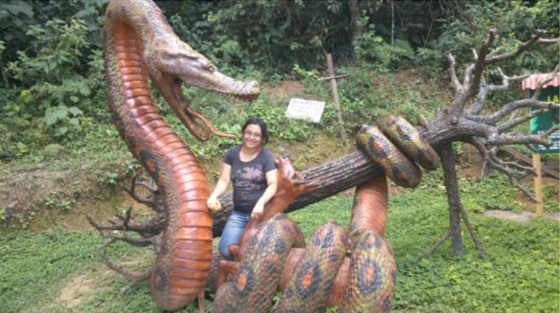
    A modern depiction of the Yacumama: 

    Photo of a Yacumama Statue in Parque Tematico Peru. Courtesy of Mike Dreckschmidt

    As anacondas and rivers in South America are mutually inclusive, the pairing of Yacumama and her watery home was natural. South America is home to thousands of rivers including the Amazon, and is home to 169 species of snakes, including the world’s heaviest species: the Green Anaconda. The largest Green Anaconda recorded weighed over 500lbs and was nearly 20 feet long. The longest snake species, the Reticulated Python, which measured over 25 feet long, is not native to South America but is a related species to the Anaconda. While these are the largest snakes ever measured in current day, the largest snake ever found hails from South America: The Titanoboa.

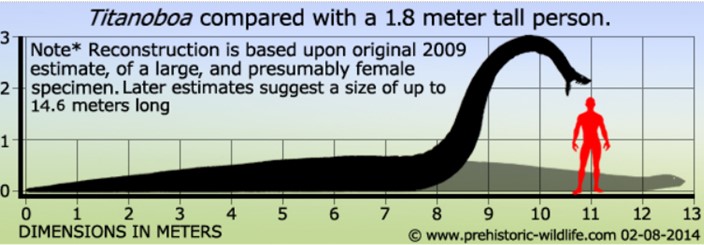
    Titanoboa fossil size model. Courtesy of Darren Pepper

    The Titanoboa fossil found in Colombia created a fear of all ancient snakes. Weighing in at over 2,500 lbs. and reaching up to nearly 50 feet in length, this behemoth snake truly could have swallowed a man whole. This dinosaur-sized serpent could strangle and crush every living organism that came within striking distance until its extinction 56 million years ago. If these snake fossils had been found by natives in South America prior to the official paleontological discovery, a giant water serpent named Yacumama could have certainly been created to explain the phenomena. The Yacumama is possibly an exaggeration of a sighting of a large wild anaconda, or it could have been a fossil based explanation from an earlier find of a titanoboa fossil. A massive serpent, a man eater, and a terrifying hunter from the depths, the Yacumama was definitely a monster that inspired fear, but it is also a monster that can be flushed into explanation. 


    References:

    • Aym, Terrence. “History Mysteries: The Legendary Yacumama, Mysterious Monster of the Amazon.” Salem-News.com, Salem-News.com, 16 Aug. 2010, www.salem-news.com/articles/august162010/monster-amazon-ta.php.
    • Combing, Beach. “Cyclops Origins.” Beachcombing’s Bizarre History Blog, Beachcombing’s Bizarre History Blog, 8 July 2011, www.strangehistory.net/2011/06/07/cyclops-origins/.
    • Dreckschmidt, Mike. “Terrifying Legends of Peru #3: Yacumama and Sachamama.” Traveling and Living in Peru, Peru Exprience S.A.C, 6 Aug. 2020, www.livinginperu.com/terrifying-legends-peru-3-yacumama-sachamama/.
    • “Green Anaconda: National Geographic.” Animals, National Georgraphic, 10 Oct. 2018, www.nationalgeographic.com/animals/reptiles/g/green-anaconda/.
    • Hennings, Julie, and Harry Lynch. “Birth of a Monster.” EarthDate, Burea of Economic Geology, www.earthdate.org/birth-of-a-monster.
    • Juran, Nathan, director. Seventh Voyage of Sinbad. Columbia Pictures, 1958.
    • Pepper, Darren. Titanoboa, Www.prehistoric-Wildlife.com., 2011, www.prehistoric-wildlife.com/species/t/titanoboa.html.