Category: Articles
-
Volcanoes: Quick and Easy
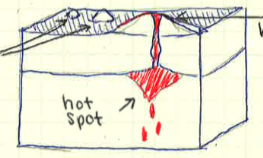
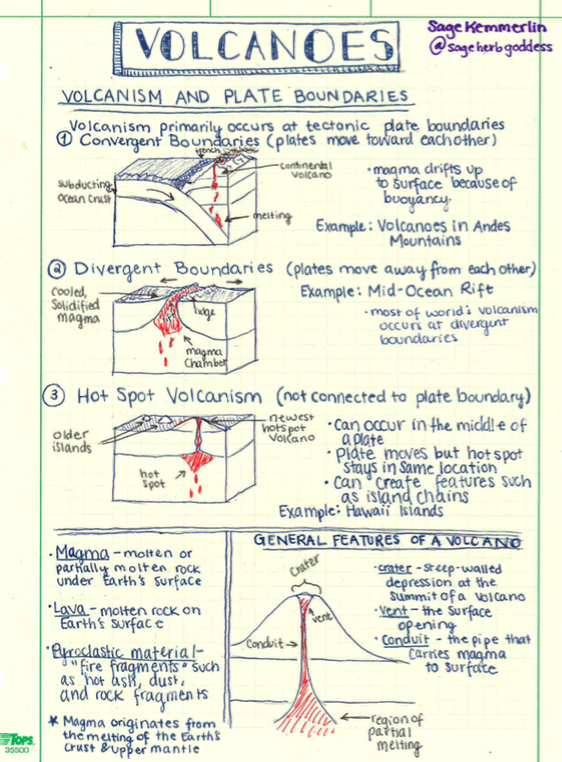
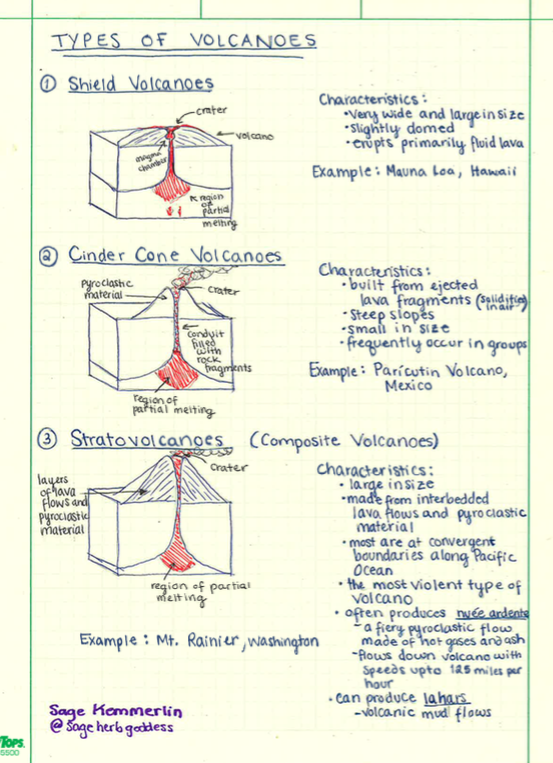
I present to you my two page cheat sheet on volcanoes since they are one of the most fascinating and awe-inspiring features of the earth:
-
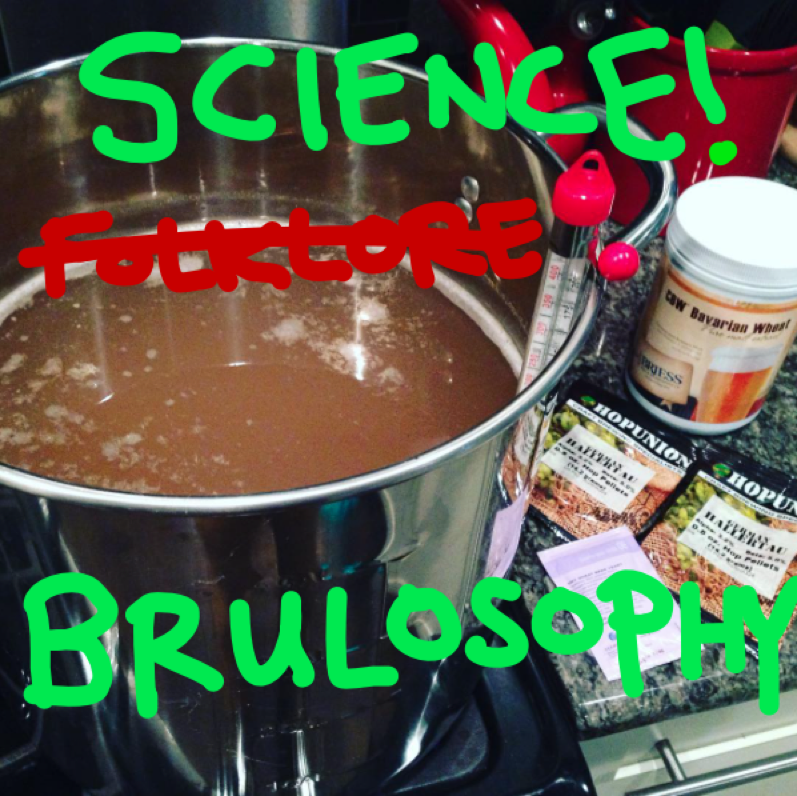
Brulosophy: Home Brewing Meets the Scientific Method
 “One man’s making cheap booze is another man’s crafting an ecosystem in which a microorganism can thrive.” That’s my usual response whenever someone’s eyes go wide upon hearing that (a) I’ve used home brewing examples in my general chemistry class or (b) I’ve started plotting how to turn my six-week-old son into a young homebrewer. My love affair with homebrewing started in graduate school, where I was mesmerized by a group of older graduate students who were obsessed with brewing beer at home. This was back in 2010, before the “craft beer revolution” was co-opted by every dime-a-dozen hipster between Greenwich Village and The Mission. Cynical enough to be driven to drink but clever enough to apply chemistry to produce alcohol, my pioneering idols could be heard every Friday night discussing the challenges of growing hops at home or the merits of various sparging methods (read on). I was hooked.
I got started in home brewing when a Mr. Beer kit showed up under the tree one Christmas a few years back (thanks, mom). Newbies and experienced brewers alike love to read books and magazines written by a whole crew of pseudo-celebrities who regularly publish books and magazines promising the perfect brewing process, reminiscent of Calvin and Hobbes’s Chewing Gum Magazine. (Okay, we’re not quite that bad. But we’re pretty bad.) What’s the perfect mash temperature? How much Sparge water should I use? Is my local water okay, or should I add minerals to it? Usually these works are heavy on oral tradition and light on science, which is surprising for a hobby dominated by engineers.
Enter Brulosophy, a blog that demystifies homebrewing with SCIENCE! Ring leader Marshall Schott is a clinical psychologist and homebrewer (take that, engineers) on a mission to test the mountain of informal homebrewing advice that has accumulated over the years. In a typical exBEERiment (xBmt), he brews two batches side by side using identical techniques, altering only a single variable. He then gathers a group of testers and does what is called a triangle test—more or less a scientific version of “two truths and a lie.” Each tester gets three beer samples, two from batch A and one from batch B. The tester’s task is simply to identify the unique sample from batch B. The logic goes that if a significant number of testers are able to correctly identify the unique beer, changing the variable during the brewing process had a significant impact.
Marshall is careful to recognize the limitations of his approach. The triangle test does not assess which of the two batches is better, just whether changing the variable by a specified amount makes an impact on the final beer. In essence, each experiment answers the yes-no question: does changing variable X by amount Y cause a noticeable difference in the final beer? Some exBEERiments include follow-up studies that address quality, but these are generally very subjective.
Still, the folks at Brulosophy have built up an impressive body of exBEERiments addressing everything from the ideal material for fermentation vessels (PET plastic versus glass, the eternal battle) to whether clarifying agents are worthwhile (they’re nuts for gelatin but surprise, it doesn’t have a significant impact). Their table of xBmts even lists a p-value for each trial, a statistical measure of how likely it is that the two batches are not significantly different. If you’re looking for an impact, a smaller p-value is better. Below, I’ve organized some of the more notable xBmts by the relevant stage in the brewing process. For those of us familiar with the typical brewing lore passed down on stone tablets through the ages, his results contain some reassuring results but quite a few surprises. Check out the table below for some of the most interesting results.
● Extremely significant difference (p < 0.01)
● Significant difference (p < 0.05)
● Insignificant difference (p > 0.05)Stage of Brewing Process Experimental Variable Description Pre-mashing Size of grain crush More finely crushed grains surrender more starches; this is very consistent with the advice of the “experts.” Water chemistry – mineral adjustments The homebrewing demigods tend to downplay the importance of minerals in water, as it’s fairly easy to overdo it and end up with a carboy full of saltwater, but Brulosophy’s results indicate that minerals can have a big positive impact on the final beer—at least for Dry Irish Stout and Belgian Pale Ale styles. They observed an effect both before the mash and after fermentation. Mashing Liquor-to-grist ratio What would brewing be without jargon? Brewers call the grains used in the mash the grist, and the water used the “liquor.” That’s right: we’re such a bunch of alcoholics that we call water liquor. Figures. Although the “grain heads” like to make a big deal about the water-to-grain ratio in the mash, this xBmt indicates no perceptible impact on the final beer. Extract vs. all-grain The “feud” between extract and all-grain brewers is legendary. Extract brewers use pre-mashed solid or liquid malt extract and start with the boil; all-grain brewers (they’re just the snobbiest) start from crushed grains and run their own mashes. An xBmt with pale ale showed a difference between the extract and all-grain recipes, but Marshall is careful to say that it doesn’t mean that all-grain is better. Single infusion vs. step mashing Different chemical reactions occurring in the mash have different ideal temperatures. The idea of a step mash is to hold the liquid at a series of temperatures to get the most out of all of these reactions. Single infusion involves using a single temperature throughout the mash. Although the difference was subtle, a significant number of testers could tell the difference between single-infused and step-mashed beers. This is in line with expectations, but the difference was more subtle than the experimenters expected. Sparging Fly sparging vs. batch sparging vs. no-sparge Who knew there were this many ways to introduce water to wort? Traditionally, how sparge water is added to the grains affects the yield of starches extracted (efficiency). A series comparing these three methods in a pair-wise way confirms it: sparge method has an important impact on the final beer. Fermentation Rehydrated vs. sprinkled dry yeast Some homebrew books advocate dissolving dry yeast cells in a little bit of “side wort” to beef them up before sending them into the big game—that’s called rehydration. Others warn that rehydration can introduce bacteria into the fermenting wort, especially if the side wort is not properly sterilized. I’ve never rehydrated dry yeast and it’s worked fine for me; this xBmt also supports the idea that rehydration has no noticeable impact on the final beer. Yeast pitch rate More yeast is generally described as better (they can grow, but they suffer in the process), and this xBmt confirms that yeast pitch rate does have an impact on the final beer. PET plastic vs. glass fermentation vessel Much to my own chagrin, using glass instead of plastic as a fermentation vessel did have a significant effect on the final beer. In a separate xBmt, stainless steel and glass performed equally well. Dry hopping Adding hops after the boil to the fermentation vessel is known as dry hopping. A series of xBmts demonstrated that the temperature, length of time, and quantity of dry hops all have a noticeable effect on the final beer. The form of hops had only a significant effect (p = 0.029). -

To Zoo or Not to Zoo: a Story of Harambe
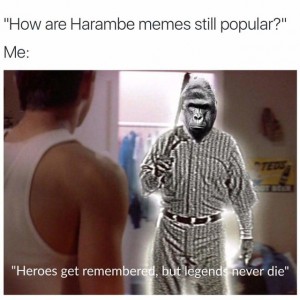
If you have been online at all the past couple of months, you have probably ran into Harambe–the latest meme hot off of the internet presses (wherever that is). Like, really, he is everywhere. It is kind of scary.
With many of these memes you will find a lot to the effect of #RIPHarambe or #neverForget. And yeah, it is kind of hilarious and kind of ridiculous and kind of sad at the same time. The majority of stuff you find online is probably not authentic, but as a great scholar once said, “At the heart of every meme there is a grain of truth.” Or something like that, I don’t know.
 For the uninformed, Harambe was a gorilla at the Cincinnati Zoo and Botanical Garden. On May 28th, 2016, a young child climbed (or fell) into the enclosure.
 Harambe claimed the child as his own and raised him as part of the troop.Frightened, the child begins to cry as the adult male gorilla approaches. I mean shit, I would probably cry too. This stresses out Harambe, and he begins to drag the child around the enclosure. It is honestly terrifying, and shows just how effortlessly this gorilla could kill a small child. If you haven’t seen the recording of the encounter, you really need to check it out.After about ten minutes of this, the zookeepers decided to shoot and kill Harambe. In my opinion, this is both a simple and complicated issue. Simple in that a kid’s life was in danger. I mean, damn, look at that video. I am sure that many of people placed in that situation would make the same choice, but what about the alternatives? Why not tranquilize Harambe, then remove the child when the endangered Western lowland gorilla is out cold? According to zookeepers and primatologists responding to the incident, that would of just pissed the ape off before any effects took place. So that means Harambe had to be shot. This is where the problem becomes a bit more complex. Who do we blame for this?
Surely there is some pitchfork that can be grabbed–someone needs to take responsibility. Do we blame the child for wandering into the pit? Do we blame the gorilla for acting like a gorilla? Do we blame the mother for negligence? Maybe. I think Donald Trump actually (and shockingly, I know) summed this up quite eloquently.
Or, we could think about the zoo itself. Many people disagree with zoos. Whether it is for treating the animals poorly, being unnatural, or commercializing nature itself, zoos often take the hotseat when discussing eco-conservation. For transparency, I am not one of those people.
I love zoos, but I understand and empathize with many of those points. I believe, that in a perfect world, there would be no zoos in the concrete jungle, and that profit would always take a back seat to conservation. I agree that zoos must be kept under constant supervision in regard to the treatment of their animals. And I think the most important item on the docket is restoring natural habitats–Yes. All of that is important. But I also believe that how zoos support communities, and how zoos support conservation are also important.
One of my favorite memories from my childhood is visiting the Atlanta Zoo. I had the pleasure of seeing its famous silverback gorilla, Willie B., just before he passed away. My mom bought me a silver necklace of Willie B., and I thought it was the coolest thing in the world. My name is William Bradley Martin. My mom would call me Willie B., and now I got to see this awesome animal that had the same name! How cool is that? I still have the necklace to this day.
That memory is so important to me, because it was the first time in my life I found myself interested in science. I wanted to know more about it, no matter what shape it took. I read Zoo Books, watched Animal Planet, I would draw chimpanzees in a sketchbook I had. My young mind was on overload. Though this interest in science has grown and changed a bit over the years, I can trace it back to that specific moment. All because of a zoo. It makes me wonder, how many other people that now work in wildlife conservation were at one point inspired by some zoo or garden, aquarium, or museum? Zoos have been around for hundreds of years, surely some other sparks must of been lit besides mine.
So when I think of the Cincinnati Zoo and of Harambe and of the tragedy that happened, I am saddened. Yes, he had to be shot. But I believe that the blame is put on society instead of any one individual. Zoos can be a wonderful and enlightening experience – an opportunity to learn about a world that naturally we would most likely never come in contact with. But the moment the zoo is simply an amusement park, with horseplay (no pun intended) and spilt popcorn and kids running around like animals, someone – or something – is bound to get hurt.
Sources:
Downes, Azzedine. “Jane Goodall, Azzedine Downes Together Offer Thoughts on Tragic Harambe Killing.” IFAW. N.p., 19 June 2016. Web. 09 Sept. 2016. <http://www.ifaw.org/united-states/news/jane-goodall-azzedine-downes-together-offer-thoughts-tragic-harambe-killing>.
Ohlheiser, Abby. “The Internet Won’t Let Harambe Rest in Peace.”Washington Post. The Washington Post, 27 July 2016. Web. 09 Sept. 2016. <https://www.washingtonpost.com/news/the-intersect/wp/2016/07/27/the-internet-wont-let-harambe-rest-in-peace/>.
Also, I highly recommend reading Life of Pi, by Yann Martel, for a beautiful and passionate defense of zoos.
-

Could Aliens be Living in Our Solar System?
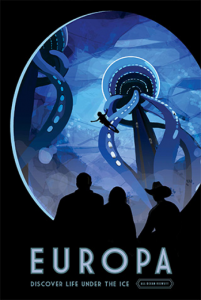
Image Credit: NASA/JPL-Caltech
http://www.jpl.nasa.gov/visions-of-the-future/
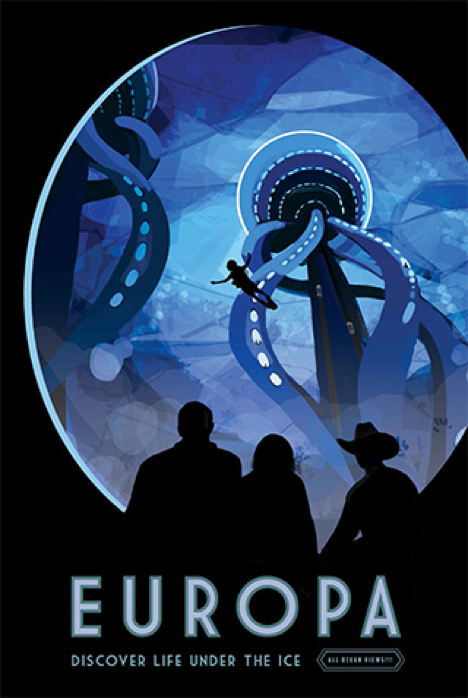
Water: the ultimate resource. We depend on it to survive, but Earth is not the only place with a substantial amount of water. Buckle up, because I want to tell you about my favorite moon, Europa.
Europa is one of the moons of Jupiter. It is approximately 4.5 billion years old (about the same age as Jupiter) and is about 485 million miles from the sun. It is the smallest of the Galilean moons with a diameter of 1900 miles (smaller than Earth’s moon but larger than Pluto). Europa looks like a dead, frozen, wasteland covered in large cracks and fractures in the ice, but it is exactly for this reason why it is so cool (literally and figuratively). These cracks are likely caused by tides in an ocean that lies buried underneath Europa’s icy surface. Europa’s tide is the result of host planet Jupiter. Jupiter’s gravity lifts and lowers the sea level causing cracking in the ice. Below the ice and ocean is a rocky interior and inside that is an iron core [1].
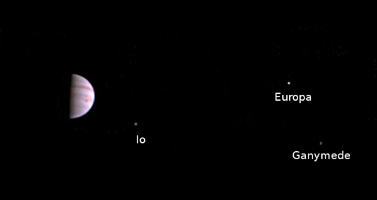
Image Credit: NASA/JPL-Caltech/SwRI/MSSS
http://photojournal.jpl.nasa.gov/catalog/PIA20707
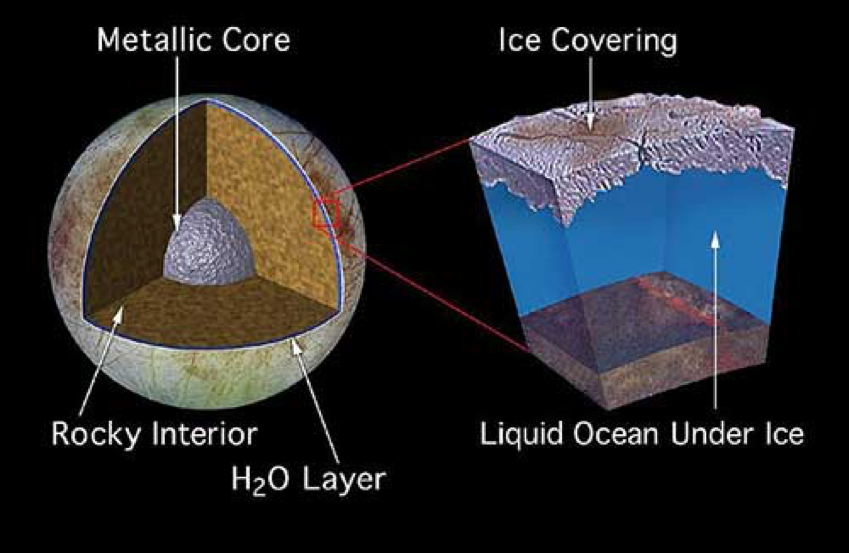
Image Credit: NASA
http://spaceplace.nasa.gov/europa/en/
Ok, so you might be thinking, “that’s kinda cool, a frozen moon. Why do I care?” Well, you should care because Europa’s subsurface ocean hosts the possibility of life. That makes Europa a possibly habitable location for us humans (in the future though, cause we are no where near that yet), which is awesome.
The ocean beneath the surface is widely believed to be salty liquid water which is a big deal (but not yet known for certain since we haven’t sent any missions directly to Europa thus-far). In a recent study done by NASA’s Jet Propulsion Laboratory (Vance et al., Geophysical controls of chemical disequilibria in Europa), the researchers calculated the potential amount of hydrogen that could be produced from interactions of seawater with the rock below it.This process of interaction is called serpentinization. NASA also looked into oxidants in Europa’s ocean. Jupiter, being the massive gas giant that it is, bathes Europa in radiation from it magnetosphere (Earth actually has this type of radiation too called the Van Allen belts, although they are about a thousand times weaker than Jupiter’s). This radiation can split apart water ice molecules and create oxidants. One of the lead authors of NASA’s study, Steve Vance, said, “If the rock is cold, it’s easier to fracture. This allows for a huge amount of hydrogen to be produced by serpentinization that would balance the oxidants in a ratio comparable to that in Earth’s oceans”. The balance between hydrogen and oxidants is an indicator to the energy available for life [2]. However since no spacecrafts have been sent to Europa to investigate this, it is currently unknown if serpentinization occurs (several spacecrafts have done flybys such as Pioneer 10 and 11, Voyager 1 and 2, and Galileo [1] ).
NASA is planning an orbital reconnaissance mission of Europa called the Europa Clipper with the main goal of investigating the habitability of Europa. The Clipper will have 45 low-altitude flybys over the course of 3.5 years. The clipper will have three main objectives [3] : (1) to investigate the ice shell and ocean, (2) investigate the composition, and (3) investigate the geology of Europa. Essentially, NASA wants to confirm what they think they know about the structure and composition of Europa and how it’s layers interact (like the rocky interior, the ocean, and the icy shell) both mechanically and chemically, and determine the effect Jupiter’s radiation has on Europa. This will give insight to the habitability of Europa. There will be nine scientific instruments aboard to try meet these scientific objectives.
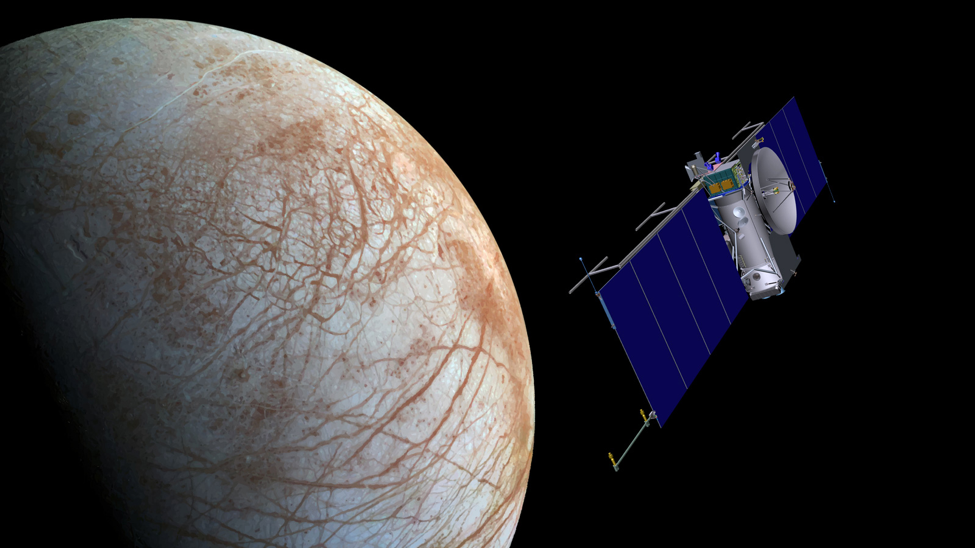
Image Credit: NASA/JPL-Caltech
http://www.jpl.nasa.gov/news/news.php?feature=4627
The Europa Clipper’s launch date is not yet determined, but it is likely to be in the early 2020s and would arrive 6-9 years later depending on the launch vehicle [4]. There is still A LOT of work needed to be done on the mission planning, but I’m very optimistic that it will yield in fascinating results, maybe even giving us significant insight to if we are alone in the solar system.
Here is a NASA/JPL-Caltech video about the Clipper:
References:
- Howell, E. Europa: Facts about Jupiter’s icy moon and its ocean. Retrieved September 4, 2016, from http://www.space.com/15498-europa-sdcmp.html
- Greicius, T. (2016, May 16). Europa’s ocean may have an Earthlike chemical balance. Retrieved September 4, 2016, from https://www.nasa.gov/feature/jpl/europas-ocean-may-have-an-earthlike-chemical-balance
- The Europa Clipper. (2013, June ). Retrieved September 4, 2016, from http://www.lpi.usra.edu/opag/jul2013/presentations/Clipper_Summary.pdf
- Europa Clipper Update. (2015, February 19). Retrieved September 4, 2016, from http://www.lpi.usra.edu/opag/feb2015/presentations/04_Clipper%20OPAG%20Feb%202015.pdf
-
Chemistry at Home: Exploring the MEL Chemistry Kit
MEL Science is on a mission to make mail-order chemistry kits for kids big again. They’ll deliver two sets per month right to your door containing 1 – 3 chemistry experiments. From their website: “I don’t know about you, but we are very worried about our children. They often spend more time with computer games than science. And we are trying to do everything to make science as interesting as possible.”
We got a chance to check out the MEL Chemistry Kit and Tin experiments. Take a look!
-

The Lab 1: Hard at Work
The majority of science majors, at least the ones that I know, work in a lab as an undergraduate researcher at some point during their college experience. Those of us that have, know very well the amazing, fun time that is working with post-doc fellows and grad students, absent PI’s and PI’s that are always around. There is a problem though, and that is that we never really get to share our stories with people outside of our labs. Our non-scientist friends don’t always get it. Our scientist friends are busy in their own labs. I present to you, the solution to all of your problems (…okay at least one of your problems), The Lab. The Lab is a comic series unraveling the adventures that come with working in a research lab. Enjoy and share with your friends to spread some understanding about scientist struggles!

Stay tuned for more adventures with The Lab!