For as long as I can remember, I have been obsessed with how people move. Now, hear me out. Even simple movements are fascinating if you really think about it. Electrical signals from your brain and spinal cord communicating with hundreds of muscles, forcing them to work together in a perfectly balanced symphony of contractions. All to maneuver our unwieldy skeletons gracefully through space.
Do me a favor and stand up.
For most of us, this movement feels like one of the simplest things we can do.
Now, look at your legs.
There are over 50 muscles below your hips alone. Yet, all these muscles just contracted in expert harmony to use the precise amount of force needed to move your body against gravity, all while maintaining near perfect balance. Precisely how we can perform these seemingly simple yet crucial movements on a whim is an active and exciting area of research, leading us toward innovation in movement rehabilitation, robotics, and beyond. These are movements we don’t even notice, like activating our muscles to breathe, blink, maintain our balance, or even walk. If you did notice these movements, you likely wouldn’t be able to focus on much else, transforming a simple grasp into an impossible and difficult task.
Luckily, you don’t need your brain to do any of these things.
More than just a cord
Many people think of the spinal cord as just that, a cord. The cords and cables we typically interact with are charged with a very important but relatively simple task: bringing electricity from point a to point b. While the spinal cord is very important for bringing electrical signals from your brain to your muscles and organs, it does so much more.
Picture an orchestra with a smart but rather lazy conductor performing for an audience. The musicians are like the motor neurons in the spinal cord, connecting to and contracting the muscles when the neurons fire, allowing you to move. Complicated musical pieces require guidance by our lazy conductor, just like throwing a dart or grasping an object requires guidance by the brain [1]–[4]. The audience’s cheers allow the orchestra to adapt, just like you use sensations from your body to improve or guide movements [5], [6].
Yet, just like our experienced musicians don’t need the conductor to play simple or repetitive musical pieces, you don’t need your brain to perform “classic” movements. “The spinal cord is able to achieve so many behaviors by itself, completely isolated from the brain,” explains Dr. Cope, spinal cord neurobiology researcher and Georgia Institute of Technology professor. “You can completely isolate the spinal cord in a living animal from the brain and it can walk on a treadmill [7], [8]. It can change speeds as the treadmill changes speed. You put an obstacle in its way, it can learn to lift its leg over that obstacle,” all without our lazy conductor [9].
It was discovered in the early 1900’s that your motor neurons are fully capable of running the show [10]. “What that tells you is that there is this rich circuitry that in fact the whole motor system relies upon,” Dr. Cope explained. All in all, it looks like the spinal cord has the classics all worked out for you. Feel free to tell your conductor they can take the day off.
How to run around like a chicken with its head cut off
Unsurprisingly, experienced musicians are able to play complicated, intricate music without their conductor. Surprisingly to many, however, your spinal cord is able perform complicated, intricate behaviors without any input from the brain. How exactly are these behaviors possible? It’s all in the organization.
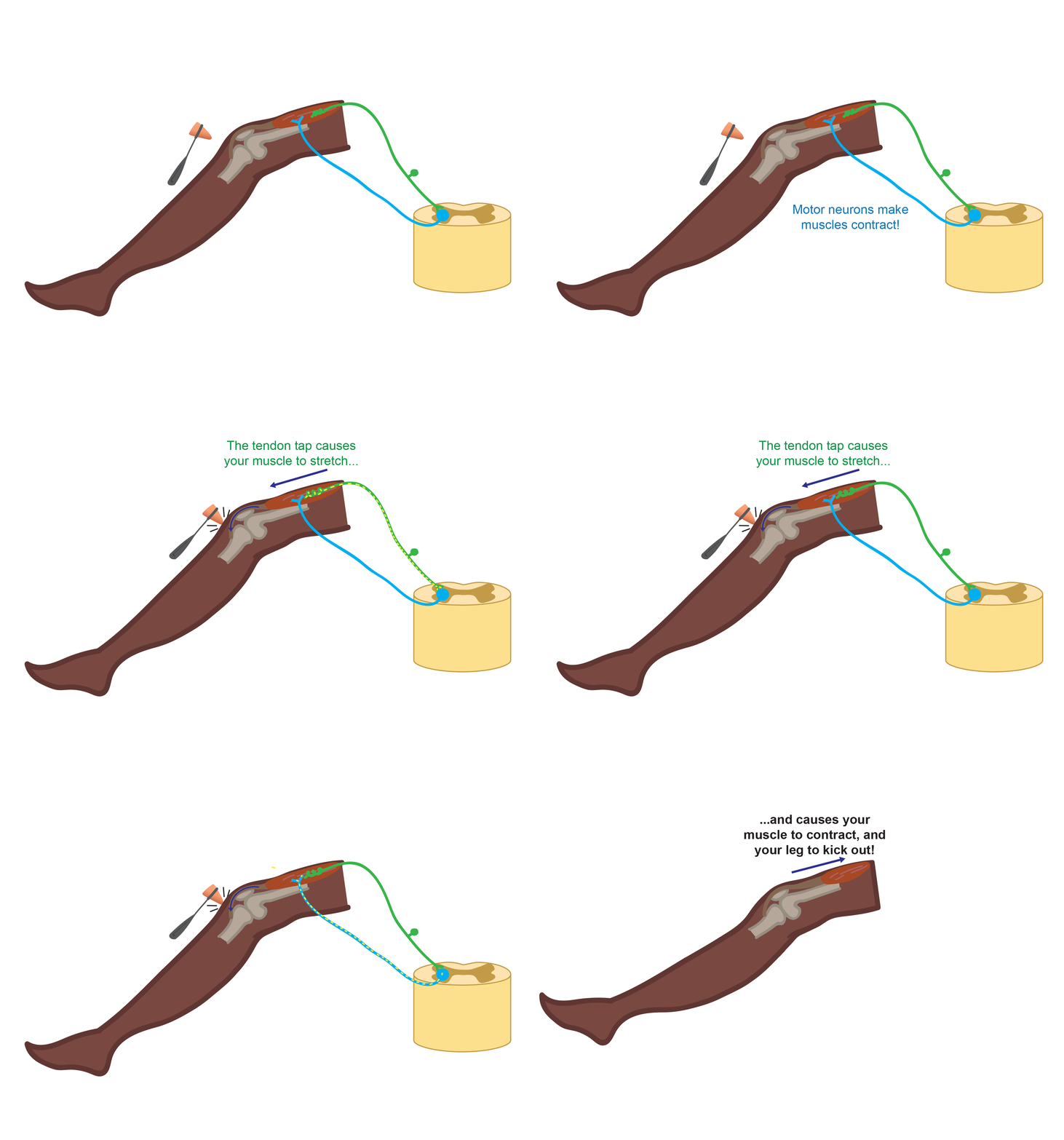
If you’ve ever gotten a physical, you have probably experienced the odd sensation of your leg flying through the air without your consent. In the right spot, a simple tap on your knee by the doctor sends your foot on a trip automatically. We commonly refer to these types of movements as “reflexes,” in which no approval by the brain is required. This reflex pathway is relatively simple in organization; only two neurons are required, making this one of the fastest reflexes we have. One neuron senses the stretch of your muscle caused by the tap and immediately tells the second neuron to flex that same muscle. This flexion rapidly moves your leg before you can stop to think about it. This can happen in less than a few milliseconds [11]! You use your stretch reflex more often than your visits to the doctor, however. The stretch reflex helps you keep your balance without a second thought and is believed to be crucial for general sensory feedback and movement control.
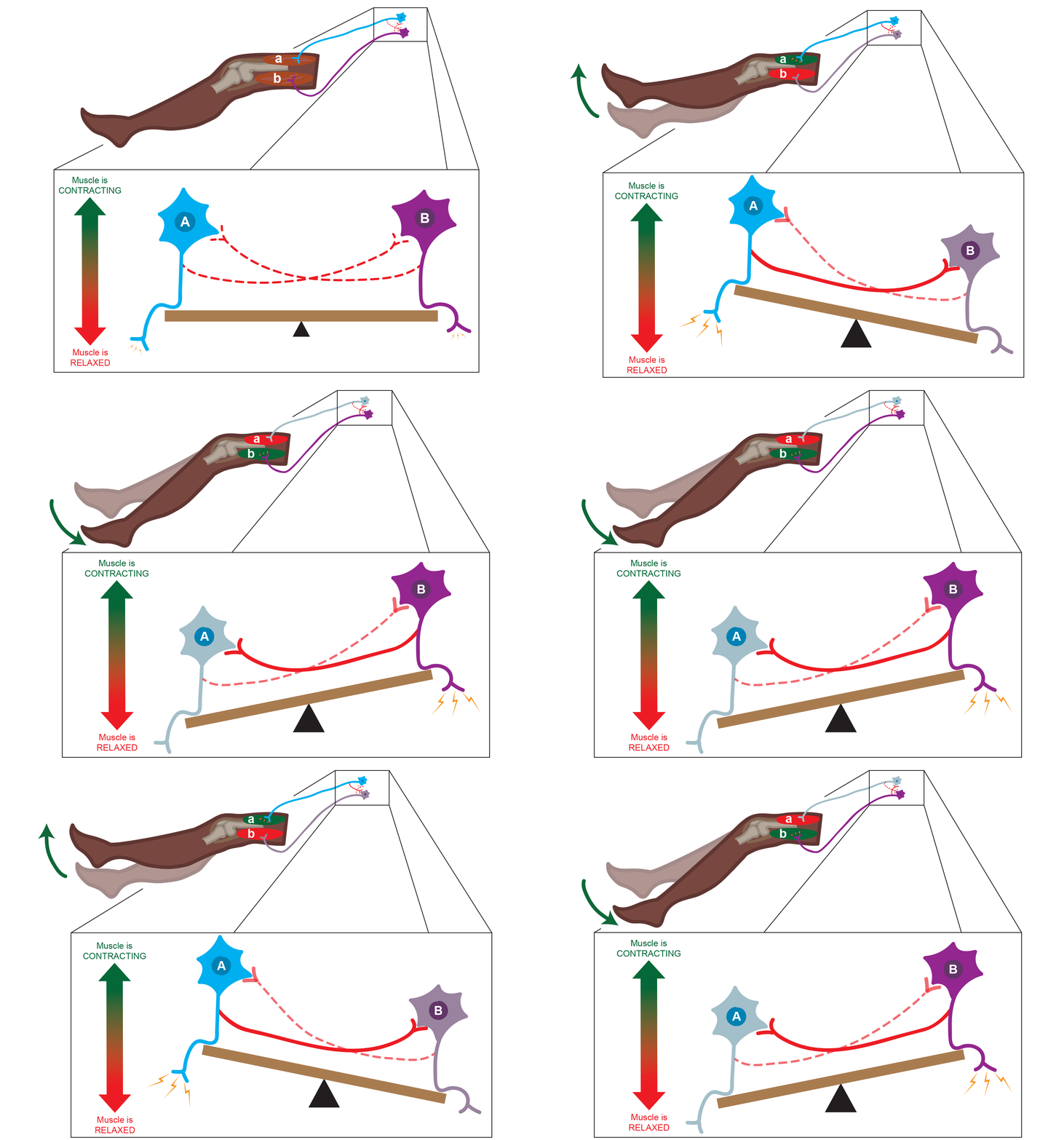
What if we make things a little more complicated? Instead of just two neurons, let’s add in two sets of neurons in the spinal cord: set A controlling muscle a, and set B controlling muscle b. Much like a seesaw, these sets of neurons rhythmically alternate in activity. A neurons fire until they run out of juice, then B neurons take over and the cycle continues. With this small set of neurons, a pattern of alternating activity emerges. Together, A and B neurons form a central pattern generator. For humans, however, a 2-muscle central pattern generator isn’t very useful. Adding in more sets of neurons allows your spinal cord to rhythmically control more muscles in a more complicated pattern. With anything from breathing and scratching an itch to walking and running, the spinal cord is in charge.
The patterns are there in your spinal cord, all you need to do is press start. “One of the things the brain does and can take full advantage of is to just send a ‘go’ signal to the spinal cord,” Dr. Cope explained. “[The brain] can say ‘Hey, all of the complicated things you do with timing and organizing … different muscles in different patterns, you do it. You’ve worked all that out. I don’t have to complicate my life with that.’” And while the brain can initiate and influence this pattern of alternating activity, it isn’t required. This pattern can just as easily be started by sensory input from your environment, or by sensory signals from throughout your body [9].
At the end of the day, it seems like the spinal cord has it all figured out for us. But do we have the spinal cord all figured out? Not even close.
The Mysterious Cord
In the past year, the news has been abuzz with instances of paralyzed patients regaining the ability to walk [12]. Paralysis is typically caused by spinal cord damage. Up until recently it seems, spinal cord injuries often left patients with limbs that were difficult or impossible to move willingly, oftentimes without hope for improvement. So how are these patients taking these miraculous steps?
A better question might be what happens to the spinal cord when it’s injured? We know some things about how it repairs itself, but we are far from the whole story. This means we are a far cry from fully repairing spinal cords ourselves. While these recent miraculous findings may make it seem like we have it all figured out, don’t let that fool you. “I think it’s exciting and I think it’s encouraging. I would say that we shouldn’t let our encouragement overshadow the fact that it’s nowhere close to what we want,” laments Dr. Cope. “It’s going to require some basic neuroscience information about what the mechanisms are that are limiting recovery.”
Researchers like Dr. Cope at Georgia Tech are working on a piece of this puzzle, studying to understand how the healthy and injured spinal cord contributes to and controls movement. Even with the great strides achieved recently by clinical studies [12], Dr. Cope explains that “We’re encouraged, but we have a long way to go.”
References
[1] D. P. Hanes and J. D. Schall, “Neural Control of Voluntary Movement Initiation,” Science (80-. )., vol. 274, no. 5286, pp. 427–430, 1996.
[2] D. M. Wolpert and Z. Ghahramani, “Computational principles of movement neuroscience,” vol. 3, no. november, 2000.
[3] D. A. Rosenbaum, K. M. Chapman, M. Weigelt, D. J. Weiss, and R. van der Wel, “Cognition, Action, and Object Manipulation,” Psychol. Bull., vol. 138, no. 5, pp. 924–946, 2013.
[4] E. Freud, S. N. Macdonald, J. Chen, D. J. Quinlan, M. A. Goodale, and J. C. Culham, “Getting a grip on reality: Grasping movements directed to real objects and images rely on dissociable neural representations,” Cortex, vol. 98, pp. 34–48, 2018.
[5] R. Shadmehr, M. A. Smith, and J. W. Krakauer, “Error Correction, Sensory Prediction, and Adaptation in Motor Control,” Annu. Rev. Neurosci., vol. 33, pp. 89–108, 2010.
[6] D. M. Wolpert, Z. Ghahramani, and M. I. Jordan, “An internal model for sensorimotor integration,” Science (80-. )., vol. 269, no. 5232, pp. 1880–1882, 1995.
[7] T. G. Brown, “The Intrinsic Factors in the Act o f Progression in the Mammal,” Proc. R. Soc. London. Ser. B, Contain. Pap. a Biol. character, vol. 84, no. 572, pp. 308–319, 1911.
[8] S. Grillner and P. Zangger, “On the Central Generation of Locomotion in the Low Spinal Cat,” Exp. Brain Res., vol. 261, no. 34, pp. 241–261, 1979.
[9] E. P. Zehr, “Neural Control of Rhythmic Human Movement : The Common Core Hypothesis,” Exerc. Sport. Sci. Rev., vol. 33, no. 1, pp. 54–60, 2005.
[10] C. S. Sherrington, “Flexion‐reflex of the limb, crossed extension‐reflex, and reflex stepping and standing,” J. Physiol., vol. 40, no. 1–2, pp. 28–121, 1910.
[11] E. G. T. Liddell and C. S. Sherrington, “Reflexes in response to stretch (myotatic reflexes),” Proc. R. Soc. London. Ser. B, Contain. Pap. a Biol. Character, vol. 96, no. 675, pp. 212–242, 1924.
[12] P. J. Grahn et al., “Enabling Task-Specific Volitional Motor Functions via Spinal Cord Neuromodulation in a Human With Paraplegia,” Mayo Clin. Proc., vol. 92, no. 4, pp. 544–554, 2017.