Category: Articles
-

Understanding Static Electricity
A Normal Winter Night
It’s a cold winter night, you’re snuggled up in your favorite blanket sitting on a couch and watching TV, the heater doing its best to prevent the winter winds from disturbing your moment of Zen. You’re thirsty, craving the delicious nature of nice, hot chocolate. So, you get up, placing your fluffy socks on the carpeted floor, blanket wrapped, and head towards the kitchen; however, on your way, you have to go through a closed door, and brace yourself against the icy, wooden floors that is your kitchen. As you take the courage to confront the chilly adversary and reach your hand to the metal knob, you feel a jolt of energy against you, a loud SNAP, and a flash of lighting going from your hand startles you, bringing about a moment of pain. Feeling betrayed, worried, you try again. What you felt was the power of static electricity, something that we’ve all experienced in one form or another.
What is Static Electricity?
Static electricity is a common occurrence in life. From rubbing an inflated balloon on your furry pet to rubbing socks on a carpeted floor, the friction between two objects (normally insulators such as fur, plastic, or clothing) causes electrons to move from one object to another. This creates a difference of charge, or electrostatic potential. When there is enough energy to match this electrostatic potential, the electrons will move. Think of it like this: every molecule wants to wants to be in balance, and whenever there is an imbalance, those molecules will do what is necessary to return to said balance, but need the energy to do so. In the example above, your covered feet rub against the carpet and collect electrons that spread throughout your body – this makes you negatively charged, or “electron rich”. Metal – the door knob – is typically positively charged, or “electron deficient”, and therefore wants to take any electrons it can get. When the two objects get close enough, there is less energy required for the electrons to move (imagine trying to move a ball far away from you compared to right next to you… much easier, right?) and so they do. This causes for that “flash” to be seen from your fingertip to the door knob, and the pain you feel is caused by the sudden movement of electrons (look at E-Stim, my other article, it talks a bit about the human body and electricity… this isn’t advertisement, I swear!)) that then trigger nerve receptors, the more electrons that move, the stronger the feeling.
So, how does all of this tie in with exploding gas? The answer, my dear friend, is one word: combustion. Combustion is the reaction of oxygen, a fuel source, and energy, as seen in the formula for the combustion of rubbing alcohol below:

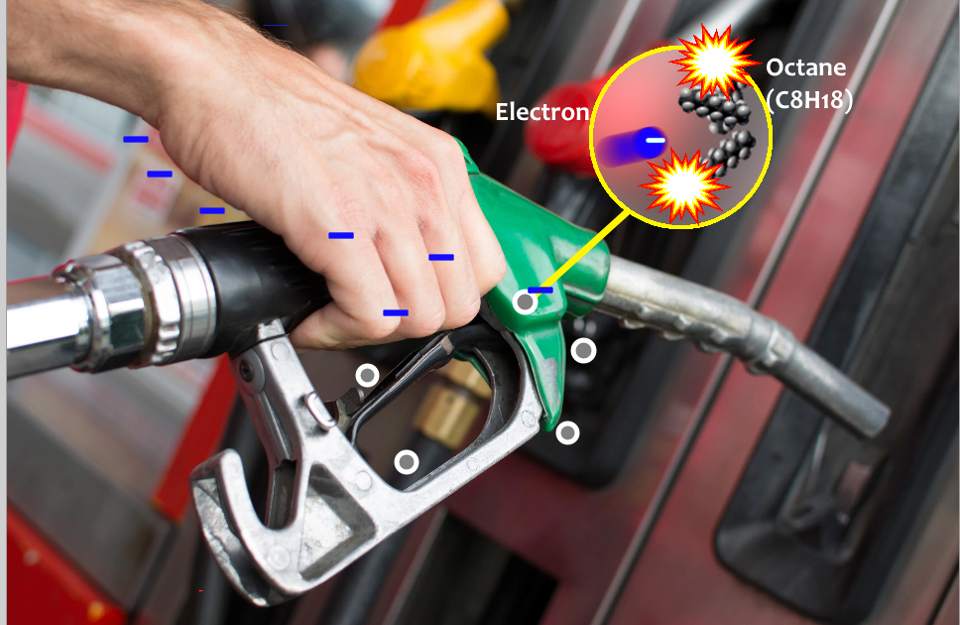
But wait, what’s a reaction? Remember what I said before about molecules doing whatever it takes to return to balance? Well, that’s a reaction! When atoms combine to form molecules, they use energy to form bonds to stick together and reach a form of balance. In order to break these bonds, more energy is required, and atoms separate and join with other atoms nearby to form new molecules. This causes for energy to be, in this case, released. This is used in your cars to move pistons and make your car move, but that’s another lesson. Now, imagine your clothes rubbing against your seat when you’re getting out of the car to fuel up or after getting something. Considering that the fuel nozzle is metal, that gasoline has a tendency to become a gas, and you have a charge build up… since energy is made from the movement of electrons (they literally crash into other atoms when they move) it causes for this reaction to occur, and now the expansion of heat and air spread out and cause those explosions that many people see in horror movies.
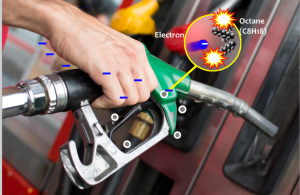
As electrons move from the hand to the metal, they can collide with gas vapors. But how do we counter this?!
It’s actually pretty simple: touch your car before you touch the nozzle. The extra electrons on your clothes and body will go to the car, and then to the ground instead of to the gasoline vapors near the nozzle. Make sure to do this a ways away from your gas tank – ideally by the doorframe by the driving wheel, and you should be fine!
Either way, there are other ways for energy to be transferred, so you need to always be careful when going near a fuel source. Just don’t smoke, use flint, or summon the power of the force while you’re gassing up. Be smart, and don’t do anything that might cause for combustion to occur!
Electric Potential Energy. (n.d.). Retrieved April 14, 2018, from http://hyperphysics.phy-astr.gsu.edu/hbase/electric/elepe.html
E., E., E., E., E., & E. (n.d.). Electricity – Electrical Charge, Electric Fields, Coulomb’s Law And The Forces Between Electrical Charges, Resistance – Current, Voltage, Ohm’s law. Retrieved April 14, 2018, from http://science.jrank.org/pages/2342/Electricity.html
Combustion. (n.d.). Retrieved April 14, 2018, from https://www.grc.nasa.gov/www/k-12/airplane/combst1.html
Combustion Reactions. (n.d.). Retrieved April 14, 2018, from http://www.iun.edu/~cpanhd/C101webnotes/chemical reactions/combustion.html
-

Overcoming Depression at the Level of the Brain

Depression is a common but serious mood disorder that causes persistent feelings of sadness. Many people, ranging from young to old, suffer from depression. It is especially prevalent in young adults and college students. Those suffering from depression often have trouble doing every day activities and sometimes may feel that life is hopeless.
However, since depression has been around for so long and is so common, the good news is there are numerous treatments for it that have been proven successful. Two of the most common treatments are antidepressant medication (SSRIs) and cognitive-behavioral therapy. Here, we take a closer look at how these two treatments work in battling depression at the level of the brain.
Levels of serotonergic neurotransmission play an important role in determining mood. Depression is said to caused by low levels of serotonergic neurotransmission. SSRIs counter these low levels by interfering with the serotonin transporter 5-HTT—it causes slower reuptake of serotonin. This causes the low levels of serotonin in the brain to be elevated, thus relieving depression. Like antidepressant medication, cognitive-behavioral therapy also produces changes in the brain when treating depression. In those suffering from depression, their hippocampus decreases in size by the constant release of glucocorticoids due to stress. This, in turn, creates more stress and depression. It has been found that after completing CBT, those with depression show significant improvement in their depression, which is associated with significant increases in the hippocampus. Both antidepressant medication and CBT are successful in treating depression, however how they affect the brain in different ways to achieve this.
Those who struggle with depression also face risk of relapse after discontinuing treatment. In terms of preventing relapse, it has been shown that CBT has significantly less risk of relapse than medication. In one study, it was found that the percent of relapse after treatment was 30% for CBT versus 76% for antidepressant medication. A reason for this disparity may be that CBT teaches patients how to change the way they think and in turn, how they feel and act, so that even after they discontinue therapy, they can continue to apply the skills they have learned in therapy. Medication only changes the serotonin levels in the brain with no conscious effort on the person’s part, so it is harder to prevent depression after discontinuing the medication.
In conclusion, both antidepressant medication and cognitive-behavioral therapy relieve depression by altering the brain. Medication works by inhibiting serotonin reuptake, which elevates the low levels of serotonin in people with depression. CBT helps patients change the way they perceive thoughts, which has been associated with increased hippocampus size, which helps prevent stress and depression. However, when discontinuing treatment, those who completed CBT are at a much lower risk of relapse than those who took medication, as CBT teaches people skills they can apply even after treatment ends. It is often recommended to those suffering from depression a combination of medication and therapy, so that they have the most promising outlook on overcoming their depression.
Goldapple, K. (2004, January 01). Modulation of Cortical-Limbic Pathways in Major Depression. Retrieved January 16, 2019, from https://jamanetwork.com/journals/jamapsychiatry/fullarticle/481941Hollon, S. D. (2005, April 01). Prevention of Relapse Following Cognitive Therapy vs Medications in Moderate to Severe Depression. Retrieved January 16, 2019, from https://jamanetwork.com/journals/jamapsychiatry/fullarticle/208447Schafer, W. R. (n.d.). How Do Antidepressants Work? Prospects for Genetic … Retrieved January 16, 2019, from https://www.cell.com/cell/fulltext/S0092-8674(00)80042-2 -
A History of Bias: The Tuskegee Syphilis Experiment
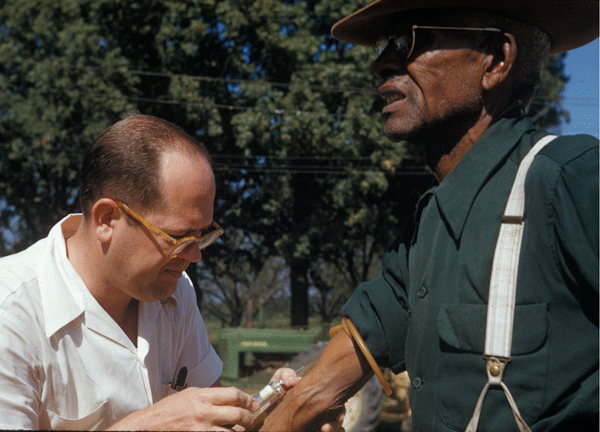
We’ve come a very long way in the way we perceive medicine and how we use it. We’ve grown from studying the humors of medieval times and performing brain lobotomies in the 1900s to the most complex surgeries and medicines that can save millions of lives. But sometimes the question that isn’t asked is, what was the cost of this new knowledge? Were the decades of long, painstaking research and repeated experiments worth it when some subjects were put through experiments that ended in permanent injury or their death? There has always been a long and dark history to the cases of medical bases, especially in the case of race, sex, and gender. In this article, I want to focus on racial bias, discussing the story of the Tuskegee Syphilis Experiment, why it is an example of medical bias and the impact that this bias made on history and future research.
What Started This?
In 1932, a study was started by the Public Health Service to study the natural history of syphilis to justify treatment programs for black males. The experiment was meant to build upon a similar study on untreated syphilis in Norway in 1928. The initial goal of the study was to follow the disease in black men for six to nine months, and have a treatment phase for the subjects after. The study took place at the Tuskegee Institute in Alabama and the subjects were recruited from Macon County, which is part of the Black Belt, a region with rich soil and black sharecroppers. The participants were mostly poor and illiterate, signing up mainly for the benefits described to them. About 600 participants were recruited, 399 who had untreated syphilis and 201 who acted as control subjects.

What Went Wrong?
The problem with this study that caused so much controversy was what the research participants were told about the study and what would happen to them. The participants were told that they were being treated for bad blood, which was used to describe issues like fatigue, anemia, and syphilis. They were told that they would receive medical exams, rides to and from the clinics, meals on examination days, free treatment for minor ailments and guarantees that provisions would be made after their deaths in terms of burial stipends paid to their survivors. The participants were told that the study would last for six months in 1932, but it went on until 1972. Another problem with the ethics of the study was the fact that the participants gave no written or informed consent to be experimented on. There was no evidence to show they had an option to leave the study, and the treatment they were given was slightly effective and highly toxic. After years of research and generations of unknown diseases transferred to spouses, children, and many affected, a report by the Associated Press was released in 1972 about the experiment, which was then forced to shut down a month after. Even though a class-action lawsuit led to nine million dollars given to the participants and an apology was given by President Clinton, the consequences brought to the participants and their families couldn’t be undone. The last survivor of the experiment passed away in 2004, and the last widow receiving benefits from the Tuskegee Health Benefit Program passed away in 2009.
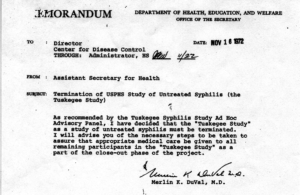
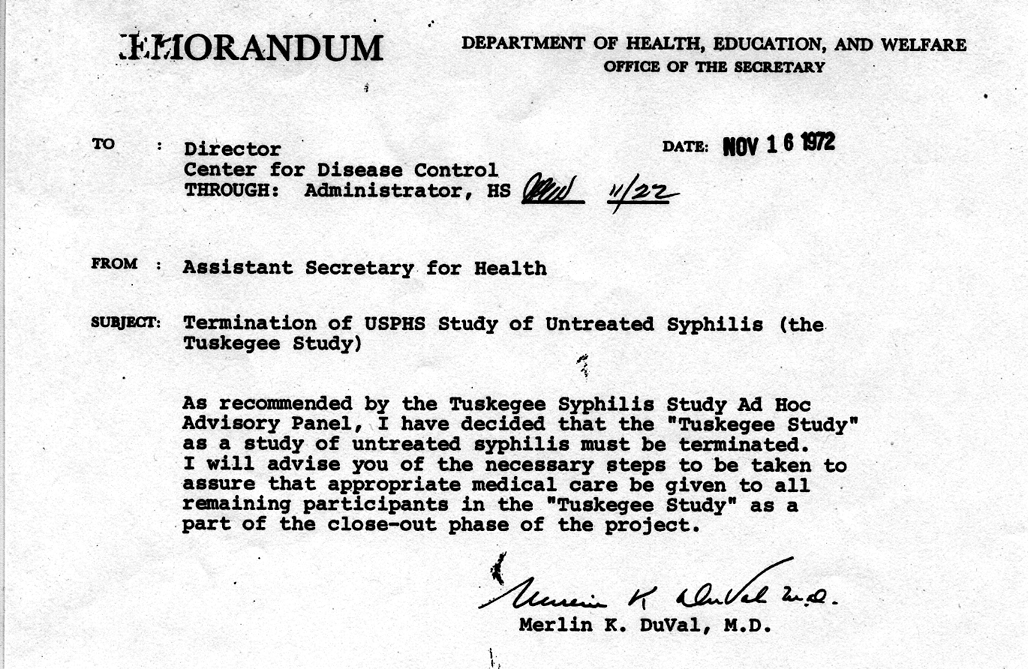
A memorandum from the Department of Health, Education and Welfare in November 1972 requiring the Tuskeegee Syphillis Study to be terminated, and for all remaining “participants” to be given the cure. How Has It Affected Research & Medicine Today?
Despite the heartbreaking story of the Tuskegee Syphilis Study, it has helped to change how researchers approach studies similar to it. The study led to the creation of the National Commission for the Protection of Human Subjects of Biomedical and Behavioral Research and the National Research Act, as well as the establishment of institutional review boards, or IRBs for institutions receiving federal support. Since the end of the study, IRBs require that all participants in a study are willing and voluntary patients. In the end, because of the syphilis study, the U.S. was able to become a more ethical place for research, even creating the Tuskegee Bioethics Center, a national center for research and health care.
Sources:
About the USPHS Syphilis Study. (n.d.). Retrieved October 25, 2019, from https://www.tuskegee.edu/about-us/centers-of-excellence/bioethics-center/about-the-usphs-syphilis-study.
Brown, D. N. L. (2019, August 26). ‘You’ve got bad blood’: The horror of the Tuskegee syphilis experiment. Retrieved October 25, 2019, from https://www.washingtonpost.com/news/retropolis/wp/2017/05/16/youve-got-bad-blood-the-horror-of-the-tuskegee-syphilis-experiment/.
CDC. (2015, December 22). Tuskegee Study – Timeline – CDC – NCHHSTP. Retrieved October 25, 2019, from https://www.cdc.gov/tuskegee/timeline.htm.
Heller, J., Burns, L., Merritt, C., Corine, Thompson, M., Sam, … Bryant, D. (2018, April 13). Generations later, the effects of the Tuskegee syphilis study linger. Retrieved October 25, 2019, from https://www.statnews.com/2017/05/10/tuskegee-syphilis-study/.
Jones, J. H. (1993). Bad blood: The Tuskegee Syphilis Experiment. New York: Free Press.
-
Health Shot: Vitamin Overdose
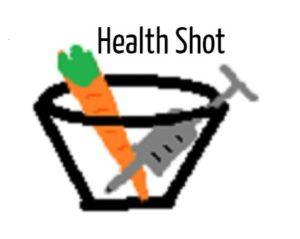 Too much of a good thing is even better? Right? Wrong. Turns out with vitamins, this is not the case. The Vitamin market is a $23.3 Billion industry, and we are increasingly turning to these convenient capsules for a quick fix. The effect of vitamins is a U curve – too little has negative effects, but so does too much. A moderate amount has the best effects on the body – but this can be hard to achieve with vitamin supplements. Vitamins usually have 1-10x the recommended daily allowance in their pills, and people take these without question. With public opinion largely being that vitamins are a revolution, I want to shed some light on how overdosing on some of the most popular supplements can have detrimental effects.
Vitamin D
Vitamin D manages calcium in your blood, bones and gut and helps cells all over your body to communicate properly. Since the rise of sedentary lifestyles, many have been turning to Vitamin D supplements over being outside in the sun. Large overdoses of vitamin D (100x the daily allowance for many months) can cause calcium buildup in the blood, called Hypercalcemia This buildup can result in persistent nausea and frequent vomiting. Additionally, the calcium buildup in the blood can cause kidney damage when the calcium binds with phosphate and forms crystals in tissues. In a case series conducted in Kashmir, India, researchers found that the Vitamin D prescribed by physicians to treat deficiencies was far exceeded the required daily amount, and pushed patients to hyperclacemia. In their conclusions, the researchers cautioned against taking a seemingly innocuous vitamin in large doses.
Vitamin A
Vitamin A is important for eye heath and helps prevent eye diseases like Age-related macular degeneration. However, Acute Vitamin A toxicity can occur when a single excessively high dose and chronic toxicity when 10x the recommended daily amount is taken over a long period. Side effects can include headaches, vision disturbances, joint pain, and skin irritation. Worse, toxicity can impact fetal health and even cause birth defects of the eye, skull, lungs, and heart. The national institutes of health warns pregnant women about taking high dose Vitamin A supplements.
Vitamin E
Vitamin E is important to important to vision, reproduction, and the health of your blood, brain and skin. In a clinical trial called SELECT (Selenium and Vitamin E Cancer Prevention Trial), 35,000 men 50 years and older took Vitamin E and Selenium supplements for 5.5 years and then were observed for 1.5 years following. Men tho took Vitamin E supplements alone had a 17% increased risk of prostate cancer compared to men on the placebo pill. Men taking vitamin E and selenium both also had an increased risk of prostate cancer, but in lower amounts. After analyzing the results, the SELECT team concluded that the vitamin dose (400IU/day) given was far too high based on the U shaped curve. The recommendation from the SELECT team was that men should not take vitamin supplements for cancer prevention.
The Takeaway
As the negative repercussions of vitamin overdoses continue to come to light, researchers are starting to question the practice of prescribing vitamins to those with deficiencies in high doses. As consumers of vitamins, we have the responsibility to ensure that we are getting our vitamins in reasonable quantities through vitamins or sticking to natural sources. Next time you decide to pop a pill, you might want to flip the bottle around and get a better look at what you’re having!
Sources:
Nicastro, H. L., & Dunn, B. K. (n.d.). CHAPTER 25. The Selenium and Vitamin E Cancer Prevention Trial (SELECT): Prevention of Prostate Cancer Using Selenium and/or Vitamin E in the SELECT Cancer Prevention Trial. Food and Nutritional Components in Focus Selenium,428-457. Retrieved from https://epi.grants.cancer.gov/Consortia/members/select.html.
Office of Dietary Supplements – Vitamin A. (n.d.). Retrieved from https://ods.od.nih.gov/factsheets/VitaminA-HealthProfessional/
Penniston, K. L., & Tanumihardjo, S. A. (n.d.). Vitamin A in dietary supplements and fortified foods: Too much of a good thing? Journal of the Academy of Nutrition and Dietetics. Retrieved from https://www.ncbi.nlm.nih.gov/pubmed/12963949.
Trend Insights: Vitamins & Supplements. (n.d.). Retrieved from https://www.fona.com/trend-insights-vitamins-supplements/.
-
Psychedelics
Introduction:Microdosing is the use of micro amounts of psychedelic substances on a consistent basis (Anderson). Psychedelics, such as LSD and psilocybin (street names acid and shrooms), are “powerful psychoactive substances that alter perception and mood and affect numerous cognitive processes” (Nichols 266). Recent studies have shown that full-doses of these substances used for psychotherapy decreased depression and anxiety in cancer patients (Johnstad). The theory behind microdosing is that small amounts of psychedelics can help increase creativity and problem-solving abilities (Johnstad).
Psychedelics have been used for centuries sometimes as part of cultural rituals. After the discovery of serotonin in the brain, researchers believed that the effects of psychedelics were linked to serotonin. After studies were completed on rats, it turns out they were somewhat correct. Researchers, now, believe that psychedelics are agonists or partial agonists meaning they combine with receptors in the brain to achieve the psychological effects (Kenakin; Nichols). The brain receptor that’s affected is serotonin 5-hydroxtryptamine 2A (Nichols).
Studies:
Due to legal restrictions, psychedelic studies are limited. There are several self-reported studies from the US where people voluntarily reported how they feel when they microdose, and there was a singular study published in 2018 from the Netherlands that explored microdosing in a scientific setting.
In one of the self-reported studies, Microdosing psychedelics: personality, mental health, and creativity differences in microdosers, microdosers showed significantly lower scores on “dysfunctional attitudes. . . and negative emotionality” meaning they reacted more positively to life experiences (Anderson, et al. 731). Microdosers also had significantly higher wisdom, open-mindedness, and creativity scores which agrees with the theories stating that microdosing makes people more creative and better at problem solving (Anderson, et al.).
Another self-reported study, Powerful substances in tiny amounts: An interview study of psychedelic microdosing, looked extensively at 21 microdosers. These microdosers reported “improved mood, cognition, and creativity” (Johnstad), but some reported that they quit the practice due to cons outweighing the pros. Some people had issues with preforming tasks like driving or work, and others had issues like accidental overdosing (meaning that they experienced hallucinations and other aspects caused by a full dose of a psychedelic). Mushrooms, in particular, have varying amounts of psilocybin, so it’s hard to ingest an accurate amount when microdosing (Johnstad).
The study titled Exploring the effect of microdosing psychedelics on creativity in an open-label natural setting is the only study that tries to quantify the effects of microdosing on cognitive abilities. Before microdosing, participants completed three different tasks meant to test their convergent, divergent, and fluid thinking. The participants then consumed a small amount of psychedelics and performed the tasks again. The researchers concluded that convergent and divergent thinking where enhanced by the psychedelics while fluid intelligence remained the same. This was an extremely preliminary study with no placebo group, but the results suggest a need for further testing in this subject matter (Prochazkova).
Conclusion:
Although research has been done into microdosing, it’s hard to make a finite conclusion about its quantitative effects. There are possible pros to microdosing, but there are also negatives including accidental tripping and cost.
Sources:
Anderson, Thomas, et al. “Microdosing Psychedelics: Personality, Mental Health, and Creativity Differences in Microdosers.” Psychopharmechology, vol. 236, no. 2, 2019, pp. 731–740., doi:10.31234/osf.io/gk4jd.
Johnstad, Petter G. “Powerful Substances in Tiny Amounts.” Nordic Studies on Alcohol and Drugs, vol. 35, no. 1, 15 Feb. 2018, pp. 39–51., doi:10.1177/1455072517753339.
Kenakin, Terry P. “Agonist.” Agonist – an Overview, Science Direct, 2009, www.sciencedirect.com/topics/neuroscience/agonist.
Nichols, David E. “Psychedelics.” Pharmacological Reviews, vol. 68, no. 2, Apr. 2016, pp. 264–355., doi:10.1515/9781400878697-012.
Prochazkova, Luisa, et al. “Exploring the Effect of Microdosing Psychedelics on Creativity in an Open-Label Natural Setting.” Psychopharmacology, vol. 235, no. 12, 2018, pp. 3401–3413., doi:10.1007/s00213-018-5049-7.
-
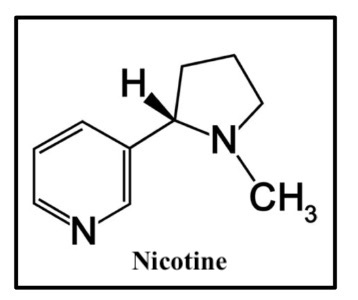
Nicotine is Dope: a poem on vaping and addiction
What nice etiquette
Not to be burning a cigarette.
With flavors like Diet Coke
Instead of plain old smoke.
Youth claim to thrive
On something that resembles a flash drive.
But wait,
Maybe we should take five.
It seems vaping has strayed from its original intent.
It is no longer used to prevent.
And is now an addictive supplement.
Without trying to overreact,
Let me present some facts:
With every juice pod that is drained,
There are effects on the brain.
Research shows detriments to the prefrontal cortex –
An area so important for cognitive development…
Especially during adolescence!
This is what lower activity in this region can mean:
Difficulty choosing between
Or even troubles controlling the obscene…
Things that, quite frankly, are already hard enough for teens.
So make sure you look for the current research and stats.
So next time one says it’s healthier than cigarettes,
You can say, “Well maybe we should chat.”
References:
England L, Bunnell RF, Pechacek, et al. Nicotine and the developing human: A neglected element in the electronic cigarette debate. American Journal of Preventive Medicine. 2015;49(2): 286–293.
Musso F, Bettermann F, Vucurevic G, et al. (2007). Smoking impacts on prefrontal attentional network function in young adult brains. Psychopharmacology. 2007;191(1): 159-169.
Primack BA, Shensa A, Sidani JE, et al. Initiation of traditional cigarette smoking after electronic cigarette use among tobacco-naïve US young adults. The American Journal of Medicine. 2018;131(4): 443.e441-443.e449.
Yuan M, Cross SJ, Loughlin SE, Leslie FM. Nicotine and the adolescent brain. Journal of Physiology. 2015;593(16):3397-412.