Category: Articles

  • La Balada del Gringo Perdido

    La Balada del Gringo Perdido

    Este artículo fue escrito en el 2012 por el profesor Joe Mendelson, director de investigación en el zoológico de Atlanta e instructor en Georgia Tech. Lo he traducido lo mejor que pueda, pero siempre hay cosas subjetivas y rarezas de cada dialecto. Espero que no sufran tanto mis cantabridades.

    La herpetología y el perderse. Estos son los grandes temas de mi vida. Me han dado forma a mi carrera y me han permitido descubrir especies desconocidas a la ciencia, pero también me han costado relaciones, frustrado a todos cerca de mi, y casi me han costado la vida. Sin ellos, sería otra persona, así que esto es una balada al arte perdido del perderse.

    Después de la universidad, me fui de Santa Bárbara, en California, a una escuela de posgrado en Tejas para estudiar con un [mid-career hotshot] que se especializaba en la herpetología de Centroamérica. Es un gringo norteamericano que creció en Guatemala, así que para él es normal entrar y salir de esa cultura. En el primer año de mi posgrado me salió la asignatura de mis sueños. Iba a ser trasladado a una plantación de café en una región remota de Guatemala para hacer una encuesta científica de anfibios y reptiles. Tenía que hacer un transecto ecológico de la diversidad herpetológica por [la ladera/el lado] de una montaña muy pindia en la Sierra de la Minas, en el estado de Alta Verapaz. Aunque el área había sido poblada desde la era clásica de los maya, ningún biólogo había trabajado por cualquier sitio cerca de la región. Si echas un vistazo a un mapa de Guatemala, verás un lago enorme (el lago de Izabal) en el este del país. Estaba ubicado a unos treinta y dos kilómetros al oeste del lago, en el valle Polochic, a la base del [vertiente] norte del Cerro Raxón. La plantación se llamaba Pueblo Viejo, una referencia al hecho que el sitio había sido habitado por los maya desde hace miles de años. Resultaban dos problemas: 1) No hablaba ni una palabra de español; 2) aunque crecí en europa [army brat] y estaba acostumbrado a ser inmerso en culturas extranjeras, además de unos viajes de pesca, nunca había estado en latinoamérica; y 3) Guatemala estaba enrollada en una terrible guerra civil genocida (la cual, por cierto, fue instigada a propósito por la CIA en los años cincuenta).

    El dia antes de ir al aeropuerto mi mentor me dio unos mapas topográficos de mi sitio de estudio y me dijo, “Si te para cualquier persona con pinta de policía o soldado, no les dejes ver estos mapas porque van a pensar que estás allí para informar a la insurrección indigena y te van a arrestar. Ah, y no traigas esas botas militares que llevas. Son las que lleva el ejército americano. Cojete algunas con pinta de turista.” Entonces pedí dinero de mis padres y me compré unas botas coloridas del REI cercano, y puse los mapas en el fondo de mi mochila.

    Juro que jamás viajaré con semejante ignorancia de mi situación. Resultó que el hablar español hubiera tenido utilidad muy limitada, porque estaba en una región tan aislada que la mayoría de las personas hablaban Q’eqchi’, uno de los muchos diversos dialectos mayas en la región, y solo un poquito de español. Cada vez que aventuraba tras la parte principal de la plantación de café, encontraba [aldeanos/nativos] que dejaban todo y echaban pitando. Estaba aterrorizado. Si ellos me tenían miedo, sabía que había algo que debería temer también. Desde mi regreso, he construido una biblioteca pequeñuca sobre la historia guatemalteca, y ahora entiendo lo que no entendía cuando aquello. Resulta que los agujeritos que vi en las paredes de cemento en el pueblo cercano de Telemán eran de una masacre pocos años antes de mi llegada al país. Las guerras genocidas aún existen, y son increíblemente feas.

    Tenía que hacer un transecto ecológico, y al final llegué al pueblo más alto de la vertiente de esa sierra, un pueblín Maya llamado Peña Blanca, con algún otro nombre en Q’eqchi’ que nunca pude pronunciar (los dialectos Maya tienen oclusivas glóticas a mitad de sílaba, o sea, básicamente imposibles para los hablantes que no son nativos). La gente se veía maja en Peña Blanca, y no se huían de mí. Acampe justo afuera de su pueblo, con su permiso implícito. Las primeras dos noches tuve un pequeño grupo de gente alrededor mirándome mientras hacía mi cena de campamento de mierda y preparaba mis especímenes, muestras, y notas. No nos podíamos hablar, pero logré explicar que quería acampar allí, que no les deseaba ningún daño, y que planeaba recorrer las afueras del pueblo en busca de culebras y ranas y cosas parecidas. Estaban tranquilos con eso, e incluso me trajeron las culebras que mataban en los maizales cada día (especímenes muy útiles para mi).

    Después de unos días camine de vuelta a mi campamento principal en la plantación [and got read the riot act] director racista y fascista guatemalteco por haber tenido “cualquier relación con los rebeldes de la montaña” (recuerda que había un guerra civil, básicamente entre aristócratas como este tío y los maya por las montañas). Como una semana después me fui de vuelta a mi campamento, pero esta vez no se me acerba ni una persona. Estuve allí por tres días hasta que me di cuenta de que estaba haciendo algo malo – mi colección de datos egoísta para mi licenciatura estaba severamente comprometiendo su vida cotidiana.
  • Common Cat-astrophes

    Common Cat-astrophes

    Finding and trying (usually unsuccessfully) to pet street cats is often one of the highlights of my day. Nevertheless, it is always somewhat bittersweet to find a feline friend outdoors, as it is almost certain that it is killing local wildlife. Various studies have estimated that outdoor cats cause the deaths of billions of birds in the United States, and potentially dispatch over twenty billion mammals. However, they can hardly be held responsible for their deaths, much as we cannot be held responsible for breathing. A cat chasing a lizard or a mockingbird is simply following its instincts. These behaviors persist even if cats are well-fed, given that they will consistently seek stimulation from the outdoors, especially if neglected or under-stimulated at home.

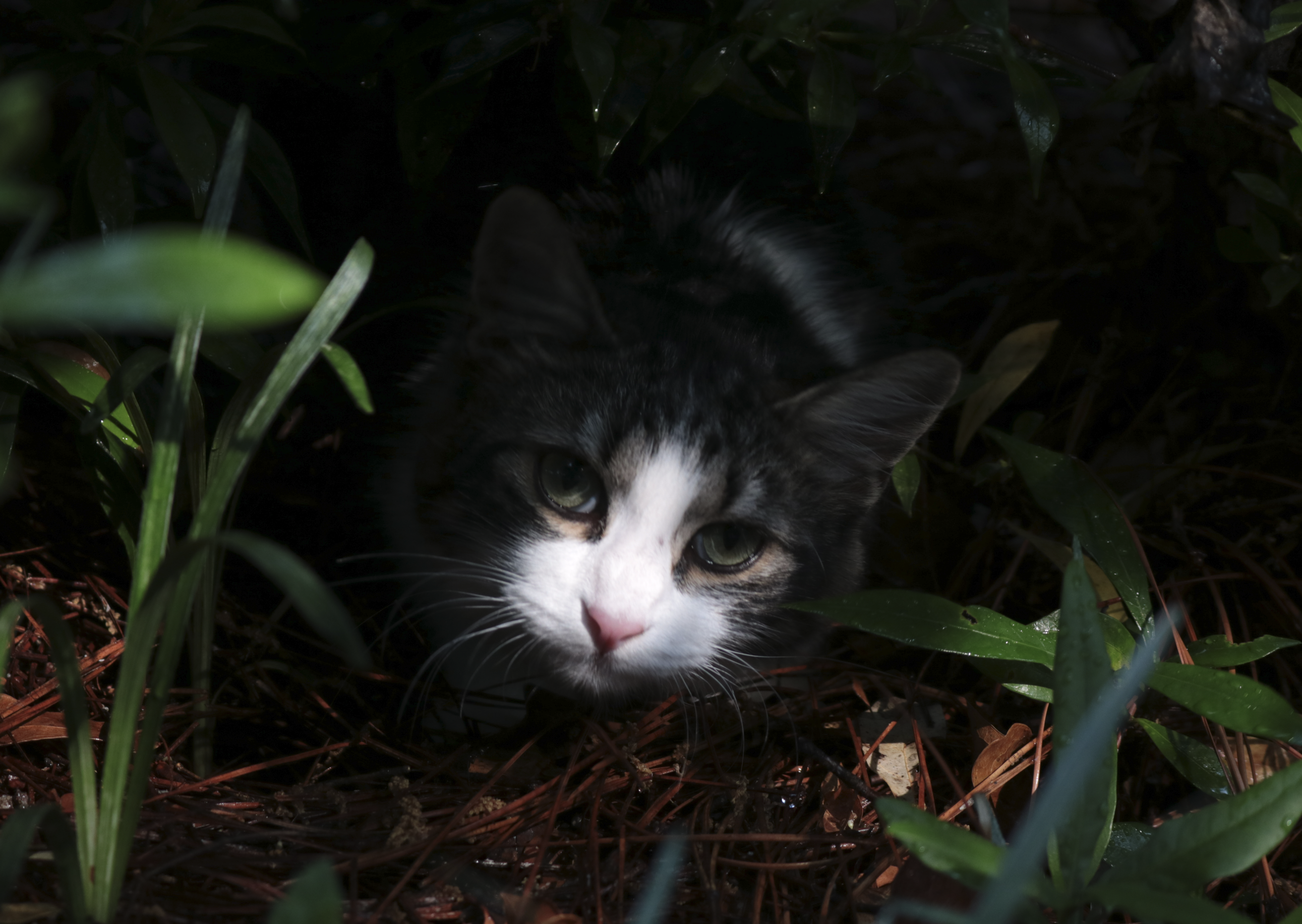
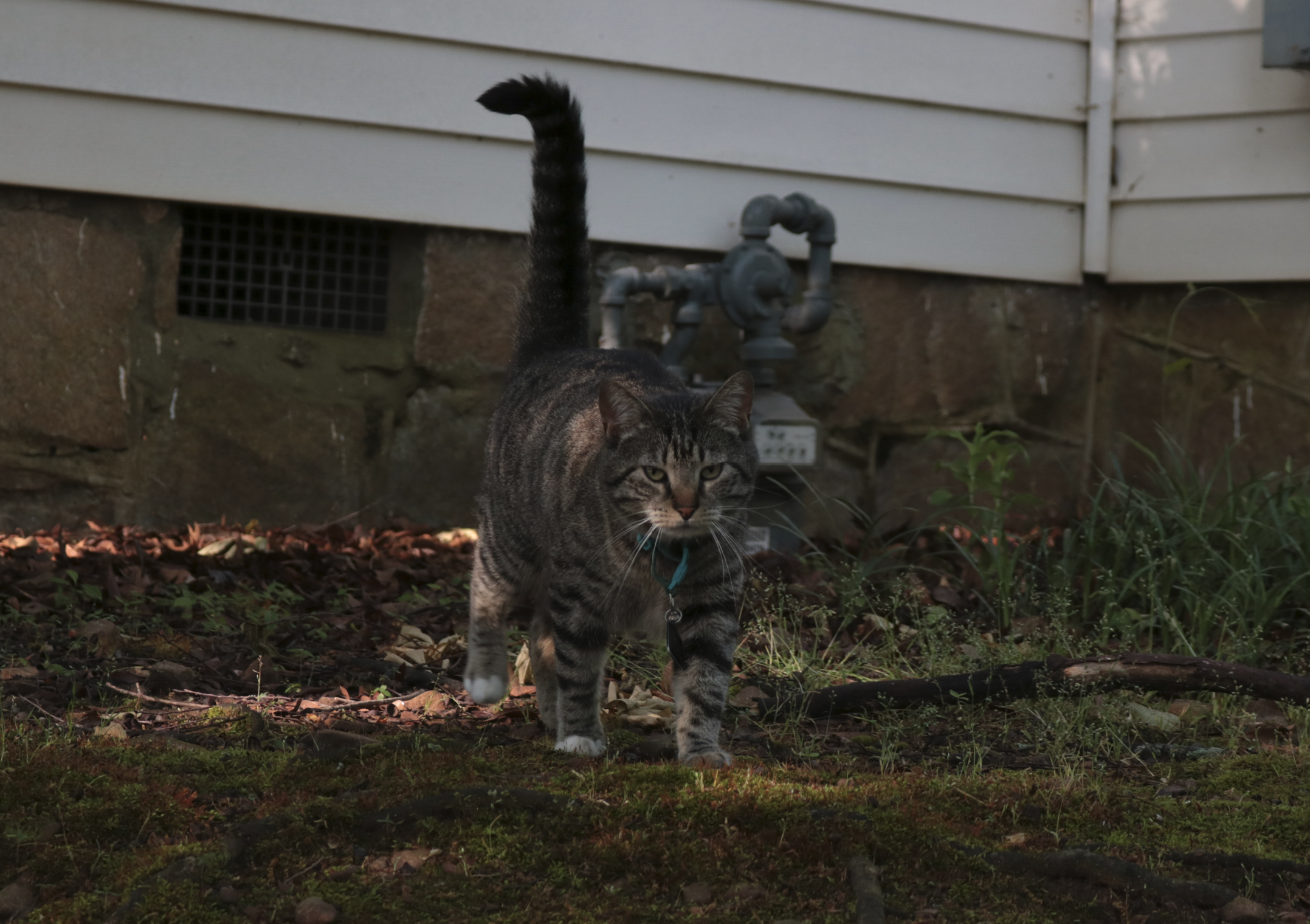
    Pictured above is Mikigo, a friendly kitty which wanders around Home Park Avenue. Although I love petting her, I have seen her chasing birds around the neighborhood. It is almost certain that she kills a few every month, and even this number may very well be an underestimation of her murderous proclivities. These effects can be even more devastating in environments with endangered species, especially if said species have no predators similar to domestic cats and have not developed any sort of defense mechanisms against them.

    Another tiny monster I found in Home Park

    Perhaps you don’t think that a few birds a month makes much of a difference, and if there were only a few dozen cats in the United States, I’d agree. However, a few seconds of multiplication shows the true extent of feline ecological damage. There are at least fifty million feral cats, not counting millions more house cats which are allowed to roam. Even if each feral cat killed only one bird a month, this would result in six-hundred million dead birds every year. Unfortunately, many feline-welfare programs which trap cats either neuter or spay them but release them back into the wild after the procedure, which might lead to another few years of ecological damage while the cat roams freely. The best option for wildlife is to adopt feral cats, and to keep your kitty indoors.

    Loss et al. The impact of free-ranging domestic cats on wildlife of the United States. Nature Communications, 2012.

  • Probiotics in Food

    Probiotics are living microorganisms like bacteria and help intestinal issues. Issues that can be helped through probiotics are bloating, irritable bowel syndrome (IBS), diarrhea, and even lactose intolerance. They help “prevent diarrhea when taking antibiotics and help to ease some symptoms of IBS” (Probiotics). For all the lactose intolerant readers, probiotics like Lactobacillus acidophilus and Lactobacillus bulgaricus help with lactose digestion (Aubrey). Ways to supplement intestinal probiotics exist through food, for example specific foods like yogurts and kefir. I would like to know if probiotics in different foods work enough to significantly improve intestinal health. 

    Yogurt remains a common and known source of probiotics, however not all yogurts label as probiotic. Probiotic yogurts claim their product “inhibits the growth of unfriendly bacteria, regulates bowel transit time and helps maintain a healthy gut microbial balance”( Beck). Probiotic labeled yogurt needs a minimum of 100,000 cfu in the yogurt. One would want to know if the bacteria lives long enough that it stays alive until eaten. The health of probiotics depends on many factors such as temperature, number of day within the yogurt and probiotic food source within the yogurt. Probiotic regulation lacks the intensity of regulating other foods, so “we can’t always be sure that: the product contains the bacteria stated on the label; the product contains enough bacteria to have an effect; the bacteria are able to survive long enough to reach your gut” (Probiotics). To consume the probiotic strain to help intestinal health, yogurt like Danon’s Activia has less than 25 times the needed serving proven to help (Beck). Reliable yogurts do exist, but they may be harder to find. Yoplait’s Yoptimal provides the amount of specific probiotic bacteria proven to decrease cavity-causing bacteria (Beck). Therefore, research into individual yogurt contents prove necessary if probiotics are needed rather than simply the flavor.


    A balanced and healthy diet helps your intestines, but if extra help is needed here are a few food items to look for. Barley and red kidney beans are excellent sources of fiber, which is fuel for the probiotic bacteria (Cadman). Sources of probiotic bacteria like pickles made with salt and not vinegar, miso, and kefir have a substantial amount of probiotics. Cheeses that have live probiotic cultures like gouda, mozzarella, cheddar, and cottage cheese show that flavor coincides with health (Palsdottir). Cheeses fermented but not all of them have live cultures, therefore reading the label proves necessary. Fermented foods like kimchi and sauerkraut prove beneficial because they both contain a large amount of probiotics, however kimchi has more probiotics and better benefits. Throughout the world wonderful and flavorful ways of intaking probiotics remain. To maintain intestinal health, a diverse diet of these foods and other probiotic filled foods proves mandatory. If these foods do not have the amount of probiotics to help your gut, supplemental vitamins provide a more powerful source and would have large amounts and diversity of probiotics. Maintaining a healthy lifestyle and listening to your body will manifest healthy results for your intestinal tract.


    Bibliography

    Aubrey, Allison. “Confusion at the Yogurt Aisle? Time for Probiotics 101.” NPR, NPR, 9 July 2012, https://www.npr.org/sections/thesalt/2012/07/09/156381323/confusion-at-the-yogurt-aisle-time-for-probiotics-101.

    Beck, Leslie. “Not All Probiotic Yogurts Are Created Equal. Does Yours Measure up?” The Globe and Mail, The Globe and Mail, 21 Apr. 2017, https://www.theglobeandmail.com/life/health-and-fitness/health/not-all-probiotic-yogurts-are-created-equal-does-yours-measure-up/article34780110/.  

    Cadman , Bethany. “The 19 Best Prebiotic Foods Suitable for Vegans.” Medical News Today, MediLexicon International, 1 Oct. 2018, https://www.medicalnewstoday.com/articles/323214#fruits. 

    Palsdottir, Hrefna. “11 Probiotic Foods That Are Super Healthy.” Healthline, Healthline Media, 6 Jan. 2022, https://www.healthline.com/nutrition/11-super-healthy-probiotic-foods. 

    “Probiotics.” NHS Choices, NHS, 27 Nov. 2018, https://www.nhs.uk/conditions/probiotics/. 

  • Neurotransmitter Notes: Serotonin + Oxytocin

    Neurotransmitter Notes: Serotonin + Oxytocin

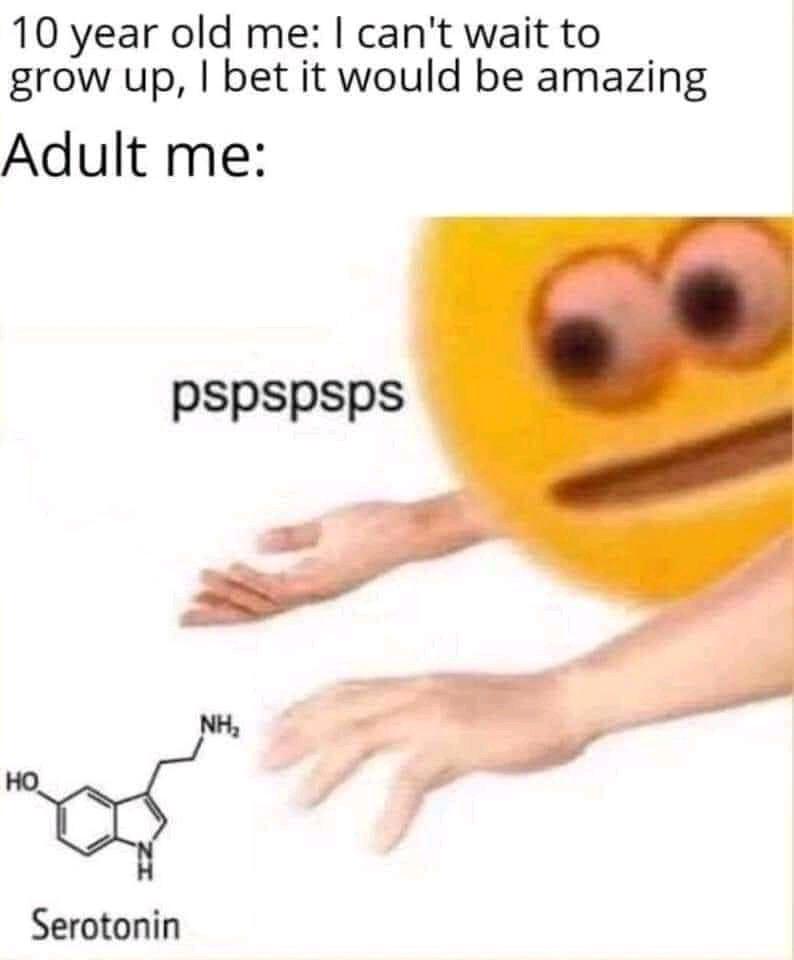
    10 year old me: I can't wait to grow up, I bet it would be amazing. Adult me: a picture of a cartoon face making the pspsps sound at a chemical diagram of serotonin the way one would call a cat.


    Take two of our Neurotransmitter Notes! If you are in the midst of finals season like me, maybe you want something to cheer you up. I might not be able to make your neurons fire off serotonin or oxytocin, but maybe learning about them will help you produce your own! Without further ado, let’s set the tone with serotonin…


    “Am I going crazy

    Consuming me lately

    And I’m well

    I’m over it

    Not where I’ve been

    It’s where I’m going

    Looking for my vibe

    Wanna bathe myself in serotonin”


    Serotonin- Courtney Govan


    After dopamine, serotonin might just be the second most well known neurotransmitter. And like dopamine, it has effects beyond making you happier: it could be better described as a mood regulator that can also affect your sleep, digestion, and wound healing (Serotonin, n.d.).


    But before you buy those serotonin gummies off the internet, be careful! Too much serotonin can lead to serotonin syndrome, This alliterative ailment can cause vomiting, headache, rapid heart rate, and muscle twitches (Dunkin, n.d.). In this situation, you really can have too much of a good thing. But what about the opposite?


    A lot of people being treated for depression know about serotonin in the context of “the thing I need more of”. This perception is described in girl in red’s Serotonin:


    “I’m running low on serotonin

    Chemical imbalance got me twisting things

    Stabilize with medicine

    But there’s no depth to these feelings

    Dig deep, can’t hide

    From the corners of my mind

    I’m terrified of what’s inside”


    Serotonin- girl in red


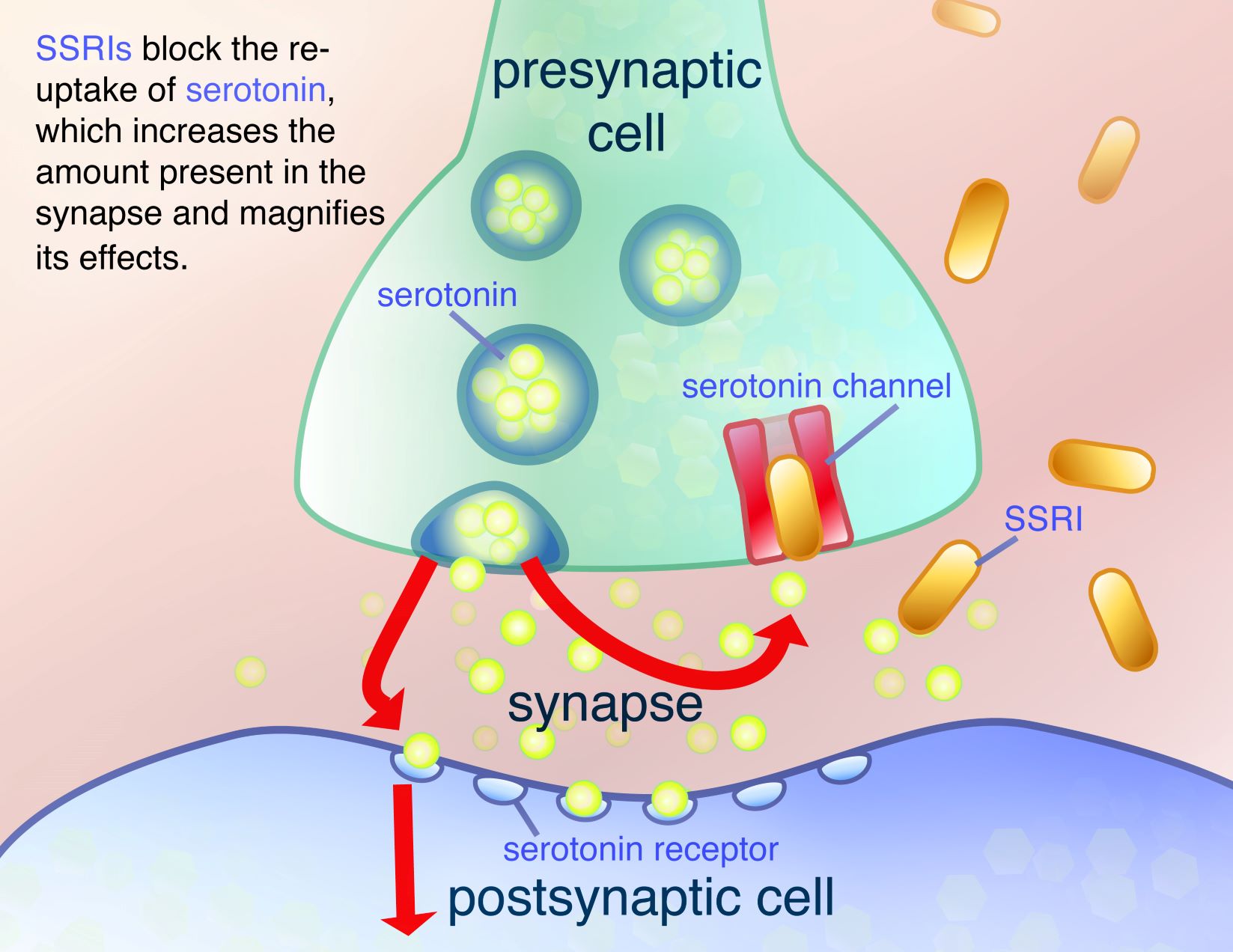
    Indeed, depression is linked to lower activity of neurons that use serotonin. One of the most common antidepressants prescribed nowadays are the selective-serotonin reuptake inhibitors (SSRIs). The medicine girl in red describes is likely an SSRI, which works by preventing serotonin from being taken up by neurons after it is released into a synapse (the junction between neurons where neurotransmitters transfer a signal from one neuron to the next). This increases synaptic serotonin levels. Then, like if you were to increase the number of balls in a pinball machine, the serotonin is more likely to bind to a receptor on the other side, activating the next neuron. Boom–more activity!

    an image showing the process by which ssris prevent serotonin from leaving the synapse.
    A diagram showing the function of SSRIs (SSRIs, 2010)


    And to round out our discussion of the three “happy chemicals” people know about, let’s talk about oxytocin! Now, oxytocin is technically a hormone and not a neurotransmitter (do you remember the difference from my last article?).  Compared to dopamine and serotonin, oxytocin is perhaps the one most related to gettin’ hot and heavy in the public eye. Just take a look at these lyrics from Billie Eilish:


    “Can’t take it back once it’s been set in motion

    You know I need you for the oxytocin

    If you find it hard to swallow

    I can loosen up your collar

    ‘Cause as long as you’re still breathing

    Don’t you even think of leaving”


    Oxytocin- Billie Eilish


    Here, she really shows the burst of excitement that can stem from oxytocin. Oxytocin makes us feel more connected to the people around us. However, it is not just released among lovers–it’s actually a key player in childbirth and nursing (Watson, 2021). It is also released during exercise, listening to music, and any type of physical contact. How touching!


    That’s all I have for you all today. Take some personal time to relax and hug a friend (or partner)! We’ll get through this period together.


    Check out this playlist with the tunes mentioned in this article, as well as some other neuroscience related songs! (Note: please be aware that some songs in this playlist may have explicit lyrics)


    References

    Dunkin, M. A. (n.d.). Serotonin syndrome. WebMD. Retrieved April 27, 2022, from https://www.webmd.com/depression/guide/serotonin-syndrome-causes-symptoms-treatments

    Serotonin: What is it, function & levels. (n.d.). Cleveland Clinic. Retrieved April 27, 2022, from https://my.clevelandclinic.org/health/articles/22572-serotonin

    Skabreus. (2021, June 12). I can’t wait to grow up [Reddit Post]. R/Memes. www.reddit.com/r/memes/comments/ny9ds6/i_cant_wait_to_grow_up/

    SSRIs. (2010, June 30). HOPES Huntington’s Disease Information. https://hopes.stanford.edu/ssris/

    Watson, S. (2021, July 20). Oxytocin: The love hormone. Harvard Health. https://www.health.harvard.edu/mind-and-mood/oxytocin-the-love-hormone


  • We need to talk about the women founders of modern science: Meet Chien-Shiung Wu

    We need to talk about the women founders of modern science: Meet Chien-Shiung Wu

    Born near Shanghai, China and later moving to the US, Chein-Shiung Wu was Chinese-American physicist at the forefront of nuclear physics and a contributor for the Manhattan Project. The bulk of her research surrounded that of beta decay, including publishing a still well regarded book on the topic in 1965. Wu was the first woman president of the American Physical Society in 1975 and the first woman recipient of an honorary doctorate from Princeton University.

    Read more about her:

    https://www.atomicheritage.org/profile/chien-shiung-wu

    https://www.britannica.com/biography/Chien-Shiung-Wu

    https://wams.nyhistory.org/confidence-and-crises/world-war-ii/chien-shiung-wu/


  • A Reflection on Planning Educational Children’s Activities

    As a part of this year’s Atlanta Science Festival, I was able to help organize and set up the event with our STEMcomm team. Our event was planned to be for young minds and their families to be able to enjoy, with crafts ranging from paper airplane making to sand art, which was the table I helped to run.  

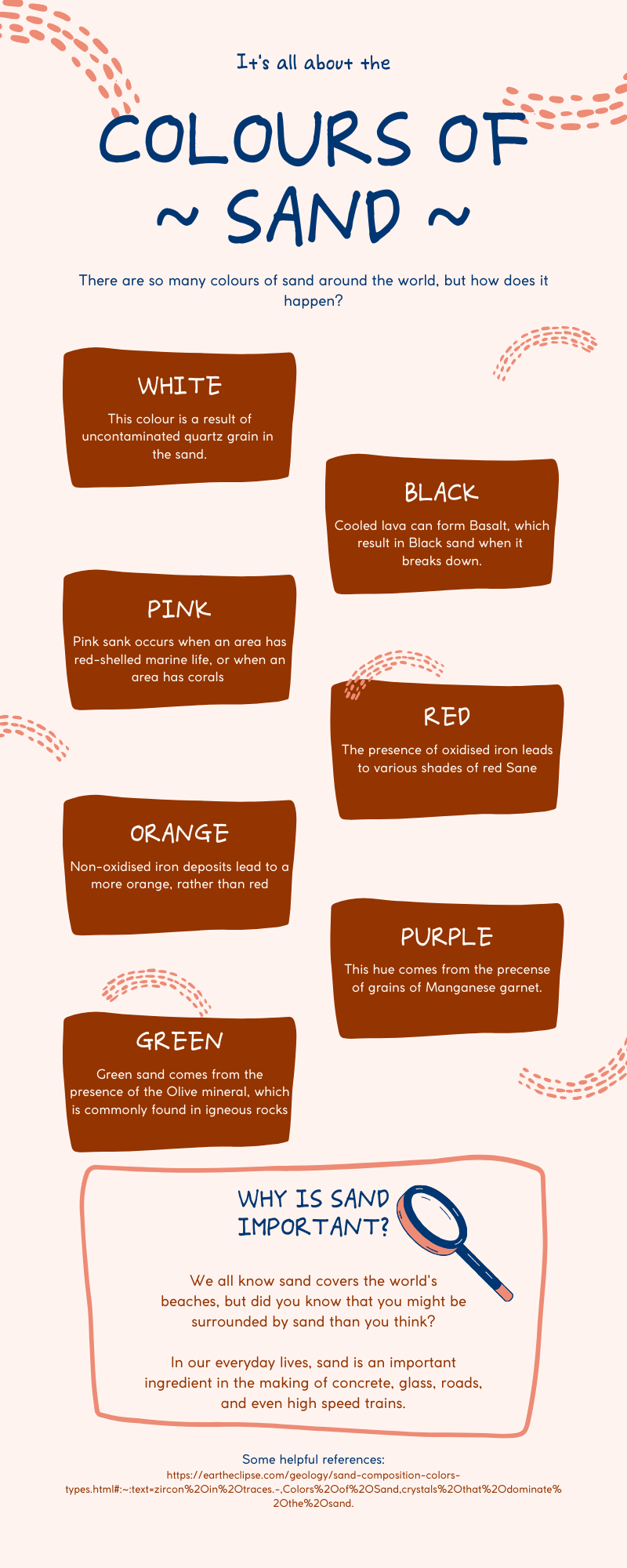
    It was interesting to see how the different people who stopped by at the sand table interacted with the activity, the educational aspects, and volunteers. Our group had originally decided to set up the tables with our individual posters depicting the science behind the activity at each table, as well as creating activity guides for attendees to carry around and keep track of which tables they had visited. While everyone received a copy of the guides, parents seemed more often to be the ones who carried them for their kids. Some encouraged their kids to ask about the poster and listen to the volunteer’s educational speeches, while others let their kids choose if they wanted to educational aspect or not. The children who didn’t have their parents encouraging them to ask about the activity largely seemed only to be interested in the craft they could participate in. While it makes sense that elementary aged children especially may not be as interested in the educational side that we had originally hoped, to see their interest still captured by our event was one that made all the work put into worth it.