Category: Articles

  • Cracking the Code: Binary Basics

    Cracking the Code: Binary Basics

    The Towers of Hanoi

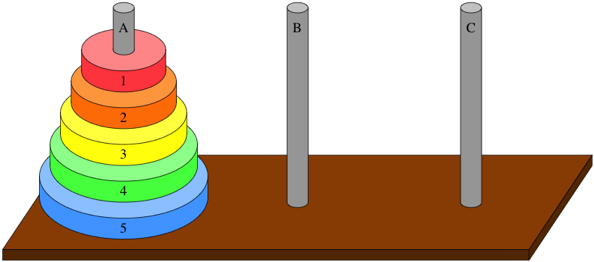
    A set of colorful, cascading disks stacked on a peg. What could easily double as a child’s toy also serves as an ancient mathematical puzzle, the Towers of Hanoi. Often used to teach recursive problem solving strategies, the puzzle poses a simple challenge—to move the stack of disks from the leftmost peg to the rightmost peg one disk at a time with one restriction: a disk cannot be placed on top of a smaller disk.

    Take a moment to familiarize yourself with the puzzle by playing around with this online version. Setting the number of disks to 3 is a great place to start.

    It may be surprising that, no matter how many disks there are, this problem is always solvable with just three pegs. Even more surprising, the optimal solution for any number of disks (the solution that requires the fewest number of moves) directly mirrors the rhythm of counting in binary.

    Before diving into this optimal solution (in a later article), this article focuses on understanding what counting in binary looks like and explores the nature of different number systems.

    Base-10

    The number system we most commonly use involves counting in base-10, a natural choice given the number of fingers we have on our hands. Consider the number 104 for example. Let’s index the digits from right to left, beginning with zero:

    • the value at index 0 is 4,
    • the value at index 1 is 0,
    • and the value at index 2 is 1.

    Because we are working in base-10, there are 10 possible values for each digit (0, 1, 2, 3, 4, 5, 6, 7, 8, or 9) and each index represents a consecutively larger power of 10 corresponding to its index. The number 104 can be expressed as the sum of powers of 10 as follows:

    • 10^0 * 4 (or 4 ones)
    • 10^1 * 0  (or 0 tens)
    • 10^2 * 1 (or 1 hundred).

    Base-2

    Let’s now consider how this same value would be written in a different base: base-2, or binary. The binary system has only 2 possible values for each digit (0 or 1) and is most useful in the field of computer science as it is easy to consider an electrical component as having one of two possible states (on or off). In the binary representation of a number, each index represents a consecutively larger power of 2 corresponding to its index.

    After some calculation, we can express 104 as the sum of powers of 2 as follows:

    • 2^0 * 0 (or 0 ones)
    • 2^1 * 0 (or 0 twos)
    • 2^2 * 0 (or 0 fours)
    • 2^3 * 1 (or 1 eight)
    • 2^4 * 0 (or 0 sixteens)
    • 2^5 * 1 (or 1 thirty-two)
    • 2^6 * 1 (or 1 sixty-four)

    Thus, the binary representation of 104 is 1101000.

    Converting Between Bases

    To round out this introduction to different counting systems, let’s actually go through the process of converting a value from one base to another.

    Consider the base-10 value 2643. Although base-10 is standard, it is good practice to break apart the digits and understand how this value is written. From right to left, we have:

    • 10^0 * 3 (or 3 ones)
    • 10^1 * 4 (or 4 tens)
    • 10^2 * 6 (or 6 hundreds)
    • 10^3 * 2 (or 2 thousands)

    Now we will determine how to express 2643 in base-8 by recursively answering the same question:

    • What is the largest power of 8 less than or equal to 2643?
      • The answer is 8^3 = 512, and we can fit five 512s into 2643 with 83 left over. 
    • What is the largest power of 8 less than or equal to 83?
      • The answer is 8^2 = 64, and we can fit one 64 into 83 with 19 left over. 
    • What is the largest power of 8 less than or equal to 9?
      • The answer is 8^1 = 9, and we can fit two 8s into 19 with 3 left over. 
    • What is the largest power of 8 less than or equal to 1?
      • The answer is 8^0 = 1, and we can fit three 1s into 3 with 0 left over. 

    Putting it all together, from right to left, we have:

    • 8^0 * 3 (or 3 ones)
    • 8^1 * 2 (or 2 eights)
    • 8^2 * 1 (or 1 sixty-four)
    • 8^3 * 5 (or 5 five-hundred twelves)

    Thus, the base-8 representation of 2643 is 5123.

    The Value 10

    One interesting tidbit about working across different number systems is how different values are represented by 10. In any arbitrary base-n system, the value 10 can be read as:

    • n^0 * 0 (or 0 ones)
    • n^1 * 1 (or 1 n)

    Thus, in any base-n system, the value of 10 is exactly n. To get a bit existential, every number system is, to itself, base-10. 
    References

    1. https://www.khanacademy.org/computing/computer-science/algorithms/towers-of-hanoi/a/towers-of-hanoi
    2. https://www.mathsisfun.com/games/towerofhanoi.html
    3. https://www.youtube.com/watch?v=2SUvWfNJSsM
  • ‘Fun’nett Squares: Gene-tic-tacs Activity Booth

    ‘Fun’nett Squares: Gene-tic-tacs Activity Booth

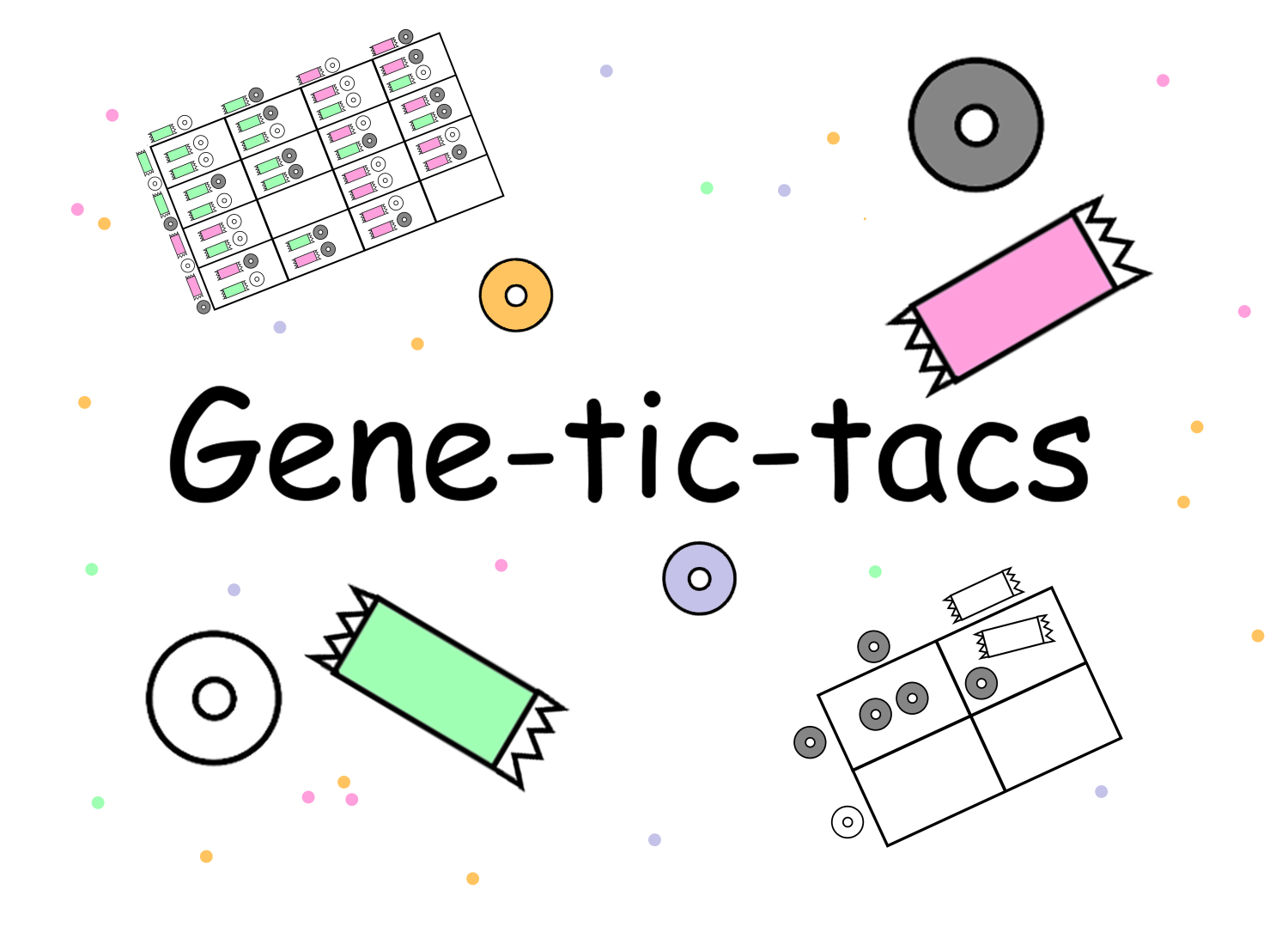
    Recently, our project team ran an activity booth at a science-themed block party. The booth was a fun way to teach partygoers about the science behind genetics, phenotypes, and Punnett squares. Our team created an interactive activity that presented partygoers with three genetics-based puzzles at varying levels of difficulty. Because it was close to Halloween, we incorporated the use of candy into these puzzles, which served as an incentive for puzzle-solvers to challenge their scientific skills and learn something new.

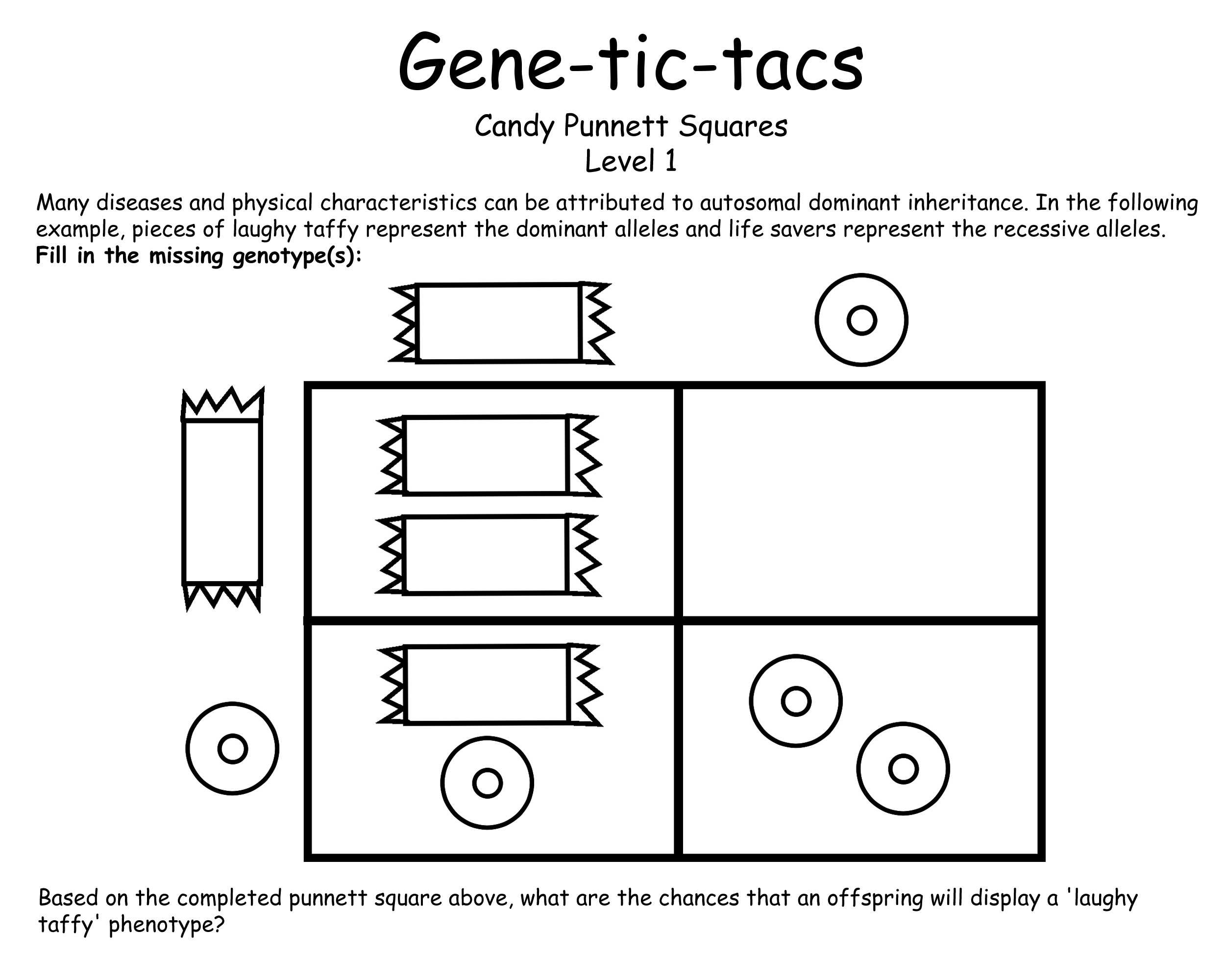
    The easiest puzzle involved crossing two parents with an identical genotype in a single-trait Punnett square. In this example, taffy was used to represent the dominant allele and hard candy was used to represent the recessive. Two piles of candy were provided to participants, who used the sweets to complete the missing square in the puzzle. Afterwards, we asked a question on the phenotypes of the resulting organisms to ensure conceptual understanding on the part of the participant. The puzzle is included below:

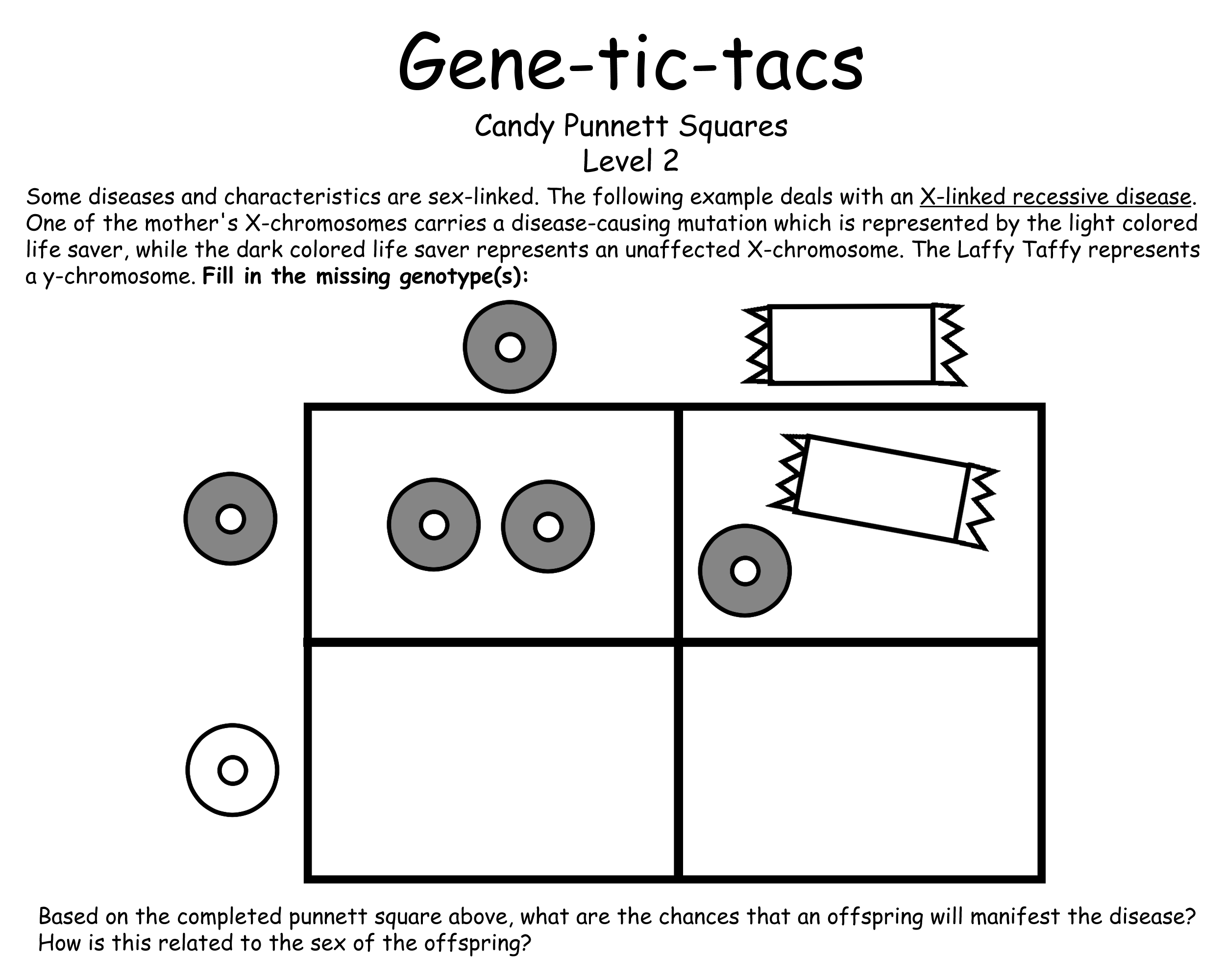
    The second puzzle involved the evaluation of a sex-linked trait. In this case, unaffected X-chromosomes were represented by dark colored hard candy while affected X-chromosomes were represented by light colored candy. Taffy was used to represent the Y-chromosome. Participants were now asked to fill in two separate squares using the corresponding candy chromosomes. Two questions regarding the outcome of such a genetic cross were then posed. This puzzle helped to teach participants about why some diseases and conditions are more prevalent in one sex. The puzzle is included here:

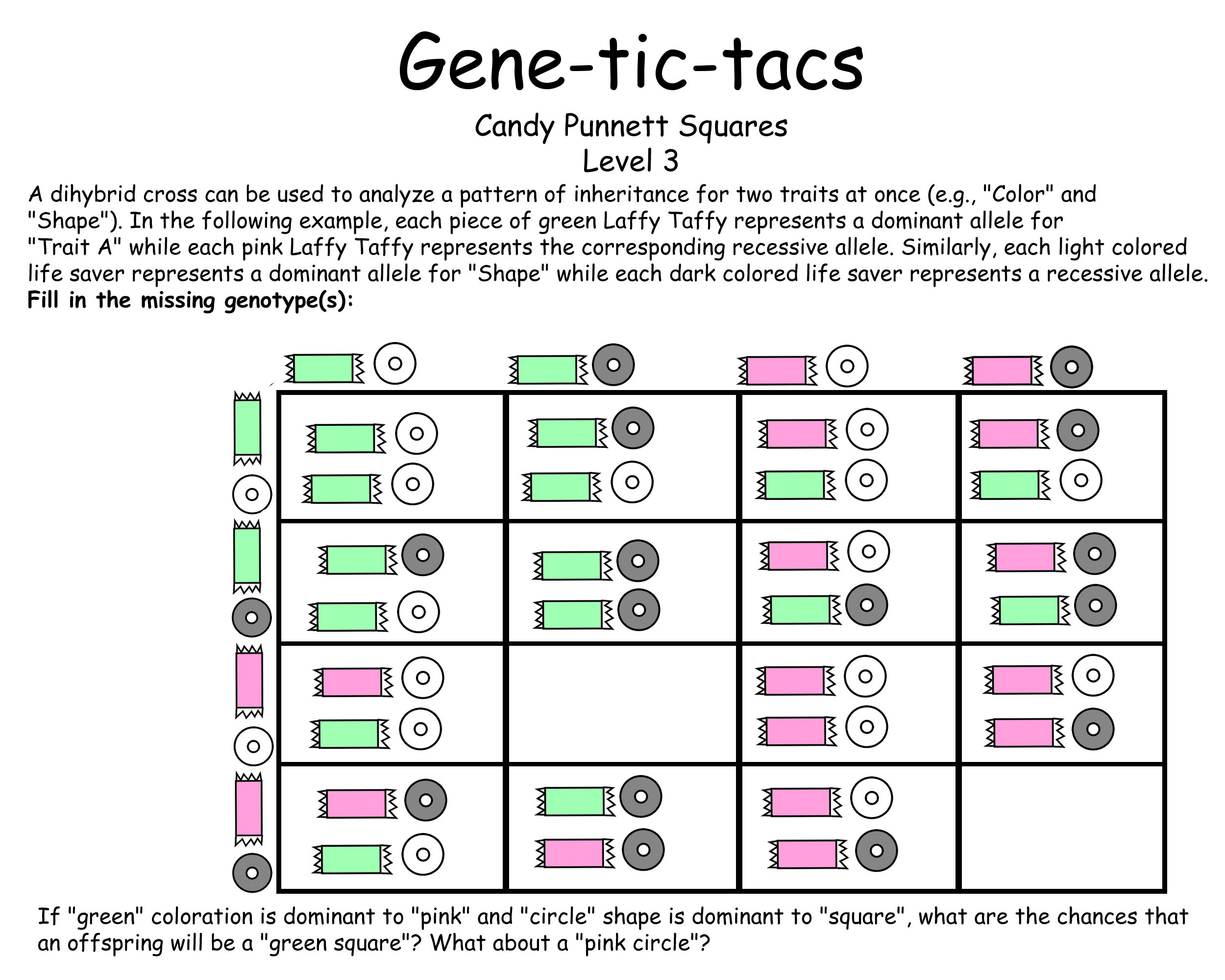
    Lastly, the third puzzle challenged participants with a dihybrid cross, which involved analyzing two distinct traits using one Punnett square. This example analyzed the traits ‘color’ and ‘shape’. It took on a similar format as previous puzzles, but its complex nature resulted in participants needing more assistance when solving it. This reflects the idea that we were successful in varying the difficulty of the problems. Here is the final puzzle:

    Overall, this serves as a fun activity that helps partygoers to engage with some of the scientific concepts behind genetics. When we used them, these puzzles sparked conversations and inspired scientific interest in participants. This is a great activity to try if you’re doing a science-themed event, and it’s fun for kids and adults!

  • Kidneys: The Innocent Bystanders

    Kidneys: The Innocent Bystanders

    When we purchase over-the-counter medicines, there’s often an assumption of their relative safety and harmlessness. After all, most ‘dangerous’ compounds are protected behind a prescription, right? Surely, if the directions on the back of the box or bottle are followed, no long-term health risks are possible, right?

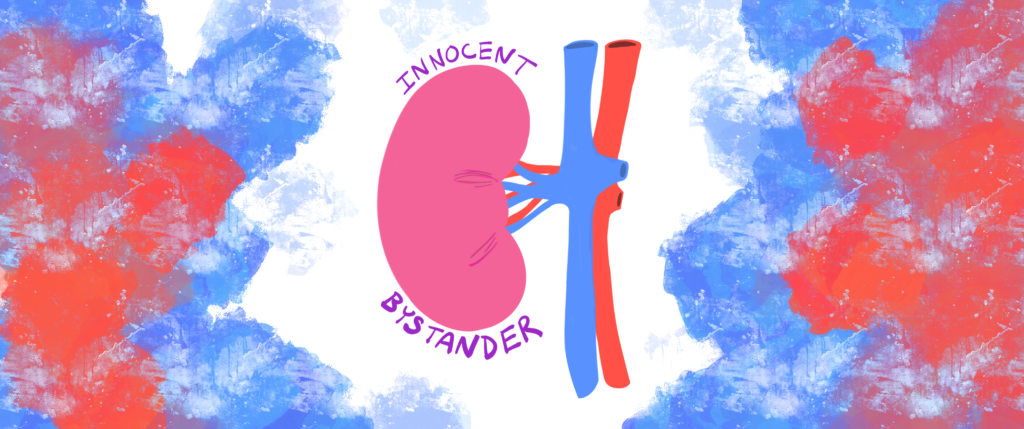
    Unfortunately, this is often not the case. Long term use of NSAIDs — a class of common anti-inflammatory drugs including aspirin and ibuprofen — is associated with an increased risk of acute kidney failure.[1] Previously healthy young people have developed kidney problems due to long-term NSAID use while being none the wiser; kidney injury thus represents a generally unknown side-effect of NSAID use. Indeed, this feeds into a much larger idea within the field of healthcare — the role of the kidney as an ‘innocent bystander’. Often, acute and even chronic kidney injury are iatrogenic — an unintended byproduct of treatments for other diseases or conditions. NSAIDs aren’t the only common treatment that can negatively impact kidney health; diuretics are associated with an increased risk of acute kidney injury and even surgical procedures like heart transplants have been linked to acute kidney failure.[2,3] The susceptibility of the kidneys to iatrogenic conditions is often attributed to the high rate of blood flow through them and the resulting increased exposure to potentially nephrotoxic drugs.[4] After all, the kidneys are the blood filtration system meant to remove waste from the body; it makes sense that the drugs that enter the bloodstream and are filtered out may put a strain on the kidneys. Not just treatments, but even diagnostic techniques can have an adverse effect on the kidneys. The iodinated contrast drugs often used in diagnostic imaging have also been linked to acute kidney injury, with few suitable alternatives available.[5]

    With all these harmful pitfalls, preserving kidney health may seem like an impossibility when tackling complex conditions and comorbidities. However, awareness is a crucial first step towards improving patient outcomes. The kidneys are often put on the back burner when managing other conditions; physicians may prescribe NSAIDs, diuretics, and similar drugs that harm the kidneys over time while treating other conditions, or order diagnostic imaging that utilizes contrast fluid that puts a strain on the kidneys. On their own, these small actions may not have a significant effect, but it’s critical to be mindful of how treatments and conditions may intersect to cause renal dysfunction. By spreading awareness of the susceptibility of the kidneys to damage in these ways, individuals at higher risk for developing renal issues may be mindful about their use of certain over-the-counter medications and can develop a better toolkit with which to advocate for themselves.

    References:

    1 Dixit, M., Doan, T., Kirschner, R., & Dixit, N. (2010). Significant Acute Kidney Injury Due to Non-steroidal Anti-inflammatory Drugs: Inpatient Setting. Pharmaceuticals (Basel, Switzerland), 3(4), 1279–1285. https://doi.org/10.3390/ph3041279

    2 Ejaz AA, Mohandas R. Are diuretics harmful in the management of acute kidney injury? Curr Opin Nephrol Hypertens. 2014 Mar;23(2):155-60. doi: 10.1097/01.mnh.0000441150.17202.be. PMID: 24389731.

    3 F. J. Romeo et al., Acute Kidney Injury After Cardiac Transplantation: Foe or Common Innocent Bystander? Transplantation Proceedings 50, 1489-1495 (2018).

    4 Davidman M, Olson P, Kohen J, Leither T, Kjellstrand C. latrogenic Renal Disease. Arch Intern Med. 1991;151(9):1809–1812. doi:10.1001/archinte.1991.00400090095017

    5 Andreucci, M., Faga, T., Serra, R., De Sarro, G., & Michael, A. (2017). Update on the renal toxicity of iodinated contrast drugs used in clinical medicine. Drug, healthcare and patient safety, 9, 25–37. https://doi.org/10.2147/DHPS.S122207

  • Atomic Bombs and Nuclear Chain Reactions: Are We Doomed?

    Atomic Bombs and Nuclear Chain Reactions: Are We Doomed?

    “I am become death, the destroyer of worlds.” The fear of the atomic bomb was felt not only by the citizens who feared enduring its wrath but also by the inventor himself, Robert J. Oppenheimer. With its debut in his 1965 interview, the quote reflects not only the fear of the wrong force holding the atomic bomb but also of the idea that the atomic bomb could set off a sudden atmospheric chain reaction, causing the earth itself to incinerate. This fear is also portrayed in the recent film “Oppenheimer,” which is based on the life story of Robert J. Oppenheimer before, during, and after the Manhattan Project. In the movie, there is an especially memorable scene in which the portrayal of theoretical physicist Edward Teller claims that there is a 3 in one million chance that the world could be incinerated via the ignition of the nitrogen in the atmosphere and oceans. After this tense moment and the initial hesitation of continuing with the Trinity test, the probability is never mentioned again. So was Teller right? Do we still face the slight probability of atmospheric incineration? Thankfully, after further calculation, it’s been determined that this method of mass extinction is not a matter of slim probability; it’s an impossibility.

    Post Trinity test, a declassified 1946 Manhattan Report dives into detail proving the impossibility of a thermonuclear reaction caused by an atomic bomb of the size they were dealing with. The report analyzes atmospheric nitrogen as the subject of ignition due to the instability of its nuclei, the reactions of which yield much more energy in the form of gamma rays. On the basis that there is an ignition point of the atmosphere (10 MeV temperature), the high reactivity would need to surpass that point such that “…the thermonuclear reaction may be propagated to all parts of the atmosphere” (Konopinski et al, 1946), setting off a chain reaction. Despite the energy release via nitrogen reactions, the earth’s atmosphere is transparent to the radiation emitted by them: it cannot absorb or reemit these radiation frequencies. The energy instead escapes into other systems, causing the temperature to restabilize and fail to propagate further reactions. However, the best models of the time first considered the energy produced via the nitrogen reaction to go towards the establishment of the temperature required for atmospheric ignition. Using these more conservative models for the sake of establishing a broader safety net, the Stephan-Boltzmann law – which claims that the hotter an object is the faster it cools – affirms the impossibility of such atmospheric detonation. The size of the bomb they were dealing with would only have about 1% of the energy it released be absorbed as heat by the atmosphere. The rest would dissipate as light, kinetic energy, or escape into space (Konopinski et al, 1946). This ultimately renders a nuclear chain reaction impossible; exponentially more fission material is needed to reach atmospheric ignition. For the technology at the time, there just simply was not enough bomb to generate the required energy.

    All science, however, is subject to change over time. This was the core argument of a contradictory article written almost 30 years after the initial Trinity tests and the publication of the 1946 report. The article reopens the previously debunked fallacy, arguing it’s not very possible that “…those who were instrumental in developing fusion devices (1948 to 1958) ever seriously considered the ultimate potential or the unexpected results of fusion explosions that were a 1,000 times as powerful as the fission device of 1945″ (Dudley, 1975). The current scope of today’s technology is beyond what would have been fathomed 80 years ago, including the ability to alter the rate of radioactive decay and half-lives, rendering the energy yield of fusion devices difficult to predict. This argument, however, is weak and extremely flawed as it is based on the idea of Murphy’s Law – that anything can go amiss – and maintains almost no mathematical basis. This short-sighted view and misconception was concisely rebuked less than a year later in a much more scientifically sound article. As in the 1946 report, the article looks into the unstable “…collision between two nuclei of N14 because N14 is a nucleus of relatively high energy content” (Bethe, 1976). The energy produced in the reaction that Bethe looks into (eq 1 below) surpasses the Coulomb barrier required for the reaction to occur with little difficulty and is the same process looked at by Konopinski et al.

    N14 + N14 = Mg24 + He4 + 17.7 MeV eq 1

    Unsurprisingly, Bethe comes up with similar results to those of Konopinski et al, finding that the energy produced by the reaction is only a minute fraction go the energy lost via physical processes such as the rapid dispersion of the energy in the form of radiation (which, as stated before, our atmosphere is transparent to), heating of the atomic nuclei, etc. The main principle is that “The air cannot be heated as hot as the weapon” (Bethe, 1976). For the atmosphere to ignite, the atomic bombs of modern scale would have to be of an entirely different design such that they could reach the required temperature for ignition; these temperatures are so high that it’s nearly impossible to create a bomb that possesses such qualities.

    The profound fear associated with the atomic bomb, articulated by Robert J. Oppenheimer’s chilling words, has left an indelible mark on history. This fear extended beyond the devastation it could unleash upon humanity to include the apprehension that it might trigger an unthinkable catastrophe—igniting the Earth’s atmosphere. The portrayal of this fear, as depicted in the recent film “Oppenheimer,” highlighted a pivotal moment when theoretical physicist Edward Teller suggested a slim probability of atmospheric incineration. However, this fear was ultimately disproved via rigorous scientific analysis and understanding. Including the contradiction of these calculations in the film would take away the tension from the generally uninformed audience. While technological advancements have been made since the early days of nuclear weapons development, the fundamental principles of physics governing these devices and the behavior of our atmosphere remain unchanged. We live to see another day without nuclear damnation.

    Sources:

    Bethe, H. A. “Ultimate catastrophe?” Bulletin of the Atomic Scientists, vol. 32, no. 6, 1976, pp. 36–37, https://doi.org/10.1080/00963402.1976.11455623.

    Dudley, H. C. “The Ultimate Catastrophe.” Bulletin of the Atomic Scientists, vol. 31, no. 9, 1975, pp. 21–24, https://doi.org/10.1080/00963402.1975.11458293.

    Teller, Edward, et al. 1946, Ignition of the Atmosphere With Nuclear Bombs.

  • The Mask Against COVID-19

    The Mask Against COVID-19

    Dr. Sundaresan Jayaraman, a professor in the School of Materials Science and Engineering, here at Georgia Tech worked on finding a form-fitting mask that provided superior protection against respiratory viruses like COVID-19. These masks, which have been in development even before the COVID-19 pandemic, aim to provide a comfortable way to wear masks and still provide the most protection against foreign particles. The masks use a combination of barrier filtration material and stretchable fabric in order to hold their shapes and be form-fitting for their users. The barrier filtration is made from a moisture-wicking material that allows for the material to fit the user’s face without causing any restriction to the nasal airways and speech. The stretchable material provides holds for the ears and positions the mask on the face correctly. The mask also uses electrospun nanofibers to filter out the smallest particles, which makes it more effective than the N95 respirators. The main flaw that N95 respirators have is that it leaks air around the edges allowing for virus particles to be breathed in by the users. The leakage problem also causes discomfort to the user, where users eyeglasses would fog up and constant adjustment of the mask can dissuade users from wearing a mask in public. 

    The Form-Fitting Mask created by Dr.Jayaraman and his team Photo Credit: Christopher Moore, Georgia Tech

    I got the pleasure to work with Dr.Jayaraman and his colleague Dr.Sungmee Park when creating presentations for The Devil Wear Science event. As the event was a part of the Atlanta Science Festival, we got to showcase the true effectiveness and design of the mask to the viewers. During the event, the models for the event which included my partner, Carrera Ortiz, wore masks that were connected to a device that showcased the effectiveness of the air filtration system that the mask had. The device showcases how little to no particle was able to get through. It was exciting for me to get to be so up close and personal with what the mask can do and its effectiveness of it. 

    During the show, Dr.Jayaraman shared the way, design, and thought process of creating the mask and his reason for doing so. Though the importance of a highly effective mask might not seem like a big thing today, as more and more countries are getting rid of mask-wearing policies, it was not the same that could be said about two years ago. When COVID-19 was at its peak around April and May of 2020, many countries started to notice the importance of the mask and funded a project that could lead to a more effective mask. Dr.Jayaraman and his past research placed him in a perfect position to fight against COVID-19. Overall, the work of Dr. Jayaraman and his team serves as a testament to the power of science in solving real-world problems. By creating a mask that is effective, comfortable, and sustainable, they have made a significant contribution to the ongoing fight against the COVID-19 pandemic and beyond.

    Sources: 

    Premium vector: People wearing medical mask: Vector illustration design, medical masks, nurse art. Pinterest. (2020, March 25). Retrieved May 3, 2023, from https://www.pinterest.com/pin/premium-vector–757378862321960976/

    Researchers redesign the face mask to improve comfort and protection. News Center. (n.d.). Retrieved May 3, 2023, from https://news.gatech.edu/news/2020/09/03/researchers-redesign-face-mask-improve-comfort-and-protection

    Tech researchers recruit for CDC Mask Study. News Center. (n.d.). Retrieved May 3, 2023, from https://news.gatech.edu/news/2021/08/27/tech-researchers-recruit-cdc-mask-study

  • From Chaos to Calm: The Benefits of Organizing Your Space

    From Chaos to Calm: The Benefits of Organizing Your Space

    Being a Georgia Tech student sure does come with its ups and downs. There are times during the semester when your life is great, you meet up with friends, finish your work early, and even sleep before 10 pm. On the opposite side, there are weeks where you have tests back-to-back along with a weekly lab report and group presentation all due on the same day. There are so many different types of stress that Georgia Tech students are experiencing at the same time. Whether it is stress within a relationship, academic stress, or even stress about missing a day at the gym, all these stress factors build up and end up decreasing your mental health and leading to depression.

    Though there are many things that can lead to an outlet of stress. A reliever of stress that some Georgia Tech students do is clean. Cleaning, often seen as a sign of a tedious and mundane task, has proven to be a powerful tool in reducing stress and anxiety. Cleaning gives a sense of peace in the calm. When the world around you seems to be in chaos, cleaning gives you a sense of control where you have power over certain objects in your life, and cleaning and getting rid of them makes you calmer and more controlled in your life. Even a simple task like clearing your desk or doing the dishes in the sink gives you that sense of control and thus reduces your level of stress. 

    “Brain Cleansing” Photo from Pixabay

    Cleaning also helps reduce sensory overload and improve focus. In the fast-paced world that we live in where our senses are constantly bombarded with stimuli, it can lead to high stress and anxiety levels. By cleaning, you remove unnecessary clutter and create an environment that is free from distraction. This can improve focus and reduce sensory overload. As cleaning can be a form of mindfulness, it allows you to focus on the present moment and forget about worries and anxieties. You can block out distractions and engage in a form of active meditation, which can help improve mental clarity and reduce stress. This mindfulness can have a lasting impact, as it helps to cultivate a positive mindset and promote feelings of calm and peace.

    Another reason that cleaning is important is that it can release of endorphins in the brain. Endorphins are neurotransmitters that are produced by the central nervous system, and they are responsible for reducing pain and increasing feelings of pleasure and happiness. When you engage in physical activity like cleaning, your brain releases endorphins in response. This release of endorphins can create a sense of euphoria and elation, commonly referred to as a “runner’s high.” The same phenomenon occurs during cleaning, as it requires physical movement and exertion. The satisfaction of completing a task, combined with the endorphin release, can create a sense of accomplishment and happiness. Endorphins are not only good for your mood, but they can also provide physical benefits. They can act as natural painkillers and boost the immune system, which can help reduce the risk of illness and improve overall health. The release of endorphins during cleaning can also help to reduce stress and anxiety, leading to a more relaxed and calm state of mind. In conclusion, cleaning can be a powerful tool to reduce stress and anxiety levels. Cleaning provides a sense of accomplishment, reduces sensory overload, and improves mental health and mindfulness. 


    Sources: 

    Brain mind clear – free vector graphic on Pixabay. (n.d.). Retrieved May 4, 2023, from https://pixabay.com/vectors/brain-mind-clear-help-support-7283928/

    How to release endorphins and what they are. How to Release Endorphins and What They Are. (n.d.). Retrieved May 4, 2023, from https://www.betterup.com/blog/how-to-release-endorphins

    The mental health benefits of a clean home. Newport Healthcare. (2023, January 26). Retrieved May 4, 2023, from https://www.newporthealthcare.com/resources/press/clean-home-benefits/ 

  • Collaboration is Key!

    Collaboration is Key!

    As a senior in college, about to graduate with an engineering degree, I’ve come to actually appreciate the dreaded “group project” – and trust me, working with others can be very challenging. But on reflection, I can really see how they also build key skills in collaboration and communication, that are especially important in STEM fields believe it or not.

    In classes: working with different people, even if you all have the same major, can offer different perspectives, ideas, ways of thinking that you wouldn’t have thought up alone. The benefits of working in a group are not just division of labor – although that’s also important, as you quickly learn that one person can’t do everything without burning out – Group projects also teach the art of compromise (and it is a tough one to learn).

    One of my biggest projects in my undergrad has been my senior Capstone project: a more practical application of the things we’ve learned in our undergraduate classes. For me in particular, working in an interdisciplinary group and coming up with our own idea for a product, even with all my experience working in groups, it was a bit mind-opening to see what could be done with everyone offering different skills.

    It let me see how other majors approach the same sort of problem from different angles, with different concerns. It also opened my eyes to how you never really know where which skills will come into play, going into a project. Despite being an engineer myself, I learned to lean a lot more on my colleages who had deeper expertise or were more comfortable with actual manufacturing – instead, I found myself unexpectedly using a lot of my intersocial and organizational skills; understanding that this was an area that I excelled in, that my teammates in turn had less experience with.

    For our group in particular, our chosen project of making a new device and app that would potentially be brought to market required a large range of skills: some people were devoted to marketing and aesthetic design, some were focused on the coding of the app and device itself, some were focused on customer outreach and feedback, while others focused more on making the device itself.

    Everyone did their part, but communication was absolutely key to make sure the rest of the team was kept up to date on your own progress, as well as making sure your aspect’s concerns were known. For example, if someone on the coding team knows that it’d be practically impossible to code for some function, then it’s key that they communicate that to the marketing team before they claim that function is an important feature. Or if someone conducting interviews with customers learns that they absolutely won’t want a product that’s too heavy, it’s important that that gets passed along to the group members handling manufacturing so they know not to use heavy materials.

    Outside of normal class projects, like for this group, STEMComm and Charged Magazine, I’ve seen how through collaboration you can learn and be exposed to so much more than you would normally – from reading the articles on new topics from my teammates, to learning about the varied projects research labs completely removed from my field are making, and presenting that to the public.

    And even outside of a school environment, out in the real world, you can find some pretty nifty examples of science happening from collaboration.

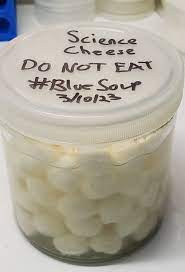
    Take the ongoing “#BlueSoup” saga over on microbiology-Twitter, where a microbiologist shared her amazement at how some old soup she had in the back of the fridge had turned blue – then, through encouragement of her fellow scientists, decided to take a sample of the soup to take back to the lab, to find out just what bacteria or microbe caused the color change. And from there, other labs requested samples, different experiments were conducted, DNA is being sequenced, and now several researchers are involved and collaborating on this interesting little question – potentially even working towards publishing their findings in the future!

    Collaboration is so very important for many things in life, and especially in STEM fields – so for any aspiring scientists, try not to shy away from learning it!