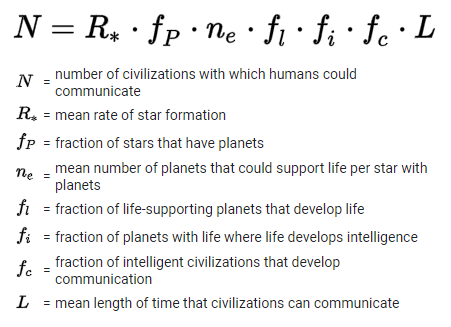
Category: Articles

  • Three Dog Star Night (Part 3)

    Three Dog Star Night (Part 3)

    Welcome back to our discussion on the Drake Equation and the Fermi Paradox! If you haven’t read parts 1 and 2 already, it goes without saying that you should start there! This time we’ll be discussing what we know about the evolution of intelligence and communication… or at least what we think we know. This part is going to be more philosophical and speculative than the last two, but unlike a certain notorious tv show, our aim will be informed speculation.

    The poster child for uninformed speculation

    Before we dive into our discussion, we first need to clear up a common misunderstanding surrounding the evolution of intelligent life: the notion that intelligence is ‘more evolved’ and thus evolution has been “building up” to it all along. Evolution by natural selection is a process by which a species’ genetics change over successive generations to better fit their environment. It is not a guided process with an end goal, nor does it converge to a single result in a given environment. If it did, the word ‘biodiversity’ wouldn’t be part of our lexicon. Intelligence is an example of complexity, but complexity is not synonymous with ‘most evolved’. In fact, the most evolved species are generally those which are the least complex because they reproduce the fastest and have been around the longest. These two factors allow for the greatest number of environmental adaptations to take place in a species. For example, the bacteria in your digestive system are several million times ‘more evolved’ than either you or I are. While it’s certainly true that intelligence provides a substantial survival advantage, this is not unique. By definition all adaptations provide survival advantages, and those that help to survive the threat of mass extinction events should also be considered. In that light, the organisms living around geothermal vents on the ocean floor take first prize. Genetic and molecular clock modelling suggests that the last universal common ancestor (LUCA), to which all extant life originated from, was just such an organism. To put it simply, LUCA was most likely an organism that survived a massive planetary extinction event which wiped out all other genetic lineages around 4 billion years ago. This makes it and life like it not only the ‘most evolved’, but arguably the most capable survivors.

    With that out of the way, let’s examine some more factors!

    Fraction of Inhabited Planets that Develop Intelligent Life, Fi

    The first thing to note is that this factor is heavily debated, with estimates more or less divided into two camps: those who argue this number is very small, and those who argue it’s close to 1. For simplicity, we’ll refer to these as “Rare Intelligence” and “Inevitable Intelligence”, respectively.

    Rare Intelligence

    Anatomically modern humans arose only very recently, around 200,000 years ago, civilization a mere 12,000 years ago, and recorded history began a paltry 5,000 years ago. As a percentage of the total time life has existed on Earth, these account for 0.005%, 0.0003%, and 0.0001%, respectively. The precursor hominids (i.e. not Neanderthals or Denisovans) to our own species did not have the intellectual capacity to become broadcasting civilizations. They never even developed agriculture, which enabled specialization. This was a critical step in making the switch from isolated, nomadic tribes to densely populated cities.  Even if high intelligence is a generic product of the evolutionary process, the enormous amount of time it may take to evolve places constraints on our estimates given the current age of the universe. If the development of intelligence is limited to planets around stars of similar mass to our own, then the window for it to develop is limited to around 5 billion years. In around 1 billion years the sun’s brightness will have increased, significantly raising our planet’s temperature to the point that (unless we do something about it) the Earth will be completely uninhabitable. Thus if intelligence takes on average a few billion years to develop, when a planet only has a few billion years of habitability to begin with, we would expect relatively few organisms to ever develop intelligence.

    David Kipping, from Columbia University’s department of astronomy, recently performed an objective Bayesian analysis on this topic in an attempt to determine just how likely intelligent life is to evolve on other planets given what we know about Earth. Unlike other methodologies, Bayesian analysis seeks to directly compare two or more competing hypotheses in order to determine which explanation is most probable. Using this methodology, he determined that the odds of life arising very soon after a planet becomes habitable may be as high as 9:1. However the evolution of intelligence is far less constrained, with 3:2 odds of intelligence being rare. As we learn more about our own planet’s history and perhaps finally detect life on another planet, these odds will shift quite a bit. The key to this sort of analysis is that the odds can be refined as more information is gained. While the odds of intelligence being common don’t look good at the moment, they have plenty of room to improve.

    For simplicity, we will set the fraction of planets that develop intelligent life under the assumption of rare intelligence at roughly 9:1 odds: Fi,Rare = 0.1.

    Inevitable Intelligence

    Though it took billions of years for intelligence to evolve, we don’t actually know for certain just how long it will survive. Drawing conclusions about the frequency with which intelligent life develops based on Earth’s history thus far is fundamentally flawed. If, for example, intelligent Earth life were to continue on for another trillion years, long after the Sun and Earth are gone, then intelligent Earth life would have been around for 99.6% of the total time Earth life existed. If Earthly intelligence survives until the end of the Stelliferous Era, that percentage increases to 99.996%. Even if Earth life never becomes interplanetary, then our time here is hard-capped at around 7.5 billion years and intelligent life will have accounted for 65% of life’s existence on the planet. Unless we wipe ourselves out tomorrow (a topic we will revisit in Part 4 of this series), the previous analyses of our existence as a fraction of the time life has currently existed on Earth is irrelevant. If we allow for the possibility that life can develop on worlds orbiting red dwarf stars, then the window of habitability could be trillions of years rather than a mere 5 billion.

    Lesser extinction events don’t prohibit evolution to intelligence unless they happen frequently enough that multicellular life can’t gain a long-lasting foothold on the planet before the host star burns out. Given the fast pace at which even the slowest-reproducing life evolves compared to how long typical life-supporting stars live, extinction events would need to be so frequent that such a planet arguably wouldn’t be considered habitable in the first place. It’s only been around 66 million years since the last ‘big one’ hit, a length of time representing less than 2% of the total time that life has existed on the planet, and less than 1% of the sun’s total lifetime. During that short span, mammals progressed from near the bottom of the food chain to dominating the entire planet. Geographically speaking, humans are the most widely distributed single species on land*. In the ocean, that award goes to the killer whale. Both of these species are mammals and both are at the top of their respective food chains. Life has recovered similarly quickly after other mass extinctions events, so we should only expect frequent, near-total extinction of life on a planet to prohibit the development of intelligence. If intelligence ever does arise, then if/when it later goes extinct will be accounted for with the final value in the equation, L.

    The Land Before Time CLXVII: The Great Space Rock Adventure

    Again, for simplicity, we will set the fraction of planets that develop intelligent life under the assumption of inevitable intelligence Fi,Inev = 1.

    Fraction of Intelligent Civilizations that Develop Detectable Communication, FC

    In our discussion of the Drake Equation thus far, we’ve swept an important detail under the rug: how exactly would we detect intelligent extraterrestrial life? The prevailing presumption in all analyses of the Drake Equation has, until very recently, been that we would detect signs of intelligent life via their radio broadcasts. At the time the equation was penned, that was the only pragmatically conceivable means for detecting alien intelligence beyond our solar system. This factor is also disputed, but less so than the previous one. In most conceivable scenarios, it’s likely that intelligent life will eventually develop electromagnetic communication techniques if left to its own devices, as intelligence does provide a great survival advantage once it has developed. Even though complex brains are an enormous energy investment, one of the primary advantages they ultimately provide, through the development of agriculture, is complex societies that enable individuals within a species to become highly specialized and efficient in various tasks. Using the Pareto Principle, a general mathematical principle which states that a majority of the results come from a minority of the causes, we can surmise that an 80% efficiency level in most skills can be attained with around 20% of the effort. Beyond this, the effort required for incremental efficiency attainment increases exponentially. You’re likely familiar with this concept, even if you don’t recognize the name. Anyone who has learned to play an instrument knows that learning how to play all the notes takes only a few months, but true mastery of more advanced techniques like circular breathing can take a lifetime of daily practice. Our nomadic ancestors couldn’t afford to invest limited resources on specializing in a single skill because the marginal returns were low. In contrast, a society with a food surplus (that is, an energy surplus) can afford to make that investment and quite literally ‘reap’ the benefits they ‘sowed’. That’s not to say we don’t see socialization or specialization elsewhere in nature, but never to the same extent as in human societies.

    The sheer degree to which we socialize and specialize in and of itself necessitates an advanced capability like communication through language. The further advancement of this capability into the Information Age has provided us with survival benefits the likes of which our ancestors would never have dreamed of. It’s possible that intelligence, sociality, and advanced communication capabilities are paired at a deep level. Using our own brains as a model, we might reasonably expect that natural selection will disfavor intelligence that does not possess a comprehensive capability to communicate. Similarly we can expect such capabilities to generally trend towards the use of electromagnetic technologies since the speed of light is the fastest possible way to transmit information. While it’s certainly plausible that there may be a species of strong, independent geniuses out there in the cosmos who can comprehend General Relativity by the age of 10, their time spent not doing the basic things required to survive is just as limited as yours or mine. Such capabilities, impressive as they would be, don’t automatically outweigh the benefits of being a social animal. After all, you can’t exactly eat the Einstein Field Equations.
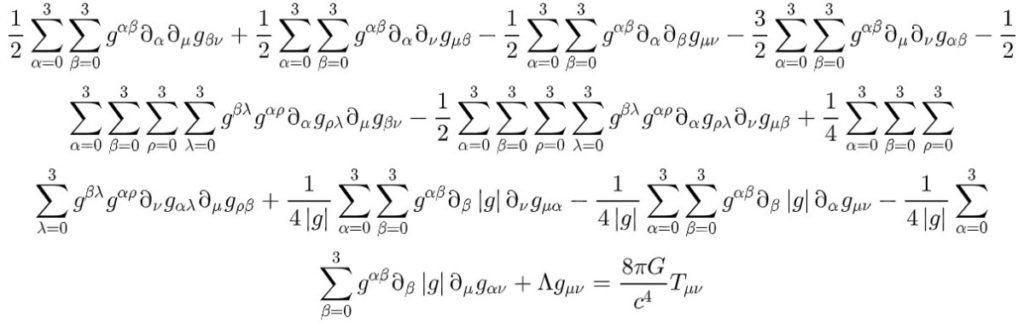
    Part of a Complete Breakfast™

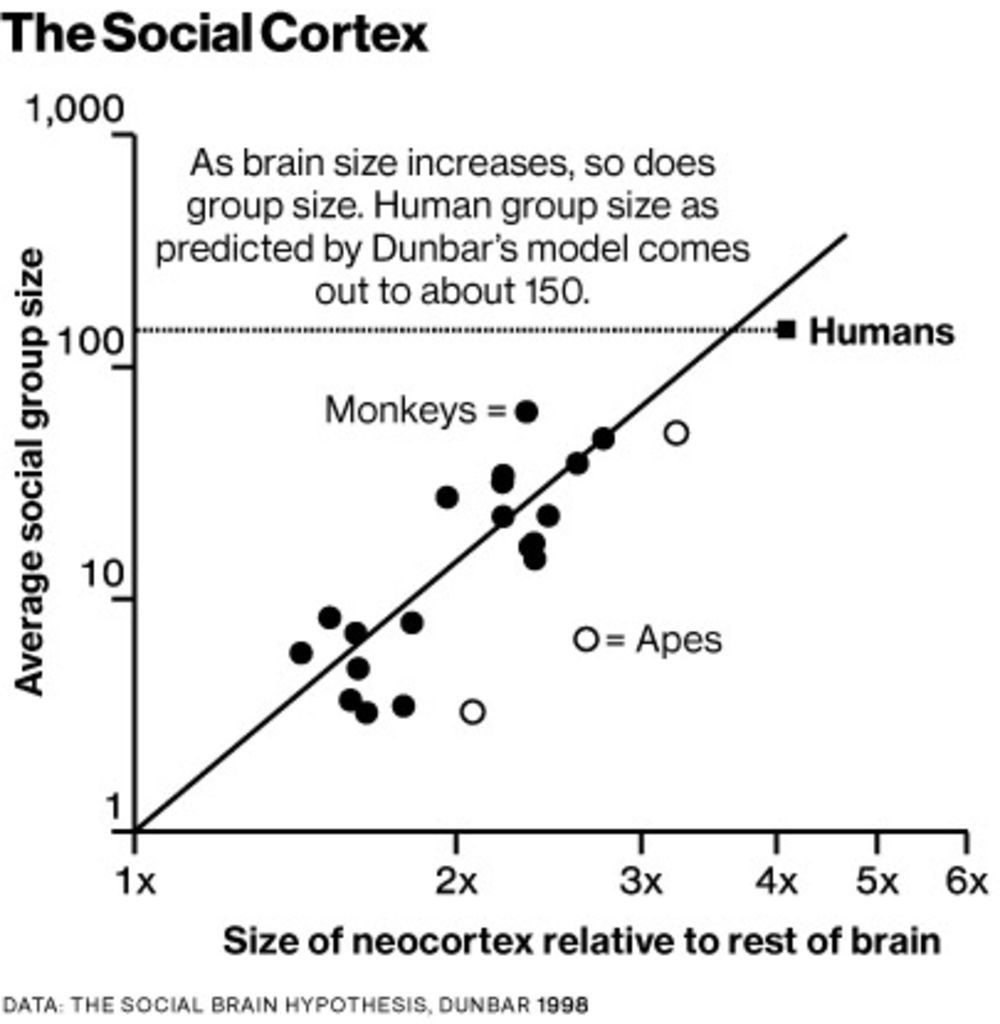
    We generally measure intelligence in humans with the intelligence quotient, but IQ tests are designed for humans and can’t be generalized to other species. In theory, we could instead estimate a species’s intelligence by measuring their degree of sociality, but how exactly would one do that? Dunbar’s Number aims to measure the maximum number of other members of a species with whom its members can maintain meaningful relationships. In his original work, Robin Dunbar compared the relative neocortex sizes of different primates to the average sizes of the social groups they formed and found that the average human social group size is approximately 150. Some real-world examples of Dunbar’s Number include the average size of Hunter-Gatherer societies, average size of Christmas card networks, average number of wedding guests, size of the Roman Maniple, average size of an English Village in the 11th century, and even the number of Super Bowl rings the NFL gives to the winning team each year.

    The link between neocortex complexity, intelligence, and social behaviors means that a species with a larger Dunbar’s Number would generally have higher intelligence, more cooperation, and a higher degree of specialization. These, in turn, contribute to a more rapid pace of technological development. In contrast, a species with an extremely low Dunbar’s Number will have lower intelligence, difficulty cooperating, less specialization, and slower development of technology. As we consider species with lower and lower values, eventually one will be less likely than not to develop electronic communication. Since the values for other primates aren’t all that far behind ours, this lets us set a measurable baseline for what we mean by ‘intelligence’ insofar as the Drake Equation is concerned.
    Of course there are a plethora of conceivable exceptions to this rule, but most fall apart under closer scrutiny. Some insect species live in colonies of more than 100,000, so what about a species of hyper-intelligent alien insectoids like the Formics in Ender’s Game? What about a species of ocean-dwellers with human level intelligence that nonetheless never develops electronic communication due to their aquatic environment? As intriguing as these and other Sci-Fi aliens may be, insects don’t have a neocortex and even the most intelligent sea creatures lag far behind humans. If we wish to extrapolate characteristics of Earth creatures, we should aim to be consistent rather than picking and choosing which features we want them to have.
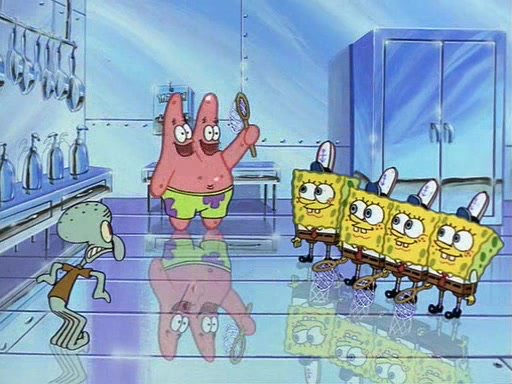
    On a planet somewhere in the infinite universe… probably…

    Since we expect what we generally define as intelligence to go hand-in-hand with the development of electronic communication, we will set FC ≈ 1.

    As a final note, the Drake Equation was formulated under the assumption that alien intelligence could only be detected via radio signals. With the launch of the James Webb Space Telescope fast approaching, the landscape of possible methods for detecting an extrasolar intelligent civilization are about to shift dramatically. The ability to detect the atmospheric compositions of extrasolar worlds will give us our first chance at detecting alien life forms through the spectroscopic signatures of volatile chemicals they leave in their atmosphere.

    Next time, we’ll be discussing the final factor in the Drake Equation as well as what it and equations like it actually are.
  • The Science of Baking Pt.2

    The Science of Baking Pt.2

    Introduction

    Welcome to Part 2 of The Science of Baking! Since this is the second installment of the series, I would recommend going back and reading part 1. This article will go through an experiment of baking a flaky pastry using two different types of fat: butter and coconut oil. There are accompanying pictures that I took myself showing in detail the two pastry doughs!

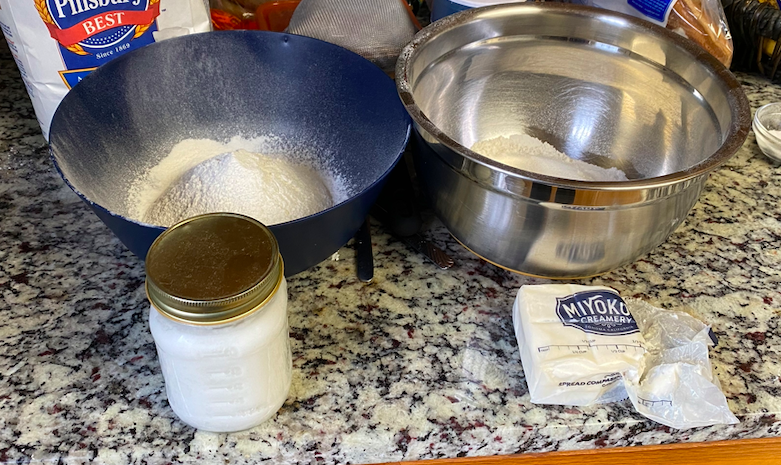
    Step 1: Mix flour, salt, and sugar.

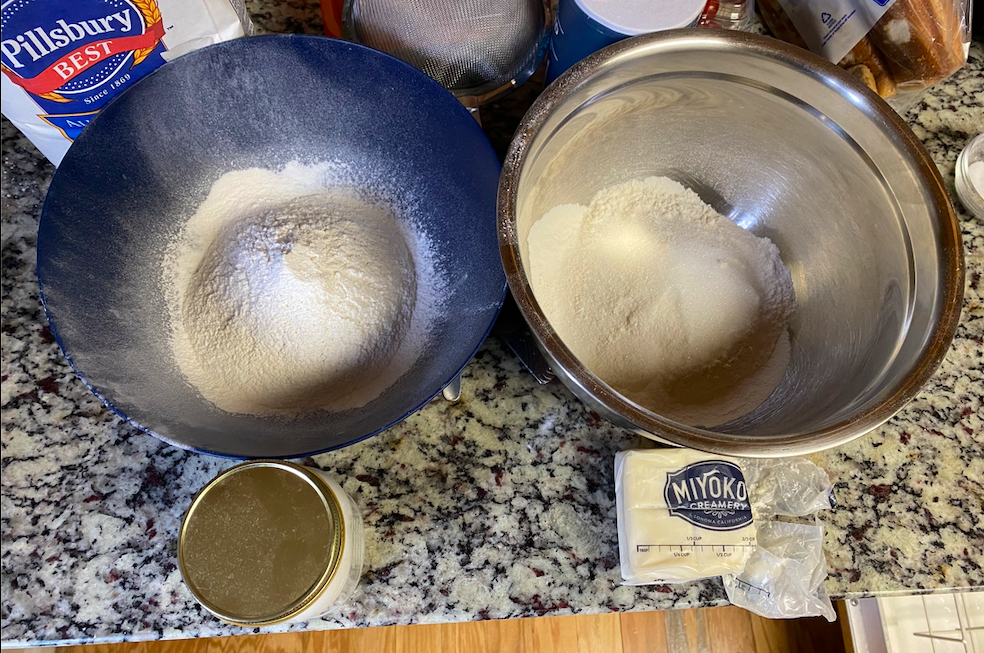
    The two bowls of flour mix for each fat.
    The two bowls of the flour mix and the corresponding fats in front of them.

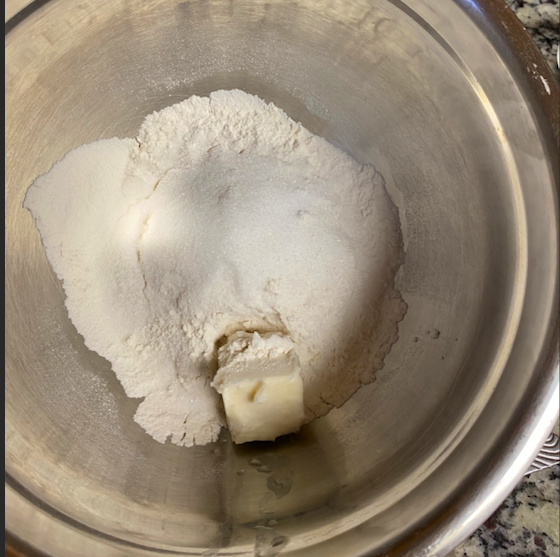
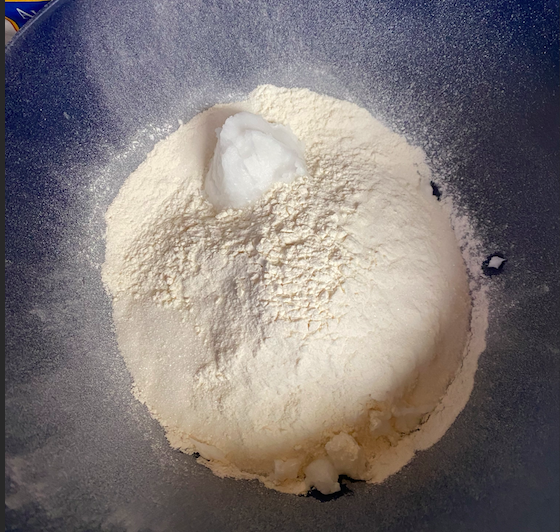
    Step 2: Break the fat up into 4 equal portions and add one portion of the fat component to flour mix.

    The butter + flour mix
    Coconut oil + flour


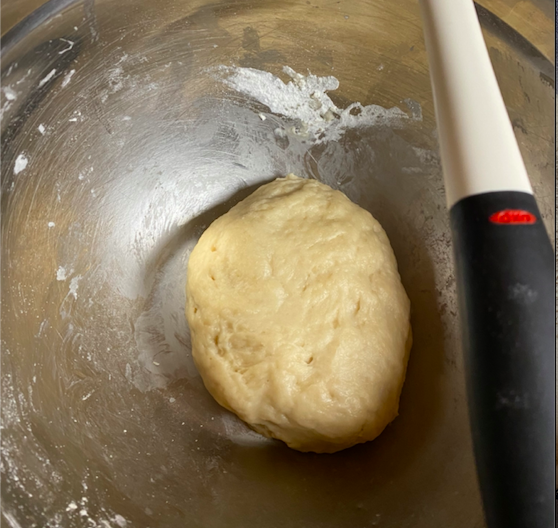
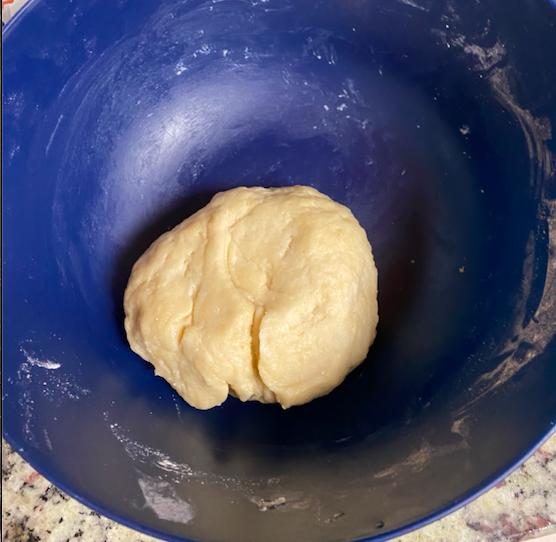
    Step 3: Mix and add water slowly until a dough forms.

    Dough with butter
    Dough with coconut oil

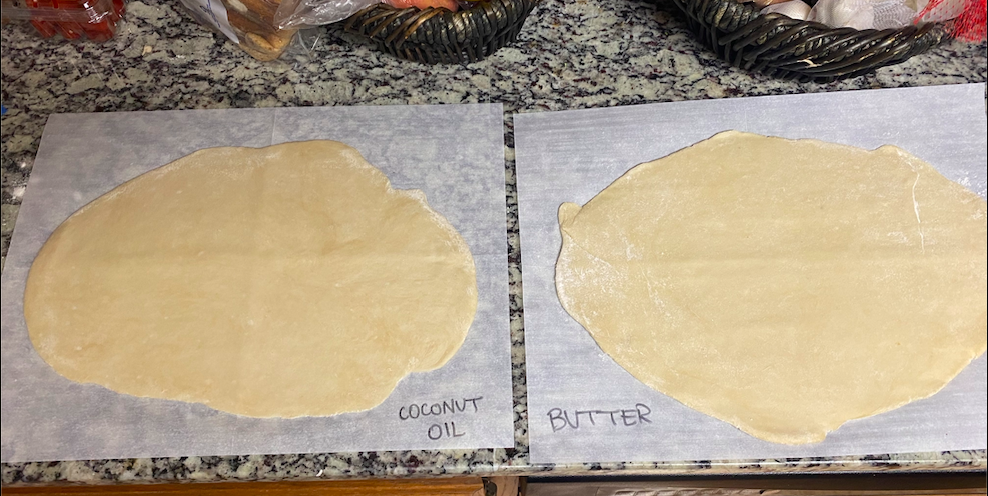
    Step 4: Roll out dough into flat sheet

    The doughs rolled out into rectangles

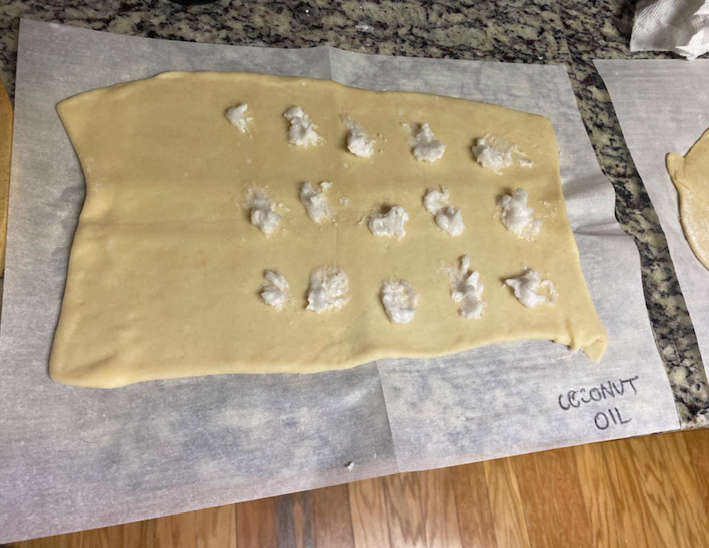
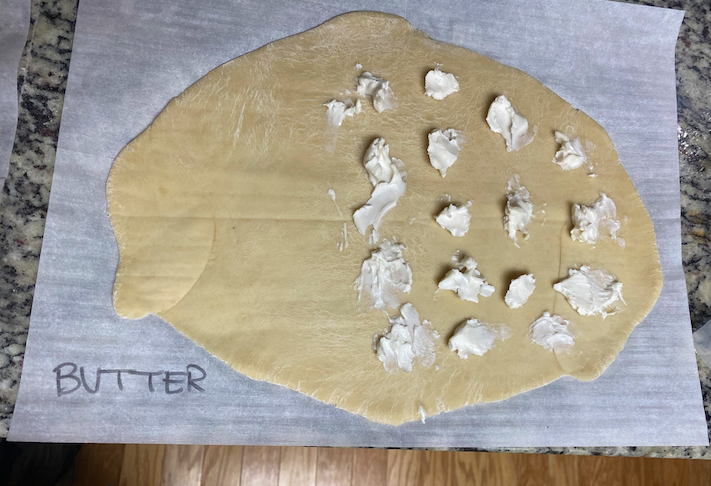
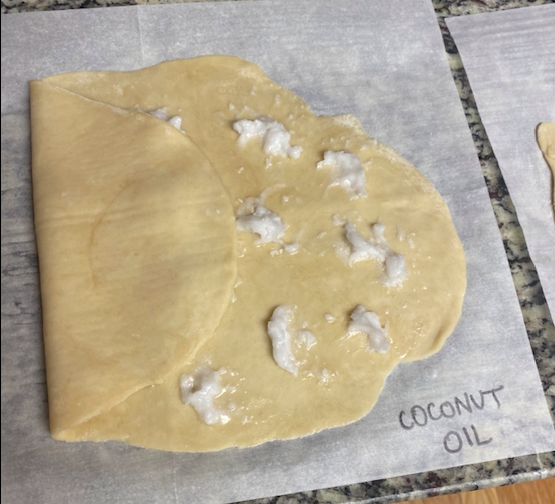
    Step 5: Break up the next portion of fat and spread along sheet of dough

    One portion coconut oil dotted on dough
    Butter dotted on dough


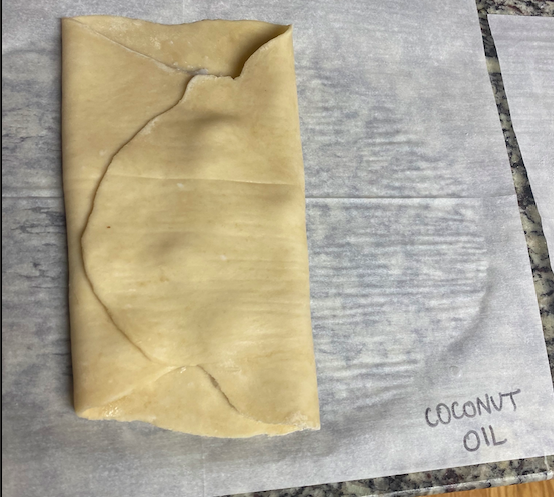
    Step 6: Fold the end without fat over 1/3 of sheet and fold the other end over the top.

    First fold
    Second and last fold

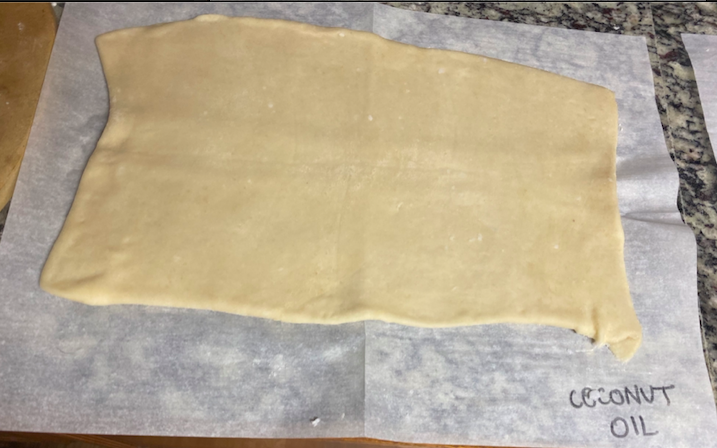
    Step 7: Roll out the dough exactly like in Step 4 carefully.

    Rolled out dough for second time

    Step 8: Repeat steps 5-7 two more times with the next two portions of fat.

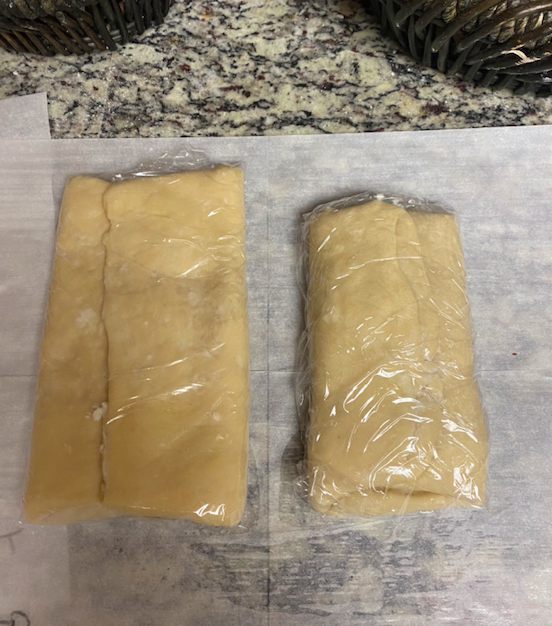
    Step 9: Wrap the dough in plastic wrap and chill in fridge for 30 minutes.

    Wrapped up and ready to go into the oven!

    Step 10: Preheat oven to 450° F and bake pastry for 8-10 minutes. 

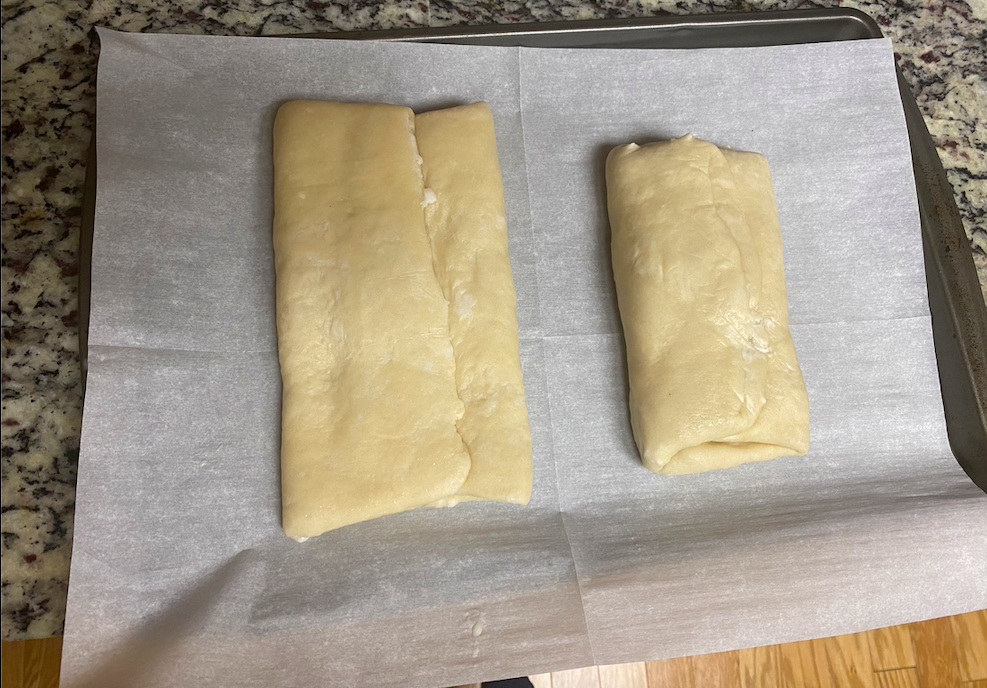
    Before baking…
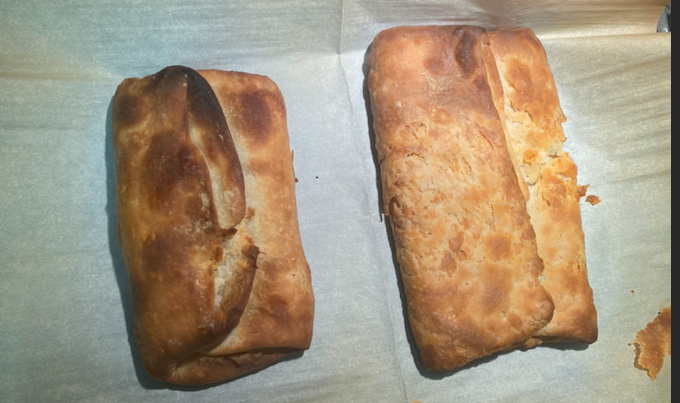
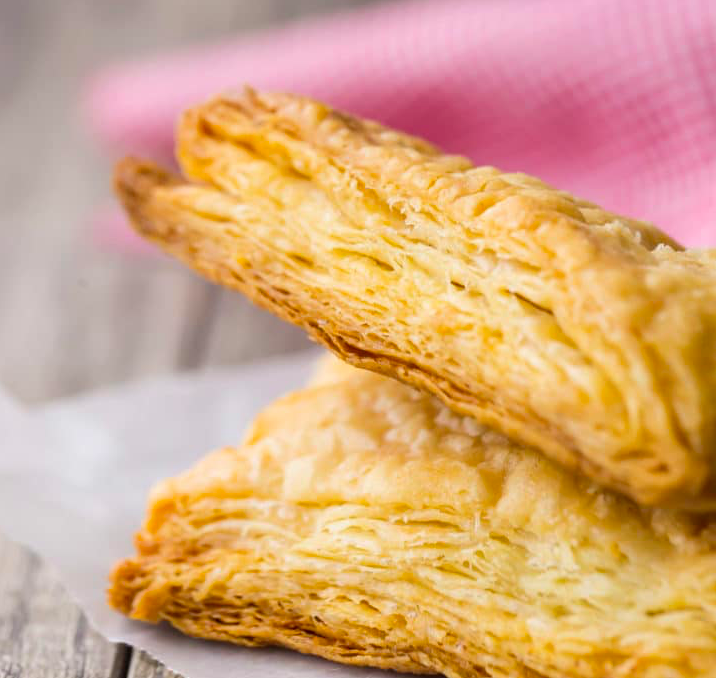
    Crispy, baked flaky pastry fresh out of the oven!


    Observations

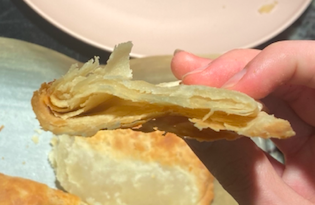
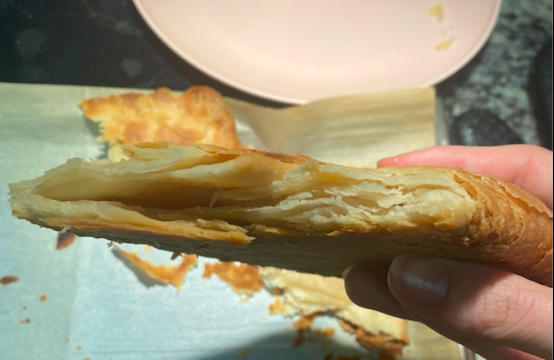
    There were many, many differences between the butter pastry and the coconut oil pastry not only during the preparation, but after baking as well. Although coconut oil and butter have very similar structure at first glance, the butter was much creamier and incorporated into the flaky pastry dough much easier than the coconut oil. The oil melted super quickly, making it difficult to keep very doughy as it was getting way too wet. The coconut oil was also much harder to de-clump while the butter of course, had real clumps. Another huge difference between the doughs was their size. As seen from the photos, the coconut oil dough had a much larger size than the butter dough. My theory for this stark difference was that the butter was much thicker than the coconut oil, making the dough much more cohesive and elastic. The coconut oil pastry was clearer flatter and more spread out, due to the silky nature of the coconut oil. The butter pastry was also much taller than the flat coconut oil version; my thinking tells me the butter allowed for the pastry to rise better than the oil did.

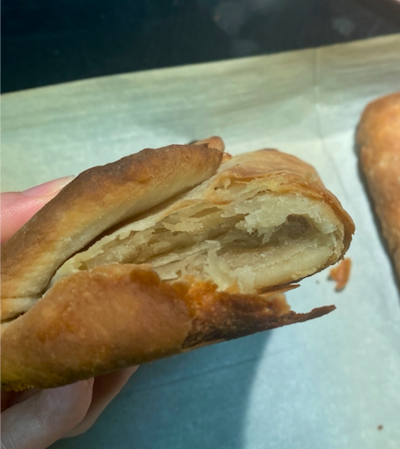
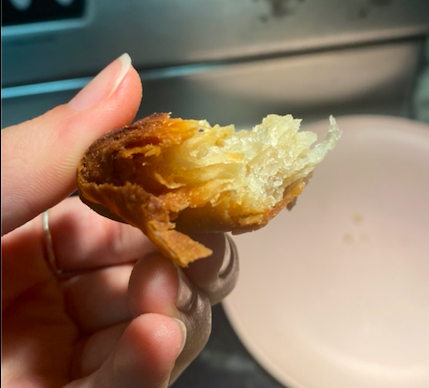
    In terms of taste, texture, and overall flakiness, both doughs performed relatively well but the butter dough definitely outshone the coconut oil. Though the butter dough was better in taste and more compact, the coconut oil pastry was also quite delicious as a substitute for butter. For any coconut lover, this is the perfect pastry substitution for fat. All in all, both doughs baked into beautiful flaky pastries with multiple light layers of crisp pastry, but the dough using the butter cooked better and tasted more like a pastry would normally taste.

    The dough with butter and its nice flaky layers
    Buttery, flaky layers of delicious pastry


    The flatter layers of the coconut oil pastry
    The coconut oil flaky pastry result


    Conclusion

    This experiment was so much fun to do considering I love to bake and have never made a flaky pastry dough before! I learned so much from the experience- not just how to make a flaky pastry but also so much new insight on how the science of baking really works together to create a magnificent dessert when heat is introduced to a couple of different ingredients. I encourage anyone reading this post who enjoys baking to try this experiment out for yourself to see if your results are the same! Not only did this experiment make me want to bake even more, but now I have an urge to try this recipe with all possible substitutes for fat like ghee, vegetable shortening, even lard. The possibilities are endless and we are just getting started!

  • The Science of Baking Pt. 1

    The Science of Baking Pt. 1

    Introduction

    Have you ever wondered how exactly baking turns a soupy batter or a thick paste into a beautiful cake or cookie? Think no further, this article will soon explain what goes into the magic that is baking and some other cool facts.

    How does science play its part?

    Baking does a great job of showcasing just how prevalent science is to everyday activities. It combines chemistry, biology, and physics to create the decadent end product. The laws of physics apply to everything, but for baking, those laws are compounded with chemical reactions within ingredients and the processes of biology. The incorporation of many different edible chemicals like baking soda and baking powder to create a cake batter or dough causes reactions like tiny air bubbles forming that are trapped and cause rising. This is where biology also comes in with the culture of yeast as a leavening agent that provides carbon dioxide for bread to rise.

    Role of Ingredients in Bake

    Every single ingredient that goes into a baked good is there for a reason. Many people know from experience that forgetting to include even a single item on a baking recipe can end in total disaster. But what exactly is each basic baking ingredient doing?

    Sugar and Fat

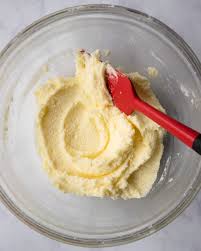
    Many recipes will tell you to add the sugar and fat component, whether it be butter or ghee or oil, and there is a very specific reason for that. When sugar is added to butter, the sharp crystalline structure of the sugar slice the butter molecules and introduce air into the mixture. This is why creaming the sugar and butter before adding it to the other dry ingredients causes a lighter and fluffier outcome! Fat also adds that rich flavor by coating the gluten molecules so they do not combine as easily which also makes the product more tender.

    Creaming of butter and sugar

    Flour

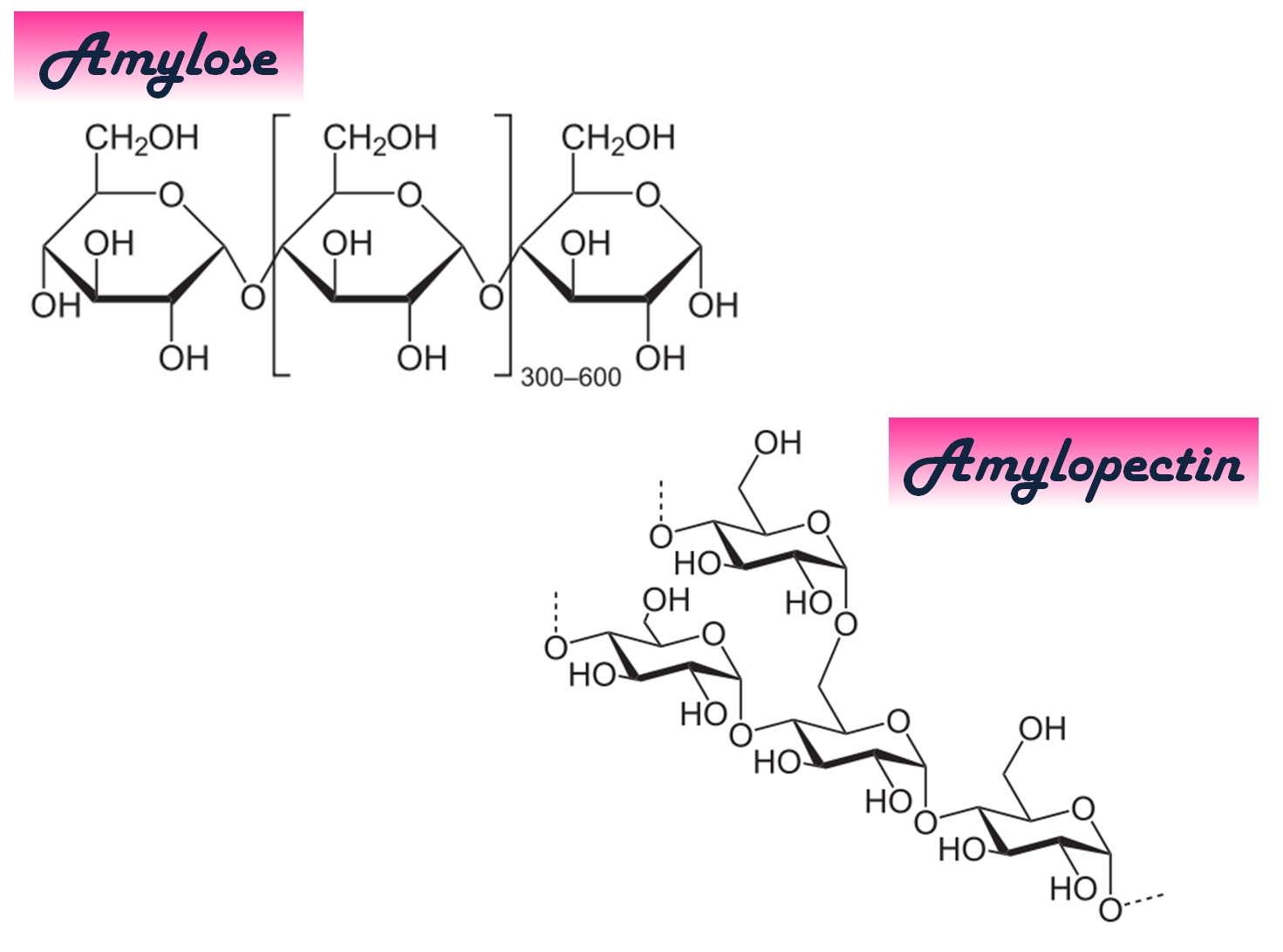
    Flour is made up by grinding raw grains or wheats or nuts to form a powder. The protein in the flour, gluten, works to form a web that traps air bubbles and allows the pastry to set in place. Basically, flour makes up the entire structure of the baked good and without it, the pastry would collapse! While the baked good heats in the oven, the starch in the flour sets in order to add and support the structure of the dish.

    Chemical structure of starches in flour

    Salt

    Salt has many functions in normal cooking, but it does in baking as well! It enhances and strengthens the flavors in other ingredients to form the perfect balance. Salt also allows the gluten provided by the flour to form better as well.

    Baking Soda

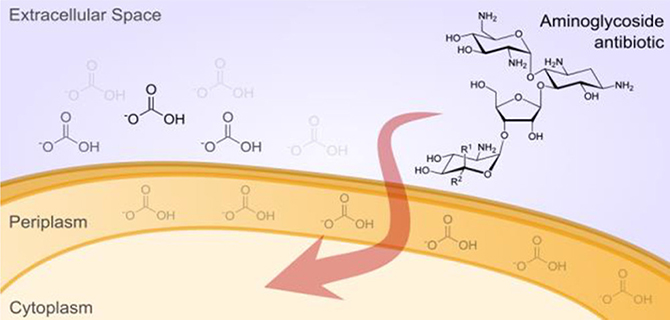
    Baking soda, has a very special role in baking as well. It’s scientific name is sodium bicarbonate, and it is a crystalline salt. For the sodium bicarbonate to work it’s leavening magic, it can either be combined with an acidic component like buttermilk to cause an acid-base reaction or can be left to perform with just thermal decomposition in the oven.

    This graphic shows the chemistry going on with baking soda

    More to come…

    As we can see, there is a lot of science that goes into perfecting a pastry. Without the chemistry, biology, and physics, it would be impossible to create any pastries or bread goodies. In the next article, we play with an at-home experiment of varying the type of fat used in one type of pastry and comparing the two different end products!

    Sources

    Babincáková, Mária. “Leavening Agents: The Chemistry of Baking Discovered with a Computer-Based Learning.” Journal of Chemical Education, vol. 97, no. 4, Apr. 2020, pp. 1190–1194. EBSCOhost, search.ebscohost.com/login.aspx?direct=true&AuthType=ip,shib&db=eric&AN=EJ1250850&site=eds-live&scope=site.

    Bodach, Vijaya. Baking a Cake. Perfection Learning, 2013. EBSCOhost, search.ebscohost.com/login.aspx?direct=true&AuthType=ip,shib&db=nlebk&AN=650384&site=eds-live&scope=site.

    Claire, Jillian, “The Chemistry of Baking” (2014). Senior Theses. 23. https://scholarcommons.sc.edu/senior_theses/23

  • CS4641 Project 3: Neural Networks Reflection

    CS4641 Project 3: Neural Networks Reflection

    Introduction

    If you have read my last article, you know that we have been here before. Although I talked about the process of completing and submitting Project 2, I wanted to write about Project 3 but focus on more of the content I learned from it.

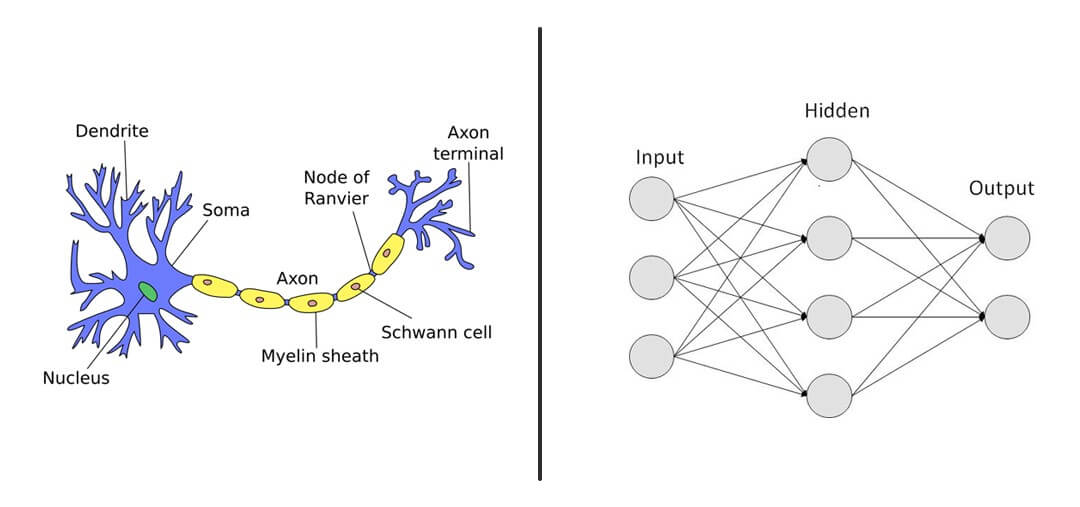
    Project 3 was completely different to Project 2- not only in terms of difficulty, but also what it meant it to me. In high school, I remember binging YouTube videos on neural networks for hours upon hours. I thought they were extremely interesting and powerful- but still had no idea how they really worked. Another reason that the algorithm caught my attention firstly was due to the relation the name has to the human brain, which has always fascinated me. Below is a picture that shows the relation between a brain’s neurons and a computer neural network.

    Neural networks and their allure were part of the reason that I wanted to study the Intelligence thread as CS major- so this particular project in Machine Learning was going to be important for unveiling the black box of how they work.

    What is a Neural Network?

    Neural networks seem extremely complicated, and they definitely can be. However, there are simple ways to think about them that makes the understanding much easier. Simply put, a neural network is a set of algorithms working together to show relationships in a dataset and try its best to mimic the behavior of human brains. They represent one of the most popular algorithms and can be programmed to do almost anything.

    This particular project was focused on one of the algorithms potential uses- text classification. Text classification is when a computer model is able to categorize words based on a certain trait they possess. For example, for this assignment, we were given the iMDB dataset of movie reviews that the computer model would take in and break down to analyze. The model is also fed training data and testing data- the training data is what the computer uses to learn how things are classified and the testing data is used to test the model’s accuracy. The computer model must be accurate on classifying movie reviews as either positive or negative on both sets of data. The coolest part of implementing a neural network like this is when it can accurately predict whether it is reading a nice review or bad review just like a human.

    Neural Bag of Words

    For the sake of length, I will only discuss one of the algorithms we implemented for Project 3, Neural Bag of Words. NBOW represents the situation in which a bag contains a bunch of words; think of someone reaching into a bag and fetching a word, but only paying attention to the amount of times a word appears and disregards grammar and word ordering from the word’s original sentence. This means that every single word in the bag is treated the same, it doesn’t matter what the word’s meaning or significance is.

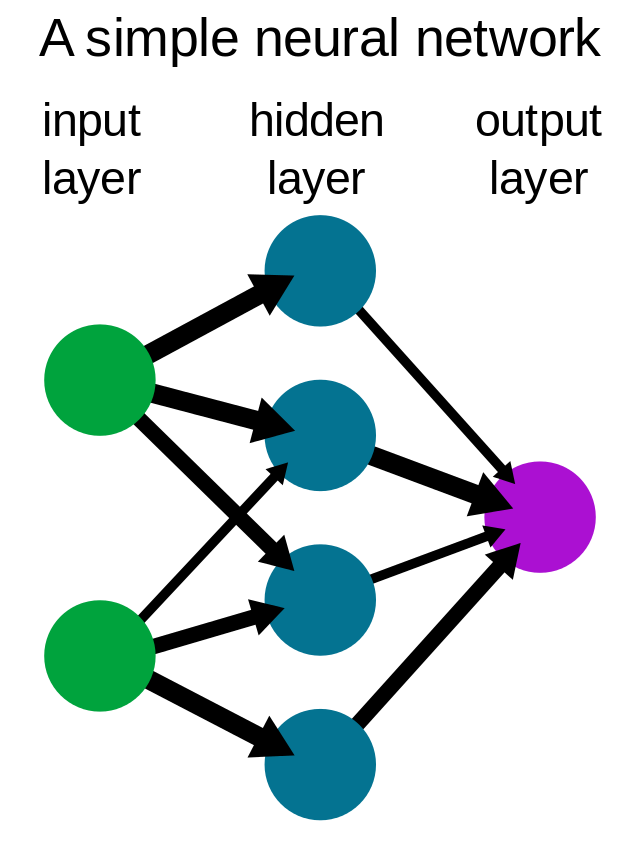
    The Neural Bag of Words model works like any other neural network- with an input and output layer, and a hidden layer in between.

    This algorithm works its magic by using an embedding layer, which helps convert words to vectors that can be used in the neural network. In our situation the input layer consists of the IMDB review dataset and the output we get is an accuracy of the computer’s prediction on the nature of the reviews.

    Conclusion

    Although I have only scratched the surface of what a neural network is made up of and does, the message of how strong it can be should be clear. Using neural networks, computer scientists can train any computer to predict anything at all using just an established dataset and training time! The possibilities of functions are endless!

  • 2021’s Partial Lunar Eclipse (With Photos!)

    2021’s Partial Lunar Eclipse (With Photos!)

    2021’s Partial Lunar Eclipse:

    A lunar eclipse occurs when Earth’s shadow block the sun’s light, that reflects off the moon. Lunar eclipses are categorized into three types: 

    1) partial – When the Earth moves between the Full Moon and the Sun, but they are not perfectly aligned. Instead, only part of the Moon’s surface moves into the Earth’s shadow.

    2) penumbral – When the Earth, Sun, and Moon are imperfectly aligned in such a way that the Earth’s outer shadow falls on the Moon’s surface. 

    3) total – When the Earth, Moon, and Sun are in complete alignment to where Earth’s shadow completely falls on the Full Moon. This causes the Moon’s surface to completely darken or redden.   

    This year’s partial lunar eclipse was considered the longest one in a millennium (one thousand years)! It took about 3 hours, 28 minutes, and 23 seconds for the partial ellipse to occur. The last long partial eclipse happened on February 18th, 1440 – which clocked to about 3 hours, 28 minutes, and 46 seconds. This partial lunar eclipse will remain the longest one for 648 years until February 8th, 2669 – which is predicted to clock to about 3 hours, 30 minutes, and 2 seconds!

    So why what the eclipse of 2021 so long? Well, the eclipse was long for two main causes: (1) the Moon’s orbital speed and (2) the near-totality of the eclipse (even though it is still considered a partial eclipse). The Moon’s orbit around the Earth is not a perfect circle. In actuality, the Earth is not in the center within the orbit, so sometimes the Moon is closer to the Earth, and other times it is farther. This variation in distance effects the Moon’s orbital speed (father = slower; closer = faster). Thus, the Moon is at a farther point in its orbit around the Earth, and as a result, it moves slowly through Earth’s shadow (which is indicated by the darkening or reddening of the Moon’s surface). Since the eclipse is almost-total, the Moon takes a longer time in the Earth’s shadow than a typical “partial” eclipse.

    Are you curious of when the next lunar eclipse will happen? Well, the next total lunar eclipse (A.K.A.: “blood moon”) will happen May 15-16, 2022. It will be visible from North and South America, Africa, Europe, and parts of Asia. Stay tuned to space news to stay updated!


    Below are pictures that I took with my iPhone of the raw partial lunar eclipse that occurred on Friday, November 19th. I stayed up until 4am to watch it happen! I was able to take these pictures while standing on Howey’s Physics Observatory! One of my friends even got to take a picture through the telescope of the moon during the eclipse. Here are the pictures below.

    Picture while at Howey Physics Observatory on                  Friday, November 19th at 3:39 am.
    Picture of the eclipse through a telescope at 3:49 am.
    Picture of the eclipse at 4:02 am. Notice the                              reddening of the moon.


    Sources: 

    https://moon.nasa.gov/news/168/an-almost-total-lunar-eclipse/ 

    https://www.space.com/15689-lunar-eclipses.html 

  • Stress Tapping: What it is & How to do it

    Stress Tapping: What it is & How to do it

    STRESS TAPPING

    Are you looking for a new method to coping with stress, pain, and anxiety? Well, “stress tapping” is one of many ways that can be added to your techniques for maintaining your mental health and wellness. Stress “tapping” is also known as EFT (Emotional Freedom Techniques) and is a combination of ancient Chinese acupressure and modern psychology.

    People who use stress tapping believe that it can create a balance in your energy system in your body and treat pain, whether physical or emotional. Although EFT tapping is still being researched, it has been used to treat people with anxiety and post-traumatic stress disorder (PTSD).

    EFT is compared to acupuncture in how they both focus on using “meridian points” (or energy hot spots) around the body. Based on Chinese medicine, meridian points are areas of the body that energy flows through and any imbalance can influence disease or sickness. Unlike acupuncture that uses needles to apply pressure to these meridian points, EFT tapping uses simply your fingertips to apply pressure.

    Although there are 12 major meridians that mirror each side of the body and correspond to an organ in your body, EFT focuses mainly on the following nine:

    Emotional Freedom Technique (EFT) | Cigna
    Diagram: https://www.cigna.com/individuals-families/health-wellness/hw/emotional-freedom-technique-acl9225
    • beginning of the collarbone: kidney meridian
    • under the arm: spleen meridian
    • karate chop (outermost side of hand): small intestine meridian
    • top of head: governing vessel
    • eyebrow: bladder meridian
    • side of the eye: gallbladder meridian
    • under the eye: stomach meridian
    • under the nose: governing vessel
    • chin: central vessel

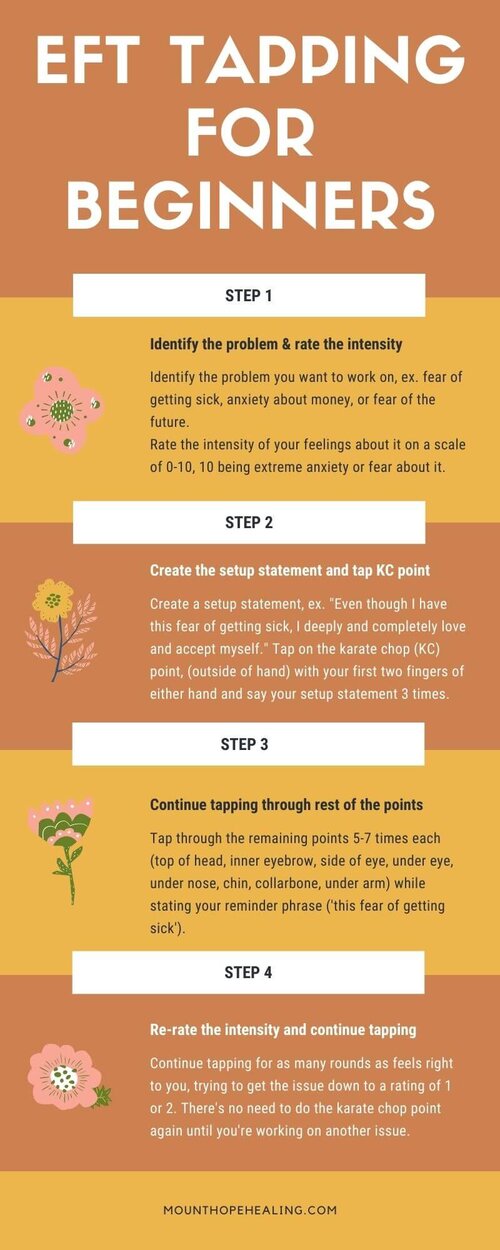
    Below is an easy guide for how to navigate stress-tapping for beginners:

    EFT Tapping for Beginners with Autoimmune Disease — Mount Hope Healing
    Infrograph: https://mounthopehealing.com/blog/eft-tapping-for-beginners


    Source(s)

    Anthony, K. (2018, September 18). EFT Tapping. Healthline. Retrieved November 4, 2021, from https://www.healthline.com/health/eft-tapping#treatment

    Ortner, N. (2021). The Tapping Solution: A Revolutionary System for Stress-Free Living by Nick Ortner (2-Apr-2013) Paperback. Hay House UK (2 April 2013).

  • Music & Emotions: A Series (Part 3 – Indignant/Defiant)

    Music & Emotions: A Series (Part 3 – Indignant/Defiant)

    Album Songs:

    1. You’ve Seen the Butcher – Deftones
    2. Links 2 3 4 – Rammstein
    3. Psychosocial – Slipknot
    4. I Stand Alone – Godsmack
    5. Ride the Lightning – Metallica
    6. The Last Ten Seconds of Life – The Face
    7. Smells Like Teen Spirit – Nirvana
    8. Duality – Slipknot
    9. Walk – Pantera
    10. Dark Entries – Bauhaus


    Welcome to Music and Emotions: A Series (Part 3)! In this part, we continue our series with the category of “Indignant/Defiant.” For a quick recap, an interesting study conducted by professors at the University of California Berkeley was conducted on how music evokes different emotions (Cowen et al., 2020). They decided upon 13 categorizations of music, one of which was “indignant/defiant.”  They found that the way that individuals classified music based on emotions was relatively similar. All of the songs included in the above album were utilized in this study and were some of the songs that participants most frequently categorized as “indignant/defiant.”


    Here, it was found that music that typically landed in this category was characterized by a “growl-like timbre” (Cowen et al., 2020). This is something often seen in music that is perceived as aggressive. In addition, there is an interesting, brief, mention of the potential connection between the threatening vocal expressions used in these songs and that of various animal species. For example, the growl of the black jaguar. This could be why there is a clear male bias in the song choices in the album since males tend to have deeper voices which are more likely to mimic the growl of an animal.

    Conversely, some examples of female-centric songs that could also fall into this category could be Shitlist by L7, Rebel Girl by Bikini Kill, and Ignorance by Paramore.


    As mentioned previously, they decided upon 13 categories and even included an interactive audio map where you can go in and see all of the songs used and see how you match up. Stay tuned for more of this series… 3 categories down, 10 more to go! Which other category would you want to hear about? Comment below any songs you may think hit the mark for the “Indignant/defiant” category and how you matched up to others in the interactive audio map! 


    Bibliography:

    Cowen, A. S., Fang, X., Sauter, D., & Keltner, D. (2020). What music makes us feel: At least 13 dimensions organize subjective experiences associated with music across different cultures. Proceedings of the National Academy of Sciences, 117(4), 1924–1934. https://doi.org/10.1073/pnas.1910704117