Grad School Confidential: Danger Zone

I am sitting. More specifically, I am waiting. Waiting on the box in front of me, a box that reminds me of my grandmother’s post-war era microwave on account of its single all-purpose knob, with the only exception being the spaghetti tubing running out of the top in two directions. The box is not an outdated kitchen appliance but a vacuum drying oven. The lollipop shaped vacuum gauge marches counter-clockwise until…

Well, until nothing. The danged thing has stalled just before bottoming out on the little steel peg that says “stick a fork in me, I’m done.”

I rouse myself to check my watch. It’s late. I haven’t seen another person save the blue handed, white cloak laden wardens of the halls for some time. The graduate students, we chosen few, patrol the length of linoleum from office to lab. I shimmy my own blue nitrile gloves down a little further and pull up the stained cuff of my lab coat to see if I have mistaken the watch face. I haven’t.

Leaning forward and squinting, I can see the small vial inside of my grandmother’s “cooker” containing a slurry of manganese dioxide and water has begun to fizzle as its boiling temperature is shifted downward. Water molecules consider their life up to this point and decide things are looking better in the great beyond, say goodbye to their friends and family, sever what remaining bonds they have to the liquid state and float into the void of the vacuum. Things are so bad in the vial, it seems, that enough of the little buggers are escaping to keep the pressure in the box from bottoming out. An imaginary leak produced from within: the bane of vacuum experimenters everywhere. I think of the Armstrong limit and making macaroni and cheese on Mount Everest. Using my phone and the cleanest edge of my glove I search the web aimlessly. The Wikipedia page says manganese dioxide was historically used as a pigment. I am literally watching paint dry.

Bored with the experiment, I decide to promote the box into the 21st century. As Ron Popeil would say, “set it and forget it”. Forgotten! After a final scrutinizing glance at the little vial, I decide to take an evening stroll around the long abandoned corridors. When I open the door to my lab, air whooshes in from the hall. Another fine example of a mechanically induced pressure gradient, but instead of the little rotary vane pump that is busily gobbling down water molecules from the vacuum oven with its occasional old-man-clearing-his-throat grumbles and burping them into the lab, this one is caused by the fume hood in the back corner of the room. The influx causes my unbuttoned lab coat to unfurl behind me like a cape.

A good lab coat imbues the wearer with a certain Fonzerellian swagger. The pop-able collar, the carefully placed stains, the pocket full of scoops and tweezers and balled up kim-wipes and what not. It’s all a carefully orchestrated ensemble. I toss my nitriles into the waste bin and move my safety-glasses to the Doc Brown position. Normally I’d put on a Ratatat album and Gene Kelley up and down the halls, but on this eve I stumble upon the Danger Zone.
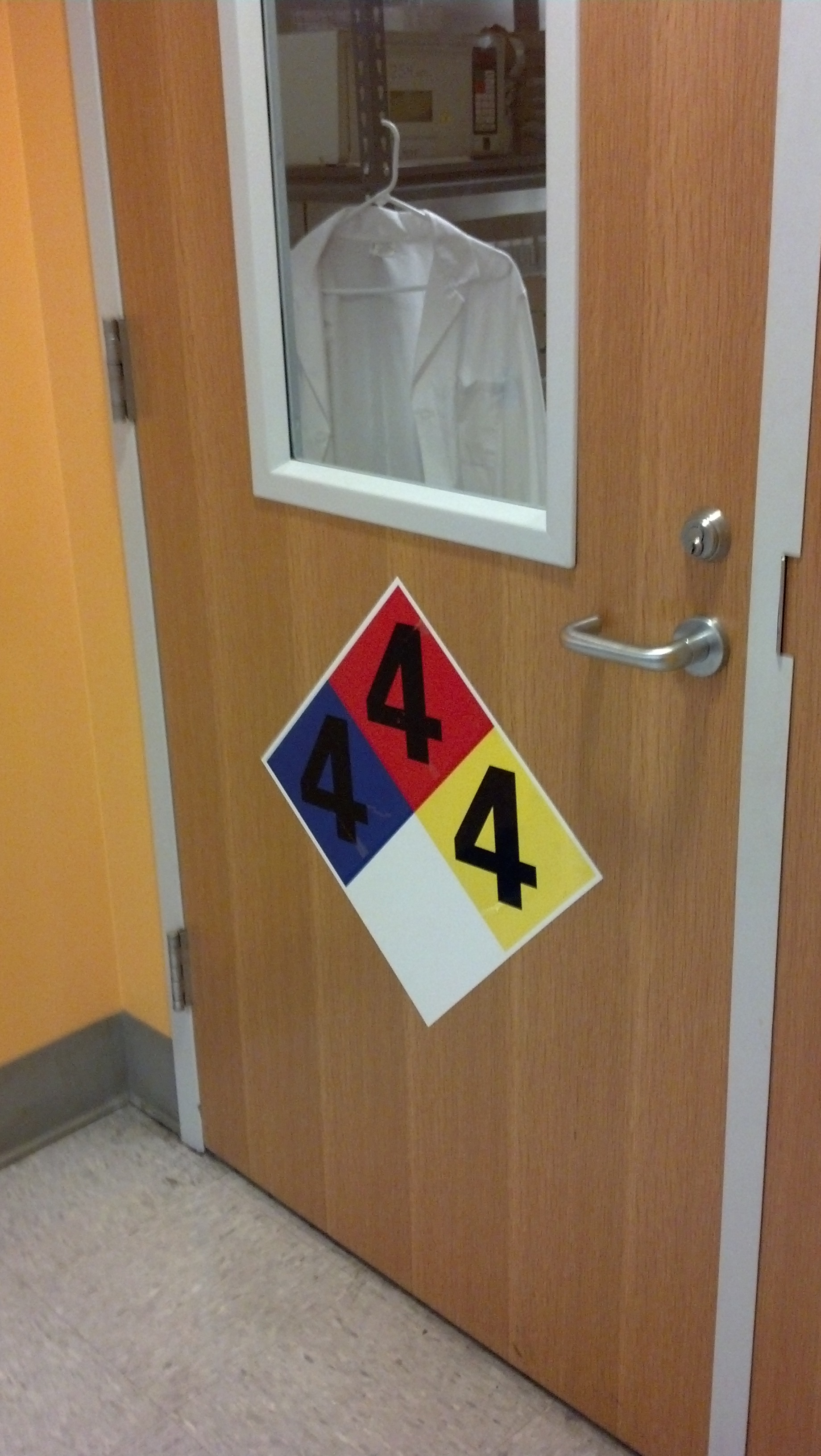
The Gateway to the Danger Zone

The Danger Zone is indicated by a large, multicolored diamond placard hung on the door of a neighboring lab. This diamond is subdivided into four sub-diamonds – one blue, one red, one yellow and one white. In the top three colored diamonds there stands an ominous number four. I can tell it is ominous because of the deliberate choice to use a bold-faced font. Italics is subtle, bold-face is ominous. Common knowledge. The placard is an NFPA safety diamond with the highest simultaneous ratings I’ve ever seen.  The NFPA diamond is the universal indicator for scientists, engineers and common folk alike to tell you the likelihood of imminent liquidation of internal organs. You’ve probably seen one on the sides of chemical trucks on the highway or in your uncle Ned’s doomsday bunker.  I’ve been to enough Environmental Health and Safety seminars to know that pretty much only a nuclear holocaust gets a 4 in every category of the NFPA diamond, those categories being health, flammability and reactivity. For comparison, gasoline, which makes such suburban pastimes as the fire melon possible, gets a three for flammability. Yeah. Meanwhile, “very short” exposure to a number 4 health hazard can be fatal and a number 4 reactivity rating is explosive at room temperature with minimal agitation.

I have to admit, even swaddled as I am in my lab coat, I begin feeling a little overwhelmed by the idea that a mere 15 feet away from my vial of manganese dioxide (which gets a paltry rating of 1 for health and flammability and 2 for reactivity) are three distinct ways to get sent to the hospital. How do I know there are three? Well, to speak truthfully I don’t, but I would place a wager that no single chemical exists with NFPA ratings of all 4’s that would be allowed within 40 miles of a population center like metro Atlanta. Furthermore, general NFPA labeling like the one on the door to the danger zone indicates the highest combined hazards of all the chemicals found within. I imagine at least two chemicals were needed to propel a lab into the danger zone category. A container of hydrofluoric acid (which will dissolve your bones through your skin) and tri-nitro-tolune (it’s TNT, it’s dynamite) would give you a combined rating of all 4’s.

I retreat to the relative safety of my lab and barricade the door.


Image credits:

http://en.wikipedia.org/wiki/Corrosive

http://knowyourmeme.com/memes/yao-ming-face-bitch-please

 

Leave a comment

Your journey starts here! Let’s talk!

ThemeRex © 2026. All rights reserved.
  Timothy Durham was convicted of rape when a test showed his DNA genotype matched the DNA recovered from the crime scene. Eye witnesses testified that Durham was in a different state at the time of the incident, but he wasn’t exonerated from his 3000 year sentence until follow up DNA analysis showed that the preliminary forensic analysis used in the trial was misinterpreted (Thomas et al.). DNA testing serves an invaluable part in our criminal justice system, but it comes with complications and bias that can lead to wrongful convictions and misinformed juries.  

Background:

Forensic genetics aims to identify the origin of a biological sample. It can be traced back to Karl Landsteiner who discovered human ABO blood groups. With blood groups, suspects could be eliminated based on their blood type. For example, if a suspect had type A blood and there was type B blood left at the scene by the perpetrator, the investigators could rule out the suspect. Unfortunately, the reverse didn’t work. If the suspect and perpetrator both had the same blood type, it can’t be concluded that the suspect was guilty. Blood identifiers evolved into 8 distinct categories which improved the ability to eliminate suspects, but could only conclude that (if the system matched) it might be the perpetrator or this person might be related to the perpetrator (Jobling and Gill). The field evolved in the 1980s with the discovery of Minisatellites, lines of repetitive DNA that don’t encode proteins. Minisatellite patterns in DNA create what we know today as the DNA fingerprint, and it has a much higher accuracy rate than previous methods (Augustyn et al.). Around the same time, a breakthrough for victims of sexual assault was discovered. In the case of assault, bodily fluids of both the victim and the assaulter can get mixed. A process called differential lysis was created which could selectively increase the concentration of sperm in a fluid sample thereby allowing for accurate DNA testing (Jobling and Gill). Forensics evolved to use single-locus probe testing after several years because of its ease of interpretation. It looked at specific minisatellites that had high variability between subjects. This was the first DNA-based method to be used in a criminal investigation. Two murder homicides from several years apart were connected using DNA evidence. The evidence was then used to exonerate an innocent man, and the guilty party was found when he tried to evade mandatory DNA testing for all men in the small town. His guilt was then reinforced when the DNA profiles matched, and he gave a confession (Jobling and Gill). Finding DNA at a crime scene doesn’t guarantee that you’ll find a murderer. There are issues with non-pure samples and limited samples that make DNA work difficult, and accreditation of facilities and new techniques and take time (Jobling and Gill).  

Subjectivity of DNA Interpretation:

In a 2009 publication, the National Academy of Science discusses the possibility for subjective influence in lab based forensics. The interpretation bias happens in complex cases where, for example, there could be a mixture of DNA. A study published in 2011 looked specifically at this issue. A gang rape happened in Georgia, and the mixture in DNA from the case was used to prosecute one suspect after another suspect took a plea bargain to testify against him. With DNA mixtures, there are three possible conclusions: suspect excluded, suspect cannot be excluded, and inconclusive. If the suspect is excluded, it means that there’s little to no possibility that his DNA is part of the sample. If the suspect cannot be excluded, it means that there’s a possibility that his DNA is part of the sample. In the trial, the DNA examiners who knew the context of the case concluded that the suspect being prosecuted could not be excluded. The 2011 study gave the DNA evidence from this case and the DNA profiles of the suspects to 17 forensic examiners. These examiners had no context of the case, and they all worked independently. Of the 17, only 1 came to the same conclusion (suspect cannot be excluded) as the examiners who knew the context of the case. Twelve of the 17 concluded that the suspect who was prosecuted and convicted had no relation to the DNA found in the sample. Not only does this show that subjectivity occurs due to the context of the case, but the 17 examiners came up with different findings based on their past experiences meaning that not all DNA analysis is objective. Some organizations like the Scientific Working Group on DNA Analysis Methods say that quantitative statistical evidence should be presented with every categorical conclusion, but the US doesn’t require this (Dror and Hampikian).

False Positives:

There are two categories that cause wrongful identification in a DNA report: coincidental matches and false positives. Coincidental matches are DNA matches between two unrelated people. The probability of these matches is about 1 to 500,000 for white individuals and about 1 to 350,000 for black individuals. This small probability of coincidental matches makes people feel confident in DNA evidence. False positives, on the other hand, are matches between DNA and test DNA that result from issues in the forensics lab. There have been multiple cases of forensics labs accidentally switching victim and suspected rapist DNA which lead to convictions that were later overturned when the lab realized the error. There are also cases of misreading or misunderstanding a sample. In a case from 1993, a man was convicted of rape because someone interpreted a mixed sample of victim and perpetrator DNA as an individual sample. The conviction was again overturned. To prevent false convictions, retesting DNA is allowed, but it’s not an efficient solution. Many people are pushing for statistical information on the probability of false positives, so that the jurors can make accurate judgements based on DNA evidence (Thomas et al.).  

Conclusion:

DNA analysis is a useful tool for the criminal justice system, but subjectivity can be an issue in forensic testing. To combat wrongful convictions, there are organizations like The Innocence Project who use DNA testing to free the innocent, but reformed forensic testing standards should be put in place to prevent subjectivity and to ensure juries are correctly informed during trials. https://www.innocenceproject.org/    

Citation:

Augustyn , Adam, et al. “DNA Finerprinting.” Encyclopedia Britannica , 26 Apr. 2018, www.britannica.com/science/DNA-fingerprinting#ref153186. Dror, Itiel E., and Greg Hampikian. “Subjectivity and Bias in Forensic DNA Mixture Interpretation.” Science & Justice, vol. 51, no. 4, 2011, pp. 204–208., doi:10.1016/j.scijus.2011.08.004. Jobling, Mark A., and Peter Gill. “Encoded Evidence: DNA in Forensic Analysis.” Nature Reviews: Genetics, vol. 5, no. 10, Oct. 2004, pp. 739–751., doi:10.1038/nrg1455. Thompson, William C, et al. “How the Probability of a False Positive Affects the Value of DNA Evidence.” Journal of Forensic Sciences, vol. 48, no. 1, Jan. 2003, pp. 1–8., doi:10.1520/jfs2001171.