What are your hobbies? Do you participate in a sport, or do yoga, or grab a paintbrush and make some art? How about something that literally sounds amazing – mechanical keyboards, anyone?
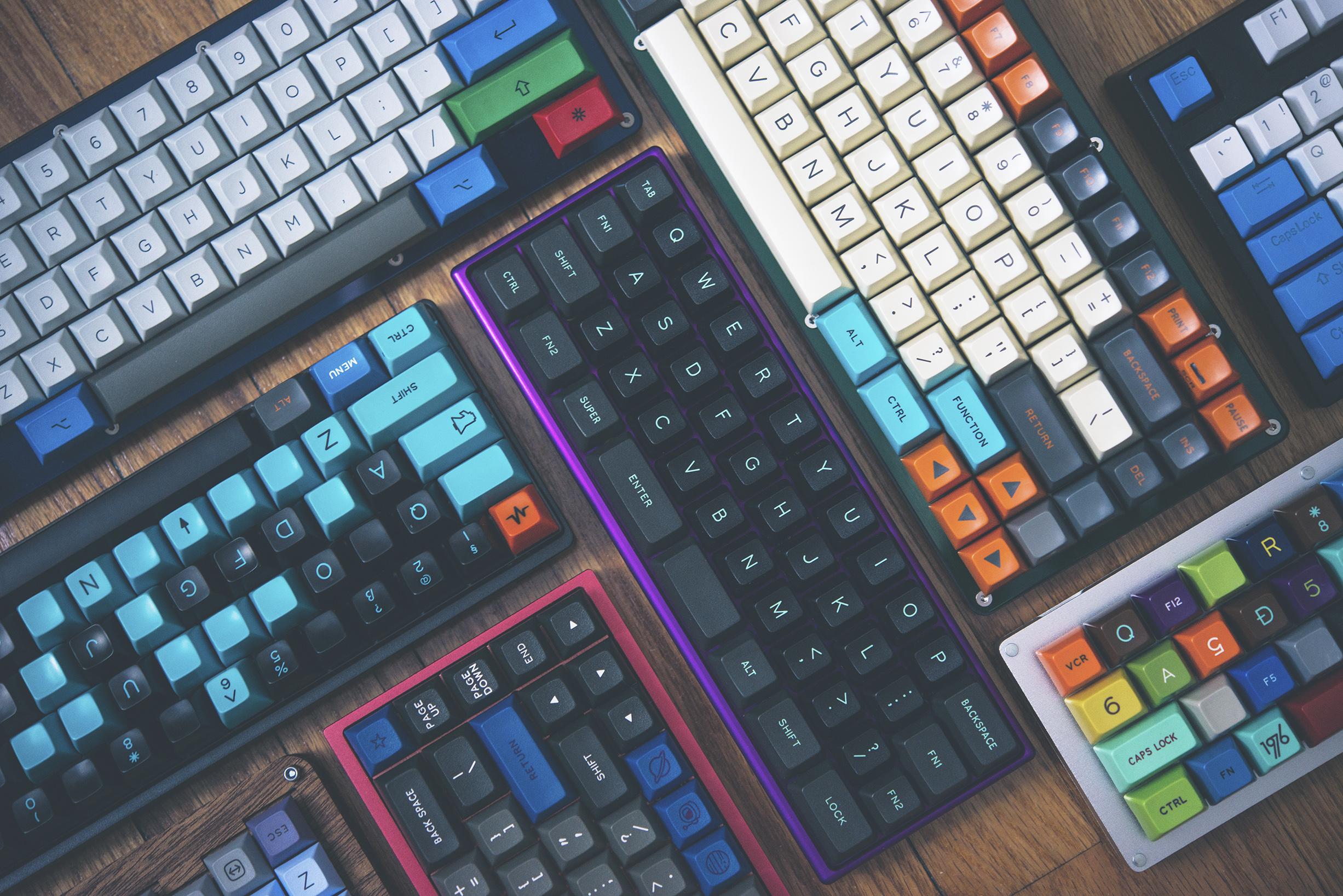
You’ll have to trust me, psychology will be incorporated soon, but first – for those unaware of the magic of mechanical keyboards – let me explain my newest hobby, pictured above, adapted from one of my presentations. Throughout the slides, you’ll see slides I used for the presentation to allow you to experience it as well!
To start, you are likely using what is known as a “membrane” keyboard. A membrane keyboard, such as those on laptops or the keyboards you’ll see waiting at the computers in a library, use linked pressure pads that result in the key press to allow you to type. A mechanical keyboard utilizes switches, which are connected to a printed circuit board (PCB) that allow the key press to be registered and result in the typed character. There are thousands of switches, each that provide unique sensory responses, sound characterizations, and aesthetic options. Soon, we’ll delve into the intricate engineering of this important aspect of the mechanical keyboard.
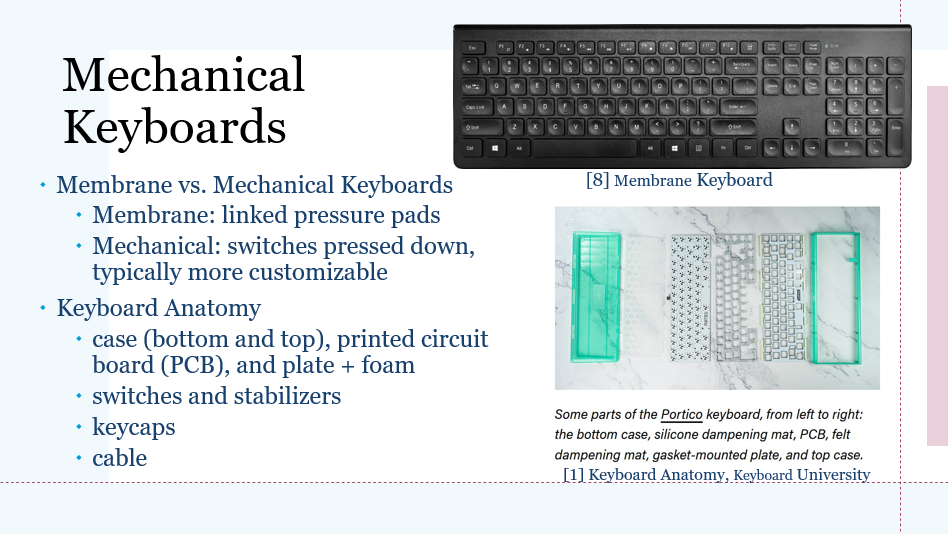
Focusing on the mechanical keyboard, though there are many modifications and options to add, there are a few basics to create the mechanical keyboard. The keyboard encases a printed circuit board, a plate to mount the switches upon, and typically some foam to help dampen the sounds of the keyboard. With these layers, the switches and stabilizers (used for longer keys, such as the space-bar and shift keys) connect to the PCB, and then are topped with key caps. The top case is put on, plug in the cable, and if all goes well, you have a working mechanical keyboard!
Given how defining the switches are, it is important to discuss their general anatomy as well. The keyboard switches are made of 6 main parts, with small changes that can be made to create a customizable experience.
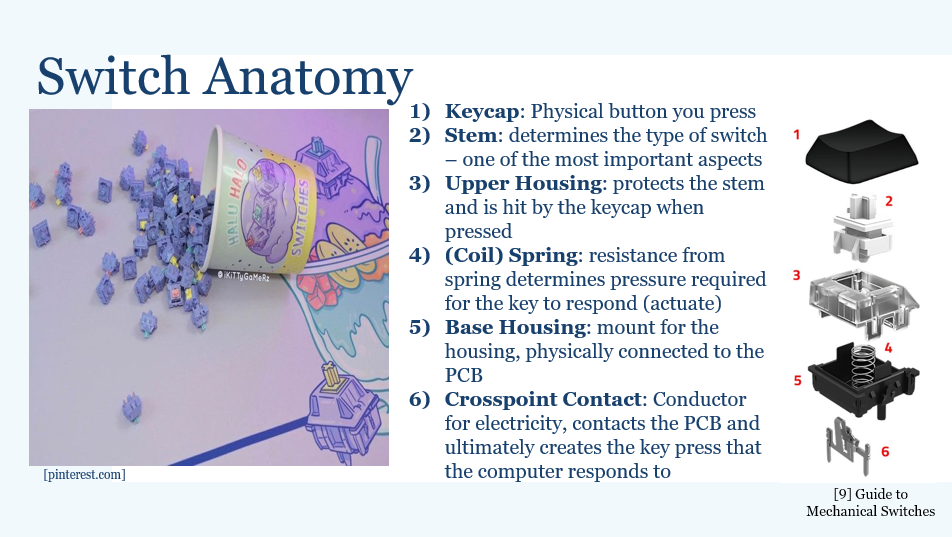 Most commonly, you’ll see switches in three main categories: linear, tactile, and clicky. The differences between these three are mostly noise levels and the smoothness of the switch. The stem of the switch largely affects this as the switches stem can be made to a certain actuation and travel distance, affecting how much force is needed to complete a key press and how quickly the key press can happen. This not only affects the feeling of smoothness or lack thereof, but is often an important aspect for those in eSports or the gaming community due to the need for lightning fast responses. For this group, linear switches tend to be the most ideal to use.
So, why do people want to make or buy these mechanical keyboards? The customization may be nice, but this can be quite the expensive hobby. According to Switch and Click, a popular website and YouTube channel centered on mechanical keyboards), “the average cost comes out to be around $200 – 600 per board,” [5]. And yet, despite how expensive this can be and how silly it may sound to have multiple keyboards, it is quite common for people in this hobby to build multiple anyway. With this in mind, I generally split the reasoning of why into two main categories: subjective and technical.
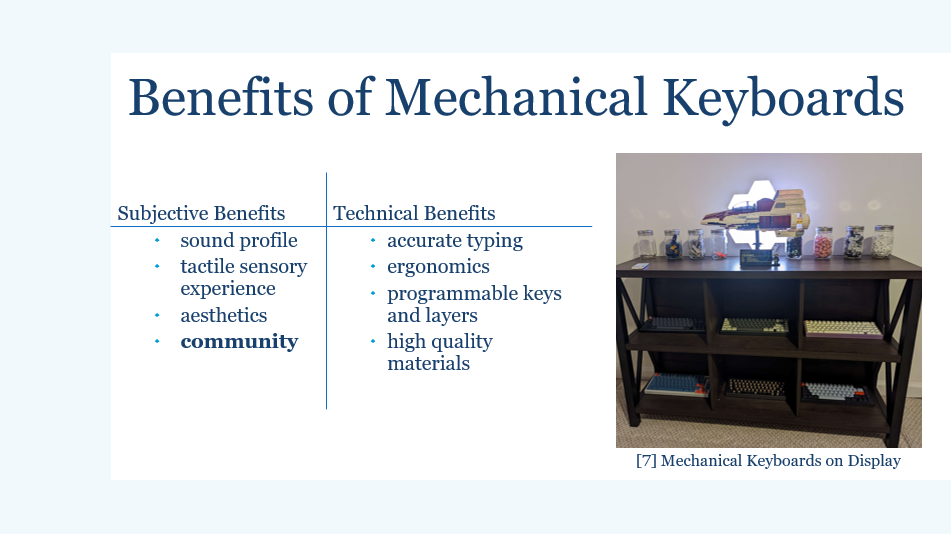
The community aspect in the mechanical keyboard sphere is unbelievable. With the amount of trial and error that may come with building a personalized keyboard, there are plenty of people that want to help others and share what they have created. In fact, even here at Georgia Tech we have a student-run Mechanical Keyboard Club for people to share their builds and enjoy the hobby together! I have no doubt that the expensive aspect actually brings about more community, as people search for such a wide variety of builds to get an idea of what they enjoy the most in terms of sound and looks before shelling out some Benjamins for their ideal keyboard. The previously mentioned Switch and Click YouTube, as of late April 2023, supports 701K subscribers, which has increased about 15K subscribers since I last checked almost two months ago. The community is huge, and only continues to grow as it reaches more people.
So, how do people typically first find the mechanical keyboard community? The ‘First Contact’ is not necessarily through someone you know showing off their keyboard. In fact, I think one of the most common ways to venture into the hobby is first by seeing Keyboard ASMR. For those that enjoy or who have never heard of it, I encourage you to watch at least a minute of this 1 hour ASMR video from “The Way ASMR” channel – who may be referred to as an ‘ASMRtist’.
Now, as I have promised, we delve into the realm of psychology.
What is ASMR? ASMR stands for Autonomous Sensory Meridian Response. According to Psychology Today, ASMR is “[the] name given to a tingling sensation, typically on the scalp, neck, or back, that some people report feeling in response to certain visual or auditory stimuli,” [3].
For the reader, I have a question. Have you experienced ASMR? I encourage you to submit your answer in the poll below, and see what others have said!
https://strawpoll.com/polls/eNg69l8EAnA
ASMR is a relatively new psychological phenomena, with few peer-reviewed articles on the subject, and even fewer that employ empirical data to analyze. Not to worry, I have dug through all the academic tunnels to find a few for this article. From a psychological perspective, many psychologists and researchers may be curious to answer questions on ASMR, such as: ‘is this a common experience?’, ‘how do we define ASMR?’, ‘who is helped by ASMR content the most?’.
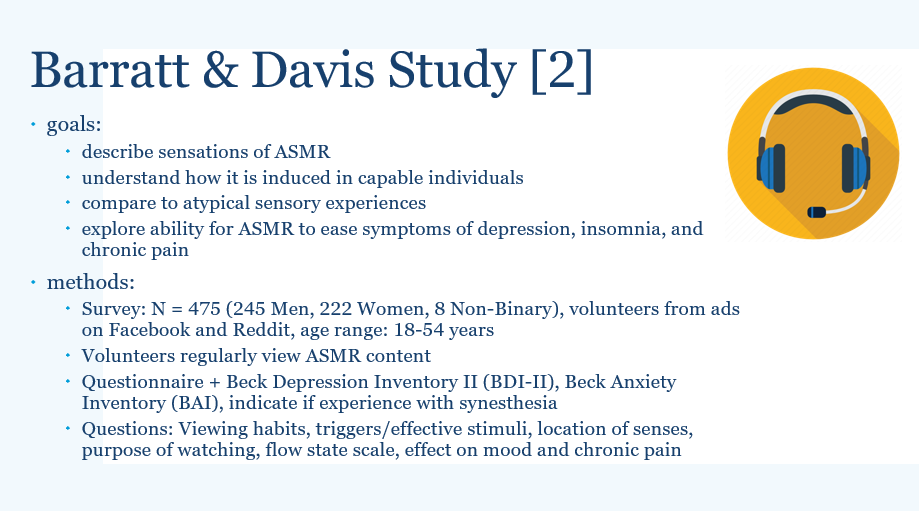
In one article, from authors Dr. Barratt and Dr. Davis, I have outlined their goals and methods on their research of the ASMR experience.
IMPORTANT NOTE: This study discusses ASMR, occasionally in the context of mental health issues such as depression, and chronic illness. The analysis or results of this study is not meant to provide any diagnosis, cure, or medical advice, and is only meant to identify any patterns or gather data on perceived helpfulness from study participants. If you or anyone else you know is struggling with chronic pain or mental health issues, please reach out to licensed professionals for help in coping and health management.
The methods employed in this study aim to yield a mix of both qualitative and quantitative results. Additionally, the study wanted to draw comparisons with other sensory disorders and states such as synesthesia and a ‘flow’ state – which you may have experienced while studying. Small spoiler alert, there wasn’t a strong connection of ASMR with either synesthesia experiences nor the flow state, indicating that ASMR is its own psycho-neurological experience.
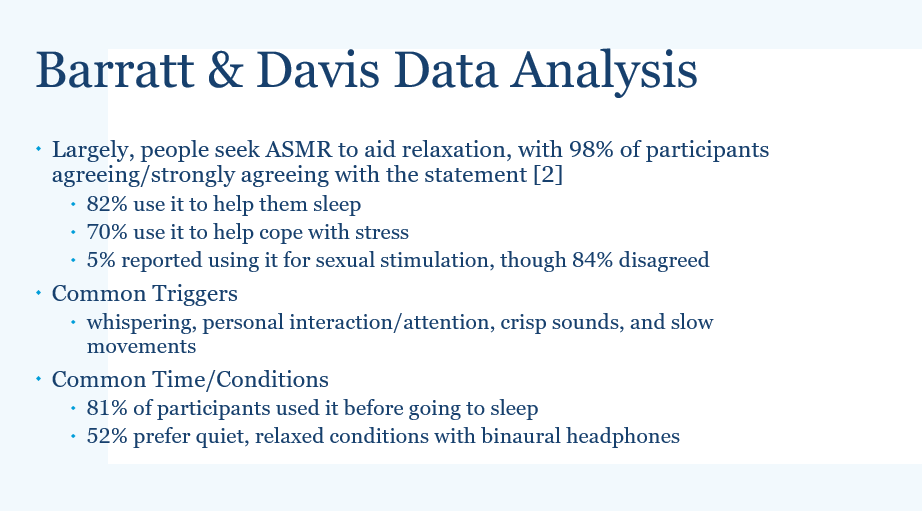
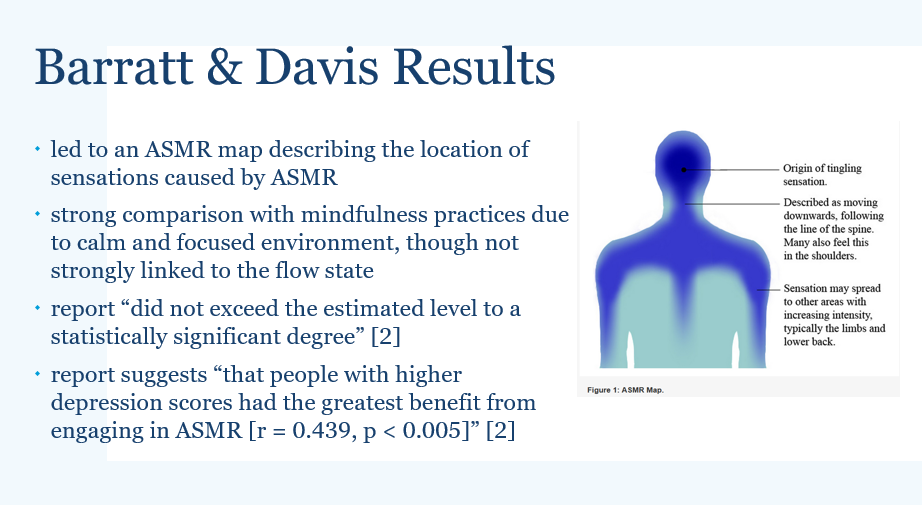
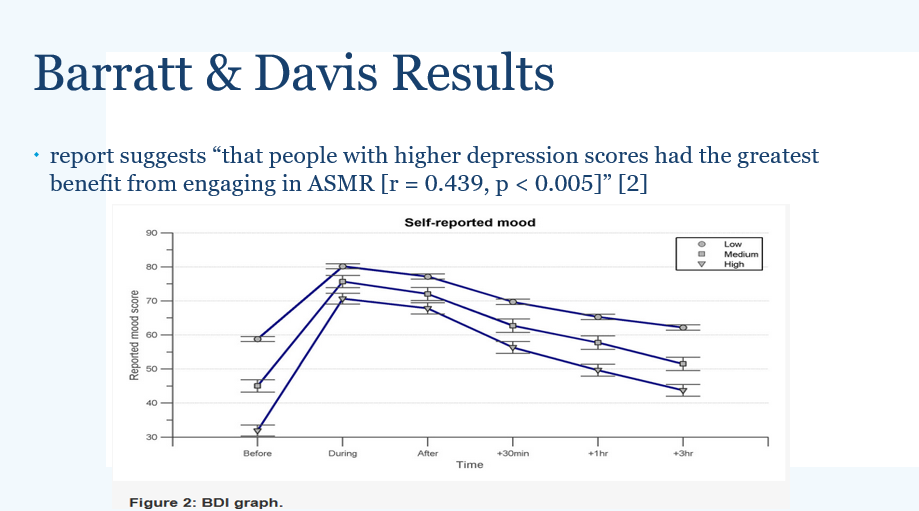
Ultimately, ASMR is something comforting and relaxing to watch and listen to for those that experience the sensations associated with ASMR. People enjoying the customization of their keyboard may find satisfaction in their work and the ability to almost create their own ASMR by utilizing the keyboard they have made. Though we understand that ASMR can be as a temporary way to boost mood and relaxation, especially those experiencing depression, more research is needed to fully understand how ASMR works in individuals. Without a significant connection to other known sensory disorders, other than effects of mindfulness, the neural underpinnings of ASMR and the extent of the selection of people that can experience ASMR are still a mystery.
Citations:
[1] Keyboard University, url: https://www.keyboard.university/100-courses/intro-to-mechanical-keyboards-p6brj
[2] Barratt EL, Davis NJ. 2015. Autonomous Sensory Meridian Response (ASMR): a flow-like mental state. PeerJ3:e851. https://doi.org/10.7717/peerj.851
[3] Psychology Today, url: https://www.psychologytoday.com/us/basics/asmr
[4] Stephen D. Smith, Beverly Katherine Fredbord & Jennifer Kornelsen (2017). An examination of the default mode network in individuals with autonomous sensory meridian response (ASMR), Social Neuroscience, 12:4, 361-365, DOI: 10.1080/17470919.2016.1188851
[5] Switch and Click. Article. Url: https://switchandclick.com/what-is-the-average-cost-for-a-custom-mechanical-keyboard/
[6] The Way ASMR. “Cozy ASMR Typing for 1 HOUR / No Talking / Mechanical Keyboard Sounds / Gateron Red Switches”. Online Video (YouTube). Url: https://www.youtube.com/watch?v=xAVoQx2hUpk
[7] kane#6661. Image from Discord. ‘mechanical keyboard display station example’.
[8] Image of Membrane Keyboard. Url: https://www.bestbuy.com/site/best-buy-essentials-be-pkrfkb-full-size-wireless-membrane-switch-keyboard-black/6460659.p?skuId=6460659
[9] Ultimate Guide to Mechanical Keyboard Switches for 2020, Dygma, url: https://dygma.com/blogs/stories/the-ultimate-guide-to-mechanical-keyboard-switches-for-2020