Have you ever wondered what goes on in outer space, especially around black holes? I know as a kid, viewing black holes as giant vacuum-like structures, I wondered about the kind of things that might be getting sucked into them while drifting through space. Well, a few weeks ago, I heard a talk by Dr. David Ballantyne about what is actually happening in space around supermassive black holes (SMBHs). (cue Twilight soundtrack)
Black holes are categorized based on their number of solar masses, where one solar mass is equal to 1.989×1030 kg. In order for a black hole to be considered supermassive, it must be greater than 105 solar masses. Goodness gracious! That’s the equivalent of several million or, in some cases, several BILLION suns. A BILLION suns?!? Yes, folks. A billion. And while the formation of black holes isn’t completely understood, it’s possible for black holes to add to one another and form new, supermassive black holes (known as merging).
One location of particular interest is the center of the Milky Way galaxy at Sagittarius A* (pronounced “Sagittarius A star”) where a SMBH potentially resides. Abbreviated Sgr A*, this radio source is about 2.5×10⁴ light years away from our solar system. It can be hard to see due to the murky clouding around it, but with advancements in adaptive optics and the use of telescope arrays, astrophysicists have been able to track young stars orbiting around the area— a key indicator that a black hole is present. In the animation below, you can see various stars orbiting around Sgr A* (the stationary star shape). Star S0-2 is particularly cool to watch as it can be seen making a complete orbit:
Another interesting thing scientists have found is a dense cloud of gas which is moving directly toward this same SMBH. As the gas nears the black hole, part of its structure gets sucked inside. As you can see in the video below (at around 3:22), the cloud will have its closest encounter with the black hole in 2013. That’s next year! As the gas gets sucked into the SMBH, the black hole will gain energy and begin to glow brighter.
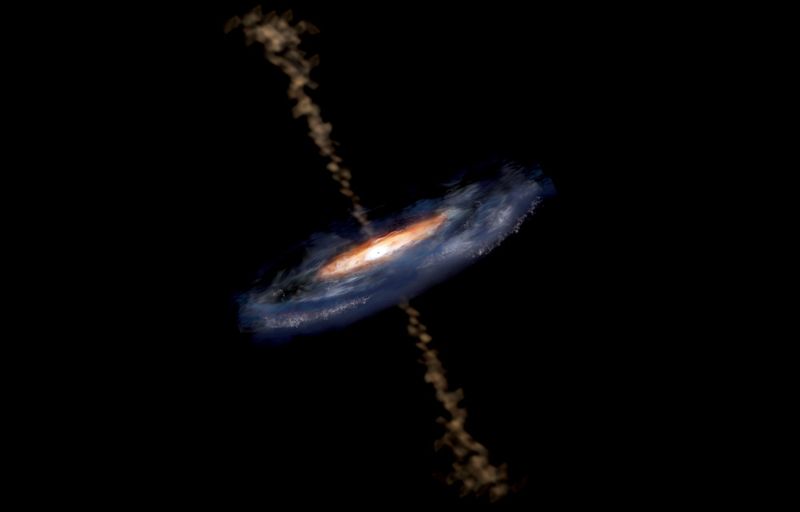
Black holes are typically found at the center of galaxies organized in structures referred to as active galactic nuclei (AGNs), which are comprised of the black hole and any surrounding material, in addition to any gas or radiation present. As the material near the black hole swirls around, it creates what is known as the accretion disk. Like our sun, whose corona emits x-rays, black holes can also emit various forms of radiation, including x-rays. What?! Yessir! In a process called magnetic reconnection, magnetic field lines interact and reconnect with one another, causing (x-ray radiating) plasma to be emitted. These x-rays are then dispersed into space, some of which hit the accretion disc and create a ‘reflection spectrum’ which scientists can study.
Now, while supermassive black holes weigh millions (sometimes billions) of suns and have the ability to tear apart nearby objects in space, you don’t have to worry about being sucked into one any time soon. Unless you’re this guy, in which case you may have some issues…
MUSE’s “Supermassive Black Hole”:
Sources:
UCLA Galactic Center Group (http://www.astro.ucla.edu/~ghezgroup/gc/)
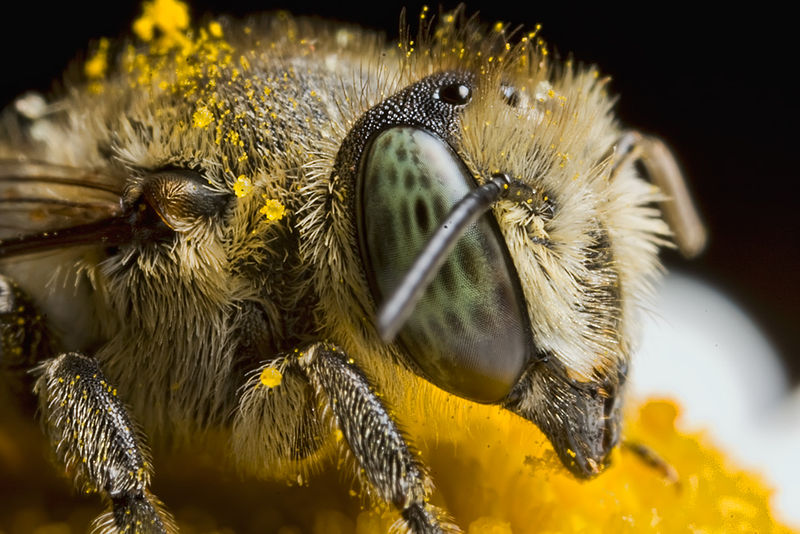
It’s pollen season, and where I live in Atlanta Mother Nature has given everything with the misfortune to be outside a healthy dusting. Now that my car has the same greeny-yellow slime color of an abandoned pool I am resolved to do some digging into the phenomenon. However, I feel pollen is fairly well known natural event. It’s part of plants making baby plants and bees are involved. What else is there to know right? Well for starters, how are pollen levels measured? Pollen levels being the standard metric by which news organizations inform drugstores to stock up on tissues and anti-histamine. This concept has gotten my engineer-sense tingling…unless that’s just… Oh geez…
::Achoo!::
Just kidding. My immune system is like an impregnable fortress made of Dwarven forged mithril (the good stuff), but if you are one of the many people who suffer from pollen allergies (known collectively as allergic rhinitis AKA hay fever) you should take solace in the fact that science is on your side. Right now, on a rooftop somewhere in your area is a greased up rod spinning around in a tube that is sucking in air and pollen. This doohickey has the understandable but perhaps uninspired name of a “rotorod”. Air is sampled for a fixed interval, usually for one minute out of every ten minutes for a twenty-four hour period, and any pollen grains in the sampled air are stuck to a layer of silicone grease on the rotorod as they pass over its surface. After the sampling period a special staining solution that contains a dye designed to adhere preferentially to the surface of the pollen grains (and not for example on mold or dust also in the air) is put onto the rotorod localized pollen, and then a fixed area of the rotorod surface is observed under an optical microscope. By utilizing the fact that the sampling rate, volume of air sampled and observation area are all fixed the number of pollen grains on the observed area of the rotorod can be used to calculate the average concentration of pollen grains floating around in the air.
If your response to that last paragraph was, “Wait, somebody has to physically count every single pollen grain collected during the test AND because they are a good scientist and want to minimize the scatter in their data took multiple tests? I thought you said science was on MY side!” then I am right there with you friend o’ mine. Sounds like a lot of work, especially when automated particle counters exist to constantly measure the concentration and size of particulates in the air. These particle counters use either the blocking of light (for particles larger than about 1000 nanometers) or scattering of light (for particles around 50-500 nanometers) and with similar methodology to the rotorod and microscope method (known volume of sampled air at fixed sampling intervals) these devices can determine total particle concentrations and size distributions for a given volume of air. This type of sampling technique is commonly used to monitor the “cleanliness” of clean rooms used for semiconductor and satellite fabrication where even minor levels of contaminants can cause device failure. The best clean rooms have as few as one or less particle with a diameter of 500 nanometers in every cubic foot of air. As someone who has spent some time as a famous clean room technician (that’s me in the background!), and considering the fact that normal “dirty” room air has over a million particulates of the same size for every cubic foot, I can tell you these are some pretty clean rooms.
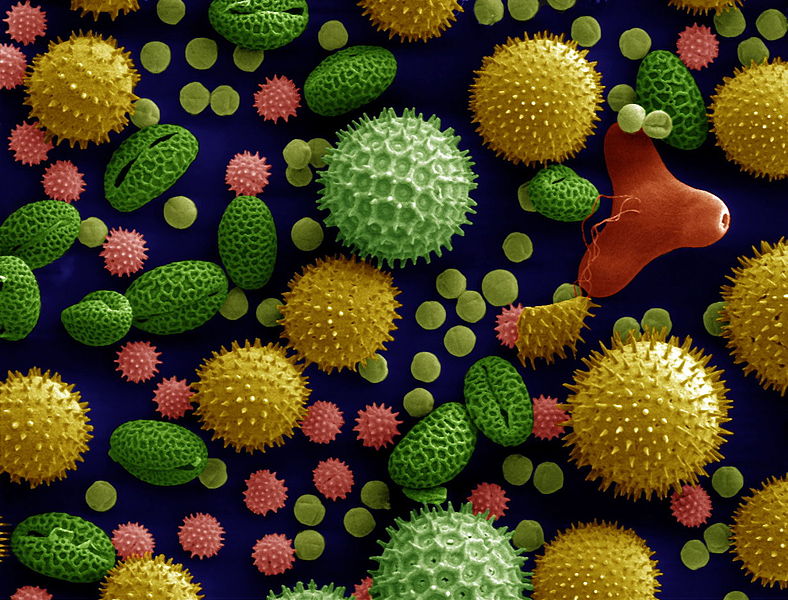
Images of pollen grains in SEM with false color added
One very important reason for not using this technique is the fact that pollens of different varieties imply different allergic responses for different people. Thus reporting a total pollen count or grain size distribution might not be an effective method to inform the public about the likelihood of a runny nose in their future which is the whole point of monitoring pollen levels in the first place. As a consequence, a trained specialist must identify both the species and concentration of pollen grains with the method described above which results in the reported “pollen count”. The myriad of sizes and shapes among different pollen grains, which macroscopically have very similar appearances, is shown in this false color image taken in a scanning electron microscope shown to the left. The original grey scale image (all SEM images are taken in grey scale) can be found here with call-outs to identify the pollen grains.
All of this finally brings us to the featured topic: the pollen count. From some sources only a value of high or low, moderate or severe or something of this nature is given, but this belies what we should now understand is a much more detailed piece of data from a very sensitive measurement system: a trained scientist. One source reported that the pollen count in Atlanta hit a record at over 9000 grains per cubic meter which seems like quite a lot, but not so bad when you consider the recent panic in Moscow when clouds of pollen from trees were so thick people thought they were toxic chemical fumes. Bonus points if you can spot the trained scientist in the video from Russia. With that knowledge, I’m feeling a little better about my car.
In 1970, 100,000 people gathered in Washington DC to protest the Vietnam War. The deaths of Jimi Hendrix and Janis Joplin that year had fatally deglamorized the hippie lifestyle. Smog-darkened skies were accepted as a byproduct of prosperity. Environmental concerns had never been at the forefront of serious discussion. It was Wisconsin senator Gaylord Nelson who first proposed a “national teach-in” on the environment to take place at every university campus in the US. What better way to ignite a grassroots-led movement than to take advantage of the existing energy from anti-war protests? The poignant events of 1970 awakened an emerging consciousness on which Earth Day was able to capitalize. Consequently, 20 million Americans participated in the first Earth Day, and thousands of colleges protested against the deterioration of the environment.
Forty-two years later, new generations are still helping to make Earth Day a huge international event. Although the subject of most concern has shifted from local toxic pollution to the complexities of climate change, Earth Day continues to stress the importance of a sustainable society.
This year at Georgia Tech’s 15th Annual Earth Day celebration the opportunity to unite our voices for a sustainable future was palpable. Events were designed to encourage environmentally aware behaviors such as recycling, energy efficiency, and reducing disposable items. The event featured a car exhibit, a green market, a clothes swap, an E-waste drop-off, free bike repair stations, Captain Planet, Reynard the Fox, a stage, and 70 exhibitors all on one sidewalk.
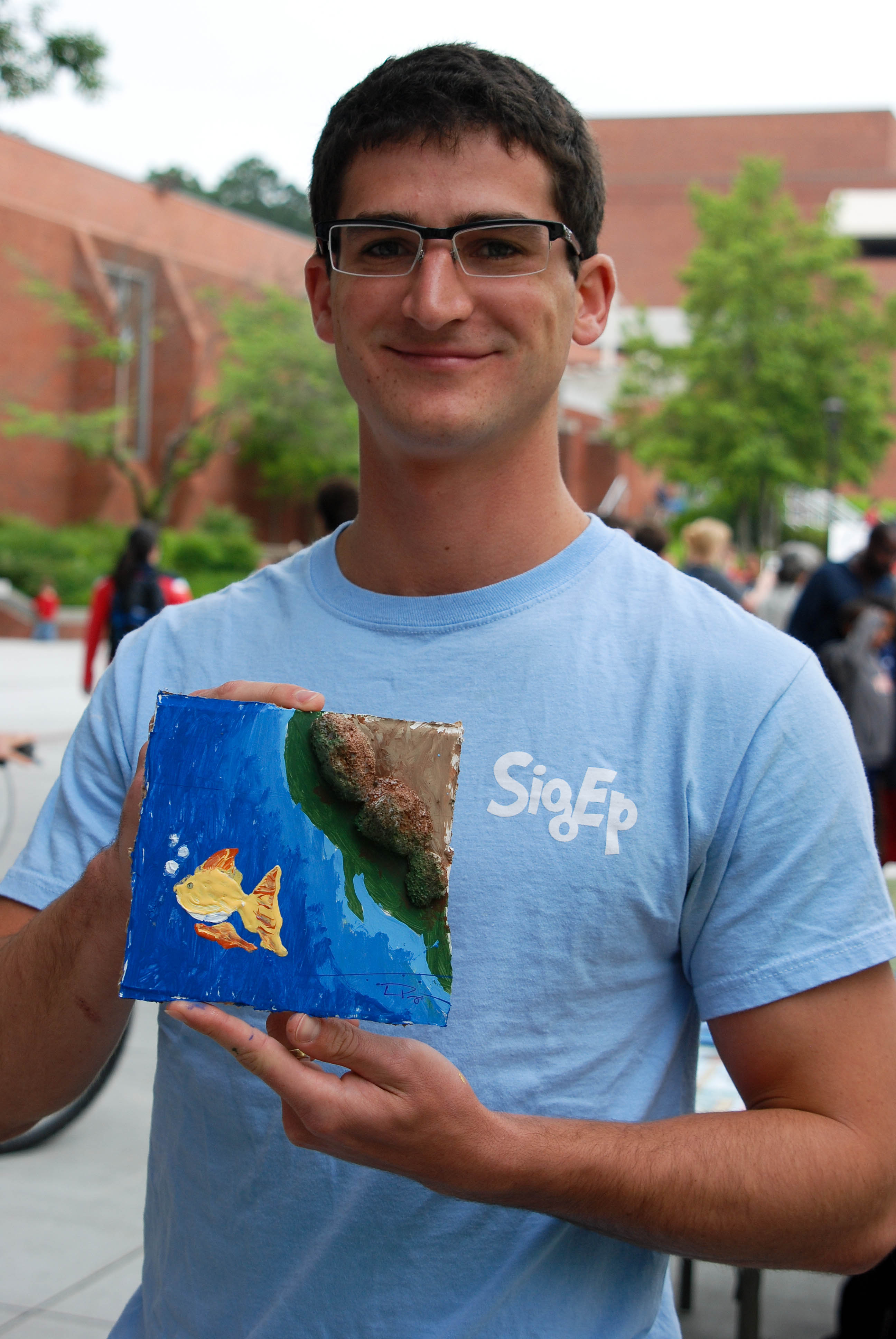
Most of Earth Day, I volunteered with the Engineers Without Borders (EWB) booth where participants had the opportunity to paint a recycled cardboard tile, with labels “land” or “water” or both, so that when all tiles were pasted together, a map of the world emerged. The message? “EWB wants to highlight the interconnectedness of our environment, our world and the importance of sustainability. Our goal at EWB is to help people on an international level to become more sustainable,” said EWB president Hannah Kates.
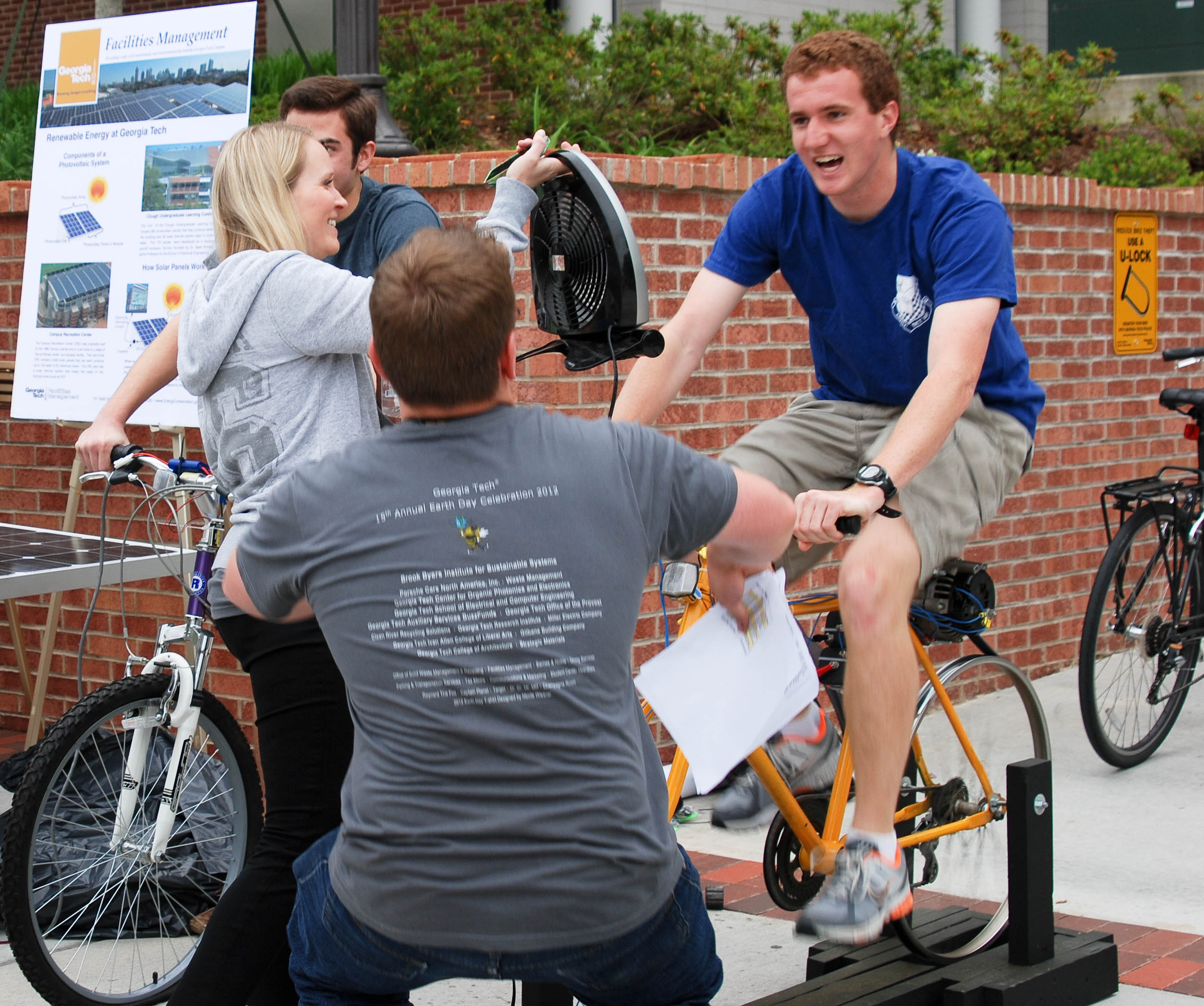
An Earth Day-goer for the last few years, Janna San Juan noted, “Earth Day seems like it’s growing every year. It gets people excited and reinforces the idea of being green.” She was looking forward to trying the ‘Renewable Energy Challenge’ where participants could race against a solar panel on a stationary bike to generate energy. They could light a bulb or fan themselves, such as the person in this image chose to do.
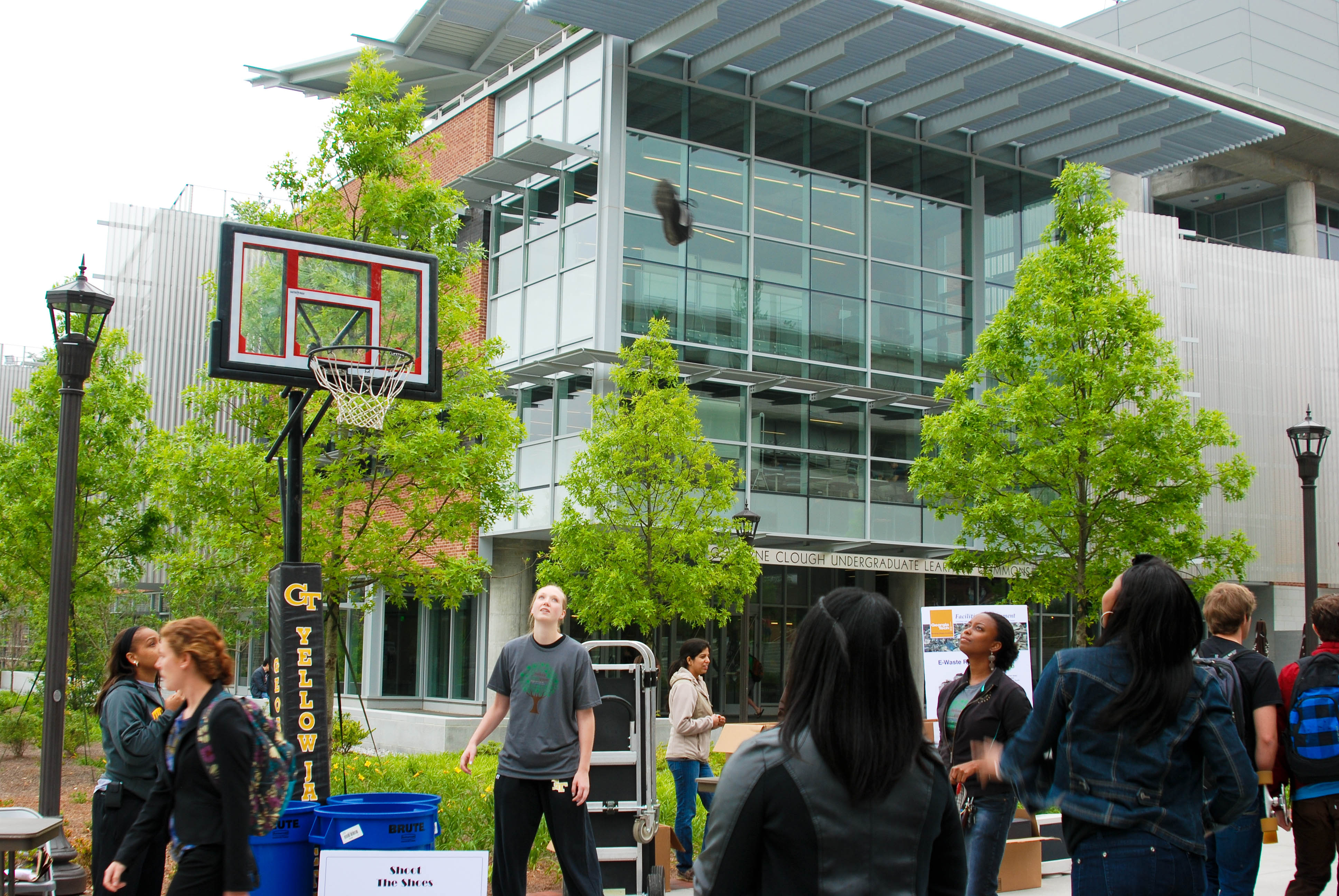
Shoes flying through the air soon caught my attention. The ‘Shoot the Shoe’ booth was run by the women’s basketball team, where participants had the opportunity to throw an old tennis shoe through a basketball hoop. Earth Day committee member, Luke Chambers, who was promoting the booth in collaboration with Nike’s Reuse-A-Shoe program said, “Nike’s shoe recycle program reduces the need for new rubber and other materials which decreases environmental impact. Our goal is to collect 500 pairs of worn-out tennis shoes.” He also went on to tell me that $10,500 worth of reusable office supplies were donated for the ‘Office Supply Exchange’ event where students could shop for free.
Before I could walk anywhere else, I was accosted by what could only be described as the Abominable Plastic Bag Man. One More Generation, the non-profit organization founded by two elementary school students, was at Earth Day to raise awareness about Americans’ plastic bag use. Fittingly, their “Plastic Bag Monster” donned 500 bags, the average person’s yearly usage and, hopefully, scared many others into purchasing reusable grocery bags.
Like a child at a carnival, I let my senses lead the way at this event, so I ended up next in front of the live music. This anomaly of a band, appearing in swing attire while at one point dishing out Spoon’s punk rock song “I Turn My Camera On,” attracted a large crowd with their energetic dancing and old school vibes. Champagne Roomlead singer Jared McGrath announced to the audience in between songs, “My favorite thing that comes from this Earth would have to be… beer.” Cheers to that.
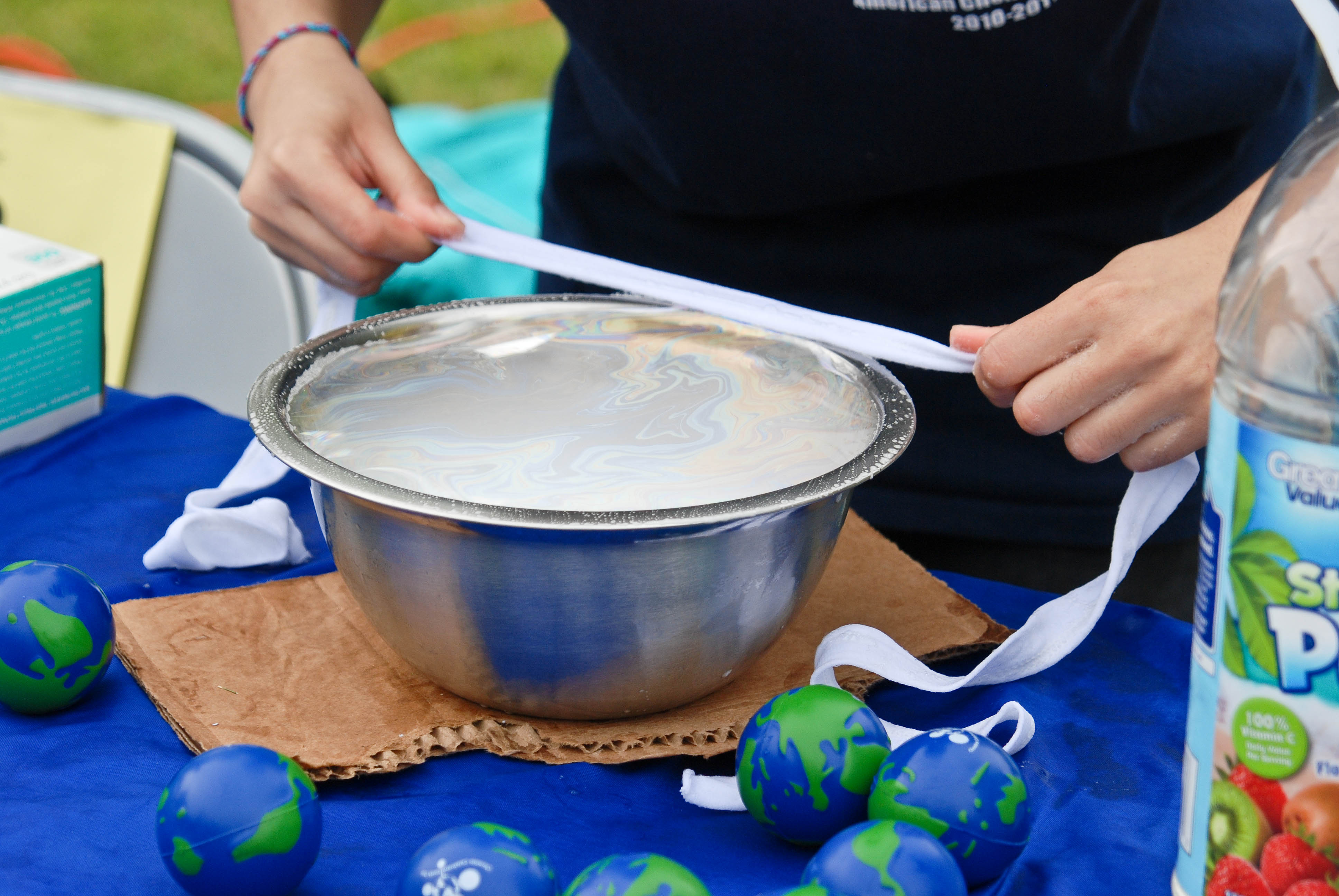
After taking dozens of photos of the self-proclaimed “Southern Fried Swing Punk” band, I turned around to find another simple sensory boost. Dry ice! It was the American Chemical Society giving out cups of cold smoking punch. They really sealed the deal with some bubble action. By filling a bowl with a block of dry ice and running soapy water over the top, they created a ‘CO2 bubble’ which eventually erupted into a cloud of fog. The kids, myself included, loved it.
Free T-shirts were available for a very small labor fee. You could collect your olive green “Helluva GREENgineer” shirt by participating in the ‘deconstructed’ maze. Four eco-trivia stations were distributed throughout the event representing earth, wind, fire, and water. Participants collected a stamp at each booth by answering the trivia question correctly, and four stamps got you the 100% organic cotton t-shirt. “We’ve already given out about 150 stamps,” Marcela Moreno, a volunteer at the wind booth, informed me two hours into the event.I quickly decided to take advantage of this freebie and ran to each station before the event ran out of shirts.
Near the end of the event, I went back to the EWB booth where all the tiles had been painted. As I helped paste the painted world back together again, I couldn’t help but think about all of the strides that have been made since the first Earth Day in 1970. The development of the EPA, the Clean Water Act, the Clean Air Act, necessary laws that were formed because of the grassroots effort behind an unsettled generation. I then noticed that someone had painted a new continent in the middle of our Pacific Ocean, and someone else had painted trees and flowers in our Antarctica. Clearly, we still have a lot to work on, but with a united society and events like Earth Day, we can still continue to make large strides to save our environment.
“Wtf, shrimp!!? I make it all the way to this website from who knows what part of the internet, and I see ‘Badass Biology’. Man, Kevin, you flip my brain out with possibilities of flying sharks, rabbits of doom, or a half-honeybee half-unicorn rainbow pollinators. And what do you deliver? A stupid shrimp??! I hate you, and I quit this website. (╯°□°)╯︵ ┻━┻)” To which I reply, “Charles Barkley, I think you’re over-reacting. Please repair my table at once”.
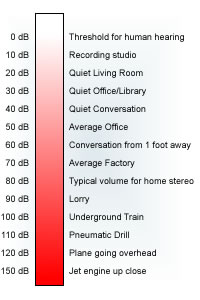
It was hard to find a chart that even went up to 150dB, let alone the 220 these guys produce.
Yes, it’s a shrimp. A measly two-inch-long shrimp. But you don’t understand. This one single stupid shrimp is just about the coolest thing I’ve ever heard. Trust me, and when you hear one too, you’ll probably go deaf, because this one little shrimp IS ONE OF THE LOUDEST ORGANISMS ON THE PLANET. I’m talking 220+ decibels, much louder than a gunshot and louder than standing next to a jet engine at take-off. O_o.
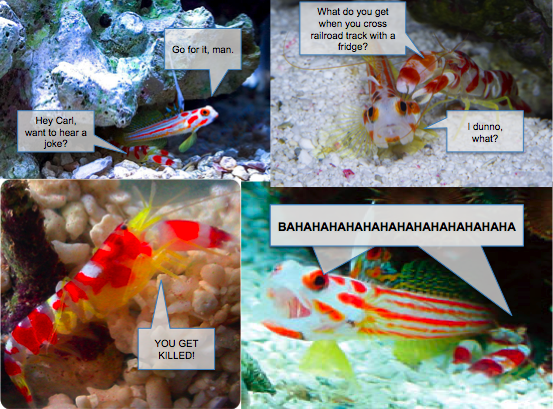
First, I want to talk about some other wicked cool stuff this little guy does apart from being a tiny walking firework of sonic pain. These shrimp garner lots of attention from ecologists because of their symbiotic, or mutually-beneficial, relationship with gobies, a type of small marine fish. The coral reef populations of this shrimp build burrows and recruit the help of a goby to stand guard out front while being no more than an antennae’s distance from the shrimp, using the goby’s well-developed vision to watch for danger. Once danger comes, the goby flicks its tail to signal a threat, and both the goby and the shrimp retreat into the same burrow. Then they start slapping five. It’s flippin sweet.
The mutualisms don't just end at gargoyle-ing.
From an ecologist’s point of view, this is totally mutualistic, and some scientific literature lists this interaction as “totally f-ing amazing” [citation needed] (Good luck with finding THAT reference -ed.). Yeah, both the goby and the shrimp live to see another day should a shark, barracuda, squid, rogue buoy, really fast snail, very-misplaced land predator, sinking boat part, cloud of wasps, or sentient shrimp-hating spear come around to threaten them. The goby gets a burrow, and the pistol shrimp gets a gargoyle. Selection at work.
I like to think of the goby as the pistol shrimp’s pet, kinda like me buying a falcon and parading it around the neighborhood on a leash. And once danger comes, the falcon goes “Hey yo, Kevo, you might need to reconsider this route”, we split, we don’t find danger, and I buy the falcon ribs for a job well done (and because I really want ribs right now). So in a sense, pistol shrimp are danger shepherds equipped with sun-blasting cannons of glory that we’ll get to in a moment.
I need to take a break to collect myself. Holy balls, these shrimp own everything own-able. Next time I see one, I’m buying it ribs. The whole rack.
Let’s get to that “pistol” thing, why don’t we? Pistol shrimp have one very distinct set of front appendages, like two arms extending outwards from its body. Only, one of these arms is disproportionately larger than the other, and it’s quite a contrast. Like no foolin’ man, this one arm alone can be as long as half the entire length of the shrimp’s body. Imagine walking around with one of your arms the size of the Hulk’s and you get the idea. This may look pretty stupid, but this powerful musculature operates one of the most badass weapons nature can offer.
Yeah, kinda like this
When in serious danger or when hunting, the pistol shrimp cocks its massive claw backwards into a 90o position. Once the claw snaps shut, it produces a jet of water propelled forward at 60mph. Yeah, woo, a fast water jet. Big deal. But here’s the amazing part. Are you ready to have your mind blown? If you have ever listened to me before, now is a pretty good time, too: This jet of water creates a bubble that cavitates, or implodes, generating a pressure wave that creates a sound loud enough to break glass in an instant. Not only that, but once the bubble cavitates, the heat generated by the force of the implosion causes the temperatures inside the bubble to reach about 18,000 degrees Fahrenheit. Yes. Eighteen. Thousand. Oh, and to top it off, the whole process takes three tenths of a second.
THIS TINY SHRIMP MAKES A BUBBLE SO AWESOME THAT IT’S LOUDER THAN A JET AND MORE THAN TWICE AS HOT AS THE SURFACE OF THE SUN.
You can imagine the horribly bubbly doom the pistol shrimp’s enemies must face. Stunned (or killed) by the force of that kind of pressure change, the pistol shrimp’s prey has basically just become lunch in an instant. The shrimp pulls its quarry into its burrow, and goes to town, just how I could go to town on some ribs right about now. I dug up a video about this whole process in case what I said wasn’t convincing enough:
http://www.youtube.com/watch?v=eKPrGxB1Kzc
If you want me to write about any other badass biological bosses, leave a comment. I may talk about them, or I may just tell you that your suggestions are awful. Probably not the latter though. I like people.
Well, I like most people except you, Charles Barkley. I really miss that table. Now I’ve got nothing to rest my wine on when Glee’s on.
The concept of a series of YouTube videos specifically designed to teach science is one that may scare the casual viral video watcher away. Luckily for Hank Green, one half of the vlogbrothers and creator of SciShow, YouTube is not filled solely with casual watchers.
Hank Green’s adventures on the Internet began on January 1, 2007, when he and his brother John challenged each other to communicate only through videoblogs and the occasional phone call. The project, Brotherhood 2.0, launched one of the greatest communities on the Internet, Nerdfighteria (as a side note: Nerdfighters don’t fight nerds. They’re nerds who fight to decrease World Suck).
In the five years since that first video of Hank explaining why every weekday included a new video from the two, the Green brothers have created an online empire of charity (Project 4 Awesome, a yearly video challenge to raise awareness of charities), DFTBA Records (home of the music of Alex Day, Charlie McDonnell, Hank Green himself, and various other YouTube musicians), and an increased following of John’s books (including Looking for Alaska, Paper Towns, and the recently released The Fault in Our Stars).
Hank’s newest endeavor on the YouTube is his most ambitious by far. SciShow, a series of short videos posted twice weekly on various scientific concepts and events, makes the often feared world of chemistry, engineering, and generally nerdy subjects from high school and college much more approachable.
So far, Hank has addressed non-Newtonian fluids as bullet-proof clothing, an electric aircraft, how gamers are smarter than computers, and a few other various topics. The videos are short and very to the point; they are not meant to provide a full education, but rather plant the seeds of interest in the heart of anyone and everyone.
Along with SciShow, Hank works with his brother on a series called Crash Course, which aims to teach the fundamentals of the core classes presented in high schools and colleges. While John gets to focus on history and literature, Hank gets to go more in depth with the subjects presented in SciShow. Videos include tours of the eukaryotic cell, biological molecules, water, and an introduction to the chemical basis of biology, namely, how carbon is, in his words, “a hussy”.
I fully recommend taking about half an hour to go through both SciShow and Hank’s episode of Crash Course (take another day to watch John’s video on early agriculture). Hopefully, these endeavors help the brothers educate the YouTube generation into incredibly wonderful members of society.
Picture a typical 1985 aerobic dancersize class at the local YMCA. Bright spandex, side pony-tails, colored leg warmers, metallic leotards. Lots of makeup, minimal sweat and sex appeal were the 80’s requirements for a good work out. Gym culture has evolved since the Era of Questionable Fashion but one aspect will never change- music. LOUD music. There’s no way those 80’s women could do a rhythmic 8-count of floor kicks so enthusiastically without Cyndi Lauper’s motivation. Nowadays, I don’t even bother to work out if I don’t have access to music. There are a lot of reasons why I don’t bother to work out but even when I’m feeling particularly motivated to exercise, I still need my IPOD! And judging by the number of headphones I spot at the gym, most people like working out to their tunes as well.
So why the dependency? Not only is music fun to listen to but music can actually make our adrenaline surge. Several studies have indicated that music tempo correlates to changes in heart rate, blood pressure and breathing rate. When the tempo (the rate of speed) of a song and athletic performance are synced up, an average person’s endurance is prolonged. Some athletes even claim music is like a legal drug because of its effect on their endurance.
It makes sense that listening to fast-paced music can increase your heart rate but a study at Virginia’s Hampden-Sydney College actually proved it. The study showed that participants who listened to music while riding bikes actually traveled 11% farther than those who rode with no music (McCook 2005). In another study, dance music at 142 beats per minute (BPM) was used in a 10-kilometer trial and the results were compared to the same study without music. Average speed, power and heart rate were higher in the group who had music (Harmon 2007). However, the effect of listening to music while working out is not completely hypnotic; the test subjects cycling at higher speeds also had higher perceived exertions. This suggests that they were fully aware of how hard they were working, despite the use of music (Harmon 2007). Therefore music does not reduce the recognition of effort during exercise but it does improve the experience by providing a fun distraction.
Research also shows that the distraction of music can reduce up to 10% of perceived exertion during treadmill running at moderate intensity (Karageorghis 2008). One study published found that basketball players prone to performing poorly under pressure during games were significantly better if they listened to catchy, upbeat music (Reynolds 2010). “The music seemed to distract the players from themselves, from their audience and from thinking about the physical process of shooting,” said Christopher Mesagno, a lecturer at the University of Ballarat in Victoria, Australia, and the study’s lead author. The music let the body work from muscle memory without interference from the brain. “The music was occupying attention that might have been misdirected otherwise,” Mesagno said.
Another reason music may help you exercise is because of something called “synchronization.” Music is conceived by our brains, played through our bodies, perceived through our sensory organs and then interpreted back by our brains. You’re already tapping your foot to the beat before you realize what you’re listening to. Same with exercising- you want to pedal at the rate of the music or tread to every dominant beat. Research has shown that the synchronization of music to repetitive exercise (like rowing, cycling and running) is associated with increased levels of output (Karageorghis 2008). The tempo can regulate movement and also create an attainable flow.
I’m not saying listening to music while working out creates miracles; the body does have its limits. Research finds that the effect of music seems to decline when exercising at an already intense level (Reynolds 2010). For example, if running at an intense pace, increasing the music’s tempo will not have an effect on your speed or heart rate because they are already at a high level of intensity. Which is fine since you wouldn’t want your heart rate to increase indefinitely until it explodes in the middle of spin class. That’s not exactly the goal, don’t push it. In conclusion, music can help during moderate exercise but when you increase the intensity of exercise, the feelings of fatigue will eventually override the music.
There are a couple of other exceptions. “Background music typically reduces a person’s perception of effort by about 10%,” says Costas Karageorghis, head of research at the School of Sport and Education at Brunel University in West London. Meaning, don’t forget your headphones. Listening to the gym’s complementary radio will make you think you are working HARDER than you actually are!
That said, what’s the best song to work out to? An exerciser whose goal during warm-up is to elevate the heart rate to 120 beats per minute should select accompanying music that has a tempo in the range of 80–130 beats per minute. Successive tracks should create a gradual rise in music tempo to match the intended gradual increase in heart rate- tempos of 120 to 140 beats per minute are ideal. That’s roughly the heartbeat of a casual exerciser who’s been on the treadmill for 20 minutes.
As obvious as this may be, choose songs you like. Emotional ties to music can help performance even more (NPR 2011). For example, Kanye West’s “Stronger,” lifts my mood and pushes me a bit harder, even though the tempo isn’t particularly fast. I have friends who start every workout listening to Rocky’s theme song “Gonna Fly Now,” by Bill Conti. Listen to whatever you gotta listen to in order to get motivated! Start singing on the treadmill if you need to; who cares about a room full of people staring at you sweating profusely and gasping for oxygen as long as you’re feeling good, right?
I’ve compiled a list of example songs along with their beats per minute. Try making your own playlist according to your heart rate goals and see if you can tell a difference in your work out. If you can’t, try wearing a metallic leotard.
Walking, 3.0-4.5 mph (miles per hour), 76- 120 bpm
Nirvana- “Smells Like Teen Spirit,” 117 bpm [soundcloud url=”http://api.soundcloud.com/tracks/5968275″ iframe=”true” /]
Elliptical/ Stair-climbers, 124-128 bpm
MGMT- “Kids,” 124 bpm
Jogging, 5.2-6.0 mph, 120-150 bpm
Florence & The Machine- “Dog Days Are Over,” 150 bpm
Cycling, 60-80 rpm (revolutions per minute), 139-150 bpm
The Killers- “Mr. Brightside,” 148 bpm [soundcloud url=”http://api.soundcloud.com/tracks/26159719″ iframe=”true” /]
Running, 6.0-8.0 mph, 147-170 bpm
Scissor Sisters- “Take Your Mama,” 155 bpm
TV On The Radio- “Will Do,” 161 bpm
High Intensity Training, 168 bpm & above
Beck- “Gamma Ray,” 168 bpm
Harmon, Nicole M., and Len Kravitz. “The Beat Goes On: The Effects of Music on Exercise.” IDEA Health & Fitness Association. IDEA Fitness Journal, Sept. 2007. Web. 20 Feb. 2012. <http://www.ideafit.com/fitness-library/beat-goes-effects-music-exercise>.
Karageorghis, Costas, and David- Lee Priest. “Music in Sport and Exercise : An Update on Research and Application.” United States Sports Academy. The Sport Journal, 2008. Web. 20 Feb. 2012. <http://www.thesportjournal.org/article/music-sport-and-exercise-update-research-and-application>.
“Maximizing Your Workout With The Right Tunes.” NPR, 13 Sept. 2011. Web. 20 Feb. 2012. <http://www.npr.org/2011/09/13/140438368/maximizing-your-workout-with-the-right-tunes>.
McCook, Alison. “Music Helps Exercisers Go Further with Less Effort.” Hampden Sydney College News & Events. 2005. Web. 20 Feb. 2012. <http://www3.hsc.edu/news/archive/herdegenmeeks.html>.
Reynolds, Gretchen. “Phys Ed: Does Music Make You Exercise Harder?” Well Blog. New York Times Health, 25 Aug. 2010. Web. 20 Feb. 2012. <http://well.blogs.nytimes.com/2010/08/25/phys-ed-does-music-make-you-exercise-harder/>.
High school can be very painful for anyone who is the slightest bit different. Thankfully, I’m 5 years removed from it but my little sister is a freshman so I get to sit back and observe this social phenomenon as an objective outsider. When you’re in high school (specifically a teenage girl in high school), it seems that every social situation is a CRUCIAL moment in your life. Not abiding by the invisible rules of pubescent social etiquette could result in getting shunned from the clique. This, by the teenage spectrum of standard exaggeration, is death. Girls strive to fit in and seek reassurance that they are ‘secured’ in their pack. This essentially creates an army of mini tyrants disguised in pink twill.
This brings me to introduce the concept of a ‘frenemy.’ A ‘frenemy’ is someone who you’re friends with by all appearances, but is actually someone who you would like to squirt ketchup on. In the high school scenario, she might be characterized as the bully of the group or perhaps the arrogant leader of it. Either way, you find yourself supporting her terrible behavior because you’re too afraid to speak out and risk losing your social standing.
There’s a biological reason for this behavior. According to Dr. Louann Brizendine, who wrote the fantastic book ‘The Female Brain,’ the main job of a girl brain is to keep social harmony. The teen girl’s brain circuits are wired so that social rejection actually triggers a neural stress response (Brizendine 35). When a relationship is threatened, the female’s feel-good brain chemicals drop (such as serotonin, dopamine and oxytocin) and the stress hormone cortisol takes over. Now this has become a matter of life or death. She’ll start feeling anxious and fearful of being rejected. She’ll become cranky to family members. She soon begins to crave that feeling of closeness again, for that great intimacy drug oxytocin. She’ll eventually decide to stick to her clan of frenemies to keep that utterly important social harmony.
This can also explain why girls go to the bathroom together. Those girls hanging out in the bathroom are reinforcing their most important relationships- with other girls. Many women find biological comfort in one another’s company and language is the glue that connects them together. Talking and sharing secrets activates even more oxytocin release. The oxytocin reinforces the desire to gossip and connecting then brings a sense of pleasure and well-being (Brizendine 37).
Why exactly are girls built this way? One plausible reason goes back to primitive basics. Remember- our modern female brain still has the circuitry of our most successful foremothers. Studies have shown that female mammals in a bonded social group are more likely to come to another’s aid in a threatening situation, such as if a male is overly aggressive to a female. Members of a group can alert one another of conflict ahead of time, enabling them to move away from potential danger and to continue safely tending dependent children. This pattern of behavior is called ‘tend and befriend,’ and it is particularly a female strategy (Brizendine 42). Since teen girls are biologically reaching optimal fertility, their primitive brain begins to stress the importance of this strategy. It’s saying, “Lose that bond with your peer, and both you and your offspring are toast.” No wonder girls find it unbearably hard to cope with feelings of being left out.
There’s even a biological reason for why some teen girls can become so evil to one another. Hormonal surges can turn these girls mean but so can sexual competition. This competition is much different in girls than in boys. When females are competing with other females, they often use subtle tools, such as spreading rumors, to undermine a frenemy. That way she can cover her tracks. Instead of using force, which is the male’s standard protocol, the female uses her best set skill-language- to get what she wants. Such tactics lessen the risk of destroying the bond that the teen girl brain sees as essential to survival.
The teenage girl brain is drowning in estrogen and other chemicals that make it pretty difficult to survive these years. It’s always drama, drama, drama. That’s not to say that teenage boys aren’t dealing with an insurgence of hormones- they are and they have their own set of embarrassing problems. But research findings like these can reassure a gal that her feelings of mayhem are only temporary. So if you are a teenage girl, remind yourself that you will mellow out. Then remember to tell your frenemy that it is not her fault she’s acting like a jerk but that it is just her cortisol coming out to play.
Brizendine, Louanne. The Female Brain. New York: Broadway Books, 2006.