Category: Story Time

  • Insect robots: How do they fly?

    Insect robots: How do they fly?


    “How do airplanes stay afloat?”

    “The same way a bird stays afloat.”

    When we give that answer to a kid, we fondly realize the connection between nature’s creatures and machines, and that the nature influenced creation of many machines from time to time. That is why the Wright brothers spent a great deal of time observing birds in flight and realized that when birds soared into the wind, the air flowed over the curved surface of their wings, and thus generated lift which helps them stay in flight. They noticed the wings of birds minutely, and realized that they change the shape of the wings to turn and maneuver, and thus flaps and stabilizers were born in the airplane wings. In a similar fashion, various insects and birds have influenced designs of many machines for their structural and aerodynamic ability. These creatures not only helped design the structural and aerodynamic systems of large machines, but attracted considerable attention from scientists and engineers for small-scale robots. Today we deep dive into the world of small robots and how they fly!

    Insects were the first organisms on Earth to take to the skies – estimates on the origin of insect flight range from ~320 to ~400 million years ago (Misof et al., 2014). That is a long, long time before vertebrates achieved this feat. Over time, insects mastered their flying ability, and achieved great perfection in speed, agility, and grace in the air. By design, insects such as hover flies and birds such as hummingbird have remarkable abilities to hover in the air, as well as being able to perform aerobatic maneuvers such as sideways or backward flying. The technique that they use is called a flapping wing motion. This remarkable ability is a key in the design of small-scale aircraft for surveillance or reconnaissance. Traditionally, engineers designed a medium to large scale aerodynamic vehicle with traditional mechanical linkage systems (Van Breugel et al., 2008). However, when it comes to an unmanned small-scale aerial vehicle (or even micro-scale that mimics the size of an actual small insect such as a hover fly), one of the key challenges in traditional designs was that the flapping-wing action was not stable because of the power and weight ratio that needs to be achieved to match the hovering and flying abilities of the insects and birds observed in nature.

    Historically, there have been a number of research efforts that focused on the mechanical and structural aspects of a small-scale flying robot design. One such project was the Entomopter project in Georgia Tech (Michelson et al., 1998). The researchers used a chemical muscle to produce linear actuation strain. Two sets of rigid wings (front and back) were placed, and chemical muscle actuated them. Other traditional designs of small-scale flying robots used gears and links for the movements needed for of an airborne vehicle.

    How do the “insect” robots get up in the air?

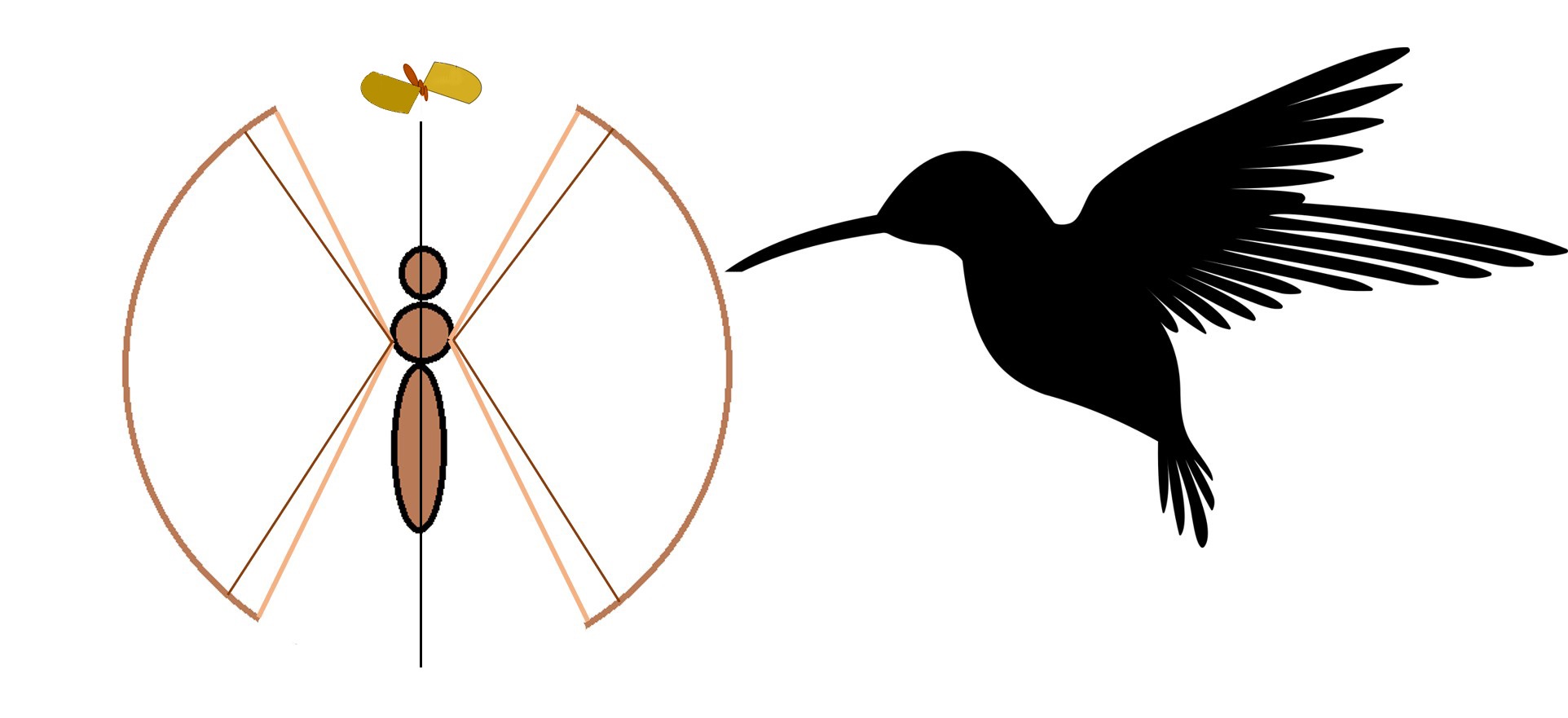
    In order to achieve a flapping action in-flight to gain altitude, sweeping and the pitching motions are needed to be achieved. The current design is set up to exploit resonant properties, as exhibited by flying insects, to reduce the energy expenditure and to provide amplitude amplification for the wing sweeping motion (Bolsman, 2010). Design objective for a small-scale flying machine is to reproduce a reference motion based on the kinematics of insects. Insects and birds perform wing flapping and adjustments of the body orientation in order to control speed, altitude and orientation of the flight. As shown in the figure below, to transfer this analogy to a micro-robot, the sweeping motion of the wings are emulated as a steady-state motion. The details of a control system can be found in advance literature (Bolsman, 2010). However, in simple terms, the design takes into account a constant resonance frequency, and a maximum wind sweeping stroke. As the stroke increases (shown by the extreme lines in the figure), the wings generate lift. The mass of the device (as in an insect) is centered towards the geometric center of the device, resulting in maximum possible stability. This is the stage where the robots get airborne and continue hovering.
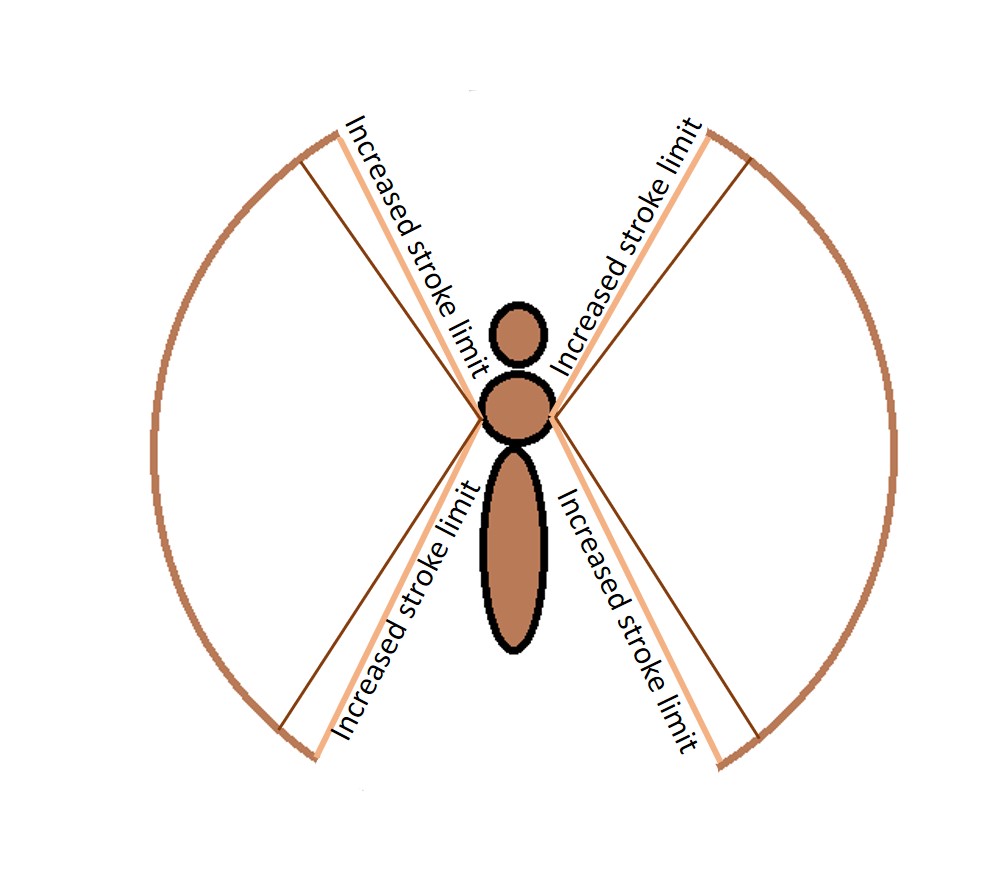
    Lift: Flapping wing motion with sweeping stroke

    How do the “insect” robots move in the air?

    The hovering is the first state of condition that the robots achieve, similar to an insect. The figure above shows a simple two wing device. Each wing is designed to have independent controls to change flapping In order to change the direction to left or right, so that each wing is capable of having a different sweeping motion. This inevitably creates a sweeping motion that are not equal in each wing, and results in a rotation in the direction of the difference. An insect performs these exact same maneuvers to create a rotational motion for left-right (rolling) movement.

    As shown in the figure, the center position holds the center of mass for the whole assembly. As such, changing the center position of the sweeping motion will change the direction of flight as well. This is performed by shifting the positions of the effective centers of pressure of the left and right wings. This invariably creates a backward motion (or pitch), and more power from the device’s power source provides a required forward motion while maintaining the achieved altitude.

    How strong are these “insect” robots?

    A simple model of a small-scale flying robot has been described here to depict the fundamentals that are derived from an insect or a small bird for flapping motion design. A fully fledged flying micro robot has more control systems that are able to achieve a full range of motions if needed, with more complicated actuations that are associated with multiple wings and wing rotations. In addition, structural integrity is also a key factor which, surprisingly, is also derived from insects. One of the most fascinating and extraordinary creatures in earth are ants, they can carry objects several times of their body weight. Ant’s neck has a very sturdy construction by nature, because of the fact that they lift the large weights with their mouth, and the load is transferred through the neck. Researchers found from models that an ant’s neck can withstand loads of about 5,000 times the ant’s body weight! (Nguyen, 2012). This design is also simulated to be able to provide the micro robots a sturdy yet very lightweight construction, a critical requirement for such a device.

    Ultra-light, small scale robots are in use for surveillance, military operations, rescue missions, medical sector, hazardous material test/retrieval, and many other scenarios. We will continue to see the marvelous development of these micro machines, inspired by the insects and small birds around us, while pondering over the question: “how birds fly?”

    References:

    1. Bolsman, C. T. (2010). Flapping wing actuation using resonant compliant mechanisms: An insect-inspired design.
    2. Van Breugel, F., Regan, W., & Lipson, H. (2008). From insects to machines. IEEE robotics & automation magazine, 15(4), 68-74.
    3. Misof, B., Liu, S., Meusemann, K., Peters, R. S., Donath, A., Mayer, C., … & Niehuis, O. (2014). Phylogenomics resolves the timing and pattern of insect evolution. Science, 346(6210), 763-767.
    4. Michelson, R. C. (2000). S. Patent No. 6,082,671. Washington, DC: U.S. Patent and Trademark Office.
    5. Michelson, R. C., & Reece, S. (1998, March). Update on flapping wing micro air vehicle research-ongoing work to develop a flapping wing, crawling entomopter. In 13th Bristol International RPV/UAV Systems Conference Proceedings, Bristol England(Vol. 30, pp. 30-1).
    6. Nguyen, V. N. (2012). Development of a Finite Element Model of an Ant Neck Joint for Simulation of Tensile Loading(Doctoral dissertation, The Ohio State University).
  • To the Depths (a sci-fi short story)

    To the Depths (a sci-fi short story)

    “What’s the password?” Said the person whose eyes peeked through the crack in the door.


    “Cal.” Mel growled. Mel would have been stunning if xe didn’t currently resemble Odysseus during the worst of his trials. Xe was soaked through to the bone, chiton stuck to xer form like a second skin, and xer hair was only saved from complete disaster by the many, many pins in it that would be a nightmare to get out and that Mel probably wouldn’t completely accomplish for many weeks.


    “You’ve looked better.” Cal said mildly.


    Mel growled again and shoved xer way inside.


    The aforementioned Cal backed up without complaint chuckling lightly as he headed back behind his bar.


    Mel, who was raised with common decency– unlike some people– closed the door behind xem and gracefully avoided the squeaky floorboard as xe followed behind.


    “You promised me Rome, Cal.” Mel said, knocking sharply on the bartop.


    “And Rome you had.” Cal returned, tossing Mel the towel he’d been looking for. Mel took it and began drying xemself. “Or, at least a version of it. Let me get you a new chiton, and you’ll be back out and exploring in no time.” So saying, the bartender ducked down to rummage behind the bar, placing various items on the bartop to be out of the way.


    “Oh!” Cal popped back up, startling Mel. “Don’t you dare sit on my barstools while you’re still wet they’re ori-”


    “Original to the saloon, yes, I know Cal.” Mel rolled xer eyes.


    Cal pouted a bit, but went back to his search.


    Mel turned to lean against the bar and peruse the space while xe waited out the clattering behind xer. Cal’s saloon didn’t look exactly like it had stepped it’s jangling, spurred boots right out of a spaghetti western, but it was an incredibly close call. Rough wood floors, hard leather seats, dim lighting, and the scars of all of the many brawls the place had seen were certainly telling, but Cal’s had its own quirks. The changing stalls that lined the front wall by the door, for one thing. The metal on those stalls was painted with painstaking care to look wooden, but enough bottles and glasses had been thrown at them over the years that the shine of the metal came through the chipped paint. The leather seats were surprisingly well padded, and the alcohol stock came from everywhere and everywhen in this universe, and others besides. Cal himself was his own oddity, no one knew how many Cals were before him, or how many would come after, or if some of them were the same, but Cal was a good sort. Mel wouldn’t work with him if he wasn’t.


    There weren’t too many patrons this go round, only a few regulars who were looking for something, and a relatively new guest, a nervous young lady who had some rather long, webbed fingers, scales, and big, bright eyes. Mel though that she might find what she was looking for in the city outside.


    Mel turned xer contemplation back to the bar, where Cal’s shuffling was now sounding more purposeful, and to the oddities that had been displaced onto the bartop.

    “What even is half of this stuff?” Mel muttered.


    There on the bar seemed to be a host of items with no discernable pattern. There was a bayonet without a gun, a glowing amulet, a few small bottles of what looked to be antivenoms, three plants that were either incredibly alien or incredibly extinct for how odd they were, and what appeared to be an astrolabe made for the use of someone who didn’t have hands or bifocal vision.


    Cal made a triumphant noise as he finally came up from behind the bar, holding a bright green mass of cloth in his hands. He passed it over to Mel, and xe went to the nearest changing booth.


    Xe returned, mostly dry and carrying the sopping wet orange garment xe had been wearing, and passed it over the bar to Cal, who grimaced before chucking it underneath the bar. Mel heard a wet thunk and a louder crash before a light hum let xem know that Cal had put xer old outfit in his dryer.


    “So tell me.” Cal said, automatically going to fix xem a drink. “What has you so upset about this Rome?”


    “When I asked for Rome, I expected a Colosseum, some of those famous Roman Roads.” Mel returned.


    “What do you mean?”


    “There aren’t any.” Mel said.


    “… There aren’t any… roads?” Cal asked, sliding xer drink over to xem.


    “No.” Mel gave a sardonic smile. “This Rome seems to be the love child of Rome and Venice. All of the streets are paved with water.” Xe took a sip of xer drink, making an appreciative sound. “That’s how I got into that state. It was too dark. I fell into a canal.”


    Cal snorted before quickly covering it and making Mel another drink.


    “Well, that certainly is a new one, but not the strangest reality this place has visited.” Cal said.


    It was Mel’s turn to snort. “True enough.”


    Cal finished a drink for both of them this time and they saluted each other with their glasses.


    “Did you spot anyone who might join us? Or anyone that might become a regular?” He asked.


    “Mmmm. There were some.” Mel allowed. “The mermaids all seemed to clock me as someone not from around here, and there were a few young women that seemed to have the air of revolution around them. We might end up losing a regular, rather than gaining one.” Mel turned to look at the fish-girl, and Cal followed xer gaze.


    “Well,” he nodded slowly “if it happens, it happens. Now, what’s this about mermaids?”


    “Not like you’re thinking. Mermaid is a profession here, sort’ve like street sweepers mixed with traffic directors. For a fee, a mermaid will lead your boat through a canal to where it needs to go and protect it from minor damage, or they’ll dive to the bottom of the canal and retrieve items you may have dropped. I also got the impression that they were paid by the city to keep the canal’s clean of trash and debris that was too heavy for the current to sweep away.” Mel said. “And, most of them are young women, interestingly enough.”


    “Hm. This will need some investigating.”


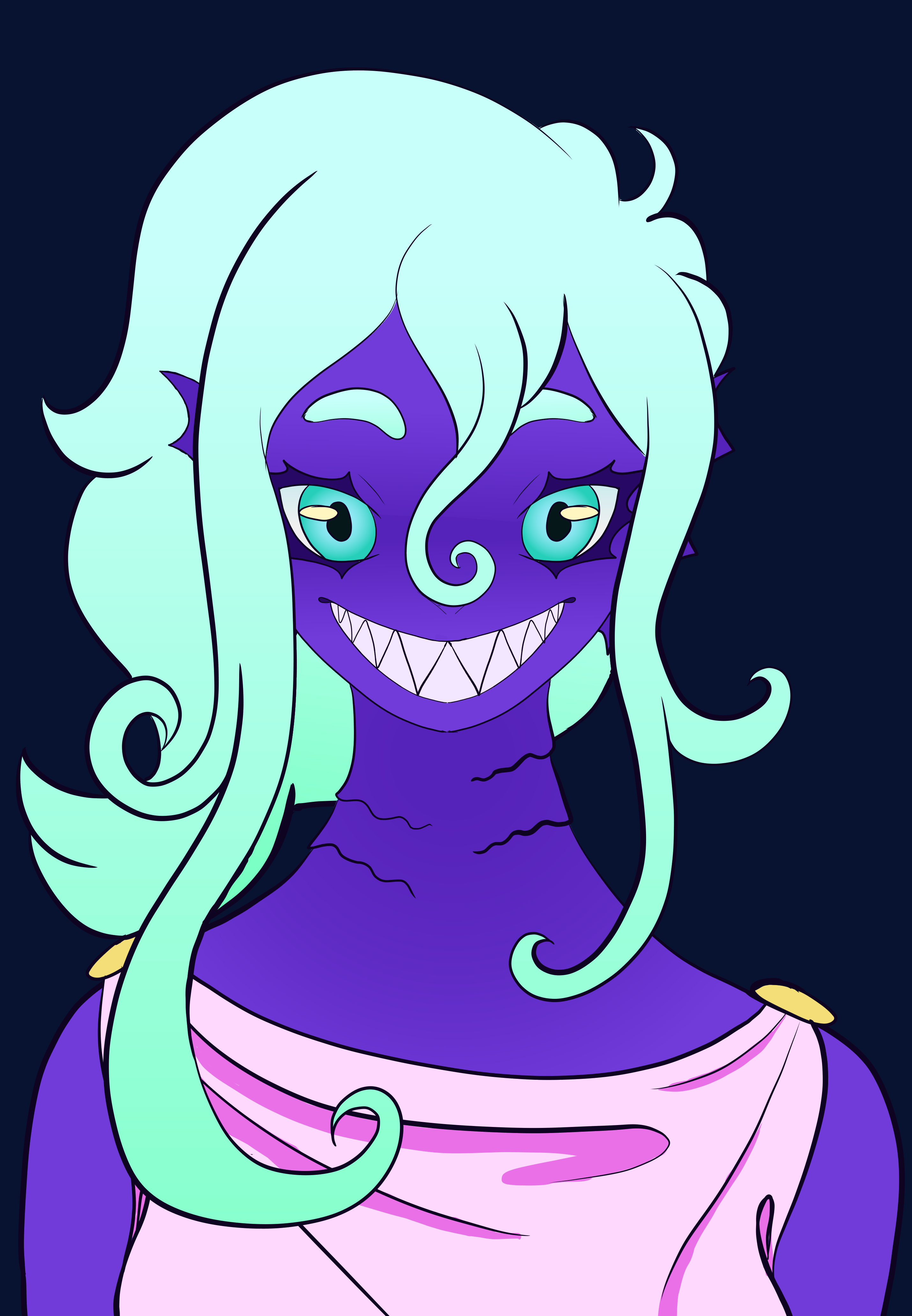
    A headshot of the Lochmaenean woman, Aure.

    The next day, Cal came down late to the bar floor. Mel had been out in Rome for a few hours already and Cal was expecting her to be out a while longer. He left his regulars to Ka’al, the new kid needed to work some time and this trip was shaping up to be a slow one.


    [Excuse me.] Cal startled a bit at the sudden appearance of his newest customer, a young Lochmaen woman, at the bar. He watched her webbed fingers as she continued to sign. [My name is Aure. Is there any way I can get some clothing to go outside?]


    “Aure? Well sure you can, although,” Cal gave Aure a once over, “Although, you probably don’t want to go out until dark, what with the scales and everything. But the dark will make it hard for you to communicate…”


    [I can speak.] Aure signed in return. [I don’t when I’m around humans who can see because it makes them nervous.]


    “Hmmm.” Cal tapped his fingers on the bartop. “May I see? I’ll understand if you don’t want to speak, but honestly?” Here he leaned in, as if inviting Aure into a confidence. “I don’t know if I count as human anymore. I’ve owned this bar for a very, very long time.” He cocked his head to the side, “Or was it no time? Concepts tend to get a bit muddled if you stay here long enough, but I wouldn’t have it any other way.” He grinned at her. Aure smiled back helplessly.


    “If you insist?” Aure said. Her voice was low but light, a tone that could easily carry a fair distance before it needed to be raised, but still incredibly lyrical. What probably made the humans she had met before nervous were her very large, slightly translucent teeth. When she opened her mouth the rows of teeth were reminiscent of a shark or a cartoon piranha. Cal thought that they must retract into her face as when she closed her mouth her face was incredibly human in shape, ignoring the purple scales, the barely visible gills, and the slightly bioluminescent eyes and hair.


    “Let me get you an appropriate outfit.” Cal said, ducking underneath the bar for just the right thing. He emerged with a pale pink bundle of fabric which he handed off to Aure, along with a small paper.


    “What?” Aure wobbled the paper.


    “Instructions on how to put on the chiton. It’s not as intuitive as it looks.” Cal replied.


    Aure thanked him and took the clothes and paper to the furthest changing booth.


    Cal began to idly clean the bar, keeping an eye on the door, when he caught sight of Aure making her way back.


    “I think, miss Aure, that you have the potential for being mistaken for a siren if you go out there.” Cal mused. Aure ducked her head.


    “A siren?” Came a voice from the door.


    Both Cal and Aure looked over to see a young woman who was obviously local standing in the doorway, haloed in the light of the setting sun. The young woman had olive skin, light brown hair, dark eyes, the build of a runner, was noticeably taller than Aure, and had an air about her that said that she was used to commanding respect. She seemed to take in the anachronistic bar in which she found herself— Cal who was wearing a vest and fitted dress shirt, Aure, who was obviously inhuman with her dark purple scales, webbed appendages, and a tail, and the other alien patrons— in stride, closing the door behind her, and making her way to a seat at the bar, somehow avoiding the squeaking floorboard in the process.


    Aure found herself quickly pinned by the gaze of the other woman. She felt those dark eyes roam over her as if she were having her soul measured against the value of one of the Pure Pearls which had brought her planet to the Assembly’s attention.


    “You are the siren?” The woman demanded softly.


    “My name is Aure.” Aure just barely managed to reply. She was nearly blinded by the smile the other woman sent her.


    “I’m Penelope, I think the two of us will get along famously.” So saying, Penelope turned to rummage through the bag on her waist, finally giving up her hold on Aure’s lungs so she could catch her breath.


    Cal was about to say something, when Penelope made a noise of triumph and turned back to the others at the bar.


    “So, I don’t suppose either of you is good at decoding things?” Penelope said, slapping down a piece of parchment on the bartop.


    “Hn. Not my area of expertise.” Cal admitted.


    Aure had already drawn the parchment towards her and clicked to herself as her large eyes roved over the words.


    “I have it.” Aure said.


    “You do?” Cal asked.


    “Already?” Penelope asked.


    “Not, not the message.” Aure said, “But I know what kind of code it is. It’s a shift cipher. I believe the key is the number five so…” Aure looked up.


    Cal caught her drift and produced a pen and paper from behind the bar, quickly passing it to Aure.


    “You see, a shift cipher is a very simple one, really, but effective. See, at the top of the message here is a date?” She pointed, Cal and Penelope both nodded. “Well the V the 5 in the date is darker than the rest of it, which means it’s important. It is also the rightmost 5 in the date, which I believe means that the cipher is shifted to the right by five. A shift cipher is made by writing out all of the letters or symbols of whatever writing system you are using, and then rewriting them underneath with the applied shift so, with a right shift of five:


    A B C D E F G H I J K L M N O P Q R S T U V W X Y Z

    Becomes

    F G H I J K L M N O P Q R S T U V W X Y Z A B C D E


    So for the message you would take the letter from the original alphabet, and replace it with the cipher version. To decode it, simply work in reverse.” Aure showed them.


    “It’s so simple!” Penelope grunted in frustration.


    “Only if you know what to look for.” Aure tried to reassure the other woman.


    “So, what does the message say?” Cal got them back on track.


    “It says: To the General: the tunnels within tunnels were a genius idea, and no one will be the wiser. I’m having my people take over important positions on the route. Soon our communication will be unbreakable and undetectable, then it is on to the next phase. For the Glory of the Atlanteans.” Aure read.


    “Atlanteans?” Cal asked.


    “Atlanteans.” Penelope snorted. “Most of the patrician men are obsessed with the idea that there is some underwater civilization that is incredibly advanced and that, if they find the civilization, they will be welcomed with open arms into paradise.”


    “Well that’s…” Cal trailed off.


    “Really stupid.” Aure finished. She ducked her head at the approving look Penelope sent her way.


    “It really is.” Penelope agreed. “Aure, how would you like to join me, and my Nereides?”


    “What?”


    “The Nereides are a group of young women who don’t believe that Atlantis exists, but believe that it could and want to build it.” Penelope said. “With your help decoding messages and notes, we can take back what the patricians have been keeping from us to build our future.”


    “You, but won’t it be obvious that something is going on? I mean I don’t exactly look…”


    “It doesn’t matter.” Penelope insisted. “The Nereides will adore you, and if anyone takes issue with how you look we have places to hide you, people you can go to for protection. If I say you are an emissary of the Gods, no one would dare call me a liar.”


    “You must have some pull, miss.” Cal said, skeptically.


    “I am a Vestal.” She said proudly, “I can go where I please in the city, I am a woman that most men wouldn’t dare to talk down to.”


    Cal gave a low whistle of appreciation.


    “Please, Aure, at least meet the others. You could do an incredible amount of good.” And with Penelope looking at her, hope and a righteous fervor shining in her eyes, what else could Aure do?


    “Okay.”


    Mel came back to the bar a few minutes before midnight— and a few hours after Aure and their newest guest had departed for the most secret places of Rome— and looked around. “So, what did I miss?”