Category: Articles

  • Water: Prankster of the Natural World Part 2

    Water: Prankster of the Natural World Part 2

    If you haven’t read part 1 (why would you do that?), here is a review of the scenario we are considering in part 2:


    Two identical containers of water (same volume, same container size and material) are placed into a freezer. One container contains water at just below its’ boiling point (< 100 °C) and the other at roughly room temperature (21 °C). Which will freeze first?
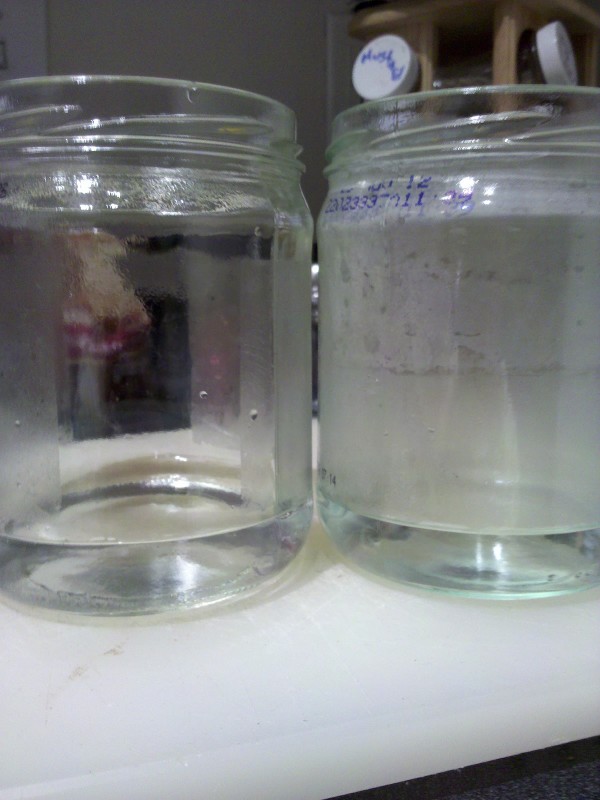
     

    Well I have two jars right here!

    In part 1 I discussed the Leidenfrost effect, named after a guy named Leidenfrost. In part 2 I will discuss the Mpemba effect named after, you guessed it, a guy named Mpemba. Interestingly, Erasto Mpemba was a young student when he made the initial observation that hot water can freeze faster than cold water. While he was not the first to make this discovery, his observation led to the first scientific study of the topic so it bares his name.


    At first glance, the second scenario is decidedly less exciting. No boiling, no sizzling, and unfortunately no shoddy videography, but unlike the Leidenfrost effect the mechanism behind the Mpemba effect is still hotly debated. During the boiling experiment the lower thermal conductivity of a trapped steam layer prevented efficient heat transfer to the remaining liquid droplet. Several competing explanations are offered for the Mpemba effect, but I will only consider the influence of variation in heat transfer upon freezing. In general “heat transfer” can be considered to explain both the Mpemba and the Leidenfrost effect, and there are three modes of heat transfer. Last time I described conduction which is the transfer of heat within a solid material or between two physically connected bodies. Conduction assumes that the atoms involved in the transfer of heat are fixed in space, like they would be in the solid pan from the Leidenfrost scenario or the walls of the container for the Mpemba effect. Thermal conductivity as described in part 1 is a measure of heat conduction. In a fluid convection is the major mode of heat transfer and implies that atoms or molecules are free to move around. Convection is the reason a bath of cold water with hot water poured into it will eventually reach a single homogenous temperature or opening the front door on a cold day will “let the cold in”. When dealing with both solids and “fluid” phases (a fluid means a non-solid phase) both conduction and convection can be considered. A more detailed explanation of conduction and convection can be found here.

    The third mode of heat transfer is radiation, which is the transfer and absorption of electromagnetic radiation. This was indirectly discussed in a previous article but is not important for these scenarios. A nice animation of each of the three modes mentioned here can be found on the web.

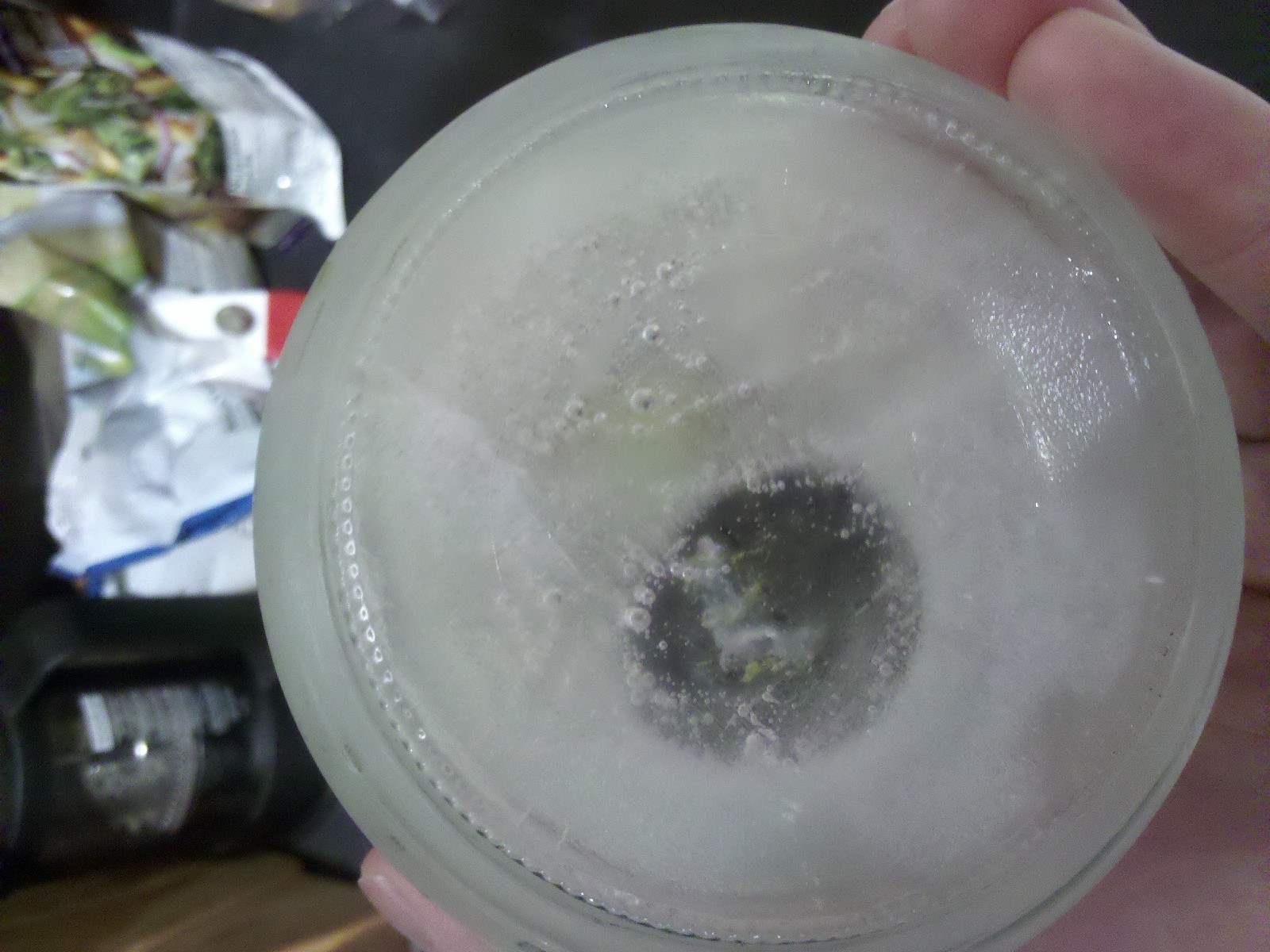
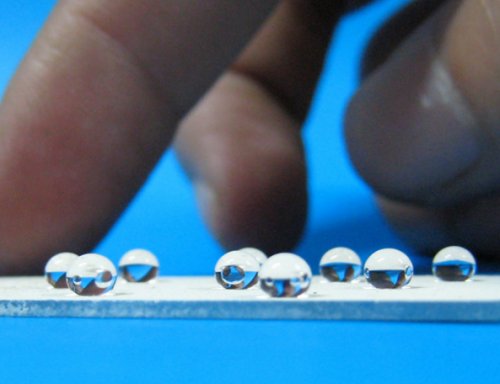
    To observe the Mpemba effect I took two identical salsa jars and ate their contents. This did not result in the Mpemba effect so I cleaned the jars and set about a second experiment. In one jar I put ¼ cup of tap water and allowed the water to reach room temperature by setting it on the counter for a few minutes. The temperature of my room was about 24 °C (75 °F). In the second jar I put ¼ cup of boiling water. By the time I poured the water it had cooled slightly from the boiling point (100 °C or 212 °F) to about 88 °C (190 °F). I checked these temperatures with a meat thermometer intended for porkchops and roasted chickens so the accuracy is not perfect but for this experiment it doesn’t matter – we only want to confirm that one container has water at a significantly higher temperature than the other. I placed both containers into my freezer which according to the same thermometer is somewhere around -15 °C (5 °F). After two hours I took the containers out and had a look-see. The room temperature water was mostly frozen except for a cavity between the ice at the top of the jar and the bottom of the jar itself. The boiled water was frozen solid. If I moved both jars around motion of the remaining liquid water in the tap water jar was obvious. From left to right below is both jars from the top after freezing, the room temperature jar from the bottom, and the boiling water jar from the bottom. The opening image for this article shows both jars unfrozen.
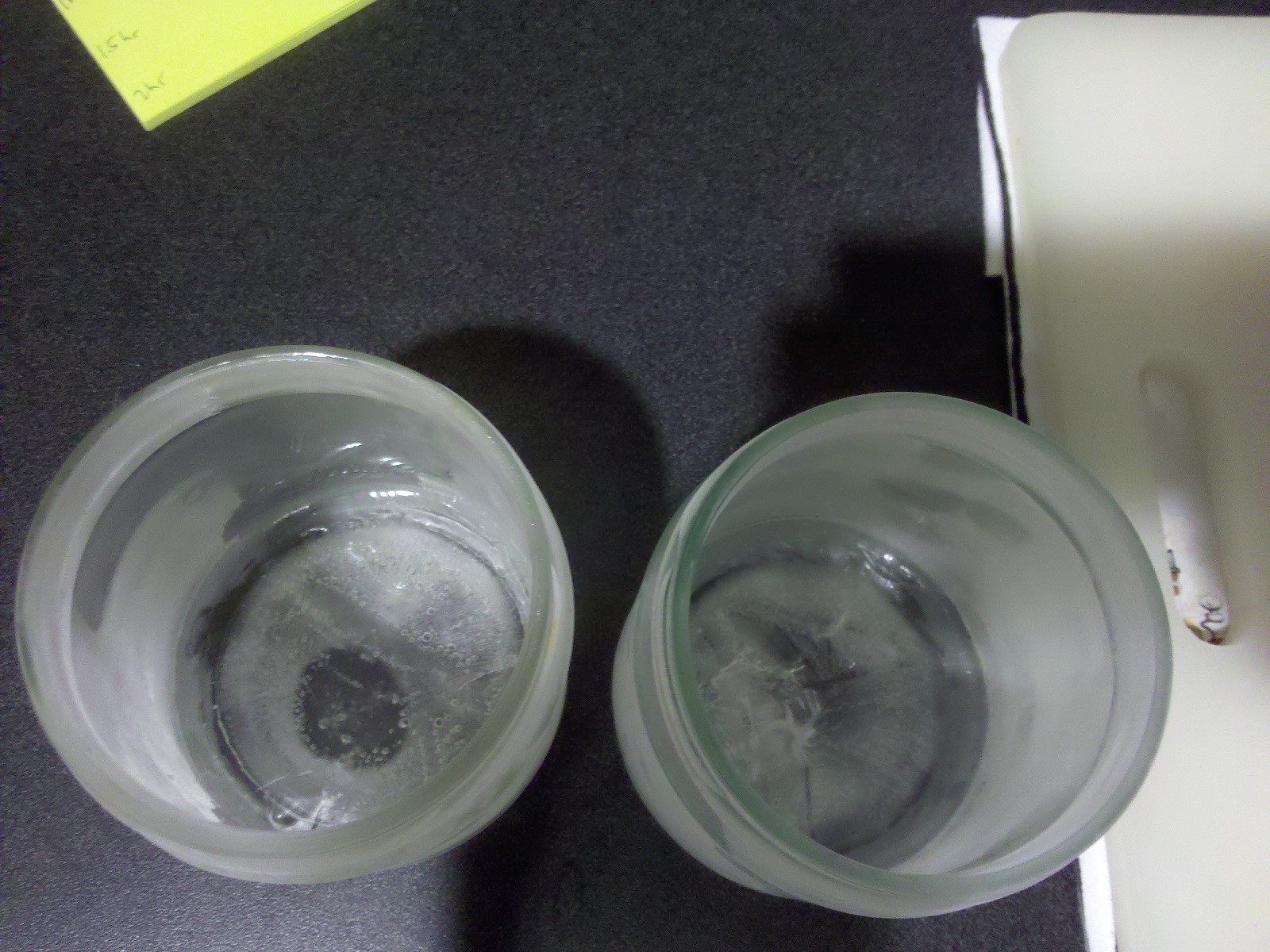
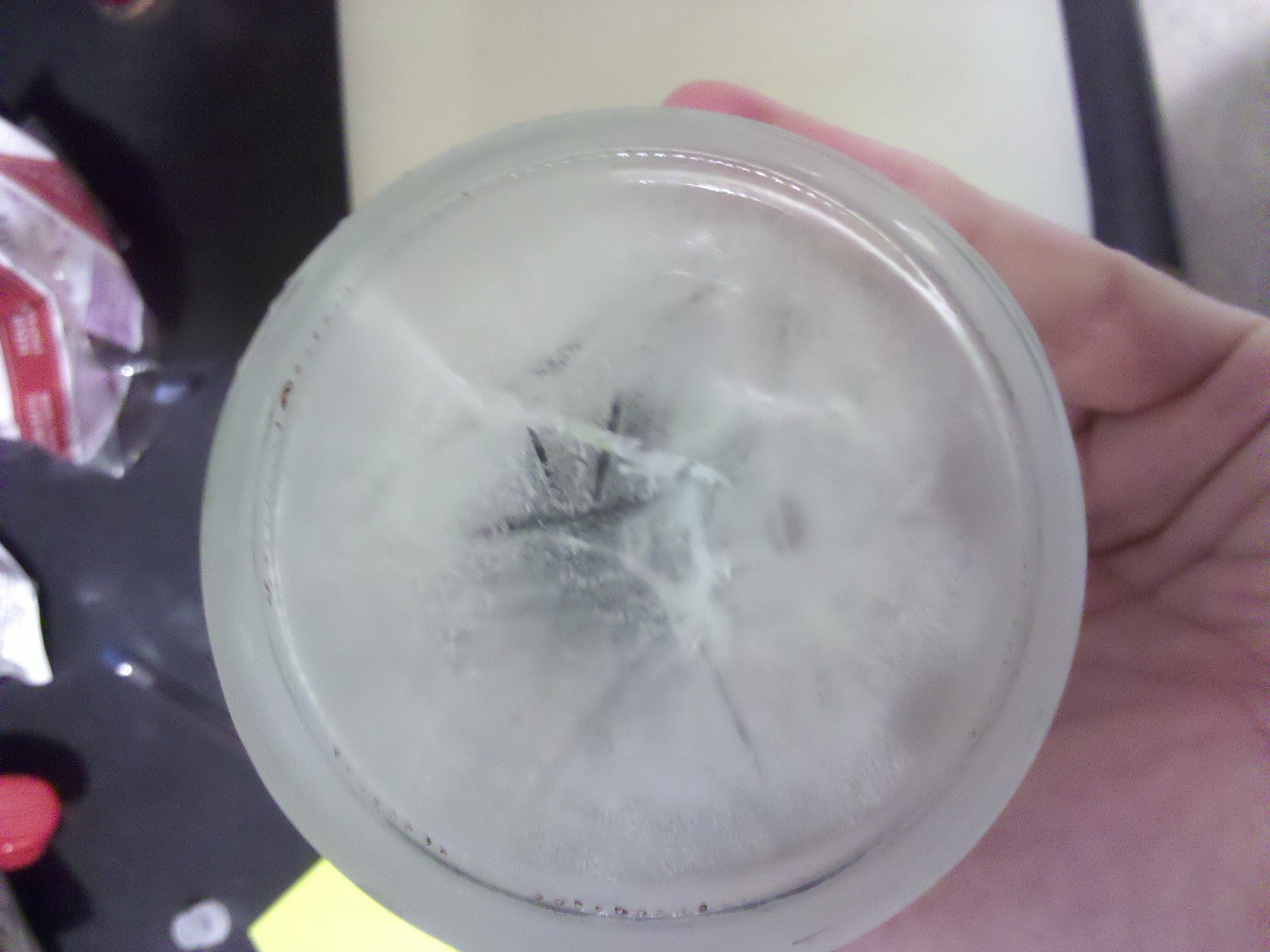
     

    Both jars after freezing – tap water on left
    Boiled water frozen
    Frozen tap water


    The heat transfer explanation that fits my results goes something like this: due to a difference in density between hot and cold water, hot water in the boiled container rises to the top and delays freezing. When the hotter water cools slightly it sinks to the bottom of the jar and stirs the rest of the container, keeping the temperature in the container homogenous. These movement within the water due to relative density differences are called convective currents. The convective currents are strong enough to keep the average temperature in boiled hot water jar above freezing until the entire container freezes simultaneously. Convective currents due to temperature differences are responsible for many naturally occurring events like the movement of an atmosphere around a planet. Meanwhile, the initially cooler tap water freezes at the top of the container preventing convective heat transfer between the water and the cold air in the freezer. Convective currents are also present in the tap water jar, but the remaining heat distributed by them is not enough to prevent a top layer of ice from forming.


    I feel obligated to admit that I had some difficulty getting this experiment to work. At first I tried using a whole cup of water in the same jars, checking the temperature in each container every five minutes. In this test I found that the boiled water dropped in temperature very rapidly at first whereas the tap water changed temperature very slowly. Both jars reached around 34 °F, just above the freezing point, at about the same time. The tap water jar froze on the top first making subsequent measurements of the underlying liquid difficult. Eventually both containers were mostly frozen but I couldn’t tell when the interior of either jar had frozen. Repeatedly opening the freezer door to inspect the jars also manipulates the experimental conditions, so when trying this at home I recommend you only check the freezer once an hour or so to see if anything is frozen. Transparent containers like my glass salsa jars make a quick inspection easier, but using containers of different materials could lead to some interesting results. It is this apparent sensitivity to experimental conditions that makes the mechanism responsible for the Mpemba effect subject to question. You can read more about some of these on the Wikipedia article for the Mpemba effect, but I encourage you to try some of your own tests and see what you find!
  • Water: prankster of the natural world part 1

    Water: prankster of the natural world part 1

    If you’ve ever taken a life sciences course your teacher probably mentioned one of several properties that make water particularly interesting. Water is cohesive meaning it sticks to itself, adhesive meaning it sticks to other things (superhydrophobic surfaces notwithstanding), and is considered the “universal solvent” because it readily dissolves many other substances. These properties are some of the most critical that allow water to function as the key to most terrestrial forms of life. Another interesting fact about water is that it is one of the few substances that exists in all three states of matter (solid, liquid and gas) in fairly non-extreme locals on earth. Furthermore, these phases exist within a relatively narrow range of temperatures – the entire transformation from solid to gas spans only 100 degrees Celsius (from melting of ice at 0 °C to boiling of liquid water at 100 °C). Compare that to ethyl alcohol (the alcohol in “alcoholic” beverages) which solidifies at -114 °C  and boils at 78 °C (a range of only about 200 °C, but with freezing occurring at a temperature below the coldest temperature ever recorded on earth) or a pure metal like iron with a melting temperature of 1538 °C and boiling temperature of 2862 °C  – that’s a phase range of over 1000 °C!

    It is important at this point in my introduction to define a phase: a phase is one of several atomic or molecular configurations for a given composition. When considering melting and boiling points, we are observing only the transition between the three states of matter mentioned above, however it is equally correct to consider multiple crystal structures for one composition of solid as different phases. Some of these solid phases are not easily distinguishable without sophisticated analytical techniques, while others have characteristic changes in physical properties.  No one would confuse graphite and diamond though they are in fact different phases of the same element. Plasma, also known as a superheated gas, is considered a fourth phase of matter but not one normally observed in nature with a notable exception being bolts of lightning. However, when heated to the point of being a plasma the atoms defining a given composition become ionized and for this reason plasma is normally considered separate from the more conventional states of matter. Fun fact for gamers: this is the plasma in all your favorite late game super-weapons.

    This is where things get weird for our old friend agua.

    Consider the following scenarios:

    1) Two identical pans are pre-heated to temperatures above the boiling point of water. The first pan is heated to 150 °C and the second pan to 300 °C. If drops of water at room temperature are placed into each pan, which drop will undergo the phase change from liquid to gas (boil) first?


    2) Two identical containers of water (same volume, same container size and material) are placed into a freezer. One container contains water at just below its’ boiling point (< 100 °C) and the other at roughly room temperature (21 °C). Which will freeze first?


    If considering only the energetics of each scenario, the logical conclusion is that a higher temperature pan means faster boiling, and a lower starting temperature means faster solidification. But if you were to perform these exact experiments at home (which I hope you do!) the opposite would occur.


    So whats going on? Is water playing by the rules (of thermodynamics)? Fortunately for us, Gibbs will remain stationary in his grave. As it turns out, both of these scenarios are good examples of how the properties of matter can change dramatically after a phase change. In both of these cases, variations in heat transfer between phases is likely to blame.


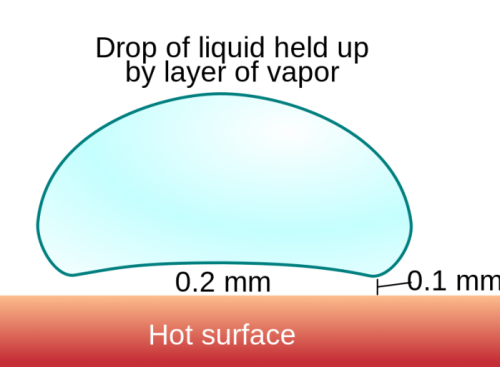
    For the water in the pan scenario, there exists a temperature above which water is so quickly vaporized upon hitting the pan a thin layer of steam is trapped below the liquid droplet, causing it to literally levitate above the surface of the pan on cushion of water vapor. Think air hockey table, but droplets of boiling water replacing the plastic puck. This temperature is called the “Leidenfrost point”, which according to unreferenced figure from Wikipedia is about 200 °C. Steam has a thermal conductivity roughly 10-100 times lower than that of liquid water depending on the temperature. In an idealized example, thermal conductivity is a measure of how easily a quantity of heat in a high temperature region can travel from one side of a 100% dense (no porosity) slab of material to the other. Thermal conductivity has units of energy per length per degree per second (Joules/(meter*°C*seconds)), meaning for a fixed length and temperature a material with lower thermal conductivity will take more time than a material with higher thermal conductivity to transfer the same amount of energy.

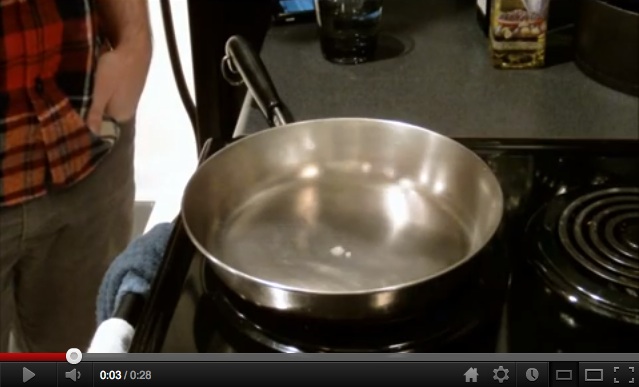
    At temperatures above the Leidenfrost point the Leidenfrost effect is observed and drops of water on a pan will take longer to boil because the steam trapped below the liquid water takes more time to transfer heat to the droplet from the pan. The videos below demonstrate drops of water into a pan below (top) and above (bottom) the Leidenfrost point. Above the Leidenfrost point, the droplets can barely be heard to sizzle as they zoom around on cushions of steam. For the pan heated above the Leidenfrost point, occasional contact with the edges of the pan, which are actually at a lower temperature or placing drops repeatedly in the same area which leads to local cooling will lead to momentary sizzling as the entire droplet boils. For the videos below, I used a nonstick pan and an eyedropper to put a few drops of tapwater onto the pan at a time. For the lower temperature I set my range to setting of 2 out of 10 and for the higher temperature I set it to about 6 out of 10 and waited a few minutes at each temperature for the pan to heat up.


    You may have heard of ole’ Leidenfrost’s namesake before associated with dipping things (namely one’s hand) into boiling lead after placing it in water. The Myth Busters did it after significant deliberation and preliminary testing, but somehow the alpha geeks at PopSci seemed to think it would make a good “DIY” project. I have to say, I can understand why dipping digits is the sexier version of the Leidenfrost effect demonstration, but the pan + water trick seems a little less invasive. In their defense, PopSci also covered this demo and the equivalent effect with boiling Nitrogen instead of steam as well.

    However you plan to enjoy the Leidenfrost effect, do so under proper supervision and be careful.

    Check out part 2 for a discussion on the second scenario!


  • Check it out!: SciShow

    Check it out!: SciShow

    The concept of a series of YouTube videos specifically designed to teach science is one that may scare the casual viral video watcher away. Luckily for Hank Green, one half of the vlogbrothers and creator of SciShow, YouTube is not filled solely with casual watchers.

    Hank Green’s adventures on the Internet began on January 1, 2007, when he and his brother John challenged each other to communicate only through videoblogs and the occasional phone call. The project, Brotherhood 2.0, launched one of the greatest communities on the Internet, Nerdfighteria (as a side note: Nerdfighters don’t fight nerds. They’re nerds who fight to decrease World Suck).

    In the five years since that first video of Hank explaining why every weekday included a new video from the two, the Green brothers have created an online empire of charity (Project 4 Awesome, a yearly video challenge to raise awareness of charities), DFTBA Records (home of the music of Alex Day, Charlie McDonnell, Hank Green himself, and various other YouTube musicians), and an increased following of John’s books (including Looking for Alaska, Paper Towns, and the recently released The Fault in Our Stars).

    Hank’s newest endeavor on the YouTube is his most ambitious by far. SciShow, a series of short videos posted twice weekly on various scientific concepts and events, makes the often feared world of chemistry, engineering, and generally nerdy subjects from high school and college much more approachable.

    So far, Hank has addressed non-Newtonian fluids as bullet-proof clothing, an electric aircraft, how gamers are smarter than computers, and a few other various topics. The videos are short and very to the point; they are not meant to provide a full education, but rather plant the seeds of interest in the heart of anyone and everyone.

    Along with SciShow, Hank works with his brother on a series called Crash Course, which aims to teach the fundamentals of the core classes presented in high schools and colleges. While John gets to focus on history and literature, Hank gets to go more in depth with the subjects presented in SciShow. Videos include tours of the eukaryotic cell, biological molecules, water, and an introduction to the chemical basis of biology, namely, how carbon is, in his words, “a hussy”.

    I fully recommend taking about half an hour to go through both SciShow and Hank’s episode of Crash Course (take another day to watch John’s video on early agriculture). Hopefully, these endeavors help the brothers educate the YouTube generation into incredibly wonderful members of society.

    Keep those neurons firing, kids.

  • Let’s Get Physical – a pumpin’ playlist to get you moving

    Let’s Get Physical – a pumpin’ playlist to get you moving

    Picture a typical 1985 aerobic dancersize class at the local YMCA.  Bright spandex, side pony-tails, colored leg warmers, metallic leotards.  Lots of makeup, minimal sweat and sex appeal were the 80’s requirements for a good work out.  Gym culture has evolved since the Era of Questionable Fashion but one aspect will never change- music.  LOUD music.  There’s no way those 80’s women could do a rhythmic 8-count of floor kicks so enthusiastically without Cyndi Lauper’s motivation.  Nowadays, I don’t even bother to work out if I don’t have access to music.  There are a lot of reasons why I don’t bother to work out but even when I’m feeling particularly motivated to exercise, I still need my IPOD!  And judging by the number of headphones I spot at the gym, most people like working out to their tunes as well.

    So why the dependency?  Not only is music fun to listen to but music can actually make our adrenaline surge.  Several studies have indicated that music tempo correlates to changes in heart rate, blood pressure and breathing rate.  When the tempo (the rate of speed) of a song and athletic performance are synced up, an average person’s endurance is prolonged.  Some athletes even claim music is like a legal drug because of its effect on their endurance.

    It makes sense that listening to fast-paced music can increase your heart rate but a study at Virginia’s Hampden-Sydney College actually proved it.  The study showed that participants who listened to music while riding bikes actually traveled 11% farther than those who rode with no music (McCook 2005).  In another study, dance music at 142 beats per minute (BPM) was used in a 10-kilometer trial and the results were compared to the same study without music.  Average speed, power and heart rate were higher in the group who had music (Harmon 2007).  However, the effect of listening to music while working out is not completely hypnotic; the test subjects cycling at higher speeds also had higher perceived exertions.  This suggests that they were fully aware of how hard they were working, despite the use of music (Harmon 2007).  Therefore music does not reduce the recognition of effort during exercise but it does improve the experience by providing a fun distraction.

    Research also shows that the distraction of music can reduce up to 10% of perceived exertion during treadmill running at moderate intensity (Karageorghis 2008).  One study published found that basketball players prone to performing poorly under pressure during games were significantly better if they listened to catchy, upbeat music (Reynolds 2010). “The music seemed to distract the players from themselves, from their audience and from thinking about the physical process of shooting,” said Christopher Mesagno, a lecturer at the University of Ballarat in Victoria, Australia, and the study’s lead author.  The music let the body work from muscle memory without interference from the brain. “The music was occupying attention that might have been misdirected otherwise,” Mesagno said.

    Another reason music may help you exercise is because of something called “synchronization.”  Music is conceived by our brains, played through our bodies, perceived through our sensory organs and then interpreted back by our brains.  You’re already tapping your foot to the beat before you realize what you’re listening to.  Same with exercising- you want to pedal at the rate of the music or tread to every dominant beat.   Research has shown that the synchronization of music to repetitive exercise (like rowing, cycling and running) is associated with increased levels of output (Karageorghis 2008). The tempo can regulate movement and also create an attainable flow.

    I’m not saying listening to music while working out creates miracles; the body does have its limits.  Research finds that the effect of music seems to decline when exercising at an already intense level (Reynolds 2010).  For example, if running at an intense pace, increasing the music’s tempo will not have an effect on your speed or heart rate because they are already at a high level of intensity.  Which is fine since you wouldn’t want your heart rate to increase indefinitely until it explodes in the middle of spin class.  That’s not exactly the goal, don’t push it.  In conclusion, music can help during moderate exercise but when you increase the intensity of exercise, the feelings of fatigue will eventually override the music.

    There are a couple of other exceptions.  “Background music typically reduces a person’s perception of effort by about 10%,” says Costas Karageorghis, head of research at the School of Sport and Education at Brunel University in West London.  Meaning, don’t forget your headphones.  Listening to the gym’s complementary radio will make you think you are working HARDER than you actually are!

    That said, what’s the best song to work out to?  An exerciser whose goal during warm-up is to elevate the heart rate to 120 beats per minute should select accompanying music that has a tempo in the range of 80–130 beats per minute.  Successive tracks should create a gradual rise in music tempo to match the intended gradual increase in heart rate- tempos of 120 to 140 beats per minute are ideal.  That’s roughly the heartbeat of a casual exerciser who’s been on the treadmill for 20 minutes.

    As obvious as this may be, choose songs you like.  Emotional ties to music can help performance even more (NPR 2011).  For example, Kanye West’s “Stronger,” lifts my mood and pushes me a bit harder, even though the tempo isn’t particularly fast.  I have friends who start every workout listening to Rocky’s theme song “Gonna Fly Now,” by Bill Conti.  Listen to whatever you gotta listen to in order to get motivated!  Start singing on the treadmill if you need to; who cares about a room full of people staring at you sweating profusely and gasping for oxygen as long as you’re feeling good, right?

    I’ve compiled a list of example songs along with their beats per minute.  Try making your own playlist according to your heart rate goals and see if you can tell a difference in your work out.  If you can’t, try wearing a metallic leotard.


    Yoga/ Pilates, 85-95 bpm

    Beck- “Loser,” 85 bpm [soundcloud url=”http://api.soundcloud.com/tracks/346441″ iframe=”true” /]

    Walking, 3.0-4.5 mph (miles per hour), 76- 120 bpm

    Nirvana- “Smells Like Teen Spirit,” 117 bpm [soundcloud url=”http://api.soundcloud.com/tracks/5968275″ iframe=”true” /]

    Elliptical/ Stair-climbers, 124-128 bpm

    MGMT- “Kids,” 124 bpm

    Jogging, 5.2-6.0 mph, 120-150 bpm

    Florence & The Machine- “Dog Days Are Over,” 150 bpm

    Cycling, 60-80 rpm (revolutions per minute), 139-150 bpm

    The Killers- “Mr. Brightside,” 148 bpm [soundcloud url=”http://api.soundcloud.com/tracks/26159719″ iframe=”true” /]

    Running, 6.0-8.0 mph, 147-170 bpm

    Scissor Sisters- “Take Your Mama,” 155 bpm

    TV On The Radio- “Will Do,” 161 bpm

    High Intensity Training, 168 bpm & above

    Beck- “Gamma Ray,” 168 bpm


    Harmon, Nicole M., and Len Kravitz. “The Beat Goes On: The Effects of Music on Exercise.” IDEA Health & Fitness Association. IDEA Fitness Journal, Sept. 2007. Web. 20 Feb. 2012. <http://www.ideafit.com/fitness-library/beat-goes-effects-music-exercise>.

    Karageorghis, Costas, and David- Lee Priest. “Music in Sport and Exercise : An Update on Research and Application.” United States Sports Academy. The Sport Journal, 2008. Web. 20 Feb. 2012. <http://www.thesportjournal.org/article/music-sport-and-exercise-update-research-and-application>.

    “Maximizing Your Workout With The Right Tunes.” NPR, 13 Sept. 2011. Web. 20 Feb. 2012. <http://www.npr.org/2011/09/13/140438368/maximizing-your-workout-with-the-right-tunes>.

    McCook, Alison. “Music Helps Exercisers Go Further with Less Effort.” Hampden Sydney College News & Events. 2005. Web. 20 Feb. 2012. <http://www3.hsc.edu/news/archive/herdegenmeeks.html>.

    Reynolds, Gretchen. “Phys Ed: Does Music Make You Exercise Harder?” Well Blog. New York Times Health, 25 Aug. 2010. Web. 20 Feb. 2012. <http://well.blogs.nytimes.com/2010/08/25/phys-ed-does-music-make-you-exercise-harder/>.

  • Cholera cookies, delicious or gross?

    Cholera cookies, delicious or gross?

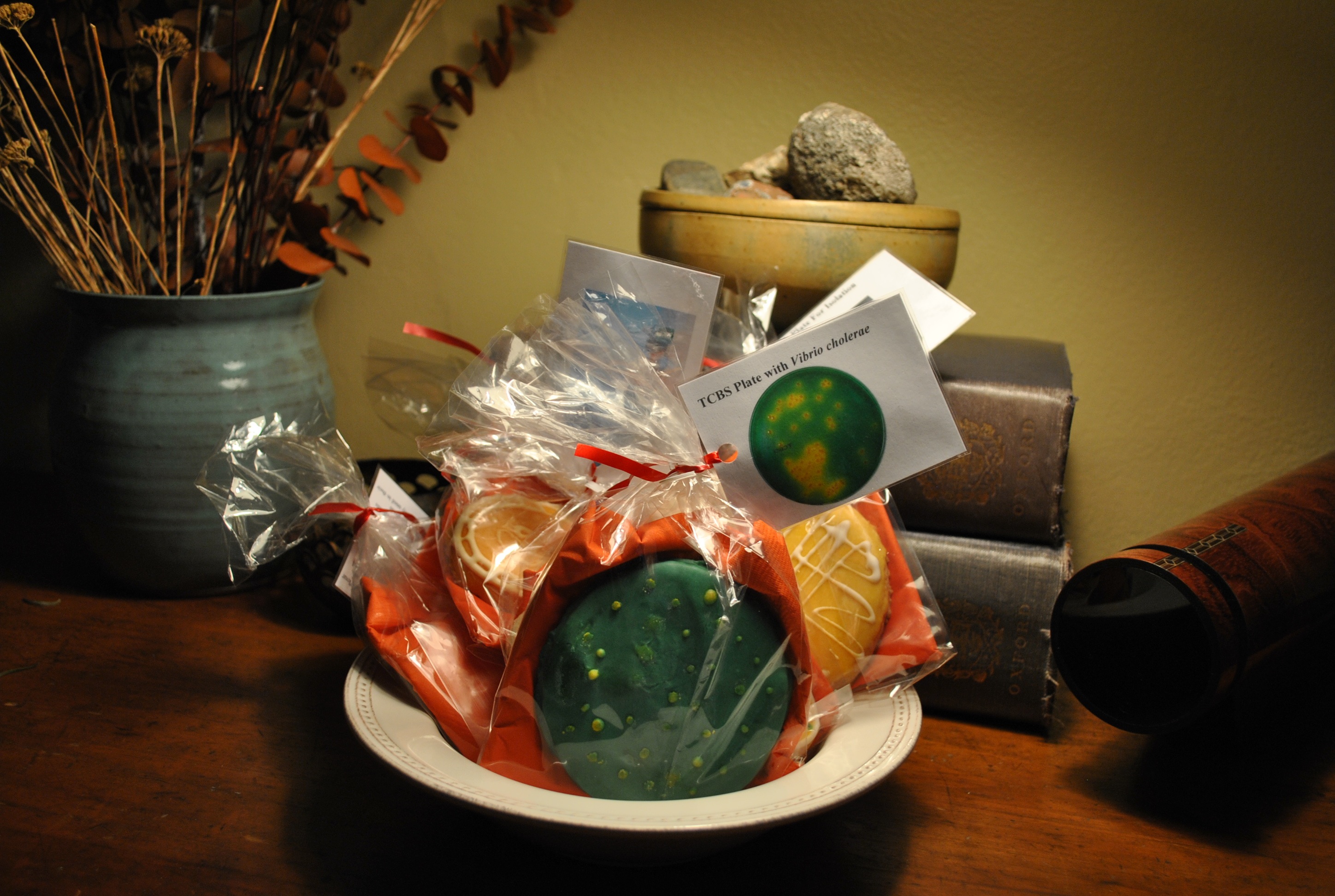
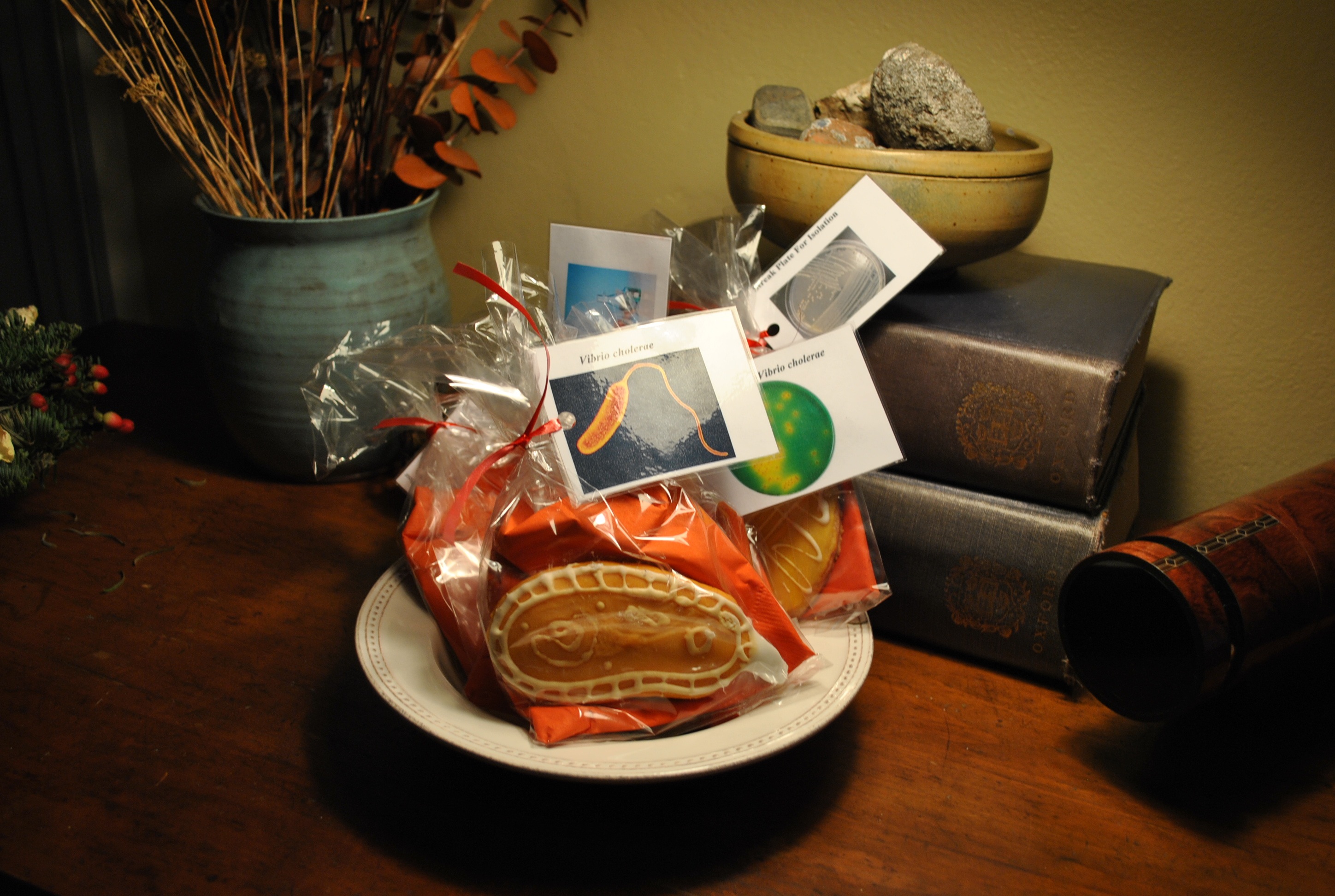
    TCBS is a selective medium for Vibrio cholerae, but this cookie didn't make me sick!


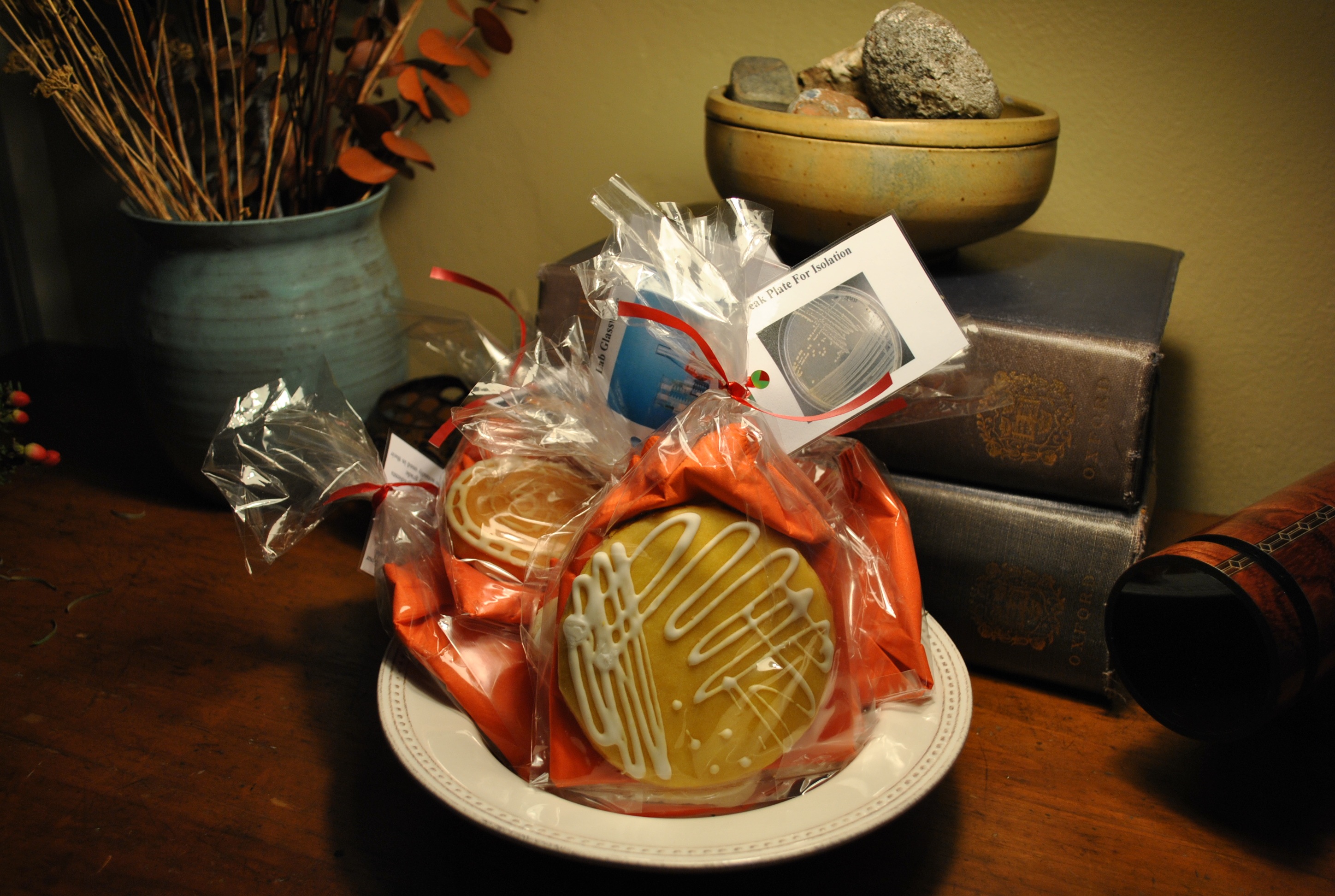
    Every December the Georgia Tech School of Biology has a holiday party with one of those never ending gift swaps.  Most of the presents are silly, and you never know if you are going to wind up taking home a ramen noodle cookbook or a puka shell necklace.  This year, every time I had a present I liked it was stolen and ulitmately I was left with the decision of whether to open the last unwrapped gift or make the game go on for another round.  I took the last gift, ending the game, and to my delight found it was filled with hilarious homemade science cookies!  Maria Nellessen, an Emory University biology major doing research in Dr. Brian Hammer’s lab at Georgia Tech made the cookies.  I recently asked her about herself and the cookies.  Read on to learn more about this budding microbiologist with a sweet tooth!

    A beaker, an erlenmeyer flask and a test tube. All edible!


    1) I understand that you go to Emory and are graduating this semester. What are you studying and what are you planning on doing after graduation?

    Yes, I am a senior biology major at Emory.  I have spent this year in Brian’s lab at Tech doing research in order to write and defend a thesis, ultimately graduating from Emory with honors.  I was initially planning on pursing a Ph.D. in Molecular Genetics immediately after graduation, however, I recently decided to act on my desire to obtain a medical education.  Part of the reason I found and fell in love with science is because of all its implications in medicine.  I truly want to make a contribution to the medical field using a strong scientific background.  Therefore, I am planning to enter a MD or a MD/PhD program in the fall of 2013.  In the meantime, I hope to find a job to keep me occupied (maybe I should add cookie making to my CV).

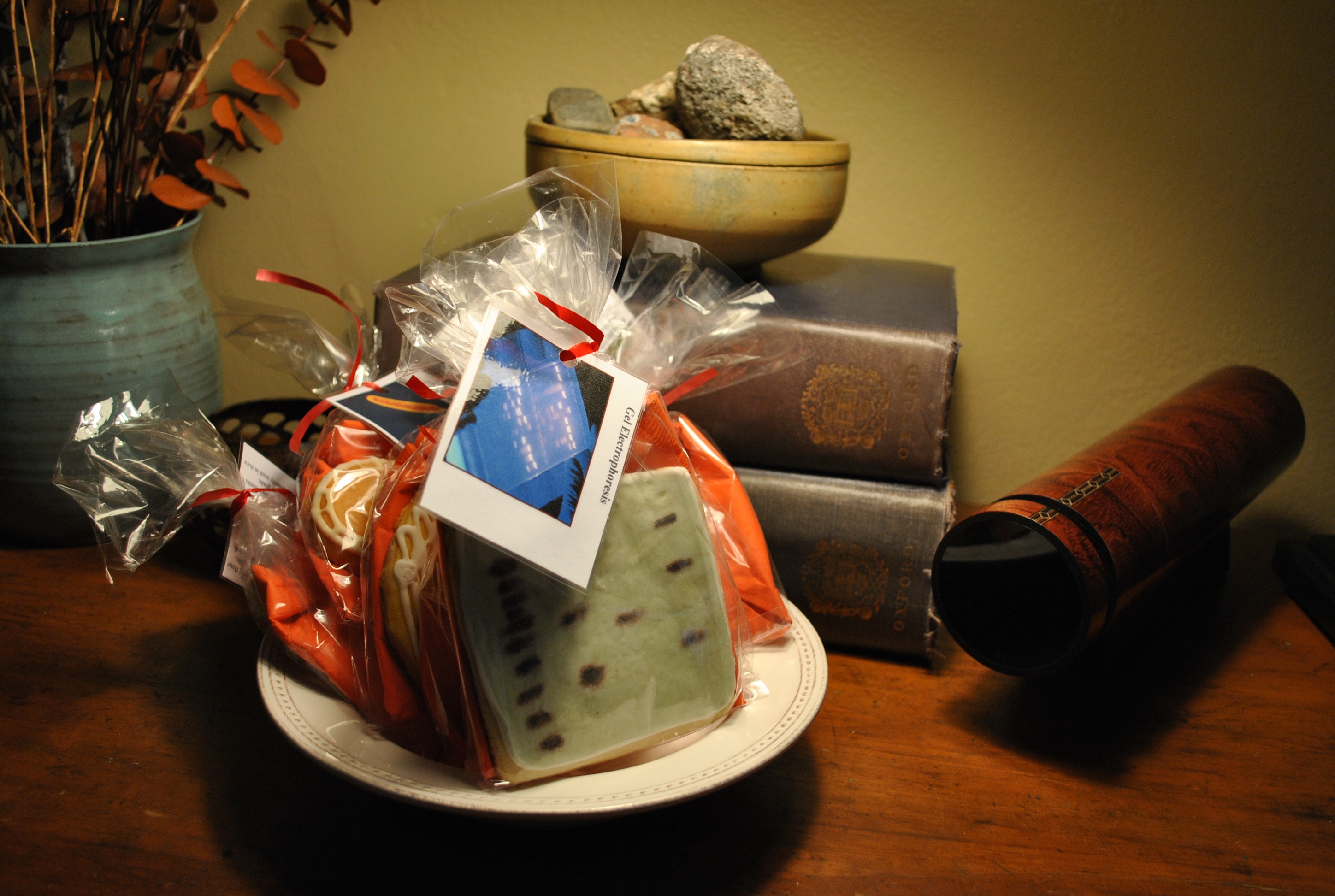
    This cookie looks like an agarose DNA gel. Hope there's no ethidium bromide in there!


    2) What inspired you to make decorated cookies depicting one of the most dangerous bacteria in the world, the causative agent of cholera? What about the other cookies? Could you describe the mice?

    To promote eating cholerae. Okay, not really.  Actually, I was in a grant writing course at Emory with a mix of both science and humanities students, and we were asked to give a creative presentation based on the project we were working on.  Since not everyone in the class was a biologist, or scientist for that matter, I was reminded of my first time learning about microbiology in my intro course and I distinctly remembered the proud feeling that came along with doing a streak plate for isolation.  To this day, I get that same proud feeling when I come into the lab the next day to see my plates with isolated colonies (success…I’m a scientist!).  I really wanted to share that feeling with my classmates, but I was limited by the fact that I couldn’t allow them to work with bacteria.  So I thought I would teach them the streak plate method and let them enjoy “results” through a cookie.

    I started getting practice making the streak plate cookies by making them for science related events (such as lab meetings and for my microbiology students).  I really didn’t want to go out and buy anything for the Christmas party (because I’m a poor college student), so I decided to make some science cookies, even branching out to new designs in efforts to brighten a fellow science nerd’s day.  Choosing to do a TCBS plate with Vibrio cholerae was easy because I work with V. cholerae in the lab and we use this green media (called TCBS) that causes V. cholerae to turn a bright yellow on the plate.  In a way, V. cholerae is actually quite pretty on the plate and I wanted to represent that in a cookie.  The other designs were just me thinking of other scientific designs I could do, as well as searching the internet for other ideas.  Sure enough, other people also make science cookies  I got a lot of inspiration from Not So Humble Pie (she makes streak plate cookies too!).  While I don’t research on mice, I thought they were cute, so I gave them a try.

    Uh oh, looks like one of those mutations is lethal!


    3) How did you make the cookies? Do you have any tips for the novice baker?

    For the record, I do not in any way consider myself a baker.  I don’t even have the tools that most bakers have, which would actually make decorating these cookies a whole lot easier.  I’m not going to pretend I have a secret recipe (let’s be honest here…I’m in college!).  For the cookie, I just follow the roll-out cookie recipe on a sugar cookie mix (I prefer Krusteaz) and use a cup to cut out the circle shape. Since I only made a few of the other designs, I just cut them out with a knife.  Then I throw together a powder-sugar based frosting to decorate my cookies.  I know….no big secret, right?  Anyone can make and decorate cookies.  Each time I make them, I may modify something to perfect my “recipe,” but getting the signature cookie takes time and practice.  The good thing is that your mess-ups are usually still edible and delicious!

    It must be hard to make a cookie flagellum.


    4) Have you ever made any other strangely decorated cookies or do you have plans to?

    My busy lifestyle rarely leaves time for me to bake for fun, but sometimes I’ll come across something (usually science-related) and think to myself “that’d be a cute cookie.”  I honestly have thought about perfecting recipes and publishing them along with information/instructions as I often do when I make my streak plate cookies for students.  When I made a batch of cookies for the Christmas party, I attempted to make a V. cholerae bacterium but it ultimately looked like some kind of squash.
    I’m sure my future medical education will provide me with plenty of opportunities to make all sorts of weird (and probably disturbing to most people) cookies.  I’d love to try to create a complete skeleton, where each bone is a cookie.
    Perfect technique!


    – So, it turns out making weird cookies is not as hard as I thought.  Maybe I’ll make some T cell cookies this weekend!
  • Zinc has bigger game than you do

    Zinc has bigger game than you do


    Still struggling to pick out that one in a million Valentine’s Day gift? Worry no longer, because I have the perfect gift idea sure to make anyone melt. No – it’s not superhot plasma from your favorite star gone supernova (the Biebs?) – We’re talking zinc baby. Baby. Baby. Baby. Oh baby.

    Zinc coatings on steel to be exact, through the process of “hot dip” galvanization.  The hot dip part is literal – pieces of steel are dunked in a bath of molten zinc metal and when they are removed a thin layer of zinc is atomically attached to the surface of the steel. The “galvanized” part belies the true function of the coating, considering this word is derived from a certain Italian who took liberties with dead frogs.

    “Why bother?” Your significant other may ask.  “Here I had this nice piece of steel and now you’ve gone and hot dipped it. I think we’re at two different places in our relationship.” We’ve all been there.

    The role of the zinc is to protect the iron in iron alloys (most importantly steel) from rusting. Like a proverbial knight in shining (preferably hot dipped) armor, zinc prevents the steel from rusting by selflessly doing all the rusting itself. As I describe it, this is starting to sound a lot less romantic and more like zinc has wandered into the friend-zone. Poor zinc.

    If you read my last article, you know that natural corrosion resistance is rare among the elements, but ironically zinc protects steel by being less good at resisting the undesirable reactions with oxygen and water that cause the formation of rust on steel. A good analogy for this process is if both zinc and iron open lemonade stands on the same block and oxygen is the customer. Every time iron is trying to seal the deal zinc unleashes a humorous ad campaign and slashes their prices, so naturally oxygen buys lemonade from zinc instead. Now replace lemonade with electrons and you’ve got a half-decent understanding of how zinc does its job – as far as oxygen is concerned it came to this two bit lemonade town to buy lemonade from somebody (form an atomic bond), and zinc sure is looking pretty good right now. The only discrepancy with this analogy is that in the business world iron would have to resort to foul play and steal all of zinc’s lemons or deface their billboards or something. Probably shouldn’t write that on your next chemistry exam though. But don’t feel bad for zinc – the corrosion products of zinc with the environment (zinc oxide and zinc carbonate), actually prevent continued corrosion of the underlying zinc. This is called “passivation” which is the way that many other metals, like aluminum, avoid needing a hot dip.

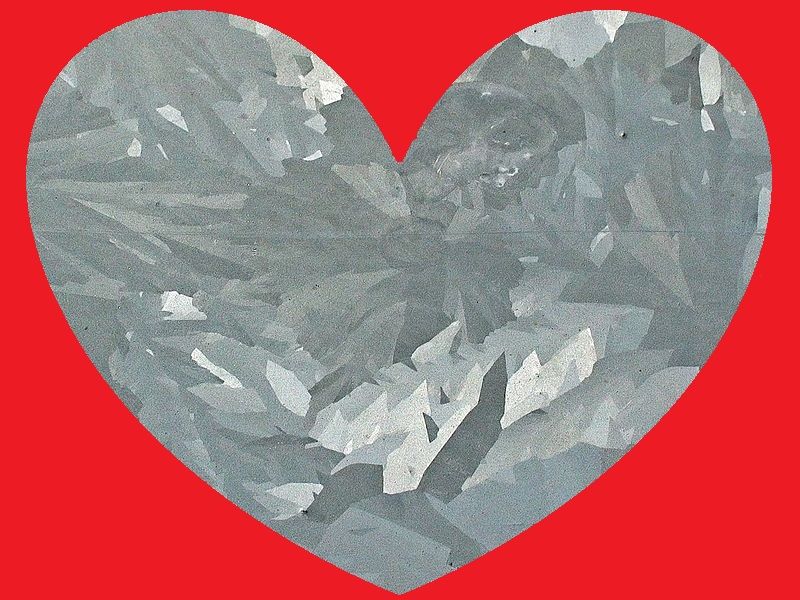
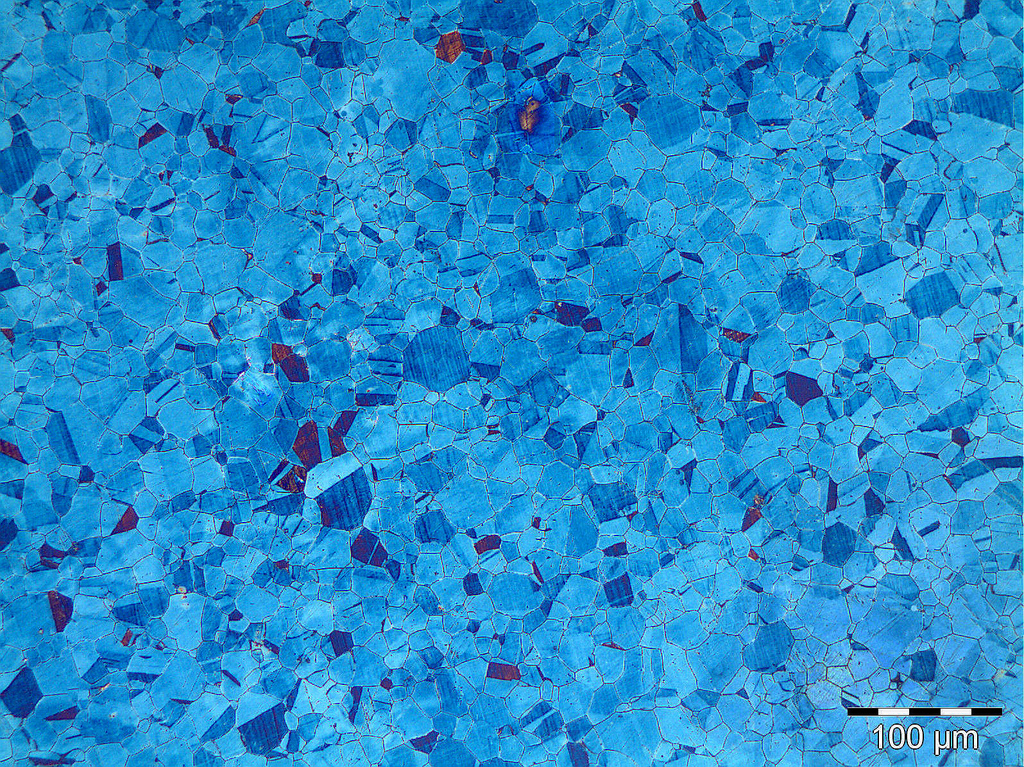
    So we’ve covered the “from the heart” part of a good V-day gift, but a box of galvanized nails might not send the right message to the apple of your eye. The good news is hot-dip galvanized steel looks really cool. The next time you’re passing a guard rail, street light pole or the like, you might notice a kind of patchwork series of flecks on the surface of the steel. No, that’s not art deco, those are the macro-sized crystalline grains of zinc busy oxidizing away. You can see some of these flecks inside the heart at the beginning of this article. In fact, all metals crystallize in this way, but because of how the zinc coating is applied the crystals of zinc that form on the surface of the steel are able to grow very large. If you were to take a high powered microscope and have a look at the surface of un-galvanized steel you would see a very similar grain structure but about 1000 times smaller. A good example is shown below from the Flikr photostream by the department of engineering at the University of Cambridge –  I admit I am a little jealous at all the cool science photos they have. Do yourself a favor and check them out.  The grains in this image are about 30-50 micrometers, which is about half the width of a human hair.

    Normally the grain size in so called “engineering materials” like steel is intentionally kept very small because it improves strength. Zinc, whose only role is as a sacrificial coating, can flaunt its’ big ole’ grains. The only other example I can think of where crystal grains are visible like this is in polycrystalline silicon solar cells. The fact that all three of these materials have the same general appearance is not by chance, but more on that another time.


    If love is sacrifice, then zinc has got it down. I will close with a poem that you can use with your gift:

    Roses are red,

    Rust is red too,

    A coating of zinc,

    says I – LOVE – YOU


    And don’t I just.


    – Gordon


    Original image sources:

    hot dip galvanized

    grains of steel


  • Even though Kim Kardashian’s marriage didn’t last, her engagement ring will. Like forever.

    Even though Kim Kardashian’s marriage didn’t last, her engagement ring will. Like forever.

    I have a joke for you:


    How long does a two million dollar engagement ring buy you with everyone’s favorite (well, mine anyways) Kardashian sister?


    As Kris Humphries found out, about 72 days.


    Sorry Kris, but at least you should take some comfort in the fact that the ring you gave Kim will sit as shiny as it is right now until it’s ready to win hearts and headlines once again. At least the platinum band will anyways. What I’m referring to as the simply staggering resistance of Platinum to oxidation, more commonly known as rust or tarnish.  Platinum, along with gold and to a lesser extent silver are  the only metals on the periodic table that enjoy this distinction. As a logical consequence, these metals were some of the first discovered by ancient peoples because they would have quite literally been found lying on the ground, super shiny. In fact, gold was the first metal discovered ever and goes back as far as the entire history of… well as far back as recorded history itself! I like to imagine when cavemen discovered gold they tried to eat it before proposing to cave ladies with chunks of the stuff. Given that these un-reactive metals are now relatively commonplace, the idea of a metal that doesn’t rust may not seem that cool but trust me, it is.


    So why aren’t these magical metals applied to more commonplace items where rust is a concern? The obvious answer is their astronomical expense. Unfortunately the expense of platinum, gold and silver is not because they don’t rust but because they are super rare, representing some of the rarest elements found it the earths crust. Even if they were more common, each of these metals are extremely ductile and malleable allowing them to be easily fashioned through pulling and hammering into jewelry but preventing their use as structural metals. Gold’s softness is the origin of the quintessential gold rush miner biting into a dubious coin to ensure it’s authenticity. Thus even if you wanted to and were rich and crazy enough to do so, it would be unwise to make solid gold or platinum rims because they would buckle when popping over a curb.


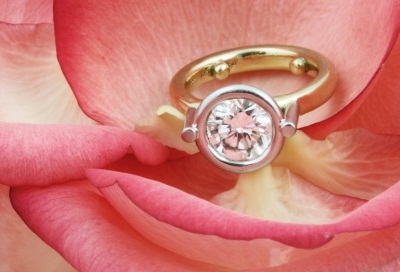
    The diamonds in Kim’s ring are another story. Formed from carbon under extreme conditions of huge temperatures and pressures, diamonds are chemically identical to pencil lead but differ in the way the atoms are arranged. Instead of being soft enough to smear onto a sheet of paper when pressed by hand, diamonds are the hardest naturally occurring substance on earth. Ironically, according to calculations using thermodynamics, a discipline used to determine the equilibrium structure for a given set of conditions and composition, diamonds should not even exist outside of the extreme conditions in which they are formed! Instead, thermodynamics predicts that diamonds should deteriorate to graphite (pencil lead) at the temperatures and pressures found around Kim Kardashian’s hand. Then why don’t they?


    To answer that we can consider again our friends platinum and gold. It is not exactly correct to say that these metals can never oxidize, but more accurate to say that without a huge input of energy they never will. Meanwhile, metals like iron actually give off some energy when they rust. From the standpoint of iron, it is energetically favorable to rust than remain as elemental iron in the presence of oxygen. A good analogy to this kind of “favorable energetics” is a cart balanced at the top of a hill – the cart has potential energy that is converted to kinetic energy and then depleted  when it rolls down the hill. An unfavorable energy case would be a cart in a deep valley. Even though the cart could reach the top of the hill, someone would have to push it up there. Maybe you could get those cavemen to do it by feeding them gold. To transform diamonds into graphite and oxidize platinum will take energy. Lots of energy. So unless Kim visits the National Ignition Facility, an active volcano or these guys, her ring is staying put. Just maybe not on her finger.

    Image: Maggie Smith / FreeDigitalPhotos.net