
Day: April 17, 2026

  • The Ransomware Trust Paradox: How and Why Cybercriminals Want You To Trust Them

    The Ransomware Trust Paradox: How and Why Cybercriminals Want You To Trust Them

    Ransomware is a cybercrime idea as old as the computer itself. The idea is simple: break into a victim’s computer, encrypt all their files, and demand payment for decryption. That being said, the social dynamics at play during this interaction are anything but simple. Generally speaking, the cybercriminal has one goal: to get paid. In order for the victim to pay, they must trust that upon payment they will get their files back. This simple dichotomy gives rise to the Ransomware Trust Paradox

    The Paradox

    The Ransomware Trust Paradox, an idea coined by Max Smeets in April 2025, refers to the idea that inherently untrustworthy individuals or groups engaging in illegal access to often sensitive data must convince their victims of their trustworthiness to meet their ends (Smeets, 2025). This shows a marked difference between ransomware and other forms of both digital and conventional crime. Think about a bank robbery: both the robber and the ransomware operator have the same goal, to make money, but the bank robber is never trusted by the victim. Rather, they achieve their ends by force. What makes this idea so fascinating to me is the lengths ransomware groups will go to to secure trust from victims. To get an idea for this, let’s first look at the first ransomware, and see what is done differently today.

    The First Ransomware

    The story of the first ransomware is an interesting one, to say the least. It was created by Joseph Popp, an evolutionary biologist from Harvard working on AIDS research in the 80s. The malware was distributed by mailing floppy discs to attendees to a WHO conference on, believe it or not, AIDS research (O’Kane et al., 2018). Popp was quickly found and arrested, and while no one knows why he did this, his idea led to the creation of an entirely new criminal enterprise in ransomware. In premise, Popp’s ransomware worked on the same basic principle of ransomware today: infect a computer, encrypt everything, and demand payment for it back, but there were several key differences between Popp’s ransomware and modern ransomware. For one, his ransom note (the message telling victims what is happening and what they should do about it) was primitive and nowhere near visually appealing. On top of that, payment was asked to be sent to a PO Box in Panama (O’Kane et al., 2018). There was no clear indication of who the money was being sent to, or how sending cash to Panama would allow one to get their files back. Put yourself in the shoes of a researcher in the 80s. You probably wouldn’t pay in this situation, right? 

    Ransomware Today

    These days, there are plenty of ransomware groups following in Popp’s footsteps taking various approaches to gaining trust. One ransomware group, Darkside, states plainly in their ransom note that they are here to make money, and if they did not return on their promise to decrypt their victim’s data, no one would pay them going forward (Smeets, 2025). This approach is backed by psychology. Studies have shown that, when marketing to a customer, companies that state their intentions plainly are more likely to gain trust (Dayal, 1999). This extends to the ransomware domain because ransomware operators are also trying to gain trust to receive payment. Another group, BlackCat, engages in anonymous “press releases” to clear up rumors about themselves. In this instance, various news outlets had misattributed attacks to BlackCat, and their “press release” attempted to clarify that they were not making any purely malicious attacks, their sole purpose was to make a deal and return the encrypted data (Smeets, 2025). Another vector of trust groups have exploited rests in User Interface (UI) design. Studies show that just changing the UI in a payment portal increased the number of users who shared their contact information by 31.3% (Yashimi, 2020). This demonstrated that interfaces based on familiar items or other interfaces makes people more likely to give up information (Yashimi et al., 2020). During Conti’s time operating as a ransomware group, they exploited this by using a professional looking ransom note, and sleek payment portals that made victims feel like they were completing a legitimate business transaction. There are many other strategies too, including providing 24/7 customer support, and referring to victims as “customers” (Smeets, 2025).

    How Much Damage Does Ransomware Cause?

    While it is hard to know exactly how much ransomware is costing year over year, many estimates exist. One estimate from the FBI placed ransomware at a market worth of 200 million USD, with one ransomware family (Cryptowall) totalling 18 million USD in losses in the US alone (O’Kane et al., 2018). How much ransomware operators are asking for in one attack varies by the operator and sometimes by the estimated worth of data encrypted. One company, Symantec, put average ransoms around 679 USD, with some as large as 6285 USD (O’Kane et al., 2018). This of course varies with the price of bitcoin, which is the most popular way for operators to demand payment (Huang et al., 2017). But who is paying these large ransoms? Turns out that, according to a study by Huang et al., 74.5% of Cerber (another family of ransomware) targets were residential. Because these numbers were based on internet service providers, this means that most targets used residential routers, so likely households. While the study is limited in scope due to these numbers being only related to one family of ransomware, these numbers are striking. While only somewhere between 1% and 3% of victims pay the ransom (O’Kane et al., 2018), one can easily see how lucrative the ransomware business is. 


    Overall, the Ransomware Trust Paradox is a theory that I find fascinating, the idea that criminal enterprises engaging in explicitly untrustworthy activities are exploiting trust to meet their ends is something never seen in the criminal world before the introduction of ransomware. Tracing ransomware from its roots reveals the importance of this paradox in the operations of modern ransomware groups, and helps us think about how to better defend against them. Going forward, individuals and corporations can use this idea to make better value judgments when they are hit by ransomware, and better understand how to defend themselves against it. 


    References

    Dayal, S., Landesberg, H., & Zeisser, M. (1999). How to build trust online. Marketing Management, 8(3), 64. Retrieved from https://www.proquest.com/scholarly-journals/how-build-trust-online/docview/194194113/se-2

    Huang, D. Y., Aliapoulios, M. M., Li, V. G., Invernizzi, L., Bursztein, E., McRoberts, K., Levin, J., Levchenko, K., Snoeren, A. C., & McCoy, D. (2018, May 1). Tracking Ransomware End-to-end. IEEE Xplore. https://doi.org/10.1109/SP.2018.00047

    O’Kane, P., Sezer, S., & Carlin, D. (2018). Evolution of ransomware. IET Networks, 7(5), 321–327. https://doi.org/10.1049/iet-net.2017.0207

    Shutterstock. (2024). Ransomware. In Ransomware explained: How it works and how to remove it.

    Smeets, M. (2025). The Ransomware Trust Paradox. https://virtual-routes.org/wp-content/uploads/2025/04/Virtual-Routes-Pharos-Report-Series-No.-2.pdf

    Yashmi, N., Momenzadeh, E., Taghipour Anvari, S., Adibzade, P., Moosavipoor, M., Sarikhani, M., & Feridouni, K. (2020). THE EFFECT OF INTERFACE ON USER TRUST; USER BEHAVIOR IN E-COMMERCE PRODUCTS. Proceedings of the Design Society: DESIGN Conference, 1, 1589–1596. https://doi.org/10.1017/dsd.2020.103
  • The Artificial Turf Epidemic

    The Artificial Turf Epidemic

    Introduction:

    Over the years, a growing trend in sports has emerged with schools, professional teams, families, and even city parks switching from real grass to artificial turf. In my life alone, I have seen my friends’ families remove beautiful grass lawns, and my high school get rid of grass fields in favor of more expensive artificial turf. 

    History:

    First installed in 1966 at Houston’s Astrodome, artificial turf originally consisted of nylon carpet over compacted soil, and the trend of replacing natural grass with so-called AstroTurf continued due to its durability and low maintenance requirements (Cumberbatch et al., 2025). Even back then, many shared concerns about the grass, as, for the first time in human history, people ran on a human-made version of a natural surface. These issues have laid the foundation for modern discourse around playing surfaces, whether we should prioritize convenience or player opinions. 

    Current Use:

    Now, artificial turf uses synthetic polymers, with the top layer consisting of polymers attached to a textile with latex backing, and the infill made of recycled tires (Cheng et al., 2014). To emulate the shock absorption of real grass, artificial grass makers use sand laid over a shock pad made of materials such as rubber. These moves have increased its energy and water costs; however, they remain lower than those of maintaining a real grass field. 

    The new turf only needs water to cool it down at times due to its material’s high heat absorption and the lack of evaporation seen in normal grass (Cumberbatch et al., 2025). The new turf also excels in durability, with strong polymers preventing the grass from tearing and avoiding the dirt spots and rough patches characteristic of a normal grass field.

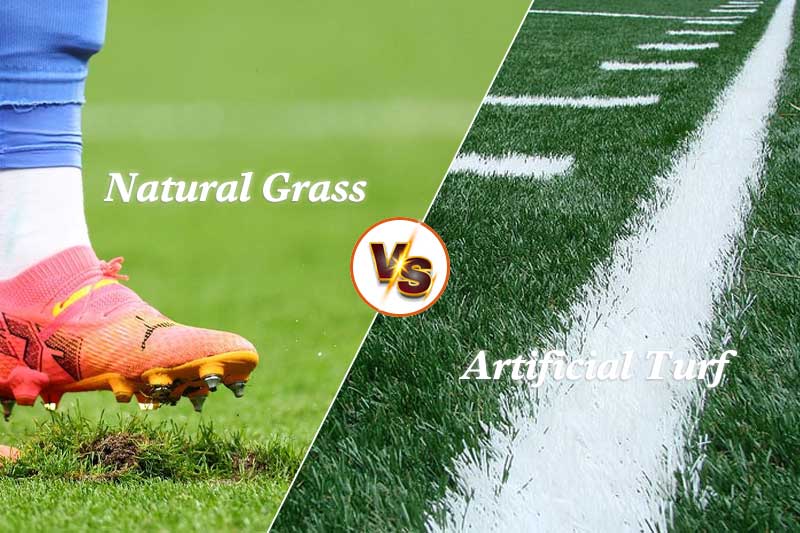
    While the new turf clearly excels in many areas, the areas it does not excel in have become the greatest sources of conversation, with its impervious surface limiting water infiltration and the synthetic grass having lower permeability to water (Cheng et al., 2014). Normal grass serves as a runoff area; as anyone who has played sports remembers, practice gets canceled because of heavy rainstorms. Furthermore, plastic pollution also becomes a major issue with artificial turf as microplastics, which do not biodegrade, linger in the environment and account for 15% of plastic debris in aquatic environments (Cumberbatch et al., 2025). Artificial turf also produces significantly more greenhouse gases than natural grass, and maintaining the grass increases the use of pesticides and cleaning solvents. Suppose you thought that you should just get rid of the synthetic grass and replace it with natural grass; even more issues emerge, as we do not have proper recycling facilities for artificial turf. 

    Health Risks:

    Health-wise, synthetic grass also raises serious concerns, as high surface temperatures increase the risk of dehydration and heat stroke (Reiad et al., 2025). The high presence of forever chemicals in artificial turf can also cause developmental issues, liver damage, and an increased risk of cancer (Reiad et al., 2025). Furthermore, athletes dislike the grass because of the increased risk of injury. In a study by John Powell, he linked artificial turf surfaces to increased knee injuries in professional football, and just from the top of my head, I can think of 10 bad lower extremity injuries from artificial turf, like Aaron Rodgers tearing his Achilles on his debut with the Jets and Dre Greenlaw doing the same in the Super Bowl. The NFL even conducted a poll in which 92% of athletes said they preferred natural to synthetic grass (The Associated Press, 2024). However, some studies have seen a greater concussion risk associated with natural grass, so you cannot simply say x is better than y in terms of injury risk. 

    Hopefully, this article has guided you to my research question: Why would anyone ever use synthetic grass? The NFL has proven, through this year’s World Cup, that it can switch fields quite easily. In Europe, nearly all professional soccer teams use grass, so why would baseball and football team owners use hated synthetic grass fields over nostalgic, beloved grass fields? The answer to your question is likely effort and money. 

    Appeal of Turf:

    When you walk on a field of grass, you may not realize the effort it took to avoid rolling your ankle on a divot or accidentally stepping on an ant hill, but maintaining a proper grass field requires continuous, multifaceted effort. It requires seasonal reseeding, watering, mowing and cutting, fertilization, and changing costs based on weather conditions. The costs behind these actions tend to add up, leading to high and even unpredictable costs at times, which has led organizations and teams to stray away from grass in favor of turf. To maintain a turf field, all you might need to do is brush the surface of artificial grass to make it stand up straight or remove any debris or stains on the field, but other than that, and maybe a light watering for cooling, the cost associated with cleaning and maintaining turf remains relatively steady. Turf withstands heavy use and weather better than grass, making it ideal for the US’s multipurpose stadium venues. Artificial turf appeals to owners because of its low-cost marketing, consistent playability, and stable costs, which allow them to more easily manage the tight budgets they deal with. Europe, in contrast, has a more holistic approach to sports, where the fans and players come first, prioritizing tradition over costs, making real grass a cultural priority in sports infrastructure.

    Conclusion:

    The grass vs. turf debate underscores the broader theme of convenience versus quality. While turf saves money and lasts longer, artificial grass can cause adverse health effects, may increase lower-body injuries, and sacrifice the traditional, beloved feeling of grass. In debating grass vs. turf, we are asking what we should prioritize. As technology advances, we must ensure our answer to the question not only makes budgeting easier but also maintains the quality that players love.

    References:

    Cheng, Hefa, et al. “Environmental and Health Impacts of Artificial Turf: A Review.” Environmental Science & Technology, vol. 48, no. 4, 2014, pp. 2114–2129. American Chemical Society, https://doi.org/10.1021/es4044193.

    Cumberbatch, Iman S., et al. “Artificial Turf Versus Natural Grass: A Case Study of Environmental Effects, Health Risks, Safety, and Cost.” Sustainability, vol. 17, no. 14, 2025, article 6292. https://doi.org/10.3390/su17146292.

    Macy. (2025). Artificial turf vs. natural grass football fields: The complete difference. Mighty Grass. https://www.mightygrass.com/artificial-turf-vs-natural-grass-football-fields/

    Reiad, Timothy A et al. “Comparing Sports-Related Orthopedic Injury Trends on Artificial Turf and Natural Grass: A 20-Year Nationwide Analysis of the NEISS Database.” Rhode Island medical journal (2013) vol. 108,7 41-47. 1 Jul. 2025

    The Associated Press. (2024, February 8). NFLPA head says 92% of players prefer playing on grass. FOX Sports. https://www.foxsports.com/stories/nfl/nflpa-head-says-92-percent-of-players-prefer-playing-on-grass