Tag: science

  • The Ballad of Gringo Perdido

    The Ballad of Gringo Perdido

    Herpetology and getting lost. These are the two driving themes of my life. They have shaped my career and enabled me to discover species new to science, but they have also cost me relationships, frustrated everyone close to me, and nearly cost me my life. Without them I would be a different person, so this is a ballad to the lost art of getting lost.

    After college, I left Santa Barbara, California to go to graduate school in Texas and study under a mid-career hotshot who specializes in Central American herpetology. He is a gringo North American but was raised in Guatemala and moving in-and-out of that culture is the norm for him. In the first year of my grad program I got the assignment of my dreams. I was to be delivered to a coffee plantation in a remote region Guatemala to conduct a survey of amphibians and reptiles. I was to do an ecological transect of herpetological diversity up the face of a very steep mountain in the Sierra de las Minas, in the state of Alta Verapaz. Although the area had certainly been populated since at least the Classic Maya Era, no biologist had ever worked anywhere near the region. If you look at a map of Guatemala, you’ll see a huge lake (Lago de Izabal) in the eastern part of the country. I was about 20 miles west of the lake, in the Polochic Valley, at the base of the north slope of a mountain called Cerro Raxon.  The village/plantation is called Pueblo Veijo (Old Village) in reference to the fact that the site had been inhabited by native Maya for millenia.  The problems turned out to be: 1) I spoke not a word of Spanish; 2) although I grew up in Europe (army brat) and was accustomed to being immersed in foreign cultures, I’d never been to Latin America beyond a couple family fishing trips to Baja California; and 3) Guatemala was embroiled in a horrific genocidal civil war (that was purposefully instigated by the US-CIA in the 50’s, by the way).

    The day before I went to the airport my mentor gave me some topographic maps of my study site and said “If you get pulled over by anyone that looks like police or army, don’t let them see these maps because they will assume you are there to inform the indigenous insurgency and you will be arrested. Oh, and don’t bring those Vietnam-era military field boots you wear. They are US-Military issue. Get some boots that look more like a tourist would wear.” So I borrowed money from my parents and bought some brightly colored boots from the local REI. I put the maps in the bottom of my bag of gear.

    I swear never again to travel so ignorant of my situation.  It turned out that speaking Spanish would have been only of partial utility, as I was sufficiently remote that most people there spoke Q’eqchi’, one of the many dozens of very distinct Maya languages in the region, and only a bit of Spanish. Every time I ventured beyond the main part of the coffee plantation (as was my task as a herpetological surveyor),  I encountered Mayan villagers who would drop everything and run away from me.  I was terrified. If they were scared of me, then there must be something that I should be scared of as well. Since my return, I have built a small library on the recent history of Guatemala, and I now know what I did not know then. It turns out that the chinks I saw in the concrete-block walls in the nearby town of Telemán were from a massacre only a couple of years prior to my trip.  Genocidal civil wars are real, and they are incredibly ugly.

    I had an ecological transect to conduct, and I finally got myself up to the highest village on that slope of the sierra, a tiny Mayan village they called Peña Blanca (“White Stone” because there was a big one there) in Spanish, or some other name I never managed in Q’eqchi’ (Mayan dialects include glottal-stops in mid-syllable, so they are essentially impossible for the non-native speaker). The people seemed nice in Peña Blanca, and they did not run away from me. I set up a camp outside their village, with their implied permission. The first two nights I had a small crowd of people around me watching as I made a crappy camp dinner and prepared my specimens, samples, and notes. None of us could really talk to one another, but I managed to get across that I hoped to camp there, wished them no trouble, and planned to wander around outside the village looking for snakes and frogs and such. They were cool with that, and even brought me all the snakes they killed in their cornfields every day (very useful specimens for me).

    After a few days I hiked back down to my main camp on the plantation and got read the riot act by the fascist, racist Guatemalan manager for having “anything to do with those rebels on the mountain” (recall there was a civil war going on, essentially between aristocrats like this guy and the Mayans in the mountains). About a week later I went back up the mountain to my camp, but this time not a single person would come anywhere near me. I was there for about three days when it dawned on me that I was doing a bad thing—my self-serving data collection for my degree was severely compromising their daily life. No kids were playing outside, and the men were sneaking off before sunrise to tend the corn.  I assumed they returned from the fields, but I never saw them. Evidently, someone had spread word that I was not what I seemed. I felt terrible, but packing up camp and leaving was not such a simple affair because I was so far up on the mountain. So I had to spend that night there, and planned to leave the next morning—carrying what I could on one trip (it took about three trips to get all my stuff up there), and leaving everything else for them; things I naively hoped could be useful (e.g., sleeping bag, not a bottle of formaldehyde).

    Evening set, it began to rain, and I realized that this was my best and last chance to sample the highest part of the mountain because I never intended to return. Nocturnal amphibians and reptiles move in the rain, and it started to rain to rain really, really, really hard so I did get some good samples. Around 1:00 am I was exhausted and turned to go back to my camp. On the way back I took a wrong fork in the trail (it was still really raining and, if you wear glasses like I do, one cannot look around during a rainstorm; you look straight down, at your feet) and I wound up not in my little encampment, but smack in the middle of this village. I was disoriented, wet, cold, and scared. As I looked around, my mega-flashlight (standard issue in my line of work) was beaming through the twig huts and wakeing everybody. I could hear commotion coming out of the huts. My first thought was of regret—oh, darn, now I’m waking everybody up! Then I started to hear machetes tinging, guns being loaded and cocked, and saw barrels sticking through the slats. I’ve since learned that it was standard practice for Guatemalan Army squads to wipe out “rogue” villages by sending in troops in the middle of the night—with mega flashlights—to massacre and set fire to entire villages. I was mortified, and terrified. So, I just started yelling “Gringo perdido, no hay problema” and “Culebra! Rana! Sapo!” at the top of my lungs. That all translates essentially into “Lost white-boy, there is no problem. Snake! Frog! Toad!”  Meanwhile I dashed in the nearest direction that did not have a hut. I clawed my way up through a steep muddy corn field and finally found my camp. At the first glimmer of daylight I left and never went back up there. I regret that I caused them so much distress, I really do. I’m glad they did not shoot me. But given what I’ve learned since then, I’m amazed that they did not. I’m convinced that those few words in Spanish, “Gringo perdido, no hay problema” and “Culebra! Rana! Sapo!” saved my life.

    I’ve returned to Guatemala many times since then, but things have changed. The war mellowed out, even if the original tensions remain. I never travel alone. I’ve learned Spanish (but no Mayan dialects, beyond a couple of animal names).  And I am not so naïve. To be sure, there were many more adventures and misadventures over the years, including a murder right in front of my face, but nothing since, anywhere, has been so personally transformative as that particular night. I have a one-man punk band called Gringo Perdido and some friends use the phrase as a nickname for me. No one wants to be known for being an uninformed, unintentionally inconsiderate, disoriented boob, but a colleague of mine returned from Guatemala recently and said,  “Joe, do you realize that every young biologist in that country knows that story?” Gringo perdido, no hay problema.
  • Who doo? You do.

    Who doo? You do.

    **Disclaimer: This post is about poop.

    A few days ago I stumbled upon this webpage and couldn’t stop laughing. I don’t think I have ever laughed so hard in my entire life. I was crying, a stitch in my side. Any time I would regain my composure, I would lose it again within 0.237 seconds of reading another line. So of course, after struggling through the page, I decided to consult my trusty friend YouTube for some poop-themed videos. Here’s one of my favorites: 3 Types of Girlfriends Based on Pooping Habits (it’s a little vulgar). Now, I’m not entirely sure why I find these types of things so entertaining, but I think I find them funny because they are usually true. Some people don’t like to admit they poop, and they definitely don’t want to talk about it, but why is that so? Everyone poops!

    Have you ever wondered how poop is formed, or why it comes in different shapes and sizes? Well, let me enlighten you. After food passes through the mouth, esophagus, and stomach, being digested by various amylases and gastric juices, it makes its way into the small intestine where the majority of the fluid and nutrients from the digestive process and from the food you eat are reabsorbed by the body. An additional amount of fluid is reabsorbed in the large intestine, also known as the colon.

    This is where the magic happens.

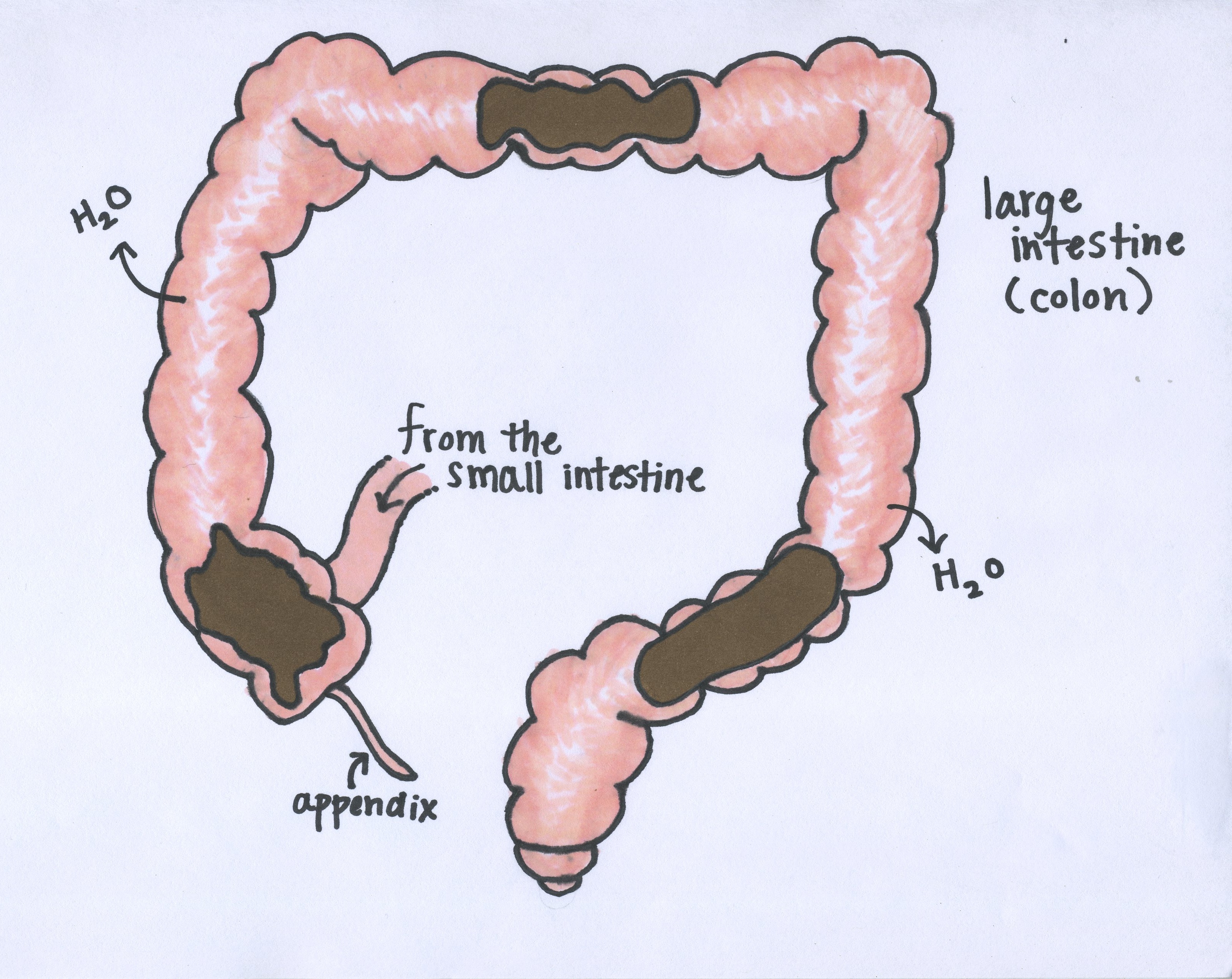
    Digested food moves through the colon via a type of smooth muscle contraction called peristalsis. As it moves along, the poop starts to take shape as the fluid (referred to as H2O in the diagram below) is drawn out. As more fluid leaves, the poop becomes more solid. During times of viral or bacterial infections, fluid may not be properly reabsorbed, causing the common side effect of diarrhea. Have you ever been constipated? This is a result of poop moving too slowly through the colon, causing too much fluid to be reabsorbed. Depending on what you eat, your poop may vary in appearance. If you eat some corn, you may see it again since our bodies can’t digest the cellulose outer layer. Ever drink a brightly colored slushy saturated with food coloring? Your poop likely changed color.

    The digestive tracts of carnivores differ from those of herbivores due to the different digestive requirements each type of animal has. Take a koala for example, whose cecum (the section of colon below the attachment point of the small intestine) is about 2 meters long! This longer cecum enables the koalas to digest leaves and provides a greater amount of surface area for nutrients to be absorbed. Check out this koala who, instead of eating leaves, is chomping on an apple. I wonder how long it took for that apple to become poop…


    Sources:

    Campbell, Neil A., and Jane B. Reece. Biology. San Francisco: Benjamin Cummings, 2002. Print.

  • A Scientist’s Perspective on Why Pie is Yummy and Delicious and Deserving of Your Respect and Admiration

    A Scientist’s Perspective on Why Pie is Yummy and Delicious and Deserving of Your Respect and Admiration

    It is an indisputable fact that I am deeply, irreversibly, head-over-heels in love with pie. Apple. Pumpkin. Blueberry. Banana Cream. You name it, I’ll eat it.

    As Thanksgiving approaches, I find myself longing for a slice of warm apple pie with a big scoop of vanilla ice cream. I also find myself contemplating the scientific majesty that is an apple pie.

    What majesty, you say? Well, friend, allow me to take you on a journey — from orchard to oven, from farm to table. Prepare yourself. Cozy up. Grab your snuggie. A tall glass of hot chocolate wouldn’t hurt either. Of course you’ll need some marshmallows. Got the marshmallows? Good! Let’s begin.

    There are few evolutionary success stories as impressive as the apple’s. Think about it. This fruit was able to evolve a trait so desirable (its deliciousness) that we humans have taken it from its ancestral home in the mountains of Kazakhstan to every populated continent on Earth. We have immortalized the apple in art; we have juiced them, fermented them, sliced them, bobbed for them, dipped them in caramel, engineered machines for the sole purpose of coring them and, yes, made them into delicious pies.

    You might think with all its uses that the apple must be a simple, easy fruit to grow. Humans are lazy, right? Surely we wouldn’t grow a fruit like the apple so much if it weren’t an easy thing to do. Wrong. False. Incorrect. Lies!

    Apples are incredibly complex. Apples are extreme heterozygotes, meaning that the genes they inherit from their parents can be radically different between one apple and another apple on the same tree. If you were to grow a tree from a seed taken from a Granny Smith apple, you would most certainly, not obtain a tree filled with Granny Smith apples. Your apple tree would likely produce “spitters” — nasty, sour apples meant only to be spit out. Every so often a sweet apple would be grown by chance, but not with consistency.

    So how do we manage consistency today? How do we grow a Granny Smith apple tree? Well, in order to produce a Granny Smith apple tree, you would need to graft one. Grafting is a horticultural surgical procedure whereby the tissues from one plant are transplanted into another, allowing for asexual reproduction of the primary tissue. As a result of this process, the tissues from the donor plant fuse with the tissues of the host plant and the resulting fruits are born from the genes of the donor tissue.

    Without this process, apples would never have been domesticated; planting an apple tree would be like opening a box of chocolates — you’d just never know what you’d get.  It would be an adventure, yes, but 99 times out of 100, it’d be an unhappy one. Through grafting we have become slaves to the apple, spending billions of dollars per year on pesticides aimed at keeping the sweet apples we love away from the dark precipice of extinction. And for what? For pies. And to be perfectly honest, that’s all the reason we need.

    The next thing you’ll need for your pie is a crust. There are many recipes that one can use to make a pie crust. But so far as it is an indisputable fact that I am deeply, irreversibly head-over-heels in love with pie, it is also a fact that the best pie crust recipe is indisputably my great-grandmother’s recipe. But I will not be supplying you with this recipe. This is not a “how-to” guide. Get over it. I will however, confide in you, my dear reader, the identity of one crucial ingredient. It’s flour. I know. Revolutionary! But don’t tell anyone. It’s a secret. Now that you know this deep, dark secret, you probably have some burning questions. If you’re like me, the first question you are probably asking yourself is “What are the explosive properties of flour?” Lucky for you, I have the answer!

    As it turns out, flour is, indeed, an explosive substance. Flour is composed primarily of starch, which is, in turn, composed primarily of glucose. Glucose is highly combustible — it reacts with oxygen to produce carbon dioxide and water. When ignited by a flame, the sugars explode! Boom! Normally, this process is highly controlled — cells convert glucose into pyruvate through glycolysis and that pyruvate is then converted to carbon dioxide and water through the citric acid cycle and oxidative phosphorylation.

    Through these processes animal cells produce the energy needed for carrying on with their day-to-day metabolic processes and that’s all good and well, but it’s probably not the type of combustion you were thinking of. Where are the explosions? Where’s the excitement? Well … this is the excitement. Your cells have the ability to carry out explosive reactions in a manner so intricate and organized that they cause no harm to you whatsoever — in fact, they help you. On a second-to-second basis, your body is “exploding” sugars and harnessing their energy. So put that energy to good use. Invest it in digesting more pie.

    Of course there are many other ingredients that go into making the perfect apple pie (cinnamon, nutmeg, sugar, butter), but we will not address those here. We will, instead, end our journey with a discussion on ice cream — apple pie’s obligatory sidekick. Ice cream is a dairy product, meaning it is derived from mammalian milk. Humans have been consuming milk since the Neolithic revolution, but it wasn’t until Louis Pasteur invented pasteurization that dairy products such as ice cream could be made and stored for extended periods of time. Pasteurization is the process by which milk is heated and cooled in order to reduce the amount of pathogenic microorganisms in the product. Once pasteurized the milk is free to be used as an ingredient for whatever ice cream your heart desires! But as for me and my heart, we will desire vanilla.

    If you’ve stuck with me this far, congratulations, your dedication is about to pay off! How, you ask?! Why with a discussion on the colligative properties of rock salt, of course! If you wanted to make your own ice cream, you could do it by filling a bag with milk (1/2 cup), sugar (1 Tbs), and vanilla (1/2 tsp), sealing that bag, and placing it in a larger bag filled with ice (4 cups) and rock salt (4 Tbs). Gently massage your bag for 5 minutes, or so, and voila, you’ve made yourself ice cream!

    Witchcraft! You exclaim. No, silly! It wasn’t witchcraft. It was science.  You see, salt has the ability to lower the freezing point of water (meaning that it enables water to remain liquid beneath its freezing point).  For your ice cream, this means your ice/salt mixture will keep your milk/sugar mixture sufficiently cool for it to freeze into ice cream despite the fact that it’s sitting in your warm, cozy hands in your warm, cozy room. It also means you have a quick, easy way to make yourself a side dish for your apple pie!

    By now you’ve probably finished your tall glass of hot chocolate and are wondering what to do next. This article is almost over; you’ll soon be left on your own. What will you do? Well, if I may make a suggestion; go make an apple pie and some vanilla ice cream. Bake it. Eat it. Respect it. Admire it. After all, it came a long way to get where it is today. Also, pie is yummy and delicious.

  • The movie “Contagion” is so realistic it’s boring

    The movie “Contagion” is so realistic it’s boring

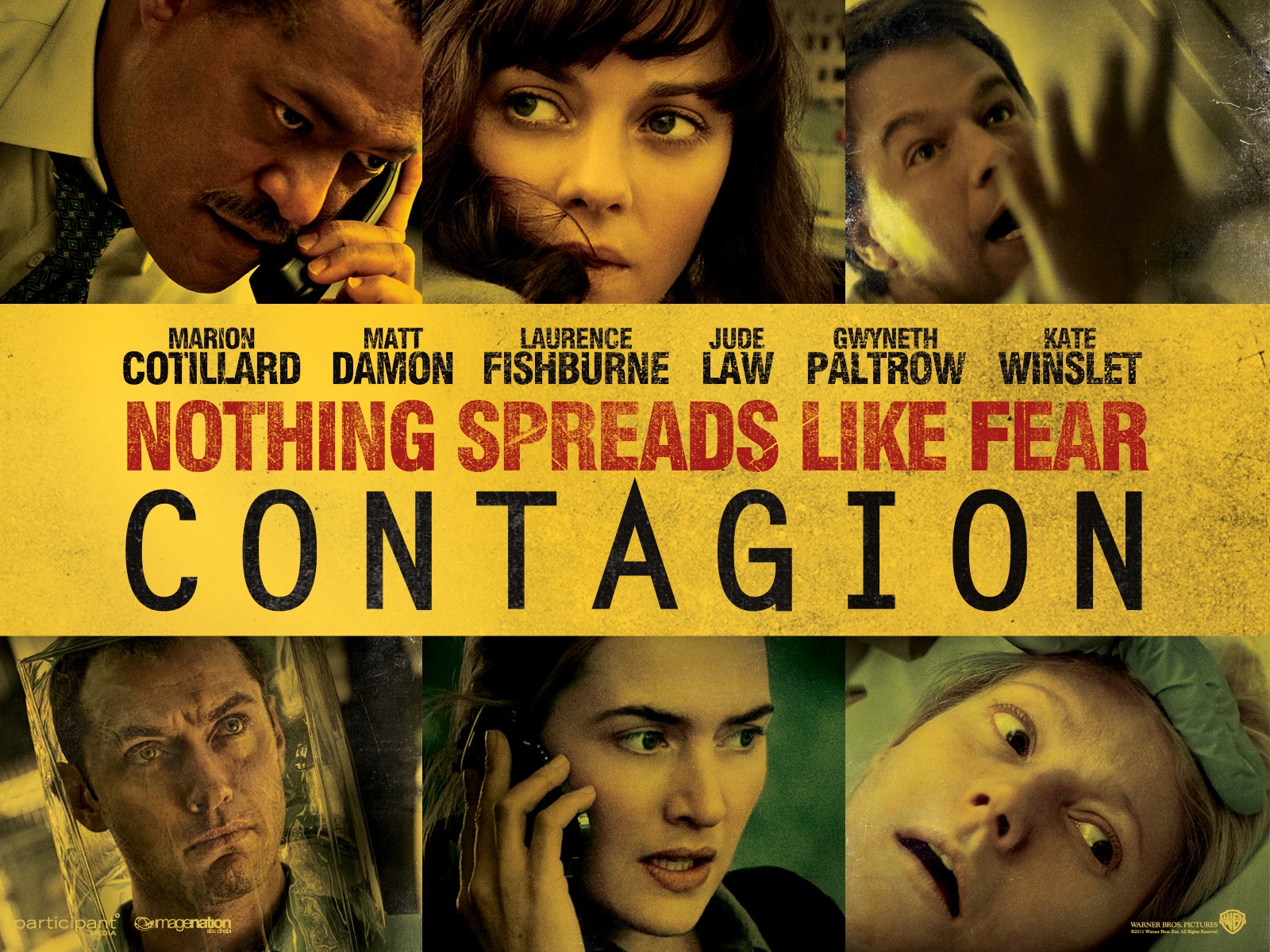
    I have been looking forward to seeing the movie Contagion since it came out last year and I finally got to see it last night. I am a big fan of outbreak/apocalypse/zombie-type movies and, since I’m an immunologist, I thought this would be right up my alley. Boy, was I wrong. The problem with the movie wasn’t with the premise (a new flu-like virus makes the jump from an animal reservoir to humans and starts spreading rapidly), the casting (Gwyneth Paltrow, Matt Damon, Jude Law, Kate Winslet, Laurence Fishburne), or the science (mostly spot on). The problem was that the movie was way too realistic.

    Hmmm, let’s see, we’ve got politicians and public health officials trying to keep the public from freaking out, a corrupt blogger/homeopathic proponent trying to get people to take an herbal remedy to recover from the virus (while he’s invested in the company that makes it), a protective father/widower (Matt Damon better watch out or he’s going to be typecast soon!), mass riots and looting, a dedicated scientist who makes a vaccine in no time, and the ultimate recovery of the country and the economy.

    Wait, huh? Where are the zombies? Where are the ghost towns? Where’s the blood oozing from eyeballs? This is just like what would happen in real-life if a virus wiped out 1% of the population of the Earth. People would be scared. People would lose loved ones. People would get sick and recover and then we’d move on. I don’t need a movie for this! There are way more dramatic things happening in the world right now! I think some character development could have saved the movie, but there were so many story lines going on at the same time it was impossible to get invested in any one character and the story lines never really converged.

    SCIENCE CRITIQUE: the screenwriters of contagion mostly did a good job with getting the science right and the set designers made things look pretty good. Only a few things stuck out. In one scene they were rotating a ribbon diagram of what was supposed to be the virus and its human receptor and they were describing four proteins, but it only looked like there were two on the screen.  It also didn’t make a lot of sense that Kate Winslet’s character, a CDC EIS officer, was explaining basic epidemiology to a group of state health department officials (don’t they have degrees in public health?). But the labs looked good and the CDC really looked like the CDC (although I’ve never been in a BSL4 lab).

    The bottom line: see the movie if you want a preview of what the next terrible outbreak will be like, but stay away if you’re looking for zombies …