You are halfway through saving a doomsday world from extraterrestrials or spending a night with a lost lover, when suddenly the sound of your alarm enters these storylines and comes to spoil the party. We’ve all been there, the feeling of waking up from a vivid dream that had us thinking we were among the likes of Quentin Tarantino or Christopher Nolan, but why then almost uncontrollably do we seem to forget these dreams as the day goes by. While scientific knowledge of dreams is still very undeveloped, there are two interesting evolutionary theories for why this happens.
Both theories stem from the fact that remembering these dreams, regardless of how cool they may be, are nonessential and sometimes even harmful to humans.
The first theory explains that our forgetfulness occurs as a natural response to continue learning and survival: for instance, in early cavemen, dreams of escaping lions by leaping off a cliff would not bode well when chased by a real lion.
The second evolutionary theory for dream forgetfulness was developed by Francis Crick, the co-discoverer of DNA. Crick believed that the function of dreams is to weed out unneeded thoughts and memories that accumulate over time in the brain, and dream recall defeats this primary evolutionary goal of dreaming. Our forgetfulness is generally attributed to neurochemical conditions in the brain that occur during REM sleep, a phase of sleep characterized by rapid eye movements and dreaming (1). It is interesting to note that after five minutes of a dream ending, we forget 50 percent of its content, and 90 percent of our dream’s detail is lost only 10 minutes later. Since most people wake up and immediately start thinking about how to start their day or other significant thoughts, these end up being the ones that get remembered. According to Crick, remembering dreams can leave the brain cluttered with useless information.
But what is it about dreams that make them so easy to forget, even when they can be so fascinating and graphic? It turns out it has to do with the nature of dreams, compared to reality. We are accustomed to remembering the past chronologically, linearly, and in terms of cause and effect. Dreams, however, are not always neatly arranged in time and effect — they meander and drift through different memory and emotional connections (2). Also, since dreams occur in deep sleep when a person is at rest, moving too much upon waking up can disrupt the memory of the dream much quicker.
After reading this, it may seem like grasping on to those vivid details of your precious dreams are not possible. While this is partially true, there are clearly methods to help with dream recall if one really cares to do so. Having to face and realize the construct of dreams (nonlinear, non sequential, etc), thinking about the dreams and only the dreams upon waking up, and limiting movement upon waking up can help someone remember more and more of those meaningful details of a lifelike dream. Also, writing down one’s memories of a dream upon waking up helps to recall more of the specific details. Using these methods can help to find those dreams our subconscious slept on.
References:
Hartmann, E. (2011, May 01). Why Do Memories of Vivid Dreams Disappear Soon After Waking Up? Scientific American. Retrieved February 20, 2018, from https://www.scientificamerican.com/article/why-do-memories-of-vivid-dreams/
Oldis, D. (2015, August 27). Why Do We Have Trouble Remembering Our Dreams? Retrieved February 20, 2018, from https://www.huffingtonpost.com/dreamscloud/remembering- dreams_b_8009552.html
It’s about that time of the year where projects are due. You want to create a fantastic looking poster to present your research in a neat editing software. Yet you’re having trouble choosing the correct colors. Or wait, is it just your computer that’s having trouble choosing the correct colors? What is this section under the “edit colors” tab that says “RGB values”? You just want to make the perfect shade of orange using red and yellow, but the computer only understands RGB. It turns out that when it comes to computer science, red, blue, and green are the primary colors.
Let’s break down this computational color system. The RGB (red, blue, and green) is known as an additive color system. The additive system was given its name because when wavelengths of light are added together, the color values approach white light. This system makes use of the physics of light to create the colorful (or colorless) pixels on your screen. To understand this further we have to break down the concept of light.
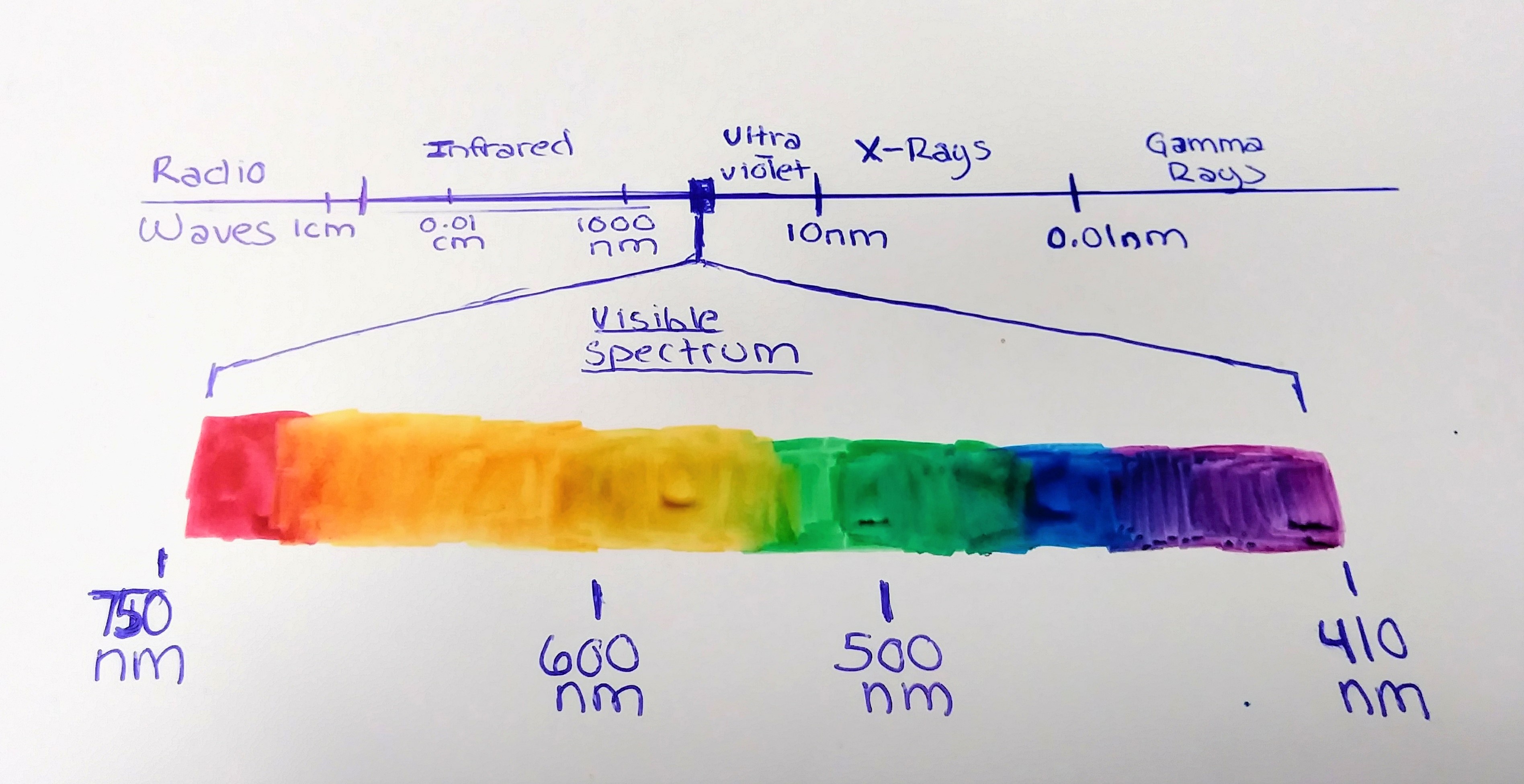
On a spectrum of radiation, known as the electromagnetic spectrum, light composes the visible part of the spectrum. Light has two natures, but for now, let’s just focus on its wavelike nature. Each range of wavelength corresponds to a different color, with around 700nm (nanometers) being red light, and 400nm being violet light.
Electromagnetic Spectrum
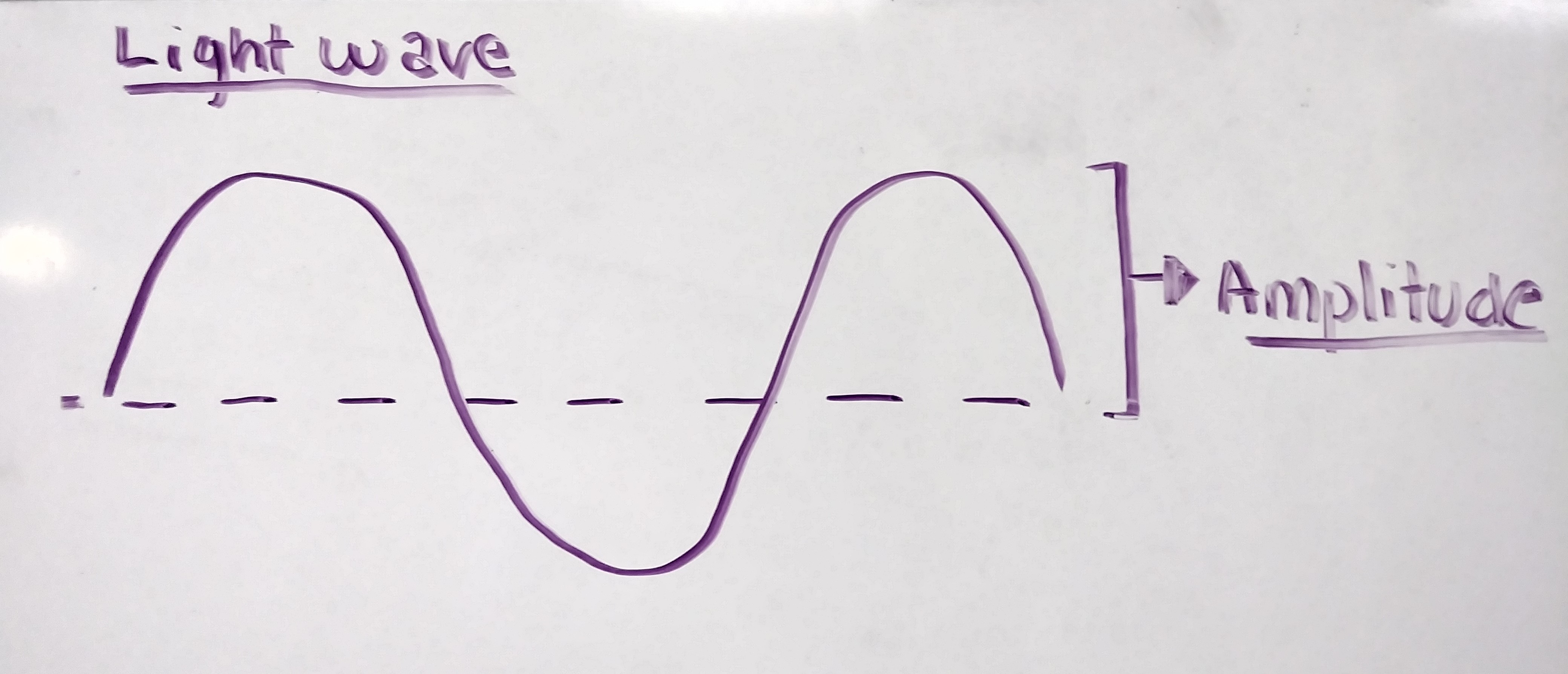
The height of the wave from its center point, or it’s amplitude, determines how bright the light shines, or how close the value is to white. This means that the colors on your computer screen are not actually programmed into your computer as red, green, or blue. Rather, your computer makes colors by shining specific wavelengths of red, green, and blue lights with different amplitudes through the pixels, tricking your eyes into seeing specific mixes of colors. Neat, right?
Light waves. The amplitude of the wave is from it’s midpoint to the top (crest) of the wave!
The colors that you might have learned as primary in your childhood, red, blue, and yellow, follow the subtractive system. This means that as these colors are mixed they approach darker values going towards black. As paints they do not emit wavelengths of energy, like the pixels on your screen. These paints have pigments which reflect the color they show, and absorb all others. For example, a red apple reflects red light, but absorbs all other color wavelengths. Unlike paints, the pixels on your computer screen do not have pigments.
Now that you know some more about the physics of color on your computer, making that science fair poster should be a breeze! Knowing how to manipulate your red, green, and blue wavelengths of light could save you a ton of time and give you some fantastic looking results! Happy poster making!
References:
Stroh, C. (Jul 1997). Basic color theory and color in computers. Art Education; Reston, 50(4).
Exams……projects……homework assignments, it never ends! In turn, the anxiety begins to manifest. According to the National Institute of Mental Health, an estimated 19.1% of U.S. adults had any anxiety disorder in the past year.
Sadly, for many yellow jackets, anxiety has become a normality. This emotional response is mostly associated with the fear of not doing well academically at Georgia Tech. Most of us don’t know why we can’t stop worrying. Many of us look past our anxiety and think this is normal, especially when you hear other students complaining about the same things you are. However, when it gets to the point of where the anxiety interferes with your life, it’s time to take action and understand your neurological chemistry.
Anxiety is a feeling that lingers ling after a stress (external stimulus that signals danger often by causing pain) has lifted and the threat has passed. The factors that trigger anxiety grow out of a response that is hardwired in our brains. For example, thinking you won’t be successful if you don’t do well and pass a class. When in reality, one class doesn’t determine our future. But why do we think this way? Are we born this way or do our experiences cultivate our thinking?
Kenneth Kendler, a psychiatric geneticist, decided to approach this question by studying groups of identical twins who share virtually all their genes, and fraternal twins, who, like any other siblings, share only some of them. What Kendler’s group found was that both identical twins were somewhat more likely than both fraternal twins to suffer from generalized anxiety disorder, phobias or panic attacks. The correlation isn’t 100%, however. “Most of the heritability is in the range of 30% to 40%,” Kendler says. That’s a fairly moderate genetic impact, so your genes set your general vulnerability. But your upbringing and your experiences still have a major role to play.
Being that we have no control over our genetic makeup, how can we turn their negative anxiety into positive anxiety? Using it as a tool to focus the mind. Think about it, when you’re worried, anxious, or fearful, whatever you’re associating these feelings with consume your thoughts and you can only focus on that discomfort. To change this, one would need to explore their amygdala and hippocampus. The amygdala tells the body what to do while the hippocampus is a cluster of nerves that help the brain learn and form new memories. These new memories will activate the prefrontal cortex which sends out an “everything is ok,” message, and lets the amygdala know that there is no reason to worry or cause anxiety. So instead of thinking negatively, think something positive no matter the situation or circumstance. Just like any habit, it’s easier to stop than it is to start, so it will require intentional effort to clear your mind of negativity. Understanding this neural circuitry can be the key to reduce the anxiety of students at Georgia Tech and increasing the jubilation of students.
Gorman, C. (2002). The science of anxiety. Time Magazine, 47-54.
As the leaning tower of Jenga pieces fell after a heated battle of, what my friends and I liked to call “Spicy Jenga”, I could only dread the immense pain and suffering about to come my way. What awaited me was the big daddy, the jefe of the chili world — the undisputed hottest chili pepper in the world (in 2013), the Carolina Reaper. As I bit into that pepper I tasted only regret. And for the next 8 hours that’s all I felt too.
Regardless of how awful of an experience that was, I still continue to eat spicy foods to this day, so it made me think:
What’s the science behind spicy things anyway?
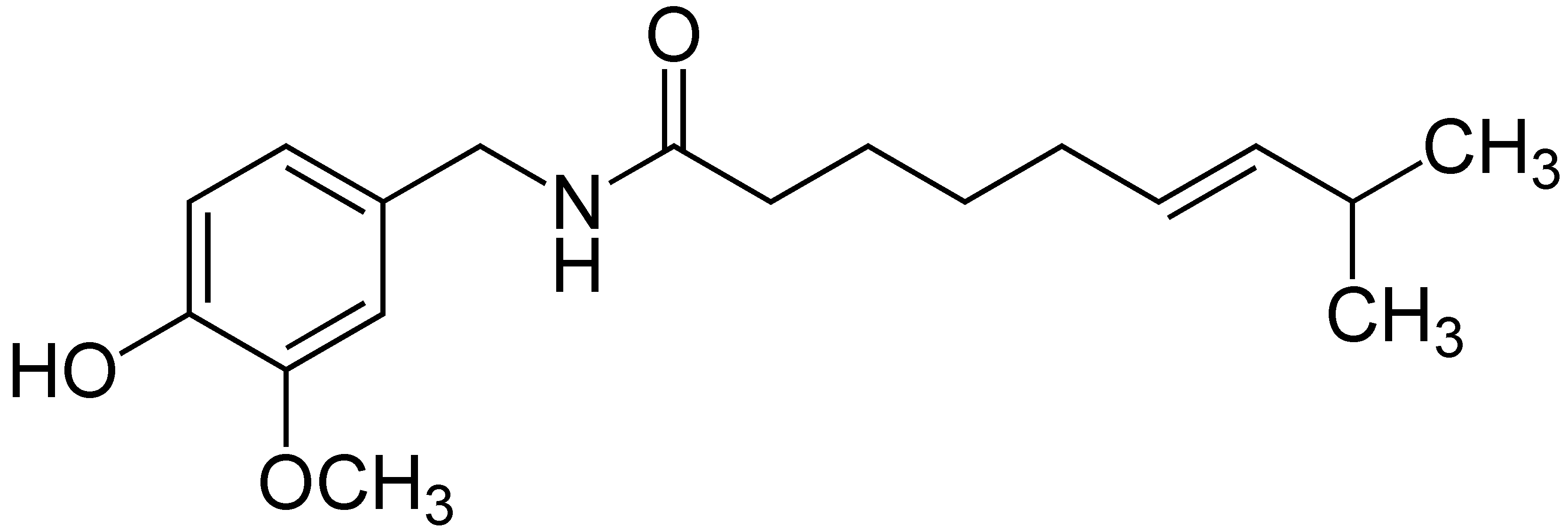
Turns out the main agent for “spiciness” is the chemical compound capsaicin. Found in the placental tissue – tissue that surrounds the seeds of a chili pepper – capsaicin is the primary chemical compound that leads to the “burning” sensation of spicy foods.
Chemical formula for capsaicin
Strangely enough, your brain – quite literally – believes that is on fire! Capsaicin activates a specific receptor on the tongue called TrpV1, which sends pain messages to your brain, causing your body to react accordingly. TrpV1 is also responsible for more than just spicy foods, however. It reacts to:
Extreme heat and
Caustic acid
That’s why when we eat spicy foods, we tear up, have our noses run, sweat in strange parts of our body, etc. in order to flush out the nonexistent heat. However, to our brain, that heat is 100% REAL, and it tries its best to get us away from potential danger. Ever wonder why spicy and hot foods always seem to taste spicier than normal? They both amplify the pain messages sent to the brain! Now, instead of having just spicy pain, your brain also adds in extra pain from the temperature of the foods you ate! Try eating something spicy at different temperatures (heat one batch and refrigerate the other) and see how much of a difference temperature plays in the overall spiciness of the dish.
This pain-relieving patch is one of the many kinds of capsaicin (or capsicum) medication available over-the-counter.
Aside from being an essential additive in cuisines all over the world, spicy foods play a larger role in our daily lives than we might think. Research has shown that regular chili intake lowered the risk of high blood pressure in a sample of 13,670 adults by almost 40%, even when controlled for diet and weight! Additionally, spices have shown to fight congestion, aid digestion, and relieve muscle and joint pain, as well as play some part in raising our overall metabolism. In fact, capsaicin is used often in the medical field as an analgesic, or pain reliever, due to its ability to prevent the production of Substance P – Substance P being the primary neurotransmitter responsible for pain from capsaicin.
The most fascinating aspect of capsaicin is that, the more capsaicin you introduce into your body, the less and less you will feel (you probably noticed how spicy foods are when you first eat them when compared to your last bite). Thus, research has shown that in high concentrations (~8%), a 60 minute application of a capsaicin patch effectively provides pain relief for months on end. Widespread use is slow-going; however, certain prescriptions are available for cancer patients and other people with chronic pain to provide some relief to them.
The benefits of capsaicin are still being researched, but even now people are hopeful in its potential in advancing our health and the field of medicine. Though, until more research is done, the most we can do is appreciate capsaicin for how much it spices our lives up!
References:
Burks TF, Buck SH, Miller MS. 1985 June. Mechanisms of depletion of substance P by capsaicin. Retrieved from https://www.ncbi.nlm.nih.gov/pubmed/2581820
Byrnes, N., Hayes, J. 2013 April. Personality factors predict spicy food liking and intake. Retrieved from https://www.sciencedirect.com/science/article/pii/S0950329312001917
Anand, P., Bley, K. 2011 August. Topical capsaicin for pain management: therapeutic potential and mechanisms of action of the new high-concentration capsaicin 8% patch. Retrieved from https://academic.oup.com/bja/article/107/4/490/228083
Sharma, S., Vij, A., Sharma, M. 2013 November. Mechanisms and clinical uses of capsaicin Retrieved from https://www.sciencedirect.com/science/article/pii/S0014299913008200
Tékus, V., Horváth A., Hajna, Z. 2016 June. Noxious heat threshold temperature and pronociceptive effects of allyl isothiocyanate (mustard oil) in TRPV1 or TRPA1 gene-deleted mice. Retrieved from https://www.sciencedirect.com/science/article/pii/S0024320516302508
Miroslav, M. 2010 August. High-concentration capsaicin for the treatment of post-herpetic neuralgia and other types of peripheral neuropathic pain. Retrieved from https://www.sciencedirect.com/science/article/pii/S1754320710705290
Shi, Z., Riley, M., Brown, A., Page, A. Chilli intake is inversely associated with hypertension among adults. Retrieved from https://www.sciencedirect.com/science/article/pii/S2405457717304965
Way back when the internet was just a dream, electricity was seen as a means to power machines, to make life easier, and to warm your bread into its toasty goodness. No one – except for the bored kids – would ever think of letting it run through your body for pleasure, let alone for medical purposes. Everything changed when the Relax-A-Cizor attacked. A device originally created in the 1950s, the Relax-A-Cizor is one of the first cases in America where electricity was used by the general public to increase muscle mass without actually doing too much. Sadly, it was banned by the FDA in 1970 because the government deemed it “potentially hazardous to health”, because why mindlessly pump your body with electricity when no one understands the side effects entirely? It just means people have to test it more, make it better, faster, stronger… when we have the technology. Nowadays, there’s a large variety of machines that zap the body to massage muscle, reteach the brain, help exercise it after surgery, and pain relief.
But how does it work? How can 10 to 15 volts cause your muscles to get stronger, relax them, or even exercise them? Well, before the scientist within you tries to experiment, here’s the gist of it:
THE MACHINE ITSELF
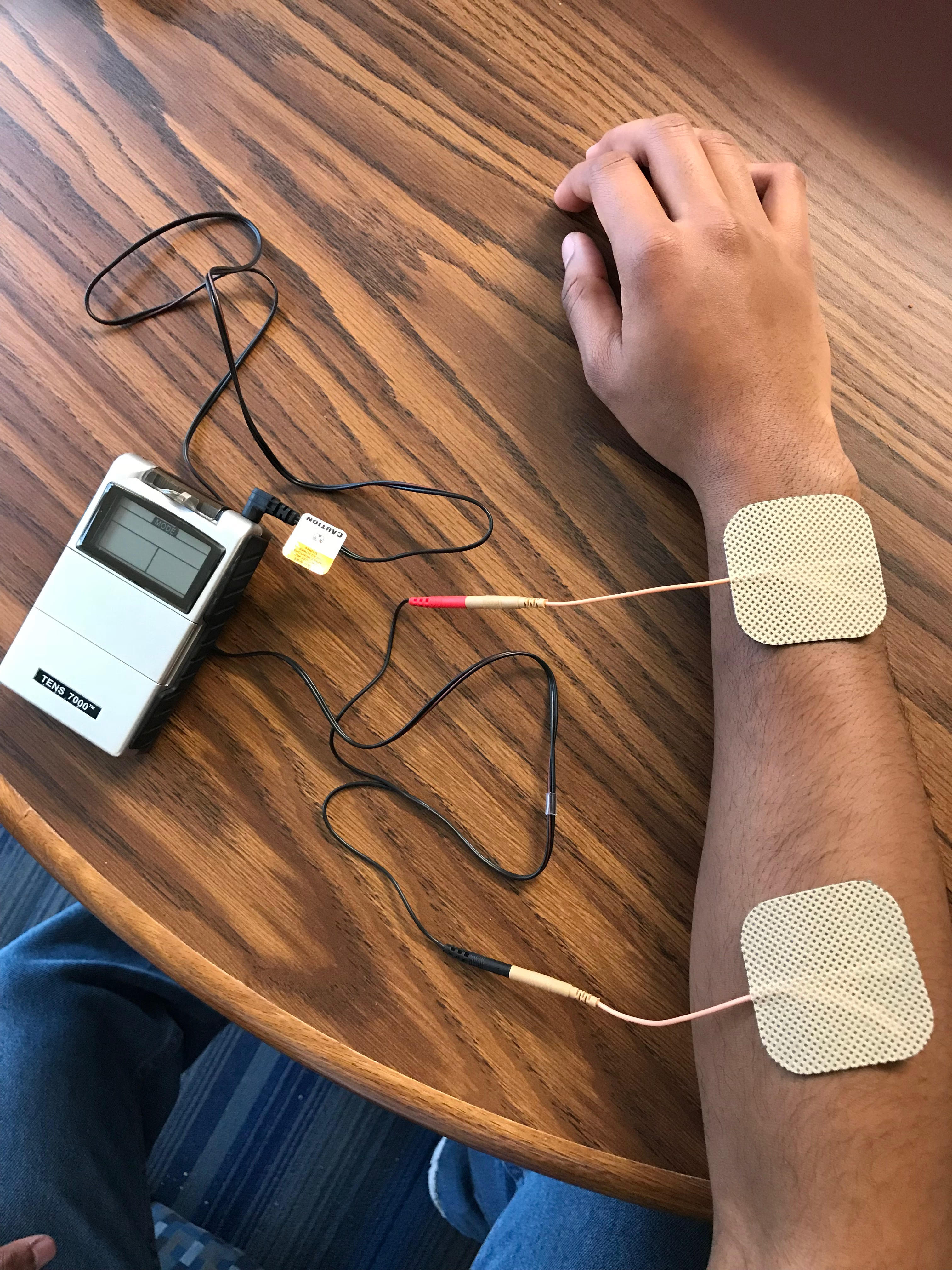
There are many devices with different designs, but they all follow the same understanding of basic circuits. There are two electrodes (dull metal disks) attached to different parts of the skin that have a positive and negative end. These two ends are points for the electricity to flow. Basically, positively and negatively charged objects relate to the amount of electrons they have. Think of it like two children and the flu. The flu is bad, and so is negative. Child 1 doesn’t have flu, and is happy and positive. Child 2 has the flu, and is unhappy and negative. Being as children are, Child 2 decides to cough on his positive brother, getting him sick and making him negative. This flow of electrons (or in this case the flu) creates a current that goes through the skin, taking the shortest, and easiest route possible. The fluids in our body (like our blood) allow for a number of different currents if the voltage is strong enough. In general, the body has a pretty large resistance, and as found by a guy named Ohm (not a Tibetan monk) you need a good amount of voltage to make a good current. Think of resistance as a mountain and current as a miner going through the mountain, the energy of the miner is the voltage… and you need a whole lot of energy to dig through a mountain. John Henry, anyone?
A Transcutaneous Electrical Nerve Stimulation (TENS) unit . Used to relieve pain and entertain bored doctors with a thing for electricity.
WHY ARE MY MUSCLES MOVING ON THEIR OWN!?
Now you’re probably asking me: “But Lee, how does this current make my muscles move?” Well, remember the two children? That exact same concept is at play within muscle cells. If you remember your high school biology class, cells have a cell membrane that wrap around it, keeping it divided from the outside world. Typically speaking, there’s a positive charge outside of cells, and a negative charge inside. This is because the cells are dividing Sodium outside and Potassium inside the cell at a ratio of 3 Sodium: 2 Potassium. Both have the same positive charge but because of the 3:2 ratio, there’s more positive outside – this causes it to polarize, where the outside is positive and the inside is negative. If you remember magnets, positive and negative attract, but the membrane doesn’t like either side to be different – so it doesn’t let the charges through. Remember the current? Remember how it’s still flowing through the body where you strapped those two electrodes on? Well now the electricity is flowing through the outside of the cell and makes it negative. Now, the cell membrane is happy because both sides are negative, so it lets the sodium back inside. If you’ve seen The Martian, there was a scene where Matt Damon had to go into a waiting chamber before entering the main building – this was to equalize pressure and content in the air so the building wouldn’t explode… like it later did. It’s about the same concept, but without a second chamber. This is a called an “Action Potential”, where the sodium I mentioned earlier goes into the cell and spreads out. From here the action potential tells the muscle cell that it’s time to contract. When the machine is running the current, the electricity in the current flows through the body and goes along the easiest route possible (often times outside the cells), and since the outside is positive, the flow of electrons outside makes it negative. Since the inside is negative as well, there’s little difference in polarity (the difference in charge) causing certain channels (e.g. proteins) to open to let sodium inside. This opening of the door is responsible for causing muscle cells to start contracting through a fairly complicated process. Pretty much, so long as that current is running, sodium will stay inside the cell and continue to make the muscle contract. When the current is turned off, the doors close and the muscle will relax. This is why the machines you get at the local store often deliver a shock in the form of a pulse.
But why!?
You can imagine how doctors use this to help retrain the brain, or have patients exercise after surgery. If someone recently had a stroke and can’t move their limbs, doctors can use an electric stimulation (E-stim) machine to move the muscle, and let the brain re-learn how to use its own body. Similar with patients after surgery, they use it to help the muscles exercise and increase circulation of blood to those regions instead of just swelling and having limited circulation, E-stim also helps with rehabilitation, making sure that muscle isn’t lost for patients who aren’t able to move them – instead letting the E-stim machine exercise the muscle. But what about relaxing it? Well, to answer that, have you ever ignored something and forgot it was there? Like forgetting where your phone is while you’re talking on it, the same thing goes with nerves. There are nerves throughout the body that sense pain and other things, with a constant current running through whatever muscle you choose, those nerves are going to sense it and let your brain know there’s pain. But, after a while the brain gets tired of it and tries its best to ignore it. The nerves in that area become less sensitive – meaning that they don’t tell the brain as often unless the signals increase – and pretty much mute it out. Think about it: to stop pain, you just keep zapping your nerve endings until they stop saying it hurts!
BEWARE PSEUDOSCIENCE!!!!
There’s been some claims that E-stim is able to gain muscle and even reduce fat. DO NOT FALL FOR IT! To date, there aren’t many studies that confirm anything significant. It might be a good thing to add onto an athlete’s training, but it’s costly and won’t get you that summer bod in half the time it takes to actually work out. The best bet for that is to eat healthy and have a daily workout routine… and THEN use E-stims to help relax the muscle when you’re sore!
The Takeaways
Overall, the use of E-stem is common in today’s society, though there’s still a decent amount that it can’t do. From retaining muscle in patients unable to move, to providing mild pain relief in athletes, there are a number of practical uses for it. Though, keep in mind, that you’re still running electricity through your body, so moderation is important! A small amount of electricity is good, but don’t go sticking a fork in an outlet because that will probably fry you. There’s not much evidence that demonstrate E-stim can reducing fat or gain muscle for healthy individuals. Will E-stem be the new way to get that beautiful 6-pack? Only future studies will be able to show it, and even then, something else might pop up and revolutionize the world!
References:
Marban, E., Yamagishi, T., & Tomaselli, G. F. (1998). Structure and function of voltage-gated sodium channels. The Journal of Physiology, 508(Pt 3), 647–657.http://doi.org/10.1111/j.1469-7793.1998.647bp.x
Miller, K. C., Stone, M. S., Huxel, K. C., & Edwards, J. E. (2010). Exercise-Associated Muscle Cramps: Causes, Treatment, and Prevention. Sports Health, 2(4), 279–283.http://doi.org/10.1177/1941738109357299
Porcari, J. P., Miller, J., Cornwell, K., Foster, C., Gibson, M., McLean, K., & Kernozek, T. (2005). The Effects of Neuromuscular Electrical Stimulation Training on Abdominal Strength, Endurance, and Selected Anthropometric Measures. Journal of Sports Science & Medicine, 4(1), 66–75.
Page, P. (2012). CURRENT CONCEPTS IN MUSCLE STRETCHING FOR EXERCISE AND REHABILITATION. International Journal of Sports Physical Therapy, 7(1), 109–119.
Khogali, S., Lucas, B., Ammar, T., Dejong, D., Barbalinardo, M., Hayward, L. J., & Renaud, J. (2015). Physiological basis for muscle stiffness and weakness in a knock‐in M1592V mouse model of hyperkalemic periodic paralysis. Physiological Reports, 3(12), e12656.http://doi.org/10.14814/phy2.12656
Wilson, J. H., & Hunt, T. (2002). Molecular biology of the cell, 4th edition: a problems approach. New York: Garland Science.
Canning A, Grenie S (2014) Does Neuromuscular Electrical Stimulation Improve Muscular Strength Gains of the Vastus Medialis Muscle. Int J Phys Med Rehabil 2:207. doi: 10.4172/2329-9096.1000207
LSD. Acid. Lucy. Whatever you decide to call it, lysergic acid diethylamide has been illegal for years in most countries world-wide despite a lack of science supporting its schedule 1 status. (Schedule 1 drugs are classified by the DEA as drugs with a high potential for abuse and no medicinal uses. LSD was approved as medication to treat a range of mental disorders in both the US and Europe prior to its ban in the 70’s.)
Despite the illegality, several of the greatest minds known to man have openly attributed LSD with making them who they are today. Here’s a list of 4 great STEM-minded people who fell down the rabbit hole and came out just a little bit bigger:
Kary Mullis. PCR, or the polymerase chain reaction, was invented by Kary Mullis in the 1980s. PCR is one of the most significant contributions to biological science in modern history, and Mullis frequently references LSD as a major contributing factor to his conceptualization of the PCR technique in interviews. It is even discussed in his autobiography.
Francis Crick, you’ve probably heard of Watson and Crick. The dynamic duo that proposed the double helix structure of DNA. What you probably haven’t heard of is that Crick was famous at the time for throwing wild parties featuring LSD.
Steve Jobs. Again, if you live in the 21st century you should know who this man is. And now you know that he has openly admitted to having used LSD repeatedly in the desert with his coworkers just before starting Apple. Whether or not the iPhone would have been invented without these adventures has never been directly confirmed but prior to his death he admitted in interviews that the experience was life changing, eye opening, and an experience he was overall glad he didn’t miss.
Last but certainly not least, Albert Hofmann. The inventor of LSD himself. While working on synthesizing medications to improve heart and lung function, Albert Hofmann accidentally ingested the drug and discovered its psychedelic properties. He discusses his intention and personal uses of the drug in his autobiography and believed strongly in its potential as a psychotherapeutic.
There are many other notable people throughout history who have attributed some of their greatest successes to a love of LSD both in and out of the STEM field. Recently several researchers in Europe have opened new trials to experiment with the drug in a psychotherapeutic setting with preliminary success. While the future of LSD is unknown, it is safe to say our lives today wouldn’t be quite the same without it.
Whether you are cramming for an exam, or simply trying to remember your grocery list, memory is involved in practically every part of everyday life- and if you are anywhere near as forgetful as I am, it can be quite the struggle. One psychology model suggests that there is an easy way to improve how much you remember something of something, simply by adjusting how you engage with it.
The Levels of Processing Model for memory, proposed by Craik and Lockhart (1972), is a major theory within cognitive psychology that attempts to explain the formation and retrieval of memories by detailing a processing hierarchy in the way you learn stimuli. They described three major categories of processing: structural or visual processing, which focuses on the physical characteristics of the material, such as the colors, shapes, or number of letters, phonological or auditory level of processing, which delivers information about how the information sounds, and semantic level of processing, a level that connects to the meaning of the stimulus, by defining it with respect to previous knowledge or evaluating what it means to you. According to their theory as one progresses from structural through the phonetic to the semantic levels, the depth of processing increases, and the better people are able to recall the information. In other words, the quality of memory is a direct consequence of the way information was learned or encoded: the deeper the level at which the information is processed, the longer lasting the memory it creates.
The model has been criticized for not being a complete picture of how memory works, specifically because it doesn’t explain why processing it at specific levels would result in better recall. In addition, others have said it may not account for the amount of time it takes to perform each of these levels of processing (it might be better remembered just because they spent more time on it), and disregards evidence for separate mechanisms for short-term versus long term memories. However, it is well supported by a number of empirical studies that have found that participants who perform tasks at a “deeper” level when learning have significantly improved memories of the material when recalling it (check out Hyde and Jenkins (1973) and Craik and Tulving (1975) for some deeper analysis and supporting data).
In my opinion, the Levels of Processing model of memory is one of the most useful psychology has to offer, because of its direct, real world implications. It emphasizes the effect of how we choose to process information, giving individuals more ability to control their memories, and taking some of the mystery out of the mnemonic. Using new vocabulary words in sentences, reframing those physics concepts to a previous experience, or making up stories to go along with your notecards- any technique that allows you to connect and relate to the material- is a great place to start in trying to remember new content.
Here are some easy ways you can apply the levels of processing model to try to improve your own memory:
Tie new information to existing knowledge
Try writing out examples from your own life that relate to the concepts you are learning, or find examples from other classes and subjects you can relate the new idea to.
Make it your own
Put the information into your own words. One way to do this is to talk about and explain the material to someone else.
Explain why it is relevant to your life.
Use the Loci Method
When you have a long list of items to remember, such as a shopping list, link every item on the list with with a familiar place or route, and try to visualize it. This helps you think about the specifics of the item, links it to pre-existing knowledge, and elaborates the encoding process.
Combine levels of processing together
When it comes to forming memories, the more the merrier! Processing the same information at different levels has been shown to improve memory as well! Mind maps are a great way to enage with something both visually and sematically, but any way to process information on multiple levels is useful.
References:
Craik, F. I., & Lockhart, R. S. (1972). Levels of processing: A framework for memory research3. Journal of Verbal Learning and Verbal Behavior,11(6), 671-684. doi:10.1016/s0022-5371(72)80001-x
Craik, F. I. M. & Tulving, E. (1975). Depth of processing and the retention of words in episodic memory. Journal of Experimental Psychology, 104(3), 268-294.