Category: today i learned (til)

health, fitness, medicine, environment, ecology, how to learn tricky topics in science and math, new discoveries, news, current events

  • Why Rejection Hurts

    Why Rejection Hurts

    When people describe the feelings that result from social estrangement, they often use words that typically are used for describing physical pain, such as “hurt feelings” and “a broken heart” and with good reason. Research has shown that physical pain and social pain share common neutral mechanisms, which are responsible for detecting cues that might be harmful to survival, such as physical danger, but also social estrangement, as humans have relied on group living to survive for centuries.

    There is evidence to suggest that the anterior cingulate cortex (ACC), specifically the dorsal subdivision (dACC), is involved when humans become distressed when responding to both physical and social pain. The dACC has also been shown in other mammals to play a part in distress from social pain. One of the few studies done on this subject examined the neural components of social pain in humans. The study recruited participants to play a ball-tossing game on the computer, while their brains were being neuroimaged. The game was played with two other “people” and the participants were ultimately excluded from the game. Their neutral activity when they were excluded from the game, compared to when they were included, showed increased activity in the dACC. Afterwards, participants were asked to report their levels of social distress during the exclusion. The degree of dACC activity had a strong correlation with the self-reports of social pain.

    One of the hypotheses derived from the physical–social pain overlap is that factors that enhance sensitivity to one type of pain also enhances sensitivity to the other type of pain as well. Conversely, factors that downregulate the sensitivity to one type of pain should downregulate the sensitivity to the other type of pain. For example, when shown video clips of people in physical pain, rejection-sensitive people, compared with non-rejection-sensitive people, report more distress. On the other hand, those with a lot of social support, are shown to experience a reduction in chronic pain situations, such as during cancer and during childbirth.

    In conclusion, since humans have evolved to live in groups to survive, that need for social acceptance seems to have produced a sense of distress when social connections are threatened or broken. So next time you lose a friend, a romantic partner, or are excluded from a social situation and you feel that your feelings are hurt, or your heart is broken, know that that is completely normal.


    References

    Eisenberger, N. I., & Lieberman, M. D. (2004, June 17). Why rejection hurts: a common neural alarm system for physical and social pain. Retrieved from https://www.sciencedirect.com/science/article/pii/S1364661304001433

    Eisenberger, N. (2008). Understanding the Moderators of Physical and Emotional Pain: A Neural Systems-Based Approach. Retrieved from https://www.tandfonline.com/doi/abs/10.1080/10478400802608855?journalCode=hpli20

    Eisenberger, N. I. (2012, May 3). The pain of social disconnection: examining the shared neural underpinnings of physical and social pain. Retrieved from https://www.nature.com/articles/nrn3231


  • Makin’ Biscuits

    Makin’ Biscuits

    Some cats are oftentimes seen engaging in a rhythmic motion of pushing their paws back and forth on a soft surface, which is referred to as “kneading.” This behavior is not universal across all cats and can be distinctive among cats (“Why Do Cats Knead?, n.d.). The exact reason behind this behavior is a mystery, but there are a few explanations to rationalize this behavior (Castro, 2013).

      1. Kittens knead their mother while nursing to stimulate milk flow. This behavior may be carried on into adulthood when cats are feeling happy, associating kneading with the comfort of its mother (Castro, 2013).
      2. Cats may be marking their territories with their scent (“Why Do Cats Knead?, n.d.).
      3. Female cats knead as a mating signal to males (“Why Do Cats Knead?, n.d.).
      4. Kneading is a form of stretching (“Why Do Cats Knead?, n.d.).

    Regardless of the reason why cats knead, we can all agree that they are super cute when they do so!


    References
    _______________________________________________________________________________________________________________

    Castro, J. (2013, October 18). Why Do Cats Knead? Retrieved from https://www.livescience.com/40548-why-do-cats-knead.html

    Why Do Cats Knead? (n.d.). Retrieved from https://www.petmd.com/cat/behavior/evr_ct_why_do_cats_knead

  • Face the Trauma

    Face the Trauma

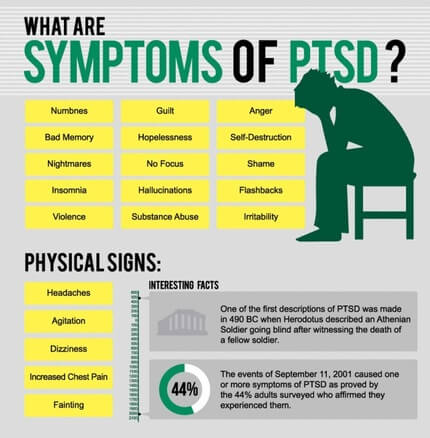
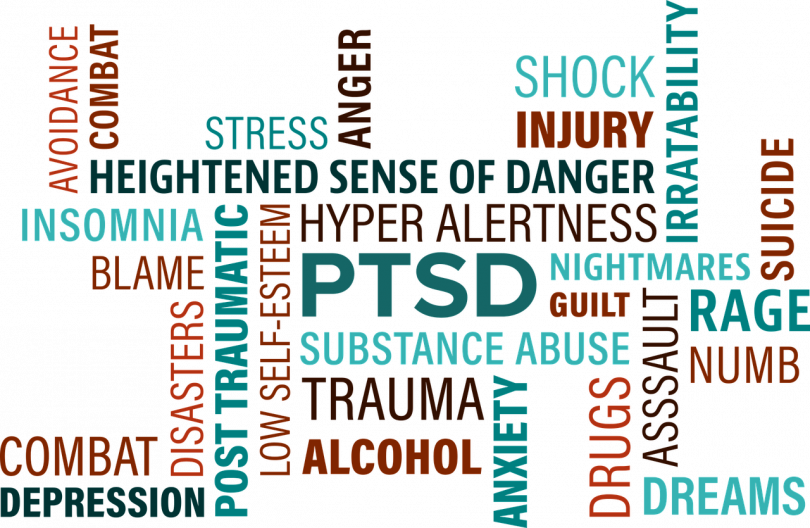
    Post-traumatic stress disorder, so-called PTSD, is a psychiatric disorder that can occur in people who have experienced or endeavored a traumatic event. Commonly we heard many violent tragedies happened because of the criminals’ former unpleasant experiences, for example, rape or any personal assault.

    The pathological environment of abuse fosters the development of a post-traumatic disorder. Past experience of abuse, especially in childhood, appears to be a major factor of becoming a psychiatric patient. Those survivors came back to normal life with a large number and variety of complaints. Bryer, studying psychiatric disorder, reported that women with historical physical abuse have significantly higher scores of depressions, stress, sensitivity, etc. (Bryer, 1987) Moreover, Briere reported that survivors of childhood abuse suffer significantly more in insomnia, drug addiction, alcoholism and so on. (Briere, 1988) Herman concluded that the symptoms can be categorized into somatic, dissociative and affective sequelae of prolonged trauma. (Herman, 1922)

    https://www.betterhelp.com/advice/ptsd/possible-signs-of-ptsd-why-do-i-avoid/

    For PTSD treatment, the very first step is to access personal symptoms. The psychometric properties of the PTSD checklist (PCL), a brief and self-reported instrument, were on research based on 40 motorcycle accident victims and sexual assault victims. All the participants need to complete the PCL and take the interview as feedback. For the PCL the PTSD symptoms are evaluated on a scale indicating how much had the respondents been bothered by a particular symptom from 1 to 5. The results supported the value of PCL as an accessing device for the possible presence of PTSD. (Blanchard, 1996)

    https://www.verywellmind.com/thmb/SbtJky-uv56Z2DdkNtlgtdPAknE=/1500×0/filters:no_upscale():max_bytes(150000):strip_icc():format(webp)/ptsd-treatment-2797659_FINAL-5c12be374cedfd00010f866a.png

    Prolonged exposure is an effective treatment for post-traumatic stress disorder, no matter what type of trauma the patients endeavored. The PE therapy includes four main components: psychoeducation, in vivo exposure, imaginal exposure and emotional processing. (Rauch, 2012) Psychoeducation focuses on the PTSD symptoms and the former experience. Confronting trauma-related memories can actually reduce post-traumatic disorder. In vivo exposure means confronting trauma-related environment, including people and places as a reminder. Then during imaginal exposure, patients will go through the memory with all the thoughts, emotions and trauma he or she experienced. Finally, emotional processing includes the therapist moving through an open-ended discussion of trauma and thoughts, comparing with the past.

    To be honest, PTSD happens to everyone, from small effect to tremendous causes. Some aspersion can make me self-abased, especially trauma in childhood. While facing those symptoms, just be confident and optimistic to access the level, and take a trauma-related prolonged exposure. It is a golden therapy.


    Bryer, J. B., Nelson. B. A., Miller, J. B., and Krol. P. A. (1987). Childhood sexual and physical abuse as factors in adult psychiatric illness. Am. 1. Psychiafry 144: 1426-1430.

    Briere, J. (1988). Long-term clinical correlates of childhood sexual victimization. AnnaL New York Acad Sci 528: 327-334.

    Herman, J. L. (1992). Complex PTSD: A syndrome in survivors of prolonged and repeated trauma. Journal of traumatic stress, 5(3), 377-391.

    Blanchard, E. B., Jones-Alexander, J., Buckley, T. C., & Forneris, C. A. (1996). Psychometric properties of the PTSD Checklist (PCL). Behaviour research and therapy, 34(8), 669-673.

    Rauch, S. A., Eftekhari, A., & Ruzek, J. I. (2012). Review of exposure therapy: a gold standard for PTSD treatment. Journal of rehabilitation research and development, 49(5), 679-688.

  • Detect True Feelings

    Detect True Feelings

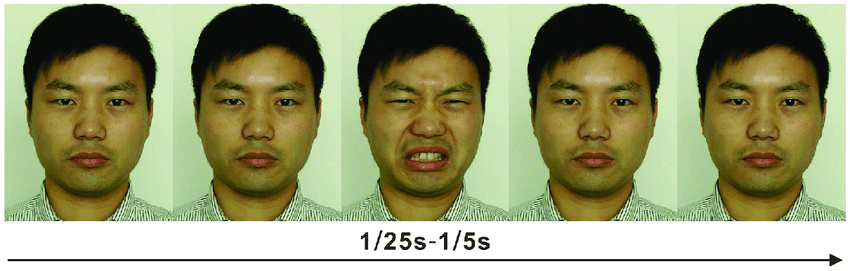
    After watching the drama series, ‘Lie to Me’, I got curious about facial micro-expressions. Facial micro-expressions are rapidly involuntary facial expressions which reveal disguised feelings. They can be significant for understanding humans’ deceitful behaviors.

    Micro-expressions were first found by Haggard and Issacs in 1966. (Haggard, 1966) They examined the video taken of a patient, who lied to her doctor to conceal her plan to commit suicide. She pretended to be happy in the video but indeed, when cautiously checking frame by frame, they detected a concealed facial look of anguish within 1/12 second. Generally, these so-called micro-expressions happen rapidly (1/3 to 1/25 second) so that researchers need to examine the process extremely carefully. (Ekman, 2003)

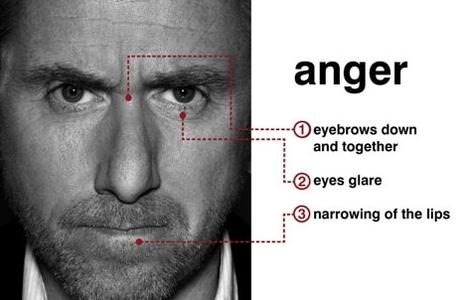
    In analyzing facial expressions, the main focus is basically to detect the six basic emotions and hence to provide facial expression unit being labeled. Different people have their own unique facial expression for each emotion. As a result, researchers have been asked to first give ordinary questions about testers’ daily life to get a baseline of different emotions (not limited to six basic emotions). (Pfister, 2011) For instance, in research done at the University of Oxford, they asked a participant about his attitude toward the murderer and he appeared to be angry since his eyebrows got down and together and his eyes glared.

    micro-expression of anger

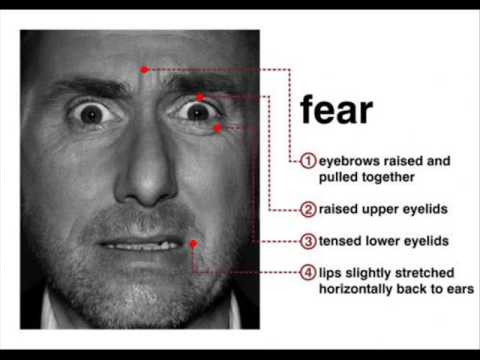
    Then changing to the question about cheating, he gave that similar facial expression as feedback. Researchers concluded that they can superficially assess that the participant never been engaged in cheating before since he should return a facial reaction of fear if he did so. (Li 2013)

    micro-expression of fear

    Compared with previously gathered micro-expression criteria, experts can better decide if the participant deceived or not.

    The field of micro-expressions is interesting in psychological research. Experts can get clues about whether someone has committed a crime. Moreover, police can quickly figure out whether the suspects deceive or not. Detecting true feelings can make life much easier.

    Pfister, T., Li, X., Zhao, G., & Pietikäinen, M. (2011, November). Recognising spontaneous facial micro-expressions. 2011 international conference on computer vision (pp. 1449-1456). IEEE.

    Haggard and K. Isaacs, “Micromomentary facial expressions as indicators of ego mechanisms in psychotherapy,” Methods of research in psychotherapy. New York: Appleton-Century-Crofts, pp. 154–165, 1966

    Ekman, P. (2003). Darwin, deception, and facial expression. Annals of the New York Academy of Sciences, 1000(1), 205-221.

    Li, X., Pfister, T., Huang, X., Zhao, G., & Pietikäinen, M. (2013, April). A spontaneous micro-expression database: Inducement, collection and baseline. In 2013 10th IEEE International Conference and Workshops on Automatic Face and Gesture Recognition (FG) (pp. 1-6). IEEE.

  • Stephen Hawking Tribute Comic Review

    Stephen Hawking Tribute Comic Review

    “Tribute: Stephen Hawking” by Michael Lent and Brian McCarthy with art by Zach Bassett and published by Tidalwave Productions, released 2019.


    I confess: I never really paid attention to Stephen Hawking. I knew who he was: a popular scientist and a man with ALS. He would appear on TV shows I watched in some form or another, so I recognized him. I didn’t think his area of expertise was anything that interested me, so reading this comic was rather eye opening. I didn’t think his area of expertise was anything that interested me, so I was surprised by everything I learned when reading  “Tribute: Stephen Hawking.”


    Stephen Hawking was obviously intelligent, and probably got “needs to apply himself more” written on his report card more than once. In school, he was funny, had a lackadaisical attitude towards studying, and an apparent lack of respect for authority. Stephen Hawking, sports team, and opera goer were never phrases I connected in my mind, but there it was in ink on paper, right in between discussions of his science, his disability, and his belief in aliens.


    The art of the comic is fantastic. I loved some of the more symbolic artistic choices. In one scene, Hawking argued with a professor and the artist set up the confrontation as a wild west shoot out. The references to both popular and classic art– Professor Xavier from X-men and The Creation of Adam, respectively– just highlighted how well rounded and influential an individual Hawking was.


    I wasn’t very affected when Stephen Hawking died. Plenty of people were, and I know a few of them personally. Still, this comic impressed me with how much content there was for the avid fan and layman alike.


    You can read more about the comic by clicking the link here.