
Category: today i learned (til)

health, fitness, medicine, environment, ecology, how to learn tricky topics in science and math, new discoveries, news, current events

  • The science and history of the PB&J sandwich

    The science and history of the PB&J sandwich

    The PB&J sandwich is a humble combination of sweet, salty, and creamy. Where exactly did this classic sandwich originate, and what are the details behind its nutritional value?

    Before the invention of the PB&J, its three essential ingredients had to be born, beginning with the peanut butter. In 1895, Dr. John Harvey Kellogg patented a process for creating peanut butter, and marketed it as a protein-rich source for patients who couldn’t chew solid food very well. In 1903, Dr. Ambrose Straub patented a peanut-butter-making machine. Peanut butter made its debut at the 1904 St. Louis World Fair, where its popularity skyrocketed [1, 2]. 

    Peanut butter was considered a delicacy during this time, and the first PB&J sandwich recipe was published by Julia Davis Chandler in the Boston Cooking School Magazine of Culinary Science and Domestic Economics. However, this recipe was intended to be served as delicate finger sandwiches at parties and in tea rooms [2, 3].

    Next comes the jelly. Marmalade and jam had been around for a long time, but the familiar purple jelly component of the PB&J was created when Paul Welch patented a method for pureeing grapes into jelly in 1917, naming it Grapelade [2].

    The final piece of the puzzle: sliced bread. The bread slicer was invented in 1928 by Otto Frederick Rohwedder. The availability of pre-sliced bread and the commercialization of the peanut butter industry increased the accessibility of the PB&J ingredients and popularized the sandwich across the nation [2, 3].

    Now that we know its origin story, let’s move on to the science of the PB&J. The nutritional breakdown: a typical PB&J has 15 grams of protein, 13 grams of fat, and 12.5 grams of sugar [4]. While a lot of sugar is never a good idea, for an active individual it can provide a needed burst of energy, and the combination with protein and fat ensures one feels full and satisfied. 

    According to a 2021 study from the University of Michigan School of Public Health, eating a PB&J can add up to 33 minutes to your life span [5]. This study assigned a health nutritional index that measured the health effects from the consumption of over 5,800 different foods, quantifying the results in minutes of healthy life gained or lost. The authors mention that this apparent health benefit of the PB&J is driven by the nut content of the sandwich, which is the source of the protein and fat. Therefore, while the PB&J is not a superfood, it is a much better option than some other processed foods, like hot dogs, which scored notoriously low during the study.

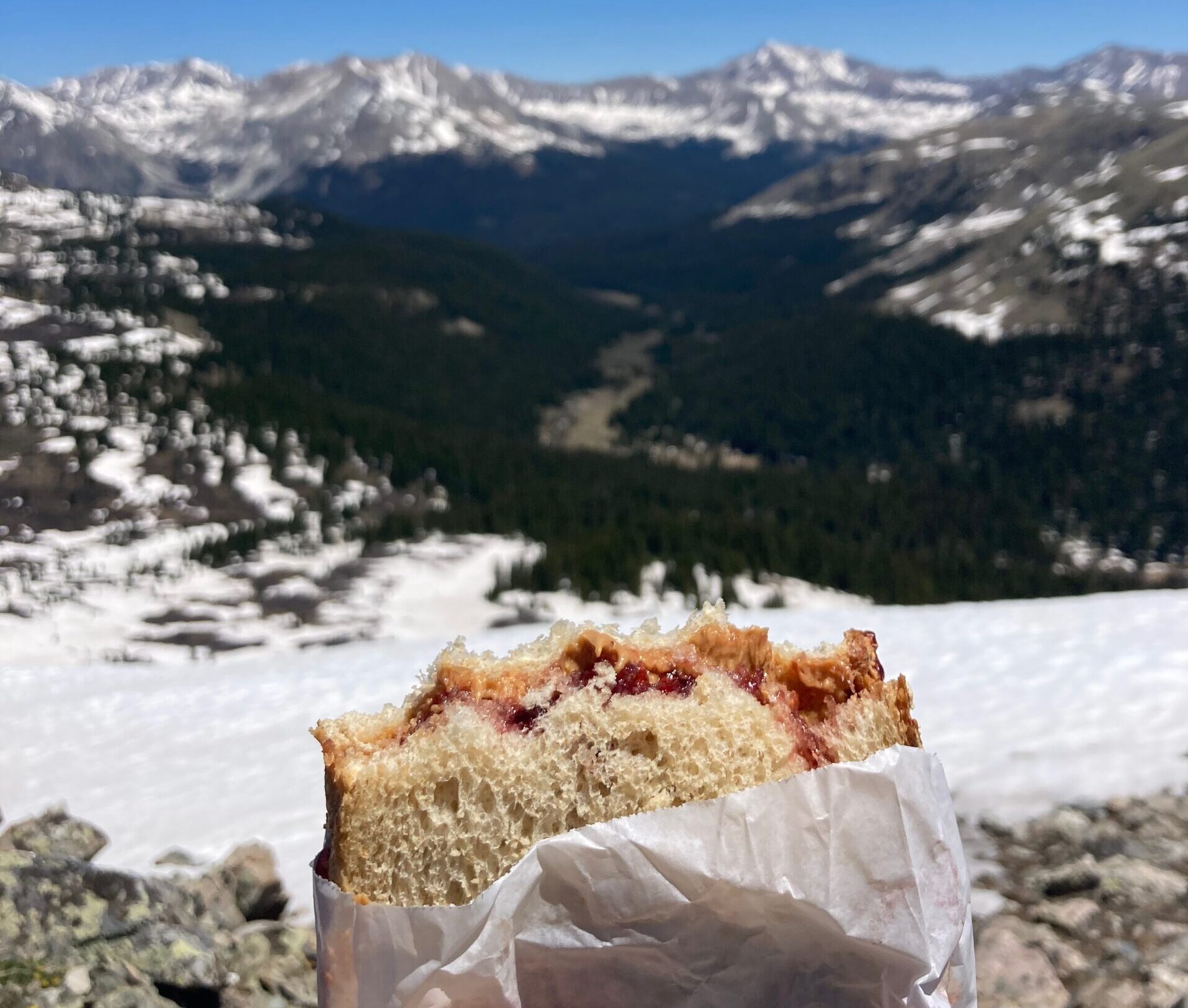
    I can personally attest to the PB&J’s standing as great adventure fuel (all of the photos in this article are from the variety of lunchtime views I’ve shared with a PB&J). It is my go-to for hiking and backpacking trips for a number of reasons: it’s affordable, portable, and customizable. Purchasing the ingredients won’t break the bank, and it doesn’t need to be refrigerated (honestly, I think PB&Js taste even better when they’re a little bit squished…). Additionally, PB&J customization is endless. I personally like to toast the bread or add a layer of plain potato chips to up the crunch factor, but one can also make changes to boost health benefits. Using whole-grain bread, swapping jelly for real fruit slices (banana is particularly delicious), or using natural nut butter are all ways to make the PB&J a little bit healthier.

    Now you know a little bit about the history and science behind a PB&J sandwich, as well as ways to customize it to make it healthier or even more delicious. 


    References

    [1] National Peanut Board. (2023). Who invented peanut butter? Retrieved from https://nationalpeanutboard.org/news/who-invented-peanut-butter/

    [2] National Peanut Board. (2023). Who invented the peanut butter and jelly sandwich? Retrieved from https://nationalpeanutboard.org/news/who-invented-the-peanut-butter-and-jelly-sandwich/

    [3] Dean, S. (2013). History of the PB&J, from spa food to school lunch. Retrieved from https://www.bonappetit.com/entertaining-style/trends-news/article/history-of-the-pbj

    [4] National Peanut Board. (2023). 5 reasons PB&J is the best sandwich ever. Retrieved from https://nationalpeanutboard.org/news/5-reasons-pbj-is-best-sandwich-ever/#:~:text=A%20PB%26J%20has%2015%20grams,of%20energy%20that%20athletes%20need.

    [5] Stylianou, K. S., V. L. Fulgoni III, and O. Jolliet. (2021). Small targeted dietary changes can yield substantial gains for human health and the environment. Nature Food, 2, 616-627.


  • Matcha Magic

    Matcha Magic

    What is matcha? 

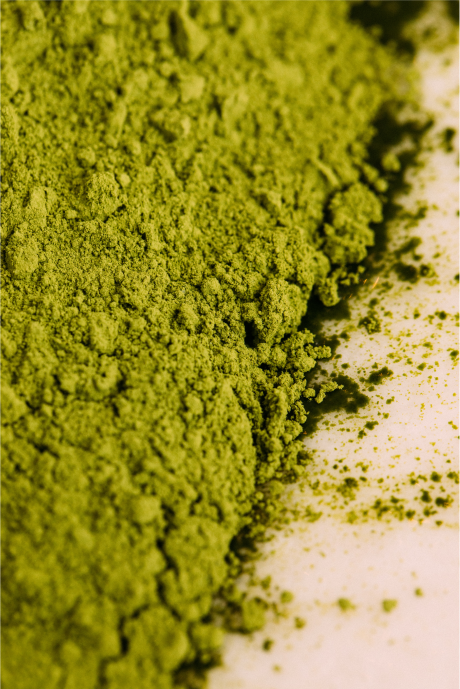
    Matcha is high-grade green tea grounded into powdered form. It comes from the leaves of the Camellia sinensis plant.

    Compared to other teas, matcha is a little quirky, due to the fact that it is shade grown, then steamed or stone ground.

    Shade grown means that it is made from shade-grown tea leaves where tea bushes are proteced from sun and light is filtered in a controlled manor. Shading boosts chlorophyll production, which gives the leaves a richer green color. The lack of sun reduces the plant’s photosynthesis of the leaves, which alters the naturally occurring levels of caffeine, flavanols, sugars, antioxidants, and theanine.

    The leaves are then treated with steam heat within to halt the oxidation process and bring out the color even more. Doing this creates a unique flavor profile of sweet and vegetal.

    Matcha can also be stone ground; this is when the leaves are laid flat to dry and become tencha (leaves from which matcha is made). The tencha leaves are stripped of their stems and venins with the remaining ground in slow-turning mills to yield a smooth green tea powder.

    How do you make matcha?

    To make a delicious matcha drink, whisk the powder into hot water to form a frothy drink. Whisking promotes aeration, allowing the matcha powder and water to mix with air to give it a thick head of foam on top. The matcha can be a tea, latte, or even a smoothie!

    Does matcha have caffeine?

    Yes, matcha does have cafeeine! It has less caffeine than brewed coffee, but more than green tea. The tea leaves retain more of their caffeine content. Consuming matcha means you’re consuming the ground tea leaf, which means you’re ingesting more caffeine content than youw ould from the extraction of tea leaves.

    What’s the difference between Green Tea and Matcha?

    Green tea uses brewed tea leaves with a light, grassy flavor. Matcha, on the other hand, is the pulverized version of green tea leaves. It has a stronger concentration of some key nutrients and antioxidants.

    References

    • https://www.teatulia.com/tea-varieties-101/what-is-matcha.html 
    • https://www.medicalnewstoday.com/articles/matcha-vs-green-tea#summary
    • https://www.sugimotousa.com/blog/how-to-whisk-matcha#:~:text=to%20Enjoy%20Matcha-,Why%20Whisk%20Matcha%3F,head%20of%20foam%20on%20top.


  • Cracking the Code: The Towers of Hanoi

    Cracking the Code: The Towers of Hanoi

    Now that we have developed a fundamental understanding of how different counting systems, especially binary, work, we can begin to understand the optimal solution to the Towers of Hanoi.

    One by One 

    Because binary digits are restricted to just one of two values, counting in binary has a particularly interesting rhythm. Understanding this rhythm is crucial in solving the Towers of Hanoi problem. This online binary counter is particularly useful in visualizing this rhythm. Beginning from zero, continue to count up, adding one with each step. Keep track of the index of the value that switches to a 1 at each step:

    0, 1, 0, 2, 0, 1, 0, 3, 0, 1, 0, 2, 0, 1, 0, 4, …

    Solution to the Towers of Hanoi

    Interestingly enough, the most optimal solution to the Towers of Hanoi comes from following this rhythm exactly. To tie the two together, first assign numeric indices to the disks: 0 is the smallest, 1 the next smallest, and so on. Then, simply follow the pattern, at each step moving the disk whose index matches the next number in the sequence.

    For example, consider the 3 disk problem:

    • 0: move disk 0 to the right peg
    • 1: move disk 1 to the middle peg
    • 0: move disk 0 to the middle peg
    • 2: move disk 2 to the right peg
    • 0: move disk 0 to the left peg
    • 1: move disk 1 to the right peg
    • 0: move disk 0 to the right peg

    And then we are done! There are some beautiful symmetries to this pattern. Also interesting is the fact that, for a setup with n disks, the optimal solution requires exactly 2^n – 1 moves.

    Why Does This Work?

    In so few words: recursion! Both the rhythm of binary counting and the problem of the Towers of Hanoi are self-similar problems. The idea of self-similarity ties directly into recursion: the full process, whether that’s counting up to a certain number or solving a problem with a certain number of disks, involves completing a smaller version of the process.

    In the Towers of Hanoi, consider again the 3 disk problem. If we were somehow able to move the stack of the 2 smallest disks as a single unit, then the problem would reduce to three steps:

    1. Move the 2-disk unit off of the third disk
    2. Move the third desk to the right peg
    3. More the 2-disk unit onto the third disk

    So, through a recursive approach, the problem becomes much simpler to solve.

    In the process of binary counting, return to the counter visualizer. Count up to the number 7 (111 in binary). Notice that we count up to the number 3 (11 in binary), roll over to 4 (100 in binary), and then count up three more to get to 7 (111). This exactly mirrors the recursive pattern in the Towers of Hanoi!

    Conclusion

    Oftentimes in mathematics, and in problem solving in general, finding an inventive way to connect and reduce one problem to another can make understanding optimal solutions much easier. The Towers of Hanoi, though it may appear as a confusing game at first, cleanly works in parallel to just counting up by one in binary. 

    References

    1. https://www.khanacademy.org/computing/computer-science/algorithms/towers-of-hanoi/a/towers-of-hanoi
    2. https://www.mathsisfun.com/games/towerofhanoi.html
    3. https://www.youtube.com/watch?v=2SUvWfNJSsM
  • Cracking the Code: Binary Basics

    Cracking the Code: Binary Basics

    The Towers of Hanoi

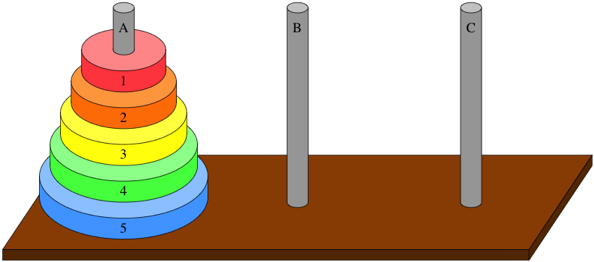
    A set of colorful, cascading disks stacked on a peg. What could easily double as a child’s toy also serves as an ancient mathematical puzzle, the Towers of Hanoi. Often used to teach recursive problem solving strategies, the puzzle poses a simple challenge—to move the stack of disks from the leftmost peg to the rightmost peg one disk at a time with one restriction: a disk cannot be placed on top of a smaller disk.

    Take a moment to familiarize yourself with the puzzle by playing around with this online version. Setting the number of disks to 3 is a great place to start.

    It may be surprising that, no matter how many disks there are, this problem is always solvable with just three pegs. Even more surprising, the optimal solution for any number of disks (the solution that requires the fewest number of moves) directly mirrors the rhythm of counting in binary.

    Before diving into this optimal solution (in a later article), this article focuses on understanding what counting in binary looks like and explores the nature of different number systems.

    Base-10

    The number system we most commonly use involves counting in base-10, a natural choice given the number of fingers we have on our hands. Consider the number 104 for example. Let’s index the digits from right to left, beginning with zero:

    • the value at index 0 is 4,
    • the value at index 1 is 0,
    • and the value at index 2 is 1.

    Because we are working in base-10, there are 10 possible values for each digit (0, 1, 2, 3, 4, 5, 6, 7, 8, or 9) and each index represents a consecutively larger power of 10 corresponding to its index. The number 104 can be expressed as the sum of powers of 10 as follows:

    • 10^0 * 4 (or 4 ones)
    • 10^1 * 0  (or 0 tens)
    • 10^2 * 1 (or 1 hundred).

    Base-2

    Let’s now consider how this same value would be written in a different base: base-2, or binary. The binary system has only 2 possible values for each digit (0 or 1) and is most useful in the field of computer science as it is easy to consider an electrical component as having one of two possible states (on or off). In the binary representation of a number, each index represents a consecutively larger power of 2 corresponding to its index.

    After some calculation, we can express 104 as the sum of powers of 2 as follows:

    • 2^0 * 0 (or 0 ones)
    • 2^1 * 0 (or 0 twos)
    • 2^2 * 0 (or 0 fours)
    • 2^3 * 1 (or 1 eight)
    • 2^4 * 0 (or 0 sixteens)
    • 2^5 * 1 (or 1 thirty-two)
    • 2^6 * 1 (or 1 sixty-four)

    Thus, the binary representation of 104 is 1101000.

    Converting Between Bases

    To round out this introduction to different counting systems, let’s actually go through the process of converting a value from one base to another.

    Consider the base-10 value 2643. Although base-10 is standard, it is good practice to break apart the digits and understand how this value is written. From right to left, we have:

    • 10^0 * 3 (or 3 ones)
    • 10^1 * 4 (or 4 tens)
    • 10^2 * 6 (or 6 hundreds)
    • 10^3 * 2 (or 2 thousands)

    Now we will determine how to express 2643 in base-8 by recursively answering the same question:

    • What is the largest power of 8 less than or equal to 2643?
      • The answer is 8^3 = 512, and we can fit five 512s into 2643 with 83 left over. 
    • What is the largest power of 8 less than or equal to 83?
      • The answer is 8^2 = 64, and we can fit one 64 into 83 with 19 left over. 
    • What is the largest power of 8 less than or equal to 9?
      • The answer is 8^1 = 9, and we can fit two 8s into 19 with 3 left over. 
    • What is the largest power of 8 less than or equal to 1?
      • The answer is 8^0 = 1, and we can fit three 1s into 3 with 0 left over. 

    Putting it all together, from right to left, we have:

    • 8^0 * 3 (or 3 ones)
    • 8^1 * 2 (or 2 eights)
    • 8^2 * 1 (or 1 sixty-four)
    • 8^3 * 5 (or 5 five-hundred twelves)

    Thus, the base-8 representation of 2643 is 5123.

    The Value 10

    One interesting tidbit about working across different number systems is how different values are represented by 10. In any arbitrary base-n system, the value 10 can be read as:

    • n^0 * 0 (or 0 ones)
    • n^1 * 1 (or 1 n)

    Thus, in any base-n system, the value of 10 is exactly n. To get a bit existential, every number system is, to itself, base-10. 

    References

    1. https://www.khanacademy.org/computing/computer-science/algorithms/towers-of-hanoi/a/towers-of-hanoi
    2. https://www.mathsisfun.com/games/towerofhanoi.html
    3. https://www.youtube.com/watch?v=2SUvWfNJSsM
  • ‘Fun’nett Squares: Gene-tic-tacs Activity Booth

    ‘Fun’nett Squares: Gene-tic-tacs Activity Booth

    Recently, our project team ran an activity booth at a science-themed block party. The booth was a fun way to teach partygoers about the science behind genetics, phenotypes, and Punnett squares. Our team created an interactive activity that presented partygoers with three genetics-based puzzles at varying levels of difficulty. Because it was close to Halloween, we incorporated the use of candy into these puzzles, which served as an incentive for puzzle-solvers to challenge their scientific skills and learn something new.

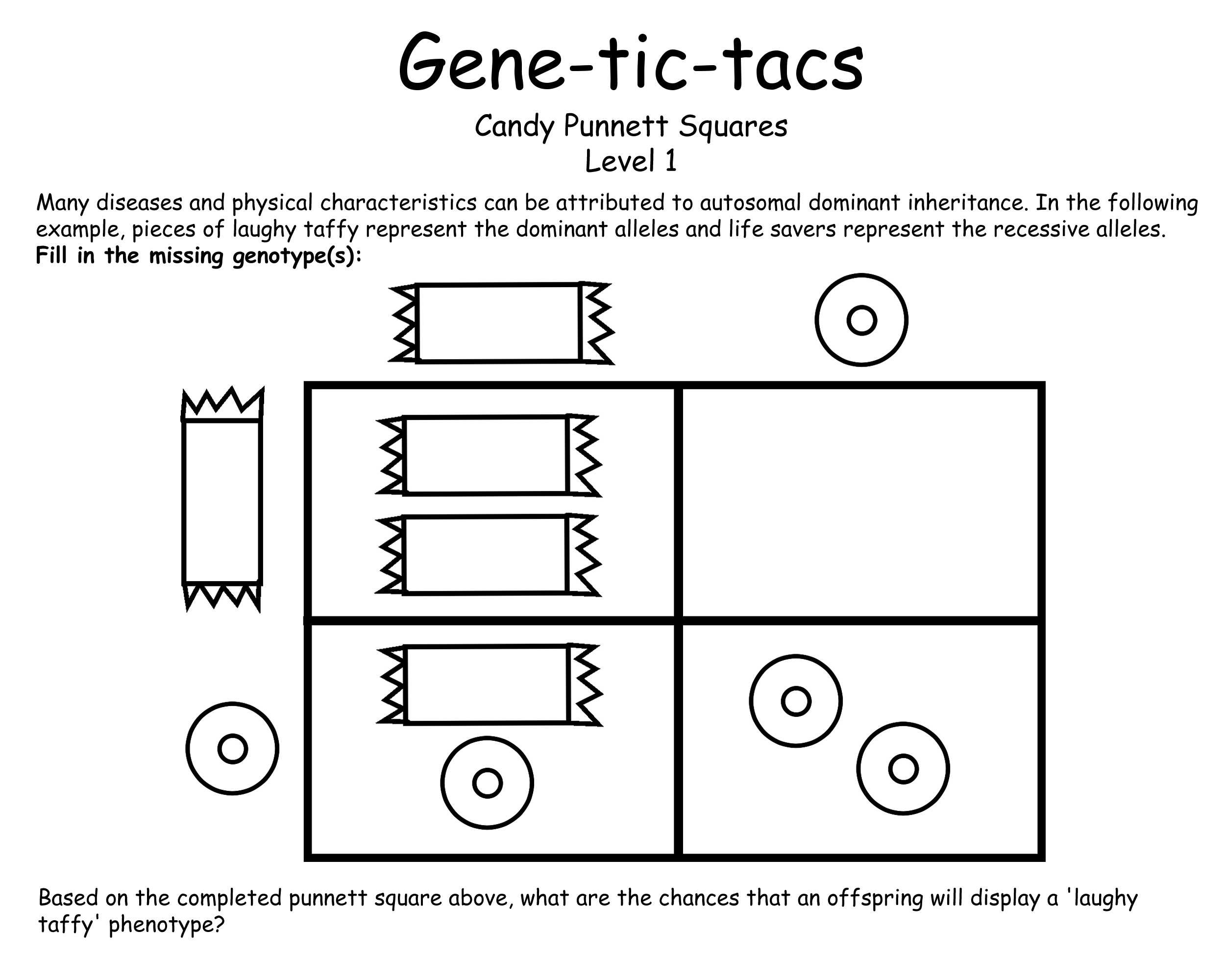
    The easiest puzzle involved crossing two parents with an identical genotype in a single-trait Punnett square. In this example, taffy was used to represent the dominant allele and hard candy was used to represent the recessive. Two piles of candy were provided to participants, who used the sweets to complete the missing square in the puzzle. Afterwards, we asked a question on the phenotypes of the resulting organisms to ensure conceptual understanding on the part of the participant. The puzzle is included below:

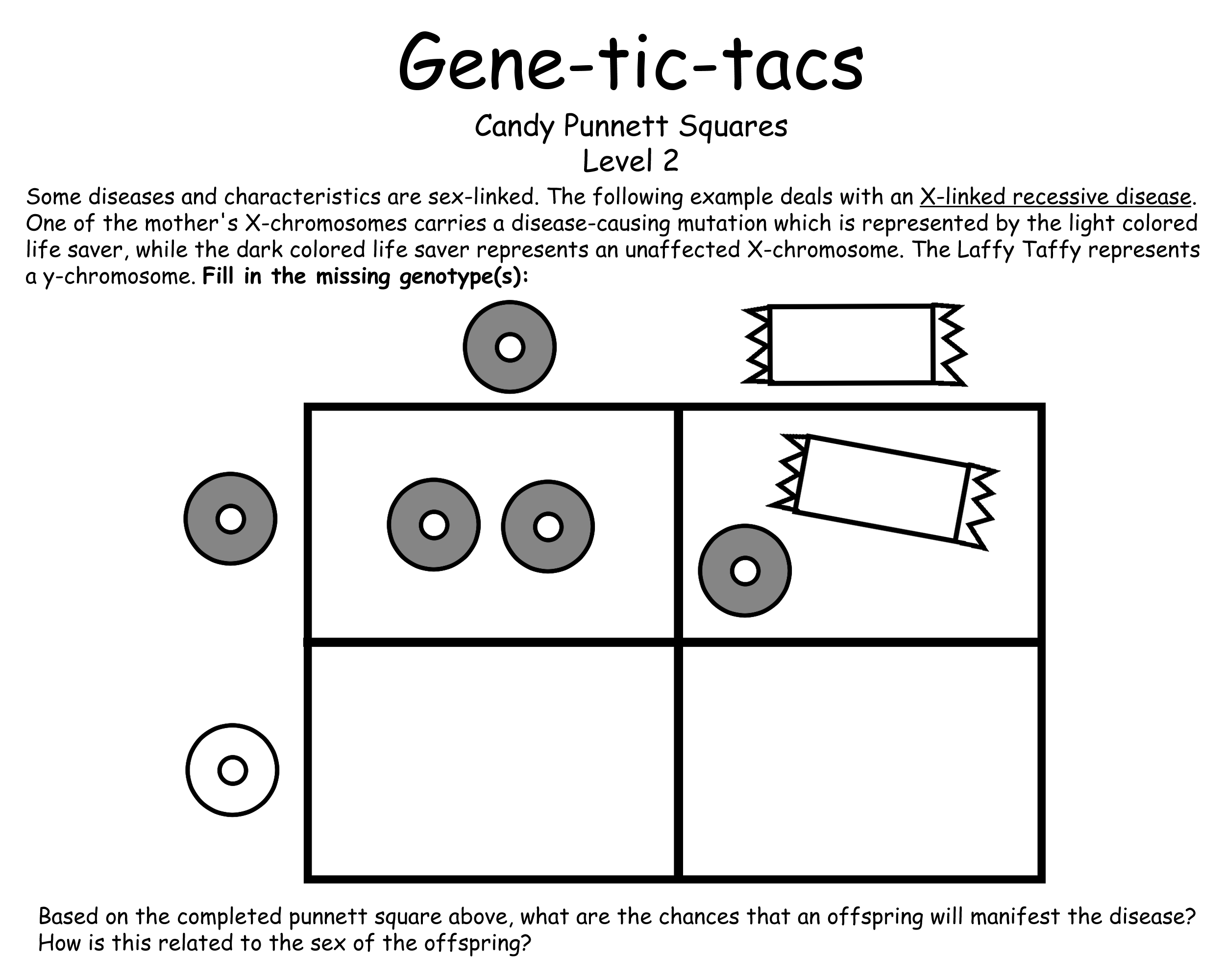
    The second puzzle involved the evaluation of a sex-linked trait. In this case, unaffected X-chromosomes were represented by dark colored hard candy while affected X-chromosomes were represented by light colored candy. Taffy was used to represent the Y-chromosome. Participants were now asked to fill in two separate squares using the corresponding candy chromosomes. Two questions regarding the outcome of such a genetic cross were then posed. This puzzle helped to teach participants about why some diseases and conditions are more prevalent in one sex. The puzzle is included here:

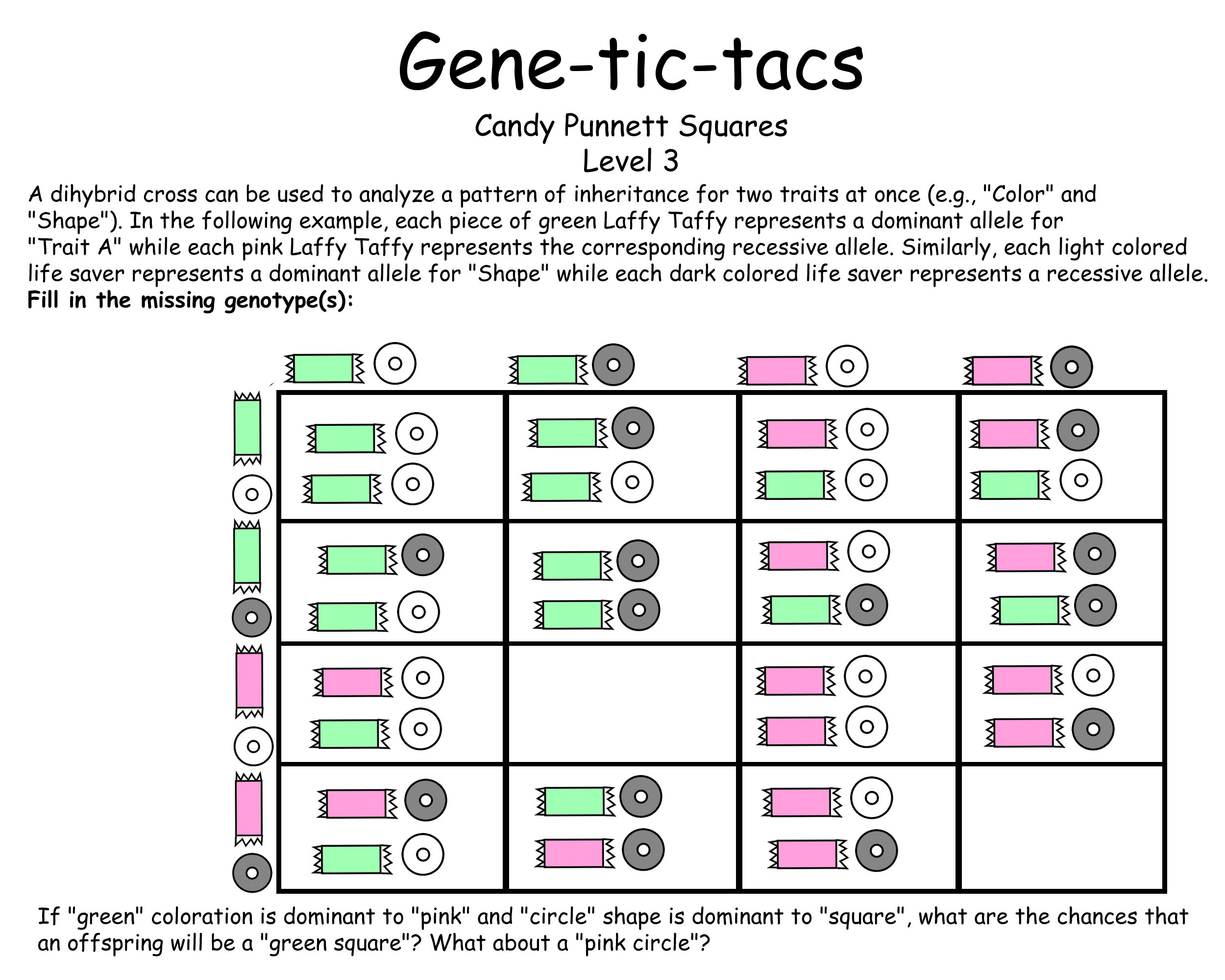
    Lastly, the third puzzle challenged participants with a dihybrid cross, which involved analyzing two distinct traits using one Punnett square. This example analyzed the traits ‘color’ and ‘shape’. It took on a similar format as previous puzzles, but its complex nature resulted in participants needing more assistance when solving it. This reflects the idea that we were successful in varying the difficulty of the problems. Here is the final puzzle:

    Overall, this serves as a fun activity that helps partygoers to engage with some of the scientific concepts behind genetics. When we used them, these puzzles sparked conversations and inspired scientific interest in participants. This is a great activity to try if you’re doing a science-themed event, and it’s fun for kids and adults!

  • Kidneys: The Innocent Bystanders

    Kidneys: The Innocent Bystanders

    When we purchase over-the-counter medicines, there’s often an assumption of their relative safety and harmlessness. After all, most ‘dangerous’ compounds are protected behind a prescription, right? Surely, if the directions on the back of the box or bottle are followed, no long-term health risks are possible, right?

    Unfortunately, this is often not the case. Long term use of NSAIDs — a class of common anti-inflammatory drugs including aspirin and ibuprofen — is associated with an increased risk of acute kidney failure.[1] Previously healthy young people have developed kidney problems due to long-term NSAID use while being none the wiser; kidney injury thus represents a generally unknown side-effect of NSAID use. Indeed, this feeds into a much larger idea within the field of healthcare — the role of the kidney as an ‘innocent bystander’. Often, acute and even chronic kidney injury are iatrogenic — an unintended byproduct of treatments for other diseases or conditions. NSAIDs aren’t the only common treatment that can negatively impact kidney health; diuretics are associated with an increased risk of acute kidney injury and even surgical procedures like heart transplants have been linked to acute kidney failure.[2,3] The susceptibility of the kidneys to iatrogenic conditions is often attributed to the high rate of blood flow through them and the resulting increased exposure to potentially nephrotoxic drugs.[4] After all, the kidneys are the blood filtration system meant to remove waste from the body; it makes sense that the drugs that enter the bloodstream and are filtered out may put a strain on the kidneys. Not just treatments, but even diagnostic techniques can have an adverse effect on the kidneys. The iodinated contrast drugs often used in diagnostic imaging have also been linked to acute kidney injury, with few suitable alternatives available.[5]

    With all these harmful pitfalls, preserving kidney health may seem like an impossibility when tackling complex conditions and comorbidities. However, awareness is a crucial first step towards improving patient outcomes. The kidneys are often put on the back burner when managing other conditions; physicians may prescribe NSAIDs, diuretics, and similar drugs that harm the kidneys over time while treating other conditions, or order diagnostic imaging that utilizes contrast fluid that puts a strain on the kidneys. On their own, these small actions may not have a significant effect, but it’s critical to be mindful of how treatments and conditions may intersect to cause renal dysfunction. By spreading awareness of the susceptibility of the kidneys to damage in these ways, individuals at higher risk for developing renal issues may be mindful about their use of certain over-the-counter medications and can develop a better toolkit with which to advocate for themselves.

    References:

    1 Dixit, M., Doan, T., Kirschner, R., & Dixit, N. (2010). Significant Acute Kidney Injury Due to Non-steroidal Anti-inflammatory Drugs: Inpatient Setting. Pharmaceuticals (Basel, Switzerland), 3(4), 1279–1285. https://doi.org/10.3390/ph3041279

    2 Ejaz AA, Mohandas R. Are diuretics harmful in the management of acute kidney injury? Curr Opin Nephrol Hypertens. 2014 Mar;23(2):155-60. doi: 10.1097/01.mnh.0000441150.17202.be. PMID: 24389731.

    3 F. J. Romeo et al., Acute Kidney Injury After Cardiac Transplantation: Foe or Common Innocent Bystander? Transplantation Proceedings 50, 1489-1495 (2018).

    4 Davidman M, Olson P, Kohen J, Leither T, Kjellstrand C. latrogenic Renal Disease. Arch Intern Med. 1991;151(9):1809–1812. doi:10.1001/archinte.1991.00400090095017

    5 Andreucci, M., Faga, T., Serra, R., De Sarro, G., & Michael, A. (2017). Update on the renal toxicity of iodinated contrast drugs used in clinical medicine. Drug, healthcare and patient safety, 9, 25–37. https://doi.org/10.2147/DHPS.S122207

  • Atomic Bombs and Nuclear Chain Reactions: Are We Doomed?

    Atomic Bombs and Nuclear Chain Reactions: Are We Doomed?

    “I am become death, the destroyer of worlds.” The fear of the atomic bomb was felt not only by the citizens who feared enduring its wrath but also by the inventor himself, Robert J. Oppenheimer. With its debut in his 1965 interview, the quote reflects not only the fear of the wrong force holding the atomic bomb but also of the idea that the atomic bomb could set off a sudden atmospheric chain reaction, causing the earth itself to incinerate. This fear is also portrayed in the recent film “Oppenheimer,” which is based on the life story of Robert J. Oppenheimer before, during, and after the Manhattan Project. In the movie, there is an especially memorable scene in which the portrayal of theoretical physicist Edward Teller claims that there is a 3 in one million chance that the world could be incinerated via the ignition of the nitrogen in the atmosphere and oceans. After this tense moment and the initial hesitation of continuing with the Trinity test, the probability is never mentioned again. So was Teller right? Do we still face the slight probability of atmospheric incineration? Thankfully, after further calculation, it’s been determined that this method of mass extinction is not a matter of slim probability; it’s an impossibility.

    Post Trinity test, a declassified 1946 Manhattan Report dives into detail proving the impossibility of a thermonuclear reaction caused by an atomic bomb of the size they were dealing with. The report analyzes atmospheric nitrogen as the subject of ignition due to the instability of its nuclei, the reactions of which yield much more energy in the form of gamma rays. On the basis that there is an ignition point of the atmosphere (10 MeV temperature), the high reactivity would need to surpass that point such that “…the thermonuclear reaction may be propagated to all parts of the atmosphere” (Konopinski et al, 1946), setting off a chain reaction. Despite the energy release via nitrogen reactions, the earth’s atmosphere is transparent to the radiation emitted by them: it cannot absorb or reemit these radiation frequencies. The energy instead escapes into other systems, causing the temperature to restabilize and fail to propagate further reactions. However, the best models of the time first considered the energy produced via the nitrogen reaction to go towards the establishment of the temperature required for atmospheric ignition. Using these more conservative models for the sake of establishing a broader safety net, the Stephan-Boltzmann law – which claims that the hotter an object is the faster it cools – affirms the impossibility of such atmospheric detonation. The size of the bomb they were dealing with would only have about 1% of the energy it released be absorbed as heat by the atmosphere. The rest would dissipate as light, kinetic energy, or escape into space (Konopinski et al, 1946). This ultimately renders a nuclear chain reaction impossible; exponentially more fission material is needed to reach atmospheric ignition. For the technology at the time, there just simply was not enough bomb to generate the required energy.

    All science, however, is subject to change over time. This was the core argument of a contradictory article written almost 30 years after the initial Trinity tests and the publication of the 1946 report. The article reopens the previously debunked fallacy, arguing it’s not very possible that “…those who were instrumental in developing fusion devices (1948 to 1958) ever seriously considered the ultimate potential or the unexpected results of fusion explosions that were a 1,000 times as powerful as the fission device of 1945″ (Dudley, 1975). The current scope of today’s technology is beyond what would have been fathomed 80 years ago, including the ability to alter the rate of radioactive decay and half-lives, rendering the energy yield of fusion devices difficult to predict. This argument, however, is weak and extremely flawed as it is based on the idea of Murphy’s Law – that anything can go amiss – and maintains almost no mathematical basis. This short-sighted view and misconception was concisely rebuked less than a year later in a much more scientifically sound article. As in the 1946 report, the article looks into the unstable “…collision between two nuclei of N14 because N14 is a nucleus of relatively high energy content” (Bethe, 1976). The energy produced in the reaction that Bethe looks into (eq 1 below) surpasses the Coulomb barrier required for the reaction to occur with little difficulty and is the same process looked at by Konopinski et al.

    N14 + N14 = Mg24 + He4 + 17.7 MeV eq 1

    Unsurprisingly, Bethe comes up with similar results to those of Konopinski et al, finding that the energy produced by the reaction is only a minute fraction go the energy lost via physical processes such as the rapid dispersion of the energy in the form of radiation (which, as stated before, our atmosphere is transparent to), heating of the atomic nuclei, etc. The main principle is that “The air cannot be heated as hot as the weapon” (Bethe, 1976). For the atmosphere to ignite, the atomic bombs of modern scale would have to be of an entirely different design such that they could reach the required temperature for ignition; these temperatures are so high that it’s nearly impossible to create a bomb that possesses such qualities.

    The profound fear associated with the atomic bomb, articulated by Robert J. Oppenheimer’s chilling words, has left an indelible mark on history. This fear extended beyond the devastation it could unleash upon humanity to include the apprehension that it might trigger an unthinkable catastrophe—igniting the Earth’s atmosphere. The portrayal of this fear, as depicted in the recent film “Oppenheimer,” highlighted a pivotal moment when theoretical physicist Edward Teller suggested a slim probability of atmospheric incineration. However, this fear was ultimately disproved via rigorous scientific analysis and understanding. Including the contradiction of these calculations in the film would take away the tension from the generally uninformed audience. While technological advancements have been made since the early days of nuclear weapons development, the fundamental principles of physics governing these devices and the behavior of our atmosphere remain unchanged. We live to see another day without nuclear damnation.

    Sources:

    Bethe, H. A. “Ultimate catastrophe?” Bulletin of the Atomic Scientists, vol. 32, no. 6, 1976, pp. 36–37, https://doi.org/10.1080/00963402.1976.11455623.

    Dudley, H. C. “The Ultimate Catastrophe.” Bulletin of the Atomic Scientists, vol. 31, no. 9, 1975, pp. 21–24, https://doi.org/10.1080/00963402.1975.11458293.

    Teller, Edward, et al. 1946, Ignition of the Atmosphere With Nuclear Bombs.