Let me check in the back: how 3D printing will revolutionize future commerce

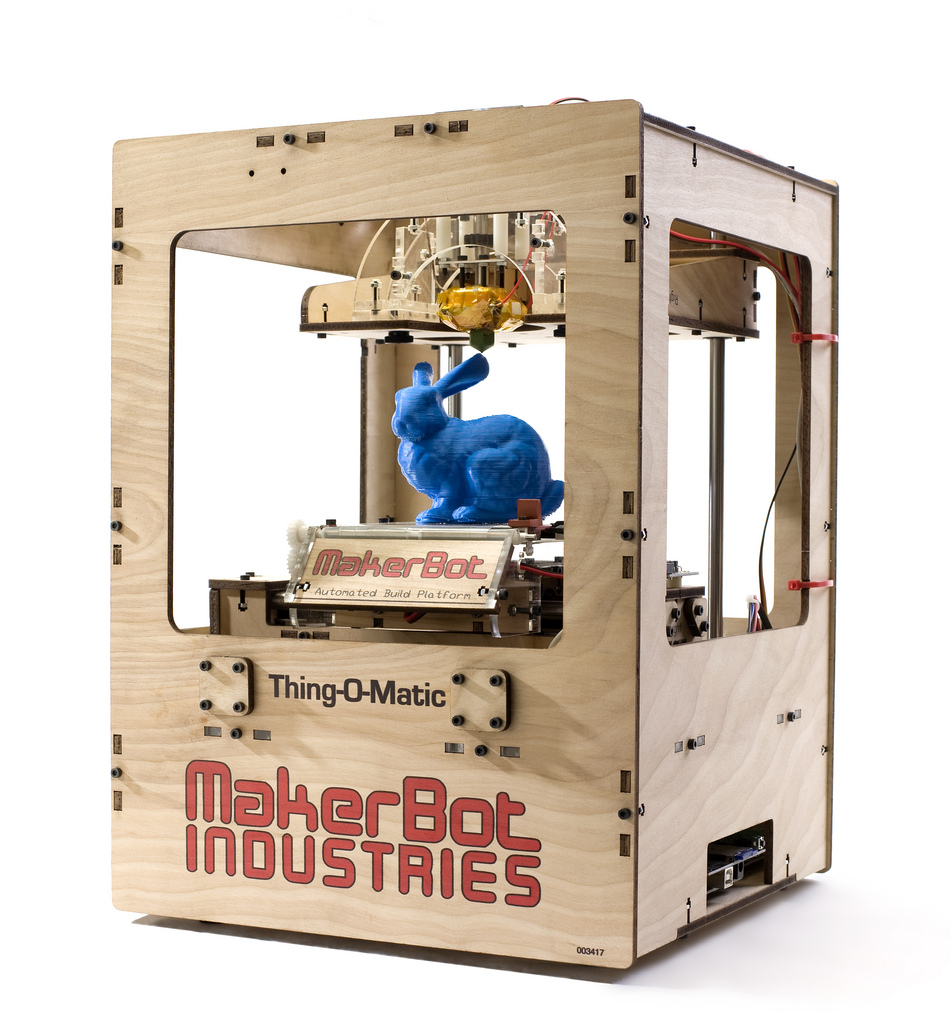
A commercially available, at home 3D printer from MakerBot Industries


Allow me to transport your mind for a moment. The year is 1999, being an “internet company” is still a viable business model, and Yahoo! makes hilarious commercials with the following premise: the internet will allow you to find and obtain anything you’ve ever wanted. Today, that’s kind of true. If I want to buy a product, hire a person with a specific skill set, or learn about a new topic, the internet is the first stop. I grew up in this era of instant gratification, at least with digital content, so to me, using the internet to obtain information is so common it’s mundane. Here in present day future land, an emerging technology known as “3D printing” is soon going to do for physical objects, even complex machines, what the internet did for the dissemination of digital information.

In a nutshell, 3D printing is a lot like regular printing… in three dimensions. If you accept the simplicity of a cop-out explanation, then you are well on your way to appreciating why 3D printing will be such a transformative technology. In a regular inkjet printer, paper is maneuvered in one dimension, say “X” on a coordinate plane, and a printing head moves in a second direction “Y”. The combined motion in X and Y allows for “two-dimensional” printing, but there is some minute third dimension even for these systems, as the deposited ink has a height on the page. With the addition of a third degree of freedom for movement into the “Z” direction, and replacing the ink with a substance that can be easily deposited and then frozen into place, this afterthought of a third dimension can be capitalized upon. With each successive pass in the XY directions the height grows in the Z direction. If the increments in the Z direction are small enough, even complex geometries can be made perfectly smooth.
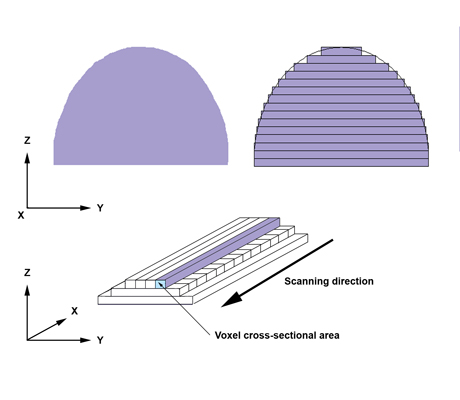
3D Printers make intricate shapes by depositing small amounts of material in successive layers

This is similar to a physical application of a “Riemann Sum” used for graphically approximating integrals in calculus. This level of precision and flexibility in manufacturing is what makes the possibilities for 3D printing so bizarrely unreal. Typically, if a material cannot be extruded, milled, pressed, or molded by machines the only option is handcrafting by skilled artisans. Think your grandmothers heirloom dining room table versus anything on sale at IKEA. Scale, my friends, is the difference.

3D printing has enjoyed niche applications in producing product prototypes and custom-ordered artistic pieces. There are a lot of variations on the general technique I have just described, but one thing is for sure – if 3D printing ever reaches a “break-even” point with conventional people-actually-making-stuff manufacturing, the concept of supply and demand economics, that universal truth applying to huge quantities of product, will lose its relevance. 3D printing would allow supply and demand to approach a 1 to 1 ratio – there would never be any imbalance between the two. No reason for a sales clerk to check in the supply room for the last lamp or chair or dining room set or pair of sneakers, because it could just be printed on the spot. Scientists 1: Businessmen 0.  Admittedly, that’s a bit farfetched, but it’s certainly true that with a technology like 3D printing readily available and fully optimized, the gulf between items that are built by the zillions and given away in Happy Meals and manufacturing-intensive high-cost products will shrink. Items would go from existing on a shelf to existing on a hard-drive, made-to-order perhaps even at the point of sale.

So what’s the catch? Sounds like a sweet deal! For a lot of creative, inventive people, it already is. Take MakerBot Industries for example – the creators of their namesake the MakerBot Thing-o-Matic shown at the top of this article, which is a bonafide do-it-at-home tabletop 3D printer. There is already a bustling community of users who submit their own CAD (computer-aided design) drawings to the Thingiverse for anyone to download and print on their own. Don’t have a 3D printer (or don’t want to spend $1749 for the MakerBot design)? No worries – you can even submit your designs to a third party 3D printer (pun intended) like i.materialise online, and they will print it for you. I uploaded a simple CAD design from Thingiverse to get an idea of pricing. I used a “hose clamp-pinch valve” with dimensions of about 1.5 inches wide and 3 inches long that came to a price of $15.50 (made of polyimide (AKA nylon), which is unfortunately not one of the plastics with a designated recycling code) and $336 to make the clamp out of brass if I was feeling fancy. For the plastic part at least, that is surprisingly affordable when compared to buying a single item of similar size and material at a home improvement store, which might run $5-$10. With prices like that I’ll have to forgive i.materialise for probably naming their company during a board room meeting at a Starbucks.

But what if I had uploaded a design I had not gotten from an open source development site like Thingiverse or designed myself? What if I downloaded it on a peer-to-peer network or even copied an existing physical object in a store? Is it the responsibility of the people running the 3D printer to analyze every possible design for copyright violations? Is it mine? Certainly it would not be illegal for me to make my own pair of jeans inspired by, even identical to, a pair of Levi’s® if I had the ability and didn’t sell them? What if I had printed out a pair of Nike® basketball shoes with a big “G” on the side and gave a pair to my buddies?

This, unfortunately, will likely be the Achilles heel for the 3D printing industry, and it is discussed in some detail by Michael Weinberg at Public Knowledge in his hilariously titled white paper on the subject –  “It Will Be Awesome if They Don’t Screw it Up: 3D Printing, Intellectual Property, and the Fight Over the Next Great Disruptive Technology”. They, I guess refers to “the man”, who has been known for previous violations of pointing his plastic finger at Jimi Hendrix and suing college kids for downloading albums in their dorm rooms. Or, say I used my own 3D printing machine to make assault rifles in the comfort of my own home. It’s been done folks, but unlimited capability is no reason to fear but rather to understand, plan ahead, and compromise.

Use your printers wisely.


Image sources:

http://en.wikipedia.org/wiki/File:Rapid_prototyping_slicing.jpg

http://www.flickr.com/photos/makerbot/5526691737/

Leave a comment

Your journey starts here! Let’s talk!

ThemeRex © 2026. All rights reserved.
  Timothy Durham was convicted of rape when a test showed his DNA genotype matched the DNA recovered from the crime scene. Eye witnesses testified that Durham was in a different state at the time of the incident, but he wasn’t exonerated from his 3000 year sentence until follow up DNA analysis showed that the preliminary forensic analysis used in the trial was misinterpreted (Thomas et al.). DNA testing serves an invaluable part in our criminal justice system, but it comes with complications and bias that can lead to wrongful convictions and misinformed juries.  

Background:

Forensic genetics aims to identify the origin of a biological sample. It can be traced back to Karl Landsteiner who discovered human ABO blood groups. With blood groups, suspects could be eliminated based on their blood type. For example, if a suspect had type A blood and there was type B blood left at the scene by the perpetrator, the investigators could rule out the suspect. Unfortunately, the reverse didn’t work. If the suspect and perpetrator both had the same blood type, it can’t be concluded that the suspect was guilty. Blood identifiers evolved into 8 distinct categories which improved the ability to eliminate suspects, but could only conclude that (if the system matched) it might be the perpetrator or this person might be related to the perpetrator (Jobling and Gill). The field evolved in the 1980s with the discovery of Minisatellites, lines of repetitive DNA that don’t encode proteins. Minisatellite patterns in DNA create what we know today as the DNA fingerprint, and it has a much higher accuracy rate than previous methods (Augustyn et al.). Around the same time, a breakthrough for victims of sexual assault was discovered. In the case of assault, bodily fluids of both the victim and the assaulter can get mixed. A process called differential lysis was created which could selectively increase the concentration of sperm in a fluid sample thereby allowing for accurate DNA testing (Jobling and Gill). Forensics evolved to use single-locus probe testing after several years because of its ease of interpretation. It looked at specific minisatellites that had high variability between subjects. This was the first DNA-based method to be used in a criminal investigation. Two murder homicides from several years apart were connected using DNA evidence. The evidence was then used to exonerate an innocent man, and the guilty party was found when he tried to evade mandatory DNA testing for all men in the small town. His guilt was then reinforced when the DNA profiles matched, and he gave a confession (Jobling and Gill). Finding DNA at a crime scene doesn’t guarantee that you’ll find a murderer. There are issues with non-pure samples and limited samples that make DNA work difficult, and accreditation of facilities and new techniques and take time (Jobling and Gill).  

Subjectivity of DNA Interpretation:

In a 2009 publication, the National Academy of Science discusses the possibility for subjective influence in lab based forensics. The interpretation bias happens in complex cases where, for example, there could be a mixture of DNA. A study published in 2011 looked specifically at this issue. A gang rape happened in Georgia, and the mixture in DNA from the case was used to prosecute one suspect after another suspect took a plea bargain to testify against him. With DNA mixtures, there are three possible conclusions: suspect excluded, suspect cannot be excluded, and inconclusive. If the suspect is excluded, it means that there’s little to no possibility that his DNA is part of the sample. If the suspect cannot be excluded, it means that there’s a possibility that his DNA is part of the sample. In the trial, the DNA examiners who knew the context of the case concluded that the suspect being prosecuted could not be excluded. The 2011 study gave the DNA evidence from this case and the DNA profiles of the suspects to 17 forensic examiners. These examiners had no context of the case, and they all worked independently. Of the 17, only 1 came to the same conclusion (suspect cannot be excluded) as the examiners who knew the context of the case. Twelve of the 17 concluded that the suspect who was prosecuted and convicted had no relation to the DNA found in the sample. Not only does this show that subjectivity occurs due to the context of the case, but the 17 examiners came up with different findings based on their past experiences meaning that not all DNA analysis is objective. Some organizations like the Scientific Working Group on DNA Analysis Methods say that quantitative statistical evidence should be presented with every categorical conclusion, but the US doesn’t require this (Dror and Hampikian).

False Positives:

There are two categories that cause wrongful identification in a DNA report: coincidental matches and false positives. Coincidental matches are DNA matches between two unrelated people. The probability of these matches is about 1 to 500,000 for white individuals and about 1 to 350,000 for black individuals. This small probability of coincidental matches makes people feel confident in DNA evidence. False positives, on the other hand, are matches between DNA and test DNA that result from issues in the forensics lab. There have been multiple cases of forensics labs accidentally switching victim and suspected rapist DNA which lead to convictions that were later overturned when the lab realized the error. There are also cases of misreading or misunderstanding a sample. In a case from 1993, a man was convicted of rape because someone interpreted a mixed sample of victim and perpetrator DNA as an individual sample. The conviction was again overturned. To prevent false convictions, retesting DNA is allowed, but it’s not an efficient solution. Many people are pushing for statistical information on the probability of false positives, so that the jurors can make accurate judgements based on DNA evidence (Thomas et al.).  

Conclusion:

DNA analysis is a useful tool for the criminal justice system, but subjectivity can be an issue in forensic testing. To combat wrongful convictions, there are organizations like The Innocence Project who use DNA testing to free the innocent, but reformed forensic testing standards should be put in place to prevent subjectivity and to ensure juries are correctly informed during trials. https://www.innocenceproject.org/    

Citation:

Augustyn , Adam, et al. “DNA Finerprinting.” Encyclopedia Britannica , 26 Apr. 2018, www.britannica.com/science/DNA-fingerprinting#ref153186. Dror, Itiel E., and Greg Hampikian. “Subjectivity and Bias in Forensic DNA Mixture Interpretation.” Science & Justice, vol. 51, no. 4, 2011, pp. 204–208., doi:10.1016/j.scijus.2011.08.004. Jobling, Mark A., and Peter Gill. “Encoded Evidence: DNA in Forensic Analysis.” Nature Reviews: Genetics, vol. 5, no. 10, Oct. 2004, pp. 739–751., doi:10.1038/nrg1455. Thompson, William C, et al. “How the Probability of a False Positive Affects the Value of DNA Evidence.” Journal of Forensic Sciences, vol. 48, no. 1, Jan. 2003, pp. 1–8., doi:10.1520/jfs2001171.