Maximizing Sleep Cycles for Optimal Well-Being: The Key 90 Minutes

Given its critical importance to our health and well-being, sleep is an essential and fundamental aspect of our lives. Our heart, immune system, metabolism, respiratory system, and circulatory system are all impacted by sleep. Understanding the concept of sleep cycles can significantly impact the quality of our rest. Sleep cycles, consisting of various stages, play a crucial role in physical and mental rejuvenation. This article aims to explore the different stages of sleep and provide tips on how to maximize your sleep cycles for a more restorative night’s sleep.
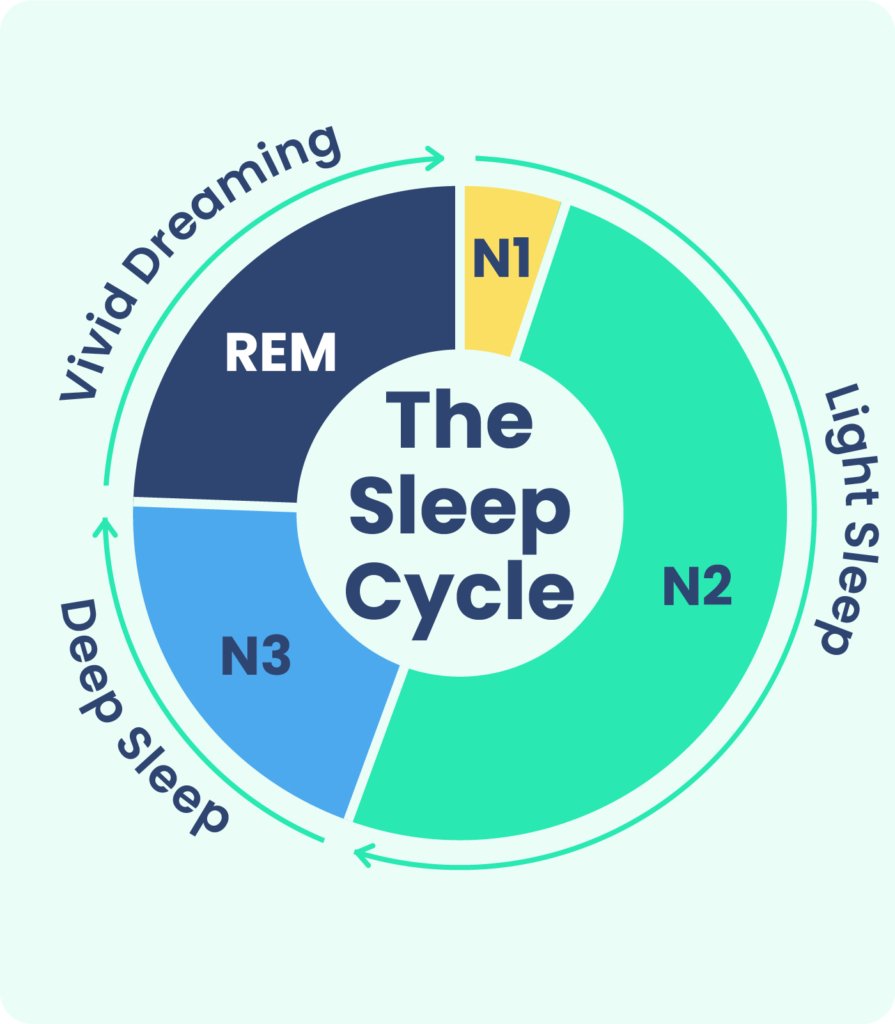
“The Sleep Cycle with the Phases” Image Credit: Sleep Foundation

The Sleep Cycle 

Sleep cycles are intricately structured patterns that govern the various stages of sleep, each contributing uniquely to the overall restoration and well-being of the body and mind. There are four distinct stages in the sleep cycle: REM (rapid eye movement), NREM1, NREM2, and NREM3 (deep sleep or slow-wave sleep). NREM1 marks the transitional phase from wakefulness to sleep, lasting only a few minutes, and sets the foundation for the deeper stages that follow. NREM2 represents true sleep, which is characterized by decreased muscle activity, decreased body temperature, and a slowing heart rate and lasts about 10–25 minutes.  This stage of sleep plays a vital role in memory consolidation and learning. NREM3, a deep sleep stage characterized by delta brain waves, is essential for the body’s physical recuperation or restoration because it stimulates the release of growth hormones, the immune system, and muscle repair. The last phase of sleep, known as REM sleep, is characterized by vivid dreams, fast eye movements, and brain activity similar to that of wakefulness. This stage is essential for memory consolidation, emotional regulation, and cognitive function. The sleep cycle is not something that happens once per night. On most nights, a person goes to 5 to 6 sleep cycles. A balanced distribution of the different stages of sleep is ensured by the cyclical nature of sleep, which is essential to its effectiveness. It is important to note that the length and distribution of each stage can change during the course of the night, with REM sleep lasting longer in the morning and deep sleep mostly happening in the earlier cycles.

The Key 90 Minutes 

The concept of 90-minute sleep cycles is rooted in the understanding of the human sleep architecture, characterized by distinct stages that repeat in a cyclical pattern throughout the night. Each complete sleep cycle, which typically lasts about 90 to 110 minutes, is crucial for overall health and well-being. Understanding the importance of these cycles sheds light on the significance of maintaining a consistent and adequate sleep duration.

Optimizing the distribution of sleep stages is a crucial feature of the 90-minute sleep cycle. The NREM1 and NREM2 lighter stages, NREM3 deeper slow-wave sleep, and the REM (rapid eye movement) stage comprise a full cycle. Each stage serves a unique purpose in physical and mental restoration. While REM sleep is necessary for emotional regulation and cognitive function, NREM1 and NREM2 aid in early relaxation and memory consolidation, and NREM3 is necessary for physical recovery. People can benefit from a balanced distribution of these stages throughout the night by following 90-minute sleep cycles. Sleep cycles guarantee a thorough and all-encompassing restorative experience for the body and mind, addressing the mental and physical dimensions of health. Achieving multiple complete cycles maximizes the body’s ability to repair, heal, and consolidate memories by allowing for a thorough exploration of the various stages of sleep.

The 90-minute sleep cycle also corresponds with the natural ultradian rhythms that control our physiological functions. These rhythms operate in cycles of approximately 90 minutes, influencing factors such as alertness, focus, and productivity. People who sleep in accordance with these innate cycles may discover that they wake up more easily and feel more rested because their sleep is in harmony with their body’s internal clock. Maintaining regular sleep cycles is also essential for controlling the circadian rhythm. The circadian rhythm, also known as the internal body clock, is triggered by light and dark in the environment. Consistent sleep habits aid in regulating the circadian rhythm, fostering a more robust and consistent sleep-wake cycle.

In summary, the significance of 90-minute sleep cycles lies in their capacity to facilitate a comprehensive and balanced restorative process. People can improve their physical and mental recovery, sharpen their cognitive abilities, and promote their general health and well-being by honoring their body’s natural sleep cycle. Cultivating a healthy sleep routine begins with making consistent and adequate sleep a priority in line with these cycles. This optimization entails establishing restful surroundings and embracing healthy sleeping practices. Maximizing the benefits of each sleep stage requires a consistent sleep schedule, a calming bedtime ritual, and a sleep-conducive environment that includes elements like darkness and a cool temperature. Knowing the mechanics of sleep cycles enables people to prioritize good sleep hygiene, which improves sleep quality and promotes general health and vitality. So, next time, whenever you are going to bed or taking a nap, remember to take them in 90-minute intervals for well-rested sleep.

Sources:

Cherry, Kendra. “The 4 Stages of Sleep (NREM and REM Sleep Cycles).” Verywell Health, Verywell Health, 11 May 2023, www.verywellhealth.com/the-four-stages-of-sleep-2795920. 

Eugene, Andy R, and Jolanta Masiak. “The Neuroprotective Aspects of Sleep.” MEDtube Science, U.S. National Library of Medicine, Mar. 2015, www.ncbi.nlm.nih.gov/pmc/articles/PMC4651462/. 

“Stages of Sleep: What Happens in a Sleep Cycle.” Sleep Foundation, 8 Dec. 2023, www.sleepfoundation.org/stages-of-sleep. 

“What Happens during Sleep.” Sleep Doctor, 19 July 2023, sleepdoctor.com/sleep-faqs/what-happens-when-you-sleep/. 

“Why Is Sleep Important?” National Heart Lung and Blood Institute, U.S. Department of Health and Human Services, www.nhlbi.nih.gov/health/sleep/why-sleep-important.


Your journey starts here! Let’s talk!

ThemeRex © 2026. All rights reserved.
  Timothy Durham was convicted of rape when a test showed his DNA genotype matched the DNA recovered from the crime scene. Eye witnesses testified that Durham was in a different state at the time of the incident, but he wasn’t exonerated from his 3000 year sentence until follow up DNA analysis showed that the preliminary forensic analysis used in the trial was misinterpreted (Thomas et al.). DNA testing serves an invaluable part in our criminal justice system, but it comes with complications and bias that can lead to wrongful convictions and misinformed juries.  

Background:

Forensic genetics aims to identify the origin of a biological sample. It can be traced back to Karl Landsteiner who discovered human ABO blood groups. With blood groups, suspects could be eliminated based on their blood type. For example, if a suspect had type A blood and there was type B blood left at the scene by the perpetrator, the investigators could rule out the suspect. Unfortunately, the reverse didn’t work. If the suspect and perpetrator both had the same blood type, it can’t be concluded that the suspect was guilty. Blood identifiers evolved into 8 distinct categories which improved the ability to eliminate suspects, but could only conclude that (if the system matched) it might be the perpetrator or this person might be related to the perpetrator (Jobling and Gill). The field evolved in the 1980s with the discovery of Minisatellites, lines of repetitive DNA that don’t encode proteins. Minisatellite patterns in DNA create what we know today as the DNA fingerprint, and it has a much higher accuracy rate than previous methods (Augustyn et al.). Around the same time, a breakthrough for victims of sexual assault was discovered. In the case of assault, bodily fluids of both the victim and the assaulter can get mixed. A process called differential lysis was created which could selectively increase the concentration of sperm in a fluid sample thereby allowing for accurate DNA testing (Jobling and Gill). Forensics evolved to use single-locus probe testing after several years because of its ease of interpretation. It looked at specific minisatellites that had high variability between subjects. This was the first DNA-based method to be used in a criminal investigation. Two murder homicides from several years apart were connected using DNA evidence. The evidence was then used to exonerate an innocent man, and the guilty party was found when he tried to evade mandatory DNA testing for all men in the small town. His guilt was then reinforced when the DNA profiles matched, and he gave a confession (Jobling and Gill). Finding DNA at a crime scene doesn’t guarantee that you’ll find a murderer. There are issues with non-pure samples and limited samples that make DNA work difficult, and accreditation of facilities and new techniques and take time (Jobling and Gill).  

Subjectivity of DNA Interpretation:

In a 2009 publication, the National Academy of Science discusses the possibility for subjective influence in lab based forensics. The interpretation bias happens in complex cases where, for example, there could be a mixture of DNA. A study published in 2011 looked specifically at this issue. A gang rape happened in Georgia, and the mixture in DNA from the case was used to prosecute one suspect after another suspect took a plea bargain to testify against him. With DNA mixtures, there are three possible conclusions: suspect excluded, suspect cannot be excluded, and inconclusive. If the suspect is excluded, it means that there’s little to no possibility that his DNA is part of the sample. If the suspect cannot be excluded, it means that there’s a possibility that his DNA is part of the sample. In the trial, the DNA examiners who knew the context of the case concluded that the suspect being prosecuted could not be excluded. The 2011 study gave the DNA evidence from this case and the DNA profiles of the suspects to 17 forensic examiners. These examiners had no context of the case, and they all worked independently. Of the 17, only 1 came to the same conclusion (suspect cannot be excluded) as the examiners who knew the context of the case. Twelve of the 17 concluded that the suspect who was prosecuted and convicted had no relation to the DNA found in the sample. Not only does this show that subjectivity occurs due to the context of the case, but the 17 examiners came up with different findings based on their past experiences meaning that not all DNA analysis is objective. Some organizations like the Scientific Working Group on DNA Analysis Methods say that quantitative statistical evidence should be presented with every categorical conclusion, but the US doesn’t require this (Dror and Hampikian).

False Positives:

There are two categories that cause wrongful identification in a DNA report: coincidental matches and false positives. Coincidental matches are DNA matches between two unrelated people. The probability of these matches is about 1 to 500,000 for white individuals and about 1 to 350,000 for black individuals. This small probability of coincidental matches makes people feel confident in DNA evidence. False positives, on the other hand, are matches between DNA and test DNA that result from issues in the forensics lab. There have been multiple cases of forensics labs accidentally switching victim and suspected rapist DNA which lead to convictions that were later overturned when the lab realized the error. There are also cases of misreading or misunderstanding a sample. In a case from 1993, a man was convicted of rape because someone interpreted a mixed sample of victim and perpetrator DNA as an individual sample. The conviction was again overturned. To prevent false convictions, retesting DNA is allowed, but it’s not an efficient solution. Many people are pushing for statistical information on the probability of false positives, so that the jurors can make accurate judgements based on DNA evidence (Thomas et al.).  

Conclusion:

DNA analysis is a useful tool for the criminal justice system, but subjectivity can be an issue in forensic testing. To combat wrongful convictions, there are organizations like The Innocence Project who use DNA testing to free the innocent, but reformed forensic testing standards should be put in place to prevent subjectivity and to ensure juries are correctly informed during trials. https://www.innocenceproject.org/    

Citation:

Augustyn , Adam, et al. “DNA Finerprinting.” Encyclopedia Britannica , 26 Apr. 2018, www.britannica.com/science/DNA-fingerprinting#ref153186. Dror, Itiel E., and Greg Hampikian. “Subjectivity and Bias in Forensic DNA Mixture Interpretation.” Science & Justice, vol. 51, no. 4, 2011, pp. 204–208., doi:10.1016/j.scijus.2011.08.004. Jobling, Mark A., and Peter Gill. “Encoded Evidence: DNA in Forensic Analysis.” Nature Reviews: Genetics, vol. 5, no. 10, Oct. 2004, pp. 739–751., doi:10.1038/nrg1455. Thompson, William C, et al. “How the Probability of a False Positive Affects the Value of DNA Evidence.” Journal of Forensic Sciences, vol. 48, no. 1, Jan. 2003, pp. 1–8., doi:10.1520/jfs2001171.