Microbes You Can Eat Vol. 1: Kombucha and Jun Tea

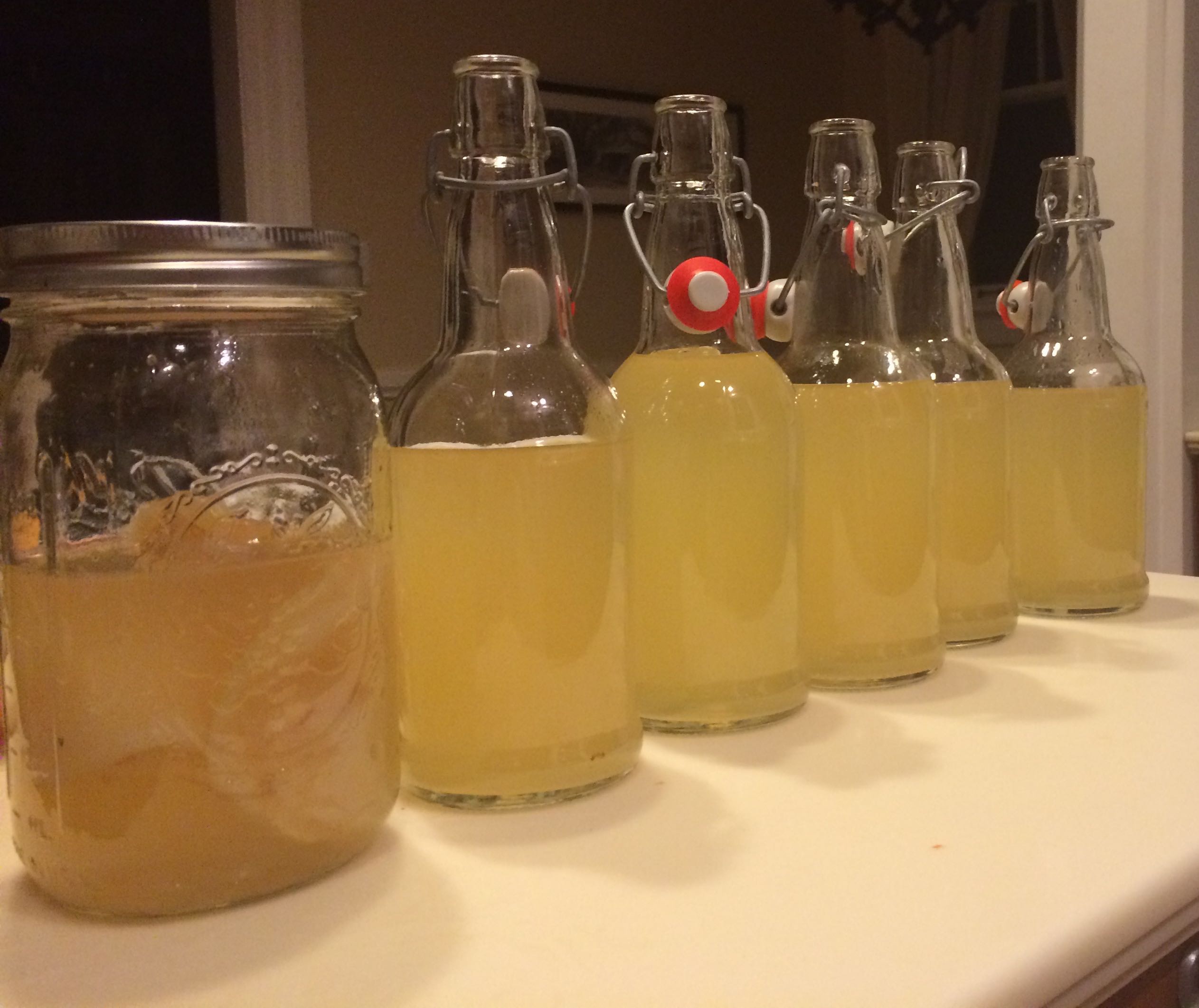
Mother and child - A Jun SCOBY with finished Jun tea.
Mother and child – A Jun SCOBY with finished Jun tea.

If you’ve browsed the refrigerated section of your local natural foods store lately, you probably noticed a big case full of kombucha where the bottled water used to be.  Kombucha is a fermented sweetened black tea that comes in lots of flavors including some slimy varieties that are full of chia seeds.  What is kombucha, anyway?  Is it really good for you? Why is this drink exploding all over my car?  This, dear reader, is what we hope to answer with this article.

Kombucha is made by adding a symbiotic culture of bacteria and yeast (SCOBY) to sweetened black tea and allowing it to ferment.  The SCOBY breaks down the sugar and produces organic acids like acetic acid and gluconic acid that lower the pH (Sreeramulu, Zhu, & Knol, 2000). Different parts of the culture carry out different steps in this process and quite a lot of research has been done to identify exactly which species of bacteria and yeast are present in kombucha.  Recently scientists used high-throughput DNA sequencing technology (the same technology used to sequence the human genome) to show that Gluconacetobacter is the primary bacterial species and Zygosaccharomyces is the primary yeast species.  There are also significant levels of Lactobacillus in kombucha. (Marsh, O’Sullivan, Hill, Ross, & Cotter, 2014).  This information can be used to help researchers develop more efficient cultures and understand the ways the microbes break down sugar better.

kombuchameme

The bacteria and yeast in kombucha transform sweet tea into something entirely different, more akin to a tangy soda.  Zycosaccaromyces ferments the sugar, producing carbon dioxide and ethyl alcohol (ethanol).  The carbon dioxide dissolves in water and makes the tea fizzy (and explode all over your car), while the ethanol is converted into acetic acid by Gluconacetobacter.  Acetic acid is the active ingredient in vinegar and gives kombucha its slightly sour, tangy flavor. A small amount of the ethanol does not get used, and so most kombucha is about 1% alcohol.  For comparison most beers are around 5% and wine is around 12%.

So is kombucha good for you?  There are plenty of websites out there that will tell you that kombucha can do everything from cure cancer to make you shit on a regular basis, but well validated research on the topic is sparse.  There is something in kombucha that inhibits the growth of food poisoning like Salmonella, E. coli, and Shigella (Sreeramulu et al., 2000), but exactly what it is has not been worked out yet.  The antibacterial effect is not due to the pH of the tea, and the culture does not need to be alive to work.  There is also other good stuff in kombucha like caffeine (Kallel, Desseaux, Hamdi, Stocker, & Ajandouz, 2012) and antioxidants (Jayabalan, Marimuthu, & Swaminathan, 2007).   Antioxidants are awesome.  EGCG, one of the antioxidants in tea, has been found to inhibit the development of skin cancer (Lu et al., 2002) and the brain plaques that cause Alzheimer’s disease. (Rezai-Zadeh et al., 2005).

Kombucha is also a guilt-free soft drink option.  Microbes break down most of the sugar in kombucha during the fermentation process, and the finished tea usually only has about 30 calories and 2g of sugar per serving.   Because it is low calorie, kombucha is a good alternative to sugar sweetened beverages like soda, which have been associated with weight gain and obesity. (Malik, Schulze, & Hu, 2006)

There may even be a future for parts of the kombucha culture that we don’t consume.  During fermentation, the kombucha SCOBY produces a floating microbial mat, or pellicle, made of cellulose that looks remarkably like a jellyfish. We usually associate cellulose production with plants (paper is made of cellulose from trees), but bacterial cellulose is special.  It has long, fine fibers, is strong, and can be molded to any shape.  It is currently being studied for use in a variety of biomedical applications including cartilage replacements (Svensson et al., 2005).
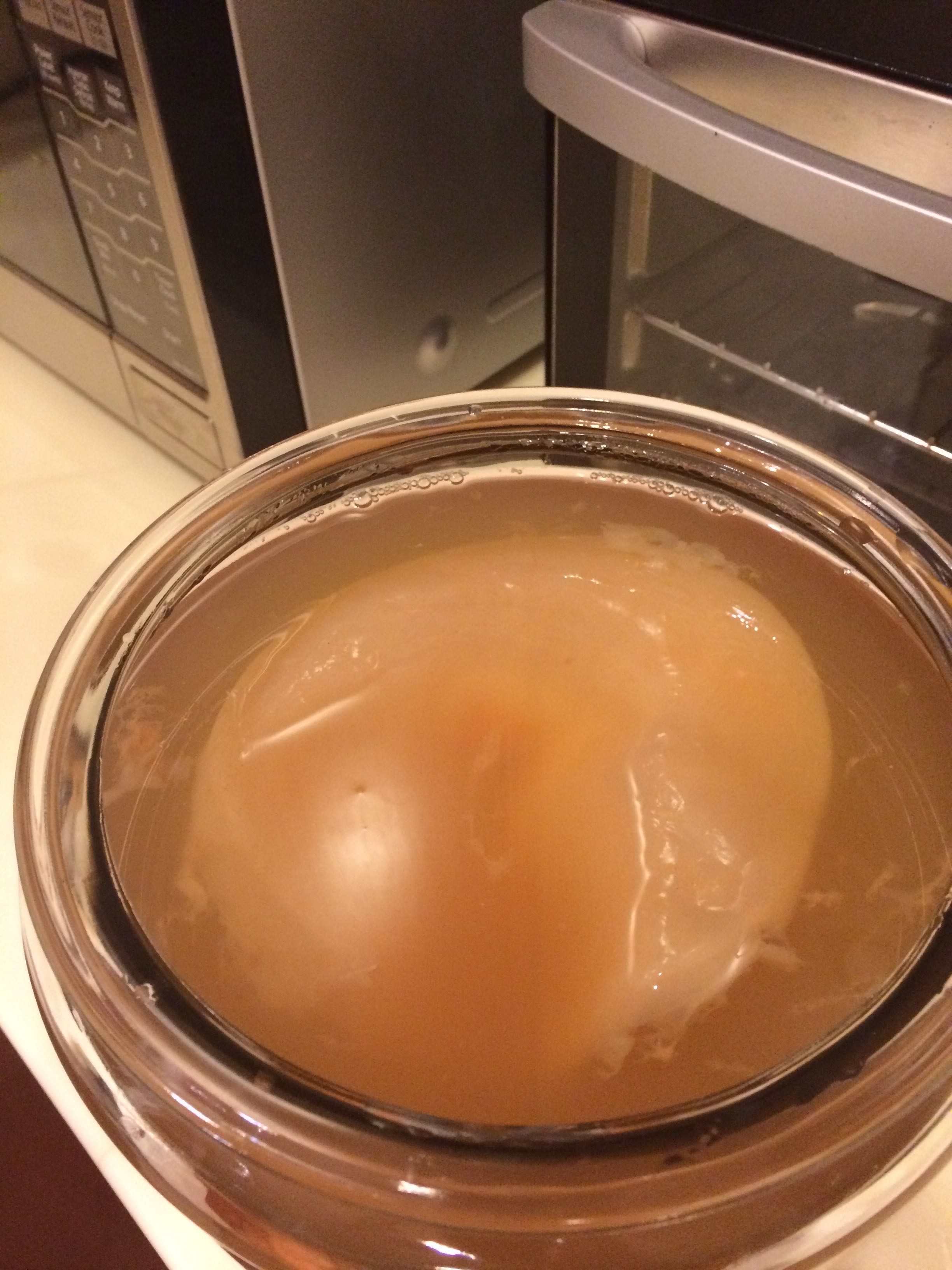
Pellicle floating in tea

Kombucha has a relative in Jun tea, a fermented beverage made with green tea and honey.  Jun may even be more healthy than kombucha because green tea and honey both have well documented benefits. (Crespy & Williamson, 2004)(Alvarez-Suarez, Tulipani, Romandini, Bertoli, & Battino, 2009) Because I keep bees and have a lot of surplus honey, I have been making jun tea for the last couple months.   To make it, I just brew 4 cups of strong green tea, dilute it with two quarts of water to cool to room temperature, stir in a cup of honey, add a SCOBY (I got mine online), and allow it to culture for 5-7 days.  Then I remove the pellicle along with a cup of the tea to use in the next batch.  I usually bottle the finished tea with a little fruit juice or cut-up fruit for flavor (although it is delicious without it).  The juice adds some extra sugar so the microbes can generate more carbon dioxide for an extra fizzy drink (just don’t open it in the car!).  Making fermented tea has been a fun and delicious experiment for me, so I say we raise a glass to Gluconacetobacter and Zygosaccharomyces…….microbes you can eat!

The author samples Jun tea with fictional talk show hosts Kat Lovejoy and Olive Brandywine:


References:

Alvarez-Suarez, J. M., Tulipani, S., Romandini, S., Bertoli, E., & Battino, M. (2009). Contribution of honey in nutrition and human health: a review. Mediterranean Journal of Nutrition and Metabolism, 3(1), 15–23. doi:10.1007/s12349-009-0051-6

Crespy, V., & Williamson, G. (2004). Nutrition , and Cancer A Review of the Health Effects of Green Tea Catechins in In Vivo Animal Models 1.

Jayabalan, R., Marimuthu, S., & Swaminathan, K. (2007). Changes in content of organic acids and tea polyphenols during kombucha tea fermentation. Food Chemistry, 102(1), 392–398. doi:10.1016/j.foodchem.2006.05.032

Kallel, L., Desseaux, V., Hamdi, M., Stocker, P., & Ajandouz, E. H. (2012). Insights into the fermentation biochemistry of Kombucha teas and potential impacts of Kombucha drinking on starch digestion. Food Research International, 49(1), 226–232. doi:10.1016/j.foodres.2012.08.018

Lu, Y., Lou, Y., Xie, J., Peng, Q., Liao, J., Yang, C. S., … Conney, A. H. (2002). Topical applications of caffeine or ( ؊ ) -epigallocatechin gallate ( EGCG ) inhibit carcinogenesis and selectively increase apoptosis in UVB-induced skin tumors in mice.

Malik, V. S., Schulze, M. B., & Hu, F. B. (2006). Intake of sugar-sweetened beverages and weight gain : a systematic review 1 – 3. American Journal of Clinical Nutrition, 84(2), 274–288.

Marsh, A. J., O’Sullivan, O., Hill, C., Ross, R. P., & Cotter, P. D. (2014). Sequence-based analysis of the bacterial and fungal compositions of multiple kombucha (tea fungus) samples. Food Microbiology, 38, 171–8. doi:10.1016/j.fm.2013.09.003

Rezai-Zadeh, K., Shytle, D., Sun, N., Mori, T., Hou, H., Jeanniton, D., … Tan, J. (2005). Green tea epigallocatechin-3-gallate (EGCG) modulates amyloid precursor protein cleavage and reduces cerebral amyloidosis in Alzheimer transgenic mice. The Journal of Neuroscience : The Official Journal of the Society for Neuroscience, 25(38), 8807–14. doi:10.1523/JNEUROSCI.1521-05.2005

Sreeramulu, G., Zhu, Y., & Knol, W. (2000). Kombucha Fermentation and Its Antimicrobial Activity, 2589–2594.

Svensson, a, Nicklasson, E., Harrah, T., Panilaitis, B., Kaplan, D. L., Brittberg, M., & Gatenholm, P. (2005). Bacterial cellulose as a potential scaffold for tissue engineering of cartilage. Biomaterials, 26(4), 419–31. doi:10.1016/j.biomaterials.2004.02.049

Your journey starts here! Let’s talk!

ThemeRex © 2026. All rights reserved.
  Timothy Durham was convicted of rape when a test showed his DNA genotype matched the DNA recovered from the crime scene. Eye witnesses testified that Durham was in a different state at the time of the incident, but he wasn’t exonerated from his 3000 year sentence until follow up DNA analysis showed that the preliminary forensic analysis used in the trial was misinterpreted (Thomas et al.). DNA testing serves an invaluable part in our criminal justice system, but it comes with complications and bias that can lead to wrongful convictions and misinformed juries.  

Background:

Forensic genetics aims to identify the origin of a biological sample. It can be traced back to Karl Landsteiner who discovered human ABO blood groups. With blood groups, suspects could be eliminated based on their blood type. For example, if a suspect had type A blood and there was type B blood left at the scene by the perpetrator, the investigators could rule out the suspect. Unfortunately, the reverse didn’t work. If the suspect and perpetrator both had the same blood type, it can’t be concluded that the suspect was guilty. Blood identifiers evolved into 8 distinct categories which improved the ability to eliminate suspects, but could only conclude that (if the system matched) it might be the perpetrator or this person might be related to the perpetrator (Jobling and Gill). The field evolved in the 1980s with the discovery of Minisatellites, lines of repetitive DNA that don’t encode proteins. Minisatellite patterns in DNA create what we know today as the DNA fingerprint, and it has a much higher accuracy rate than previous methods (Augustyn et al.). Around the same time, a breakthrough for victims of sexual assault was discovered. In the case of assault, bodily fluids of both the victim and the assaulter can get mixed. A process called differential lysis was created which could selectively increase the concentration of sperm in a fluid sample thereby allowing for accurate DNA testing (Jobling and Gill). Forensics evolved to use single-locus probe testing after several years because of its ease of interpretation. It looked at specific minisatellites that had high variability between subjects. This was the first DNA-based method to be used in a criminal investigation. Two murder homicides from several years apart were connected using DNA evidence. The evidence was then used to exonerate an innocent man, and the guilty party was found when he tried to evade mandatory DNA testing for all men in the small town. His guilt was then reinforced when the DNA profiles matched, and he gave a confession (Jobling and Gill). Finding DNA at a crime scene doesn’t guarantee that you’ll find a murderer. There are issues with non-pure samples and limited samples that make DNA work difficult, and accreditation of facilities and new techniques and take time (Jobling and Gill).  

Subjectivity of DNA Interpretation:

In a 2009 publication, the National Academy of Science discusses the possibility for subjective influence in lab based forensics. The interpretation bias happens in complex cases where, for example, there could be a mixture of DNA. A study published in 2011 looked specifically at this issue. A gang rape happened in Georgia, and the mixture in DNA from the case was used to prosecute one suspect after another suspect took a plea bargain to testify against him. With DNA mixtures, there are three possible conclusions: suspect excluded, suspect cannot be excluded, and inconclusive. If the suspect is excluded, it means that there’s little to no possibility that his DNA is part of the sample. If the suspect cannot be excluded, it means that there’s a possibility that his DNA is part of the sample. In the trial, the DNA examiners who knew the context of the case concluded that the suspect being prosecuted could not be excluded. The 2011 study gave the DNA evidence from this case and the DNA profiles of the suspects to 17 forensic examiners. These examiners had no context of the case, and they all worked independently. Of the 17, only 1 came to the same conclusion (suspect cannot be excluded) as the examiners who knew the context of the case. Twelve of the 17 concluded that the suspect who was prosecuted and convicted had no relation to the DNA found in the sample. Not only does this show that subjectivity occurs due to the context of the case, but the 17 examiners came up with different findings based on their past experiences meaning that not all DNA analysis is objective. Some organizations like the Scientific Working Group on DNA Analysis Methods say that quantitative statistical evidence should be presented with every categorical conclusion, but the US doesn’t require this (Dror and Hampikian).

False Positives:

There are two categories that cause wrongful identification in a DNA report: coincidental matches and false positives. Coincidental matches are DNA matches between two unrelated people. The probability of these matches is about 1 to 500,000 for white individuals and about 1 to 350,000 for black individuals. This small probability of coincidental matches makes people feel confident in DNA evidence. False positives, on the other hand, are matches between DNA and test DNA that result from issues in the forensics lab. There have been multiple cases of forensics labs accidentally switching victim and suspected rapist DNA which lead to convictions that were later overturned when the lab realized the error. There are also cases of misreading or misunderstanding a sample. In a case from 1993, a man was convicted of rape because someone interpreted a mixed sample of victim and perpetrator DNA as an individual sample. The conviction was again overturned. To prevent false convictions, retesting DNA is allowed, but it’s not an efficient solution. Many people are pushing for statistical information on the probability of false positives, so that the jurors can make accurate judgements based on DNA evidence (Thomas et al.).  

Conclusion:

DNA analysis is a useful tool for the criminal justice system, but subjectivity can be an issue in forensic testing. To combat wrongful convictions, there are organizations like The Innocence Project who use DNA testing to free the innocent, but reformed forensic testing standards should be put in place to prevent subjectivity and to ensure juries are correctly informed during trials. https://www.innocenceproject.org/    

Citation:

Augustyn , Adam, et al. “DNA Finerprinting.” Encyclopedia Britannica , 26 Apr. 2018, www.britannica.com/science/DNA-fingerprinting#ref153186. Dror, Itiel E., and Greg Hampikian. “Subjectivity and Bias in Forensic DNA Mixture Interpretation.” Science & Justice, vol. 51, no. 4, 2011, pp. 204–208., doi:10.1016/j.scijus.2011.08.004. Jobling, Mark A., and Peter Gill. “Encoded Evidence: DNA in Forensic Analysis.” Nature Reviews: Genetics, vol. 5, no. 10, Oct. 2004, pp. 739–751., doi:10.1038/nrg1455. Thompson, William C, et al. “How the Probability of a False Positive Affects the Value of DNA Evidence.” Journal of Forensic Sciences, vol. 48, no. 1, Jan. 2003, pp. 1–8., doi:10.1520/jfs2001171.