
Category: today i learned (til)
health, fitness, medicine, environment, ecology, how to learn tricky topics in science and math, new discoveries, news, current events
-

The Art of Boredom
Introduction
Recently, I found myself unable to do nothing, even for a few minutes. It’s like my body itches to be occupied. I think it feels uncomfortable to do nothing, which feels weird to admit. We live in a digital age where we have access to all kinds of information at our fingertips in a matter of seconds, probably more now than ever before. Things feel fast-paced, and we’re already moving on to the next big thing. After some introspection, I thought that it’s been a while since I’ve intentionally felt bored—whenever I’m bored, it’s so easy to find something for me to do. I ran into this video on YouTube, and it got me thinking, “Maybe I really should be bored sometimes!” I ended up doing my Final Speech for my public-speaking class on boredom. It’s time to be bored!
Benefits of Boredom
Boredom comes with several benefits! Here, I’ll discuss some of my favorite reasons to be bored.
Boredom often signals when a situation isn’t working for us. Think of it like a redirection. Our urge to fight boredom can lead to positive change (An et al., 2023b). An example is when we’re doing something boring to us, say, sitting in a meeting that we don’t want to be in. As our mind wanders, we start thinking of better things we could be doing instead, or how we could better manage our time. As a result, another benefit of boredom is increased creativity (Mann & Cadman, 2014). This increase in creativity is often linked to daydreaming, which occurs when bored individuals cannot physically escape their situation, and their attention shifts from external to internal focus on their inner thoughts and feelings (Mann & Cadman, 2014). In Mann and Cadmen’s study, participants who completed a boring, mundane activity performed better on creative challenges than those who didn’t. Boredom facilitates exploration and opportunity because, using our desire for change, we explore alternate goals or information in our environment that we may have missed otherwise (Bench and Lench, 2013).
Boredom also serves as an opportunity for our minds to rest and reset. When we’re not actively doing anything, our brains can disengage. This causes the default mode network in our brain to kick in, prompting reflection and introspection, which helps us understand ourselves and the world around us (UniSC Youth Mental Health Researcher, M. K. and P. of Y. M. H. & N. 2025). Boredom also “rebalances the nervous system and reduces sensory input to help calm anxiety” (UniSC Youth Mental Health Researcher, M. K. and P. of Y. M. H. & N. 2025). You might feel anxious or restless from boredom, so we reach for something for the quick dopamine hit, but it has been found that constant stimulation, especially for our nervous system, can result in increased anxiety; this is because, our sympathetic nervous system regulates our fight-or-flight response, so keeping it on overdrive results in more anxiety (UniSC Youth Mental Health Researcher, M. K. and P. of Y. M. H. & N. 2025). Simply, we’re better off embracing the boredom from time to time to allow our sympathetic nervous system to reset and recuperate.
Ways You Can Be Bored
Say on your next walk to somewhere, e.g., class, put your phone away and take in your surroundings. Try doing this without any music, too! After completing a task, take 30 seconds to a minute to do absolutely nothing. Seriously! Turn your brain off just for a minute (or however long you like). It might feel weird in the moment, but I promise, it will be so refreshing and worth it! Try doing everyday tasks without external stimuli, such as no music in the shower or screens when eating. Or, take the mindfulness route by taking a few minutes at the end of each day to think of three things you’re grateful for. These are my recommendations, so I strongly encourage you to find practices that work best for you. The point is to remove external stimulus and to be present in the moment.
Conclusion
Now that you’ve read about the benefits and the ways to be bored, I must clarify that it’s not bad to alleviate your boredom. It’s not bad to want to be productive or reach for something when you feel bored. Know that choosing to be bored sometimes is part of intentional, healthy living. You are worthy of a break. Choosing boredom is choosing you!
Check out Robert Greene’s and Veritasium’s video on boredom, too!
Sources
An, J., Payne, L. L., Lee, M., & Janke, M. C. (2023b). Understanding boredom and leisure in later life: A systematic review. Innovation in Aging, 7(8). https://doi.org/10.1093/geroni/igad109
Bench, S., & Lench, H. (2013). On the function of boredom. Behavioral Sciences, 3(3), 459–472. https://doi.org/10.3390/bs3030459
Mann, S., & Cadman, R. (2014). Does being bored make us more creative? Creativity Research Journal, 26(2), 165–173. https://doi.org/10.1080/10400419.2014.901073 .
UniSC Youth Mental Health Researcher, M. K. and P. of Y. M. H. & N. (2025). Boredom gets a bad rap. But science says it can actually be good for us. UniSC. https://www.usc.edu.au/about/unisc-news/news-archive/2025/may/boredom-gets-a-bad-rap-but-science-says-it-can-actually-be-good-for-us
-

Nature’s Architect and Engineer: Beavers!
Unironically, beavers are genuinely one of my favorite animals! With their chunky bodies, fluffy fur, five-toed webbed hind feet, five-finger hands, orange bucked teeth, and paddle-shaped tail, what’s not to love about them? They’re so cute! I recently watched Zootopia 2 in theaters, and there was a beaver character named Nibbles! I was THRILLED to say the least! I’ve never seen one in real life, so it’s on my bucket list to meet one someday.
Here’s a picture of my beaver squishmallows and bidoof plush! The beavers even have a paddle tail if you look closely. Bidoof is a Pokémon inspired by the beaver, and it evolves into Bibarel!

Pictured are two beaver squishmallows and a Pokémon inspired by the beaver, Bidoof! I was not joking when I said I love beavers. Intro to Beavers
Beavers are large, semi-aquatic rodents of the Northern Hemisphere (Brazier et al., 2020). There are two existing Beaver species: the North American beaver (Castor canadensis) and the Eurasian beaver (Castor fiber) (Brazier et al., 2020). We’re able to tell the difference between the two species based on the number of chromosome pairs: the Eurasian beaver has 48 pairs while the North American beaver has 40 pairs (Lavrov, 1983). Their distinctive features, such as the flat, paddle tail, webbed hind feet, constantly growing teeth, and dense fur, allow them to perform specialized behaviors: damming and tree felling that can transform landscapes, habitat, and water management (Brazier et al., 2020). Beavers use their construction ability to protect themselves from predators; they use their teeth to collect branches and trees to build their dams (“Beavers work to improve habitat”).
Beavers as Ecosystem Engineers
Beavers are considered ecosystem engineers because their construction capabilities can alter, maintain, or create habitats by redistributing biotic and abiotic resources for themselves and other species (Rosell et al., 2005). There are three main types of lodge structures that beavers can build, and they select their lodge location based on water depth and bank characteristics (Rosell and Campbell, 2022). These lodges are where beavers take shelter, and beavers create underwater entrances to get to the dry living space, often called the chamber, which is where they rest, raise their young, and stay safe from predators (Rosell and Campbell, 2022). The three types are island lodge, bank lodge, and stick lodge (Rosell and Campbell, 2022). The island lodge is more commonly found in North America, and beavers build this type of lodge when the bank is low (Rosell and Campbell, 2022). Because the bank is low, beavers can’t dig a burrow into a bank, so they build upwards (Rosell and Campbell, 2022). “Bank lodges are found on the water’s edge and built around a burrow dug into the bank” (Rosell and Campbell, 2022). Finally, stick lodges are built from material extending from the shoreline (Rosell and Campbell, 2022). To create a more efficient access to food and building resources, beavers dig shallow channels, canals, which extend from beaver ponds (Brazier et al., 2020). Beavers build dams to raise the water level: ”habitats with deep, slow-flowing water keep them safe from predators” (Brazier et al., 2020). There are two types of dams that beavers may build: the primary and secondary dams (Brazier et al., 2020). The primary dam maintains the main lodge pond, which is much larger than the secondary dams; the secondary dams improve mobility and serve to move woody materials (Brazier et al., 2020).
Beavers are keystone species (Brazier et al., 2020). They literally change their habitat with their engineering instincts for their survival and needs, thus directly changing their habitat’s ecology. If you like to learn more about beavers in a more entertaining format, I highly recommend checking out Lindsay Nikole’s video about beavers! She’s one of my favorite animal content creators!
Sources:
Brazier, R. E., Puttock, A., Graham, H. A., Auster, R. E., Davies, K. H., & Brown, C. M. (2020). Beaver: Nature’s ecosystem engineers. WIREs Water, 8(1). https://doi.org/10.1002/wat2.1494
Beavers work to improve habitat: U.S. Fish & Wildlife Service. FWS.gov. (2025, December 1). https://www.fws.gov/story/beavers-work-improve-habitat
Lavrov, L. S. (1983). Evolutionary development of the genus Castor and taxonomy of the contemporary beavers of Eurasia. Acta Zoologica Fennica, 174, 87-90.
Rosell, F., Bozsér, O., Collen, P., & Parker, H. (2005). Ecological impact of beavers castor fiber and castor canadensis and their ability to modify ecosystems. Mammal Review, 35(3–4), 248–276. https://doi.org/10.1111/j.1365-2907.2005.00067.x
Rosell, F., & Campbell-Palmer, R. (2022). Beavers: ecology, behaviour, conservation, and management. Oxford University Press.
-
I love sharks, maybe you should too!
“Fish are friends, not food.” – Bruce from Finding Nemo. When I watched Disney’s Finding Nemo (2003) as a child, I was absolutely horrified by Bruce the Great White Shark. I was so afraid that when I went on family vacations to the beach, I would be wary of sharks patrolling. I would watch out for the triangular fin and didn’t want to stray too far away from the shore. Ironically, I’ve never seen the iconic Jaws (1975) movie. The director, Steven Spielberg, has said he “truly regrets” his portrayal of great white sharks and the movie’s contribution to the animal’s population decline. Even the author of the 1974 book Jaws, which inspired Spielberg’s movie, Peter Benchley, has apologized for the impact his book had on sharks and dedicated the rest of his life to shark conservation! Check out Benchley’s website–it’s awesome!
I’m not sure when I became a big fan of sharks, but I think it might’ve been because I watched a YouTube or TikTok video about them, and since then, I love sharks!
Background
Sharks belong to the class Chondrichthyes, or cartilaginous fish, meaning their skeletons are made of cartilage, rather than bone like other fish (Chapman, 2017). Fossil records have shown that members of this class have been around since 400-450 million years ago, which also means that sharks are older than trees and some dinosaurs (Chapman, 2017)! Chondrichthyans represent “one of the most species-rich lineages of predators on Earth and they continue to play important functional roles in coastal and oceanic ecosystem structure and function” (Chapman, 2017). The Chondrichthyes class has two groups: Holocephali and Elasmobranchii (“Shark Species”). The Elasmobranchii group has 8 orders of sharks, so each order classifies the “biology, physical characteristics, and behavior of sharks in that order” (“Shark Species”). Check out the Shark Research Institute’s website to learn more about sharks from different orders (you can also click on a shark to learn more about them).
Sharks are typically found in marine habitats (although bull sharks, Carcharhinus leucas, may be found in estuaries and rivers in tropical/warm temperate regions), from shallow coastal waters and the continental shelf and slope to the deep ocean (Bennet, 2005). Sharks are highly diverse, with species ranging in size from about 20cm to over 18m (Dedman et al., 2024).
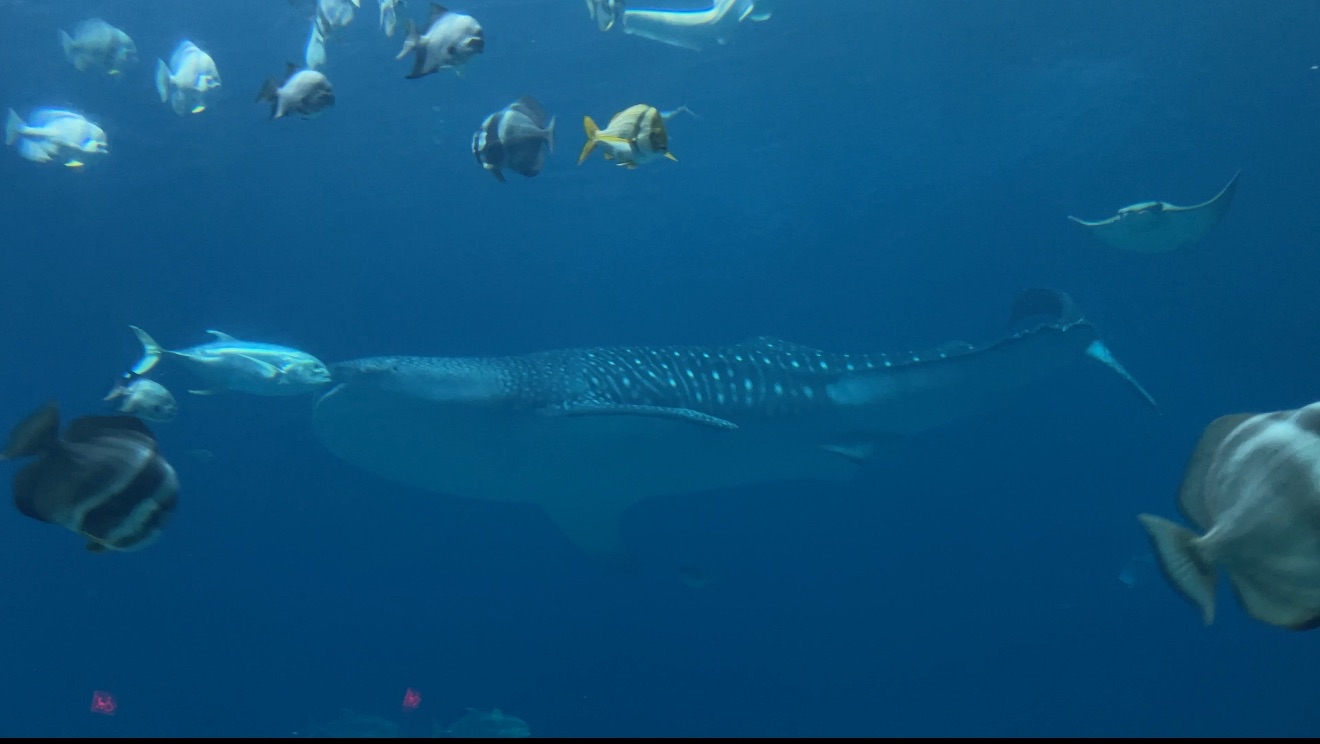
Here are some fun facts! Whale sharks are the largest fish in the sea—they can grow more than 12m long and can weigh over 21 tonnes (Chapman, 2017). You can visit Yushan, the whale shark, at the Georgia Aquarium (the only US aquarium with a whale shark). I visited the aquarium two summers ago, and whale sharks are really just gentle giants. Greenland sharks are the “longest-lived vertebrate known, with recent studies estimating a lifespan of about 390 years, give or take 120 years” (Nielson et al. 2016). Isn’t it crazy to think a species of shark could outlive three human family generations?
Ecological Roles of Sharks
It’s actually a misconception that all sharks are apex predators (Chapman, 2017). Their exact role in the ecosystem depends on the “species, region, age/size, behavior, and/or sex” (Chapman, 2017). Chapman explains that apex predators must occupy the highest trophic level, control the ecosystem from the top down, and influence the productivity of the entire system (2015). In addition, “macropredatory and large mesopredatory sharks often induce behavioral shifts in their potential prey through predation risk and possibly competitive interactions with other predators” (Dedman et al., 2024). This means that sharks can impact how prey feed, hide, or move. Most sharks do not uphold these behaviors and would be classified as mesopredators (mid-level predators); only a select few sharks are considered apex predators, i.e., “great sharks” (Chapman, 2017). Sharks are not simply large predators: they can fill ecological roles at varying trophic levels (Dedman et al., 2024). Their diets range from filter feeding (like whale sharks) to parasites to small crustaceans to classic big predators that eat fish, turtles, seals, and other sharks (Dedman et al., 2024). However, it is challenging to create a comprehensive “understanding of ecological roles and the importance of sharks because of the inherent difficulties of studying their interactions and the mechanisms through which sharks may–or may not–affect ecosystems” (Dedman et al., 2024).
Sharks also have a bottom-up and/or facilitation role in ecosystems. Though research here is currently limited, we know that sharks move nutrients across great distances: “from pelagic environments to coral reefs, shallow to deep mesophotic coral reefs and vice versa, coastal oceans to estuarine waters, and across latitudinal gradients” (Dedman et al., 2024). These nutrients are deposited via “egestion and excretion or carcasses of sharks that die” (Dedman et al., 2024). It is worth noting that the ecological importance of this deposition needs to be further studied, as it remains unknown.
Threats to Sharks
According to Dulvy et al.,”24% of shark, skate, and ray species are considered Threatened with extinction by the IUCN Red List’s Shark Specialist Group (2014). Targeted overfishing and bycatch (unintentional catches) contribute to the shark population decline (Shiffman and Hammerschlag, 2016). Shark fishing involves the sale of meat (for consumption), jaws (as tourist trinkets), cartilage and liver oil (as alternative medicine); the major reason for shark fishing is for shark fin soup (Shiffman and Hammerschlag, 2016). According to the Fisheries and Aquaculture Department (FAO), trade in shark parts is worth approximately US $1 billion annually worldwide (2010). Unfortunately, because of sharks’ slow growth, late maturity, and low reproductive rate, sharks are especially vulnerable to overfishing (Friedrich et al., 2014).
Conservation Efforts
Raising awareness about shark issues and the destructive impacts human activities have on shark populations has been found to improve attitudes towards shark conservation (Friedrich et al., 2014). At a consumer level, we can consider purchasing sustainably sourced seafood or engage with campaigning for policy change (Friedrich et al., 2014). The image of sharks as fearsome predators greatly limits public engagement and support for shark conservation, which is due to cultural representations in media, such as Jaws and sensationalized media reports of shark attacks (Friedrich et al., 2014). Effective shark protection is rooted in “international strategy, changes to fisheries regulations, and tailored conservation tools (Friedrich et al., 2014). To determine effective conservation strategies, we must study ecological communities, species’ roles, and “the context of pervasive human presence in the oceans” (Dedman et al., 2024).
Video of Yushan and Taroko from 2024 that I took! Unfortunately, Taroko died in August 2025.
Whale Sharks – Yushan and Taroko at the Georgia Aquarium’s Ocean Voyager
Sources:
Chapman, B. (2017). Shark attacks: Myths, misunderstandings and human fear. Csiro Publishing.
Bennett, M. (2005). The role of sharks in the ecosystem. St. Lucia: School of Biomedical Sciences, The University Of Queensland.
Dedman, S., Moxley, J. H., Papastamatiou, Y. P., Braccini, M., Caselle, J. E., Chapman, D. D., Cinner, J. E., Dillon, E. M., Dulvy, N. K., Dunn, R. E., Espinoza, M., Harborne, A. R., Harvey, E. S., Heupel, M. R., Huveneers, C., Graham, N. A., Ketchum, J. T., Klinard, N. V., Kock, A. A., … Heithaus, M. R. (2024). Ecological roles and importance of sharks in the Anthropocene Ocean. Science, 385(6708). https://doi.org/10.1126/science.adl2362
Dulvy, N.K., Fowler, S.L., Musick, J.A., Cavanaugh, R.D., Kyne, P.M., Harrison, L.R., Carlson, J.K., Davidson, L.N.K., Fordham, S.V., Francis, M.P., Pollock, C.M., Simpfendorfer, C.A., Burgess, G.H., Carpenter, K.E., Compagno, L.J.V., Ebert, D.A., Gibson, C., Heupel, M.R., Livingstone, S.R., Sanciangco, J.C., Stevens, J.D., Valenti, S. & White, W.T. (2014). Extinction Risk and Conservation of the world’s sharks and rays. eLife 3. (Online DOI: doi: 10.7554/eLife.00590).
FAO Fisheries and Aquaculture Department (2010). The state of world fisheries and aquaculture. Rome: Food and agriculture organization of the United States.
Friedrich, L. A., Jefferson, R., & Glegg, G. (2014). Public perceptions of sharks: Gathering support for shark conservation. Marine Policy, 47, 1–7. https://doi.org/10.1016/j.marpol.2014.02.003
Shiffman, D. S., & Hammerschlag, N. (2016). Shark conservation and management policy: A review and Primer for non‐specialists. Animal Conservation, 19(5), 401–412. https://doi.org/10.1111/acv.12265
-
The Marine Colonizers: Lionfish
Introduction:
As I scrolled through YouTube to look for something to watch, I came across a Short (the term for the vertical, short-form video format on YouTube). The short was of a free diver swimming through a kelp forest and using a tool to scoop up all the sea urchins into a gigantic net. For some reason, I was instantly mesmerized by the video. I think it’s because 1) I think the ocean is awesome, and 2) the sounds of the video felt almost like ASMR. I went down the rabbit hole that day and watched the rest of this user’s content (sea urchin harvesting). There was something so satisfying about watching him gather a netful of sea urchins and use his tool to crack one open for the nearby fish. It appears the diver and the native fish have developed a symbiotic relationship: the fish leads the diver to the sea urchins, and the diver opens sea urchins for the fish to feast on. Watching all these videos made me wonder, “Is this really the only way we can control sea urchin populations, and what happened that caused the situation to get this bad?”
I knew for a long time about the lionfish problem. Funnily enough, YouTube started recommending lionfish videos to me. The diver uses a harpoon to impale lionfish and then places them in a bin. So then that made me think, “Is gathering these invasive species the only method of managing their populations?” It doesn’t seem that effective to me.
How are lionfish so successful as invasive or non-native species?
Background
Lionfish, Pterois miles and P. volitans, are native to the warm waters of the Indian and Pacific Oceans, and were introduced to South Florida’s coastal waters about 30 years ago (Norton & Norton, 2021). These fish are actually the first non-native marine fish introduced to the US’s Atlantic Coast and the Caribbean (Morris and Akins, 2009). They were common reef predators in the Indian and Pacific Oceans, so, with no predators to keep their populations in check, South Florida’s Atlantic coast provided the perfect conditions for these lionfish to thrive (Norton & Norton, 2021). Climate change also plays a role in the rise of lionfish in the Atlantic Ocean: the increase in ocean temperatures extends the lionfish territories north and south (Norton & Norton, 2021). Another leading cause of the success of lionfish establishing their populations is believed to be their broad diet, making them ecological generalists (Côté and Smith, 2018). From 2004 to 2010, lionfish populations rose drastically, increasing from 23% to 40% of the total predator biomass in the ecosystem (Green et al., 2012). By studying lionfish stomach content, researchers have found that “90% of the prey consumed by lionfish were small-bodied reef fishes from 42 species. Between 2008 and 2010, the combined body mass of these 42 species declined by 65%” (Green et al., 2012).
Control Efforts
Lionfish’s venomous spines provide effective protection against predators, but lionfish control programs have started across the Caribbean, which may successfully reduce the effects of lionfish at local scales within high-priority areas, such as Marine Protected Areas and fish nursery habitats (Green et al., 2012). The most common form of lionfish control is culling by locals or during organized tournaments (Côté and Smith, 2018). Numerous studies have shown that regular culling at target sites could significantly reduce populations and promote the recovery of native prey populations (Côté and Smith, 2018). Lionfish sizes have decreased due to targeted culling in various regions (del Rio et al., 2023). Unfortunately, not only is culling costly and physically demanding, but for culling to be effective, the amount of lionfish removed must be high: e.g., “35-65% annually at large spatial scales” (Côté and Smith, 2018). Another mitigation strategy is found in gastronomy—we collect lionfish recreationally or commercially for human consumption (Côté and Smith, 2018). It turns out, lionfish are delicious and nutritious (Morris et al., 2011b). Unfortunately, relying on native predators, particularly big groupers, is insufficient in controlling lionfish populations (Côté and Smith, 2018). One reason is that native predators aren’t as abundant as they used to be, and so these populations don’t consume lionfish enough to be effective (Paddack et al., 2009; Sadovy de Mitcheson et al., 2013). Researchers have thought of training native predators to consume lionfish (Diller et al., 2014). However, further research has found that training predators is unrealistic, so low predation on lionfish isn’t due to native predators being unaware that they could consume lionfish, but because of lionfish’s defenses against predators (the venomous spines) (Côté and Smith, 2018).
Conclusion
Based on the existing research, I would argue that introducing or developing lionfish as a potential food source for humans could aid in controlling lionfish populations. I think it’s super important that we educate people about the environmental problems of non-native species inhabiting ecosystems, and the efforts we can make to restore balance. I would think that research in mitigating lionfish effects on ecosystems would help in further research of non-native or invasive species in other habitats too!
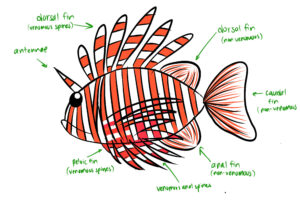
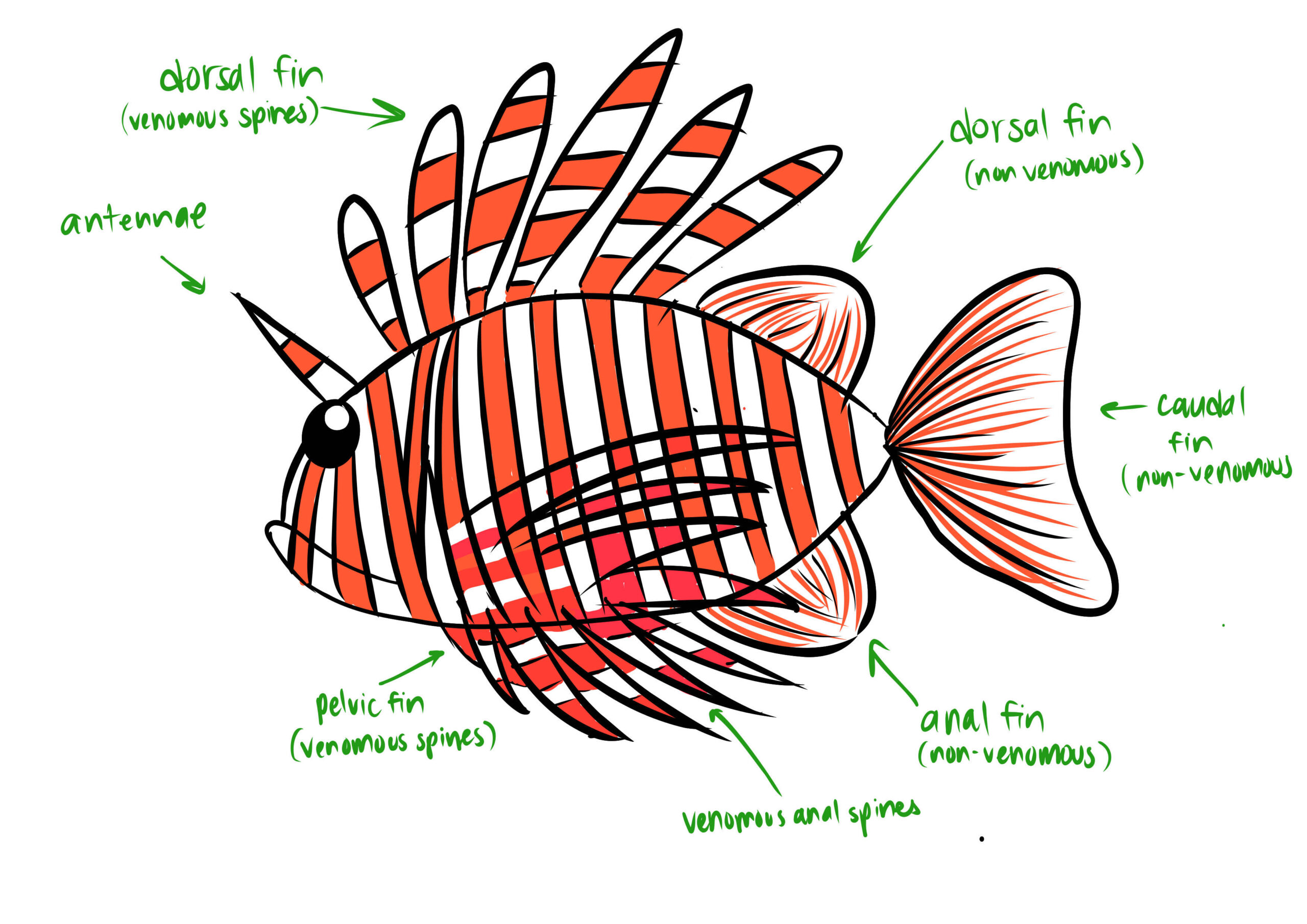
My attempt in drawing a lionfish! I’ve also labeled different parts of the fish. Sources:
Côté, I. M., & Smith, N. S. (2018). The lionfish pterois sp. invasion: Has the worst‐case scenario come to pass? Journal of Fish Biology, 92(3), 660–689. https://doi.org/10.1111/jfb.13544
del Río, L., Navarro-Martínez, Z. M., Cobián-Rojas, D., Chevalier-Monteagudo, P. P., Angulo-Valdes, J. A., & Rodriguez-Viera, L. (2023). Biology and ecology of the lionfish pterois volitans/pterois miles as invasive alien species: A Review. PeerJ, 11. https://doi.org/10.7717/peerj.15728
Diller, J. L., Frazer, T. K. & Jacoby, C. A. (2014). Coping with the lionfish invasion: evidence that naïve, native predators can learn to help. Journal of Experimental Marine Biology and Ecology 455, 45–49.
Green, S. J., Akins, J. L., Maljković, A., & Côté, I. M. (2012). Invasive lionfish drive Atlantic coral reef fish declines. PLoS ONE, 7(3). https://doi.org/10.1371/journal.pone.0032596
Morris, J. A., & Akins, J. L. (2009). Feeding ecology of invasive lionfish (pterois volitans) in the Bahamian Archipelago. Environmental Biology of Fishes, 86(3), 389–398. https://doi.org/10.1007/s10641-009-9538-8
Morris, J. A. Jr., Thomas, A., Rhyne, A. L., Breen, N., Akins, L. & Nach, B. (2011b). Nutritional properties of the invasive lionfish: a delicious and nutritious approach for controlling the invasion. AACL Bioflux 4, 21–26.
Norton, B. B., & Norton, S. A. (2021). Lionfish envenomation in Caribbean and Atlantic Waters: Climate change and invasive species. International Journal of Women’s Dermatology, 7(1), 120–123. https://doi.org/10.1016/j.ijwd.2020.05.016
Paddack, M. J., Reynolds, J. D., Aguilar, C., Appeldoorn, R. S., Beets, J., Burkett, E. W., Chittaro, P. M., Clarke, K., Esteves, R., Fonseca, A. C., Forrester, G. E., Friedlander, A. M., García-Sais, J., González-Sansón, G., Jordan, L. K. B., McClellan, D. B., Miller, M. W., Molloy, P. P., Mumby, P. J., Nagelkerken, I., Nemeth, M., Navas-Camacho, R., Pitt, J., Polunin, N. V. C., Reyes-Nivia, M. C., Robertson, D. R., Rodríguez Ramírez, A., Salas, E., Smith, S. R., Spieler, R. E., Steele, M. A., Williams, I. D., Wormald, C., Watkinson, A. R. & Côté, I. M. (2009). Recent region-wide declines in Caribbean reef fish abundance. Current Biology 19, 590–595.
Sadovy de Mitcheson, Y., Craig, M. T., Bertoncini, A. A., Carpenter, K. E., Cheung, W. W. L., Choat, J. H., Cornish, A. S., Fennessy, S. T., Ferreira, B. P., Heemstra, P. C., Liu, M., Myers, R. F., Pollard, D. A., Rhodes, K. L., Rocha, L. A., Russell, B. C., Samoilys, M. A. & Sanciangco, J. (2013). Fishing groupers towards extinction: a global assessment of threats and extinction risks in a billion dollar fishery. Fish and Fisheries 14, 119–136.
/*! elementor – v3.17.0 – 08-11-2023 */
.elementor-widget-image{text-align:center}.elementor-widget-image a{display:inline-block}.elementor-widget-image a img[src$=”.svg”]{width:48px}.elementor-widget-image img{vertical-align:middle;display:inline-block} -
Introduction: The Problem with Wet Raincoats
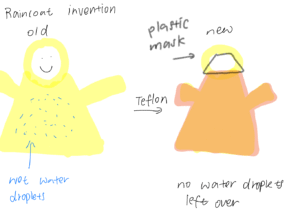 Introduction: The Problem with Wet Raincoats
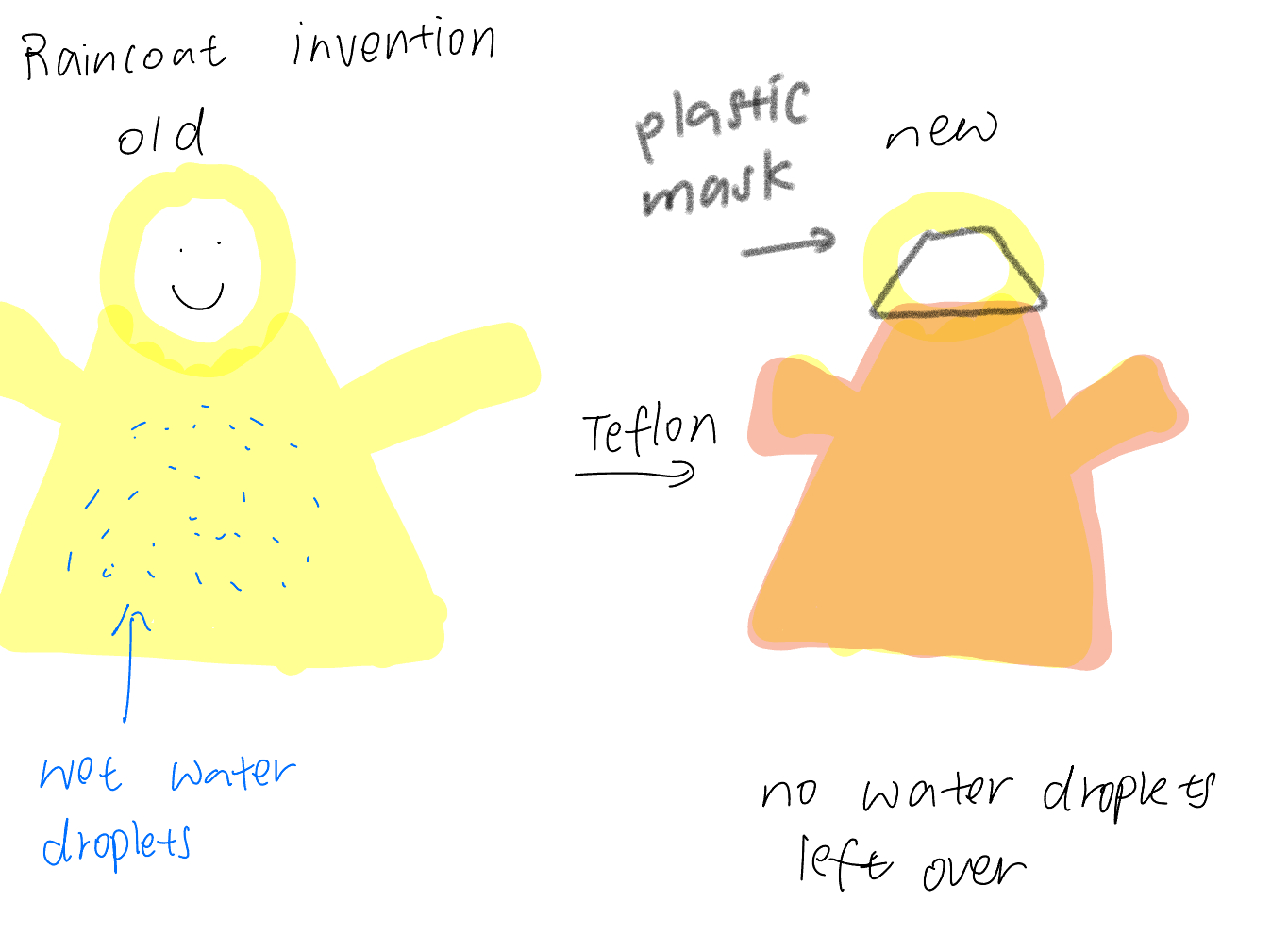
Imagine walking through rain and not seeing a single wet spot on your raincoat afterward. Most rain jackets protect you from getting soaked, but when the storm passes, you’re often left with dark streaks or damp patches on your clothes. These wet traces come from water that clings to the surface or soaks in slightly, making the coat look and feel less than perfect. Even the usual waterproof materials like nylon and polyester eventually show these marks, especially after you’ve worn them for a while.
Why Teflon Is Different
Teflon, also called PTFE, is famous for not letting things stick to it. That’s why you find it in nonstick frying pans and fancy lab gear. For raincoats, what matters is Teflon’s super-low “surface energy.” Think of surface energy as how much a material “wants” to attract water or let it spread. Teflon’s is about 18 millinewtons per meter, which is much lower than most plastics or fabrics. When rain hits Teflon, the water forms round droplets and rolls right off instead of spreading out or soaking in. This happens because the contact angle—the way a droplet meets the surface—is very large, often over 150 degrees. The bigger this angle, the less chance there is for wet marks to form.
If you zoom in on Teflon with a microscope, you’d see that its smooth surface, or even tiny nano-sized roughness added by plasma treatment, makes it even harder for water to “hold on.” This is similar to how lotus leaves stay clean in the wild—a trick called the “lotus effect”—since water picks up dirt as it rolls away.
Making the Material
There are a few ways to give fabric this Teflon power. One is to dip the fabric—usually nylon or polyester—into a liquid PTFE solution. After that, it’s baked at a high temperature so the Teflon layer sticks well. Another method uses a plasma — a kind of energized gas — to roughen the surface of the cloth before a fine Teflon spray is applied. This roughness on the microscopic scale helps water droplets sit up high and roll away easily. A third way uses a thin, expanded Teflon (ePTFE) layer, like you find in Gore-Tex. This ePTFE is full of tiny holes just big enough to let sweat escape but too small for rain, making the coat both waterproof and breathable.
How It’s Tested
To see if these new raincoat materials really work, scientists check how water interacts with the surface. First, they measure the “contact angle” by placing a tiny drop of water and seeing how round it stays. If it’s above 150 degrees, that’s a great sign. Next, they tilt the fabric to see at what angle the water starts rolling away. The lower the angle, the more water-repellent it is—ideally less than five degrees. High-speed cameras catch whether any water sticks behind as a trace. There are also tests for how well the fabric breathes, and how the coating stands up to being rubbed or folded, since nobody wants a raincoat that only works when it’s brand new.
What’s Been Found
When coated with Teflon, the fabric doesn’t just repel water in the lab—it stays free of wet streaks and dark patches even after you bend it or rub it. Expanded Teflon membranes work well, too, but sometimes a little water gets into stitched seams. Standard raincoat materials, like those with a simple polyurethane or PVC coating, tend to darken or show traces after rain because they let a little water stick or soak in. The Teflon designs solve this.
However, there’s a tradeoff. If you use a thick layer of PTFE, it can make the fabric nearly airtight, trapping sweat and making you uncomfortable. The best designs mix superhydrophobic coatings with a “breathable” textile underneath, so rain rolls off but you stay cool and dry on the inside.
Looking Ahead
New raincoats could do more than keep us dry; they could hide every sign that it ever rained in the first place. That’s what makes Teflon so promising for rainwear. There’s still work to be done, especially in making these materials eco-friendly and finding ways to repair or renew the coatings over years of use. Fabric scientists are trying things like self-healing polymers, special surface patterns made with lasers, and mixing Teflon with safer chemicals to make the ultimate “invisible trace” raincoat.
References
Barthlott, W. & Neinhuis, C. (1997). Purity of the Sacred Lotus. Planta 202, 1–8.
Wilkes, R. W. T. (1976). Surface Energy of PTFE and Its Copolymers. J. Colloid Interface Sci. 55, 29–38.
Gore Inc. (2022). Understanding ePTFE Membranes. Technical Bulletin. -

Music Influence in Daily Life
Have you ever heard that one’s emotions can be greatly influenced by music alone? Music can be used to manipulate the philosophy of a person from a young age. It can calm down or bring discomfort to an adult. Music is encoded into human traditions and cultures.
Patriotism in Culture
It is known that since our ancestors’ time, education has been a fundamental part of the culture to nurture children into responsible and dependable adults. Borea’s area in the left hemisphere of the brain links to language and speech production. This is where music resides, hence music can evoke powerful emotions (Pianka, 2012). Professor Pianka (2012), an evolutionary ecologist, also criticized that music was exploited by leaders to arouse their people into wars, using national anthems to evoke patriotism and inflame tribal instincts. In fact, this does not only apply to soldiers, but also young children and working adults.
In the book “Patriotism and Nationalism in Music Education”, many music education philosophers agree that music education is a medium of instilling patriotism in children (Hebert & Kertz-Welzel, 2016, p. 11). Take Taiwan for example, national identity is a sensitive issue that is strongly reflected in school curricula. The music curriculum is designed to promote students’ personal and national identities in the new Taiwan (Hebert & Kertz-Welzel, 2016, p. 67). In the past, corrupted politicians wanted to strengthen the relationship between citizens and their own country, which in turn would support their position in power. Fortunately, Hebert and Kertz-Welzel (2016, p. 40) noted that with the lesson from Germany, the time for music education as a means for nationalistic or patriotic education is over.
In modern days, this situation occurs more in culture than politics. For example, Pianka (2012) suggests sports fans in opposing groups using their team’s theme song to elicit passion is a form of conflict influenced by music.
Nature in Music
Aside from childhood education, religion is part of many people’s lives, which feels incomplete without listening to the music and singing. Patrick Whelan, a Harvard Medical School lecturer, suggested that church music “puts everyone in the same emotional space” (Eck, 2024).
Whelan suspects this is due to evolutionary biology. Earliest nocturnal mammals had to rely on being hyperfocused and hyperattentive for survival, which likely adapted into live music today (Eck, 2024). The human brain can tag acoustic cues as familiar or unfamiliar. Church attendants have been listening to choir since their childhood, so indeed the music is familiar to them. Eck (2024) stated that “the valence of the music, which signals whether the music feels positive, negative, or somewhere in between, influences the autonomic nervous system (ANS)”, which can also be influenced by the familiarity of the music. This is the reason why a person can feel discomfort from listening to infamous or heavy metal music if they are growing up not familiar with the genre.
Additionally, a study (Song et al., 2023) revealed that music familiar to nature sounds bring comfort, relaxation, and lower negative mood. The study suggests that despite most people now residing in urban areas, participants are more at rest with nature sounds than urban sounds. Song and others (2023) believe that the reason is due to how the ancestors have long been living with nature, while the accelerated industrialization and urbanization only occur in recent centuries. There’s a suggestion of inheritance involving music familiarity, though family environment can be a larger factor as Whelan suggests.
Healing of the Brain
Sometimes, music can be a cure. According to Eck (2024), there is growing evidence that “listening to Mozart’s Sonata for Two Pianos in D Major can reduce the frequency of seizures in some people with epilepsy”. Eck suggested that “by identifying the exact type of music able to provoke a particular cognitive, motor, or emotional response, there could be progress toward healing, improving, or compensating for disrupted brain function in various diseases.” However, further knowledge about this topic requires more research and may not provide concrete evidence in a few upcoming years.
Meanwhile, adults deal with a lot of stress nowadays. However, there is a lack of free mental healing resources. Relaxing music would be the best choice for most people. Interestingly, ASMR-triggering music is found to reduce stress equally as relaxing sounds like nature (Paszkiel et al., 2020). Visiting a natural environment is also a good option to relieve stress (Song et al., 2023). Since traveling is not a choice for busy people within cities, nature sounds (in addition to relaxing music) can easily be accessed through various platforms on the Internet.
References
Eck, A. (2024, March). How music resonates in the brain. Harvard Medicine Magazine. https://magazine.hms.harvard.edu/articles/how-music-resonates-brain
Hebert, D. G., & Kertz-Welzel, A. (2016). Patriotism and nationalism in music education. Routledge.
Paszkiel, S., Dobrakowski, P., & Łysiak, A. (2020). The impact of different sounds on stress level in the context of EEG, cardiac measures and subjective stress level: A pilot study. Brain Sciences, 10(10), 728. https://doi.org/10.3390/brainsci10100728
Pianka, E. R. (2012). Can Human Instincts Be Controlled?. Human instincts. http://www.zo.utexas.edu/courses/thoc/HumanInstincts.html
picryl. (2017). Music melody musical note, music. picryl. Retrieved November 28, 2025, from https://picryl.com/media/music-melody-musical-note-music-93af15. Creative Commons CC0 1.0 Universal Public Domain Dedication license
Song, I., Baek, K., Kim, C., & Song, C. (2023). Effects of nature sounds on the attention and physiological and psychological relaxation. Urban Forestry & Urban Greening, 86, 127987. https://doi.org/10.1016/j.ufug.2023.127987