Category: today i learned (til)

health, fitness, medicine, environment, ecology, how to learn tricky topics in science and math, new discoveries, news, current events

  • The Price of Being Too Good Too Soon

    The Price of Being Too Good Too Soon

    As sports have become increasingly globalized, the race to become the best has intensified, with athletes from across the world competing against each other, many training year-round, every day to sharpen their craft and become the next great success story. Personally, I began playing soccer at three. I played in high-level tournaments across the country, traveling to states like Texas and California and playing against the best amateur and youth players the country had to offer. I practiced daily up until high school, and hundreds of thousands of people share similar experiences, dedicating thousands of hours to their favorite sports.

    Youth Sports Environment

    In basketball, AAU circuits now push athletes as young as 10 into professional-like schedules where they train with NBA trainers, do NBA drills, play with multiple teams, and play in tournaments every weekend. In football, kids hit the weight room as early as middle school, training daily to become the strongest and the fastest versions of themselves. Olympic skater Alysa Liu recalls that her childhood training regimen at times prevented her from drinking water and ultimately prompted her to retire from skating at 16, illustrating how early specialization can push athletes beyond healthy limits (Yahoo Sports, 2024).

    Science Behind Excess Training

    You may think this intensive, clear‑cut training style produces the best athletes and leads to the greatest amount of success, as Alysa Liu has two Olympic gold medals, and LaMelo Ball (the figurehead of modern AAU basketball has enjoyed great success in the NBA); however, pediatric biomechanics and physiology research illustrates that early sports specialization increases the risk of overuse injuries chronic fatigue, and psychological burnount. According to studies by Luo et al. (2025) and Post et al. (2021), younger athletes who focus on a single sport before age 14 sustain twice as many joint or tendon injuries as their multisport peers.

    Children have different musculoskeletal systems, so early practices pose a greater risk. Children have open growth plates, more elastic tendons, and incomplete neuromuscular coordination. Repetitive movements, such as pitching, sprinting, jumping, or kicking, cause micro-damage to accumulate faster than it can be repaired (Johns Hopkins Medicine, 2024). In baseball, pitchers are explicitly warned against pitching too often because throwing stresses the rotator cuff of the shoulder and the ulnar ligament attachment, which can lead to Tom John injury (A Tommy John injury is a tear or damage to the ulnar collateral ligament (UCL) in the elbow), which can end a pitcher’s career (Johns Hopkins Medicine, 2024). In gymnastics, I have personally seen stress fractures happen to my sister and her teammates due to the constant impact from flipping and tumbling. 

    Regarding explosiveness, the ability to generate force for rapid acceleration depends on motor unit recruitment and intermuscular coordination (Enoka & Duchateau, 2017). Overuse injuries and fatigue worsen one’s ability to recruit motor units and coordinate activity. Furthermore, early specialization prevents young athletes from exposing their nervous systems to diverse movement patterns, thereby narrowing their motor capabilities.

    Physiological Impacts

    Physiologically, the human body is not meant to handle the year-round training that adolescent athletes face. Early-specialized athletes do not receive enough recovery. Recovery not only allows athletes to perform as well in the next session but also helps muscles, tendons, and the nervous system adapt to stress and facilitate growth. Chronic training can also affect growth, with training stress increasing cortisol, which suppresses immune function, growth hormone, and muscle protein synthesis, leading to poorer tissue repair and greater accumulation of fatigue (Meeusen et al., 2010). In fact, a study found that among highly specialized youth basketball players younger than 14, over half reported feeling physically exhausted and getting less than 8 hours of sleep, which can impair energy replenishment and muscle recovery (Meisel et al., 2022). A case study of the physiological impact of stress comes from soccer, where the greatest teenager to ever touch a soccer ball, Lamine Yamal, has experienced chronic groin injuries and, as of recently, tore his hamstring logging more minutes than any soccer player his age ever. His injury illustrates that even generational talents cannot best unsustainable loads.

    Mental Health in Youth Athletics

    The immense training of young athletes affects them beyond the physiological level, as the constant pressure to perform, the increased competitiveness of youth sports, and the limited autonomy of athletes have created a toxic environment that breeds burnout and emotional exhaustion. According to a study, early-specialized athletes report lower enjoyment and higher dropout rates in their respective sports, suggesting that the mental strain of youth competitive sports diminishes athletes’ intrinsic motivation  (Luo et al., 2025). The pressure placed on these young athletes can rob us of special talents, as in the case of the aforementioned Alysa Liu; her intense training regimen nearly robbed the world of her talents, as she has won two Olympic gold medals. 

    Conclusion

    The increased mental strain and physiological issues that have accompanied the ever-growing competitiveness and intensity of youth sports illustrate that talent cannot overcome biology. Humans have physiological limits, and while early specialization may lead to more refined skills, it causes athletes to reach those limits earlier, worsening muscle wear and motivation. The emotional burnout and fatigue among youth athletes are predictable outcomes of excessive training. To protect the next generation of athletes, society must prioritize rest and recovery to support their mental health and performance. In the end, the cost of being good too soon is rarely worth paying.

    References:

    Enoka, R. M., & Duchateau, J. (2017). Rate coding and the control of muscle force. Journal of Physiology, 595(9), 2853–2864. https://doi.org/10.1113/JP273196 

    Johns Hopkins Medicine. (2024). Ulnar collateral ligament (UCL) injury of the elbow. https://www.hopkinsmedicine.org/health/conditions-and-diseases/ulnar-collateral-ligament-ucl-injury-of-the-elbow 

    Luo, Z., et al. (2025). Early sport specialization in a pediatric population: A rapid review of injury, function, performance, and psychological outcomes. Clinics and Practice, 15(5), 88. https://www.mdpi.com/2039-7283/15/5/88 

    Meeusen, R., et al. (2010). Prevention, diagnosis, and treatment of the overtraining syndrome: Joint consensus statement of the European College of Sport Science and the American College of Sports Medicine. European Journal of Sport Science, 10(1), 1–24. https://doi.org

    Meisel, C., et al. (2022). Age of early specialization, competitive volume, injury, and sleep habits in youth sport: A preliminary study of U.S. youth basketball. Sports Health, 14(1), 1056301SPHXXX10. https://pubmed.ncbi.nlm.nih.gov/3475333

    Post, E. G., et al. (2021). Sport specialization behaviors are associated with a history of reported injury in youth athletes. Journal of Pediatric Orthopaedics, 41(8), 507–513. https://doi.org

    TrueSport. (2019, January 1). How to avoid athlete burnout in youth sports. https://truesport.org/preparation-recovery/avoid-athlete-burnout-youth-sports

    Yahoo Sports. (2024, March 17). Alysa Liu reveals “insane” training rule that once stopped her from drinking water. https://sports.yahoo.com/articles/alysa-liu-reveals-insane-training

  • The Dangers of Dye

    The Dangers of Dye

    Today, one of the most common issues someone will find scrolling through social media is with fashion. One of the problems lies in overconsumption, where people are buying way more clothes than they need, and throw out perfectly good pieces because they no longer like them.

    However, it is also important to consider the processes that it takes to make those clothes and the effect that those processes may have on the environment as well.


    Dyes in Textiles: Why is it an Issue?

    Clothes sold in stores can come in a plethora of colors. However, it is quite obvious that the fabric does not always start off that color. Fabrics must be dyed to be made into clothing, but the dying process can actually be harmful to the planet.

    However, dying fabric requires its own process; color is not simply added to a garment. First, the fabric must be stripped of its impurities and prepared with a chemical solution to ensure that the fabric can maintain an even color (Khattab, Abdelrahman, & Rehan, 2020). Only then can dye be added to the product, where it is later finished to ensure that the clothing maintains its color. 

    How is this possibly an issue? Well, not only is the dye in fabrics harmful to the planet, but it is directly harmful to consumers as well. While some customers have reported irritated skin due to their clothing, others who work as employees in the textile industry have reported developing contact dermatitis and asthma from prolonged exposure to the dye materials (Khattab, Abdelrahman, & Rehan, 2020). Additionally, the amount of water used in the fabric dyeing process has also resulted in a large amount of wastewater, which has found its way into streams. This has caused harmful chemicals to spread to the soil, which in return has caused harm to plants and animals in these areas. (Khattab, Abdelrahman, & Rehan, 2020).


    Dyeing with Algae

    One of the main solutions to this issue involve the use of algae, a group of photosynthetic organisms commonly found in the water. This means that they are capable of making their own food, consuming the carbon dioxide in the environment and releasing oxygen as a byproduct.

    According to one research article, algae reproduces rather quickly, taking mere hours to produce large populations (Ayyanar et al., 2023). Additionally, algae would not compete for the same resources that typical plants would, since it can grow in sea water and waste water. This means that producing algae could possibly take fewer resources than the typical agriculture used for textiles. 

    The article also writes about how algae has a large number of uses, so producing a large amount would not go to waste. Not only can algae be used to screen the waste water that is so harmful to our environment, but it can also be used to make plastics, yarn, fertilizers, and even cosmetics (Ayyanar et al., 2023). Moreover, algae is biodegradable, decomposing at a rate that is even faster than the cotton that is traditionally used to make fabrics (Ayyanar et al., 2023). This means that farming algae could serve as a potential solution to reducing the major environmental effects of the clothing industry in today’s world.

    Although it does not hold the answer to all of the problems with the industry, it can be a great stepping stone towards progress.


    Works Cited

    Khattab, T.A., Abdelrahman, M.S. & Rehan, M. (2020). Textile dyeing industry: environmental impacts and remediation. Environ Sci Pollut Res 27, 3803–3818. https://doi.org/10.1007/s11356-019-07137-z 

    Ayyanar, I., Bharathi, S.J. G., Ravindran, A., Rajendran, R., Arulprakasam, A., Vellaisamy, B. (2023) Chapter 14 – Algae materials for textile industries,In Developments in Applied Microbiology and Biotechnology, Algae Materials, Academic Press, 231-246, ISBN 9780443188169, https://doi.org/10.1016/B978-0-443-18816-9.00018-6. 

  • The Conspiracy of the 12 Scientists!

    The Conspiracy of the 12 Scientists!

    Missing and dead. Where did they go, and what happened? That is probably what you are wondering, and so am I. Say their names: Carl Grillmair, Nuno F. G. Loureiro, Monica Reza, Frank Maiwald, Michael David Hicks, Amy Eskridge, Jason Thomas, William “Neil” McCasland, Steven Garcia, Melissa Casias, Matthew James Sullivan, and Zobaidul Amin. Reports say that lawmakers and federal officials are looking into several deaths and disappearances involving people with ties to nuclear, space, or other scientific programs, which has now become widespread news across the country (Lubin, 2026; USA TODAY, 2026). Some of these individuals had connections to nuclear and space programs, which is interesting because it raises questions about whether they were involved in a revealing discovery. However, some family members of these scientists do not believe there are major concerning factors connecting their deaths or disappearances to a larger mystery (Lubin, 2026). Republican lawmakers raised this red flag, although they have not provided much context.

    You may be wondering what my opinion is. I do not understand why lawmakers would inform the public about this situation but not give clear context. So much of the government is hidden in ways we do not always understand, and certain files and pieces of information are only released years later. These cases span from the beginning of 2023, yet not many people have been talking about them recently. I walk around campus and hear many other conversations involving the government and politics, yet I cannot believe this has not been mentioned once. Science is extremely important because it forms the foundation of information, discovery, and growth around the world. Research supports the idea of how public trust in science depends heavily on clear communication, especially when uncertainty is involved and that communicating uncertainty can affect how communities perceive scientific information. (Kerr et al., 2023) However, others argue that misinformation can destroy public understanding and trust in democratic decision-making with our government. (Lewandowsky et al., 2023) These officials giving concerning information without explanation raises a huge flag of confusion, frustration and fead which leads everyone into the question: What did these people know?

    Did they find extraterrestrial life or a chemical that could potentially save lives on another planet? The possibilities feel endless, and yet nothing clear has been revealed. Was it our own government, or another country, that did not want life-changing information to come out? It does not add up that one of the deaths has been linked in reports to a mass shooter, while other cases involve missing people, suicides, or deaths with limited public information (Lubin, 2026). The story seems to move in many different directions, which makes the situation feel messy and confusing overall. Some people argue that it is unnecessary to release this kind of information if officials do not even have the full context themselves.

    Personally, I will be waiting for day-by-day updates on this situation. Could it possibly be connected to powerful people or hidden networks, which may explain why some of these individuals disappeared? I think that if I were involved in this as an aspiring dentist who wants to work in biotech, I would be scared about the direction the world is heading. Our world is moving quickly, not only in science but in many other fields as well, and it often seems as though people with power are controlling how these advancements are handled. I am scared, and this is not me trying to scare others. I simply want to raise awareness.

    Kerr, J., van der Bles, A. M., Dryhurst, S., Schneider, C. R., Chopurian, V., Freeman, A. L. J., & van der Linden, S. (2023). The effects of communicating uncertainty around statistics, on public trust. Royal Society open science, 10(11), 230604. https://doi.org/10.1098/rsos.230604

    Lewandowsky, S., Ecker, U. K. H., Cook, J., van der Linden, S., Roozenbeek, J., & Oreskes, N. (2023). Misinformation and the epistemic integrity of democracy. Current opinion in psychology, 54, 101711. https://doi.org/10.1016/j.copsyc.2023.101711

    Lubin, R. (2026, April 24). 12 US scientists have gone missing or died. The mystery has become the talk — and worry — of Washington. The Independent. https://www.the-independent.com/news/world/americas/scientists-missing-dead-fbi-investigation-b2963785.html

    USA TODAY. (2026, April 23). Deaths and disappearances of US scientists: See the list. USA TODAY. https://www.usatoday.com/story/news/nation/2026/04/23/deaths-disappearances-of-us-scientists-see-the-list/89732321007/

  • Gacha or Gambling?

    Gacha or Gambling?

    When someone tells you that they have a gambling addiction, what is the first thing you think of? The most stereotypical image would be a person in the casino, playing on slot machines. Perhaps the first thing that comes to mind is online sports betting instead. But has anyone considered video games?


    Rising in Popularity: GACHA

    One of the most popular genres of games that have developed throughout the past few years include a “gacha” system. The term stems from the Japanese word “gachapon”, which refers to small machines where people can exchange coins for a random toy capsule (Reyes, 2025). 

    According to Epic Games, some of their most popular games include Genshin Impact, Honkai Star Rail, Wuthering Waves, Zenless Zone Zero, and Where Winds Meet all employ a gacha system. While these games are free to play, they often include gacha systems as a way to win prizes such as playable characters, weapons, or cosmetics. Users can either play the game and earn in-game currency or pay real money to buy “pulls” for these games. The “pulls” are then used in the gacha system, where players try their chances at getting the prize that they need. These are often characters or cosmetics that are quite rare, incentivizing players to keep playing or spending money to get the prizes that they want. 

    In a way, this can be seen as gambling. Players are often paying real money for the random chance at winning a prize that is not guaranteed to them. Although real money is not required, some games make it difficult to earn pulls through gameplay only. 


    The Psychology of Addiction

     Addiction lacks a universal definition in psychology, making it difficult to determine what is truly an addiction or not. According to one article, some have defined addiction as “continual, excessive use and ‘loss of control’” of something to the point of dependence (Wanigaratne, 2006). In other words, addiction can be defined as the use of something to the point where it is no longer controllable for a person. They simply keep going back to it, as if they are dependent on it. With this definition, anything can be an addiction, not just substances. Sure, things like drugs and alcohol are some of the most common ideas associated with addiction, but with this definition, recreational activities such as games or gambling can be addictive as well.

    There are several different theories that psychologists have come up with to try and explain addiction. Some have theorized that it is a result of conditioning, where the results of the addictive behavior can act as positive reinforcers the same way food or sex have been used in the conditioning process (Wanigaratne, 2006). For example, gacha games often offer the most desirable prizes as the rarest ones, making it quite difficult for players to get the item that they want. However, these games often have a “pity system”, where there is a guaranteed chance of receiving a rarer item based on the number of times a player has already pulled (Reyes, 2025). Although the specific item that the player wants is not guaranteed, they are given a reward for continuing to feed into the behavior more and more. Additionally, once the player receives the item that they want, the event can act as a positive reinforcer, conditioning players to continue to buy more pulls as they did before. 


    Issues with Gambling on the Internet

    As always, enjoying mobile games or betting does not always equal addiction. However, it is important to understand how making such games available to the general public can be dangerous. For instance, the games on the Internet have certainly made gambling much more accessible, which can make it easier for people to develop harmful habits. Some studies have noted that mobile app users typically visit the apps on their phone on a frequent, habitual basis, putting those who gamble on the Internet at a higher risk than those who do not (James, O’Malley, & Tunney, 2016). Most of the games mentioned before are available on mobile devices as well, making them extremely easy to play at any time, anywhere. Although this does not necessarily mean that they can result in harmful habits, it is certainly easy for a person to play the game every single day and regularly come back to paying for more pulls whenever they want.

    This does not mean that gacha games should be banned overall, but it is important for parents and players to be careful when playing. Make sure to take breaks and think before making any big purchases on a game!


    Wanigaratne, S (2006). Psychology of addiction. Psychiatry, 5(12), 455-460. https://doi.org/10.1053/j.mppsy.2006.09.007 

    James, R.J.E., O’Malley, C., Tunney, R.J. (2016). Understanding the psychology of mobile gambling: A behavioral synthesis. British Journal of Psychology, 108(3), 608-625. https://doi.org/10.1111/bjop.12226 

    Reyes, J. (2025). Gacha games explained: Banners, pulls, pity systems, and more. Epic Games. https://store.epicgames.com/en-US/news/gacha-games-explained-banners-pulls-pity-systems-and-more 

  • A New Bumpy Buddy in the Deep Sea

    A New Bumpy Buddy in the Deep Sea

    People often say that humans have only discovered 5% of the ocean to this day. While this exact number is often argued, it is no secret that much of the ocean is unknown to us. However, scientists have recently made a discovery of a new fish in the depths of the sea: the bumpy snailfish. 


    What is a snailfish?

    The bumpy snailfish, also known as Careproctus colliculi, belongs to the Lipradae family, which is one of the only few species on Earth that have adapted to live between what are considered the “abyssal deep” and “hadal deep” parts of the ocean (Scharzans & Gerringer, 2023). These parts of the ocean are typically extremely difficult to live in due to the immense water pressure, darkness, and lack of food. However, it seems that these depths are where snailfish (fish in the Lipradae family) thrive. 

    There are currently 450 accepted species of snailfish. Scientists identify them through their lack of scales along with a suction disk on their pelvis, which allow them to attach to other surfaces (Gerringer et al., 2025).


    Discovery of the Bumpy Snailfish 

    According to the Monterey Bay Aquarium Research Institute, the fish have large heads, while the rest of the body is made up of a jelly-like substance (Nava, 2025). Snailfish are given their name because they have a disk on their bellies that allow them to attach to the ocean floor, much like a snail would (Nava, 2025). This newly discovered version of the snailfish is a light pink color, a round head, large eyes, and a bumpy texture on its skin. Thus, it was named the bumpy snailfish. 

    Researchers describe the hadal trenches as depths greater than 6000 meters below sea level, where it is easier to study snailfish that father around bait falls (Gerringer et al., 2025). However, it is more difficult to find them in the abyssal depths, which are around 3000 to 5000 meters deep in the ocean (Gerringer et al., 2025). This is what makes the bumpy snailfish special, as it is a new lifeform in the abyssal depths of the ocean for researchers to study.

    In order to determine if these were a new species of fish, clips of the fins were collected from dissected snailfish. These tissues were used for DNA extraction, where researchers were able to compare the DNA sequences of previous snailfish to this one (Gerringer et al., 2025). 


    Works Cited

    Gerringer, M. E., Suplicz, S., Palmeri, J.L., Fregosi, L., Woodworth, B.H., McMahon, E., Shepard, M., Peoples, L.M., Drazen, J.C. (2025). Descriptions of Three Newly Discovered Abyssal Snailfishes (Liparidae) from the Eastern Pacific Ocean. Ichthyology & Herpetology, 113 (3), 487-506. https://doi.org/10.1643/i2024069 

    Nava, R. (2025). MBARI’s advanced underwater technology reveals a new species of deep-sea snailfish. Monterey Bay Aquarium Research Institute. https://www.mbari.org/news/mbaris-advanced-underwater-technology-reveals-a-new-species-of-deep-sea-snailfish/ 

    Scharzhans, W.W., Gerringer, M.E. (2023). Otoliths of the deepest-living fishes. Deep Sea Research Part I: Oceanographic Research Papers, 198. https://doi.org/10.1016/j.dsr.2023.104079 

  • Burps to Breakthroughs: Reducing Livestock Emissions

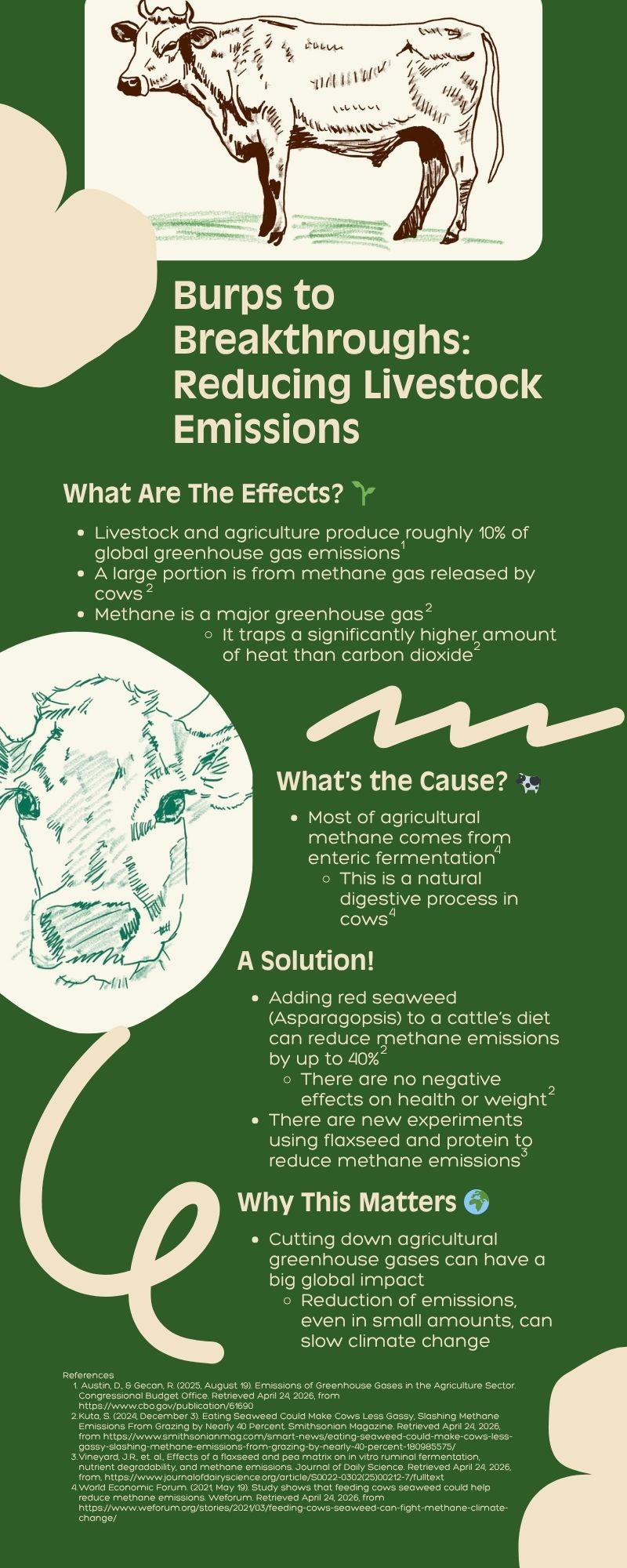
    Burps to Breakthroughs: Reducing Livestock Emissions

    What Are The Effects? 🌱

    • Livestock and agriculture produce roughly 10% of global greenhouse gas emissions.
    • A large portion is from methane gas released by cows.
    • Methane is a major greenhouse gas
      • It traps a significantly higher amount of heat than carbon dioxide.

    What’s the Cause? 🐄

    • Most of agricultural methane comes from enteric fermentation.
      • This is a natural digestive process in cows.

    A Solution!

    • Adding red seaweed (Asparagopsis) to a cattle’s diet can reduce methane emissions by up to 40%.
      • There are no negative effects on health or weight.
    • There are new experiments using flaxseed and protein to reduce methane emissions.

    Why This Matters 🌍

    • Cutting down agricultural greenhouse gases can have a big global impact.
      • Reduction of emissions, even in small amounts, can slow climate change.

    References

    Austin, D., & Gecan, R. (2025, August 19). Emissions of Greenhouse Gases in the Agriculture Sector. Congressional Budget Office. Retrieved April 24, 2026, from https://www.cbo.gov/publication/61690

    Kuta, S. (2024, December 3). Eating Seaweed Could Make Cows Less Gassy, Slashing Methane Emissions From Grazing by Nearly 40 Percent. Smithsonian Magazine. Retrieved April 24, 2026, from https://www.smithsonianmag.com/smart-news/eating-seaweed-could-make-cows-less-gassy-slashing-methane-emissions-from-grazing-by-nearly-40-percent-180985575/

    Vineyard, J.R., et. al., Effects of a flaxseed and pea matrix on in vitro ruminal fermentation, nutrient degradability, and methane emissions. Journal of Daily Science. Retrieved April 24, 2026, from, https://www.journalofdairyscience.org/article/S0022-0302(25)00212-7/fulltext

    World Economic Forum. (2021, May 19). Study shows that feeding cows seaweed could help reduce methane emissions. Weforum. Retrieved April 24, 2026, from https://www.weforum.org/stories/2021/03/feeding-cows-seaweed-can-fight-methane-climate-change/


  • TikTok Effect on Academic Burnout

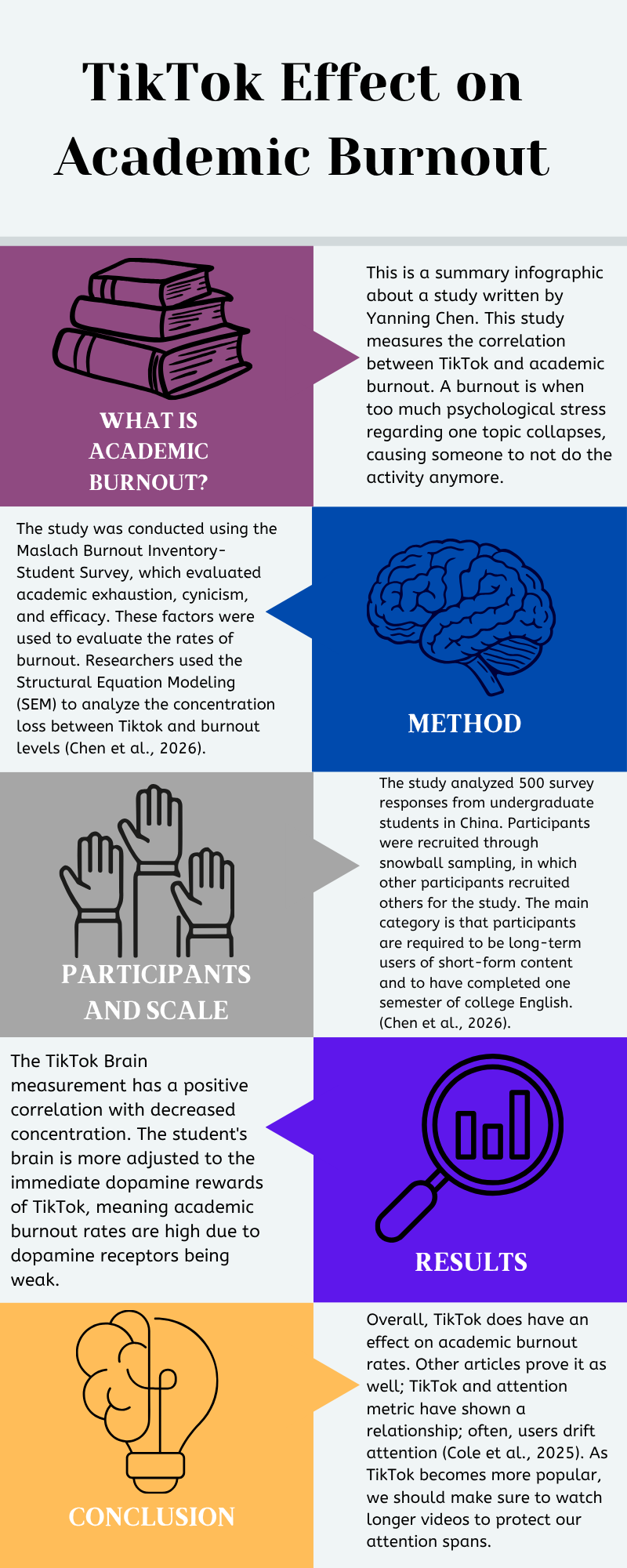
    TikTok Effect on Academic Burnout

    TikTok Effect on Academic Burnout

    What is Academic Burnout?

    This is a summary infographic about a study written by Yanning Chen. This study measures the correlation between TikTok and academic burnout. A burnout is when too much psychological stress regarding one topic collapses, causing someone to not do the activity anymore.

    Method

    The study was conducted using the Maslach Burnout Inventory-Student Survey which evaluated academic exhaustion, cynicism, and efficacy. These factors were used to evaluate the rates of burnouts. Researchers used the Structual Equation Modeling (SEM) to analyze the concentration loss between Tiktok and burnout levels.

    Participants and Scale

    The study analyzed 500 survey responses from undergraduate students in China. Participants were recruited through snowball sampling, in which other participants recruited others for the study. The main category is that participants are required to be long-term users of short-form content and to have completed one semester of college English.(Chen et al., 2026).

    Results

    The TikTok Brain measurement has a positive correlation with decreased concentration. The student’s brain is more adjusted to the immediate dopamine rewards of TikTok, meaning academic burnout rates are high due to dopamine receptors being weak.

    Conclusion

    Overall, TikTok does have an effect on academic burnout rates. Other articles prove it as well; TikTok and attention metric have shown a relationship; often, users drift attention (Cole et al., 2025). As TikTok becomes more popular, we should make sure to watch longer videos to protect our attention spans.

    References

    Chen, Y., Hu, J., & Cheng, L. (2026). Academic burnout in the TikTok era: a battle between pleasure and concentration. Frontiers in Psychology, 17, 1774030.

    Cole, B., Santana, A. D., Hu, X., & Hopp, T. (2025). TikTok Usage Effects on Attention to News Reading: An Eye-Tracking Study. Journal of Broadcasting & Electronic Media, 69(4), 365-380.