Category: Funny Bone

science humor, comics

  • Who doo? You do.

    Who doo? You do.

    **Disclaimer: This post is about poop.

    A few days ago I stumbled upon this webpage and couldn’t stop laughing. I don’t think I have ever laughed so hard in my entire life. I was crying, a stitch in my side. Any time I would regain my composure, I would lose it again within 0.237 seconds of reading another line. So of course, after struggling through the page, I decided to consult my trusty friend YouTube for some poop-themed videos. Here’s one of my favorites: 3 Types of Girlfriends Based on Pooping Habits (it’s a little vulgar). Now, I’m not entirely sure why I find these types of things so entertaining, but I think I find them funny because they are usually true. Some people don’t like to admit they poop, and they definitely don’t want to talk about it, but why is that so? Everyone poops!

    Have you ever wondered how poop is formed, or why it comes in different shapes and sizes? Well, let me enlighten you. After food passes through the mouth, esophagus, and stomach, being digested by various amylases and gastric juices, it makes its way into the small intestine where the majority of the fluid and nutrients from the digestive process and from the food you eat are reabsorbed by the body. An additional amount of fluid is reabsorbed in the large intestine, also known as the colon.

    This is where the magic happens.

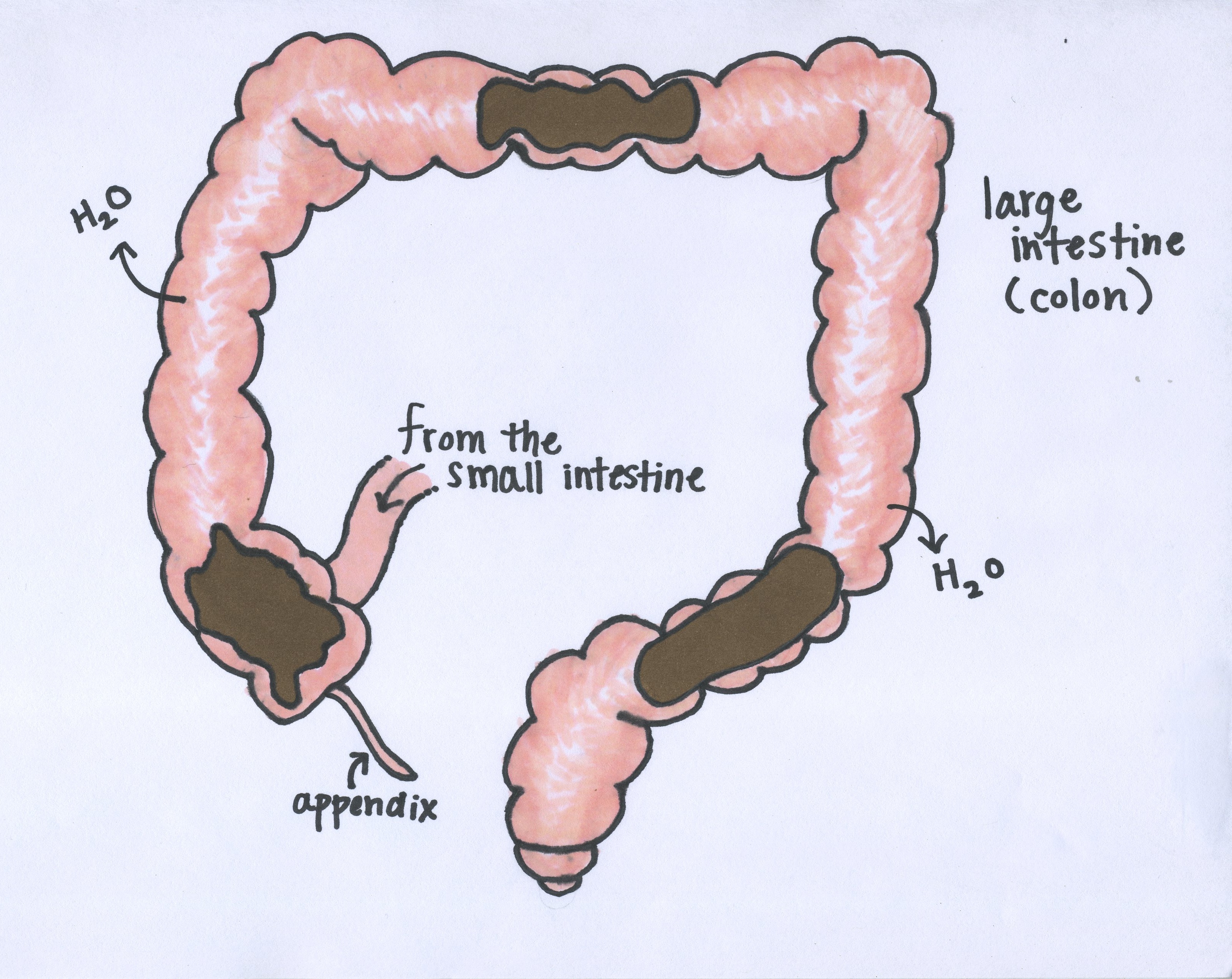
    Digested food moves through the colon via a type of smooth muscle contraction called peristalsis. As it moves along, the poop starts to take shape as the fluid (referred to as H2O in the diagram below) is drawn out. As more fluid leaves, the poop becomes more solid. During times of viral or bacterial infections, fluid may not be properly reabsorbed, causing the common side effect of diarrhea. Have you ever been constipated? This is a result of poop moving too slowly through the colon, causing too much fluid to be reabsorbed. Depending on what you eat, your poop may vary in appearance. If you eat some corn, you may see it again since our bodies can’t digest the cellulose outer layer. Ever drink a brightly colored slushy saturated with food coloring? Your poop likely changed color.

    The digestive tracts of carnivores differ from those of herbivores due to the different digestive requirements each type of animal has. Take a koala for example, whose cecum (the section of colon below the attachment point of the small intestine) is about 2 meters long! This longer cecum enables the koalas to digest leaves and provides a greater amount of surface area for nutrients to be absorbed. Check out this koala who, instead of eating leaves, is chomping on an apple. I wonder how long it took for that apple to become poop…


    Sources:

    Campbell, Neil A., and Jane B. Reece. Biology. San Francisco: Benjamin Cummings, 2002. Print.

  • A Scientist’s Perspective on Why Pie is Yummy and Delicious and Deserving of Your Respect and Admiration

    A Scientist’s Perspective on Why Pie is Yummy and Delicious and Deserving of Your Respect and Admiration

    It is an indisputable fact that I am deeply, irreversibly, head-over-heels in love with pie. Apple. Pumpkin. Blueberry. Banana Cream. You name it, I’ll eat it.

    As Thanksgiving approaches, I find myself longing for a slice of warm apple pie with a big scoop of vanilla ice cream. I also find myself contemplating the scientific majesty that is an apple pie.

    What majesty, you say? Well, friend, allow me to take you on a journey — from orchard to oven, from farm to table. Prepare yourself. Cozy up. Grab your snuggie. A tall glass of hot chocolate wouldn’t hurt either. Of course you’ll need some marshmallows. Got the marshmallows? Good! Let’s begin.

    There are few evolutionary success stories as impressive as the apple’s. Think about it. This fruit was able to evolve a trait so desirable (its deliciousness) that we humans have taken it from its ancestral home in the mountains of Kazakhstan to every populated continent on Earth. We have immortalized the apple in art; we have juiced them, fermented them, sliced them, bobbed for them, dipped them in caramel, engineered machines for the sole purpose of coring them and, yes, made them into delicious pies.

    You might think with all its uses that the apple must be a simple, easy fruit to grow. Humans are lazy, right? Surely we wouldn’t grow a fruit like the apple so much if it weren’t an easy thing to do. Wrong. False. Incorrect. Lies!

    Apples are incredibly complex. Apples are extreme heterozygotes, meaning that the genes they inherit from their parents can be radically different between one apple and another apple on the same tree. If you were to grow a tree from a seed taken from a Granny Smith apple, you would most certainly, not obtain a tree filled with Granny Smith apples. Your apple tree would likely produce “spitters” — nasty, sour apples meant only to be spit out. Every so often a sweet apple would be grown by chance, but not with consistency.

    So how do we manage consistency today? How do we grow a Granny Smith apple tree? Well, in order to produce a Granny Smith apple tree, you would need to graft one. Grafting is a horticultural surgical procedure whereby the tissues from one plant are transplanted into another, allowing for asexual reproduction of the primary tissue. As a result of this process, the tissues from the donor plant fuse with the tissues of the host plant and the resulting fruits are born from the genes of the donor tissue.

    Without this process, apples would never have been domesticated; planting an apple tree would be like opening a box of chocolates — you’d just never know what you’d get.  It would be an adventure, yes, but 99 times out of 100, it’d be an unhappy one. Through grafting we have become slaves to the apple, spending billions of dollars per year on pesticides aimed at keeping the sweet apples we love away from the dark precipice of extinction. And for what? For pies. And to be perfectly honest, that’s all the reason we need.

    The next thing you’ll need for your pie is a crust. There are many recipes that one can use to make a pie crust. But so far as it is an indisputable fact that I am deeply, irreversibly head-over-heels in love with pie, it is also a fact that the best pie crust recipe is indisputably my great-grandmother’s recipe. But I will not be supplying you with this recipe. This is not a “how-to” guide. Get over it. I will however, confide in you, my dear reader, the identity of one crucial ingredient. It’s flour. I know. Revolutionary! But don’t tell anyone. It’s a secret. Now that you know this deep, dark secret, you probably have some burning questions. If you’re like me, the first question you are probably asking yourself is “What are the explosive properties of flour?” Lucky for you, I have the answer!

    As it turns out, flour is, indeed, an explosive substance. Flour is composed primarily of starch, which is, in turn, composed primarily of glucose. Glucose is highly combustible — it reacts with oxygen to produce carbon dioxide and water. When ignited by a flame, the sugars explode! Boom! Normally, this process is highly controlled — cells convert glucose into pyruvate through glycolysis and that pyruvate is then converted to carbon dioxide and water through the citric acid cycle and oxidative phosphorylation.

    Through these processes animal cells produce the energy needed for carrying on with their day-to-day metabolic processes and that’s all good and well, but it’s probably not the type of combustion you were thinking of. Where are the explosions? Where’s the excitement? Well … this is the excitement. Your cells have the ability to carry out explosive reactions in a manner so intricate and organized that they cause no harm to you whatsoever — in fact, they help you. On a second-to-second basis, your body is “exploding” sugars and harnessing their energy. So put that energy to good use. Invest it in digesting more pie.

    Of course there are many other ingredients that go into making the perfect apple pie (cinnamon, nutmeg, sugar, butter), but we will not address those here. We will, instead, end our journey with a discussion on ice cream — apple pie’s obligatory sidekick. Ice cream is a dairy product, meaning it is derived from mammalian milk. Humans have been consuming milk since the Neolithic revolution, but it wasn’t until Louis Pasteur invented pasteurization that dairy products such as ice cream could be made and stored for extended periods of time. Pasteurization is the process by which milk is heated and cooled in order to reduce the amount of pathogenic microorganisms in the product. Once pasteurized the milk is free to be used as an ingredient for whatever ice cream your heart desires! But as for me and my heart, we will desire vanilla.

    If you’ve stuck with me this far, congratulations, your dedication is about to pay off! How, you ask?! Why with a discussion on the colligative properties of rock salt, of course! If you wanted to make your own ice cream, you could do it by filling a bag with milk (1/2 cup), sugar (1 Tbs), and vanilla (1/2 tsp), sealing that bag, and placing it in a larger bag filled with ice (4 cups) and rock salt (4 Tbs). Gently massage your bag for 5 minutes, or so, and voila, you’ve made yourself ice cream!

    Witchcraft! You exclaim. No, silly! It wasn’t witchcraft. It was science.  You see, salt has the ability to lower the freezing point of water (meaning that it enables water to remain liquid beneath its freezing point).  For your ice cream, this means your ice/salt mixture will keep your milk/sugar mixture sufficiently cool for it to freeze into ice cream despite the fact that it’s sitting in your warm, cozy hands in your warm, cozy room. It also means you have a quick, easy way to make yourself a side dish for your apple pie!

    By now you’ve probably finished your tall glass of hot chocolate and are wondering what to do next. This article is almost over; you’ll soon be left on your own. What will you do? Well, if I may make a suggestion; go make an apple pie and some vanilla ice cream. Bake it. Eat it. Respect it. Admire it. After all, it came a long way to get where it is today. Also, pie is yummy and delicious.
  • Baaah Bye, Kudzu!

    Baaah Bye, Kudzu!

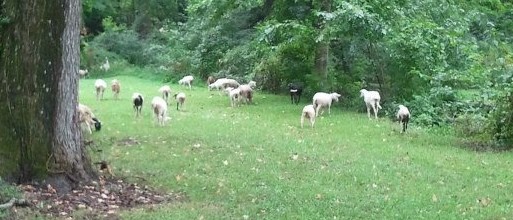
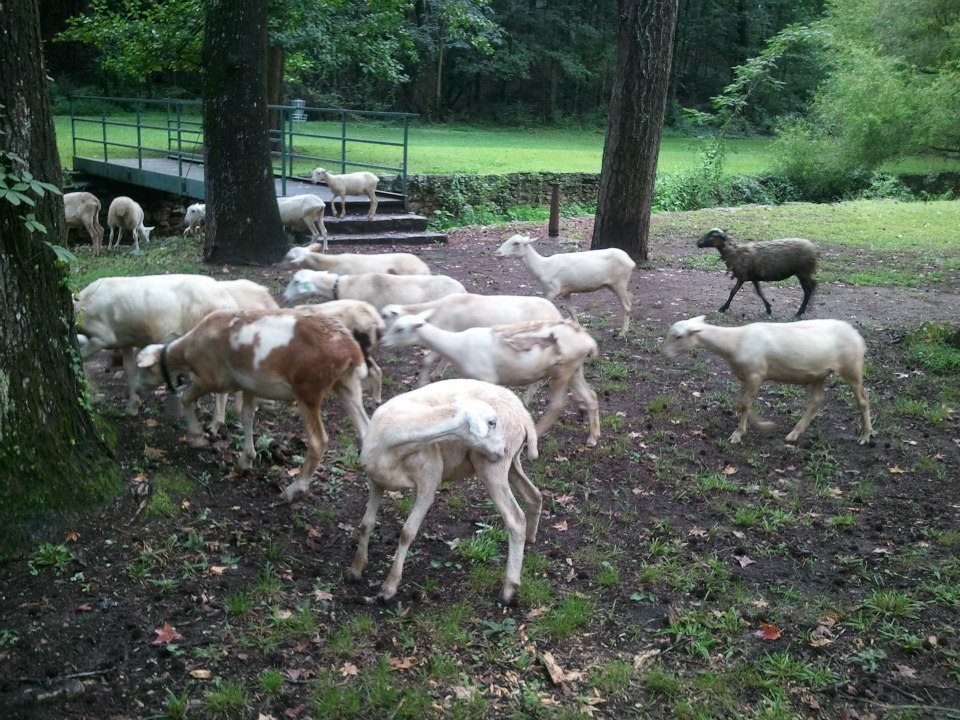
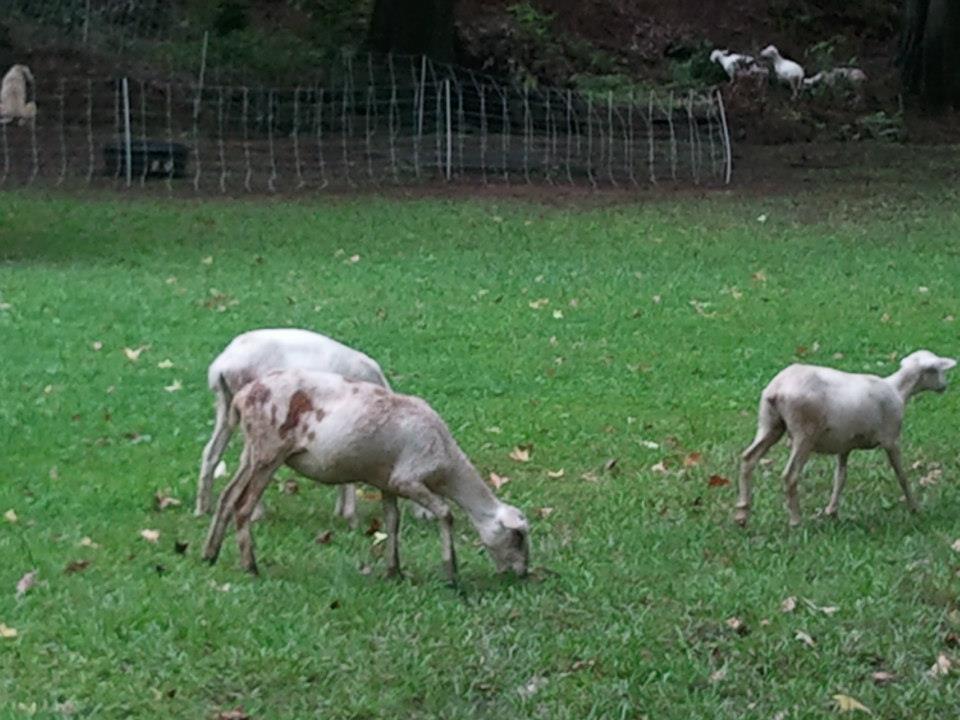
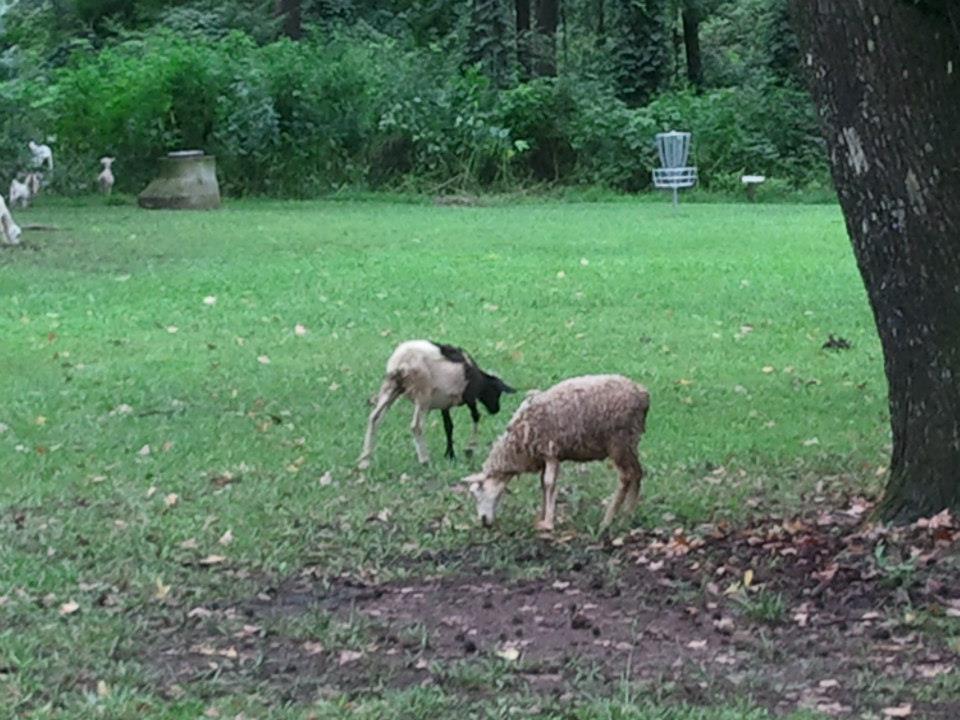
    Would you ever think sheep could be used in the place of a lawn mower? How could an animal do the same job as a piece of lawn equipment?! Well, in the case of managing kudzu, sheep (and goats) are doing a great job of keeping the invasive species at baaah. Uh… I mean bay.

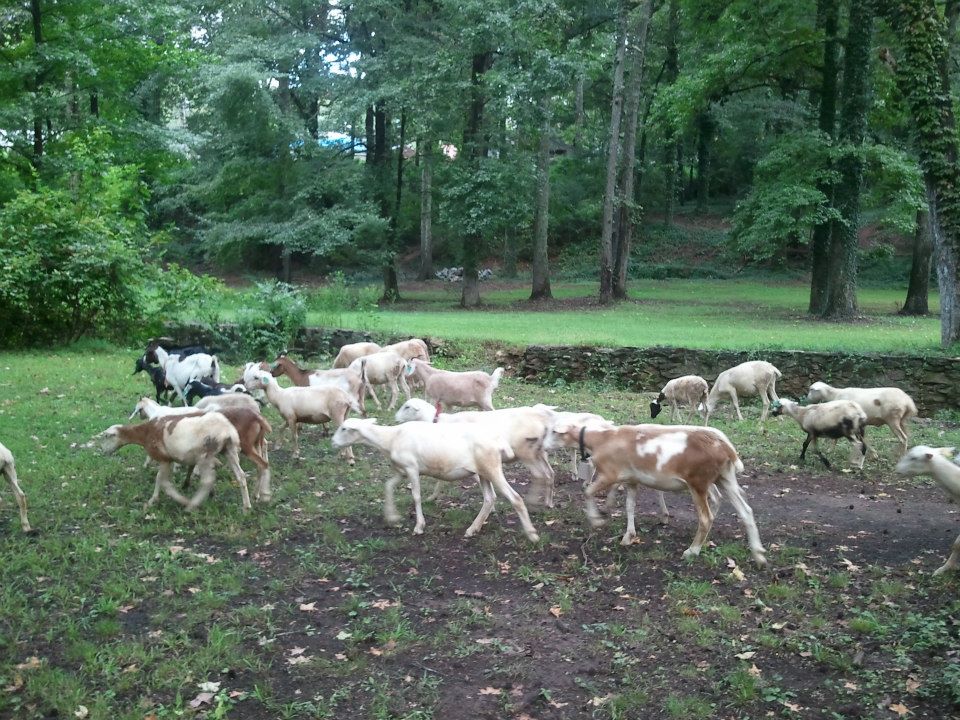
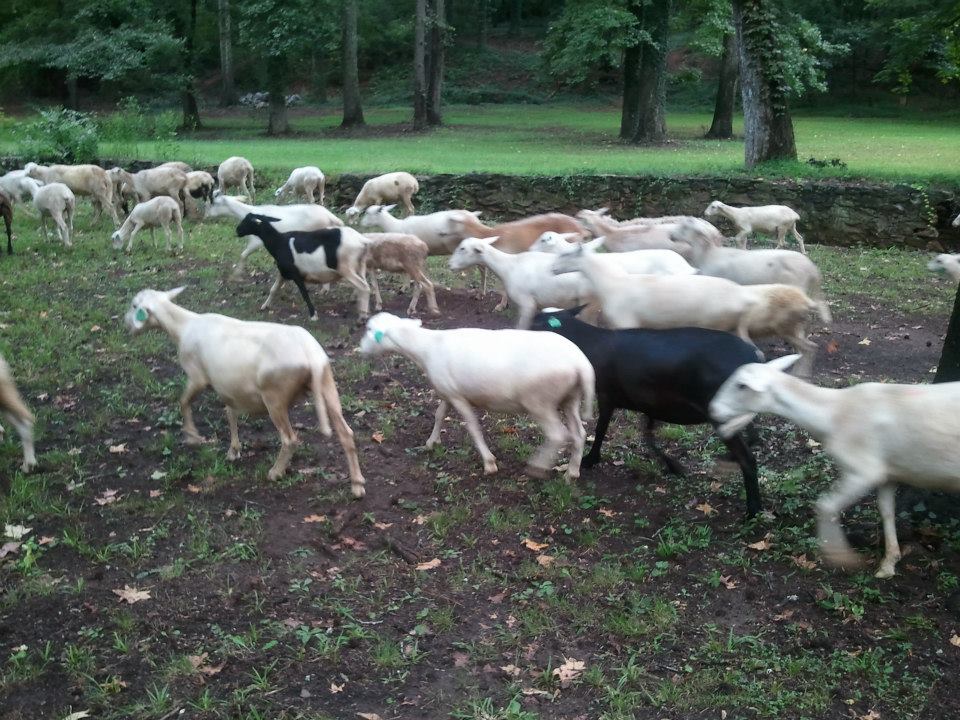
    A couple of weeks ago, I joined a few members of my learning community on a trip to visit some live action kudzu eating. The sheep we visited were part of a company named Ewe-niversally Green (clever, eh?) which specializes in the removal of invasive plants, particularly kudzu. The company is currently working with Trees Atlanta, clearing multiple acres of kudzu from the metro area each week.

    What is an invasive species and why are they bad, you ask?

    An invasive species can be any organism (both native and non-native) in an environment which grows at a rate which impedes the natural order. Every ecosystem is comprised of multiple types of organisms in balance, and if a new species is introduced or if a native species begins to dominate the system, this balance can be thrown off. Kudzu, like other invasive species, intrudes on the naturally occurring species by out competing them for resources. Over time, if the invasive species is left to prosper, a decrease in biodiversity could result and the ecosystem could crash if the invasive species caused too much damage to the natural order of the ecosystem.

    So how are invasive plant species typically removed?

    Usually, kudzu is maintained via mowing or by the use of chemicals. By using sheep instead of traditional methods, the natural habitat is conserved in a more sustainable, “eco-friendly” fashion. The risk of funky herbicides seeping into the soil or water supply is greatly decreased, or potentially eliminated completely. Plus, the sheep are supplied with yummy vegetation which makes them quite content.

    Sheep Fun Facts:

    The sheep we visited (there were about 100 of them, including a few goats) could easily clear an acre of kudzu a day! They can also clear foliage off trees up to about seven (7) feet from the ground!

    One sheep dog (a super cute Border Collie where we went) can herd around 1,000 sheep/goats by itself. The shepherd uses different whistle patterns to direct the well trained pup where to go and what to do. It’s quite spectacular!

    And poison ivy? They love it! It’s their equivalent of a tasty candy bar! Azaleas and rhododendrons, though, are poisonous to the sheep.


    If you would like to learn more about the sheep we visited, check out Ewe-niversally Green’s website here, or find them on Facebook here.


    Sources:

    Brian Cash at Ewe-niversally Green

    http://eweniversallygreen.com/home

    http://www.treesatlanta.org/SheepProgram.aspx

    http://en.wikipedia.org/wiki/Invasive_species

    Photos taken by Taylor James

  • Badass Biology: The Pistol Shrimp

    Badass Biology: The Pistol Shrimp

    “Wtf, shrimp!!? I make it all the way to this website from who knows what part of the internet, and I see ‘Badass Biology’. Man, Kevin, you flip my brain out with possibilities of flying sharks, rabbits of doom, or a half-honeybee half-unicorn rainbow pollinators. And what do you deliver? A stupid shrimp??! I hate you, and I quit this website. (╯°□°)╯︵ ┻━┻)” To which I reply, “Charles Barkley, I think you’re over-reacting. Please repair my table at once”.

    It was hard to find a chart that even went up to 150dB, let alone the 220 these guys produce.

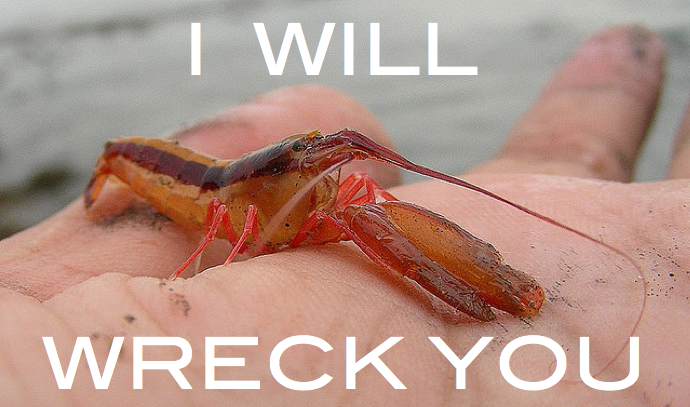
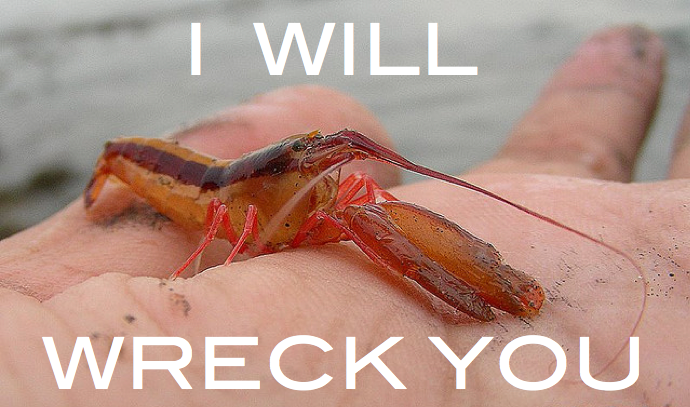
    Yes, it’s a shrimp. A measly two-inch-long shrimp. But you don’t understand. This one single stupid shrimp is just about the coolest thing I’ve ever heard. Trust me, and when you hear one too, you’ll probably go deaf, because this one little shrimp IS ONE OF THE LOUDEST ORGANISMS ON THE PLANET. I’m talking 220+ decibels, much louder than a gunshot and louder than standing next to a jet engine at take-off. O_o.

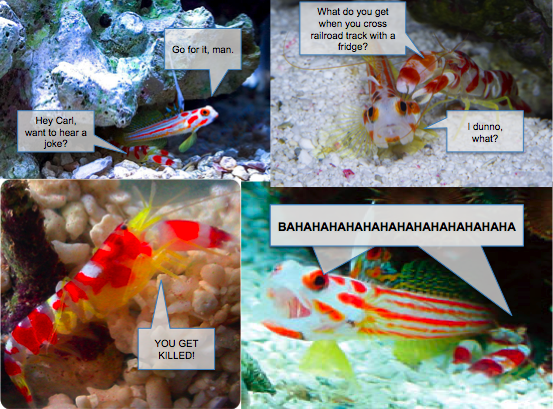
    First, I want to talk about some other wicked cool stuff this little guy does apart from being a tiny walking firework of sonic pain. These shrimp garner lots of attention from ecologists because of their symbiotic, or mutually-beneficial, relationship with gobies, a type of small marine fish. The coral reef populations of this shrimp build burrows and recruit the help of a goby to stand guard out front while being no more than an antennae’s distance from the shrimp, using the goby’s well-developed vision to watch for danger. Once danger comes, the goby flicks its tail to signal a threat, and both the goby and the shrimp retreat into the same burrow. Then they start slapping five. It’s flippin sweet.

    The mutualisms don't just end at gargoyle-ing.

    From an ecologist’s point of view, this is totally mutualistic, and some scientific literature lists this interaction as “totally f-ing amazing” [citation needed] (Good luck with finding THAT reference -ed.). Yeah, both the goby and the shrimp live to see another day should a shark, barracuda, squid, rogue buoy, really fast snail, very-misplaced land predator, sinking boat part, cloud of wasps, or sentient shrimp-hating spear come around to threaten them. The goby gets a burrow, and the pistol shrimp gets a gargoyle. Selection at work.

    I like to think of the goby as the pistol shrimp’s pet, kinda like me buying a falcon and parading it around the neighborhood on a leash. And once danger comes, the falcon goes “Hey yo, Kevo, you might need to reconsider this route”, we split, we don’t find danger, and I buy the falcon ribs for a job well done (and because I really want ribs right now). So in a sense, pistol shrimp are danger shepherds equipped with sun-blasting cannons of glory that we’ll get to in a moment.

    I need to take a break to collect myself. Holy balls, these shrimp own everything own-able. Next time I see one, I’m buying it ribs. The whole rack.

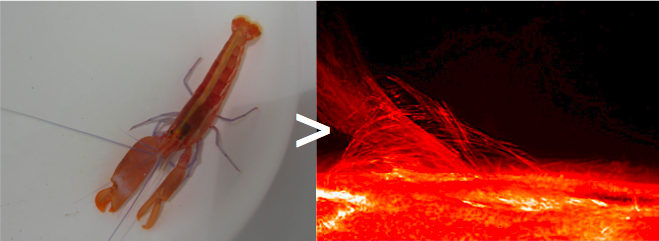
    Let’s get to that “pistol” thing, why don’t we? Pistol shrimp have one very distinct set of front appendages, like two arms extending outwards from its body. Only, one of these arms is disproportionately larger than the other, and it’s quite a contrast. Like no foolin’ man, this one arm alone can be as long as half the entire length of the shrimp’s body. Imagine walking around with one of your arms the size of the Hulk’s and you get the idea. This may look pretty stupid, but this powerful musculature operates one of the most badass weapons nature can offer.

    Yeah, kinda like this

    When in serious danger or when hunting, the pistol shrimp cocks its massive claw backwards into a 90o position. Once the claw snaps shut, it produces a jet of water propelled forward at 60mph. Yeah, woo, a fast water jet. Big deal. But here’s the amazing part. Are you ready to have your mind blown? If you have ever listened to me before, now is a pretty good time, too: This jet of water creates a bubble that cavitates, or implodes, generating a pressure wave that creates a sound loud enough to break glass in an instant. Not only that, but once the bubble cavitates, the heat generated by the force of the implosion causes the temperatures inside the bubble to reach about 18,000 degrees Fahrenheit. Yes. Eighteen. Thousand. Oh, and to top it off, the whole process takes three tenths of a second. 

    THIS TINY SHRIMP MAKES A BUBBLE SO AWESOME THAT IT’S LOUDER THAN A JET AND MORE THAN TWICE AS HOT AS THE SURFACE OF THE SUN.


    You can imagine the horribly bubbly doom the pistol shrimp’s enemies must face. Stunned (or killed) by the force of that kind of pressure change, the pistol shrimp’s prey has basically just become lunch in an instant. The shrimp pulls its quarry into its burrow, and goes to town, just how I could go to town on some ribs right about now. I dug up a video about this whole process in case what I said wasn’t convincing enough:

    http://www.youtube.com/watch?v=eKPrGxB1Kzc

    If you want me to write about any other badass biological bosses, leave a comment. I may talk about them, or I may just tell you that your suggestions are awful. Probably not the latter though. I like people.

    Well, I like most people except you, Charles Barkley. I really miss that table. Now I’ve got nothing to rest my wine on when Glee’s on.

    Photo credits:

    http://www.airpowered.co.uk/images/dbachart.jpg

    http://loyalkng.com/wp-content/uploads/2009/11/arm_wrestling_champion_03.jpg


  • Zinc has bigger game than you do

    Zinc has bigger game than you do


    Still struggling to pick out that one in a million Valentine’s Day gift? Worry no longer, because I have the perfect gift idea sure to make anyone melt. No – it’s not superhot plasma from your favorite star gone supernova (the Biebs?) – We’re talking zinc baby. Baby. Baby. Baby. Oh baby.

    Zinc coatings on steel to be exact, through the process of “hot dip” galvanization.  The hot dip part is literal – pieces of steel are dunked in a bath of molten zinc metal and when they are removed a thin layer of zinc is atomically attached to the surface of the steel. The “galvanized” part belies the true function of the coating, considering this word is derived from a certain Italian who took liberties with dead frogs.

    “Why bother?” Your significant other may ask.  “Here I had this nice piece of steel and now you’ve gone and hot dipped it. I think we’re at two different places in our relationship.” We’ve all been there.

    The role of the zinc is to protect the iron in iron alloys (most importantly steel) from rusting. Like a proverbial knight in shining (preferably hot dipped) armor, zinc prevents the steel from rusting by selflessly doing all the rusting itself. As I describe it, this is starting to sound a lot less romantic and more like zinc has wandered into the friend-zone. Poor zinc.

    If you read my last article, you know that natural corrosion resistance is rare among the elements, but ironically zinc protects steel by being less good at resisting the undesirable reactions with oxygen and water that cause the formation of rust on steel. A good analogy for this process is if both zinc and iron open lemonade stands on the same block and oxygen is the customer. Every time iron is trying to seal the deal zinc unleashes a humorous ad campaign and slashes their prices, so naturally oxygen buys lemonade from zinc instead. Now replace lemonade with electrons and you’ve got a half-decent understanding of how zinc does its job – as far as oxygen is concerned it came to this two bit lemonade town to buy lemonade from somebody (form an atomic bond), and zinc sure is looking pretty good right now. The only discrepancy with this analogy is that in the business world iron would have to resort to foul play and steal all of zinc’s lemons or deface their billboards or something. Probably shouldn’t write that on your next chemistry exam though. But don’t feel bad for zinc – the corrosion products of zinc with the environment (zinc oxide and zinc carbonate), actually prevent continued corrosion of the underlying zinc. This is called “passivation” which is the way that many other metals, like aluminum, avoid needing a hot dip.

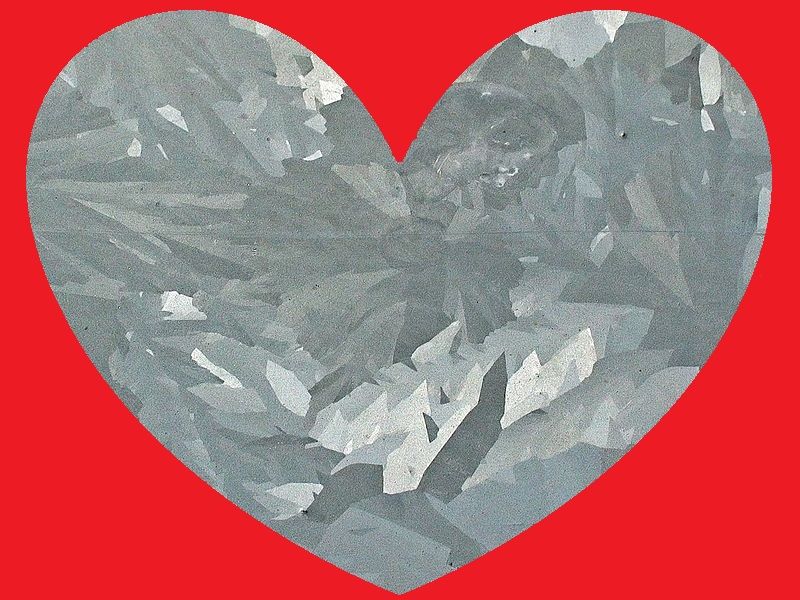
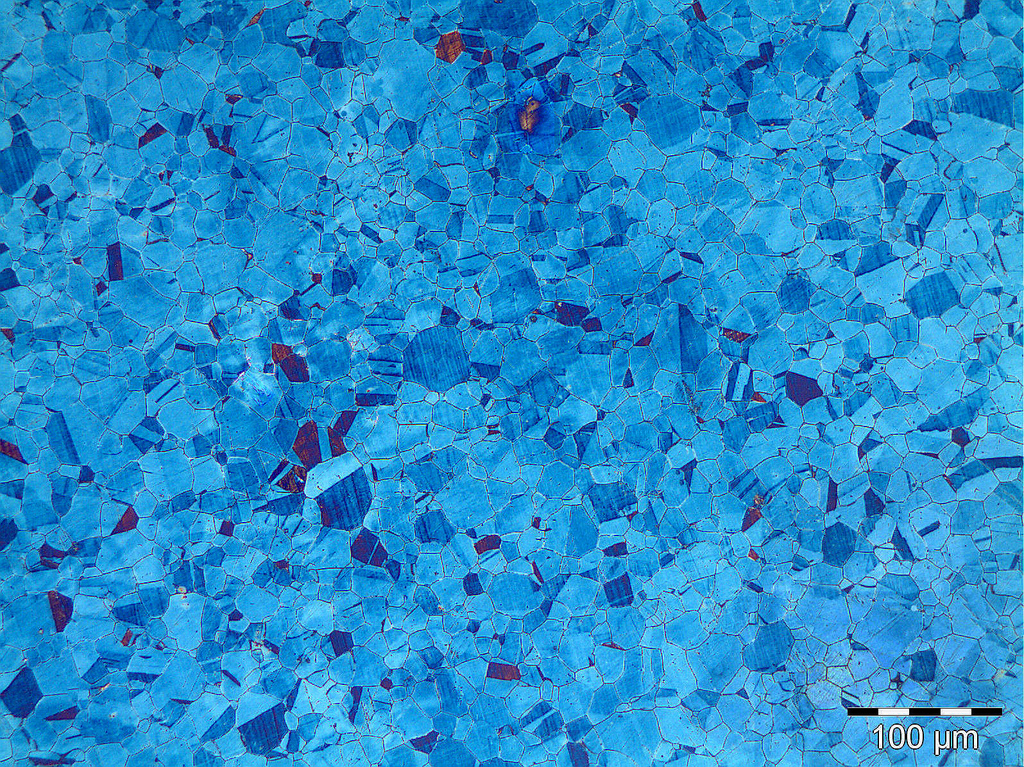
    So we’ve covered the “from the heart” part of a good V-day gift, but a box of galvanized nails might not send the right message to the apple of your eye. The good news is hot-dip galvanized steel looks really cool. The next time you’re passing a guard rail, street light pole or the like, you might notice a kind of patchwork series of flecks on the surface of the steel. No, that’s not art deco, those are the macro-sized crystalline grains of zinc busy oxidizing away. You can see some of these flecks inside the heart at the beginning of this article. In fact, all metals crystallize in this way, but because of how the zinc coating is applied the crystals of zinc that form on the surface of the steel are able to grow very large. If you were to take a high powered microscope and have a look at the surface of un-galvanized steel you would see a very similar grain structure but about 1000 times smaller. A good example is shown below from the Flikr photostream by the department of engineering at the University of Cambridge –  I admit I am a little jealous at all the cool science photos they have. Do yourself a favor and check them out.  The grains in this image are about 30-50 micrometers, which is about half the width of a human hair.

    Normally the grain size in so called “engineering materials” like steel is intentionally kept very small because it improves strength. Zinc, whose only role is as a sacrificial coating, can flaunt its’ big ole’ grains. The only other example I can think of where crystal grains are visible like this is in polycrystalline silicon solar cells. The fact that all three of these materials have the same general appearance is not by chance, but more on that another time.


    If love is sacrifice, then zinc has got it down. I will close with a poem that you can use with your gift:

    Roses are red,

    Rust is red too,

    A coating of zinc,

    says I – LOVE – YOU


    And don’t I just.


    – Gordon


    Original image sources:

    hot dip galvanized

    grains of steel