Logic word problems have recently been used to exploit individuals in thinking they help cure certain issues like Dementia, memory loss, and Alzheimer’s disease. This thought of using these logic puzzles as a remedy has been used by developers such as Luminosity. These claims made by Luminosity have proven to be false as “training” your brain to complete certain logic tasks cannot necessarily help an individual cure health problems (Day, 2013). According to George Mason University researchers, many brain puzzle games that essentially help increase an individuals brain power is due to placebo (Vlasits, 2017). Despite this information, this doesn’t change the fact that these logic puzzles cannot benefit an individual in a different aspect. Logic puzzles can be fun, but they can also provide many other benefits that will benefit an individual in many different fields
Logic puzzles became popularized through the writing of “Alice’s Adventures in Wonderland” by Lewis Carroll (Charles Dodgson). After some time, a Mathematician by the name Raymond Smullyan expanded the realm of logic puzzles and eventually popularized certain puzzles like the “Knights and Knaves” puzzles, where the reader stumbles upon Knights and Knaves and must determine their true identity. Through different problems, many people do not know ways to think of
One way to solve logic puzzles easily is to think of logic word problems as propositions. Propositions are essentially any statement that can have a true or false value as its output.
For example:
Michigan is a country.
This is a proposition cause it returns a true or false value depending on the situation. In this case, it is false. You can convert these statements to a letter to make problem solving easier, so in the above case, you can use M rather than the entire sentence.
X + 2 = 4
This is not a proposition cause it will only return a true or false value based on the value of x which could be anything
Using said propositions, you have certain symbols that allow an individual to essentially convert the logic to a easier to read statement.
V = disjunction (or) Example: A V B = A or B
disjunction is the combination of two statements by “or” which means one must depend on one statement
^ = Conjunction (and) Example A ^ B = A and B
conjunction is the combination of two statements by “and” which means the output must depend on both
¬ = Negation (not) Example ¬A = not A
→ = Condition (If Then) Example A→B = if A, then B
With the symbols used above, one needs to know what the values are when using such. In the tables, T refers to whether the statement is true, and False refers to whether they are false. These are known as truth tables.
Disjunction
| A | B | A V B |
| T | T | T (1) |
| T | F | T (2) |
| F | T | T (3) |
| F | F | F (4) |
In order to read this first table, lets think of an example.
A = Harry is in Arizona
B = The weather was cold
In line 1 we see that if A is true and B is true, then A V B must be true because you are seeing if one value is true. In line 4, A V B is false because none of A or B are true.
Conjunction
| A | B | A ^ B |
| T | T | T (1) |
| T | F | F (2) |
| F | T | F (3) |
| F | F | F (4) |
For conjunction, we will use the same example as the one provide in disjunction. In line 1, we see that when A is true and B is true then A ^ B is both true. In line 2, we see that when A is true and B is false, then A ^ B is false because only one is true and to fulfill conjunction both have to be the same.
Negation
| A | ¬A |
| T | F |
| F | T |
Conditional
| A | B | A→B |
| T | T | T |
| T | F | F |
| F | T | T |
| F | F | T |
Using the said information, lets walk through an example problem to get a general understanding of what to do.
EXAMPLE
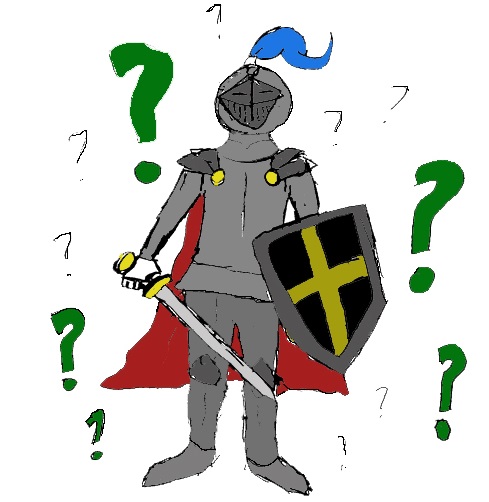
As stated previously, Robert Smullyan popularized the puzzle about Knights and Knaves where pretty much you are on an island where you encounter two individuals that are either one is a Knight or a Knave . Knights always tell the truth, whereas a Knave always tells a lie. One of the individuals states that both of them are knights, while the other says that the other is a Knave. It is up to you to solve who the knight and knave is using the information at hand (Smullyan, 2015).
Step 1: The first step to do is to set a letter or variable to each individual. So the first person is P1 and the second could be P2. It could be anything as long as it sets apart who is who.
P1 = “Both are Knights”
P2 = “P1 is a Knave”
Step 2: Setup the given phrases into a table, where you can assign P1 as Knight or Knave depending on situation and the phrases stated by the individual. Pretty much set up the many possible scenarios. To determine the possible amount of scenarios, you must do 2^(x) where X is the amount of statements , in this case there are only two, where 2 distinguishes the values of True or False.
| P1 | P2 | Both are Knights | P1 is Knave |
| Knight | Knight | ||
| Knight | Knave | ||
| Knave | Knight | ||
| Knave | Knave |
Step 3: Look at the scenarios, and determine whether the statements said by each individual are true or not and mark them in the truth table
| P1 | P2 | Both are Knights | P1 is Knave |
| Knight | Knight | T | F |
| Knight | Knave | F | F |
| Knave | Knight | F | T |
| Knave | Knave | F | F |
Step 4: After filling up the truth table, it is now time to analyze to determine who is who. We always look out for truths and in this case only Lines 1 and 3 have truths, but these two lines have a false value as well. We look further at each line to determine this. We look at the first line and see the statements. If P1 says both are knights, then both should be knights, but P2 actually lied saying that P1 is a Knave which leads to this scenario being thrown out. We look at the third line to determine this and find out that the two statements correlate with the phrases stated by the individuals which leads to P1 being the Knave and P2 being the Knight.
This method should work on word puzzles similar to the one done in the example, but if it does not, one can still use certain methods like using propositional statements and determining the validity of said statement within problem.
Now try it yourself.
Question:
In a castle far away, we find out the King has been killed by someone and a knight has set out to find the murder of the King. For the investigation, the Knight has interviewed four different witnesses to aid in solving who killed the king. Through such investigating, the Knight has concluded certain things. The Knight has concluded that if the Bishop is telling the truth then the Lord is telling the truth; both the Lord and Prince cannot both be telling the truth; both the Queen and Prince cannot be lying; If the Queen is telling the truth that means the Lord is lying. The Knight must determine who is lying in order to get further in this investigation.
Answer:
Make sure to convert said statements as propositions using the symbols discussed.
-If the Bishop is telling the truth, then Lord is telling truth = B → L
-Prince and Lord cannot both be telling truth = ¬ (P ^ L)
– Prince and Queen cannot both be lying = ¬ (¬P ^ ¬Q)
– If the Queen is telling the truth, then Lord is lying (Q → ¬L)
You must also assume everyone is telling the truth in order to catch people in the lies. Using such, we must put in all possible scenarios in a truth table. In such problem, there are 16 possible scenarios because there are four different statements which leads to 2^4.
| B | L | P | Q | B → L | ¬ (P ^ L) | ¬ (¬P ^ ¬Q) | (Q → ¬L) |
| T | T | T | T | T | F | T | F |
| T | T | T | F | T | F | T | T |
| T | T | F | T | T | T | T | F |
| T | T | F | F | T | T | F | T |
| T | F | T | T | F | F | T | T |
| T | F | T | F | F | F | T | T |
| T | F | F | T | F | F | T | T |
| T | F | F | F | F | F | F | T |
| F | T | T | T | T | F | T | F |
| F | T | T | F | T | F | T | T |
| F | T | T | F | T | T | T | F |
| F | T | F | F | T | T | F | T |
| F | F | T | F | T | T | T | T |
| F | F | F | T | T | T | T | T |
| F | F | F | T | T | T | T | T |
| F | F | F | F | T | T | F | T |
Based on the truth table, we realize that there are three possible scenarios that could actually be true.
The Bishop and Lord are guaranteed to be lying, but either the Queen or Prince could be lying or both could be telling the truth.
Solving problems using logic is applicable to many different situations. It can be used in day to day activities or even specific fields like Computer Science or Mathematics. The problem solving of logic puzzles helps individuals perform tasks by steps and aids in helping an individual make decisions (“Problem Solving and Decision Making”, 2006). In Computer Science, different problems that may use logic include choosing what method to choose or use reasoning on what the said method could be useful for.
References
Day, E. (2013, April 20). Online brain-training: Does it really work? Retrieved from https://www.theguardian.com/science/2013/apr/21/brain-training-online-neuroscience-elizabeth-day
Problem Solving and Decision Making (Solving Problems and Making Decisions). (n.d.). Retrieved from https://managementhelp.org/personalproductivity/problem-solving.htm