Author: Tina Nguyen

  • Burps to Breakthroughs: Reducing Livestock Emissions

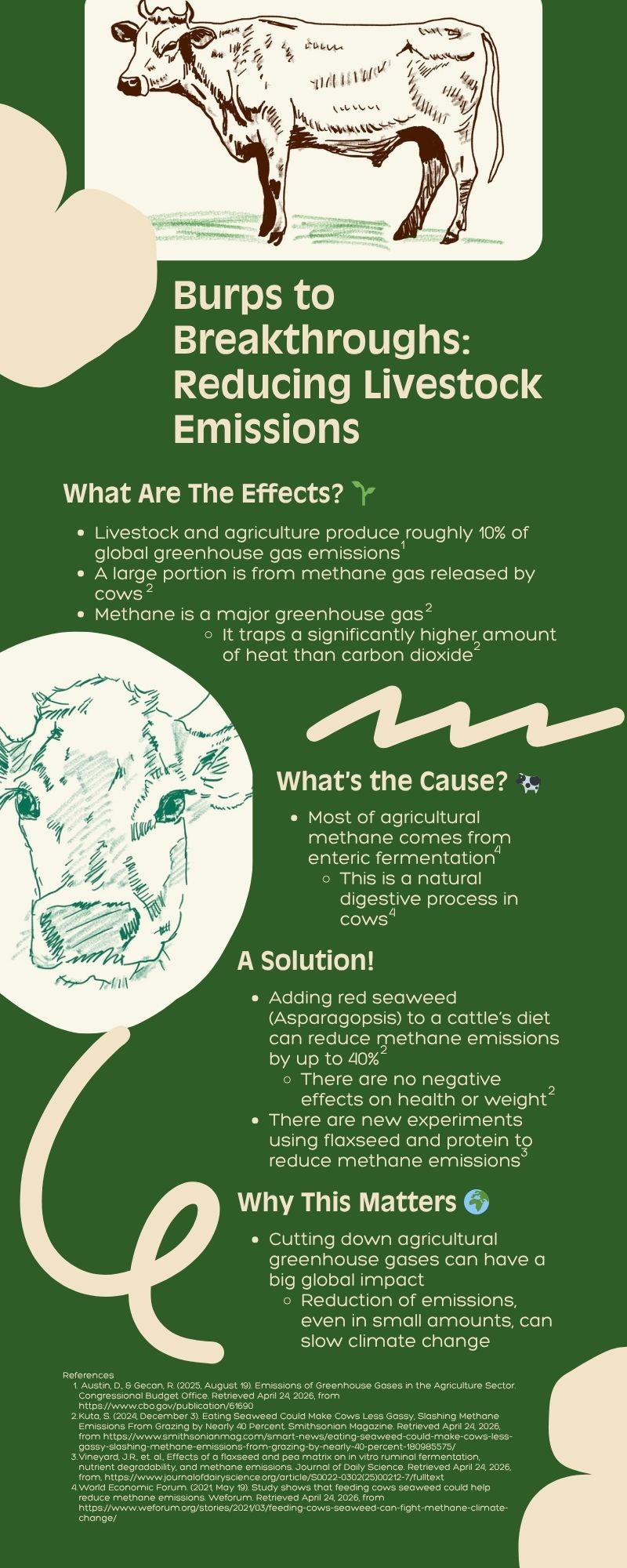
    Burps to Breakthroughs: Reducing Livestock Emissions

    What Are The Effects? 🌱

    • Livestock and agriculture produce roughly 10% of global greenhouse gas emissions.
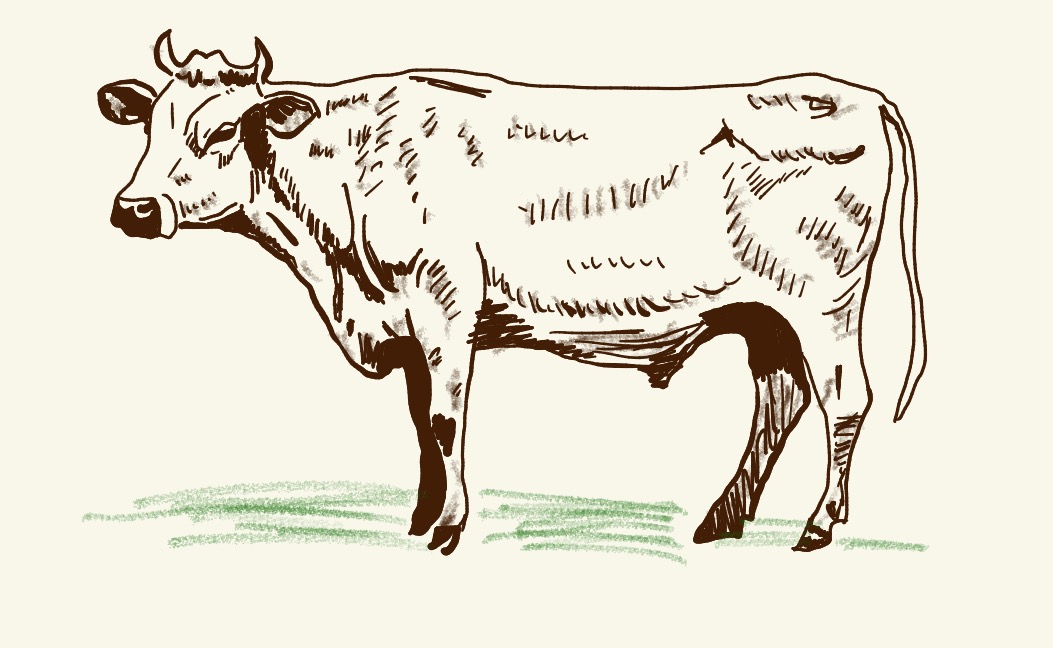
    • A large portion is from methane gas released by cows.
    • Methane is a major greenhouse gas
      • It traps a significantly higher amount of heat than carbon dioxide.

    What’s the Cause? 🐄

    • Most of agricultural methane comes from enteric fermentation.
      • This is a natural digestive process in cows.

    A Solution!

    • Adding red seaweed (Asparagopsis) to a cattle’s diet can reduce methane emissions by up to 40%.
      • There are no negative effects on health or weight.
    • There are new experiments using flaxseed and protein to reduce methane emissions.

    Why This Matters 🌍

    • Cutting down agricultural greenhouse gases can have a big global impact.
      • Reduction of emissions, even in small amounts, can slow climate change.

    References

    Austin, D., & Gecan, R. (2025, August 19). Emissions of Greenhouse Gases in the Agriculture Sector. Congressional Budget Office. Retrieved April 24, 2026, from https://www.cbo.gov/publication/61690

    Kuta, S. (2024, December 3). Eating Seaweed Could Make Cows Less Gassy, Slashing Methane Emissions From Grazing by Nearly 40 Percent. Smithsonian Magazine. Retrieved April 24, 2026, from https://www.smithsonianmag.com/smart-news/eating-seaweed-could-make-cows-less-gassy-slashing-methane-emissions-from-grazing-by-nearly-40-percent-180985575/

    Vineyard, J.R., et. al., Effects of a flaxseed and pea matrix on in vitro ruminal fermentation, nutrient degradability, and methane emissions. Journal of Daily Science. Retrieved April 24, 2026, from, https://www.journalofdairyscience.org/article/S0022-0302(25)00212-7/fulltext

    World Economic Forum. (2021, May 19). Study shows that feeding cows seaweed could help reduce methane emissions. Weforum. Retrieved April 24, 2026, from https://www.weforum.org/stories/2021/03/feeding-cows-seaweed-can-fight-methane-climate-change/
     

  • Simple, Science-backed Ways to Slow Dementia

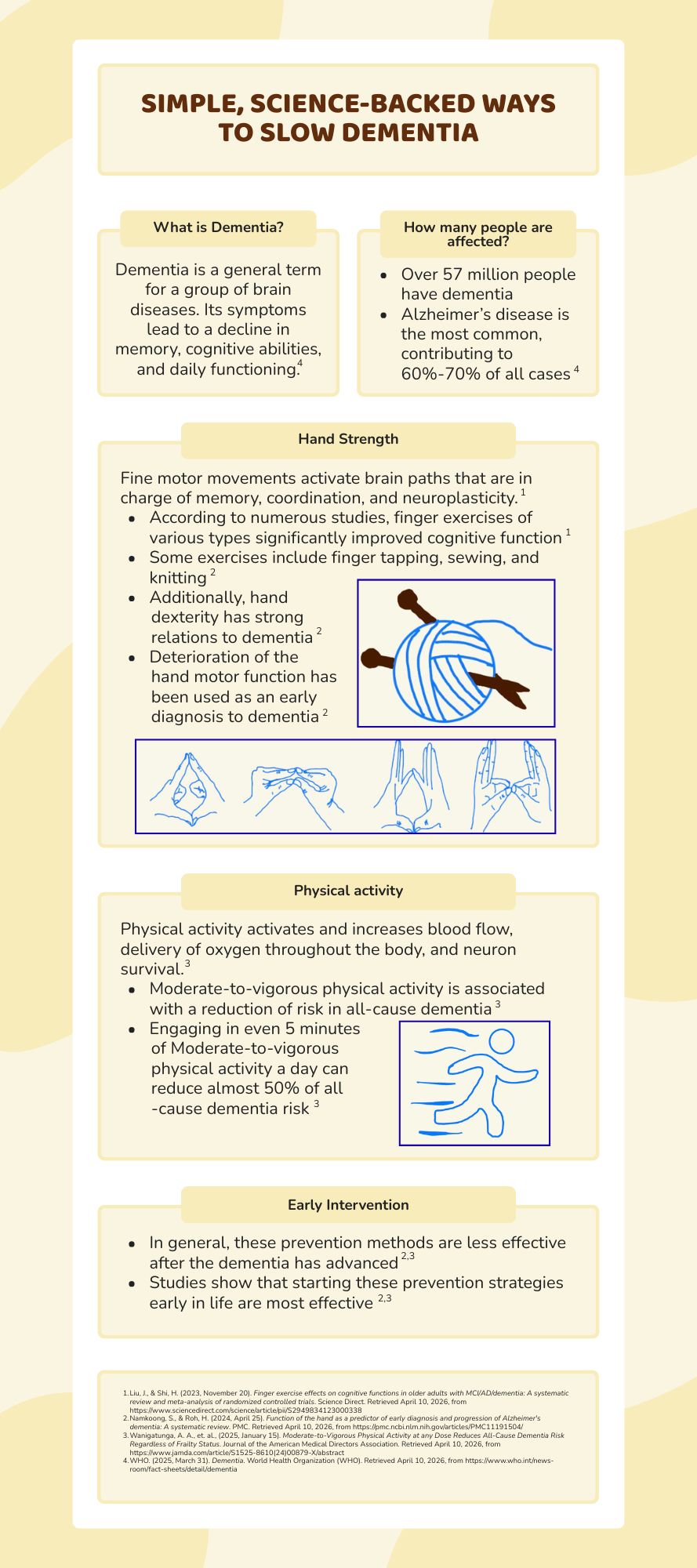
    Simple, Science-backed Ways to Slow Dementia


    What is Dementia?

    Dementia is a general term for a group of brain diseases. Its symptoms lead to a decline in memory, cognitive abilities, and daily functioning.

    How many people are affected?

    • Over 57 million people have dementia.
    • Alzheimer’s disease is the most common, contributing to 60%-70% of all cases.

    Hand Strength

    Fine motor movements activate brain paths that are in charge of memory, coordination, and neuroplasticity.

    • According to numerous studies, finger exercises of various types significantly improved cognitive function.
    • Some exercises include finger tapping, sewing, and knitting.
    • Additionally, hand dexterity has strong relations to dementia.
    • Deterioration of the hand motor function has been used as an early diagnosis to dementia.

    Physical activity

    Physical activity activates and increases blood flow, delivery of oxygen throughout the body, and neuron survival.

    • Moderate-to-vigorous physical activity is associated with a reduction of risk in all-cause dementia.
    • Engaging in even 5 minutes of Moderate-to-vigorous physical activity a day can reduce almost 50% of all-cause dementia risk.

    Early Intervention

    • In general, these prevention methods are less effective after the dementia has advanced.
    • Studies show that starting these prevention strategies early in life are most effective.

    References:

    Liu, J., & Shi, H. (2023, November 20). Finger exercise effects on cognitive functions in older adults with MCI/AD/dementia: A systematic review and meta-analysis of randomized controlled trials. Science Direct. Retrieved April 10, 2026, from https://www.sciencedirect.com/science/article/pii/S2949834123000338

    Namkoong, S., & Roh, H. (2024, April 25). Function of the hand as a predictor of early diagnosis and progression of Alzheimer’s dementia: A systematic review. PMC. Retrieved April 10, 2026, from https://pmc.ncbi.nlm.nih.gov/articles/PMC11191504/

    Wanigatunga, A. A., et. al., (2025, January 15). Moderate-to-Vigorous Physical Activity at any Dose Reduces All-Cause Dementia Risk Regardless of Frailty Status. Journal of the American Medical Directors Association. Retrieved April 10, 2026, from https://www.jamda.com/article/S1525-8610(24)00879-X/abstract

    WHO. (2025, March 31). Dementia. World Health Organization (WHO). Retrieved April 10, 2026, from https://www.who.int/news-room/fact-sheets/detail/dementia