Author: Rhea Yendamuri

  • Mind the Tentacles: How Octopuses Outsmart Scientists (and Aquariums)

    Mind the Tentacles: How Octopuses Outsmart Scientists (and Aquariums)

    Mind the Tentacles: How Octopuses Outsmart Scientists (and Aquariums)

    When you first think of an octopus, you’re probably picturing an animal with 8 tentacles floating around in the ocean. As unseeming these creatures may seem, they are one of the smartest animals in the ocean! Octopuses have a nervous system, which controls their movements, thought processes, memory, and more (Carls-Diamante, 2022). Octopuses are said to have two brains – one in their head and a complex net of massive nerves in each of their tentacles (Carls-Diamante, 2022). About 2/3 of an octopus’ nerves are in their tentacles, and this allows each tentacle to act independently or jointly with the others (Shamilyan et al., 2021). Let’s explore the capabilities and intelligence of an octopus!


    Flexibility:

    Octopuses use their flexibility in the natural environment to escape and hide from predators by squeezing into very tight spaces. For example, scientists have put a small octopus in a jar with a closed screw-lid. The challenge for the octopus was to escape the jar from the inside, which the octopus managed to do using its incredible flexibility (Mather, 2021). Since octopuses are immensely flexible, some octopuses have managed to escape from aquarium tanks by opening the top lid! In addition to their amazing flexibility, they have several other surprising abilities to survive in the wild.


    Camouflage:

    Octopuses are known for their abilities to blend in with their surroundings by changing their color to match that of their surroundings (Young, 2023). This ability to camouflage into their surroundings is a key survival mechanism to prevent predators from spotting them. However, octopuses also use their color-changing abilities to communicate with each other (Young, 2023). An octopus’ color changes based upon its mood and can be used to warn other octopuses of potential danger (Carls-Diamante, 2022). Octopuses often go on hunting trips together, but how do they remember their way back home? That’s where their navigational memory comes in!


    Spatial and Navigational Memory:

    Octopuses make their homes in holes in the seabed or coral reefs. They go on long hunting trips for food, often for days or weeks at a time for long distances before returning back home. They frequently take different paths home each time they go hunting, indicating they have incredible spatial memory on how to return home (Carls-Diamante, 2022). In addition, some octopuses have been seen putting rocks near their home as an identifier, like how people put numbers outside their homes or apartments to identify which residence is theirs (Carls-Diamante, 2022). Octopuses are more like humans than we originally thought!


    In conclusion, octopuses are amazingly intelligent ocean creatures whose wit should not be underestimated. They are able to escape closed spaces using their flexibility, change colors at will to disguise themselves or communicate with other octopuses, and use spatial memory to identify where their homes are. Next time you go to an aquarium, check out the octopuses and see their tricks in action!


    Citations:

    Carls-Diamante, S. (2022). Where Is It Like to Be an Octopus? Frontiers in Systems Neuroscience, 16. https://doi.org/10.3389/fnsys.2022.840022

    Mather, J. (2021). Octopus Consciousness: The Role of Perceptual Richness. NeuroSci, 2(3), 276–290. https://doi.org/10.3390/neurosci2030020

    Shamilyan, O., Kabin, I., Dyka, Z., Kuba, M., & Langendoerfer, P. (2021, June 1). Octopuses: biological facts and technical solutions. IEEE Xplore. https://doi.org/10.1109/MECO52532.2021.9459727

    Young, N. (2023, December 27). Exploring Problem-Solving Skills through the Octopus Mind – West Coast Centre For Learning. West Coast Centre for Learning. https://www.wccl.ca/problem-solving-skills/

  • Escape the Elements: How to Create a Science-Themed Escape Room

    Escape the Elements: How to Create a Science-Themed Escape Room

    Escape rooms are a fun way to bond with others and put your critical thinking skills to the test! An escape room is a game where people are ‘locked in’ a room and must find a way out by finding clues and solving puzzles (Cambridge Dictionary, 2025). Escape rooms are popular because they are wonderful social bonding experiences where teams of people must work together to get out of the room.

    In the past few years, several schools and universities started using educational escape rooms as an alternative method to teach students different subjects, ranging from math, history, science, and other subjects! One study had 62 students in Spain learn mathematical topics through an escape room model and found that it reduced learning anxiety while increasing motivation and learning achievement (Fuentes-Cabrera et al., 2020). Another study had 528 elementary school students go through either a virtual escape room or other digital game-based learning activities and found that the students preferred the digital escape room because it lead to higher collaboration and stronger motivation to learn among the students (Vidergor, 2021).

    During my time at Georgia Tech, I’ve created two separate science-themed escape rooms from scratch with my friends and ran them both four times collectively. We had a lot of fun, and I learned so much about escape rooms – both making and playing them – in the process. I think escape rooms are a wonderful way for people to learn and apply their knowledge while being in a fun environment and bonding with people around them who share the same interests. There are many escape room templates online that you can use, but I want to make this guide if you want to make your own customizable escape room that tailors to your audience. In this guide, I’ll share some tips about making an escape room from scratch as well as some of my own experiences.


    Step 1: Choose a Theme and a Storyline

    Choose a theme based upon your intended audience. For example, my intended audience was college students who were in different science majors, so I incorporated elements (pun intended) from as many science fields as I could. If you are making an escape room for your biology class, make the room biology themed.

    Once you have a theme, create a storyline about why they are in the room. Maybe an evil scientist is creating a formula to destroy the world, and they must figure out the formula to stop them! Maybe the room is part of a colony on Mars that lost power and communication with Earth and the crew (participants) need to work together to restore the colony’s original functions so they can get back, but they must do it quickly because oxygen levels are depleting fast! The more interesting the storyline, the more interested your players will be. The sky’s the limit with your storyline but ensure that it matches with the theme of the room and add in a specific reason for the time limit (e.g. oxygen levels depleting within the hour on the Mars colony). Both escape rooms I held involved an evil magician who performed strange alchemy experiments, and the participants were playing as detectives who got trapped inside the evil magician’s hideout. Be as creative as you want with your storyline!


    Step 2: Determine a Game Flow Plan

    Choose how you want your puzzles to be organized. Do you want your puzzles to be connected to each other linearly or do you want multiple puzzles that can be solved separately from each other?

    I organized my puzzles into 5 puzzle sets with a final number at the end of each set. Each set had 3 to 4 puzzles that had to be solved in order but sets themselves could be solved independently of each other. For example, puzzle A1 had to be solved to unlock puzzle A2, but puzzle B1 could be solved without needing to solve A1. For the participants to escape, there was a final door code (found by writing all the numbers at the end of each set in a specified order on a whiteboard).

    It’s up to you on how you want your puzzles to be organized, but it’s beneficial to have each puzzle lead to something else (unless it’s a red herring puzzle in which it will lead nowhere).


    Step 3: Design Puzzles

    Once you have your puzzle outline down, it’s time to make the puzzles! There are a variety of puzzle types you can choose from. This list below is not extensive, but these are some of the puzzle types I used:

    • Hiding secret messages in documents (letters, posters, newspaper clippings, etc.) by using CAPTIALS, bolding, italicizing, and underlining specific letters or words
      • If you want to make it more complex, you can use bolding and italicizing to create two different messages – one is a real message that leads to the next puzzle while the other message is a funny red herring but doesn’t lead to anything.
    • Locking items in boxes, cabinets, etc.
      • You can buy lock boxes from a store or you can punch holes into cardboard boxes and attach combination locks to them.
      • There are a variety of locks you can use: number locks, letter locks, among others.
    • Ciphers
      • Caesar cipher (each letter is shifted by a fixed amount)
      • Morse code (using dots and dashes for letters and numbers) – requires a key
      • Atbash cipher (alphabet is reversed; A becomes Z, B becomes Y, etc.)
      • Braille (using raised dots or gem stickers to form numbers or words) – requires a key
      • Pig Pen cipher (alphabet letters are replaced with parts of a grid or by a set of symbols) – requires a key
    • Putting a sequence of events in order which reveals a code
    • Counting the number of colored objects drawn on a board to reveal a code

    There are many other puzzle methods you can use, but keep your intended audience in mind as you determine which puzzles to use. Try to avoid making your puzzles too complex or else your audience may not understand how to solve them which can lead to immense frustration.


    Step 4: Determine How to Integrate Puzzles into Room

    Once you make the puzzles, determine where you want to hide them! They can be hidden in locked places (boxes, cabinets, etc.) or they can be hidden in plain sight (e.g. a letter with a hidden message sitting on a table in the open). I recommend writing down the locations of each puzzle in your answer key, so setting up the room will be much easier (and you can find puzzles that you’ve hidden away in case you forget).

    If your puzzles are interconnected with one another, determine how you’ll ensure they must solve the previous puzzle before continuing to the next one. I usually locked up the next puzzle in the sequence and participants would have to solve the previous puzzle to get the code for the lock.

    Additionally, use props to bring the room to life! Use props related to the theme and storyline you’re doing for your escape room, and they don’t have to be expensive props. You can either use things you already have, make props, or buy props to bring the escape room to life. The more props you use, the more immersive the experience will be!


    Step 5: Test and Adjust Puzzles (If Possible)

    It is beneficial to test your puzzles and/or your entire room with people who are not doing the escape room (if you can) prior to your official date. A puzzle that is easy for you to understand may be difficult for someone else to understand, so testing out your puzzles ensures that the puzzles are not too complicated for your intended audience.


    Step 6: Run the Escape Room!

    You’ve done all the hard work in making the escape room, so now it’s time for the big day!

    Some tips from my experience:

    • Make sure to either have an answer key or have the answers memorized in case the participants need help
    • Start setting up early! Make sure to have at least an hour or two hours for set up based upon how complex the room will be (more puzzles and decorations/props = more set up time)
      • Remove as many items as you can that are not related to the escape room to avoid confusion
    • Make sure to state the rules prior to participants starting the escape room (These are the ones I used but you can add more)
      • There is only key or code per lock
      • Don’t break the ceiling, walls, or any delicate furniture/technology
      • Don’t stand on the furniture
      • Don’t need to dig through the trash cans
      • You write using paper/pencils or whiteboards
      • They have X amount of time to escape (usually 45-60 minutes but ours lasted 2 hours because we had a complex set up)


    Making an escape room can be daunting, but it’s an amazing adventure at the end of the day! It’s a rewarding experience for players and can be a fun educational experience where participants can learn while bonding with their peers.

    Thanks for reading!


    Bibliography

    Cambridge Dictionary. (2025, January 29). escape room. @CambridgeWords. https://dictionary.cambridge.org/us/dictionary/english/escape-room

    Fuentes-Cabrera, A., Parra-González, M. E., López-Belmonte, J., & Segura-Robles, A. (2020). Learning Mathematics with Emerging Methodologies—The Escape Room as a Case Study. Mathematics, 8(9), 1586. https://doi.org/10.3390/math8091586

    How to Make an Escape Room at Home: DIY Guide. (2024). Escapely. https://escapely.com/how-to-make-an-escape-room/

    Vidergor, H. E. (2021). Effects of digital escape room on gameful experience, collaboration, and motivation of elementary school students. Computers & Education, 104156. https://doi.org/10.1016/j.compedu.2021.104156
  • Now You See It! – The Science of Misdirection in Magic

    Now You See It! – The Science of Misdirection in Magic

    Magicians have been performing seemingly impossible feats to awe-struck audiences for millennia. With a simple flick of a hand or snap of a finger, magicians can make objects appear and disappear in the blink of an eye, make someone levitate off the ground, or even saw people in half! To perform these feats, magicians often use their knowledge of how attention works and a bit of misdirection to focus their audience’s attention where they want them to focus (Alexander et al., 2022). How does attention work, and how do magicians use misdirection to pull off these incredible feats?

    What is Attention and How Does it Work?

    Attention is selectively choosing to focus on specific aspects of our environment, while ignoring other stimuli (Kuhn et al., 2022). Attention is like a spotlight – we can only focus on one aspect of our environment at a time, and everything else outside of that spotlight goes unnoticed. There are two main types of attention: goal-directed attention and stimulus-driven attention. Goal-directed attention is when we choose to focus on something to accomplish some motivated goal, while stimulus-driven attention is when a stimulus in our surroundings grabs our attention (Yantis, 2002). Imagine this scenario: we’re watching a show on the TV, when we suddenly hear a loud thump from the other room. Our attention was initially focused on the TV show but instinctively shifts as we focus on the source of the loud thump. The loud thump automatically draws our attention as it may be something we need to protect ourselves from. After determining that the sound was from a family member accidentally dropping a box on the floor, we can return our attention to watching the TV show once more. We are using goal-directed attention when we are focused on watching the TV show. When we hear the unexpected loud thump, we switch to stimulus-driven attention as we try to determine the source of that sound. Magicians often use stimulus-driven attention to direct their audience’s attention to what the magician wants them to see.

    How Do Magicians Use Misdirection?

    Misdirection in magic is when a magician guides our attention towards the magical effects and away from what is really happening. Magicians often use their gaze, multiple hand movements, and other cues to carefully control the audience’s attention to where the magicians want them to focus (Alexander et al., 2022; Icard et al., 2024). For example, a magician could do elaborate movements with their right hand, drawing the audience’s attention to their right hand, while their left hand subtlety goes into their pocket. Multiple, quick hand movements within a short period of time can overwhelm our attentional spotlight, allowing magicians to make coins magically appear and disappear within the blink of an eye without seeming to touch the coins (Icard et al., 2024). Misdirection is a skill that must be practiced well to perform in front of an audience. Famous magicians such as Apollo Robins or Penn and Teller have mastered the technique of misdirection, allowing them to perform complex tricks such as changing tin foil balls into baseballs or taking a watch right off someone’s wrist without them noticing.

    Attention is a powerful tool that can shape our perceptions of the world, so be sure to pay attention!


    Citations:

    Alexander, R. G., Macknik, S. L., & Martinez-Conde, S. (2022). What the Neuroscience and Psychology of Magic Reveal about Misinformation. Publications, 10(4), 33. https://doi.org/10.3390/publications10040033

    Icard, B., & Fervari, R. (2024). Beyond the Spell: A Dynamic Logic Analysis of Misdirection. ArXiv.org. https://arxiv.org/abs/2401.14516

    Kuhn, G., Kingori, P., & Peeters Grietens, K. (2022). Misdirection – Magic, Psychology and its Application. Science & Technology Studies, 35(2), 13–29. https://doi.org/10.23987/sts.112182

    Yantis, S. (2002). Stimulus-Driven and Goal-Directed Attentional Control. In: Cantoni, V., Marinaro, M., Petrosino, A. (eds) Visual Attention Mechanisms. Springer, Boston, MA. https://doi.org/10.1007/978-1-4615-0111-4_12

  • Why Is Sleep So Important?

    Why Is Sleep So Important?

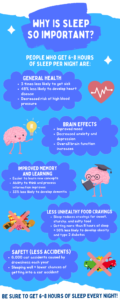
    Many of us are consistently sleep deprived. On average, children need 8-10 hours of sleep per night and adults need 7-9 hours per night (National Heart, Lung, and Blood Institute, 2022). However, many of us get less than the recommended amount of sleep on a consistent basis. Why is sleep so important and what are the benefits of getting enough sleep? This infographic explains the benefits of getting good quality sleep each night.


    Citations:

    1. Aguirre, C. (2015, November 12). What would happen if you didn’t sleep? – Claudia Aguirre. YouTube. https://youtu.be/dqONk48l5vY?si=X8WAdJ3BDkuEeTyx
    2. Finan, P. (2019). The Effects of Sleep Deprivation. Johns Hopkins Medicine Health Library. https://www.hopkinsmedicine.org/health/wellness-and-prevention/the-effects-of-sleep-deprivation
    3. Garbarino, S., Lanteri, P., Bragazzi, N. L., Magnavita, N., & Scoditti, E. (2021). Role of sleep deprivation in immune-related disease risk and outcomes. Communications Biology, 4(1). https://doi.org/10.1038/s42003-021-02825-4
    4. How Much Sleep Kids Need. (2024, June 4). Cleveland Clinic. https://health.clevelandclinic.org/recommended-amount-of-sleep-for-children
    5. Liew, S. C., & Aung, T. (2020). Sleep deprivation and its association with diseases- a review. Sleep Medicine, 77. https://doi.org/10.1016/j.sleep.2020.07.048
    6. National Heart, Lung, and Blood Institute. (2022, March 24). How Sleep Works – How Much Sleep Is Enough? | NHLBI, NIH. Www.nhlbi.nih.gov. https://www.nhlbi.nih.gov/health/sleep/how-much-sleep
    7. Papatriantafyllou, E., Efthymiou, D., Zoumbaneas, E., Popescu, C. A., & Vassilopoulou, E. (2022). Sleep Deprivation: Effects on Weight Loss and Weight Loss Maintenance. Nutrients, 14(8), 1549. https://doi.org/10.3390/nu14081549
    8. Tomaso, C. C., Johnson, A. B., & Nelson, T. D. (2020). The Effect of Sleep Deprivation and Restriction on Mood, Emotion, and Emotion Regulation: Three Meta-Analyses in One. Sleep, 44(6). https://doi.org/10.1093/sleep/zsaa289
    9. You, I. (2013, September 22). What If You Stopped Sleeping? YouTube. https://youtu.be/nNhDkKAvxFk?si=bTGL9bxLfCqiwnnu