Author: Gordon Waller

  • Water: prankster of the natural world part 1

    Water: prankster of the natural world part 1

    If you’ve ever taken a life sciences course your teacher probably mentioned one of several properties that make water particularly interesting. Water is cohesive meaning it sticks to itself, adhesive meaning it sticks to other things (superhydrophobic surfaces notwithstanding), and is considered the “universal solvent” because it readily dissolves many other substances. These properties are some of the most critical that allow water to function as the key to most terrestrial forms of life. Another interesting fact about water is that it is one of the few substances that exists in all three states of matter (solid, liquid and gas) in fairly non-extreme locals on earth. Furthermore, these phases exist within a relatively narrow range of temperatures – the entire transformation from solid to gas spans only 100 degrees Celsius (from melting of ice at 0 °C to boiling of liquid water at 100 °C). Compare that to ethyl alcohol (the alcohol in “alcoholic” beverages) which solidifies at -114 °C  and boils at 78 °C (a range of only about 200 °C, but with freezing occurring at a temperature below the coldest temperature ever recorded on earth) or a pure metal like iron with a melting temperature of 1538 °C and boiling temperature of 2862 °C  – that’s a phase range of over 1000 °C!

    It is important at this point in my introduction to define a phase: a phase is one of several atomic or molecular configurations for a given composition. When considering melting and boiling points, we are observing only the transition between the three states of matter mentioned above, however it is equally correct to consider multiple crystal structures for one composition of solid as different phases. Some of these solid phases are not easily distinguishable without sophisticated analytical techniques, while others have characteristic changes in physical properties.  No one would confuse graphite and diamond though they are in fact different phases of the same element. Plasma, also known as a superheated gas, is considered a fourth phase of matter but not one normally observed in nature with a notable exception being bolts of lightning. However, when heated to the point of being a plasma the atoms defining a given composition become ionized and for this reason plasma is normally considered separate from the more conventional states of matter. Fun fact for gamers: this is the plasma in all your favorite late game super-weapons.

    This is where things get weird for our old friend agua.

    Consider the following scenarios:

    1) Two identical pans are pre-heated to temperatures above the boiling point of water. The first pan is heated to 150 °C and the second pan to 300 °C. If drops of water at room temperature are placed into each pan, which drop will undergo the phase change from liquid to gas (boil) first?


    2) Two identical containers of water (same volume, same container size and material) are placed into a freezer. One container contains water at just below its’ boiling point (< 100 °C) and the other at roughly room temperature (21 °C). Which will freeze first?


    If considering only the energetics of each scenario, the logical conclusion is that a higher temperature pan means faster boiling, and a lower starting temperature means faster solidification. But if you were to perform these exact experiments at home (which I hope you do!) the opposite would occur.


    So whats going on? Is water playing by the rules (of thermodynamics)? Fortunately for us, Gibbs will remain stationary in his grave. As it turns out, both of these scenarios are good examples of how the properties of matter can change dramatically after a phase change. In both of these cases, variations in heat transfer between phases is likely to blame.


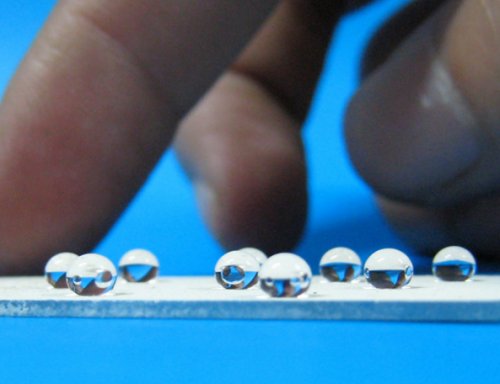
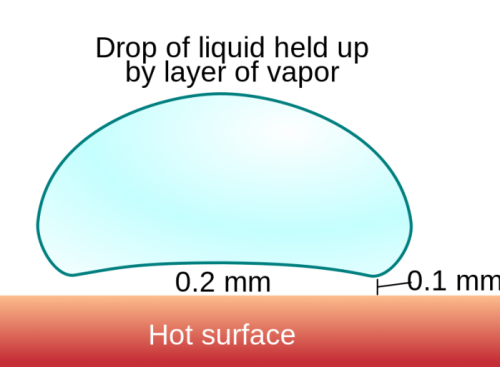
    For the water in the pan scenario, there exists a temperature above which water is so quickly vaporized upon hitting the pan a thin layer of steam is trapped below the liquid droplet, causing it to literally levitate above the surface of the pan on cushion of water vapor. Think air hockey table, but droplets of boiling water replacing the plastic puck. This temperature is called the “Leidenfrost point”, which according to unreferenced figure from Wikipedia is about 200 °C. Steam has a thermal conductivity roughly 10-100 times lower than that of liquid water depending on the temperature. In an idealized example, thermal conductivity is a measure of how easily a quantity of heat in a high temperature region can travel from one side of a 100% dense (no porosity) slab of material to the other. Thermal conductivity has units of energy per length per degree per second (Joules/(meter*°C*seconds)), meaning for a fixed length and temperature a material with lower thermal conductivity will take more time than a material with higher thermal conductivity to transfer the same amount of energy.

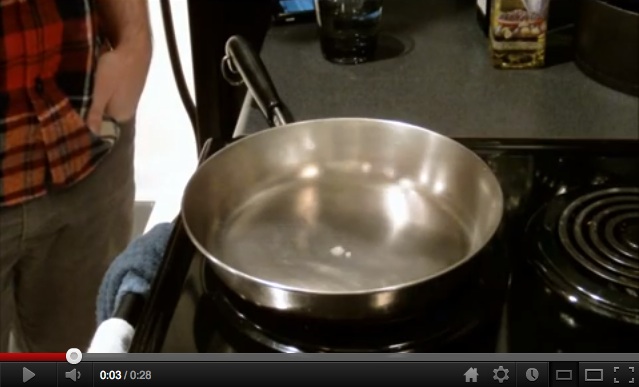
    At temperatures above the Leidenfrost point the Leidenfrost effect is observed and drops of water on a pan will take longer to boil because the steam trapped below the liquid water takes more time to transfer heat to the droplet from the pan. The videos below demonstrate drops of water into a pan below (top) and above (bottom) the Leidenfrost point. Above the Leidenfrost point, the droplets can barely be heard to sizzle as they zoom around on cushions of steam. For the pan heated above the Leidenfrost point, occasional contact with the edges of the pan, which are actually at a lower temperature or placing drops repeatedly in the same area which leads to local cooling will lead to momentary sizzling as the entire droplet boils. For the videos below, I used a nonstick pan and an eyedropper to put a few drops of tapwater onto the pan at a time. For the lower temperature I set my range to setting of 2 out of 10 and for the higher temperature I set it to about 6 out of 10 and waited a few minutes at each temperature for the pan to heat up.


    You may have heard of ole’ Leidenfrost’s namesake before associated with dipping things (namely one’s hand) into boiling lead after placing it in water. The Myth Busters did it after significant deliberation and preliminary testing, but somehow the alpha geeks at PopSci seemed to think it would make a good “DIY” project. I have to say, I can understand why dipping digits is the sexier version of the Leidenfrost effect demonstration, but the pan + water trick seems a little less invasive. In their defense, PopSci also covered this demo and the equivalent effect with boiling Nitrogen instead of steam as well.

    However you plan to enjoy the Leidenfrost effect, do so under proper supervision and be careful.

    Check out part 2 for a discussion on the second scenario!


  • Zinc has bigger game than you do

    Zinc has bigger game than you do


    Still struggling to pick out that one in a million Valentine’s Day gift? Worry no longer, because I have the perfect gift idea sure to make anyone melt. No – it’s not superhot plasma from your favorite star gone supernova (the Biebs?) – We’re talking zinc baby. Baby. Baby. Baby. Oh baby.

    Zinc coatings on steel to be exact, through the process of “hot dip” galvanization.  The hot dip part is literal – pieces of steel are dunked in a bath of molten zinc metal and when they are removed a thin layer of zinc is atomically attached to the surface of the steel. The “galvanized” part belies the true function of the coating, considering this word is derived from a certain Italian who took liberties with dead frogs.

    “Why bother?” Your significant other may ask.  “Here I had this nice piece of steel and now you’ve gone and hot dipped it. I think we’re at two different places in our relationship.” We’ve all been there.

    The role of the zinc is to protect the iron in iron alloys (most importantly steel) from rusting. Like a proverbial knight in shining (preferably hot dipped) armor, zinc prevents the steel from rusting by selflessly doing all the rusting itself. As I describe it, this is starting to sound a lot less romantic and more like zinc has wandered into the friend-zone. Poor zinc.

    If you read my last article, you know that natural corrosion resistance is rare among the elements, but ironically zinc protects steel by being less good at resisting the undesirable reactions with oxygen and water that cause the formation of rust on steel. A good analogy for this process is if both zinc and iron open lemonade stands on the same block and oxygen is the customer. Every time iron is trying to seal the deal zinc unleashes a humorous ad campaign and slashes their prices, so naturally oxygen buys lemonade from zinc instead. Now replace lemonade with electrons and you’ve got a half-decent understanding of how zinc does its job – as far as oxygen is concerned it came to this two bit lemonade town to buy lemonade from somebody (form an atomic bond), and zinc sure is looking pretty good right now. The only discrepancy with this analogy is that in the business world iron would have to resort to foul play and steal all of zinc’s lemons or deface their billboards or something. Probably shouldn’t write that on your next chemistry exam though. But don’t feel bad for zinc – the corrosion products of zinc with the environment (zinc oxide and zinc carbonate), actually prevent continued corrosion of the underlying zinc. This is called “passivation” which is the way that many other metals, like aluminum, avoid needing a hot dip.

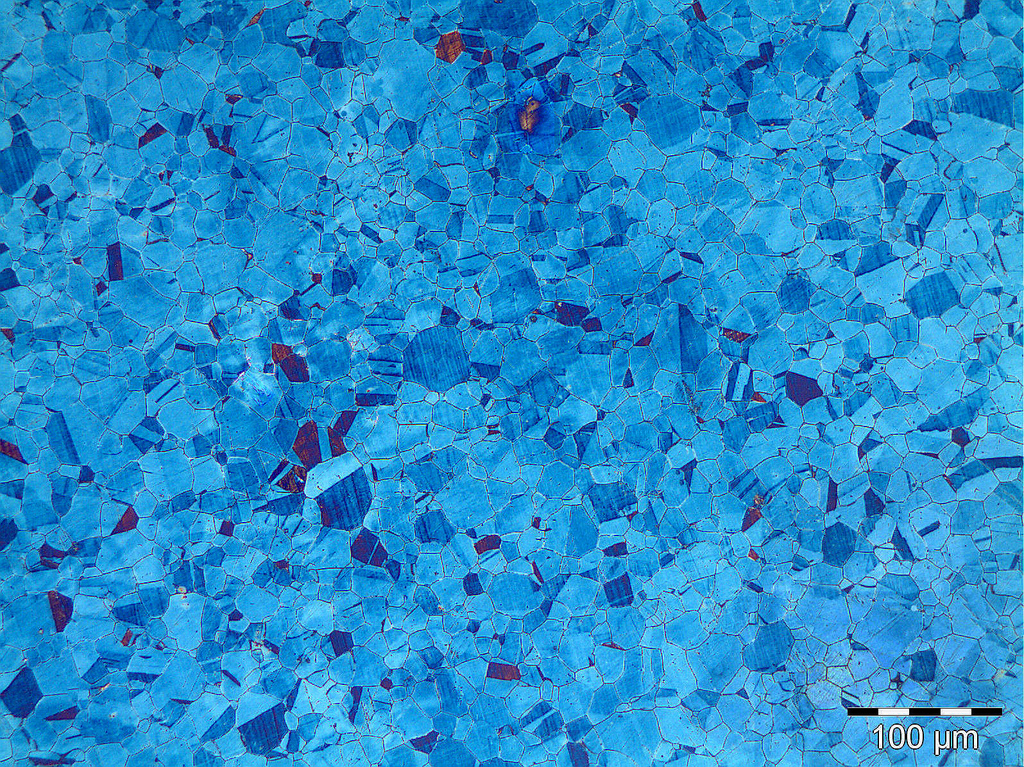
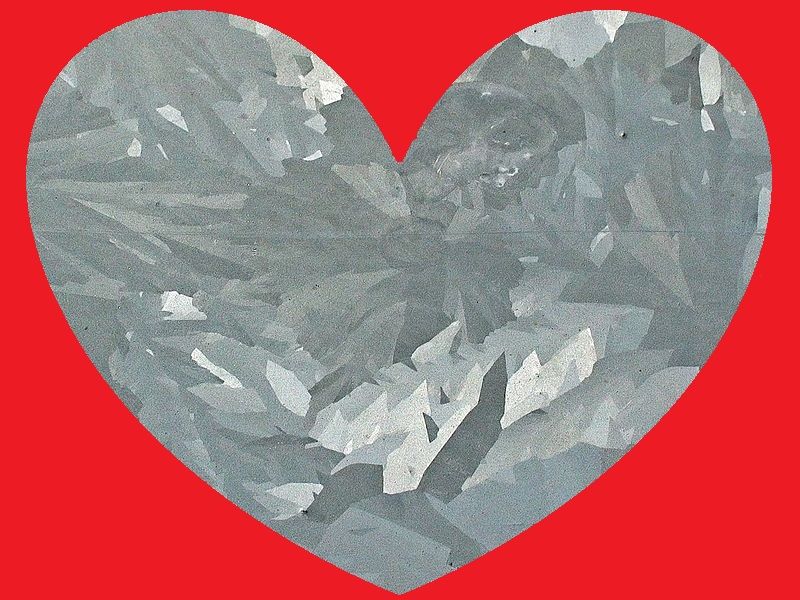
    So we’ve covered the “from the heart” part of a good V-day gift, but a box of galvanized nails might not send the right message to the apple of your eye. The good news is hot-dip galvanized steel looks really cool. The next time you’re passing a guard rail, street light pole or the like, you might notice a kind of patchwork series of flecks on the surface of the steel. No, that’s not art deco, those are the macro-sized crystalline grains of zinc busy oxidizing away. You can see some of these flecks inside the heart at the beginning of this article. In fact, all metals crystallize in this way, but because of how the zinc coating is applied the crystals of zinc that form on the surface of the steel are able to grow very large. If you were to take a high powered microscope and have a look at the surface of un-galvanized steel you would see a very similar grain structure but about 1000 times smaller. A good example is shown below from the Flikr photostream by the department of engineering at the University of Cambridge –  I admit I am a little jealous at all the cool science photos they have. Do yourself a favor and check them out.  The grains in this image are about 30-50 micrometers, which is about half the width of a human hair.

    Normally the grain size in so called “engineering materials” like steel is intentionally kept very small because it improves strength. Zinc, whose only role is as a sacrificial coating, can flaunt its’ big ole’ grains. The only other example I can think of where crystal grains are visible like this is in polycrystalline silicon solar cells. The fact that all three of these materials have the same general appearance is not by chance, but more on that another time.


    If love is sacrifice, then zinc has got it down. I will close with a poem that you can use with your gift:

    Roses are red,

    Rust is red too,

    A coating of zinc,

    says I – LOVE – YOU


    And don’t I just.


    – Gordon


    Original image sources:

    hot dip galvanized

    grains of steel


  • Even though Kim Kardashian’s marriage didn’t last, her engagement ring will. Like forever.

    Even though Kim Kardashian’s marriage didn’t last, her engagement ring will. Like forever.

    I have a joke for you:


    How long does a two million dollar engagement ring buy you with everyone’s favorite (well, mine anyways) Kardashian sister?


    As Kris Humphries found out, about 72 days.


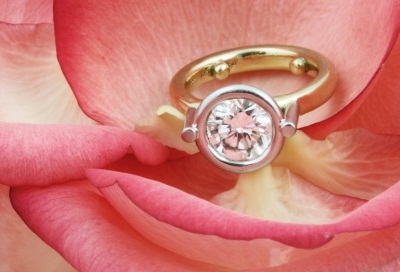
    Sorry Kris, but at least you should take some comfort in the fact that the ring you gave Kim will sit as shiny as it is right now until it’s ready to win hearts and headlines once again. At least the platinum band will anyways. What I’m referring to as the simply staggering resistance of Platinum to oxidation, more commonly known as rust or tarnish.  Platinum, along with gold and to a lesser extent silver are  the only metals on the periodic table that enjoy this distinction. As a logical consequence, these metals were some of the first discovered by ancient peoples because they would have quite literally been found lying on the ground, super shiny. In fact, gold was the first metal discovered ever and goes back as far as the entire history of… well as far back as recorded history itself! I like to imagine when cavemen discovered gold they tried to eat it before proposing to cave ladies with chunks of the stuff. Given that these un-reactive metals are now relatively commonplace, the idea of a metal that doesn’t rust may not seem that cool but trust me, it is.


    So why aren’t these magical metals applied to more commonplace items where rust is a concern? The obvious answer is their astronomical expense. Unfortunately the expense of platinum, gold and silver is not because they don’t rust but because they are super rare, representing some of the rarest elements found it the earths crust. Even if they were more common, each of these metals are extremely ductile and malleable allowing them to be easily fashioned through pulling and hammering into jewelry but preventing their use as structural metals. Gold’s softness is the origin of the quintessential gold rush miner biting into a dubious coin to ensure it’s authenticity. Thus even if you wanted to and were rich and crazy enough to do so, it would be unwise to make solid gold or platinum rims because they would buckle when popping over a curb.


    The diamonds in Kim’s ring are another story. Formed from carbon under extreme conditions of huge temperatures and pressures, diamonds are chemically identical to pencil lead but differ in the way the atoms are arranged. Instead of being soft enough to smear onto a sheet of paper when pressed by hand, diamonds are the hardest naturally occurring substance on earth. Ironically, according to calculations using thermodynamics, a discipline used to determine the equilibrium structure for a given set of conditions and composition, diamonds should not even exist outside of the extreme conditions in which they are formed! Instead, thermodynamics predicts that diamonds should deteriorate to graphite (pencil lead) at the temperatures and pressures found around Kim Kardashian’s hand. Then why don’t they?


    To answer that we can consider again our friends platinum and gold. It is not exactly correct to say that these metals can never oxidize, but more accurate to say that without a huge input of energy they never will. Meanwhile, metals like iron actually give off some energy when they rust. From the standpoint of iron, it is energetically favorable to rust than remain as elemental iron in the presence of oxygen. A good analogy to this kind of “favorable energetics” is a cart balanced at the top of a hill – the cart has potential energy that is converted to kinetic energy and then depleted  when it rolls down the hill. An unfavorable energy case would be a cart in a deep valley. Even though the cart could reach the top of the hill, someone would have to push it up there. Maybe you could get those cavemen to do it by feeding them gold. To transform diamonds into graphite and oxidize platinum will take energy. Lots of energy. So unless Kim visits the National Ignition Facility, an active volcano or these guys, her ring is staying put. Just maybe not on her finger.

    Image: Maggie Smith / FreeDigitalPhotos.net

  • Sequins + Dress + Spotlights = Laserdress

    Sequins + Dress + Spotlights = Laserdress

    I had a chance to catch some of the Golden Globes the other night. By had a chance I mean, I elected to watch the Golden Globes. For a little bit. You know how it is, when you have a choice between watching celebrities clap or watching reruns of M*A*S*H you have to ask yourself, “When is the next time I can watch M*A*S*H?”

    When I did stick around, it wasn’t just because I think Emma Stone is a stone cold fox (I do), or because I thought Ricky Gervais is particularly funny (I didn’t), and it’s not because I really care what the celebrities are wearing (I don’t). It was all the dang sequins.

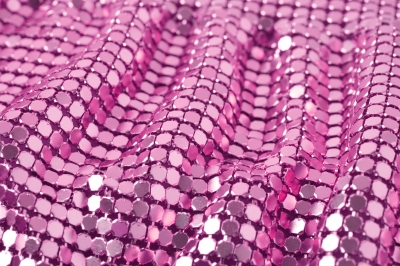
    Maybe this is just from a fashion uninitiated, but there were a lot of sequins going on at the Golden Globes. But then I thought about it – why not? Sequins do a pretty good job of catching the eye, and that’s kind of the red carpet Modus operandi, right? Sequins’ secret lies in their ability as a reflector of incident light. Much like a signal mirror used to reflect the sun towards a rescue plane, sequins sewn onto a dress (or a pair of hideous shoes at DSW) reflect any light that hits their surface at an angle equal in magnitude to the incident angle reflected through a plane perpendicular to the reflecting surface. This is analogous to bouncing a ball off of a smooth surface. If the ball is dropped straight down the angle of incidence is 0° and so the ball bounces straight back up. Meanwhile, if the ball is bounced at an angle like a basketball being bounce-passed between two players, after striking the ground the ball will travel towards the second player at an angle identical to that thrown by the first player. This is called specular reflection (with light not basketballs). When considering this concept from the viewers perspective of a be-sequined dress, the dress appears to shimmer and flash. If the light-source comes from a single direction (like a spotlight) then the incident angle is fixed and the relative angles of the sequins change with the motion of the wearer. The result is flashes of light as individual sequins pass through an orientation which places the reflection angle directly towards your eyeballs!

    Maybe that’s not that surprising to you, given that you have observed this phenomenon first hand dozens of times in mirrors. However consider this – not all light is made equal. Light can be described as wave traveling through space from the source. These waves have the shape of the trigonometric sine function when visualized in two dimensions, and have an associated wavelength that is related to the energy of different forms of light. To humans and many other species, our eyes detect this difference in wavelength as color, but only in a relatively narrow range of wavelengths. This is referred to as the “visible spectrum” , and the acronym ROYGBIV known by many a grade-schooler as the colors of the rainbow actually orders the visible spectrum correctly from longest to smallest wavelength!


    Thus, while sequins are reflecting the crap of out the visible spectrum, light waves with appreciably longer or shorter wavelengths will have different interactions. For this reason, reflectors designed to reflect these different wavelengths can require drastically different shapes and materials. Some examples include a satellite dish whose curved edges reflect microwaves (these are of similar wavelength to the ones used in microwave ovens!) towards central antenna (the prong in the middle) increasing the signal, and metal coated Mylar (a type of flexible plastic) used in space blankets and on satellites (the ones in space, not the dish on your roof) to reflect infra-red radiation. In the case of space blankets, these reflect infra-red radiation (light waves with wavelengths just above the color red in the visible spectrum responsible radiative heat transfer – this is why heat lamps in restaurants are red!) emitted by the wearer back to their body. On satellites this wavelength is emitted by the sun and reflected away from heat sensitive electronics. In the case of metalized Mylar, the reflection is diffuse rather than specular, meaning the reflection takes place at many angles.


    So we’ve learned that sequins are sparkly because they reflect light at discrete angles. If they operated with diffuse reflection, the entire dress would appear to glow rather than sparkle. Fingers crossed that the fashion community will one-up themselves at next years GGs. A simple experiment you can try at home can be done with a mirror, a yard stick, and a flashlight (or ideally a laser pointer). Measure one yard from a wall and place the mirror on the ground, then place yourself one yard away from the mirror facing the wall. Hold the flashlight at the top of the yardstick pointing towards the mirror. The reflected light should strike the wall at the exact height you are holding the flashlight! This is specular reflection in action!


    Image: m_bartosch / FreeDigitalPhotos.net