Author: Camtien Nguyen

  • The Marine Colonizers: Lionfish

    The Marine Colonizers: Lionfish

    Introduction:

    As I scrolled through YouTube to look for something to watch, I came across a Short (the term for the vertical, short-form video format on YouTube). The short was of a free diver swimming through a kelp forest and using a tool to scoop up all the sea urchins into a gigantic net. For some reason, I was instantly mesmerized by the video. I think it’s because 1) I think the ocean is awesome, and 2) the sounds of the video felt almost like ASMR. I went down the rabbit hole that day and watched the rest of this user’s content (sea urchin harvesting). There was something so satisfying about watching him gather a netful of sea urchins and use his tool to crack one open for the nearby fish. It appears the diver and the native fish have developed a symbiotic relationship: the fish leads the diver to the sea urchins, and the diver opens sea urchins for the fish to feast on. Watching all these videos made me wonder, “Is this really the only way we can control sea urchin populations, and what happened that caused the situation to get this bad?”

    I knew for a long time about the lionfish problem. Funnily enough, YouTube started recommending lionfish videos to me. The diver uses a harpoon to impale lionfish and then places them in a bin. So then that made me think, “Is gathering these invasive species the only method of managing their populations?” It doesn’t seem that effective to me.

    How are lionfish so successful as invasive or non-native species?

    Background

    Lionfish, Pterois miles and P. volitans, are native to the warm waters of the Indian and Pacific Oceans, and were introduced to South Florida’s coastal waters about 30 years ago (Norton & Norton, 2021). These fish are actually the first non-native marine fish introduced to the US’s Atlantic Coast and the Caribbean (Morris and Akins, 2009). They were common reef predators in the Indian and Pacific Oceans, so, with no predators to keep their populations in check, South Florida’s Atlantic coast provided the perfect conditions for these lionfish to thrive (Norton & Norton, 2021). Climate change also plays a role in the rise of lionfish in the Atlantic Ocean: the increase in ocean temperatures extends the lionfish territories north and south (Norton & Norton, 2021). Another leading cause of the success of lionfish establishing their populations is believed to be their broad diet, making them ecological generalists (Côté and Smith, 2018). From 2004 to 2010, lionfish populations rose drastically, increasing from 23% to 40% of the total predator biomass in the ecosystem (Green et al., 2012). By studying lionfish stomach content, researchers have found that “90% of the prey consumed by lionfish were small-bodied reef fishes from 42 species. Between 2008 and 2010, the combined body mass of these 42 species declined by 65%” (Green et al., 2012).

    Control Efforts

    Lionfish’s venomous spines provide effective protection against predators, but lionfish control programs have started across the Caribbean, which may successfully reduce the effects of lionfish at local scales within high-priority areas, such as Marine Protected Areas and fish nursery habitats (Green et al., 2012). The most common form of lionfish control is culling by locals or during organized tournaments (Côté and Smith, 2018). Numerous studies have shown that regular culling at target sites could significantly reduce populations and promote the recovery of native prey populations (Côté and Smith, 2018). Lionfish sizes have decreased due to targeted culling in various regions (del Rio et al., 2023). Unfortunately, not only is culling costly and physically demanding, but for culling to be effective, the amount of lionfish removed must be high: e.g., “35-65% annually at large spatial scales” (Côté and Smith, 2018). Another mitigation strategy is found in gastronomy—we collect lionfish recreationally or commercially for human consumption (Côté and Smith, 2018). It turns out, lionfish are delicious and nutritious (Morris et al., 2011b). Unfortunately, relying on native predators, particularly big groupers, is insufficient in controlling lionfish populations (Côté and Smith, 2018). One reason is that native predators aren’t as abundant as they used to be, and so these populations don’t consume lionfish enough to be effective (Paddack et al., 2009; Sadovy de Mitcheson et al., 2013). Researchers have thought of training native predators to consume lionfish (Diller et al., 2014). However, further research has found that training predators is unrealistic, so low predation on lionfish isn’t due to native predators being unaware that they could consume lionfish, but because of lionfish’s defenses against predators (the venomous spines) (Côté and Smith, 2018).

    Conclusion

    Based on the existing research, I would argue that introducing or developing lionfish as a potential food source for humans could aid in controlling lionfish populations. I think it’s super important that we educate people about the environmental problems of non-native species inhabiting ecosystems, and the efforts we can make to restore balance. I would think that research in mitigating lionfish effects on ecosystems would help in further research of non-native or invasive species in other habitats too!
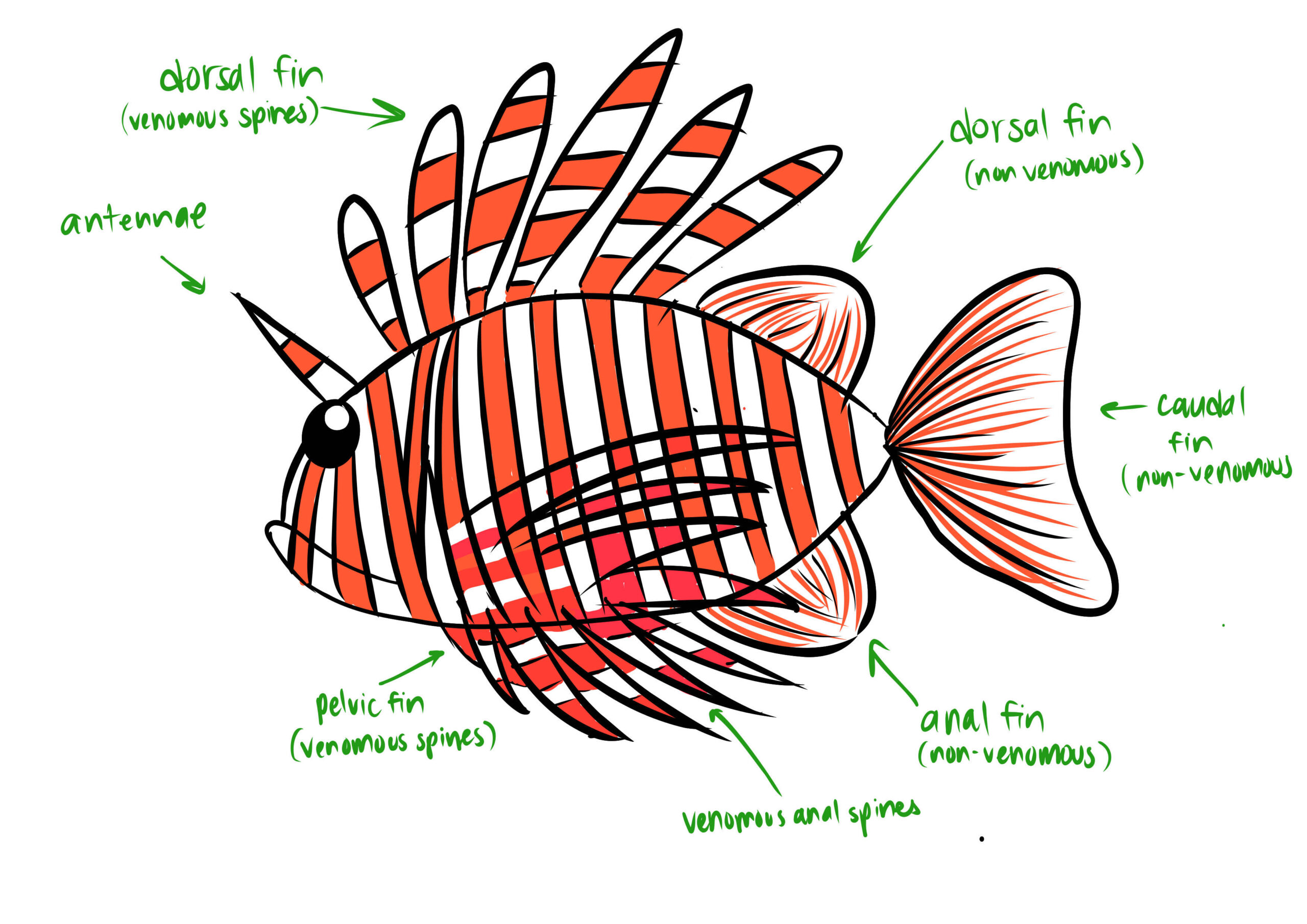
    My attempt in drawing a lionfish! I’ve also labeled different parts of the fish.


    Sources:

    Côté, I. M., & Smith, N. S. (2018). The lionfish pterois sp. invasion: Has the worst‐case scenario come to pass? Journal of Fish Biology, 92(3), 660–689. https://doi.org/10.1111/jfb.13544

    del Río, L., Navarro-Martínez, Z. M., Cobián-Rojas, D., Chevalier-Monteagudo, P. P., Angulo-Valdes, J. A., & Rodriguez-Viera, L. (2023). Biology and ecology of the lionfish                     pterois volitans/pterois miles as invasive alien species: A Review. PeerJ, 11. https://doi.org/10.7717/peerj.15728

    Diller, J. L., Frazer, T. K. & Jacoby, C. A. (2014). Coping with the lionfish invasion: evidence that naïve, native predators can learn to help. Journal of Experimental Marine Biology and Ecology 455, 45–49.

    Green, S. J., Akins, J. L., Maljković, A., & Côté, I. M. (2012). Invasive lionfish drive Atlantic coral reef fish declines. PLoS ONE, 7(3). https://doi.org/10.1371/journal.pone.0032596

    Morris, J. A., & Akins, J. L. (2009). Feeding ecology of invasive lionfish (pterois volitans) in the Bahamian Archipelago. Environmental Biology of Fishes, 86(3), 389–398. https://doi.org/10.1007/s10641-009-9538-8

    Morris, J. A. Jr., Thomas, A., Rhyne, A. L., Breen, N., Akins, L. & Nach, B. (2011b). Nutritional properties of the invasive lionfish: a delicious and nutritious approach for controlling the invasion. AACL Bioflux 4, 21–26.

    Norton, B. B., & Norton, S. A. (2021). Lionfish envenomation in Caribbean and Atlantic Waters: Climate change and invasive species. International Journal of Women’s Dermatology, 7(1), 120–123. https://doi.org/10.1016/j.ijwd.2020.05.016

    Paddack, M. J., Reynolds, J. D., Aguilar, C., Appeldoorn, R. S., Beets, J., Burkett, E. W., Chittaro, P. M., Clarke, K., Esteves, R., Fonseca, A. C., Forrester, G. E., Friedlander, A. M., García-Sais, J., González-Sansón, G., Jordan, L. K. B., McClellan, D. B., Miller, M. W., Molloy, P. P., Mumby, P. J., Nagelkerken, I., Nemeth, M., Navas-Camacho, R., Pitt, J., Polunin, N. V. C., Reyes-Nivia, M. C., Robertson, D. R., Rodríguez Ramírez, A., Salas, E., Smith, S. R., Spieler, R. E., Steele, M. A., Williams, I. D., Wormald, C., Watkinson, A. R. & Côté, I. M. (2009). Recent region-wide declines in Caribbean reef fish abundance. Current Biology 19, 590–595.

    Sadovy de Mitcheson, Y., Craig, M. T., Bertoncini, A. A., Carpenter, K. E., Cheung, W. W. L., Choat, J. H., Cornish, A. S., Fennessy, S. T., Ferreira, B. P., Heemstra, P. C., Liu, M., Myers, R. F., Pollard, D. A., Rhodes, K. L., Rocha, L. A., Russell, B. C., Samoilys, M. A. & Sanciangco, J. (2013). Fishing groupers towards extinction: a global assessment of threats and extinction risks in a billion dollar fishery. Fish and Fisheries 14, 119–136.

    /*! elementor – v3.17.0 – 08-11-2023 */
    .elementor-widget-image{text-align:center}.elementor-widget-image a{display:inline-block}.elementor-widget-image a img[src$=”.svg”]{width:48px}.elementor-widget-image img{vertical-align:middle;display:inline-block}
  • The Power of Music Therapy

    The Power of Music Therapy

    When we listen to music, our moods and minds are influenced in ways we might not notice. Listening to music activates different parts of our brain, which has been shown to positively affect brain development, learning, and functioning (Areas, 2005). Some of these functions include “attention, listening, speech production, emotions, motor skills, memory, coordination, and decision making” (Areas, 2005).

    I noticed that I gravitate towards certain music depending on my mood or the time of day. And for the longest time, I struggled with finding the perfect genre of music to listen to when I study or get academic work done.

    I found I couldn’t listen to my favorite songs or music because my brain quickly developed a negative association between my favorite songs and whatever I’m doing. For example, I thought listening to my favorite songs could help me get through the work, but when I go back and listen to the songs again weeks or months later, I would be reminded of the time I was stressed and anxious from studying or completing a major project.

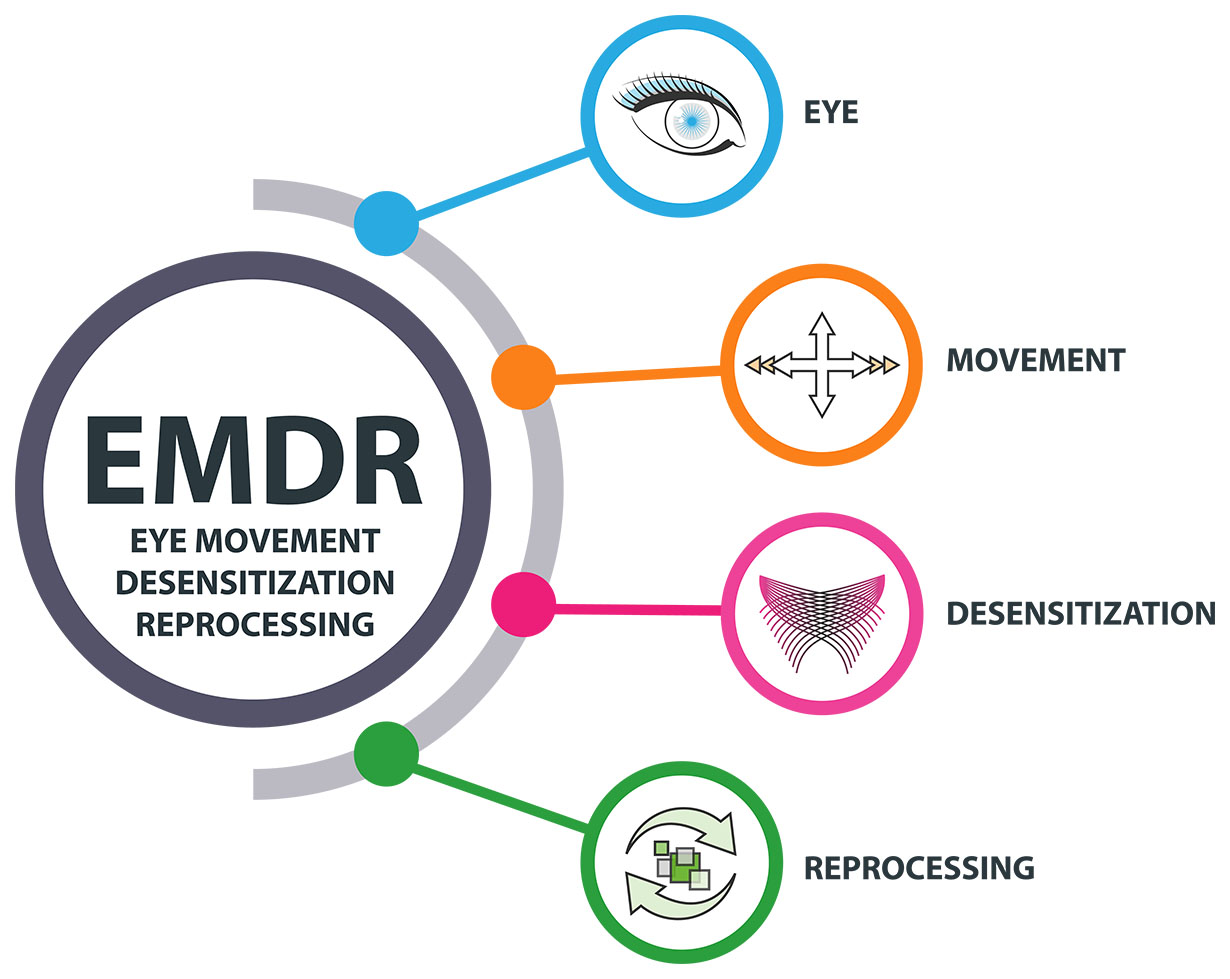
    So, I experimented with different genres: piano, lofi, classical, meditation, music with nature sounds, video game music, movie/show soundtracks, but they never stuck. One day, I came across hour-long videos on YouTube of binaural beats and ‘bilateral stimulation music’. It turns out this ‘bilateral stimulation music” is used for a therapy method called EMDR (eye-movement desensitization and reprocessing).

    Brief Overview of EMDR

    EMDR is a therapeutic approach based on the adaptive information processing (AIP) model (Oren & Solomon, 2012). Sometimes thought of as a variant of cognitive-behavioral therapy, EMDR involves an eight-phase approach that helps a person perceptual information (memories) that have been ‘maladaptively stored’ (Shapiro, 2002). Research has found EMDR therapy to be an effective treatment of trauma (Oren & Solomon, 2012). With EMDR therapy, we can process disturbing events, especially ones that we aren’t aware of. Other goals of EMDR includes “facilitates resolution of memories, …, desensitize stimuli that trigger present distress as a result of second-order conditioning, and incorporate adaptive attitudes, skills, and behaviors for enhanced functioning within larger social systems” (Shapiro, 2002).

    When we listen to bilateral stimulation, the brain can process negative or traumatic experiences which leads to memory reconsolidation (Oren & Solomon, 2012). Some other methods of EMDR besides bilateral stimulation music (alternating auditory tones) includes side-to-side eye movements and alternating hand taps (Oren & Solomon, 2012).

    However, van den Hout and Engelhard (2012) argue that these bilateral stimulation techniques may not be essential for the therapeutic effect. Instead, they suggest that what makes EMDR effective is the taxing of working memory during trauma recall. In other words, van den Hout and Engelhard claim that EMDR works best when we make our brain do two things at once.

    What is bilateral stimulation music?

    For bilateral music to be effective, listeners should hear the music using headphones. The music alternates between the right and left ear stereo channels. This bilateral music helps a person process stressful or traumatic memories without triggering severe stress (“Bilateral Music fo Anxiety, Stress and Trauma”).

    Listening to this music engages both hemispheres of our brain, which then activates the parasympathetic nervous system. The parasympathetic nervous system is responsible for our “rest-and-digest” response, which helps our mind transition from a state of anxiety to a state of calmness (“How Bilateral Stimulation Works to Reduce Anxiety“). The superior colliculus and the mediodorsal thalamus tune in, resulting in the recollection of happy memories.

    Screenshot 2025-04-14 233122.png

    This screenshot is of the video from YouTube that I’ve been listening to regularly for the past few months. When I listen to this kind of music, it feels like the auditory stimulation scratches an itch in my brain.

    As someone who becomes anxious often, listening to bilateral stimulation music has been extremely beneficial for me!


    Featured image credits: https://www.bansalneuro.com/discover-the-benefits-of-emdr-therapy-at-a-ray-of-hope-in-libertyville-il-and-kenosha-wi.html

    References:

    AREAS, I. T. (2005). Music Therapy.

    Bilateral music for anxiety, stress and Trauma. eMentalHealth.ca Resource Directory. https://primarycare.ementalhealth.ca/Ottawa-Carleton/Bilateral-Music-for-Anxiety-Stress-and-Trauma/index.php?m=article&ID=84502

    How bilateral stimulation works to reduce anxiety. Bay Area CBT Center. (2024, April 19). https://bayareacbtcenter.com/how-bilateral-stimulation-works-to-reduce-anxiety/

    Oren, E., & Solomon, R. (2012, October 3). EMDR therapy: An overview of its development and mechanisms of action. European Review of Applied Psychology. https://www.sciencedirect.com/science/article/pii/S1162908812000692?casa_token=mVz1zHojkoAAAAAA%3AJ5j4PhCogXtXhY11ATj3mwypOG0zBVHLICbxs5kCMQZ7Sr-S_d-qFCkTyou7WLmMRoBMpR85GQ

    Shapiro, F. (2002). EMDR 12 years after its introduction: Past and future research. Journal of clinical psychology, 58(1), 1-22.

    van den Hout, M. A., & Engelhard, I. M. (2012). How does EMDR work? Journal of Experimental Psychopathology, 3(5), 724–738. https://doi.org/10.5127/jep.028212

  • Nature’s Puppeteers: When Fungi Take Control

    Nature’s Puppeteers: When Fungi Take Control

    The Last of Us video game and its live-action adaptation follow a fictional post-apocalyptic story about surviving in a world where a mutated Cordyceps fungus evolves to survive in human bodies, turning people into violent zombies. According to the chief of the Mycotic Diseases Branch at the Centers for Disease Control and Prevention, Tom Chiller, this idea that a fungi species can mutate to survive the high temperatures of a warm-blooded body is “far-fetched” (Parshall, 2023). We are inhaling fungal spores all the time, but because of our immune system and high body temperatures create inhospitable conditions for fungal species to live (Beckham, 2023). 

    Ellie (Bella Ramsey) and Tess (Anna Torv)
    Photograph by Liane Hentscher/HBO: https://press.wbd.com/us/image/bella-ramsey-anna-torv

    Photograph by Liane Hentcher/HBO: https://press.wbd.com/us/image/bella-ramsey-anna-torv

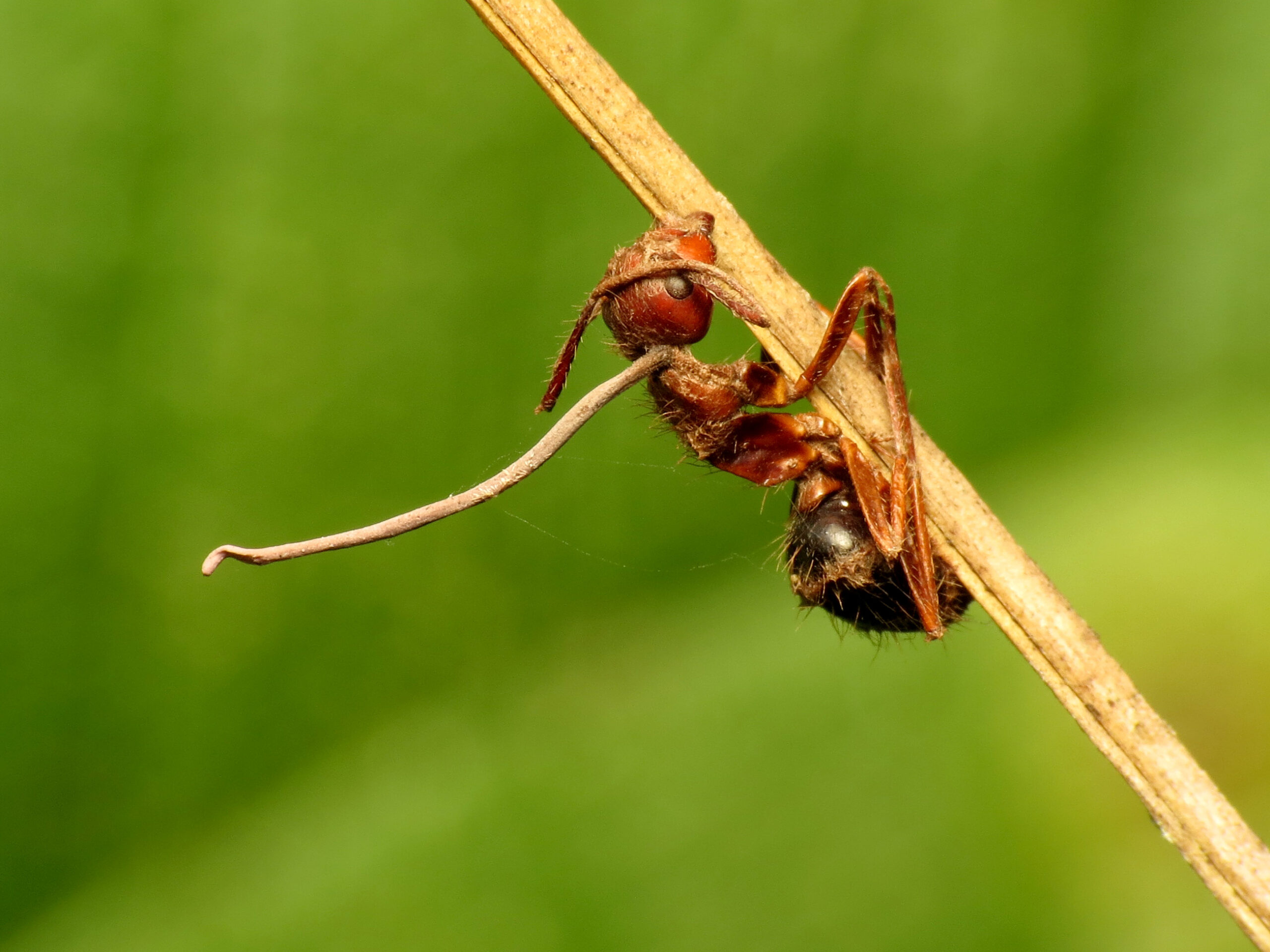
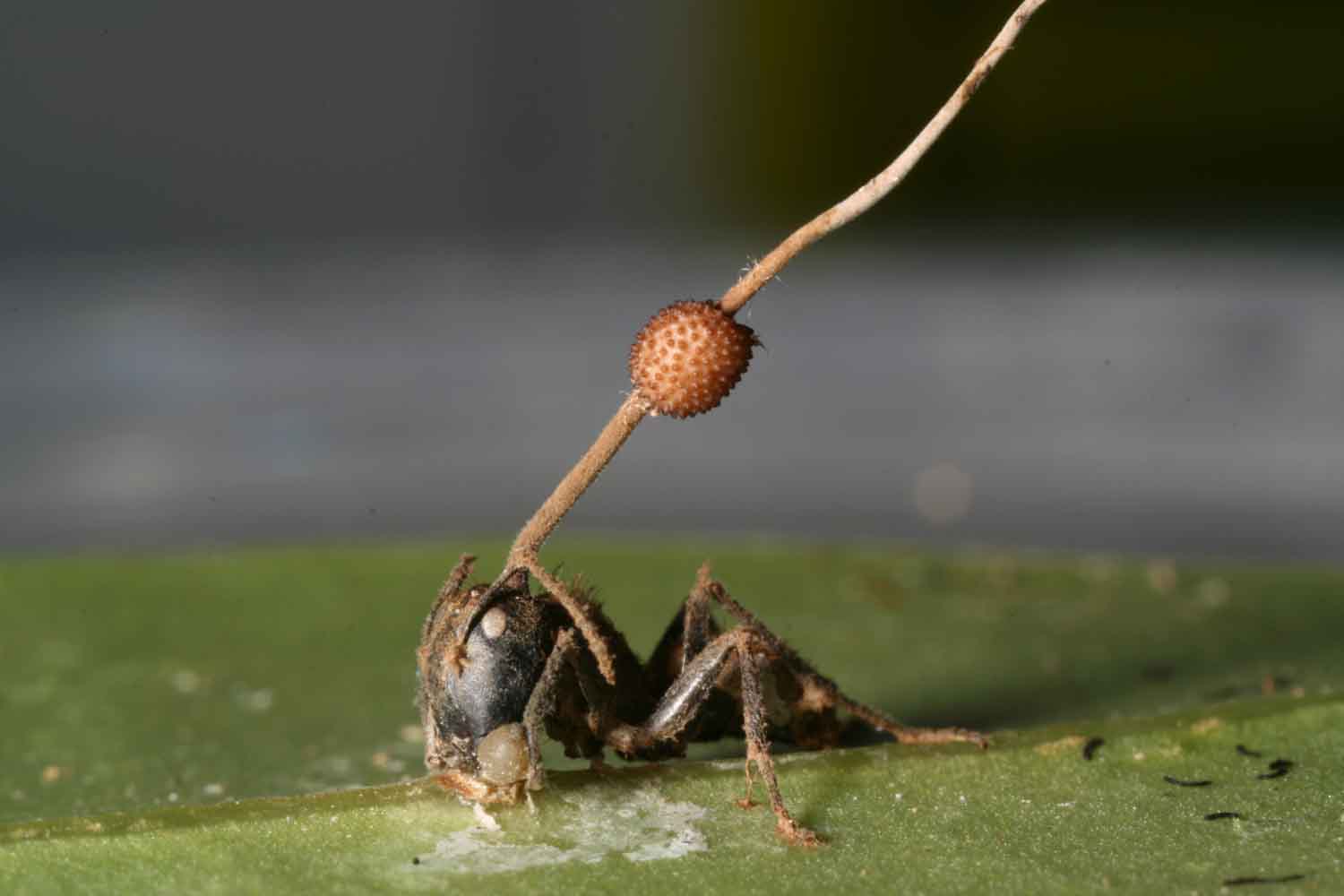
    Luckily for us, Cordyceps (Ophiocordyceps unilateralis) does not affect humans, but insects—Cordyceps are a parasitic fungus that takes control of the brains of insects such as ants and spiders.

    The spores of Cordyceps—zombie-ant fungus—take control of the mind and motor functions of their host, paralyze them, grow in them, and reproduce (Stone, 2023). The fungus will exhaust the host of all nutrients, spreading spores in the host’s body. It then makes the insect go to a higher location, where the direct sunlight makes optimal conditions for the spores to continue spreading. The Cordyceps infection to other insects is airborne, whereas in The Last of Us, the infection is transferred through bites.

    Ant killed by Ophiocordyceps fungus
    “Ant killed by Ophiocordyceps fungus”
    Taken By: Katja Schulz
    https://www.flickr.com/photos/treegrow/29867355174/in/photolist-swe1Eu-hnxMQY-dsinf4-mCtuwz-MvgZQu-Mvh1kh-Mvh18y

    Image taken by: https://www.flickr.com/photos/treegrow/29867355174/in/photolist-swe1Eu-hnxMQY-dsinf4-mCtuwz-MvgZQu-Mvh1kh-Mvh18y

    Fungi can spread in two ways: “vertical transmission from mothers to their offspring and horizontal transmission through spores in the environment” (Stone, 2023). This means that spores can be inhaled or land on surfaces of the body and infect that area of the body. 

    Are there Fungi that can affect humans?

    According to Perlin, about one billion people suffer from hair, skin, or nail infections, e.g. ringworm or Athlete’s foot. While treatable, fungal infections carry major health risks. He adds that over 1.5 million people globally die from fungal infections. Discovered in 2009, a multidrug-resistant fungus, Candida auris, and has been placed on the World Health Organization’s list of ‘priority pathogens’. This is the first fungus to be able to spread from person to person and survive in higher temperatures (Beckham & Roberts, 2023). Candida auris and Aspergillus fumigatus are now global threats, according to the CDC.

    Besides that, environmental fungi, e.g., mold, spread by emitting spores in the air, while others spread in the water and food supply (Perlin, 2023).

    Rest assured, we know that fungal infections originate from the environment through inhaling spores or an exposed wound, and unlike viral infections that can easily be spread person-to-person, the risk of spreading a fungal infection is extremely low (Beckham).

    Scott Roberts, MD warns that while a fungal apocalypse like The Last of Us is unlikely, there has been an increase in the risk of fungal disease because of the increased dependency on antibiotics. He explains that antibiotics kill all the good bacteria, which makes it easier for fungi to spread.

    It’s challenging to make antifungal medication that doesn’t harm humans because fungi are more closely related to humans than viruses and bacteria (Beckham, 2023).

    While it’s unlikely that a fungus-driven pandemic could occur in humans, we must take measures to respond to rising fungal infections or dangers.

    The Last of Us brought awareness to the lack of antifungal vaccines or research on fungal infections. These fungal infections are difficult to treat due to fungi’s nature to mutate and evolve—many of the current drugs used to treat fungal infections are ineffective towards certain strains (Pires, 2024).


    Sources Cited:

    Backman, I. (2023, February 5). “The Last of Us” apocalypse is not realistic, but rising threat of fungal pathogens is. Yale School of Medicine. https://medicine.yale.edu/news-article/the-last-of-us-apocalypse-is-not-realistic-but-rising-threat-of-fungal-pathogens-is/

    Parshall, A. (2024, February 20). Could the zombie fungus in TV’s the last of US really infect people? Scientific American. https://www.scientificamerican.com/article/could-the-zombie-fungus-in-tvs-the-last-of-us-really-infect-people/

    Perlin, D. (2023, Feb 16). Zombie fungus from “The Last of Us”: Is it real? New Jersey’s Top-Ranked Hospital Network. (2023, February 16). https://www.hackensackmeridianhealth.org/en/healthu/2023/02/16/zombie-fungus-from-the-last-of-us-is-it-real

    Pires, T. C. S., & Pires, Y. M. S. (2024). From Candida Auris to The Last of Us Cordyceps: Addressing Fungal Infections before it’s too late. Int J Allergy & Imm, 2(1), 1-2.

    Stone, L. (2025, April 6). Distinguishing between fungal fact and fiction in “The last of us” . NETEC. https://netec.org/2023/05/02/distinguishing-between-fungal-fact-and-fiction-in-the-last-of-us/