Day: November 14, 2025

  • A Spritz of Sperm Whale

    A Spritz of Sperm Whale

    When you think of perfume, what kinds of ingredients come to mind? Some people may think about flowery scents like rose, cherry blossom, or jasmine. Others may think of sweet notes vanilla, cinnamon, or honey. For some, the note “ambergris” may come to mind, but what is it? It can be described as a unique, musky scent with hints of the ocean. The original scent is actually derived from the intestines of sperm whales. How in the world would part of an animal’s digestive system end up in a perfume bottle?

    History of Ambergris

    According to the Smithsonian Museum, ambergris is a waxy substance that can only be found in the bowels of sperm whales, and it can only be collected if the whale regurgitates or defecates it (Brito, Jordão & Pierce, 2016). In other words, the scent comes directly from sperm whale intestines, where food is digested and turned into waste. The idea of the substance coming from intestines can certainly be off-putting. After all, the substance comes from the same place that feces are made in the whale. 

    Despite such an unappealing origin, ambergris was actually beloved throughout history. It was used by a multitude of cultures, ranging from Egypt to Europe. Ancient Egyptians burned the substance as incense to ward off evil spirits, Arabic regions used it as medicine, and some people in medieval Europe even consumed it in luxury dishes (Olson, 2024). Evidently, ambergris had many different uses throughout history. It was even described to have a sweet, musky scent with “notes of tobacco, sandalwood, and ocean” that got better with age (Olson, 2024). Thus, it makes sense that the fatty gold somehow found its way into the perfume industry. 

    Animal Products in Perfume

    At first glance, hearing about animal parts in perfume may sound alarming. However, animal products were commonly used in perfumes before chemists could synthetically recreate those scents. For instance, many common perfumes found in beauty stores will often have “musk” listed as one of the key notes. Musk actually comes from a sac in the musk deer, which is then removed and excreted to make perfume. (Fortneau, 2004). Thus, it was not necessarily a strange practice to implement the secretions of different animals into perfume. In fact, the same ambergris was originally used in Chanel No.5, utilizing the ambrein alcohol found within ambergris to help enhance the other scents within the perfume (Olson, 2024). 

    Is it Still Used Today?

    If there are any perfumes that contain the scent of ambergris in modern times, chances are the scent is synthetic. This is due to the fact that whale poaching is now illegal in most countries. In fact, it is illegal to even sell the ambergris in certain countries because the sperm whale is considered an endangered species due to the over hunting of the animal in the past (Olson, 2024). In order to emulate the same scent while keeping wildlife safe, chemists have found ways to replicate similar scents to those made with animals synthetically. 

    For instance, it was previously discussed that the scent “musk” originally came from the musk deer. However, it would likely cause harm to the population if the deer were to be hunted to satiate the demand of the perfume industry. Thus, chemists can replicate the scent by creating synthetic compounds that are chemically similar to what gives each note its specific scent. For musk, the main component that gives it its scent is called muscone. This was replaced by “musk Baur”, a scent that was discovered by Albert Baur when experimenting with trinitrotoluene (TNT) and “tert-butylhalides” to create new explosives (Fortneau, 2004). Today, chemicals like musk Baur are used much more often because they are much cheaper than hunting the animal themselves.

    This way, endangered species can be kept safe from hunting, while people can still enjoy the scents they love – even if they do come from the innermost parts of a whale.


    References

    Brito C, Jordão VL, Pierce GJ. (2016). Ambergris as an overlooked historical marine resource: its biology and role as a global economic commodity. Journal of the Marine Biological Association of the United Kingdom. https://doi.org/10.1017/S0025315415000910 

    Fortneau, AD. (2004). Chemistry Perfumes Your Daily Life. Journal of Chemical Education. American Chemical Society. https://doi.org/10.1021/ed081p45 

    Olson, D. (2024). The Mystery of Ambergris. Smithsonian National Museum of Natural History. https://ocean.si.edu/ocean-life/marine-mammals/mystery-ambergris 

  • The Uncanny Valley – An Exploration of How Humans Perceive AI

    The Uncanny Valley – An Exploration of How Humans Perceive AI

    Have you ever seen a humanoid design that looks just off? Whether it’s the subtle placement of facial features, an abnormal glint in the eyes, or even just a subconscious lurking feeling that something’s not right, you’ve likely experienced the sensation often described as the uncanny valley.  


    What is the uncanny valley?

    The concept of the uncanny valley was first introduced in the early 1970s by a robotics professor, Masahiro Mori. Mori describes the term as an irregular representative of a linear relationship, stating, “as robots appear more humanlike, our sense of their familiarity increases until we come to a valley.” (Mori et al., 1970) This ‘valley’ he refers to is a point in the relationship between human ‘likeness’ and familiarity in which familiarity plummets before increasing again. Mori designed a graphical relationship indicating this phenomenon, which can be viewed in the image below. This dynamic can be even further exacerbated by attentional human-like cues added, such as movement or touch sensation (Mori et al., 1970). 
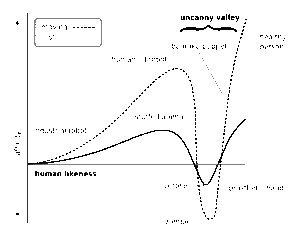


    (Original diagram created by Masahiro Mori, who coined the uncanny valley term in the early 70s.) Source: Wikimedia Commons [https://commons.wikimedia.org/w/index.php?curid=2041097]


    The actual origin of the uncanny valley is a question sought after and theorized on by many researchers. A few common hypotheses about its origin have been proposed though. Some examples that will be further discussed below are categorization uncertainty and perceptual mismatch. Unfortunately these hypotheses and actual root of the phenomenon is under researched area, making it difficult to tie a definitive cause (Kätsyri et al., 2025). 


    Categorical perception deals with one’s predisposition to better perceive something if it distinctly falls into a mental category. This causes things felt to fall into discrete categories to be highlighted in their uniqueness, and those that remain similar to have an understated emphasis on difference (Goldstone & Hendrickson, 2009). The hypothesis is that a cognitive dissonance is created when the uncanny valley is reached in a humanoid design. Essentially, at this stage, there is a difficulty in the mental categorization process, with ambiguity in the design making it hard to determine if the figure falls into the ‘human’ category or the ‘robot/inhuman’ category. This uncertainty is thought to bring the discomforting feeling described by the effect (Kätsyri et al., 2025).


    Another hypothesis is rooted in the idea of perceptual mismatch. This theory follows a similar line of reasoning to the categorization uncertainty hypothesis, being that the uncanny valley effect is thought to be brought on by a feeling of discomfort that arrives by the brain’s difficulty to discern something. In this case, it relates to the perceptual confusion brought along by something with high human likeness with a feature that is inhuman or artificial in appearance. The discrepancy between a primarily human perception and an identifying feature that is misaligned with that is thought to create the uncomfortable feeling of uncanniness (Kätsyri et al., 2025). 


    Uncanny Valley and AI

    As time has gone on, the general public has witnessed the rapid development of technology. With our world’s rising implementation of artificial intelligence (AI) run programs, generative technologies, and interfaces, the question arises, how does this concept intersect with AI? Can the uncanny valley phenomenon expand beyond visual design?


    A recent study explores these perceptions in action and how it affects user interaction and emotional responses. Deepali Kishnani, a student at MIT, employed an experimental structure that examined text interactions between participants and 3 variables – a bot engineered to be ‘human-like’, a bot engineered to be ‘uncanny-like’, and a human for control. After conversing with one of the 3, the participant ranked the system on anthropomorphism, animacy, likeability, perceived intelligence, and safety (Kishnani, 2025). 


    Based on the rating and analysis of the results, it was concluded that there is evidence that the uncanny valley is present in text-based interaction, as the ‘uncanny-like’ bot was consistently rated lowest on all dimensions. Findings also revealed that people are having an increasingly more difficult time distinguishing human interaction from AI interactions, as 60% of participants in the human control group incorrectly identified their chat companion as AI (Kishnani, 2025).


    With the now confirmed presence of possible uncanny valley in AI chatbot interactions, an additional question of how it influences trust from users arises. Another study explores this concept, seeking how the anthropomorphism of AI systems induces concern into the patron, instigating fear of human-natured negative actions onto the inhuman bot (Kim et al., 2024). This study specifically introduces a concept known as ‘uncanny valley of the mind,’ which focuses more on human-like intentions rather than human-like appearance. They suggest that the uncanny valley of the mind is brought on when a chatbot is perceived to have human-like mentalites (also known as a ‘digital mind’), they will also possess human-like intentions- such as the ability to misuse information (Kim et al., 2024).


    To test this phenomenon, researchers created 2 chatbots that could be accessed through facebook messenger, one ‘anthropomorphized’ and one ‘non-anthropomorphized.’ Through a series of interactions, the bot asked for personal information and later synthesized either an ad containing that information or a generic ad without it. Interestingly, when the anthropomorphized bot presented the user with a personalized ad, participants reported increased privacy concerns. This effect was not present in the non-anthropomorphized ads, regardless of it being the personalized or non-personalized ad. With this being said, it was determined that higher anthropomorphism in chatbots decreases consumer trust/likelihood to purchase a product when personal information is included in the pitch (Kim et al., 2024).


    What Does this Mean for the Future of AI?

    It seems that as the days go on, more applications of AI are created and present in a multitude of functions. As implementations into features like writing programs, customer service, and ad-personalization grows, opportunity for distrust in these systems increases along with it. The research above proves that the uncanny valley can seep into perceptions of these AI powered systems, so how will producers handle this realization?


    In my opinion, there are two ways this industry can progress to mediate this issue from a psychological standpoint. Either producers will make efforts to develop AI systems that are less uncanny and more perceptual humans or consumers will begin to gravitate away from trust. Historically both of these things have occurred in product development and examples regarding the uncanny valley can even be observed. 


    A great exemplification of both of these mediations is the design of ‘Sonic the Hedgehog’ in the 2020 film rendition. When the first trailer released, fans of the franchise were horrified by the uncanny design of their beloved main character. Sonic, a very cartoonish character, had been adapted to his life action role by combining realistic CGI texturing and a flurry of human-like features on a very non-human creature. The uproar after the release was instant, with many fans taking to social media to detest the movie and state their refusal to endorse it. (Alexander, 2020) This is an example of the consumers gravitating away from trust. Producers were then forced to change the design to be more appealing and cartoonish, exemplifying the need for producer design in a way that is more appealing to consumers. 


    The true outcome of how AI develops can only be told by time. Until then, be a critical consumer. Do you find yourself experiencing a lurking, unsettling, off feeling when chatting with AI systems?


    References:

    Alexander, B. (2020, February 17). How “Sonic the Hedgehog” avoided death by Twitter with a dramatic, game-saving redesign. USA Today. https://www.usatoday.com/story/entertainment/movies/2020/02/13/sonic-the-hedgehog-movie-redesign-how-backlash-made-character-better/4730593002/

    Goldstone, R. L., & Hendrickson, A. T. (2009, December). Categorical perception. WIREs Cognitive Science. https://wires.onlinelibrary.wiley.com/doi/10.1002/wcs.26

    Kim, W., Ryoo, Y., & Choi, Y. K. (2024). That uncanny valley of mind: When anthropomorphic ai agents disrupt personalized advertising. International Journal of Advertising, 1–30. https://doi.org/10.1080/02650487.2024.2411669

    Kishnani, D. (2025, March 7). The uncanny valley: An empirical study on human perceptions of AI-generated text and images. The Uncanny Valley: An Empirical Study on Human Perceptions of AI-Generated Text and Images. https://dspace.mit.edu/handle/1721.1/159096

    Kätsyri, J., Förger, K., Mäkäräinen, M., & Takala, T. (2025, November 1). A review of empirical evidence on different uncanny valley hypotheses: Support for perceptual mismatch as one road to the valley of eeriness. Frontiers. https://www.frontiersin.org/journals/psychology/articles/10.3389/fpsyg.2015.00390/full#B19

    Mori, M. (1970). The Uncanny Valley. https://www.almendron.com/tribuna/wp-content/uploads/2018/01/morunc.pdf 
  • How Science is Reinventing What it Means to “Stay Cool”

    How Science is Reinventing What it Means to “Stay Cool”

    Introduction:

    On a hot July day, what you wear to stay cool matters. There are common remedies to help you stay cool: wearing cotton and light colors to allow for air circulation and light reflection. Some textiles, like wool, insulate heat to help you stay cool during the winter months and others, like polyester, prevent sweat from absorbing into its fibers. As global temperatures rise and daily heat records are broken more often, these traditional “summer” fabrics can only do so much to keep you cool because of their one big drawback: they trap the body’s infrared radiation induced heat (Tang, 2025).

    The body is always emitting infrared radiation, but this radiation typically is let off into the air. However, fabrics like wool, polyester, and cotton, absorb or reflect this radiation back to your body and trap heat. This problem is exactly what scientists studying radiative cooling textiles hope to combat (Yu et al., 2025). 

    What Scientists are Doing:

    Researchers are reengineering textiles at the molecular level to design radiative cooling textiles that release the infrared radiation the body lets off instead of reflecting it back to the body like traditional textiles (Tang, 2025). These thermoregulating textiles focus on the movement of heat and light through fibers rather than just controlling airflow and moisture retention. Through the careful design of specific polymers, coating fibers, and embedding of nanoparticles, how radiation interacts with fabric can be manipulated. For example, some of these textiles have been made from engineering polyethylene that reflects visible light but is transparent to infrared radiation, allowing for heat to escape from the body (Yu et al., 2025). 

    Outside of science labs, early prototypes of these thermal textiles are being tested by research teams and companies. Specifically, several research teams, like brrro and IRCool textiles at Stanford University, are testing radiative cooling textiles that appear to lower body temperature by a few degrees even in the direct sun, which is a major development as extreme heat events become more common (Yu et al., 2025). Additionally, these thermal textiles are being tested for use as athletic wear and for architectural purposes (Tang, 2025). 

    Not Quite Cool Enough, Yet:

    Despite major developments in the use of these thermal textiles, there are still several challenges that textile researchers are facing. One of the major problems is that polyethylene, the main polymer being used in these thermal textiles, is difficult to recycle, receiving criticism from environmental activists (Tang, 2025). Additionally, these polymers are difficult to dye due to their amorphous structure, limiting their aesthetic uses in industry. While radiative cooling textiles offer a promising improvement in keeping you cool in the warmer months, their presence remains primarily in the researching and prototype phases rather than the mass-market clothing industry (Yu et al., 2025). 

    Conclusion:

    As temperatures continue to rise, the fabrics we wear have an ever important role in keeping us cool and safe. Radiative cooling textile advancements show how science intersects design to create clothing that works with the body’s heat flow for maximized comfort and functionality. While there is a long road ahead of these textiles becoming commercially available, their innovation marks a step towards cooler clothing. 

    References:

    Tang, B. (2025). Recent progress in the development of radiative cooling textiles. Nanomanufacturing, 5(2), 22. https://www.mdpi.com/2673-7248/5/2/22 

    Yu, Z., Zhang, L., & Li, Y. (2025). Next-generation passive cooling textiles for personal thermal management. Nano Research Energy, 4(1), 713-725. https://link.springer.com/article/10.1007/s40820-025-01713-4

  • Misophonia: The Unofficial Common Neurobehavioral Disorder

    Misophonia: The Unofficial Common Neurobehavioral Disorder

    For sure most people have already experienced some ‘disliking’ sounds before. For example, the emergency sirens, high-pitched yellings, public space noises, etc. What’s about daily life sounds? From the snoring, sniffling, heavy breathing, a few people might be triggered into intense negative emotion such as rage or disgust (Salamon, 2023). This is a sign of misophonia.

    What is Misophonia? 

    According to Kumar et al (2021), “misophonia is a common disorder characterized by the experience of strong negative emotions of anger and anxiety in response to certain everyday sounds” (para. 1). Most of the known triggers for misophonia are human-orofacial actions such as eating and chewing, including images and silent videos (Kumar et al, 2021). 

    Patients and causes

    The cause of misophonia remains unknown, but an experiment with 15 members of the same family suggests a possible hereditary factor (Sanchez & Silva 2017). These 15 Caucasians with misophonia span across 3 generations, with more than half being women. The younger generations reported to have misophonia earlier than their parents, with the youngest starting at age 2. Surprisingly, 80% of the women with misophonia have all of their children also diagnosed with misophonia, suggesting this is a genetic disorder. According to a study published in 2023 by journal PLOS One, nearly one out of five adults experience similar conditions, with women responding more intensely than men (Salamon, 2023).

    A separate research focusing more on severe cases of misophonia suggest that the disorder involves brain regions, including the mirror neuron system, orofacial motor area, and both auditory and visual cortex. These areas seem to respond to sensory stimulation associated with the production of trigger sounds, potentially causing the patients to unknowingly mirror the perceived action (Kumar et al, 2021). The study further suggests that extreme negative reactions occur in misophonia possibly due to a sense of loss of control, invasion of personal space, or interference with current goals and actions. Kumar et al (2021) also highlight that automatic mimicry of eating behavior is commonly learned within families since young age, which may explain why a family member usually becomes the initial source of sound triggers developing misophonia. This finding is consistent with Sanchez and Silva’s study (2017), where younger generations tend to experience misophonia earlier than their parents – suggesting environmental factors contribute to the disorder.

    According to Cleveland Clinic, a worldwide nonprofit academic medical center and healthcare provider, about 50%-80% of reported misophonia patients are women (Cleveland Clinic, n.d.) The information page suggests brain structure differences, family history or genetics are causes of the disorder. 

    Cure and Prevention

    Even though most people reported that misophonia has zero to minimal effect on their life (Sanchez & Silva 2017), many might encounter daily life struggles as residents in busy areas. There are people who cannot eat out at restaurants due to the eating noises, feeling uncomfortable in dark spaces which enhance hearing functions like in movie theater, etc – in some cases, misophonia can become socially impairing (Salamon, 2023). For the few severe situations, body reactions can include blood pressure increases, chest pressure or tightness, goosebumps, heart rate increases, or sweating (Cleveland Clinic, n.d.). As misophonia is a lifelong condition, it could worsen or introduce chronic diseases.

    Unfortunately, as the exact sources and causes of misophonia remain uncertain, there is no exact cure for it and therefore it is not officially recognized as a medical condition (Cleveland Clinic, n.d.). Many patients are able to manage the condition using sound aversion methods like wearing earplugs or headphones, listening to white noise, practicing deep breath or muscle relaxation (Salamon, 2023). 

    It’s very important to not criticize behavioral symptoms (Salamon, 2023) as chances are that they are experiencing some medical conditions. Much of the older generation lived with misophonia all their life without getting treatment. Sadly, they resist going to doctors because of the stigma surrounding mental disorders. Although misophonia is still an unofficial disorder, many experts recognize the patterns. If you ever encounter someone potentially experiencing misophonia and thinking they have gone mad, it would be nice to tell them about the disorder, and suggest ways to manage the condition in daily life.  

    References

    • Kumar, S., Dheerendra, P., Erfanian, M., Benzaquén, E., Sedley, W., Gander, P. E., Lad, M., Bamiou, D. E., & Griffiths, T. D. (2021). The motor basis for Misophonia. The Journal of Neuroscience, 41(26), 5762–5770. https://doi.org/10.1523/jneurosci.0261-21.2021 
    • Misophonia: What it is, triggers, symptoms & treatment. Cleveland Clinic. (n.d.). https://my.clevelandclinic.org/health/diseases/24460-misophonia
    • Salamon, M. (2023, September 1). When everyday noises upset you. Harvard Health. https://www.health.harvard.edu/diseases-and-conditions/when-everyday-noises-upset-you 
    • Sanchez, T. G., & Silva, F. E. (2018). Familial misophonia or selective sound sensitivity syndrome : Evidence for autosomal dominant inheritance? Brazilian Journal of Otorhinolaryngology, 84(5), 553–559. https://doi.org/10.1016/j.bjorl.2017.06.014