Day: October 7, 2022

  • Never Heard of Biomedical Engineering? Let me tell you what it’s all about!

    Never Heard of Biomedical Engineering? Let me tell you what it’s all about!

    For anyone interested in going into Engineering, there are no shortage of disciplines that you can go into at Georgia Tech. You could major in Computer Engineering, Civil Engineering, Mechanical Engineering, Industrial Engineering, Environmental Engineering, Chemical Engineering, Biomedical Engineering, and any other type of engineering that comes to your mind, you can bet that we have it. Plus, we are a top-ranked school for any major that you have heard of! I, however, am not here to run a promotion commercial for Georgia Tech. I am sure that you have already seen and heard plenty about this school! Rather, I am here to tell you about why I chose Biomedical Engineering, and why I love what I do and the major that I am in! I am sure that many of you are either at the exciting point in your life, where you are getting ready to apply to college and wondering what you want to do, or are parents of kids and wondering what is an efficient way to spend your money! Whoever you are, I hope that you leave this post, gaining some more insight and with more information to be better prepared for your first day as an engineer at Georgia Tech, and, hopefully, a Biomedical Engineer!

    First of all, you are probably wondering, what the heck is Biomedical Engineering, and why should you consider it? If you read the name of the major, you are probably thinking, “Well, it has something to do with Biology and Medicine, and how the two interact!” If this is you, then I am here to tell you that you are on the right track! In fact, broadly speaking, what we do is try to find better solutions for common medical problems facing tons of individuals in the United States, and globally, using principles that we learn in math classes, biology, chemistry, etc. But, there is so much more to it than that! With BME, there is never a wrong answer to a problem! You are probably thinking, “Is he crazy?” No, you read that right, there is never a wrong answer to a problem! Unlike Civil Engineering or Mechanical Engineering, where you may have to perform calculations, many of the problems that you are faced with in Biomedical Engineering are more personal and the choices that you make and the perspectives that you bring can profoundly change their lives for the better, or for the worse! In Biomedical Engineering, you truly get the opportunity to think outside of the box, which is something that I really think you don’t have in other majors. Are you intrigued yet? Wait till you read more!

    So you may still be wondering, is this the right major for me? Specifically, you might be wondering, what type of person is a good fit for this major? My answer to those questions is that there is no such person as an ideal or a perfect fit for this major. Rather, you have to ask yourself, do you have a vested interest in having a personal impact on people’s’ lives?. This is not like Computer Science, or Mathematics where the work that you do is all theoretical, and involves sitting in a cubicle all day. This major is truly different from all the other majors because it is extremely practical in nature. If you go into this major, keep in mind that the majority of the time you spend is going to be thinking through scenario – based problems that do not have perfect answers. This may seem scary! However, I can assure you that that will make you better prepared for the real world. You grow the most when you are pushed outside of your comfort zone, and that is what will happen in this major.

    Okay, so you’ve read this far, and thought to yourself, “Yes, this major is for me!”, then you are probably wondering, “I don’t really understand how and where science comes into Biomedical Engineering! All he has talked about is working in teams, on real – world and practical problems. However, I promise you that all the concepts that you learn in Biology, Chemistry, and Physics come to use here. Just this past school year, I had to work on making a Pulse Oximeter, using Arduino to better measure Oxygen Saturation Levels in users with Dementia who had Long Covid. I remember that, at first, I was so confused where to even start. However, then, by using the knowledge that I learned about the Respiratory system from my systems physiology, and biology classes, I was able to dramatically simplify the problem, and start at a much more basic level. This also was true for a project I did about creating a mathematical model to predict the likelihood that a woman would develop Endometriosis. At first, it seemed way too complex for me with my skill level to make such a sophisticated model. However, when I thought about the role of Bayes’ Rule, which I had learned in my Biology class, and its uses, I realized how excellently I could apply it to my project at hand, even if it was not necessarily a mathematics – related project. You will also be at the forefront of research, and projects where you apply science directly. For example, many of my friends are research assistants in the Laboratory for Synthetic Immunity, led by Dr. Gabe Kwong. They use some of the information that they learned in Introductory Biology, such as how T-cells work to fight off an infection to utilize the body’s own immune powers to fight off cancer cells! In Dr. Krishnendu Roy’s lab, another lab run by a prominent BME professor who teaches Biomaterials, you perform research on how to speed up the process of delivering important therapeutics to those who need them, using principles you learned in Biology, Chemistry, Biomaterials, etc! In the BME Design Shop, you can apply the principles of torque and rotational motion that you have learned in Physics to create some extremely sophisticated physical prototypes! No, I’m not talking those stick figure drawings or those simple foam prototypes! You can create real, elegant prototypes that show the mechanics of how your design would work in practice. You can use programs, such as Fusion 360 to create 3D models of your design ideas using principles that you literally learned in Geometry and Differential Calculus! My point is that, the science aspect may not always be so obvious! You may have to really do some soul searching to find where the science aspect comes into your work. However, I can assure you that it is there. Sometimes, you really just have to think outside of the box. 

    However, with choosing any major comes tradeoffs. The tradeoff with BME is that the classes are extremely challenging, and they require you to truly apply different principles from different disciplines, rather than just regurgitate information. In classes like BMED 2110, or Conservation Principles in Biomedical Engineering, you have to learn how to take a poorly defined system, or a poorly defined problem, and uses the principles you know, such as the Conservation of Mass, the Conservation of Energy, the Conservation of Moles etc., and the equations you learned in Physics or Chemistry to deduce and obtain information that you do not easily have access to. Similarly, in BMED 2250, Problems in Biomedical Engineering, you are going to have to take the skills that you have learned in classes, such as Intro to Matlab, General Chemistry, and Statistics to figure out how you can solve an otherwise time consuming problem, much more rapidly. In BMED 2310, Introduction to Biomedical Engineering Design, you take that to the next level. You have to ask yourself, how can the principles that I have learned be used to create a better solution to a problem, as compared to the existing present solution? Put another way, how can my use of Matlab, or linear regression, or circuits be used to create a more efficient solution that better solves the problem for the user, or the various stakeholders that are affected by a problem? This may all seem daunting, but I promise you that you will be extremely thankful at the end! These skills prepare you for a career in Research, Manufacturing, Product Development, and whatever else you may dream of!

    I sincerely hope that by reading this article, you have developed the same passion for Biomedical Engineering that I have! Just kidding, I don’t expect you to have gotten that invested! However, I do encourage you to truly consider the field. One of the nice things about Biomedical Engineering is, you do not need to know immediately if you enjoy it or if it is what you want to do! There is no timeline for when you have to decide! One of the nice things about Biomedical Engineering is that it is becoming so well sought after because healthcare, and better solutions for common healthcare problems are at the forefront of many peoples’ values, and what many stakeholders want. I truly believe that there is a place for anyone who is interested as a Biomedical Engineer, so if you choose to go into this major, I guarantee that you will find what you are passionate about!


  • Why the tiny arms?

    Why the tiny arms?

    Why are small arms better?

    A question bugging palentologists for years: Why did T. Rex evolve to have short arms? Why was it beneficial for them to have shorter arms? Intuitively, one might think that longer forelimbs would be much more advantageous. However, out of all the hypotheses, one by Kevin Padian struck me as quite interesting!

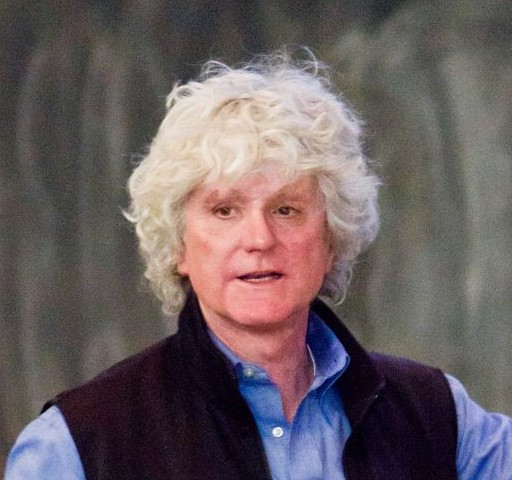
    Introducing Kevin Padian:

    Kevin Padian is a professor of integrative biology at UC Berkeley. He recently authored an article that gives one of his hypotheses for why Tyrannosaurus Rex evolved to have such short forelimbs.

    Learn more about Professor Padian here:

    https://ib.berkeley.edu/people/faculty/padiank

    Read more about his hypothesis at:  https://www.app.pan.pl/article/item/app009212021.html

    The following is a fun animation I made inspired by his hypothesis:


  • Frankenscience – The future of medicine?

    Frankenscience – The future of medicine?

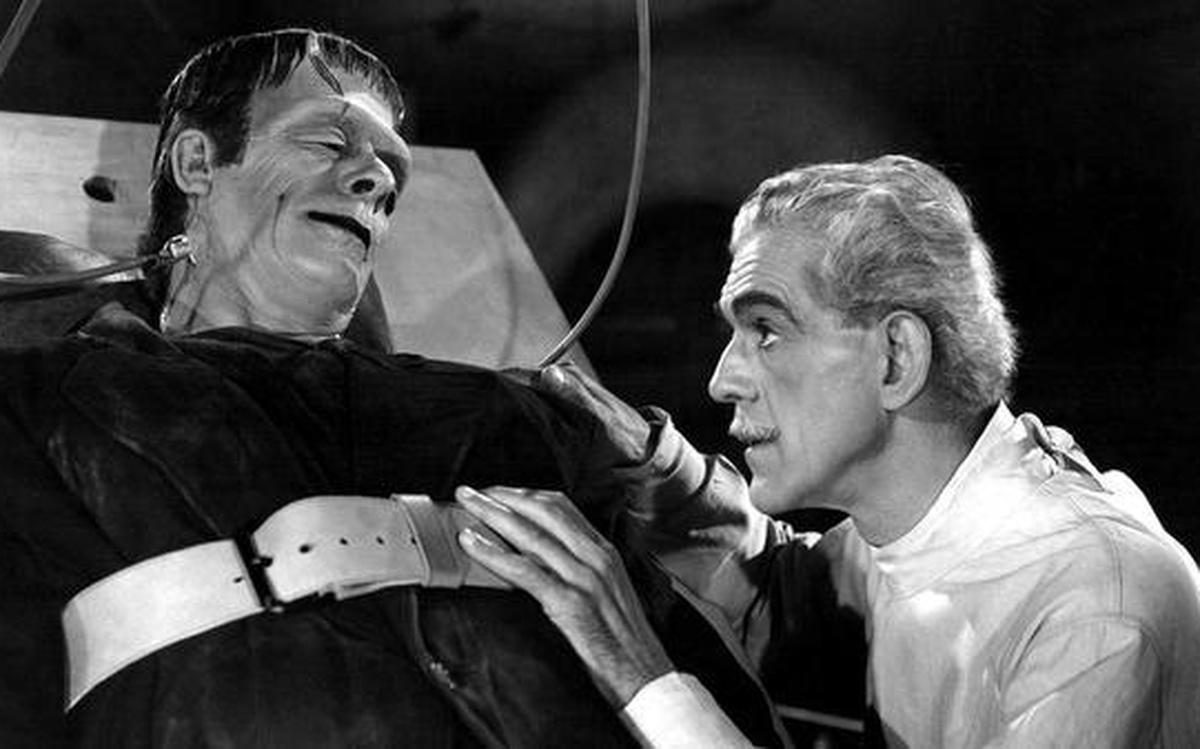
    If you think of science fiction, you might think of Victor Frankenstein. Originally from Mary Shelley’s book Frankenstein, the creature and its lore has been modified over the centuries, but the general idea has remained quite the same. The story follows an ambitious student of natural sciences, Victor Frankenstein, who creates artificial life from pieces of corpses. Now, most people assume the creature is named Frankenstein, although that is the name of the scientist who created it and the monster itself is just known as Frankenstein’s monster. When you think of the monster, you probably imagine some stitched up humanoid creature, with nuts and bolts and different colored body parts, pale gray or even a light blue/green shade. But you get the idea: it’s a creature composed of body parts from several different corpses. What if I told you that there is an actual science relating to what Frankenstein did? It’s not exactly creating artificial life from human body parts, but it’s transplanting living cells, tissue, or even organs from one species to another. While it sounds like a concept straight out of a science fiction novel, it is in fact a real scientific concept that has been used in the past and present, and it is known as xenotransplantation. 

    Why is this even a concept? Frankly, it sounds impossible. But it is an important subject, and it is a very heavily debated one. In the USA currently, there is a long list of patients waiting to receive an organ transplant. There aren’t enough organ donors to meet the demand, and as a result, 17 people die daily waiting for a transplant. When there’s such a shortage of donors, we need to turn to science to help us find a solution. One proposed solution has been xenotransplantation, which is not a new concept in medicine, but very heavily debated, and hasn’t had much success proving itself as a viable option. The biggest concern with xenotransplantation right now is success. Every trial of it has ended in the death of the patient, largely due to infections and complications with the body accepting a foreign organ. The first recorded case of heart xenotransplantation was in 1964, when Dr. James Hardy transplanted a chimpanzee heart into a semi-comatose patient experiencing a vascular disease. The transplant was only successful for a couple of hours, before the patient passed away due to the chimpanzee heart not being large enough to support the blood circulation. 

    Potential animal donors include pigs, chimpanzees, and baboons; primates being the most common due to their compatibility with humans. Currently, there is a lot of research going into genetically modifying these organs to be compatible with the human body. A more recent case of xenotransplantation was a kidney transplant in September of 2021. While the donor recipient was technically deceased and placed on a ventilator, the point of the transplant was to study the function of the kidney and watch for signs of rejection. In this case, the kidney was a genetically modified pig kidney. Throughout the period of study, which lasted 54 hours, no signs of rejection were detected and key indicators of a properly functioning kidney were present. This is a huge step towards the implementation of xenotransplantation in the future, but much more research remains to be done. 

    Ethical concerns are also brought up in discussion of xenotransplantation. There is a public health risk associated with cross-species transplantation; we do not know how interactions with the donor recipient and the general public will go and if there is risk of disease transmission. Therefore, the question is brought up: can we allow xenotransplantation if it will affect people outside the recipient and how do we gauge that level of consent? Aside from public health, animal rights are also brought into question. Animals cannot speak for themselves and therefore do not have a say in what happens to them. Is it ethical to use animals like chimpanzees and pigs solely for their organs, and if not, what makes it different from raising animals to kill them for their meat? Is killing a primate more serious than killing a pig due to its proximity to humans? What actually lets us determine if it is or isn’t ethical to raise and kill animals for the purpose of using their organs? What are our limits, as human beings? These are only a couple of questions raised when debating the ethics of xenotransplantation. 

    Until the risk of transmission of animal pathogens is eradicated, and researchers actually find a way for cross-species transplants to be successful, xenotransplantation remains out of the question as a solution to the organ donor shortage. We cannot think of xenotransplantation until we make a medical breakthrough that would allow it to be a success, and have recorded success. The ethical debates surrounding it also can only be considered when progress is made. Regardless of the chance of success, it is still an interesting topic to think about. The implications of xenotransplantation affect subjects just beyond organ donors; cross-species medicine could be the future. While it isn’t the same science as Frankenstein, the intersection of science and science fiction is truly amazing to see. 


    Sources: 

    https://www.fda.gov/vaccines-blood-biologics/xenotransplantation 

    https://www.organdonor.gov/learn/organ-donation-statistics 

    https://www.ncbi.nlm.nih.gov/pmc/articles/PMC3246856/ 

    https://nyulangone.org/news/progress-xenotransplantation-opens-door-new-supply-critically-needed-organs 

    https://www.pbs.org/wgbh/pages/frontline/shows/organfarm/regulators/clark.html#:~:text=Ethical%20issues%20concerning%20xenotransplantation%20include,given%20the%20public%20health%20risks 

  • I Got My Brain Scanned for Science

    I Got My Brain Scanned for Science

    Yeah, I got my brain scanned for science. And you should too! (If you’re eligible, that is.)

    Basically, I got an MRI scan of my brain done recently as part of a study at the GT/GSU Center for Advanced Brain Imaging (CABI). And while I was kind of nervous about the process, I wanted to write about the experience to help other people. If you’re about to get an MRI scan for medical reasons or for a study, I hope this article can relieve any fears or answer any questions you might have!

    So, what is an MRI? MRI stands for Magnetic Resonance Imaging. An MRI machine looks like a very large tube with a donut sized hole on the end. During an MRI, you lay down in front of the donut and the technician moves you into the machine. By using magnets, the machine is able to take 3D images of your organs (in my case, my brain!). Since an MRI is so detailed and there’s no radiation risk, it is often used by doctors to detect tumors and look at brain injuries. There’s a version of an MRI called an fMRI, which shows which areas of your brain are activated. The f in fMRI stands for function, and fMRI images are able to help scientists understand how we think.

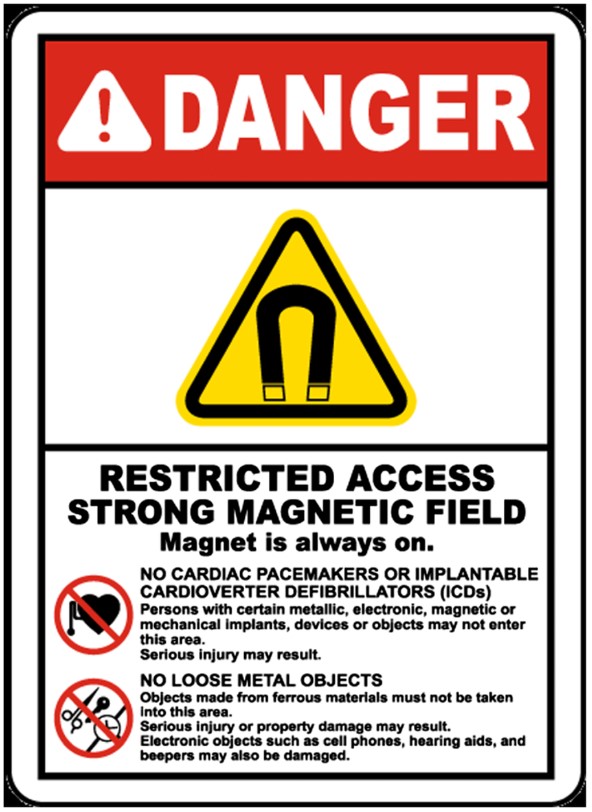
    Since an MRI uses a really powerful magnet, you can’t bring anything metal in there. So, people with pacemakers, metal stents, braces, etc. might not be able to get an MRI. And when I say a powerful magnet, I mean it. The MRI machine at CABI is behind a heavy, access locked door with two large signs looking like the one on the right:

    A danger sign with a red header saying danger. Underneath is a yellow triangle with a magnet symbol indicating a strong magnetic field.And if you have a morbid curiosity as to what would happen if you did bring in metal on or in you, check out this video: MRI vs Metal Coins (American Currency) DO NOT ATTEMPT To Replicate. Notice that just by being near the MRI, the camera goes all wonky. Some other metal things that you might not consider:

    • Some tattoo inks that include metal
    • Earrings
    • Hearing implants
    • Magnetic eyelashes
    • Those metal fasteners on pants

    If you have any of these, it doesn’t mean you’re automatically disqualified from getting an MRI, but it’s important to bring it up to the technician or radiologist.

    After I made sure I was metal free, I stepped into the MRI control room. There was a giant window where the researchers and technician would be able to see me laying in the MRI in the next room. I took off my jacket and shoes, feeling a bit jittery now. I was going to be INSIDE that giant thing.

    The research assistant made her way over to me with a Vitamin E capsule and some tape. At my confused look, she explained, “Vitamin E shows up really brightly on the MRI, so we are gonna put this on your left forehead. That way, when the scans come in, we can tell which side is the left.” Makes sense to me. But that didn’t make it feel less weird when I put it on my head.

    The technician led me into the MRI room, where I laid down on the extended platform. It felt like the kind of examination table they have at the doctor’s office, but it was more padded. That was to discourage people from moving around and messing up the scan. After I laid down, I felt the technician place down more padding around my head and feet. She also gave me earplugs and a bulb that I was supposed to squeeze if I needed anything once I was in the machine. As she did all this and wheeled me into the darkness of the machine, she told me what she was doing. This helped calm my nerves a lot, considering I couldn’t see what was going on. 

    Finally, the technician turned the machine on, and I immediately appreciated the earplugs. The beeping reminded me of an alarm clock. I heard that some people can fall asleep during an MRI, but that wasn’t me. It wasn’t earsplitting, but just loud enough that it never faded into the background.

    My earplugs were attached to an earpiece. After a burst of static, I heard the research assistant over the beeps. 

    “Okay, we’re going to do the first part of the MRI and take a picture of your brain’s structure. Do you feel okay?”

    I nodded. There was a pause. “Wait, sorry,” I said, smiling sheepishly to myself in the dark of the machine. Obviously, they couldn’t see me. “Yes, I’m all ready.”

    The actual imaging itself was boring, but I passed the time imagining the magnetic beam hitting all of my cells. After a while, I could almost feel the beam on my skin. There wasn’t actually anything, of course. Then, the fMRI was done. The beeping was a different rhythm–more pleasant, in my opinion.

    While the scan was being performed, I completed a memory task as part of the study. A screen was put in front of me while I was still in the scanner, with the image projected from a computer screen in the control room using some mirrors. Using a control pad of buttons, I was even able to manipulate what was on the screen. I didn’t even know you could do all that while in an MRI machine!

    Soon, I was able to be released from the dark void I had been in previously. The whole process took around half an hour–much shorter than I expected. Other than some numbness from staying as still as possible, I felt alright. And I was excited to see what my brain really looked like!

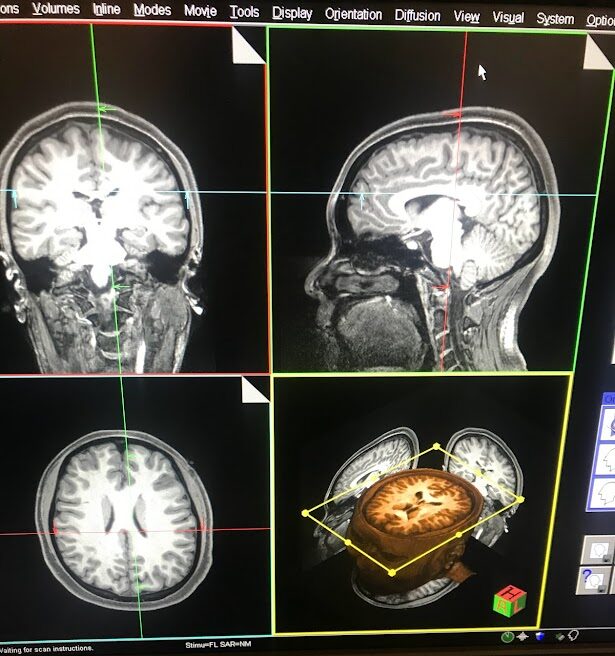
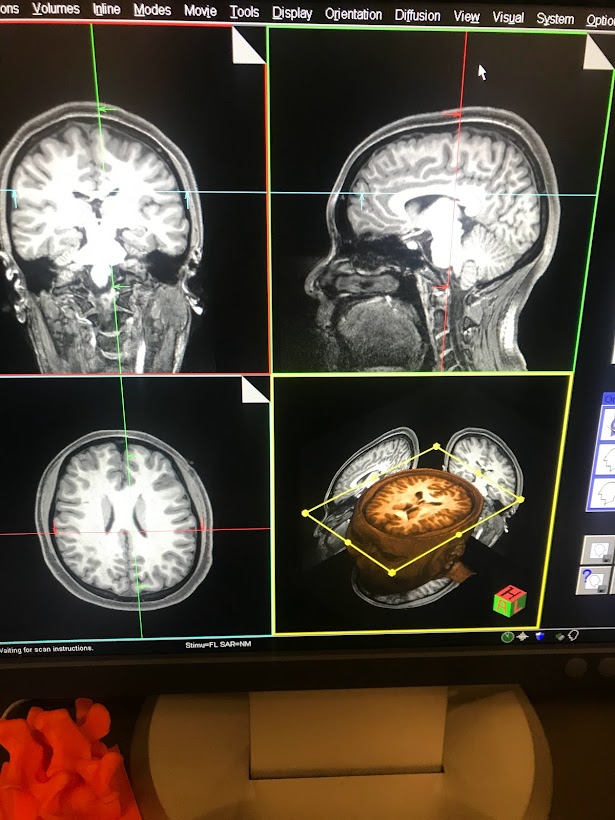
    A picture of my MRI scan from the coronal, sagittal, and horizontal views.
    This is my brain! From the top left going counterclockwise, that is the coronal view, horizontal view, and sagittal view. The bottom right shows all the slices of my brain that were taken, which you can see by moving the yellow lines.

    And there it was–all of my consciousness, my memories, my thoughts, my emotions, dreams, fears all up on that screen. It looked so complicated and fragile and beautiful. As a neuroscience major, I saw pictures of brains every day. But nothing hits quite like seeing your own brain up there in black and white. And there I was, using my brain to understand that what I saw in front of me was itself. It’s such an indescribable feeling!

    And that reason, beyond just the contributions to science, is why I recommend getting an MRI done as part of a study. After this experience, I felt myself thinking about my own brain with more affection. This squishy, bumpy organ is me, and I should treat it with the study and love that it deserves.


    References

    https://www.researchgate.net/figure/Magnetic-field-warning-sign_fig1_345758192

  • Coffee Chemistry

    Coffee Chemistry

    Written by Julia Raver and Lauren Mellinger

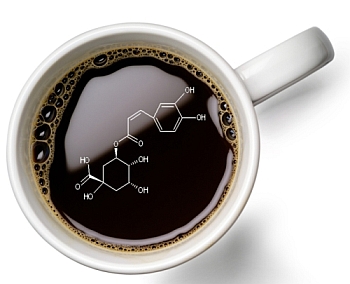
    Coffee – an integral part of your morning routine. You wake up and groggily walk to the kitchen to make your morning cup. It has become so integral to our morning routine that a lot of people can’t function without it. Especially in the mornings, having your order messed up at Starbucks or Dunkin Donuts can change the trajectory of your entire day. But how does coffee keep you awake all day? Caffeine is the secret to coffee’s success. 


    Part 1 – The Chemistry

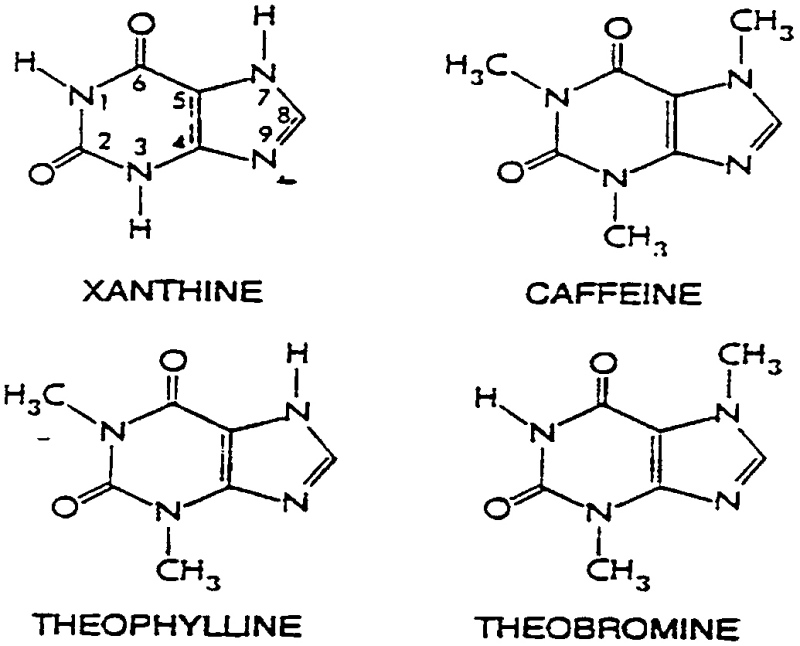
    Caffeine, or C8H10N4O2, is a drug known for its ability to give you energy and boost metabolism. It functions very similarly to xanthine, which is a crystalline drug that is often found in chocolates and teas. This provides an increase in stimulation and wakefulness, the ability to sustain intellectual activity, and decrease in reaction times. In the image below, you can see the similarities between the xanthine and caffeine molecules. The main differences are that caffeine has extra methyl (or CH3 groups) attached to its two rings (National Academy Press, 2001).

    Due to the polarity in caffeine molecules, or difference in strength between the nitrogen and oxygen bonds, caffeine exhibits unique bonding forces. It can bond via dipole-dipole forces, where positive and negative atoms of different molecules bond together. Caffeine also bonds via hydrogen bonding with water, which is a strong bonding of hydrogen atoms with carbon atoms of water and caffeine respectively. In layman’s terms, caffeine reacts in the bloodstream by bonding via its nitrogen and oxygen atoms. 

    Absorption in the Bloodstream

    We can now dive deeper into how caffeine is absorbed in the bloodstream. People absorb caffeine within 45 minutes of ingestion but has an elimination half-life of anywhere from 1.5 to 9.5 hours. This means that if you drink your morning coffee at 8 am, it could still be in your system at 5:30! When absorbed, caffeine undergoes the hepatic first-pass effect, meaning it is not removed by the liver and heads straight for the bloodstream. There, due to the presence of carbons within the structure, caffeine acts as a hydrophilic (or water-liking) molecule and can bond with the water in your tissues. Once bonded with this tissue water, caffeine works with proteins and begin to give you that energy boost you so desperately needed when you drank it at 7am (National Academy Press, 2001). 

    Now remembering that caffeine is in fact a drug, it is important to note that it also comes with a certain toxicity level. Luckily for coffee drinkers however, caffeine only becomes fatal when around 10-14g are ingested daily. To get an idea of how much this really is, divide 150 or 200 by your total body weight in kilograms. This gives the toxicity level based on your weight per day (National Academy Press, 2001). For example, if you weigh 110 pounds (or 50kg), 7500 milligrams or 7.5 g of caffeine is your daily toxic dosage of caffeine. An average cup of coffee contains around 100 mg of caffeine so you would need to drink 75 cups of coffee in a day to die of caffeine overdose (Dews, 1982).

    Caffeine Appearance

    Caffeine is what helps coffee give you energy in the morning but what makes coffee look and taste how it does? Melanoidin, or heterogeneous polymer with a brown pigment, is formed when sugars and amino acids combine at high temperatures (Merriam-Webster). This melanoidin is what gives coffee its nice rich brown color. Depending on the temperature to which the coffee beans are heated, the coffee can taste differently. Once heated above 180 °C, exothermic reactions (that release heat) within coffee beans occur (Rao, Fuller, & Grim, 2020). 

    The reactions occurring at these high temperatures are called Maillard reactions, which are defined as reactions between amino acids and sugars. Basically, sugars and amino acids reacted at high temperatures produce brown products, or these melanoidin molecules that create brown pigments (Ellis, 1959). Therefore, different roasting temperatures cause these reactions to go to either more or less completion and are responsible for both the color and taste of your morning beverage. Now that we understand the chemistry behind caffeine, we can look at flavor preferences.


    Part 2 – The Psychology

    Cold beverages have accounted for 75% of Starbucks’ sales in the past quarter (Creswell, 2022). All across the world, coffee drinkers prefer the mellow, balanced flavors of cold coffees. Hot coffee, on the other hand, can only be enjoyed for the fleeting moments between scalding and sour. But why is it that the same beans can produce such different flavors?

    The Making

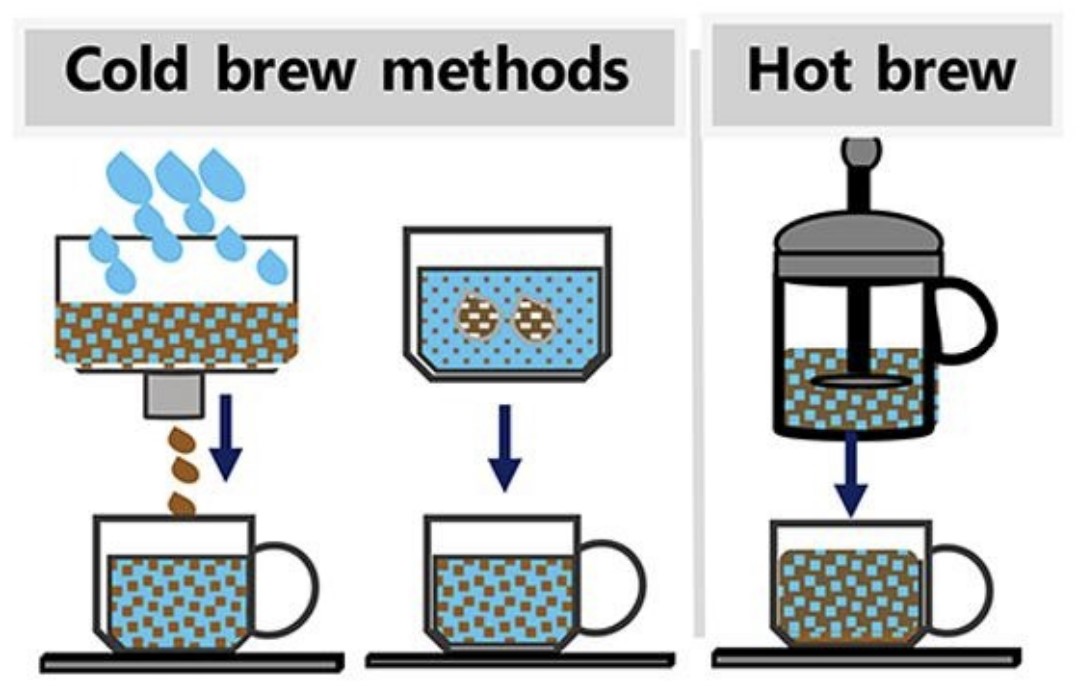
    The final cup of coffee is affected by the extraction method — the way water pulls flavor, aroma, and caffeine from the grounds. This is strongly influenced by temperature and time.

    For example, in a pour over, water moves over the coffee and produces a brighter tasting coffee. Immersion brews result in a fuller extraction leaving more body in the cup (Kelly, 2018). The cold brew method taking the coffee world by storm involves lower temperatures than your typical drip coffee. To compensate, it needs a much longer extraction time (between 8 and 24 hours) (Córdoba et al., 2021).

    Coffee and the Senses

    The ability of substances to dissolve out of the grounds and into the water increases with temperature. This causes acids to extract more efficiently in hot brewing. In turn, more sour and bitter elements are released. (Córdoba et al., 2021). Using a lower temperature better retains those delicate flavor components that would degrade or evaporate with exposure to heat (Lane et al., n.d.). Plus, hours of contact with water causes the fats in the beans to emulsify, creating that creamy mouthfeel. Therefore, higher temperatures lead to more nutty, roasty notes — and possibly some unsavory ones as well. Colder temperatures retain flavor compounds and generate a smoother, sweeter beverage (Córdoba et al., 2019).

    When you walk into a coffee shop, you are guaranteed to be welcomed by the scent of roasted beans. But you might notice that your cup of cold brew doesn’t smell very strong at all. Since the oils that carry aromas remain in the water, they stay in your coffee. You’ll perceive these as cold brew’s characteristic floral and fruity flavor (Oden, n.d.). Your drink might not have a strong fragrance or bite, but cold brew rewards those who wait (Alkin, 2014).

    Is Cold Brew Better?

    The novel brewing method also extracts more caffeine with time, which means cold brew is a concentrate. This allows coffee drinkers to adjusted it to their preferred strength and endlessly customize it to their liking. In addition, the lack of acidity may mean cold brew is a better alternative for those with sensitive teeth, heartburn, or GI issues (Rao & Fuller, 2018).

    Whether you crave the smokiness of an automatic drip, or the natural sweetness from an hours-long immersion, ultimately, the choice of brew is up to you.


    Reference List

    • https://www.scienceandfood.org/coffee-brewing-chemistry-hot-brew-and-cold-brew/
    • https://www.sciencedirect.com/science/article/pii/S0924224419305692
    • https://www.nytimes.com/2022/08/02/business/starbucks-quarterly-earnings.html
    • https://www.sciencedirect.com/science/article/pii/S0963996921000387
    • https://www.sciencedirect.com/science/article/pii/S0023643821005168
    • https://doi.org/10.1146/annurev.nu.02.070182.001543
    • https://doi.org/10.1016/s0096-5332(08)60223-4
    • https://blog.lacolombe.com/2018/09/19/brewing-method-affects taste/#:~:text=Immersion%20and%20pourover%20brewing%20each,%E2%80%9D%2Dtasting%2C%20brighter%20coffee
    • https://journals.uvic.ca/index.php/arbutus/article/view/16816
    • https://www.merriam-webster.com/medical/melanoidin
    • https://www.ncbi.nlm.nih.gov/books/NBK223808/
    • https://www.javapresse.com/blogs/cold-brew/hot-brewed-vs-cold-brewed-coffee
    • https://www.nature.com/articles/s41598-018-34392-w
    • https://doi.org/10.3390/foods9070902