Day: April 24, 2021

  • Vinyl is Better than Digital Music

    Vinyl is Better than Digital Music

    Hear that music??? That, my friend, is the sound of classic vinyl…

    Meet Ernie. My vinyl player 🙂

    You know that round spinning thingy that plays music that your grandparents and/or parents used growing up? Well, good news – it’s not extinct! When it comes to enjoying music, one of the best ways that I have discovered is by using vinyl (aka: the record player).

    Compressed MP3 files and digital streaming services such as Spotify, Apple Music, Pandora, and YouTube have been the social norm for listening to music; however, vinyl sales have tremendously increased from under a million in 2007, to more than 8 million today in the U.S alone. According the British Phonographic Industry, vinyl sales hit a peak in the UK and the US in recent decades. Why? Because vinyl just is better!!

    Let’s delve into the reasons why vinyl records are superior to digital MP3.

    1) Simply put, vinyl sounds better than MP3:

    Vinyl is the only playback format readily available to consumers that is fully analog and fully lossless. That means that with a quality record player, you get to enjoy a high-fidelity listening experience. High-fidelity equates to high-quality reproduction of sound, that has inaudible background noise and distortion – giving a sound extremely similar to the original. Who wouldn’t want to listen to music that sounds as authentic as the source intended it to be?

    The quality is immaculate. The song you hear playing in this article is featured above. It is a vinyl by the Righteous Brothers, with a song clip entitled “The White Cliffs of Dover” (1965).

    2) Listening to vinyl is a complete experience:

    An expanding collection of my vinyls!

    You know when you can feel the music when listening to your favorite songs? Well, with vinyl, you not only figuratively feel the music coursing through your mind and soul, but you can physically feel the music through the tangible form of the vinyl. There’s nothing like unraveling a vinyl wrapped in its cover. There’s nothing like being able to smell the music, just like the comforting smell of books in the library. With vinyl, you get to fully experience music with literally all of your senses.

    3) Going to record stores is so fun!!

    There’s nothing like the nostalgic and magical experience of entering a record store, whether it’s your first time, third time, or hundredth time! You can easily spend hours in the record store browsing, searching, and discovering music! You can mingle with other vintage audiophiles, and you can usually always get a special discount when buying vinyl in bulk! Furthermore, there is no monthly subscription to enjoy the music you want (Haha, take that Spotify and Apple Music)!

    Unraveling a shiny vinyl!

    Vinyl is an unbeatable classic that has remained relatively unchanged for the past 40 years! Since it’s creation in 1948, numerous developments and refinements within the vinyl industry have been made to perfect its technical and practical excellence. As George Plasketes, a professor of media studies and popular culture in the School of Communication and Journalism at Auburn University in Alabama, put it:

    “Vinyl is not simply a recording format, but the artefact of an age; it is an experience that embraces emotion, passion and romance”.

    Keep calm and vinyl on!

    Sources:

    Oregonian/OregonLive, David Greenwald. “Does Vinyl Really Sound Better? An Engineer Explains.” Oregonlive, 19 Nov. 2014, www.oregonlive.com/music/2014/11/does_vinyl_really_sound_better.html.

    Plasketes, George. “Romancing the Record: The Vinyl De‐Evolution and Subcultural Evolution.” Wiley Online Library, John Wiley & Sons, Ltd, 5 Mar. 2004, onlinelibrary.wiley.com/doi/abs/10.1111/j.0022-3840.1992.00109.x.

    Sarpong, David, et al. “’Vinyl Never Say Die’: The Re-Incarnation, Adoption and Diffusion of Retro-Technologies.” Technological Forecasting and Social Change, North-Holland, 29 Nov. 2015, www.sciencedirect.com/science/article/pii/S0040162515003078#bb0310.

    Zabowski, Jason. “4 Reasons Why Vinyl Is Better Than MP3.” VOX Player, 21 Nov. 2017, https://vox.rocks/blog/vinyl-is-better
  • Direct Fusion Drive— It IS Rocket Science!

    Direct Fusion Drive— It IS Rocket Science!

    Rockets had their humble start in 13th century China: bamboo tubes filled with gunpowder, attached to arrows, to be shot at Mongol invaders. Seven hundred years later, similar, albeit slightly bigger, tubes were filled with liquid hydrogen and oxygen, attached to a lunar module, and shot at the moon. Now, in the 21st century, we’re seeing another evolution, this time with Direct Fusion Drive (DFD). But the more things change, the more they stay the same, and the fundamental concepts behind rocketry that repelled the Mongols at the Battle of Kai Keng are the same fundamentals that are going to propel us to Pluto and beyond in record time.

    Rocket Science

    Well, how do rockets work anyway? On a theoretical level, they work thanks to Newton’s Third Law of Motion, which holds that every action has an equal and opposite reaction. Propellant is mixed and burned in a combustion chamber. The gas produced goes through a nozzle and accelerates to supersonic speeds (think about how partially covering the outlet of a hose with your thumb sends the water shooting out). The gas shooting out the other end necessitates an equal reactive force in the opposite direction on the engine, a force called thrust. This thrust is what makes the rocket fly, and since the rocket carries its own fuel and oxidizer (the chemical that fuel needs to burn), it doesn’t need oxygen from the environment to conduct combustion like a car engine does, making it ideal for traveling through the vacuum of space.

    Chemical Rockets

    Since their creation, conventional rockets have depended on exothermic chemical reactions to create the necessary hot, propelling gas. An exothermic reaction is a chemical reaction that produces heat. These rockets come in 2 major forms: solid-fuel rockets and liquid fuel. The fuel and oxidizer grains are mixed from the beginning, and to cause combustion, the surface of the mixture is ignited. Liquid fuel rocket fuel and oxidizer are originally separate and then injected into the combustion chamber, where they mix and burn.

    How DFD Works

    These two methods have sent countless astronauts into space, but in the coming decades, DFD may supplant them. DFD aims to use the power of its fusion reactions to not only propel the module but to generate its electricity. 

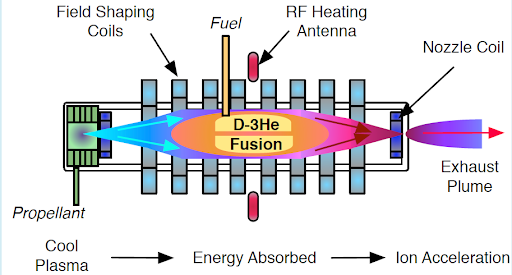
    Schematic showing how DFD works
    Image courtesy of http://fiso.spiritastro.net/telecon/Thomas_5-29-19/Thomas_5-29-19.pdf

    At its core, DFD is a fusion reaction powering a plasma rocket. Powerful rings of magnets are lined up to form something resembling a cylinder. Smaller but stronger magnets are situated at both ends. In the center of this configuration, helium-3, a stable helium isotope with only 1 neutron, is put in a fusion reaction with deuterium, a hydrogen isotope with roughly double the mass of ordinary hydrogen (isotopes are atoms of the same element that have the same number of protons but a different number of neutrons). These reactions and some side reactions create a fusion region the length of a surfboard. Cool plasma flows around it to extract energy (plasma is gas-like matter made up of ions and electrons; the presence of these electrons makes plasma really good at conducting electricity and easily influenced by electromagnetic fields). Antennae surrounding the engine create a rotating magnetic field that induces a current in the plasma. The plasma ions get more and more energized until they fuse, and the fusion products get shot out the back of the engine like hot gases in a conventional rocket, creating thrust.

    This process produces tons of excess heat, which is used in a Brayton Engine to create more than 200 kW of electrical power. All remaining heat gets rejected to space, the ultimate thermal reservoir.

    How DFD Measures Up to Conventional Propulsion

    Conventional rockets have many advantages: high thrust and (relatively) low cost. They’re a reliable mechanism that has been used for centuries. What makes DFD so attractive is its compact design and efficiency. An important quantity in rocketry is specific impulse—impulse per unit of propellant or how efficiently a rocket creates thrust. The higher the specific impulse (often measured in seconds), the less propellant required for the desired impulse. Solid and liquid fuel rockets top out with a specific impulse of around 500 seconds, but a DFD engine boasts a specific impulse of 10,000 to 20,000 seconds, all while being no more than 2 meters in diameter.

    With these numbers, NASA predicts that a 10,000 kg mission with DFD could get to Pluto in 4 years, which is much shorter than the 9.5 years it took 478 kg New Horizons on hydrazine propulsion, with more capabilities to do scientific work thanks to its increased power supply.

    The Future

    All in all, NASA is very excited about the DFD concept, as it can easily fit into NASA’s current launch infrastructure and would be an ultra-low radiation fusion option; however, there’s still a lot of work to be done. For example, while the Brayton Engine has been developed and the ion-energizing process is being developed, the crux of the concept, nuclear fusion, still has to be demonstrated. DFD design is going into its second phase, which seeks to improve its plasma heating system and shielding capabilities. According to the current timeline, actual flights are planned for after 2030 and, in the future, could power orbital platforms, interplanetary travel, and even bases on the Moon and Mars.


    Hablas español? Haz clic aquí para leer una traducción al español!

    —–


    Sources:

     Paluszek, M., Pajer, G., Razin, Y., Slonaker, J., Cohen, S., Feder, R., … Walsh, M. (2014). (rep.). Direct Fusion Drive for a Human Mars Orbital Mission (pp. 1–9). Princeton, New Jersey: Princeton Plasma Physics Laboratory Office of Reports and Publications. 

    Princeton Satellite Systems. (2018). Technical Video of Dfd Engine. YouTube. https://www.youtube.com/watch?v=hggqvB5I95I. 

    Thomas, S. (n.d.). Direct Fusion Drive: Enabling Rapid Deep Space Propulsion. Lecture. 

    Benson, T. (2014, June 12). Brief History of Rockets. NASA. https://www.grc.nasa.gov/www/k-12/TRC/Rockets/history_of_rockets.html.