A Normal Winter Night
It’s a cold winter night, you’re snuggled up in your favorite blanket sitting on a couch and watching TV, the heater doing its best to prevent the winter winds from disturbing your moment of Zen. You’re thirsty, craving the delicious nature of nice, hot chocolate. So, you get up, placing your fluffy socks on the carpeted floor, blanket wrapped, and head towards the kitchen; however, on your way, you have to go through a closed door, and brace yourself against the icy, wooden floors that is your kitchen. As you take the courage to confront the chilly adversary and reach your hand to the metal knob, you feel a jolt of energy against you, a loud SNAP, and a flash of lighting going from your hand startles you, bringing about a moment of pain. Feeling betrayed, worried, you try again. What you felt was the power of static electricity, something that we’ve all experienced in one form or another.
What is Static Electricity?
Static electricity is a common occurrence in life. From rubbing an inflated balloon on your furry pet to rubbing socks on a carpeted floor, the friction between two objects (normally insulators such as fur, plastic, or clothing) causes electrons to move from one object to another. This creates a difference of charge, or electrostatic potential. When there is enough energy to match this electrostatic potential, the electrons will move. Think of it like this: every molecule wants to wants to be in balance, and whenever there is an imbalance, those molecules will do what is necessary to return to said balance, but need the energy to do so. In the example above, your covered feet rub against the carpet and collect electrons that spread throughout your body – this makes you negatively charged, or “electron rich”. Metal – the door knob – is typically positively charged, or “electron deficient”, and therefore wants to take any electrons it can get. When the two objects get close enough, there is less energy required for the electrons to move (imagine trying to move a ball far away from you compared to right next to you… much easier, right?) and so they do. This causes for that “flash” to be seen from your fingertip to the door knob, and the pain you feel is caused by the sudden movement of electrons (look at E-Stim, my other article, it talks a bit about the human body and electricity… this isn’t advertisement, I swear!)) that then trigger nerve receptors, the more electrons that move, the stronger the feeling.
So, how does all of this tie in with exploding gas? The answer, my dear friend, is one word: combustion. Combustion is the reaction of oxygen, a fuel source, and energy, as seen in the formula for the combustion of rubbing alcohol below:

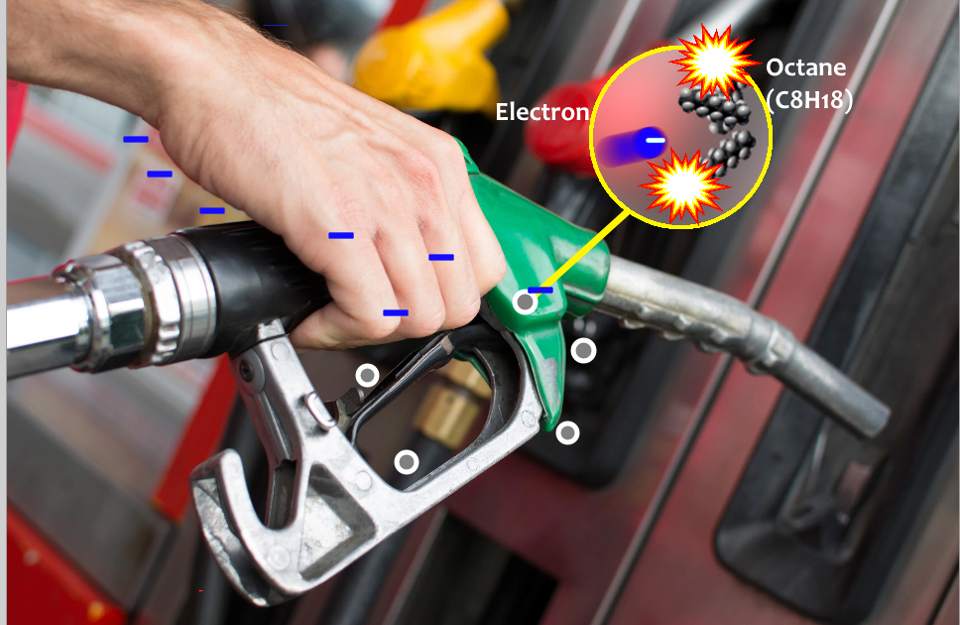
But wait, what’s a reaction? Remember what I said before about molecules doing whatever it takes to return to balance? Well, that’s a reaction! When atoms combine to form molecules, they use energy to form bonds to stick together and reach a form of balance. In order to break these bonds, more energy is required, and atoms separate and join with other atoms nearby to form new molecules. This causes for energy to be, in this case, released. This is used in your cars to move pistons and make your car move, but that’s another lesson. Now, imagine your clothes rubbing against your seat when you’re getting out of the car to fuel up or after getting something. Considering that the fuel nozzle is metal, that gasoline has a tendency to become a gas, and you have a charge build up… since energy is made from the movement of electrons (they literally crash into other atoms when they move) it causes for this reaction to occur, and now the expansion of heat and air spread out and cause those explosions that many people see in horror movies.
But how do we counter this?!
It’s actually pretty simple: touch your car before you touch the nozzle. The extra electrons on your clothes and body will go to the car, and then to the ground instead of to the gasoline vapors near the nozzle. Make sure to do this a ways away from your gas tank – ideally by the doorframe by the driving wheel, and you should be fine!
Either way, there are other ways for energy to be transferred, so you need to always be careful when going near a fuel source. Just don’t smoke, use flint, or summon the power of the force while you’re gassing up. Be smart, and don’t do anything that might cause for combustion to occur!
Electric Potential Energy. (n.d.). Retrieved April 14, 2018, from http://hyperphysics.phy-astr.gsu.edu/hbase/electric/elepe.html
E., E., E., E., E., & E. (n.d.). Electricity – Electrical Charge, Electric Fields, Coulomb’s Law And The Forces Between Electrical Charges, Resistance – Current, Voltage, Ohm’s law. Retrieved April 14, 2018, from http://science.jrank.org/pages/2342/Electricity.html
Combustion. (n.d.). Retrieved April 14, 2018, from https://www.grc.nasa.gov/www/k-12/airplane/combst1.html
Combustion Reactions. (n.d.). Retrieved April 14, 2018, from http://www.iun.edu/~cpanhd/C101webnotes/chemical reactions/combustion.html