Day: October 13, 2017

  • Learning Quantum Mechanics

    Learning Quantum Mechanics

    Mastering science concepts for many students can be difficult. Great instructors, learning resources, and even video games can all be ways to help students comprehend difficult information. For college students and some high schoolers, quantum mechanics is a topic that many have a hard time understanding. Researchers Johnston, Crawford and Fletcher at the University of Sydney focus on better approaches to teaching quantum mechanics concepts. Their research is driven by answering two questions: 1) How do we define the most important concepts to learn quantum mechanics and 2) How do students conceptualize the ideas of quantum mechanics (pg 428). Researchers and students at Georgia Institute of Technology have developed a quantum mechanics game for students. I recently had a chance to interview one of the students working on the project, Aditya Anupam a 2nd year PhD student in Digital Media.
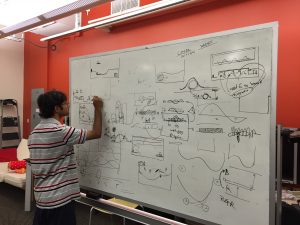
    aditya2
    Aditya Anupam working on project

    How long have you been working on the project? Why did you join?

    I started working on the project in 2016. I have a master’s degree in electrical engineering and was frustrated with how science was being taught.

    Why teach quantum mechanics through video games? Its immersive and easily accessible to students and teachers in and outside the classroom.  

    What is the quantum mechanics game about?

    The core concept for the game(which is named: Particle in a Box) was to help undergraduate students challenge their preconceptions about quantum mechanics (which are often rooted in classical mechanics). Quantum mechanics is hard because people don’t get the opportunity to engage actively with the quantum phenomena or experiment with quantum systems.  The game provides a scientifically accurate, yet fun, environment to do this.

    logo2-2

    Why is science important?

    There are four reasons why I think science is important:  

    Jobs: most jobs require at least a basic understanding of science.  

    Personal use:  for example, choosing the right food, fixing things in your house

    Public discourse: It helps us become more informed so that we can support the right policy that will impact science.

    It’s beautiful: It helps us understand the world and our place in it

    Is Particle in a Box being used in the classroom? And where can we play it?

    We tested the game on undergraduate electrical engineering students at Georgia Institute of Technology and received generally favourable results. Who is the audience for the game? The game is primarily for undergraduate students enrolled in courses involving introductory quantum mechanics, but it may also be of interested to high schoolers. Where can we play game?  You can visit: learnqm.gatech.edu and please feel free to share feedback if you have suggestions on how we can improve the game.

    What’s the next project you’ll be working on?

    I plan to continue working on the field of digital media and science education. We are currently in the process of redesigning the game based on our research results. We are interested in making a multiplayer version of the game to encourage a more collaborative learning atmosphere in the classroom. Other than the game, I am also interested in the public understanding of science and how depictions of science in the media affect that understanding.

    If you get a chance, please play the quantum physics game at learnqm.gatech.edu. And let’s work on making sure more students are given the resources to succeed in the field of science!

    Notes: What is Particle in a Box?

    So you maybe wondering, how does the game work?  The game design is very similar to Donkey Kong and Mario in the appearance and layout. Once you begin the game, there is a small textbox on the left bottom corner. The textbox has information on how to play the game and explains principles of quantum mechanics.  The user plays a small blue character that has to pick up certain materials when prompted. 

    Resources:

    Crawford K., I.D. Johnston and P.R. Fletcher. “Student difficulties in Learning Quantum Mechanics.” International Journal of Science Education, vol.20, no. 4, 1998, http://citeseerx.ist.psu.edu/viewdoc/download doi=10.1.1.1009.2311&rep=rep1&type=pdf. Accessed 22 September 2017.

    Special thanks to Aditya Anupam for the interview!!!

  • The Black Dot vs The Highlighter

    The Black Dot vs The Highlighter

    As college student, we have all had that one class that is required for graduation that we aren’t the most interested in. Most of us have a hard time retaining information for that particular subject. So, what would you consider the most effective way to retain the information you need to be successful throughout the course? There have been many research studies conducted on study habits and IMG_9773.JPG the effects a study habit has on the student’s ability to retain the information. Perhaps, the worst study habit a student can partake in is highlighting, and the best would be studying information in intervals along with adequate rest. But are these practices beneficial for a Georgia Tech Yellow Jacket? I decided to find out.

    Many students at GT are seen in class highlighting or using a bullet point method when taking notes, but which is the most beneficial and how do they affect the student’s ability to retain information if they are not interested in the subject matter? I’m sure any student at GT would agree that lectures are 50 to 75 minutes of information overload that result in sleepless nights to complete homework assignments. What if the reason we can’t retain the information is because of the way we organize the important aspects of the information given?

    IMG_9781.JPG I gave two GT students the same packet of information to learn over the course of two days. One student was instructed to highlight all the important information within the packet, and the other student was instructed to use the bullet point method. Exactly one week later, the two students were given an additional packet with new information to learn using their same methods of organizing the important information. At the end of week 2, the students were asked to provide as many facts as they could from packet one. Both students could recall a great sum of information, but the student who used a highlighter could only summarize. The student who used the bullet point method could recall more detailed information. When asked why he thought this may be the case, he said it was more repetition. He claimed that using the bullet point method allowed him to read, recite, determine what was important to remember, and write the information, and that made the information stick with him. Clearly, my two person study needs to be replicated, but in the meantime my advice to kick the highlighter to the curb and use the bullet point method.

    Dunlosky, J., Rawson, K. A., Marsh, E. J., Nathan, M. J., & Willingham, D. T. (2013). Improving students’ learning with effective learning techniques: Promising directions from cognitive and educational psychology. Psychological Science in the Public Interest, 14(1), 4-58.

    Photos by Rakiya Winton

  • The Science of Tempering Chocolate

    The Science of Tempering Chocolate

    Which dessert can take shape as a chip in your favorite cookie or as a bar, and can be enjoyed in both a liquid and solid form? That’s right- it’s chocolate! Most of the time that you take a bite of chocolate, however, you probably don’t think about how a peanut-sized cocoa bean was crafted into the smooth, shiny, and sweet dessert of your dreams.

    The complex transformation process includes a variety of chemical reactions among the approximately 380 chemicals that comprise it (Kuwana, 2010). In this article, you are going to learn about one such process that highlights chocolate’s unique chemical properties and how you can replicate this fundamental technique on your own.

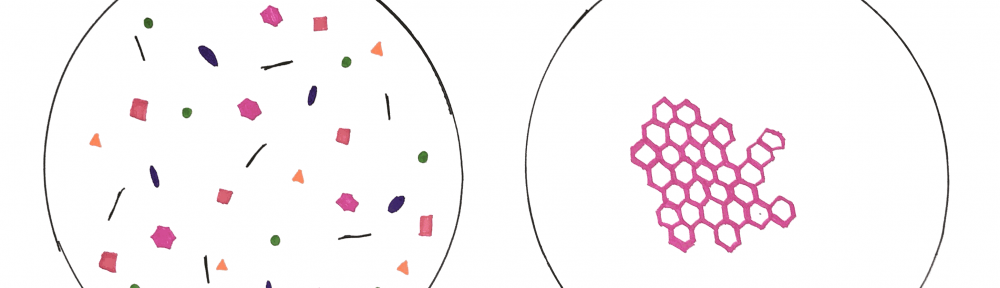
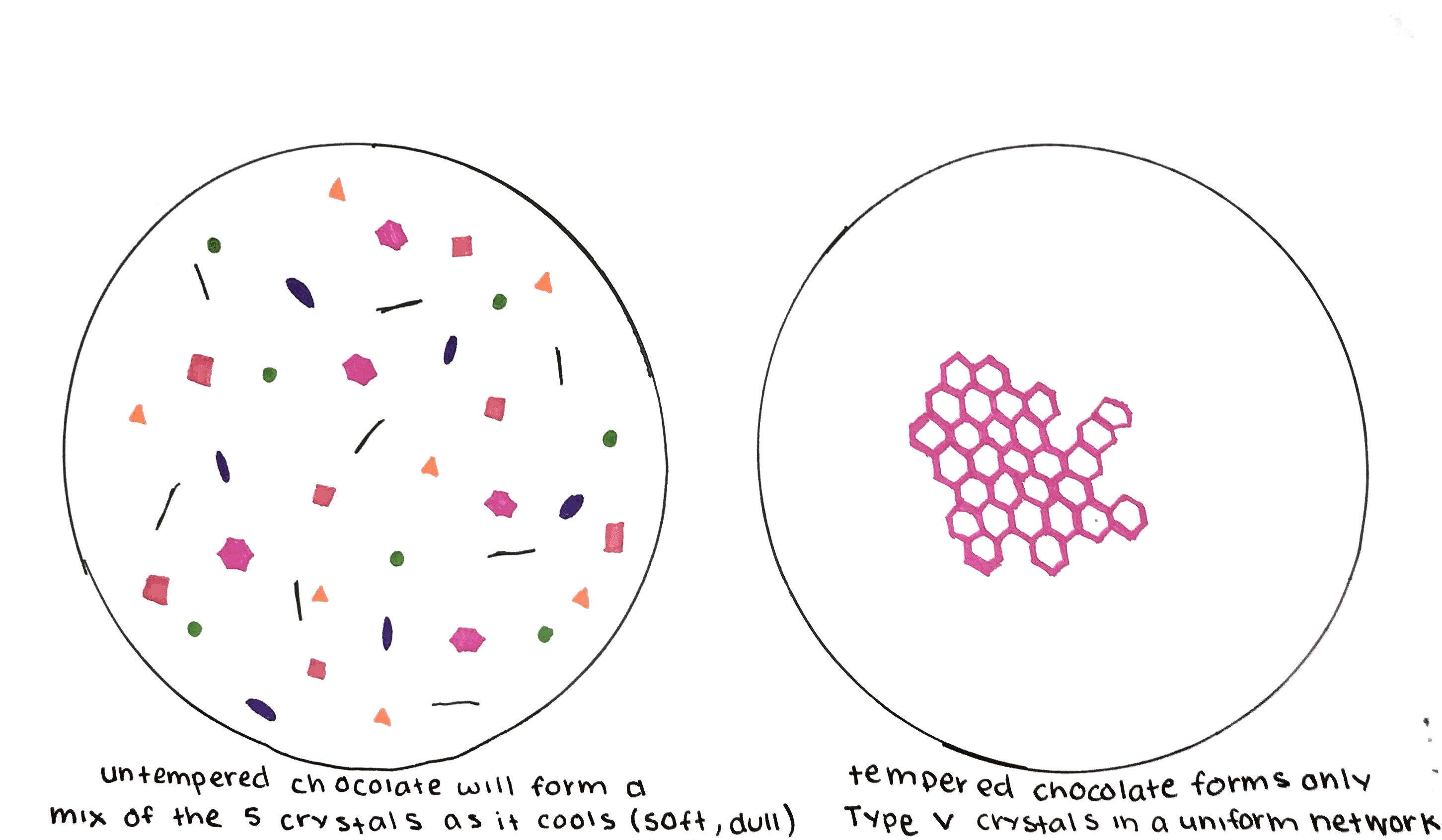
    The word temper meaning to heat to make hard applies to chocolate by making it solid at room temperature and perfectly melted you begin to chew it. As a chocolate lover, you should be very appreciative of tempering because the cocoa butter can solidify into 6 different kinds of fat crystals, however only two of these structures produce a stable/hard chocolate that is palatable (McGee, 2004). To ensure that the ideal texture is achieved, tempering is needed.

    Scannable Document on Sep 29, 2017, 9_50_25 AM

    Tempering generally follows a three-step process of heating the chocolate to dissolve the fat crystals, lowering the temperature slightly to form a new crystal structure, and reheating to dissolve all unstable crystals. This way you are left with only the desirable and stable crystals, which can then control the development of the crystal network upon the solidification of the chocolate (McGee, 2004). The stable cocoa butter crystals have a higher melting point meaning they form at a higher temperature than that of unstable ones. This follows the same principles of the method of slow-cooling crystallization where a rapid drop in temperature doesn’t provide the stable crystals with enough time to assemble before the unstable ones are already forming. Basically, the key to tempering is keeping the chocolate temperature below the melting point of stable cocoa butter crystals, but above that of unstable ones (this varies depending on the type of chocolate and the ratio of cocoa and milk fats).

    Try it Yourself:

     What you need:

    • candy thermometer
    • saucepan and glass bowl (or a double boiler)
    • milk chocolate

    The Recipe (extracted from On Food and Cooking):

    • To temper the chocolate from scratch, heat it to 40-45°C to melt all crystals, and cool it down to around 27-28°C. Then either stir the chocolate as it cools further, until it thickens noticeably (an indication of crystal formation), or pour a portion onto a cool surface and scrape and mix it until it thickens, and return it to the bowl. Then carefully raise the temperature of the chocolate to the tempering range, 30-31°C, and stir to melt any unstable crystals that might have formed during the stirring or scraping.

    References:

    Kuwana, Ellen. “Discovering the Sweet Mysteries of Chocolate.” Neuroscience For Kids,     Eric Chudler, 01 October 2010, faculty.washington.edu/chudler/choco.html.

    McGee, Harold. On Food and Cooking: the Science and Lore of the Kitchen. Scribner, 2004.

    Tomazincic, Sara. “Dessert Hungry.” Dessert Hungry, 06 October 2014, desserthungry.blogspot.com/2014/10/tempering-chocolate-caramel-and-almond.html.

  • Three Science Haikus

    Three Science Haikus

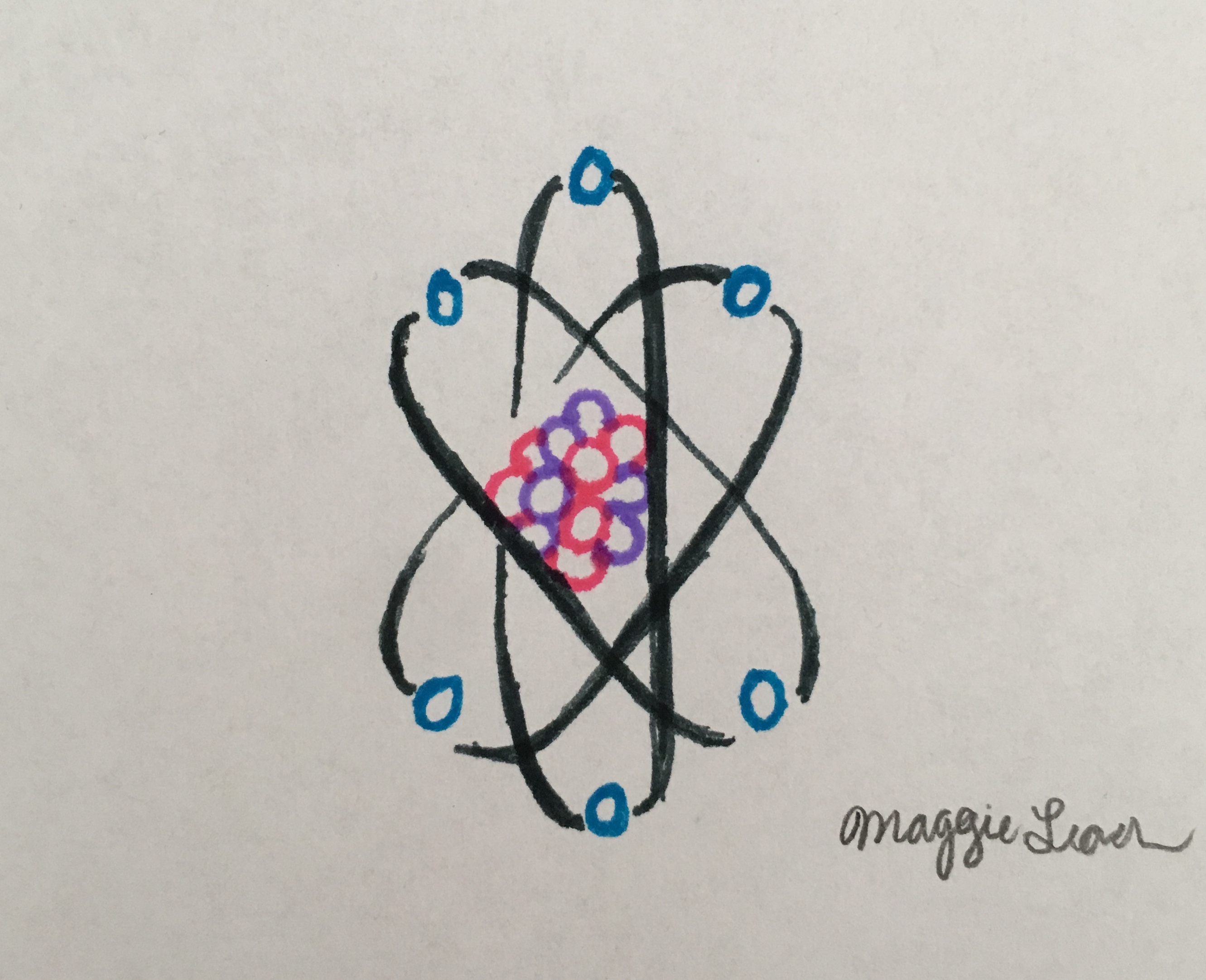
    Electrons, protons

    Wow, I do really love them

    Talk about atoms!

    IMG_6283

    Light years and darkness

    Supernovas and black holes

    Space is a wonder

    15618006994_03c516ff37_b

    The earth is warming

    Polar ice caps are melting

    Oh- goodbye penguins 🙁

    IMG_6282